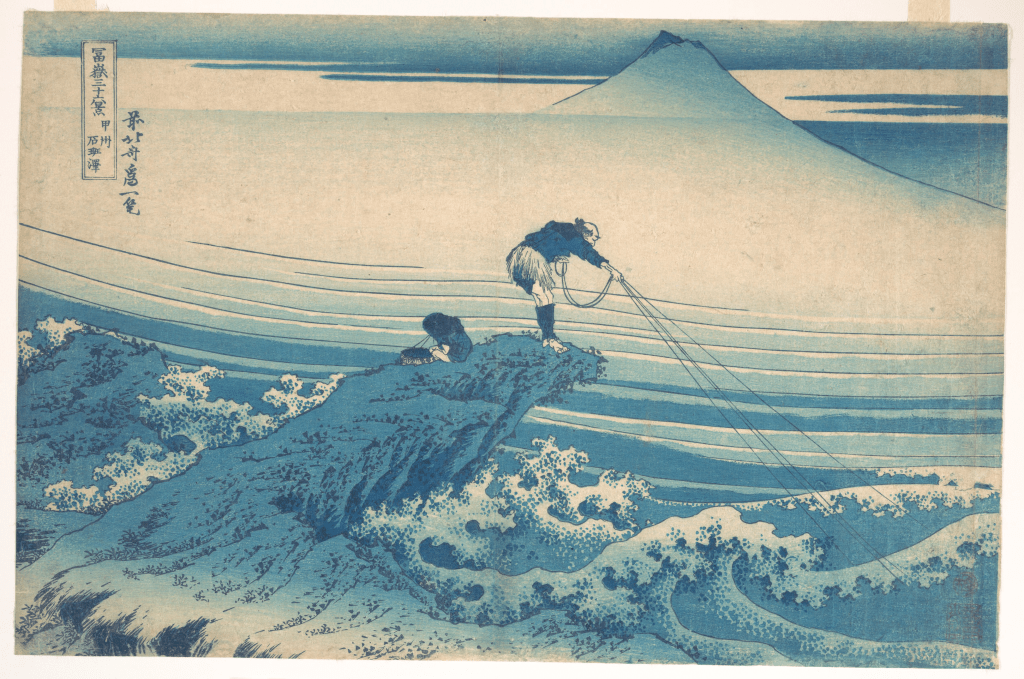
There are certain images, or should I say icons, that exert a visual power over all others. Two in particular come to mind: Turner’s great paintings of various “Storms at Sea” and Hokusai’s series of “Thirty-six Views of Mt. Fuji” which includes important images of nearby waves and distant views of Mt. Fuji. Whereas Hokusai often happily described himself as an old crazy man to paint, Turner was often derogatorily described by many of his contemporaries, often depicted as a crazy man wielding mops in order to complete his paintings!
“Turner painting one of his pictures” Satirical cartoon, Almanack of the Month 1846 J. Paul Getty Trust, Los Angeles, California
We have often seen entire sets of Hokusai’s woodcuts exhibited at both the Art Institute of Chicago and the Metropolitan Museum of Art in New York. As for Turner, nothing surpasses the work from the Turner Bequest at the Tate Museum in London, or the Clowes Collection at the Indianapolis Museum of Art.
Contemporary writers have also been drawn to these two artists, including Yusef Komunyakaa and Patricia Clark. We have previously written regarding Komunyakaa’s “Turner’s Tussle with Water” and take a look now at Hokusai’s waves as written by Patricia Clark. Clark and her husband, the contemporary painter Stanley Krohmer, are often traveling and visiting museums. They collect exhibition catalogues, calendars and post cards from these locations. These are all important visual mnemonic devices, reminders of people and places seen, as well as sources for future investigations into both painting and poetry.1
Stanley Krohmer, “Nocturne, Lake Michigan” 2021 Oil on wood panel 30” x 24” Collection of the artist.
As a result of one of these trips, an image from Hokusai re-appeared in Clark’s memory. When I asked her about it, this was her response: “I never PLAN to write about some image ahead of time; I like to wait & see if it speaks to me somehow, over time. And somehow this one did. I think I was attracted to the tension in the fishing lines, the odd outfit the fellow is wearing, and the two figures. Plus the evident danger they might be in. I was surprised when it called up an old memory of mine — fishing during a camping trip, and also wandering along the shore, looking into tidepools and under rocks.”2
As is her practice, Patricia Clark uses her direct written responses to this visual work of art in order to combine them with certain memories of family members and their interactions with a landscape remembered from a distance.
Katsushika Hokusai “Thirty-six Views of Mount Fuji: Fishermen standing on a rocky promontory at Kajikazawa” 1830-1832 Woodblock print on paper 10” x 15 1/8” Metropolitan Museum of Art, New York
Barnacle
“The fisherman’s bent in half on the tip of a promontory,
a jacket, short pants, a grass skirt over the pants, no hat, tall socks
with shoes—though I’m fearful he’ll slip where below waves growl and snap.
He’s pulling in at least four lines, heavy with fish, one has to hope—
and he’s not alone. Nearby crouches a person down on his haunches also holding lines.
If the land’s rocky, okay, but it looks fragile enough to break off,
soft ground with wet sod crumbling to pitch him in, if not both of them. Once,
we wandered far down Agate & Crescent Beach, stooping at tidepools, turning over rocks
to find small gray crabs and touch anemones, fascinated by their pulse, heedless of tides.
By the time we looked up, our path back was erased, water crashing in, spraying foam,
and only through luck did we find a cut in the bluff where a path
snaked down—we clambered up with sea- salt biting at our heels. That was the day
later on, we hauled in a creature of the deep we didn’t know, a purple spiny thing large
as a cabbage we brought to the park ranger in a bucket— sea urchin, he said mildly.
It was a fearsome beautiful thing— those spines dripping with the sea, waving–I hope we let it go.
My father and his father, me and who else? –my brother Dan?— last seen on that shore
now washed away by waves of time though memory has planted a barnacle there.”3
Stanley Krohmer “Steller’s Jay” 2015 Oil on canvas 36” x 36” Collection of the Artist.
1 And as a footnote to this essay, I have included at the end an image of one of Stanley Krohmer’s paintings, “Steller’s Jay” which was actually used as the cover art for one of Patricia Clark’s books, “The Canopy” published by Terrapin Books in 2017.
2 Clark, Patricia; “Barnacle;” Manuscript page and notes in an E-Mail correspondence to this author, 2 December 2021, 4:58 PM.
3 Clark, Patricia; “Barnacle;” Included in the journal SALT; Santa Barbara, California; Issue 4, #1; 2023.
“The humanity, the simple direct humanity of his figures—you feel like they’re real people that you can empathize with. He treats them with a certain dignity, it’s not like he’s trying to belittle them by making them seem so down-to-earth. He has respect for the ordinary person.”1
This is one of the many observations that my friend and colleague Stephanie Dickey has made regarding the work of Rembrandt van Rijn. She is one of the leading authorities on this artist, and was interviewed by Smithsonian Magazine on the anniversary of his 400th birth. She is unique amongst art historians, in my opinion, as she is so aware of, and sensitive to, the thought and painting processes of artists, not unlike the writing of the poet Robert Bly, who has himself had a life long interest and sensitivity to the work of painters and sculptors.
The Old St. Peter by Rembrandt
“Noah’s ship does not sail with its elephants forever. The crying of the monkeys breaks off and starts again. Even shame does not last a whole lifetime.”
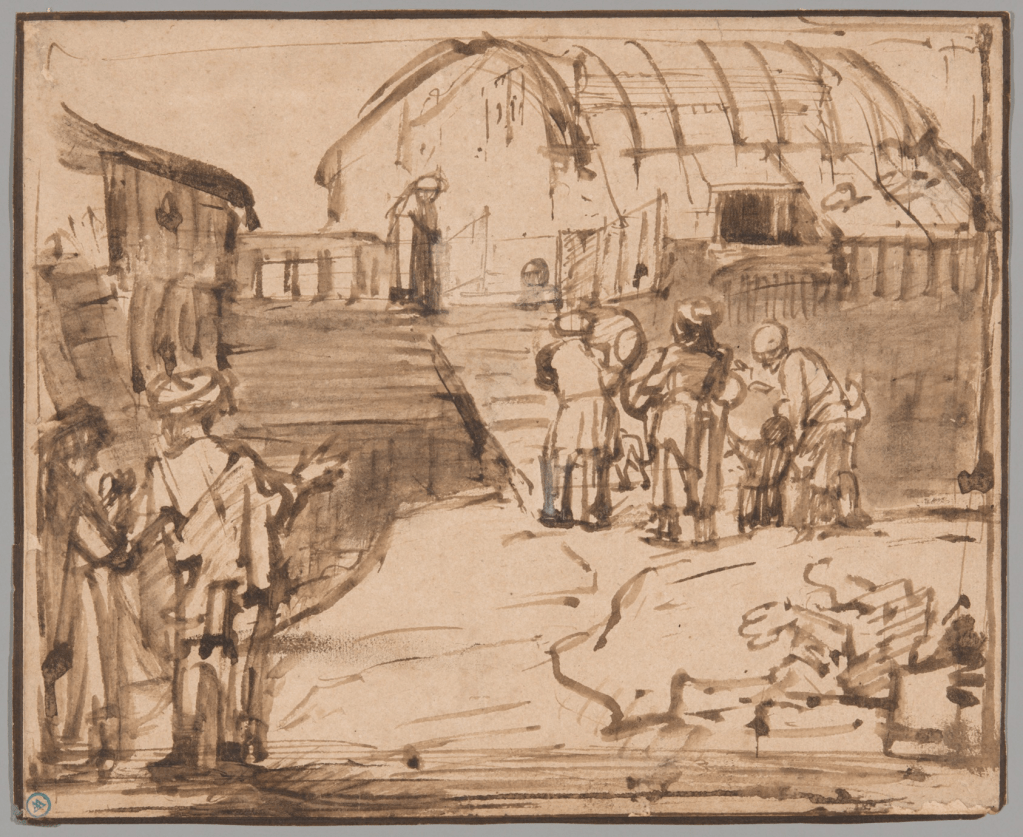
Rembrandt van Rijn “Noah’s Ark” 1660 Pen & ink with brown washes 203mm x 248mm The Art Institute of Chicago, Chicago, Illinois.
“‘It was dark,’ Peter said. ‘We were alone. We had A single candle which shone on the steel breastplate Of the Roman soldier. The whole town was asleep.’
We are bubbles on the lips of our friends. Each time they turn their heads, we drift toward the Pole; We pass into the Many and return.
Who can say, ‘With God, the rest is nothing?’ Who can say, ‘I am a grandchild of the unfaithful?’ Who is able to wait one month to drink water?
We fell into weeping yesterday at five o’clock. We wept because slavery has returned; we wept Because the whole century has been a defeat.
Oh Peter! Peter! The night behind you is black. A beam of light falls on your outworn face. What can you do but lift up your hand for forgiveness?”2
Rembrandt van Rijn “The Apostle Peter” 1632 Oil on canvas 32.2” x 24.4” Nationalmuseum, Sweden
Rembrandt’s Brown Ink
“The sorrow of an old horse standing in the rain Goes on and on. The plane that crashes in the desert Holds shadows under its wings for thirty years.
Each time Rembrandt touches his pen to the page, So many barns and fences fly up. Perhaps that happens Because earth has pulled so many nights down.
When we hear a Drupad singer with his low voice Patiently waiting for the next breath, we know The universe can easily get along without us.
So much suffering has been stored in the amygdala That we know it won’t be long before we put Our heads down on the chopping block again.
Our thighs still remember all those smoky nights When we crouched for hours on the dusty plains Holding small-boned mammals into the fire.
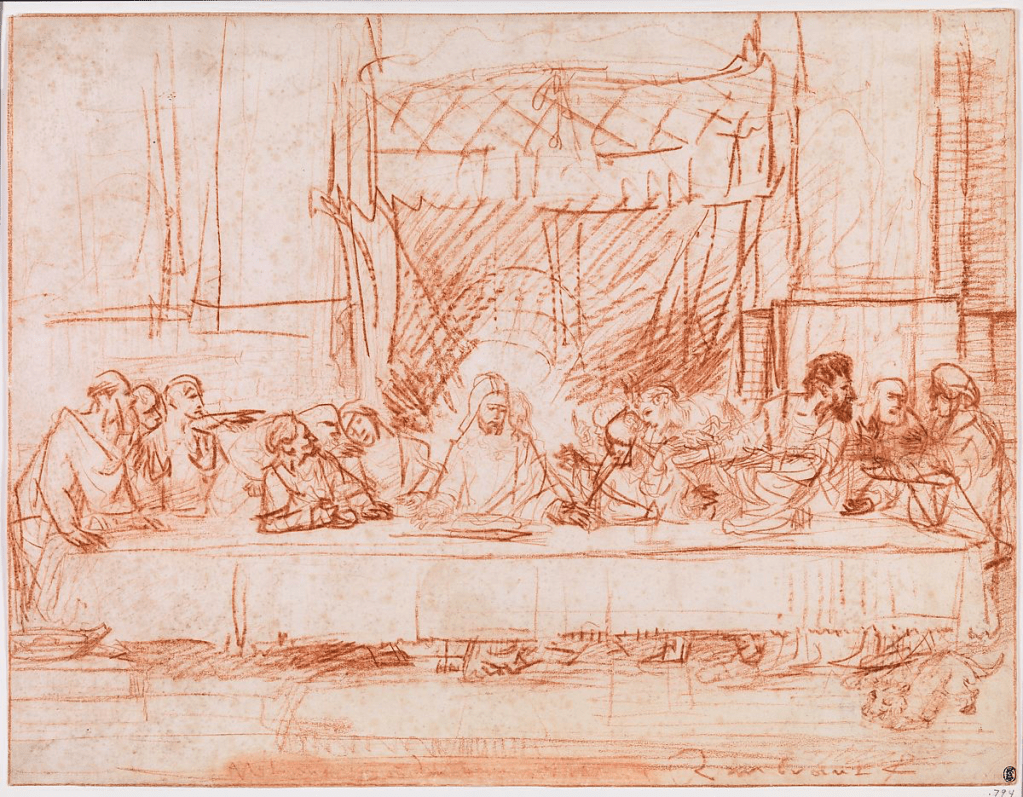
How is it possible that so many nights of suffering Could be summed up by a sketch in brown ink Of Christ sitting at the table with Judas near?”3
Rembrandt van Reign “The Last Supper, after Leonardo da Vinci” 1634-1635 Red chalk 14 1/4” x 18 11/16” Robert Lehman Collection, The Metropolitan Museum of Art, New York, New York.
Rembrandt’s Portrait of Titus with a Red Hat
“It’s enough for light to fall on one half of a face. Let the other half belong to the restful shadow, The shadow the bowl of bread throws on the altar.
Some are like a horse’s eating place At the back of the barn where a single beam Of light comes down from a crack in the ceiling.
Painting bright colors may lie about the world. Too many windows cause the artist to hide. Too many well-lit necks call for the axe.
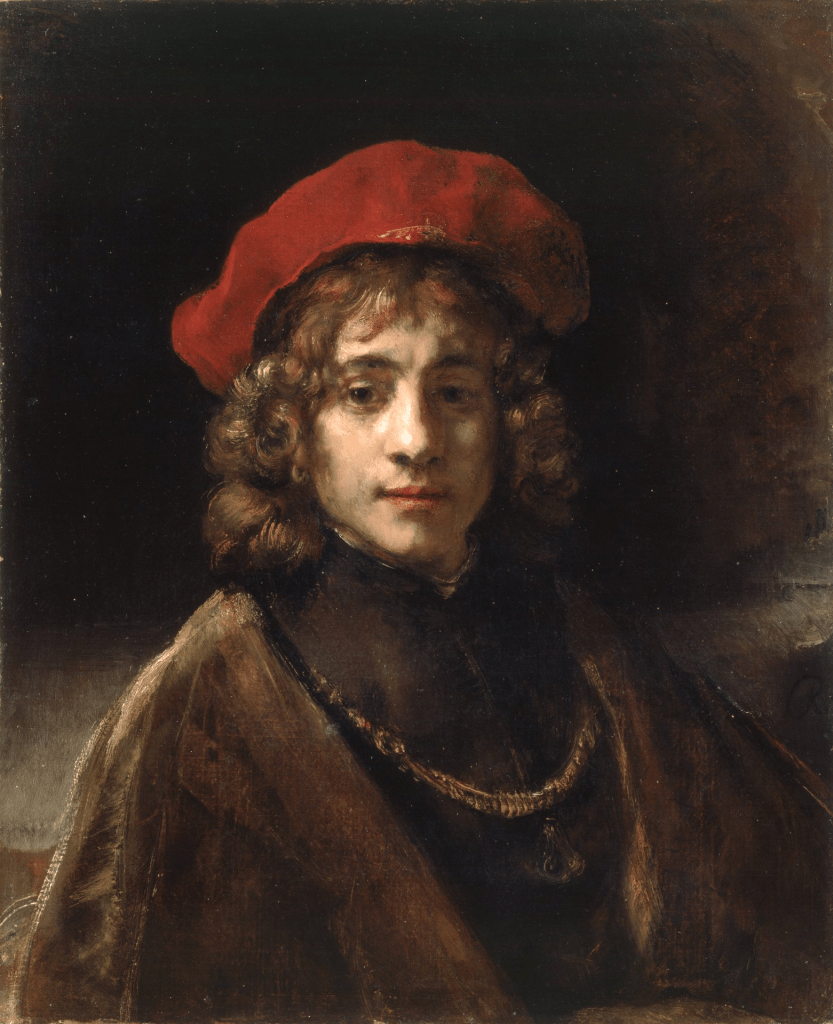
Beneath his red hat, Titus’s eyes hint to us How puzzled he is by the sweetness of the world— The way the dragonfly hurries to its death.
So many forces want to kill the young Male who has been blessed. The Holy Family Has to hide many times on the way to Egypt.
Titus receives a scattering of darkness. He’s baptized by water soaked in onions; The father protects his son by washing him in the night.”4
Rembrandt van Rijn “Portrait of Titus with Red Hat” 1657 Oil on canvas 68.5cm x57.3cm The Wallace Collection, London, The United Kingdom.
Everything he paints, he paints with a sense of light (a touch of light) and a tacit understanding of the sitter just across from him. The form is felt with each brushstroke, and handled with sensitivity as the light falls across the space/face. One may identify one of these paintings from across the gallery, even without seeing the didactic information posted on the nearby wall. Always recognizable. And this work has grown so much, almost mythologically, that it exists on a whole ‘nother level of culture. So the last word on this surely belongs to my colleague and friend Stephanie Dickey from her observations on 400 Years of Rembrandt. Rembrandt’s reputation has taken on a life of its own:
“One thing that really surprises me is the extent to which Rembrandt exists as a phenomenon in pop culture. You have this musical group called The Rembrandts, who wrote the theme song to Friends—‘I’ll Be There For You.’ There are Rembrandt restaurants, Rembrandt hotels, art supplies and other things that are more obvious. But then there’s Rembrandt toothpaste. Why on Earth would somebody name a toothpaste after this artist who’s known for his really dark tonalities? It doesn’t make a lot of sense. But I think it’s because his name has become synonymous with quality. It’s even a verb—there’s a term in underworld slang, ‘to be Rembrandted,’ which means to be framed for a crime. And people in the cinema world use it to mean pictorial effects that are overdone. He’s just everywhere, and people who don’t know anything, who wouldn’t recognize a Rembrandt painting if they tripped over it, you say the name Rembrandt and they already know that this is a great artist. He’s become a synonym for greatness.”5
Dr. Stephanie Dickey, Bader Chair in Northern Baroque Art, Queen’s University, Kingston, Ontario, Canada.
1 Amy, Crawford; An Interview with Stephanie Dickey, author of ‘Rembrandt at 400’; “Arts & Culture,” Smithsonian Magazine; 1 December 2006; Washington, DC; Archived 21 September 2018.
2 Bly, Robert; The Night Abraham Called to the Stars; Perennial/Harper Collins; New York; 2001; p. 75.
3 Bly Robert; My Sentence was a Thousand Years of Joy; Harper Perennial; New York, London, Toronto and Sydney; 2005; p. 35.
4 Bly, Robert; The Night Abraham Called to the Stars; Perennial/Harper Collins; New York; 2001; p. 39.
5 Amy, Crawford; An Interview with Stephanie Dickey, author of ‘Rembrandt at 400’; “Arts & Culture,” Smithsonian Magazine; 1 December 2006; Washington, DC; Archived 21 September 2018.
“She’s got everything she needs, She’s an artist, she don’t look back. She’s got everything she needs, She’s an artist, she don’t look back. She can take the dark out of the nighttime And paint the daytime black.”1
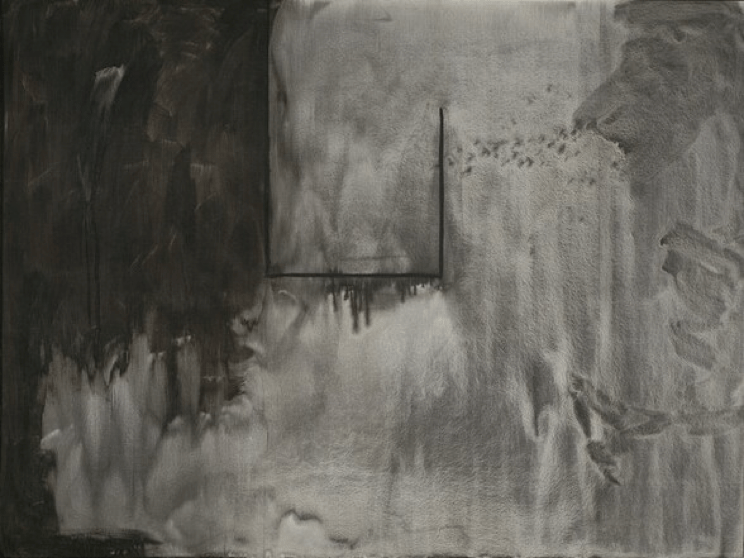
Louise Nevelson “Black Wall” 1959 Painted wood 2642mm x 2165mm x 648mm The Tate Gallery, London, United Kingdom.
We might be reminded of a couple songs on this subject: the first one written by Bob Dylan and the other by Mick Jagger and Keith Richards. Or, we might think of Goya’s late Pinturas Negras from 1819 to 1823; or two individual bodies of monochromatic abstractions produced by Ad Reinhardt and Louise Nevelson during the 1960’s. All incorporating the color black. Additionally, poets such as Robert Bly, Lawrence Ferlinghetti and Edward Hirsch have described various uses of this same color. Hirsch especially has commented on this in one of the essays in his larger collection titled The Demon and the Angel. He quotes a statement from the painter Robert Motherwell, and takes note that there are both physical and technical as well as psychological reasons for using this specific color.
Aaron Siskind “Installation view of the ‘Black or White’ Exhibition”2 1950 b&w photograph 14cm x 25cm Archives of American Art, Smithsonian Institution, Washington, DC.
“The New York painters discovered that they could use black pigments to create a feeling that was sometimes infernal, sometimes transcendent. They entered a zone of black hues that was both boldly contemporary and richly archaic. Black fit the spirit of urban painters who also embraced a Modernist Primitivism: ‘The chemistry of the pigments is interesting: ivory black, like bone black, is made from charred bones or horns, carbon black is burnt gas,’ Robert Motherwell explained in a catalog note to the 1950 show Black or White. ‘Sometimes I wonder, laying in a great black stripe on a canvas, what animal’s bones (or horns) are making the furrows of my picture.”3
In another collection, My Sentence was a Thousand Years of Joy, Robert Bly includes several examples of the ekphrastic tradition related to this subject. He speaks of Cézanne and Monet, as well as Giotto, Fra Lippi, Rembrandt, and especially Robert Motherwell.
For Robert Motherwell
“Hunter, give me your horse. I am going into sorrow again. I’m looking for the dead people hidden in the grass. Help me up. I am crazy about suffering again.
I see that I am walking in a dead man’s shoes. I have been born so many times as an orphan. The thin fiddle Strings stretched tight have saved me from suicide.
When Robert Motherwell lifts up his two black clouds So that they float a few feet from each other, I know grief is the one who tells me what to do.
The soul can never get enough of the taste of its sorrow. I am a horse throwing his head sideways, galloping Away from the place where the happy people live.
I don’t care anymore whether I am educated or not. We have learned so much pain by not going to school. Our lines suggest the luck lost between heartbeats.
We who love Motherwell’s black clouds may be insane, But at least we know where to feed. We are close Relatives of the birds that followed Jesus to Egypt.”4
Robert Motherwell “Elegy to the Spanish Republic” 1962 Acrylic on canvas 71″ x 132 1/4” Yale University Art Gallery, New Haven, Connecticut
As poets over the years, Robert Bly, Edward Hirsch, and Lawrence Ferlinghetti have all been interested in their contemporaries who were painters, as the above examples by Hirsch and Bly illustrate. In the example below, one of his late prose poems, Ferlinghetti writes about the many transformative processes that painters often go through, inspired by a certain painting by Motherwell.
The Painter’s Dilemma
“There they all were still, the unfinished canvasses, all chimeras, chiaroscuro illusions, dead stick figures still to be brought to real life, with their numbered pigments upon the canvas ground where formed the limbs the figures the faces of longing, yearning dogs and hungry horses’ heads among them, the skulls with ears, liquid porches, spilling light, onto the canvas, pools of it forming into shape of eyes, but as soon as they were formed they ran down with too much turpentine and ran onto the dark dogs and horses, and they turned into echoes of laughter with every mocking sound a different color echoing about the canvas and transfiguring all its painted parts, horses’ penises turned to yellow flutes that fitted to manifolds that fitted into female plumbing that in turn dissolved and floated down streets as yellow sunlight, while numbered shadows melted and percolated up into the gutters of tilted houses. Hunger and passion were what was needed but this got lost in the whirl of paint, in the depths of the cave that every canvas became, and the brush could not reach the boundaries of being inside Plato’s Cave.”5
Robert Motherwell “In Plato’s Cave” 1991 Acrylic on canvas 72″ x 96” National Gallery of Art, Washington, DC.
These have been several observations pertaining to this one subject, which are shared by Robert Bly and Robert Motherwell, Edward Hirsch and Lawrence Ferlinghetti. It is a specific theme and color range that occurs in various periods of art history. And in Rock ’n Roll. So it seems like some one should have the final word here. But it will come to this, shared by three writers and one painter: Mick Jagger and Keith Richards, Franz Kline for one of his great ‘black’ paintings, and last but not least: Robert Bly.
“I see a red door And I want it painted black No colors anymore I want them to turn black. . . .”
“Maybe then, I’ll fade away And not have to face the facts It’s not easy facing up When your whole world is black. . . .”
“I wanna see the sun Blotted out from the sky I wanna see it painted, painted, painted Painted black. . . .”6
Franz Kline “Untitled” 1952 Enamel on canvas 53 3/8” x 68” Metropolitan Museum of Art New York, New York.
“Some people say A painting is a pitcher full of the invisible.”7
“I don’t know why these poems keep veering off Toward darkness.”8
1 Dylan, Bob; “She Belongs to Me” from Writings and Drawings; Alfred A. Knopf, Inc.; New York, New York; 1973; p.159.
2 In this installation photograph of the exhibition “Black or White” by Aaron Siskind, the works shown are from left to right: “Dark Pond” by Willem de Kooning, 1948; “Granada” by Robert Motherwell, 1948-1949; and “Germania II” by Hans Hofmann, 1950. Kootz Gallery, New York, New York, 1950.
3 Hirsch, Edward; The Demon and the Angel: Searching for the Source of Artistic Inspiration; Harcourt, Inc.; New York, San Diego and London; 2002; p. 183.
4 Bly Robert; My Sentence was a Thousand Years of Joy; Harper Perennial; New York, London, Toronto and Sydney; 2005; p. 59.
5 Ferlinghetti, Lawrence; When I Look at Pictures, Peregrine Smith Books; Salt Lake City, Utah; 1990; p. 46.
6 Jagger, Mick, & Keith Richards; Aftermath: Paint It Black; Audio Recording; Decca Records & RCA Studios; Los Angeles, California; 1966.
7 Bly Robert; My Sentence was a Thousand Years of Joy; Harper Perennial; New York, London, Toronto and Sydney; 2005; p. 13.
8 Bly Robert; My Sentence was a Thousand Years of Joy; Harper Perennial; New York, London, Toronto and Sydney; 2005; p. 85.
Writing about the George Ault Retrospective Exhibition at the Whitney Museum of American Art in New York in 1988, the critic Roberta Smith observed: “. . . Ault’s firm, unflamboyant way with a brush, his feeling for a building’s austere, carefully dovetailed planes and, above all, his love of light as painting’s form-giving, mood-setting force, sustained him at nearly every turn, in any direction he chose to move. His forte was the nocturne, which he painted from the beginning to the end of his career.”1
George Copeland Ault was born in Cleveland, Ohio in 1891. Between 1899 and 1911 the Ault family lived in London where his father represented his family’s business. During this time George was encouraged by his father to study at the Slade School of Art. Four years after the family’s return to the States in 1915, George’s younger brother committed suicide. Five years later, his Mother died of pernicious anemia in a New Jersey mental hospital. In 1929 his Father died and the family fortune was lost in the stock market crash. Within the next two years both of his older brothers committed suicide. George and his sister Esther were the only remaining family members at that time. Ault continued working on his paintings of city views during the early nineteen-thirties. However, he left his affiliation with the Downtown Gallery in New York City in 1937 and sought isolation outside of the city.2
In this late series of paintings one might see and understand how George Ault came to embrace the darkness and solitude of an isolated country crossroads. For several years he was often grouped with other early 20th Century artists. His Precisionist tendencies, combined with an understated surrealist sensibility placed him in good company with the likes of Ralston Crawford, Charles Sheeler, and Edward Hopper, and even the early city-scapes of Arthur Dove and Georgia O’Keeffe.
George Ault “Hudson Street” 1932 Oil on linen 24 3/16” x 20” Whitney Museum of American Art, New York.
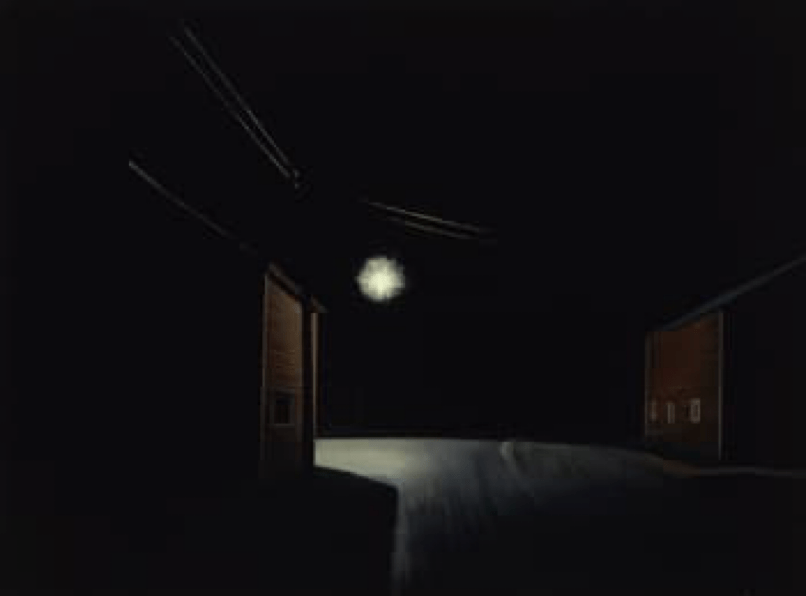
Moving north, George Ault found his isolation in small town America, and an even smaller crossroads just a short walk outside of Woodstock, New York. It was there that he found a particular quietude, and his vision as an artist. From 1943 through 1948 Ault painted five views of Russell’s Corners, one in daylight and four at night. George Ault’s life and work has sparked new interest recently: from Roberta Smith to Alexander Nemerov, and especially for the art historian and poet, Joseph Stanton.
George Ault “Black Night at Russell’s Corners” 1943 Oil on canvas 18” x 24 1/16” Pennsylvania Academy of Fine Arts, Philadelphia, Pennsylvania
Stanton’s writing has often had as a source, specific works of visual art, in the true ekphrastic tradition. These have included many works by Edward Hopper and Winslow Homer, and even one painting by Marjorie Phillips of Joe DiMaggio coming up to the plate for the last time at the old Griffith Stadium against the Washington Senators.
Joseph Stanton has captured that sense of isolation that is particularly American in certain paintings: the lone batsman, standing at home plate; or the architectural abstractions of both Edward Hopper and Charles Sheeler. Not nearly as well known as Hopper, or other of his contemporaries, George Ault nonetheless created a powerful and haunting body of work.
“Bright Light at Russell’s Corners” 1946 Oil on canvas 19 5/8” x 25” Smithsonian American Art Museum, Washington, DC.
George Ault’s Last Painting of Russell’s Corners
“He loved the lamp that made the corner bright, adored it as a stay against the dark, but dark returned when he moved past the light.
The chaos of this era out of sight, his deft Precision kept his vision stark, shaped by the lamp that made the corner bright.
Against the tumult of the world he posed this site; he dreamt geometry as if a truth were clear, but dark returned when he moved past the light.
This Catskill village was his whole delight, his universe had Woodstock at its heart, a tiny town had made his corner bright.
He painted roofs to shoulder up the night, and walked this road, avoiding shadowed forks, but dark returned when he moved past the light.
Beyond himself in art, he could not quite decide to live and plunged into dark. He loved the lamp that made the corner bright, but dark returned when he moved past the light.”3
On the night of 30 December 1948, George Ault was walking alone in a storm along the Sawkill Brook, in Woodstock, New York, where he drowned. What we are left with is this sense of loneliness, and that feeling of the solitary figure or place. Isolation, and a uniquely American sense of place and light.
Roberta Smith again describes this work: “The setting is the same in each case—a solitary streetlight, the same bend in the road, the same collection of barns and sheds—but seen from different vantage points. In them, Ault has summoned up the poetry of darkness in an unforgettable way—the implacable solitude and strangeness that night bestows upon once-familiar forms and places.”4
George Ault “August Night at Russell’s Corners 1948 Oil on canvas 18” x 24” Joslyn Art Museum, Omaha, Nebraska
1 Smith, Roberta; “George Ault’s Sad, Everyday Beauty in Stillness;” The New York Times; 29 April 1988; Section C, p. 17.
2 Nemerov, Alexander; To Make a World: George Ault and 1940’s America; Smithsonian American Art Museum and Yale University Press; New Haven, London, and Washington, DC.; 2011. This information summarized from the more extensive chronological information, pp. 131-133.
3 Stanton, Joseph; Prevailing Winds; Shanti Arts Publishing; Brunswick, Maine; 2022; p. 37.
4 Smith, Roberta; “George Ault’s Sad, Everyday Beauty in Stillness;” The New York Times; 29 April 1988; Section C, p. 17.
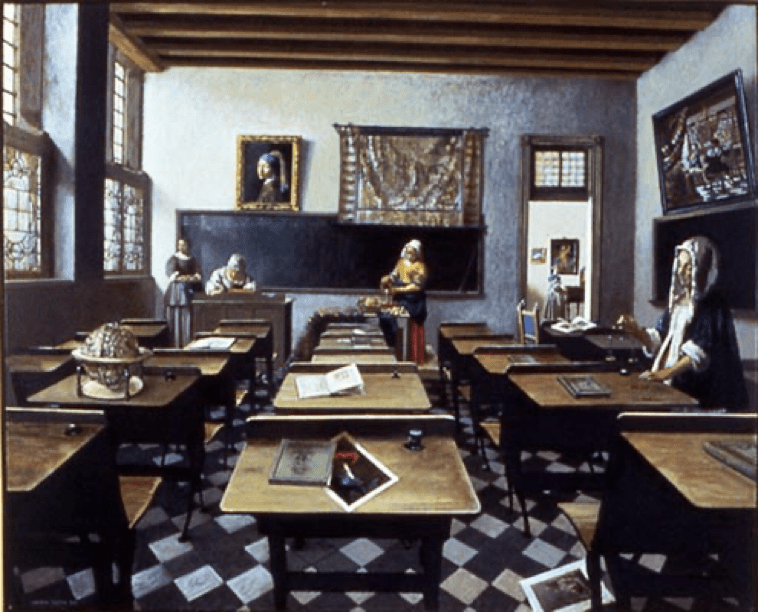
Years ago in the mid-west we often heard about an artist, originally from Vincennes, Indiana, who had studied at the Art Institute of Chicago. When he was drafted into the United States Army in 1953 he served in Germany and was able to visit many of the great European museums. After returning to the States and finishing up his education in Chicago, George Deem moved to New York City where he became interested in synthesizing both art and art history. This is where and when he began a long series of paintings as mash-ups, or pastiches of famous works of art: variations on themes by Caravaggio, Chardin, Balthus, Edward Hopper, and especially Vermeer. The interior of an old time school house became the setting for many subjects such as the “Hoosier School” of 1987 and the “School of Vermeer” from 1984.
George Deem “School of Vermeer” 1984 Oil on canvas 86.4cm x 106.7cm Garland and Suzanne Marshall Collection, Clayton, Missouri.
I first began visiting the National Gallery of Art in Washington, DC during my junior and senior years in high school. Over the next four years I continued and intensified those visits on the weekends when I was home from art school in Baltimore. It is hard to say where I would begin, but on every one of these visits I knew definitely that I would always end in the rooms that housed the Dutch paintings, and especially the four Vermeers in the collection. When I first saw both “The Girl with the Red Hat” and the “Woman Holding a Balance” it was an instantaneous lesson in light and color.
Both of these paintings glowed, as if from the inside out. Each figure being bathed in light. The light and the reflections coming through and effecting all of the objects were simultaneously subtle and intense: from the feathers around the edge of that red hat, to the highlights on the finials on the back of the chair; and then to the pearls, pieces of gold and other objects collected on the table and being weighed in a balance.
Woman Holding a Balance Vermeer, 1664.
“The picture within the picture is The Last Judgement, subdued as wallpaper in the background. And though the woman holding the scales is said to be weighing not a pearl or a coin but the heft of a single soul, this hardly matters. It is really the mystery of the ordinary we’re looking at—the way Vermeer has sanctified the same light that enters our own grimed windows each morning, touching a cheek, the fold of a dress, a jewelry box with perfect justice.”1
Johannes Vermeer “Woman Holding a Balance” c. 1664 Oil on canvas 15 5/8” x 14” The Widener Collection National Gallery of Art, Washington, DC.
Many years later, in 1996, we would visit the historic “Johannes Vermeer Exhibition” also at the National Gallery. Although it was a horrible winter, with many blizzards, and a major government shutdown, we flew in to National Airport and stayed in Arlington, a short Metro ride over to the mall. We arrived early, stood in line for a few hours in the snow, and made friends with other like-minded visitors, each of us taking turns running to a nearby coffee shop for warm-ups. Even a couple of reporters from USA Today!2
Although I have now seen almost all of his work both in the United States and Europe, there are certain paintings that will always stay with me. “The Little Street” and the “View of Delft” have directly influenced my work, and I often see echoes of these images in everyday views anywhere from Bloomington, Indiana to Brussels, Belgium, whenever I find myself just walking down the streets.
Several contemporary writers have been influenced by this same imagery. Not just popular novels and movies, but the subtle subjects that appear and re-appear in the work of this artist. Two such poets are Linda Pastan above and Joseph Stanton below. In fact, both have taken on this very painting, the Woman Weighing Gold, or Pearls, or Holding a Balance, as it is often referred to.3
Contemporary painters such as James McGarrell and George Deem have also responded to Vermeer’s work. Both of them have revisited these historic images during certain periods of their careers.
I first encountered James McGarrell’s paintings at the Smithsonian National American Art Museum after they had been featured in the American contribution to the Venice Biennale in 1968.4 Later I came across his variation on Vermeer’s “The Art of Painting” at either the Indiana University Art Museum in Bloomington, or the Allan Frumkin Gallery in New York.
George Deem, after moving from Chicago to New York in the 1950’s realized how important his study of art history had been, and began to mine several of these sources. Above is an example of Deem’s synthesis of these paintings, several subjects combined in one interior. Below is a series of studies for these interiors: “Seven Vermeer Corners” depicts the emptied out rooms of these paintings, with the interior of the “Woman Weighing Pearls” shown in the bottom row, second from the left.
George Deem “Seven Vermeer Corners” 1999 Oil on canvas 50” x 86” Wellington Management Company Collection, Boston, Massachusetts.
Vermeer’s A Woman Weighing Gold
“Motionless with musing, the woman weighs her delicate ounces of earthly treasure.
Behind her, framing her head in a squared halo is another weighing: the last judgements— Dies Irae, the damned cascading down, writhing, toward their fiery demise.
But the woman’s body, swelling with new life, eclipses most of this excess of painted dying. What little we can see of it is distant and shadowy, memento mori as muted afterthought.
The woman’s seeing is turned inward to the treasure building there, an interior glory, mystery beyond measure. She is the balance of the moment’s precarious presence.
Vermeer belonged to his theatrical era, but his drama’s action rises in a bravura quiet of gesture and tone. What he would have us see is entirely known yet impenetrable reality distilled to its contours: a subtle seizure of daylight. Vermeer’s conceit here is metaphysical, so we must weigh with care his elaborate composure.”5
1 Pastan, Linda; Carnival Evening: New and Selected Poems 1968-1998; W. W. Norton & Company; New York and London; 1998; p. 38.
2 Schwiesow, Deirdre R.; “Vermeer fans brave nature, politics to see exhibit;” USA Today; Arlington, Virginia, 7 February 1996, Volume 14, No. 101, p 4D.
3 Wheelock, Arthur K., and Frederik J. Duparc; Johannes Vermeer; National Gallery of Art, Washington, DC. and Royal Cabinet of Paintings Mauritshuis, The Hague; Yale University Press. New Haven & London; 1995; p. 140.
4 Gaskey, Norman A.; The Figurative Tradition in Recent American Art; 34th Venice Biennial Exhibition; National Collection of Fine Arts, Smithsonian Institution, Washington, DC; 1968; pp. 93-98.
5 Stanton, Joseph; Imaginary Museum: Poems on Art; Time Being Books; St. Louis, Missouri; 1999; p. 20.
It is not really a debate, more like an on-going discussion on the Post-Modern Condition from the point of view of a rabbit and a kitty cat. They are constantly asking each other questions, and pointing out the contradictions in both the real and imagined worlds surrounding them, leading to a long list of interesting philosophical problems which often begin in The Artist’s studio.
“Maybe it comes from her imagination, so it’s not real at all.”1
“‘You don’t always want to imagine something,’ Kitty Boy answered. ‘Sometimes you just do it: it comes to you whether you want it or not.’”2
“I think I get it now, Rabbit thought. I’ve been taking this situation seriously. But the whole thing is a joke, the dancing rabbits and the pink flower and the torn-up field. It isn’t really happening. I thought it was a dream, or eating the flowers, or my imagination, or The Artist’s new painting. It’s just a joke someone is playing on me.”3
Kristy Deetz “New Year’s Eve Pawsing” Acrylic paint, embroidery, on digital pattern printed on silk 36” x 36” x 1.5” 2020 Courtesy of the artist.
In the new publication “Holidays Unfolding: The Continuing Adventures of Rabbit and Kitty Boy” the main characters are of course Rabbit and Kitty Boy, along with one or two supporting characters such as Bo-Doggie. Then there are two other main characters, “The Artist” and “The Writer” who are often referred to and always seem as gods to the animal characters. Kristy Deetz and Edward S. Louis are the creators of this fictional story: the series of paintings depicting the animals and their adventures and the text that so aptly describes the world in which they exist.
The paintings are seen at first as patterns repeated across a background fabric. The animals are flattened and fitted together in order to hold that plane. However, placed just in front of this screen, are a series of small ceramic animal sculptures, coming forward in space. And finally, in front of this backdrop, the characters of Rabbit and Kitty Boy come to life. This after having discovered that they have jumped off of the picture plane and can now see themselves as separated from the patterned background. This is a startling existential recognition. This is also where the confusing discussion regarding the difference between the modern and the post-modern and the function of the imagination begins. We are seeing and experiencing three levels of plastic space, as well as three levels of literary irony and parody. The two fit perfectly together like a fine glove.
There are many questions in any discussion of the ekphrastic tradition and two of the most important ones ask: are these paintings illustrations of the stories, or are the stories true literary reactions/responses to already existing works of visual art? These same questions, regarding several other historical artists immediately come to mind: both the poems and prints of William Blake, the classic French story and the accompanying drawings for “Le Petite Prince” by Antoine St. Exupery, and the many versions and editions of “The Fables of La Fontaine.” These works of visual art and the writing are seemingly inseparable. We must add to this list the new work created by the artist Kristy Deetz and the writer Edward S. Louis.
Their work also raises new questions not just regarding the ekphrastic tradition, but also related to the post Post-Modern era. In recent years we have become lost in a jumble of images, meanings, and interpretations of every little thing, very often losing track of any original ideas. In literature, art and even architecture, certain forms and images were re-introduced into the overall content of this era that came after the Modern one. Although this was all supposed to become more enlightening, it most often led to confusion. Beginning with a sense of historical playfulness, this point of view was soon replaced with parody, irony, and even out right joking!
Kristy Deetz “Friends Day Hiding” 2020 Acrylic paint, embroidery, image transfer, on digital pattern printed on silk 36″ x 36″ x 1.5” Collection of the artist.
Over the years, Deetz has been producing a series of “Veil Paintings” investigating the idea of “Nature Morte” and giving life back to certain objects and imagery. Adding to this, a new series titled “Holidays Unfolding” explores certain contradictions in the phenomenon of seeing. In painting, the process of applying the paint itself becomes a metaphor for the subjects of a still life: laying on the under-painting and the background; developing and arranging the drapery; and finally the arrangement of objects in an overall composition. Although the resulting life is still, a closer seeing of the paintings will reveal a lot of shifting movement.
Through correspondence with both Kristy Deetz and Edward S. Louis I have discovered several unique interrelationships regarding their work. Describing this process, Deetz writes: “The painted fabric, ellipses, and patterned fabric in the paintings act as limina or thresholds that, along with the accompanying images and forms, place the viewer into multiple, often conflicting, layers of space and meaning. . . . The paintings good-humoredly deconstruct imagery from my own painting history, as well as from pop and high culture to create new ‘spaces’ of meaning. The paintings also contain dark humor, visual puns, symbols and metaphors, moments of silence, art historical allusions, and spiritual conundrums.”
“Yes, our process is ekphrastic. I make the painting series and when completed Ed creates a story about the series. Rabbit and Kitty Boy evolved out of my Through the Veil series but appeared in other forms in past work. Our process is also somewhat collaborative. We are very self-directed but give each other feedback in the middle of things, on titles, visual puns, and finished products.” 4
The author Edward S. Louis, who has often taught on the subject of ekphrastics, has offered this definition to me: “Ekphrasis in Greek literally means to ‘tell out’ or ‘recount.’ By its nature it relies on collaboration, since it incorporates or encapsulates the original to which it responds. I’ve been thinking about it for a long time, too, for me in the context of what ‘literary criticism’ means. I’ve argued in critical as well as creative outlets that our tradition has often drawn too firm a line between ‘scholarly’ work and ‘creative’ work. The creative is much better if it has a scholarly base, and scholarly work is more fun to read if it has a creative edge. Ekphrasis is an excellent means/mode to do critical and creative work at once.”
“The stories ‘illustrate’ the visuals (that, I think, is our major innovation, since it’s backwards of standard expectations). There would be no stories without the visuals. In some cases the stories explicate, whereas in others they derive from or expand on the paintings. So they both ‘tell out’ and ‘recount’ what the paintings do, as well as taking some latitude to introduce narrative possibilities that the paintings imply or inspire, sometimes one at a time or sometimes through the course of several at a time.”5
Kristy Deetz “Halloween Floating” Acrylic paint, embroidery, image transfer, on digital pattern printed on silk 36” x 36” x 1.5” 2017 Courtesy of the artist.
At the beginning of this adventure, these characters are speculating on many possibilities. Reflecting on all of this near the end, it is Kitty Boy who observes:
“Kitty Boy wondered. They all seem to be floating into that hole. Where does it go, and what will happen to them? That one looks a little like Rabbit, and that one: is it Bo-Doggie? And, hey! Is that one supposed to be me?” “He was standing on the windowsill in the studio looking at The Artist’s new painting.” “It showed many rabbits, all wearing masks—one that Kitty Boy thought looked like him—and they were all drifting up toward a large, black hole.” “Back out of the hole came nothing but ghost rabbits, thin shadows of their former selves. But the live rabbits seemed not to care; they seemed not even to be aware of what they were doing. Ghost bats flew around the rabbits, but neither seemed to notice the other. A tablecloth that someone had been starting to sew was also drifting toward a hole, about to get tugged in. On top of the table another cloth unfolded—Kitty Boy wasn’t sure if it was a banderole or a toilet roll.”6
“Maybe imagining isn’t such a bad thing.”7
1 Deetz, Kristy, and Edward S. Louis; Holidays Unfolding: The Continuing Adventures of Rabbit and Kitty Boy; Elm Grove Publishing; San Antonio, Texas; 2021 & 2022; p. 15.
2 Deetz, Kristy, and Edward S. Louis; Holidays Unfolding: The Continuing Adventures of Rabbit and Kitty Boy; Elm Grove Publishing; San Antonio, Texas; 2021 & 2022; p. 16.
3 Deetz, Kristy, and Edward S. Louis; Holidays Unfolding: The Continuing Adventures of Rabbit and Kitty Boy; Elm Grove Publishing; San Antonio, Texas; 2021 & 2022; p. 33.
4 Deetz, Kristy; E-mail communication with this author; 10 October 2021, 5:43 PM.
5 Risden, Edward (aka Edward S. Louis); E-Mail communication with this author; 12 January 2022, 10:30 PM.
6 Deetz, Kristy, and Edward S. Louis; Holidays Unfolding: The Continuing Adventures of Rabbit and Kitty Boy; Elm Grove Publishing; San Antonio, Texas; 2021 & 2022; p. 77.
7 Deetz, Kristy, and Edward S. Louis; Holidays Unfolding: The Continuing Adventures of Rabbit and Kitty Boy; Elm Grove Publishing; San Antonio, Texas; 2021 & 2022; p. 95.
He is both a poet and an art critic. An important combination. He reminds me a bit of another great poet, who early on became a curator at the Museum of Modern Art in New York, Frank O’Hara. Both were so important as poets and as members of the larger art world. I am speaking about the writer John Yau, and especially his collection titled Borrowed Love Poems.
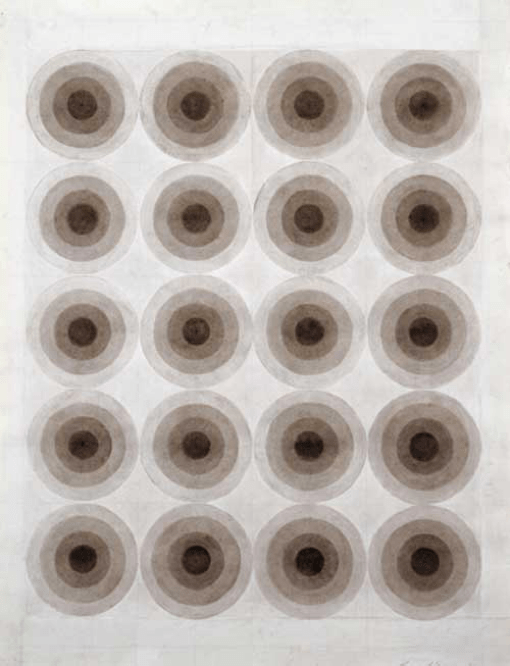
In order to follow up on these poems, I have recently been re-reading several books on three of the artists. These include: Lucy Lippard’s book on Eva Hesse1, Craig Burnett’s extended essay on Philip Guston: The Studio2, and the tribute to Frank O’Hara, In Memory of My Feelings by Russell Ferguson3. On the surface, these three artists seem to have nothing in common: they are people of such a great variety of ages and backgrounds, aesthetics and motivations. Yet the insistence and determination that each exhibited in their life’s work, their struggles for acceptance, and their ultimate recognition are important examples of the lives of painters and poets.
Eva Hesse “Untitled” 1966 Watercolor on paper 12” x 9” Private Collection, Estate of the artist.
Bowery Studio
“It is never just matter
Smooth as the paper holding them in its mouth
the circles float in their circles of ink
Solace is found in sameness as is the soul
should one cling to such matter
and such matters mean much to some
But the sum is not all
The circles float in their perfect mouths of ink
Where else am I to store them
The windows have their own tasks The sky brings its own table”4
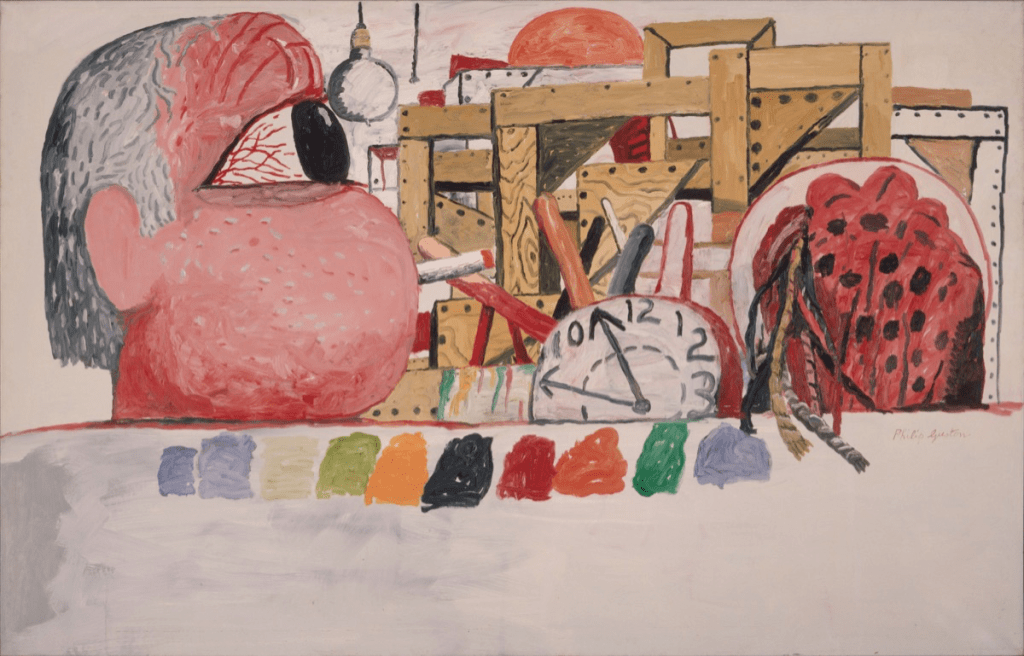
In writing about Hesse’s watercolors, Yau speaks of circles that float and a table that is brought in by the sky. On the other hand, Guston’s table is like a rock: piles of shoes and pyramids, books like stale bread, and light bulbs inhabiting and surrounding this table top landscape. And finally, a tribute to a fellow poet: in remembrance of Frank O’Hara, Yau laments the careers of well-groomed curators and artists, where images reflected in their windows offer sights of real flesh and blood. From three very different perspectives, we realize these are indeed descriptions of an important and ongoing dialogue amongst contemporary poets and painters.
Phillip Guston “The Painter’s Table” 1973 Oil on canvas 77 1/4” x 90” National Gallery of Art, Washington, DC.
Studio Dream
“Your face is a shoe or a pyramid
What do you do with a bandaged rock
clogged with muck tea kettle’s dented noggin
common clock cracked with arrows
One is up or down staring into book of stale bread
dotted slab and square cloud Does the world move closer
when you scratch black lines Bulb hangs its note above bed
Head and arms embrace dust inside web
Did you want to join me on the sofa watch my skull float out to sea
Old crust, stitched mitten You’ve got a big empty head
but no place to cram it”5
Phillip Guston “Studio Landscape” 1975 Oil on canvas 67” x 104” Estate of Philip Guston, Courtesy David McKee Gallery, New York
Broadcast from 791 Broadway
“Salacious, broken-nosed, bantamweight Animals don’t ring my doorbell bring me cookies and champagne biscuits as big as movie stars’ post-nuptial crumbs I am not another image of the Buddha preaching or the ornate clouds he manufactures for those in need of eternal wisdom I am not even his rapid flagship cousin part nugget, part fly I am a defection from the mind of an Abyssinian tram quill rising through the pages of the wall and wind you surround yourself in almost hard-headed enough to make an appearance at the Statue of Librettists because the Primogeniture Mink pleaded with me to grind for the people of New York and to squirt you with news of how powerfully afloat we feel in Heaven its many villas and huts copied from the terracotta model of Manhattan we carried into the snowy mountains of thought”
Alice Neal “Portrait of Frank O’Hara” 1960 Oil on canvas 33 3/4” x 16” National Portrait Gallery, Smithsonian Institution, Washington, DC.
“Since I left you, American art has received many stamps of approval I was commissioned to design by the School of Better Living Through Lusty Dancing and didn’t
Since I left you, smoother stools and life-like cats are being peddled by the curlicue gates of the Museum of Modern Fate
Since I left you, well-groomed curators have learned how to store their robes and purr without becoming overly philosophical, and artists have stopped skinny-dipping in the reflections carried past their windows on the shoulders of dead and dying poets disgusted perhaps by the sight of real flesh and blood
Since I left you, many other curious celebrations have taken place”6
Larry Rivers “Preparatory drawing for In Memory of My Feelings” 1967 Pencil on acetate 19” x 24 15/16” Gift of the artist Museum of Modern Art, New York
1 Lippard; Lucy; Eva Hesse; New York University Press; New York, New York; 1976.
2 Burnett, Craig; Philip Guston: The Studio; Afterall Books; London, United Kingdom; 2014.
3 Ferguson, Russell; In Memory of My Feelings: Frank O’Hara and American Art; University of California Press; Berkkeley, Los Angeles, London; 1999.
4 Yau, John; Borrowed Love Poems; Penguin Books; New York, New York; 2002; p. 15.
5 Yau, John; Borrowed Love Poems; Penguin Books; New York, New York; 2002; p. 16.
6 Yau, John; Borrowed Love Poems; Penguin Books; New York, New York; 2002; pp. 17-18.
“Between the gathering of food and its consumption there is an interval when it is on display. To this arrangement of eggs on the sideboard, as may be, brought in from the henhouse. . . apples and pears from the orchard, a string of fish from the river, a brace of partridges flecked with blood, a basket of squash and beans from the garden, the Dutch gave the name still life around the middle of the seventeenth century.”1
William Bailey “Still Life with Seven Eggs” c. 1965 Oil on canvas 24” x 30” Collection: Harold Mailand, Indianapolis, Indiana.
“Over the years (William) Bailey’s still lifes have changed. In the 1960s a few eggs appeared on a tabletop. Then a few utensils were added. Gradually, over the next fifteen years, as the utensils took over the eggs vanished, except for the occasional appearance of one, as affectionate reminder perhaps of humble beginnings. The early paintings made up mainly of eggs seem, when compared with the recent paintings, casual in disposition. And the tabletops seem nowhere as ample as they do now. Increasingly they have become sites, and their objects have grown in size. Coffee pots are towers, bowls are colosseums, other containers are houses or forts, and between them shadowy piazzas, dreamlike passageways. And then they are nothing of the kind, but themselves, as they were, parts of an elaborately orchestrated picture that is much more powerful and assertive than its individual pieces. What began with a few eggs on a table has become an image of immense inaction, an apparition of fixity and quietude.”2
In the selections above, two contemporary writers, Guy Davenport and Mark Strand, provide important observations on contemporary still life painting. Throughout the history of art the still life however, has constantly been overshadowed: as the great classical themes in painting were always monumental narrative histories set in deep and panoramic landscapes, making the arrangement and presentation of domestic objects only a footnote, of little meaning or consequence. The writer and critic Guy Davenport would argue with me on this point: “We must not, however, imagine that still life is inconsequential or trivial. Composers work out ideas in string quartets—Beethoven’s and Bartok’s experimental forms for discovering what can be done with harmonies and tempi—that have become masterpieces. There are artists like Chardin and Braque for whom still life was their major form of expression, as there are poets who have excelled only in the sonnet and the short lyric.”3
Jean-Baptiste-Siméon Chardin “Still-Life with Pipe and Jug” c. 1737 Oil on canvas 32.5 cm x 40. cm Musée Louvre, Paris, France
Along with Davenport and Strand, there have been many other contemporary examples of writing about still life, or as it is known in French, nature morte. For me, one influential example was a catalogue for the “Big Still Life” exhibition at the Allan Frumkin Gallery in New York in 1979.4 Frumkin’s proposal was to challenge gallery artists and a few invited friends to paint large sized images of a variety of traditionally intimate subjects. James McGarrell’s submission was a veritable tour de force of this idea.
James McGarrell “A Fine Excess with Chardin Quotation” 1978-1979 Oil on canvas 45 1/4” x 93 1/4” Allan Frumkin Gallery and the Estate of the Artist
The poet Mark Strand has written chapters in catalogues and small books on both Edward Hopper and William Bailey that read like prose poems about the artists. There is also Guy Davenport’s book of essays on this very subject, “Objects on a Table.” Also, there are the writings of the poet and critic John Ashbery who was always attentive to this subject, especially with his colleagues Fairfield Porter and Jane Freilicher.
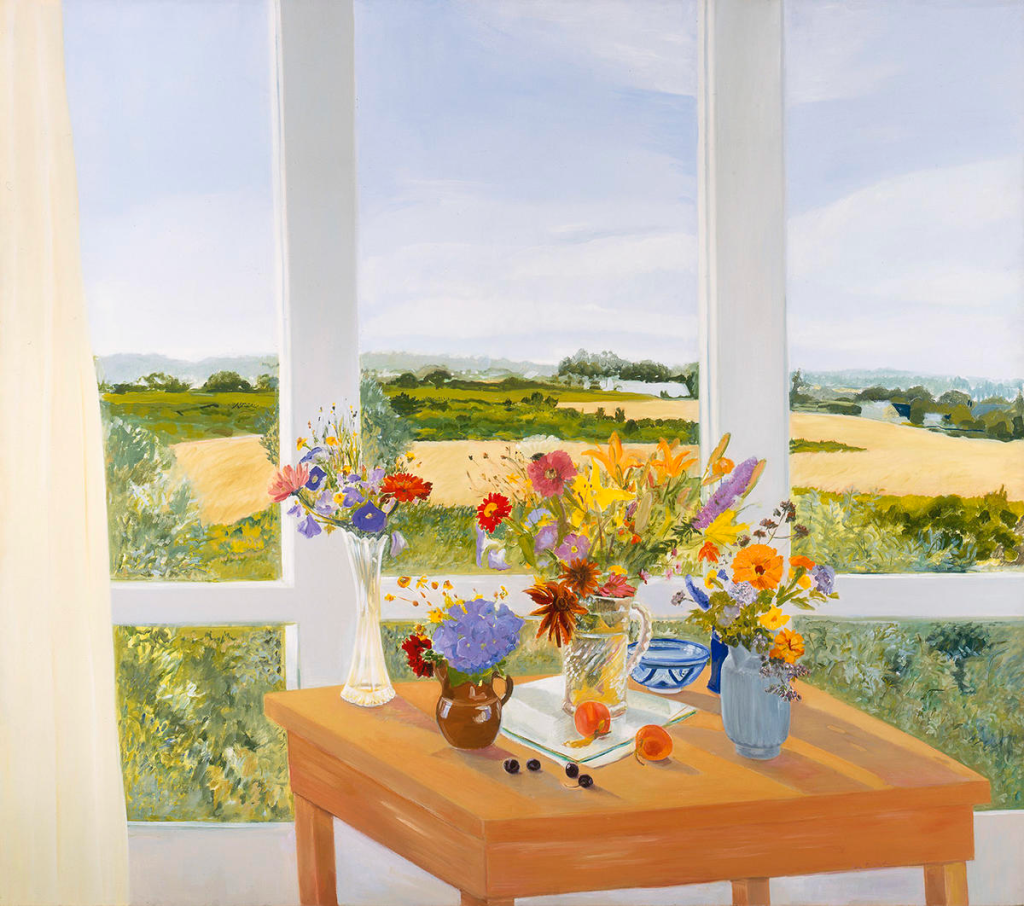
Jane Freilicher “In Broad Daylight” 1979 Oil on canvas 70” x 80” McNay Art Museum, San Antonio, Texas
Here are Ashbery’s observations regarding Freilicher’s paintings: “Her pictures always have an air of just coming into being, of tentativeness that is the lifeblood of art. There are always new and surprising full passages where you couldn’t imagine another artist coming to the same decisions, which are invariably the right ones. Her subjects are often the same—still life or landscapes, sometimes viewed through a window—but the way of painting is constantly different, fresh, and surprising. Her work is rich in meanings that continue to resonate with us even after we have moved on and are thinking of something else. It is one reason why we value art and part of what makes her a great artist.”5
Some would say that these things are just objects on a table. Sometimes in art school they were referred to as table-top landscapes. Random placements of things, occupying our field of vision. Right at eye level. Although appearances may often be random, happenstance and arbitrary, this is not the case. As every painter knows, it is indeed a calculated risk to place one certain object next to another. It is the ancient idea of the just placement of things. And the poet Mark Strand, a classmate of William Bailey at Yale, has always been keen on this idea.
“Every painting is an answer to randomness, a metaphysical solution—each object has found its proper place in the scheme of things. And the arrangement, inasmuch as it is an ideal order, inspires belief. So that when a number of Bailey’s still lifes are seen at the same time, we are forced to experience the provisional nature of even the most extreme order. The painting, instead of being conclusive, becomes a revision, a judgment on the previous painting’s power to enchant and to subdue anxiety.”
William Bailey “Piano Scuro” 2003 Oil on linen 38 1/8” x 51” National Gallery of Art, Washington, DC.
“Bailey’s seemingly reductive world of pots and bowls on a table becomes complex. His objects are as basic as colors in their capacity to recombine into new figurational orders. In its studied reordering of ideal groupings, Bailey’s work is anything but repetitious. Objects keep reappearing, sometimes with their size or shape slightly altered, sometimes with the stations they occupy changed, and as a result their positions are diminished or aggrandized. Each change, we feel, is a new final chapter in the life of the objects. To miss these permutations in Bailey’s work is to resist what amounts to a critique of what passes for change in our culture.”6
1 Davenport, Guy; Objects on a Table: Harmonious Disarray in Art and Literature; Counterpoint; Washington, DC; 1998; p. 3.
2 Strand, Mark; William Bailey; Harry N. Abrams, Inc.; New York, New York; 1987; pp. 28-30.
3 Davenport, Guy; Objects on a Table: Harmonious Disarray in Art and Literature; Counterpoint; Washington, DC; 1998; p. 10.
4 Frumkin, Allan; The Big Still Life; Allen Frumkin Gallery; New York, New York; 1979; (unpaginated).
5 From a portion of John Ashbery’s statement before his presentation to Jane Freilicher of the Gold Medal for Painting given by the American Academy of Arts and Letters, 18 May 2005.
6 Strand, Mark; William Bailey; Harry N. Abrams, Inc.; New York, New York; 1987; pp. 32-34.
“Metaphor, juxtaposition, unsettling connections, meaning evoked in the missing connective tissue between somehow familiar objects—these are the poet’s tools.”1
In her introduction to a new publication of de Chirico’s poems, Stefania Heim has written of the many qualities and concerns which are shared between painters and poets. In this particular instance, the poems were written and the paintings were produced by the very same person, Giorgio de Chirico.
It all seems like a stage set: houses lined up around the edges of piazzas; foreground still lives shifting the scale of the entire vista; statues, some riding horses in the background and some asleep in the center; trains speeding past in the far distance, all seemingly without reason or purpose within the total scene. All of them, however, contributing to the interconnectedness and the overall strangeness, with smokestacks and towers looming over the horizon.
Enigmatic imagery and hermetic signs, these elements often function in both painting and poetry. Classical marble statues: heads and figures that often appear livelier than their human counterparts, resulting in a kind of painting that strives to be magical. These are the very ideas that form the foundation for all of Giorgio de Chirico’s imagery in both painting and poetry. A portion of his poem, “Mysterious Night” contains the following image, taken directly from one of his still lives.
“Two iron artichokes on the ocher table. The geometry of shadows lacerated the heart all melancholy morning. But evening came and the volumes and forms fused. Men and animals were passing like silent shadows in the crepuscular light. Long dream’s light. The strange sounds arrive muffled only the mind’s wheels, vertiginous, rotate.”2
Giorgio de Chirico “The Philosopher’s Conquest” 1913-1914 Oil on canvas 49 1/4” x 39” The Joseph Winterbotham Collection, The Art Institute of Chicago
In the poem “Vision” de Chirico speaks of the houses that line the piazzas, and then there is this excerpt from “Zeus the Explorer” a prose poem incorporating anther favorite image from de Chirico’s work:
“The big colored zinc glove, with the terrible golden nails, swinging on the shop door in the sad breaths of the civic afternoons, showed me with its index finger pointing toward the slabs of the sidewalk the hermetic signs of a new melancholy.”3
Giorgio de Chirico “Turin Spring” 1914 Oil on canvas 124cm x 99.5cm Private Collection
VISION
“Houses along the piazzas, houses at the top of the world at the near horizon of our faraway desires, friends you came one evening in which at every moment hope escaped before our hands that uselessly attempted to stop it and we were thinking about the white acropolises where the poet exalts himself and kneels.”4
Giorgio de Chirico “Piazza d’Italia with Statue” 1937 Oil on canvas La Galleria Nazionale, Rome, Italy
(fragment)
“Life, life, great mysterious dream! All the enigmas that you muster; joys and flashes… Porticoes in the sun. Sleeping statues. Red chimney tops; nostalgias for unknown horizons… And the enigma of the school, and the prison, and the barracks; and the locomotive that whistles night below the frigid vault and the stars. Always the unknown; the waking at morning and the dream it has become, dark omen, mysterious oracle…”5
Later during the 1930’s, as the whole idea of ‘surrealism’ was becoming institutionalized, painting mostly formulas and facing failure, certain artists saw new doors opening. This was especially important for Alberto Giacometti and Giorgio Morandi. Giorgio de Chirico to some extent realized this as well, he even wrote about it at the time: “Around me the international gang of modern painters was stupidly striving amid exhausted formulas and sterile systems.”6
De Chirico looked back to the classical period admiringly, tried to return to it, but with very mixed results. Turning his head on the ‘modern’ movement, he did indeed go backwards, whereas Giacometti and Morandi looked forward, seeing ways out of this dilemma in order to discover new methods of seeing, rediscovering their own eyes.
“La Parisienne” (Camp-Stool Fresco) c. 1350 BCE 20cm high Archaeological Museum of Heraklion
ZEUXIS THE EXPLORER for Mario Broglio
“The most ancient Cretans would print an enormous eye in the middle of the skinny profiles that chased each other around their vases, their domestic utensils, the walls of their houses. Even the fetus of a man, of a fish, of a chicken, of a serpent, in its first stage, is entirely an eye. You must find the eye in every thing.”7
1 de Chirico, Giorgio, (Stefania Heim, translator); Geometry of Shadows; A Public Space Books; Brooklyn, New York; 2019; p. xi.
2 de Chiric, Giorgio; (Stefania Heim, translator); Geometry of Shadows; A Public Space Books; Brooklyn, New York; 2019; p. 3.
3 de Chiric, Giorgio; (Stefania Heim, translator); Geometry of Shadows; A Public Space Books; Brooklyn, New York; 2019; p. 37.
4 de Chiric, Giorgio; (Stefania Heim, translator); Geometry of Shadows; A Public Space Books; Brooklyn, New York; 2019; p. 69.
5 de Chiric, Giorgio; (Stefania Heim, translator); Geometry of Shadows; A Public Space Books; Brooklyn, New York; 2019; p. 83.
6 de Chiric, Giorgio; (Stefania Heim, translator); Geometry of Shadows; A Public Space Books; Brooklyn, New York; 2019; p. 35.
7 de Chirico, Giorgio; (Stefania Heim, translator); Geometry of Shadows; A Public Space Books; Brooklyn, New York; 2019; p. 35.
Raphael’s painting of “St. George and the Dragon” from the collection of the National Gallery of Art is an unforgettable image. It is an heroic and monstrous image contained within a very small sized painting. The figure is astride his horse, they are fighting as one, vanquishing this beast, with a panoramic landscape framing the whole image. It is a classic theme, echoed by many artists.
Raphael “Saint George and the Dragon” 1505 Oil on wood 11.2″ x 8.5″ National Gallery of Art, Washington, DC.
As in the ‘folk tradition’ in music, one artist will set out a theme, which is later taken up and elaborated upon, by later artists. The ideas and images continue to grow and develop over time. The 15th Century German artist Bernt Notke and the 20th Century American poet Robert Bly are two important examples of this process.
Taking its inspiration from the sculptural group of the same name by the German artist Bernt Notke, “St. George and the Dragon” is an excellent example of the ekphrastic tradition. Robert Bly is literally reading this sculpture from top to bottom: from the boyish expression on the face of this knight down to the horrific vestige of the monster on his death bed.
Over the years, the poet Robert Bly made several appearances at the Butler University Visiting Writers Program here in Indianapolis, including 1989, 1994, 1999 and 2003. I have continued to follow his work over these years, and had it not been for these visits, I would never have heard of, nor read about, this artist and this particular piece of sculpture.
Bernt Notke was an eastern German painter, printmaker and sculptor who lived from 1440 to 1509. During his lifetime he lived and worked in Lassahn and Lübeck, several other areas near the Baltic Sea, and made intermittent visits to Sweden. It was in Stockholm in 1489 that he produced his most important work, “St. George and the Dragon” for the City Church, now known as the Cathedral of St. Nickolas.
Robert Bly has often studied and written about works of visual art. These have included both Bernt Notke’s “St. George and the Dragon” and Albrecht Durer’s etching of “Two Middle Aged Lovers.”1 Bly has not just referred to earlier German artists: many others have included ancient examples of an Egyptian figure of “Isis” and a Mycenean “Ecstatic Mother,”2 both at the Louvre. He also references Pieter Breughel’s painting of a Flemish pageant3 (now only known to us as a woodcut printed by an anonymous artist in 1566), as well as the great series of “Haystacks” painted by Claude Monet. Bly always seems to be attracted to the heroic and the universal and how they both are intertwined with the personal and everyday existence of his subjects.
Bernt Notke “St. George and the Dragon” 1489 Bronze replica of the original wood and mixed media. 3.75 meters high, 6 meters including base. The Cathedral Church of St. Nicholas, Stockholm, Sweden
St. George and the Dragon
A sculpture made by Bernt Notke in 1489 for Stockholm Cathedral
“The dragon is losing. He fights on his back Fiercely, as when a child Lifts his four feet To hold off The insane parent. His claws grasp The wooden lance that has Pierced his thorny Breast. . . . But too late. . . .
As children, we knew ours Was a muddy greatness. We knew our part Lay with the dragon.
And this girlish knight? Oh I know him. I read the New Testament as I lay Naked on my bed As a boy. The knight Rises up radiant With his forehead Eye that sees past The criminal’s gibbet To the mindful Towers of the spirit city. But I now hate This solar boy Whom I have been.
This solar knight Grows victorious All over the world. And the dragon? He Is the great spirit The alchemists knew of. He is Joseph, sent down To the well. Grendel, What we have forgotten, Without whom is nothing.”5
And as a footnote to all of this, I remember a painting from several years ago by the contemporary artist, Ellen Fischer. It is an abstracted version of St. George based on that Raphael painting mentioned above from the National Gallery. Many of Fischer’s earlier paintings incorporate the playful placement and movement of a variety of objects on and around the picture plane.
In this particular painting, “St. George and the Dragon,” she includes all of the elements from the original with slightly differing placements. This painting however, stands out as very tightly constructed: horse and rider fused as one, the shadow of the leg and tail of the monster just below the middle of the horse. It gives us an interior intensity complimented with the perfect placement of the various elements.
When I asked her about this, this was her response:
“I made St. George and his horse one and the same! See the princess in the background with the red dress? She is in the distance in my painting, too—iconography is the same in every picture I can think of—I’ve always loved St. George’s heroic, plump white horse, who appears to be as much into the fight as St. George, swinging its hooves at the dragon!”6
Ellen Fischer “St. George and the Dragon” c. 1977-1978 Oil on canvas 48″ x 60” Collection of the artist
1 Bly, Robert; Eating the Honey of Words; Harper Collins Publishers; New York, New York; 1999; pp. 119 & 202-203.
2 Bly, Robert; Sleepers Joining Hands; Harper Collins Publishers; New York, New York; 1991; pp. 35 & 45.
3 Bly, Robert; Iron John; Adddison-Wesley Publishing Company, Inc.; New York, New York; 1990; pp. 244-245.
4 Bly, Robert; The Night Abraham Called to the Stars; Harper Collins Publishers; New York, New York; 2002; p. 15.
5 Bly, Robert; “St. George and the Dragon” from Eating the Honey of Words; Harper Collins Publishers; New York, New York; 1999; pp. 202-203.
6 Fischer, Ellen; “A statement on St. George and the Dragon;” E-MAIL communication with this author; 14 April 2022, 7:58am.