“To a man who knows, Mountains are Mountains, Waters are Waters, and Trees are Trees. But when he has studied and knows a little, Mountains are no longer Mountains, Waters no longer Waters, and Trees no longer Trees. But when he has thoroughly understood, Mountains are again Mountains, Waters are Waters, and Trees are Trees.”1
These were certain types of hermit monks: poets, calligraphers and painters living in isolated mountains and at peace. Their Zen philosophy is evidenced in all of their works, both paintings and poems. However it was surprising for me to discover this very Zen statement not in historic writing, but from the American artist Charles Sheeler as he wrote in his journal known as the Black Book.
Originally formulated by the master Ch’ing-yuan Hsing-ssu it states: “Thirty years ago, before I began practicing Zen, I saw mountains as simply mountains. Then, while I was practicing Zen, I realized mountains were not mountains. But now that I understand Zen, I see mountains are simply mountains.”2

“Streams and Mountains Without End”
Early 12th century, China, Northern Sung Dynasty,
Handscroll, ink and slight color on silk
13 13/16” x 83 7/8”
The Cleveland Museum of Art, Cleveland, Ohio.
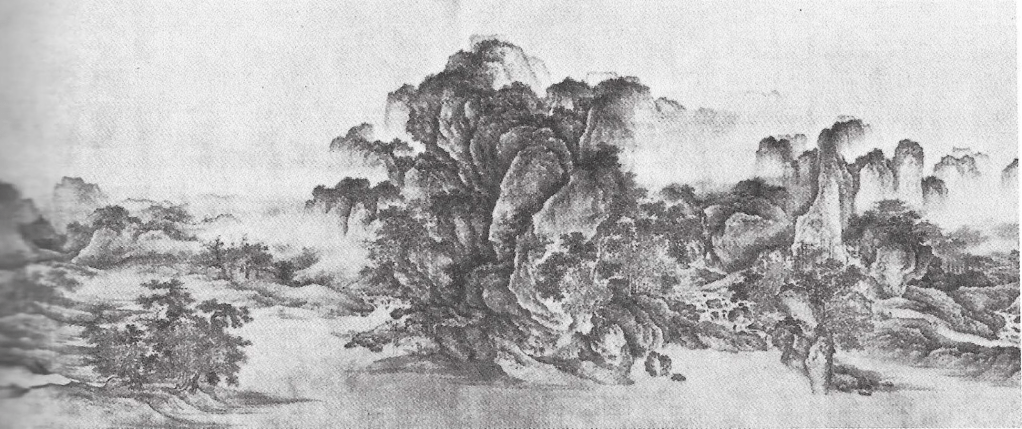
B&W Photograph.
“I built a thatch hut beneath tall pines
windows open on every side
all day I sit facing mountains
nothing else comes to mind.”3
Echoes and descriptions of this philosophy come down to us through a variety of writers, including Ernest Fenellosa, Ezra Pound, and several Beat Generation writers. Below is a section from Canto XLIX by Ezra Pound:
“For the seven lakes, and by no man these verses:
Rain; empty river; a voyage,
Fire from frozen cloud, heavy rain in the twilight
Under the cabin roof was one lantern.
The reeds are heavy; bent;
and the bamboos speak as if weeping.”4
Extending this poetic tradition, Gary Snyder’s translations and variations on the Cold Mountain poems by the hermit poet Hanshan elaborate on the poet’s relationship and feeling for nature. One major source of inspiration for Snyder was the great “Mountains and Rivers Without End” scroll which he saw in person at the Cleveland Museum of Art.
Continuing into the plastic realm, the painter Brice Marden, chose to use Matisse’s late drawing method of a brush filled with paint attached to an extension stick. Gestural paintings paralleling the images of a path coming down along a stream or a trail climbing up stairsteps and forks in the road were the central forms for his “Cold Mountain Series.”
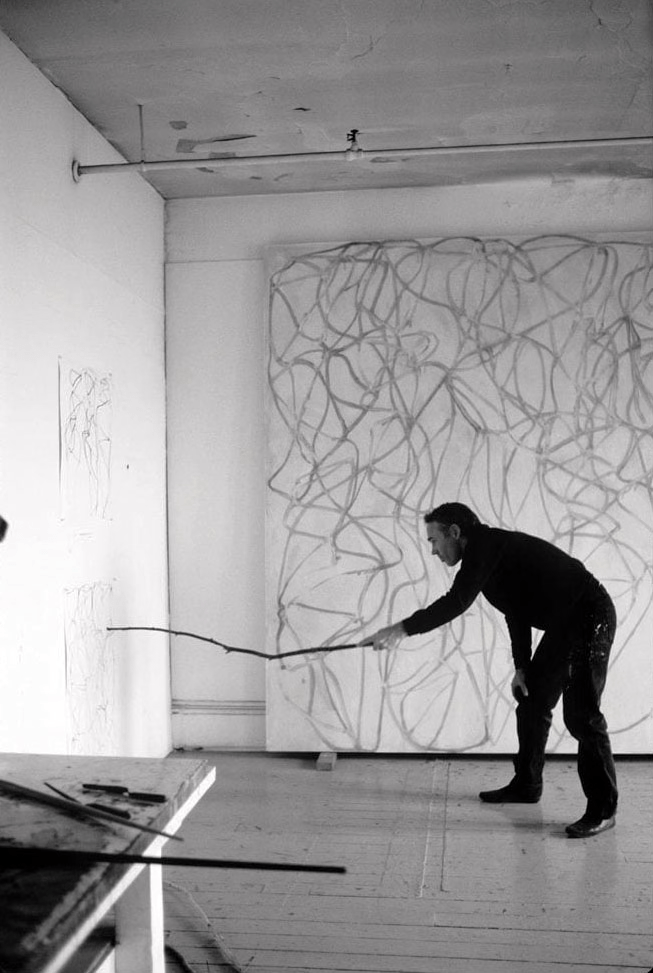
Photograph by David Seidner.
“The path comes down along a lowland stream
slips behind boulders and leafy hardwoods,
reappears in a pine grove,
no farms around, just tidy cottages and shelters,
gateways, rest stops, roofed but unwalled work space,
—a warm damp climate;
a trail of climbing stairsteps forks upstream.
Big ranges lurk behind these rugged little outcrops—
these spits of low ground rocky uplifts
layered pinnacles aslant,
flurries of brushy cliffs receding,
far back and high above, vague peaks.
A man hunched over, sitting on a log
another stands above him, lifts a staff,
a third, with a roll of mats or a lute, looks on;
a bit offshore two people in a boat.”5
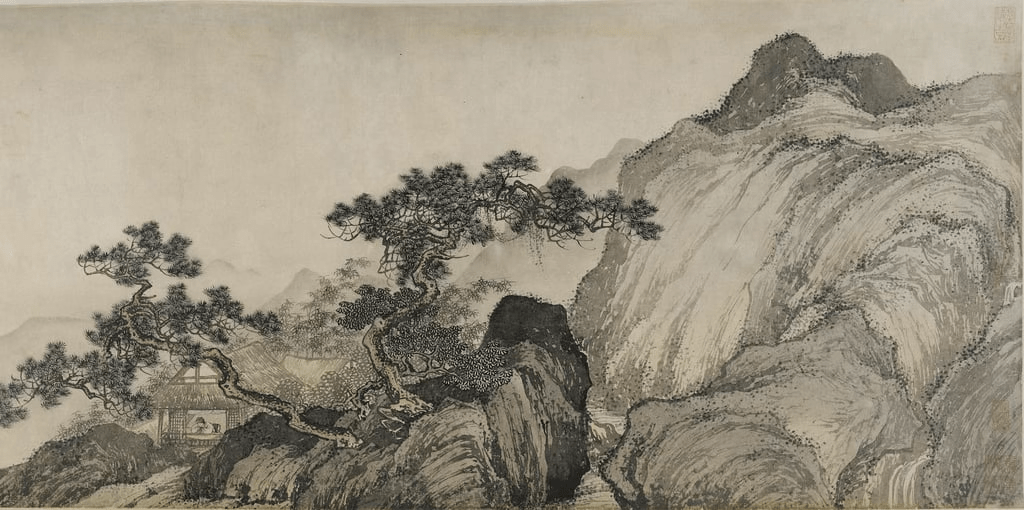
“The Thatched Hut of Dreaming of an Immortal” (DETAIL)
Early 16th Century, China
Ink and color on paper
29.6 cm x 682.1 cm
Freer Gallery of Art, Smithsonian Institution
Washington, DC.
“I built my hut on top of Hsia Summit
plowing and hoeing make up my day
half a dozen terraced fields
two or three hermit neighbors
I made a pond for the moon
and sell wood to buy grain
an old man with few schemes
I’ve told you all that I own.”6
These themes, inspired by the imagery from “Cold Mountain,” continued in the hands of more modern painters and poets. A letter from Henri Matisse, late in his life, to Mr. Henry Clifford, Director of the Philadelphia Museum of Art, expresses Matisse’s concern regarding younger artists who might mistake his work without going through the discipline necessary for the development of an artist.
Of the work of a mature artist, Matisse explained: “He will place it in accordance with a natural, unformulated and completely concealed drawing that will spring directly from his feeling; that which allowed Toulouse-Lautrec, at the end of his life, to exclaim, ‘At last, I no longer know how to draw.’”
“The painter who is just beginning thinks that he is painting from the heart. The artist who has completed his development also thinks that he is painting from the heart. Only the latter is right, because his training and his discipline allow him to accept impulses from within, which he can in part control.”7
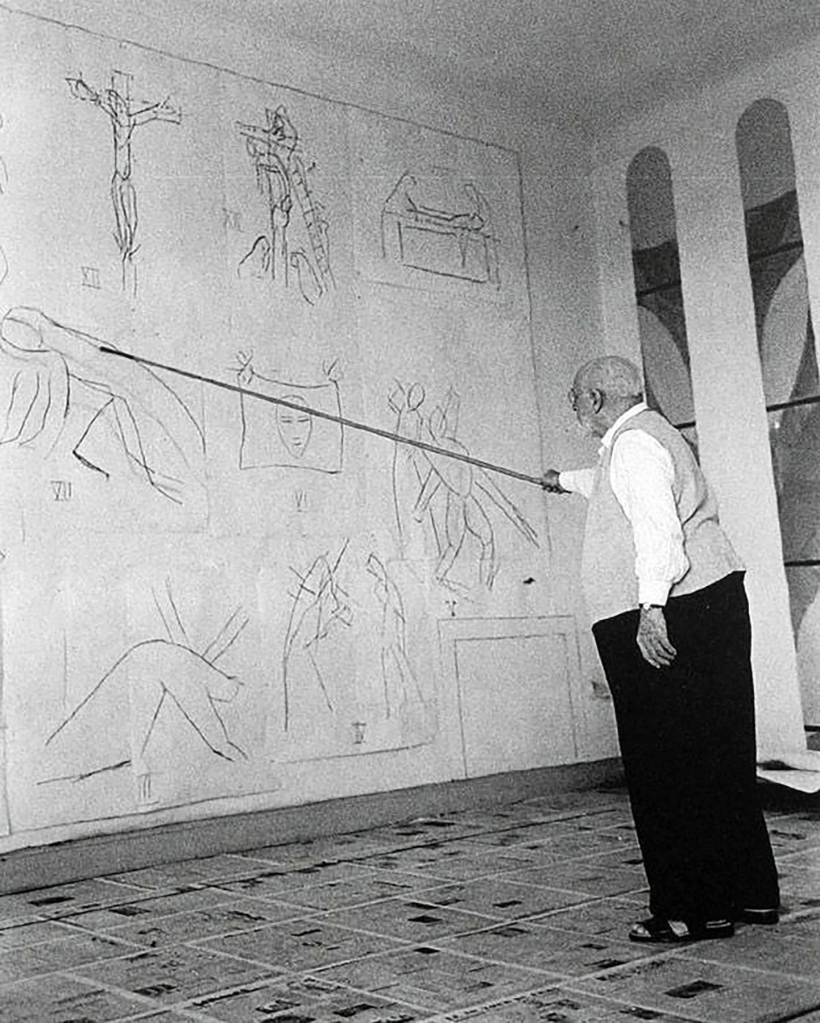
“The Stations of the Cross” for the Vence Chapel,
c. 1948-1950, Hotel Regina, Cimiez, France.
The later American artist, Brice Marden, took up Matisse’s challenge as well as the theme of “Cold Mountain” in an elegant and disciplined series from the 1980’s. Fluid pathways of ink come down along an abstract landscape, and leave a trail climbing upwards. With an entire foggy set of paths underneath.
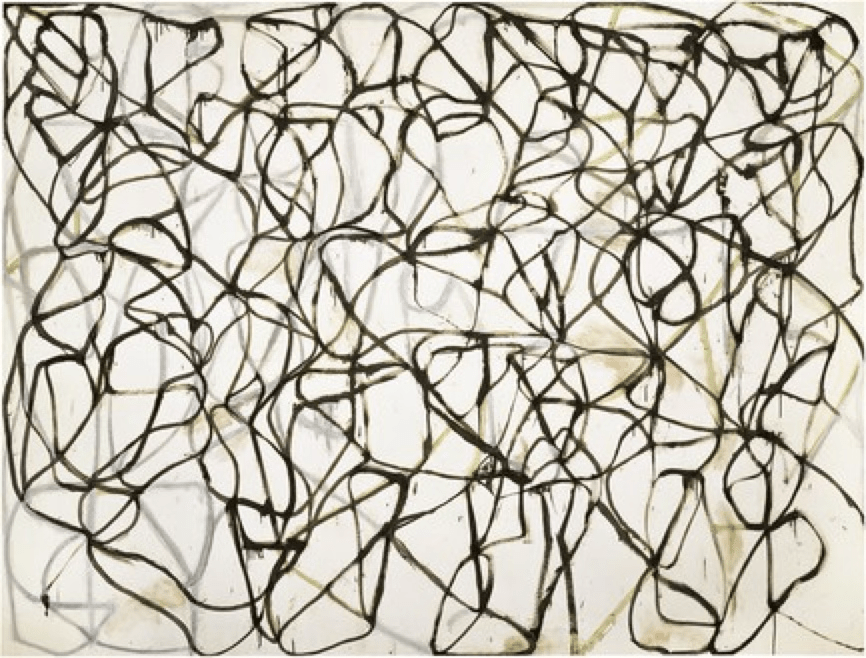
“Cold Mountain 6 (Bridge)”
1989-1991
Oil on linen
108” x 144”
San Francisco Museum of Modern Art
And finally, we come back to the original Zen saying but with an English folk rock twist: the song written and performed by Donovan Leitch, “There is a Mountain.”
“First there is a mountain, then there is no mountain, then there is. First there is a mountain, then there is no mountain, then there is.”
“Caterpillar sheds his skin to find a butterfly within.
Caterpillar sheds his skin to find a butterfly within.”8
1 Friedman, Martin; Bartlett Hayes and Charles Millard; Charles Sheeler; The National Collection of Fine Arts and the Smithsonian Institution Press; Washington, DC; 1968; p. 97.
2 Stonehouse; Translated by Red Pine; The Mountain poems of Stonehouse; Copper Canyon Press; Port Townsend, Washington; 2014; p. 57.
3 Stonehouse; Translated by Red Pine; The Mountain poems of Stonehouse; Copper Canyon Press; Port Townsend, Washington; 2014; p. 153.
4 Pound Ezra; The Cantos; New Directions Publishing Corporation; New York, New York; 1979; p.244.
5 Snyder, Gary; Mountains and Rivers Without End; Counterpoint; Washington, DC; 1996; p. 5.
6 Stonehouse; Translated by Red Pine; The Mountain poems of Stonehouse; Copper Canyon Press; Port Townsend, Washington; 2014; p. 199.
7 Flam, Jack, ed.; Matisse on Art; University of California Press; Berkeley and Los Angeles; 1995; p. 183.
8 Leitch, Donovan; “There is a Mountain” Audio Recording; Peermusic Publishing, Licensed by LyricFind; London, United Kingdom; 1967.

