“The importance of an artist is to be measured by the number of new signs he has introduced into the plastic language . . .”1
During the fall semester of 1964, my first year in art school, the Baltimore Museum of Art opened an exhibition titled “1914” in celebration of the 50th Anniversary of the museum’s founding: all of the work in this exhibition had been created in that year. It was such a special event and continues to hold a place in my memory.
In particular, the Matisse painting “A View of Notre Dame” was shocking and effectively changed how and what we saw. First and foremost, it is not flat! Many people see it at first as a flat wall, with possibly a window in the upper left corner. However, the view from Matisse’s studio window clearly shows the wall from his apartment building on the right, the River Seine with a bridge crossing it in the middle distance, and finally the overall form of Notre Dame in the distance, with the sign for a tree just in front of it.
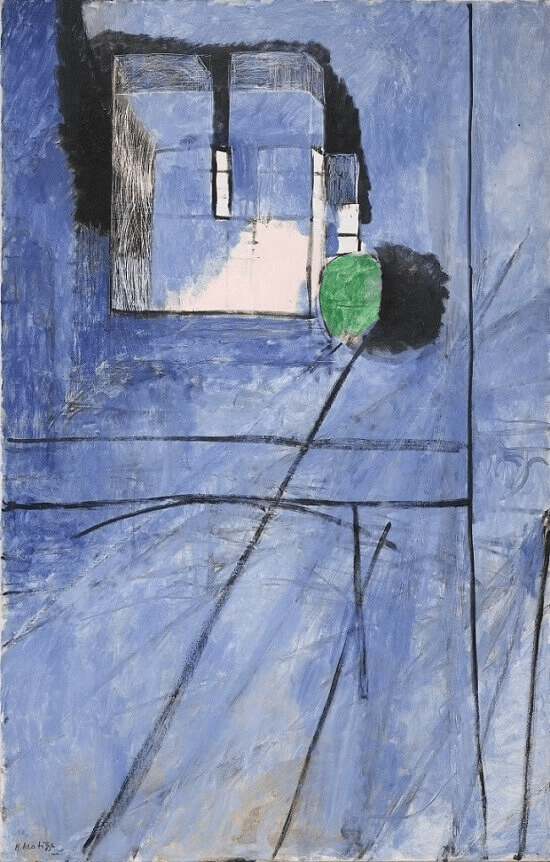
“View of Notre Dame”
1914
Oil on canvas
58” x 37 1/8”
Museum of Modern Art, New York
“In 1914, as in 1964, ‘today’ for one was not the same as ‘today’ for another. One neglects, the other attends the new. We see now, looking back, new doors were opened, some artists unfettered, new possibilities were seen, challenges made possible, the unfamiliar explored, and we recognize in the art of 1914 ourselves emerging.”2
During this time period Mr. Charles Parkhurst was the Director of the Baltimore Museum of Art and was primarily responsible for the “1914” exhibition. As many historians will remember, during World War II, he was also one of the Monuments Men who were in charge of the inventory and return of the many works of art that had been stolen by the Nazis. Beginning in 1943 they were acting as advisors on cultural resources and continued into 1946 when these duties were absorbed into other agencies.
From 1941 until Matisse’s death in 1953, the poet Louis Aragon and Henri Matisse were friends. Over these years, during ongoing conversations with Aragon, Matisse spoke of the importance of searching for his own personal signs for the many objects he was drawing and painting. And Aragon, for his part, spent nearly his last 30 years writing his book Henri Matisse a Novel!
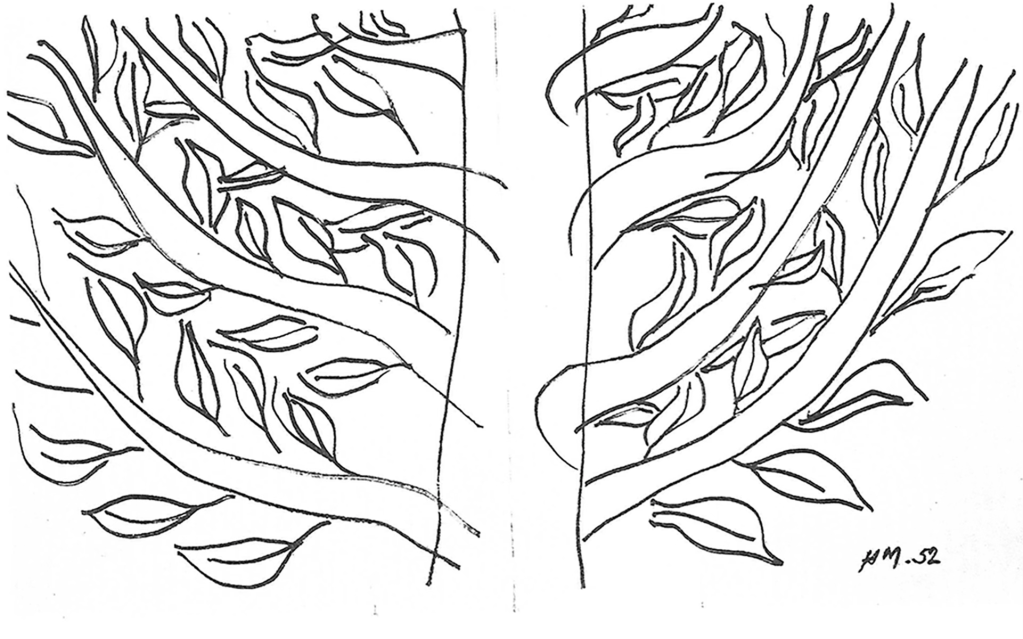
“Tree”
1952
Brush and ink over charcoal on paper
5’ 3” x 9’ 3 13/16”
Private Collection
“I have shown you, haven’t I these drawings I have been doing lately, learning to represent a tree, or trees? As if I’d never seen or drawn a tree. I can see one from my window. I have to learn, patiently, how the mass of the tree is made, then the tree itself, the trunk, the branches, the leaves. First the symmetrical way the branches are disposed on a single plane. Then the way the branches turn and cross in front of the trunk . . . Don’t misunderstand me: I don’t mean that, seeing the tree through me window, I work at copying it. The tree is also the sum total of its effects upon me. There’s no question of my drawing a tree that I see. I have before me an object that affects my mind not only as a tree but also in relation to all sorts of other feelings . . . I shan’t get free of my emotion by copying the tree faithfully, or by drawing its leaves one by one in the common language . . . But only after identifying myself with it. I have to create an object that resembles the tree. The sign for the tree, and not the sign that other artists may have found for the tree: those painters, for instance, who learned to represent foliage by drawing 33, 33, 33 . . . . This is the residuum of the expression of other artists. These others have invented their own sign.”3
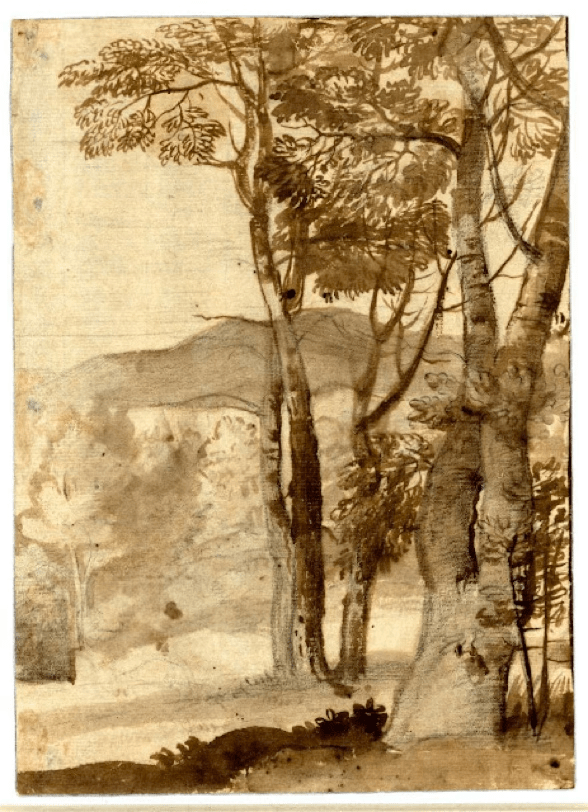
“Trees”
c1650
Ink wash drawing
The British Museum, London
United Kingdom
In further conversations with Aragon, Matisse continues this discussion: “. . . and the residuum of another’s expression can never be related to one’s own feeling. For instance: Claude Lorrain and Poussin have ways of their own of drawing the leaves of a tree, they have invented their own way of expressing those leaves. So cleverly that people say they have drawn their trees leaf by leaf. It’s just a manner of speaking: in fact they may have represented fifty leaves out of a total two thousand. But the way they place the sign that represents a leaf multiplies the leaves in the spectator’s mind so that he sees two thousand of them . . . They had their personal language. Other people have learned that language since then, so that I have to find signs that are related to the quality of my own invention. These will be new plastic signs, which in their turn will be absorbed into the common language if what I say by their means has any importance for other people . . .”4
In letters and discussions with the French poet Louis Aragon, Henri Matisse would often describe his working process. It was not one of copying or imitating, but rather one of searching or discovering. One of abstracting: of noticing how a single line could completely change our understanding: like so many young American tourists who come to realize the differences between the numbers “1” and “7” when written in Europe.
As for Matisse, early on he realized that numbers such as “2” and “3” or “8” could be used as a means in the process of abstracting. Of discovering or inventing signs. There is even a page of one of Matisse’s letters where he draws these numbers out in various configurations becoming noses and eye sockets, or upper and lower lips on the model.5
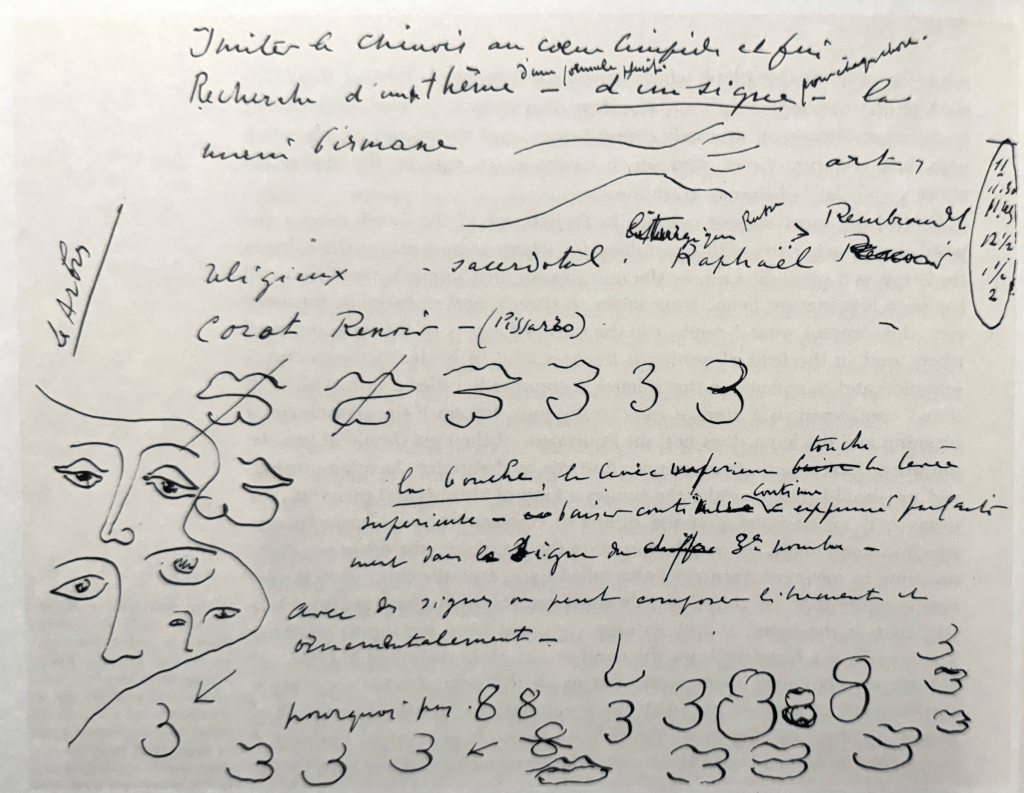
“Page from a letter by Henri Matisse to Louis Aragon”
16 February 1942
Pen and ink on paper
For some of the most insightful writing on Matisse, research and background, one can do no better then the two volume biography The Unknown Matisse and Matisse the Master by Hilary Spurling; the collection of Matisse’s own words, Matisse On Art as edited by Jack Flam; and finally, the two volume Henri Matisse a Novel by the surrealist poet Louis Aragon.
So I will conclude with a short passage from Spurling’s second volume on Matisse, wherein he reflects upon his later work:
“Matisse was operating literally as well as metaphysically on the borders of perception. ‘I’m out of action because of having flirted for too long, more or less nonstop, with these enchanted colours,’ he had written to André Rouveyre at the end of 1943, when the paper cut-outs he made for Jazz brought his lifelong confrontation with colour to a climax. His Nice oculist (who had treated Monet in his last years in Paris) explained that the eye could not fabricate pigment fast enough to keep up with the speed and intensity of Matisse’s response to colour. The painter said he had achieved the same intensity before without being able to sustain it, like a juggler throwing his clubs so high he couldn’t catch them (‘I was perfectly capable of pinning down on canvas the colours that give me relief . . . but I had no way of keeping them at that pitch’).6
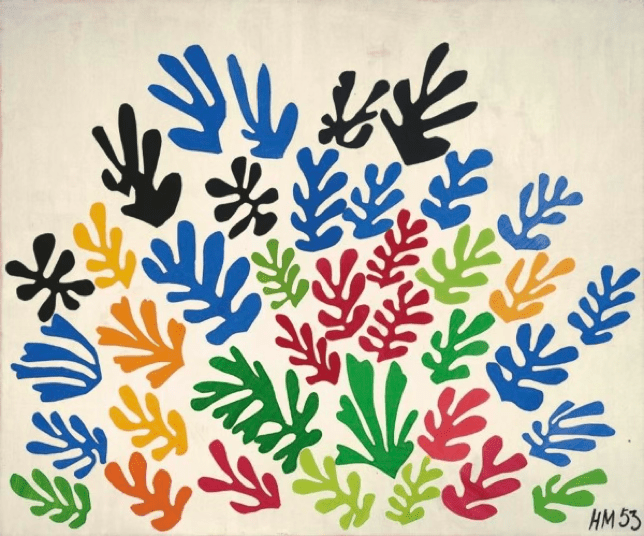
“The Sheaf”
1953
Gouache on paper, cut an pasted, on paper.
115 3/4” x 137 3/4”
Hammer Museum, University of California
Los Angeles, California
1 Flam, Jack, editor; Matisse on Art; University of California Press; Berkeley and Los Angeles, California; 1995; p. 150.
2 Parkhurst, Charles, et al; 1914: An Exhibition of Paintings, Drawings and Sculpture; The Baltimore Museum of Art; Baltimore, Maryland; 1964; p. 7.
3 Flam, Jack, editor; Matisse on Art; University of California Press; Berkeley and Los Angeles, California; 1995; p. 149.
4 Flam, Jack, editor; Matisse on Art; University of California Press; Berkeley and Los Angeles, California; 1995; pp. 149-150.
5 Aragon, Louis; Jean Stewart, Translator; Henri Matisse a novel; Two Volumes; Harcourt Brace Jovanovich, Inc.; New York, New York; 1971-1972; vol. 1, p. 150.
6 Spurling, Hilary; Matisse the Master; Alfred A. Knopf; New York, New York; 2005; pp. 427-428.


Really enjoyed reading this!
Merci!
LikeLike