“To a man who knows, Mountains are Mountains, Waters are Waters, and Trees are Trees. But when he has studied and knows a little, Mountains are no longer Mountains, Waters no longer Waters, and Trees no longer Trees. But when he has thoroughly understood, Mountains are again Mountains, Waters are Waters, and Trees are Trees.”1
These were certain types of hermit monks: poets, calligraphers and painters living in isolated mountains and at peace. Their Zen philosophy is evidenced in all of their works, both paintings and poems. However it was surprising for me to discover this very Zen statement not in historic writing, but from the American artist Charles Sheeler as he wrote in his journal known as the Black Book.
Originally formulated by the master Ch’ing-yuan Hsing-ssu it states: “Thirty years ago, before I began practicing Zen, I saw mountains as simply mountains. Then, while I was practicing Zen, I realized mountains were not mountains. But now that I understand Zen, I see mountains are simply mountains.”2
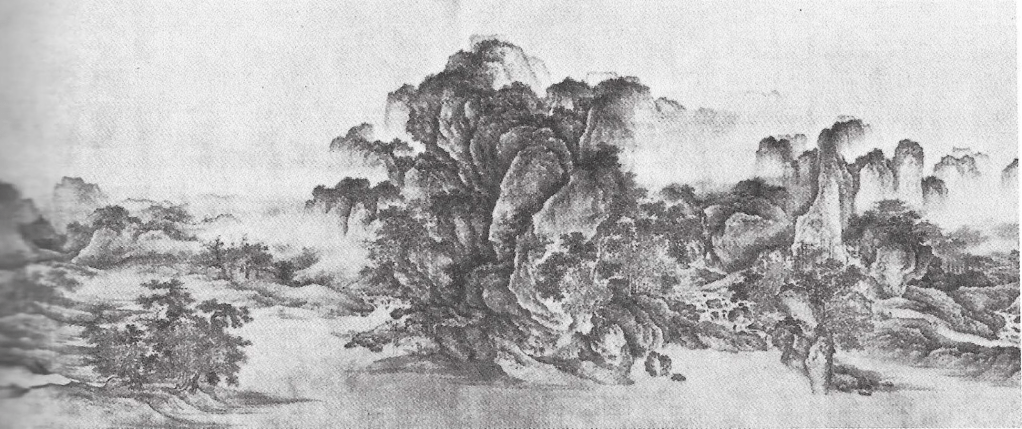
Anonymous “Streams and Mountains Without End” Early 12th century, China, Northern Sung Dynasty, Handscroll, ink and slight color on silk 13 13/16” x 83 7/8” The Cleveland Museum of Art, Cleveland, Ohio.DETAIL of the above image B&W Photograph.
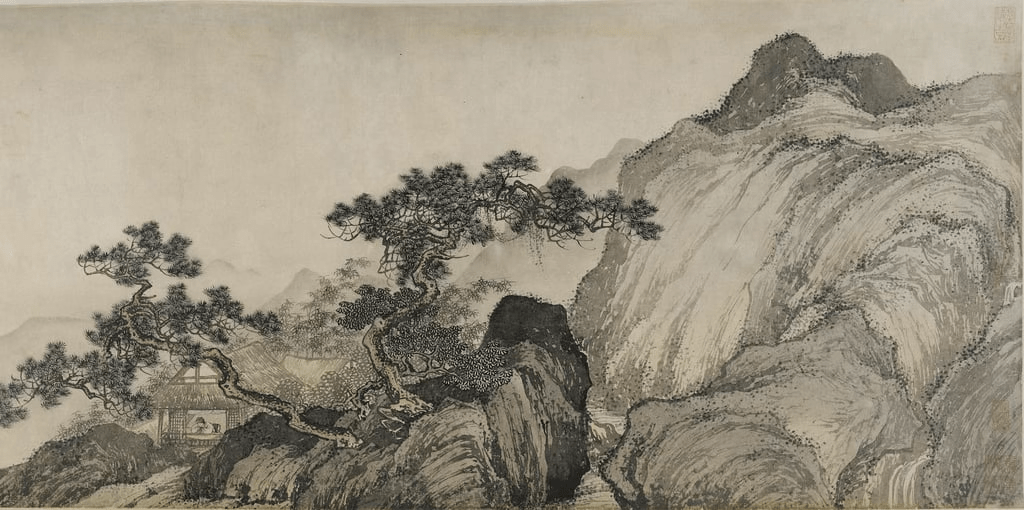
“I built a thatch hut beneath tall pines windows open on every side all day I sit facing mountains nothing else comes to mind.”3
Echoes and descriptions of this philosophy come down to us through a variety of writers, including Ernest Fenellosa, Ezra Pound, and several Beat Generation writers. Below is a section from Canto XLIX by Ezra Pound:
“For the seven lakes, and by no man these verses: Rain; empty river; a voyage, Fire from frozen cloud, heavy rain in the twilight Under the cabin roof was one lantern. The reeds are heavy; bent; and the bamboos speak as if weeping.”4
Extending this poetic tradition, Gary Snyder’s translations and variations on the Cold Mountain poems by the hermit poet Hanshan elaborate on the poet’s relationship and feeling for nature. One major source of inspiration for Snyder was the great “Mountains and Rivers Without End” scroll which he saw in person at the Cleveland Museum of Art.
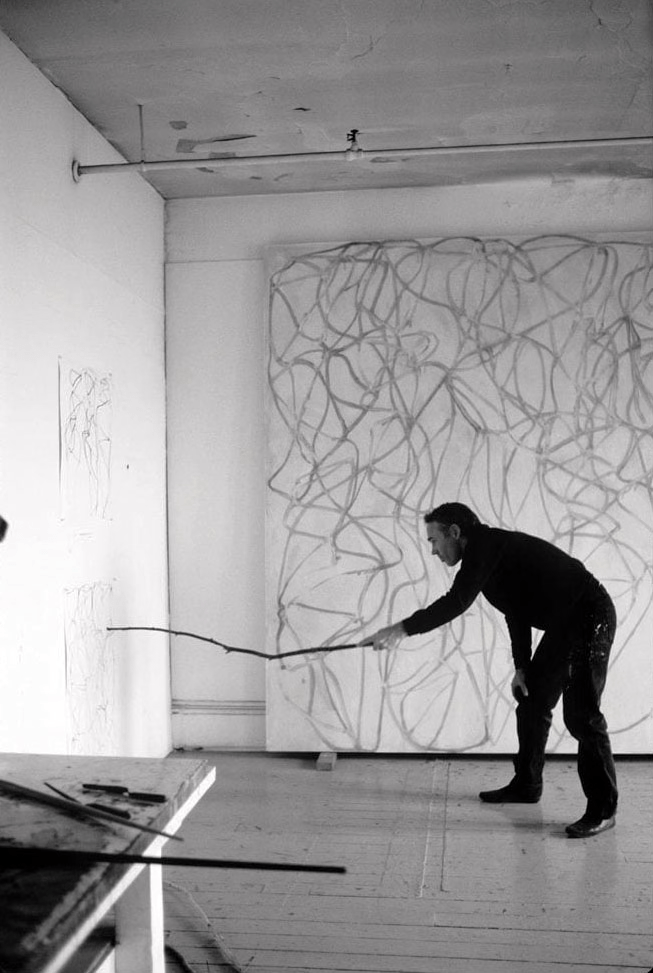
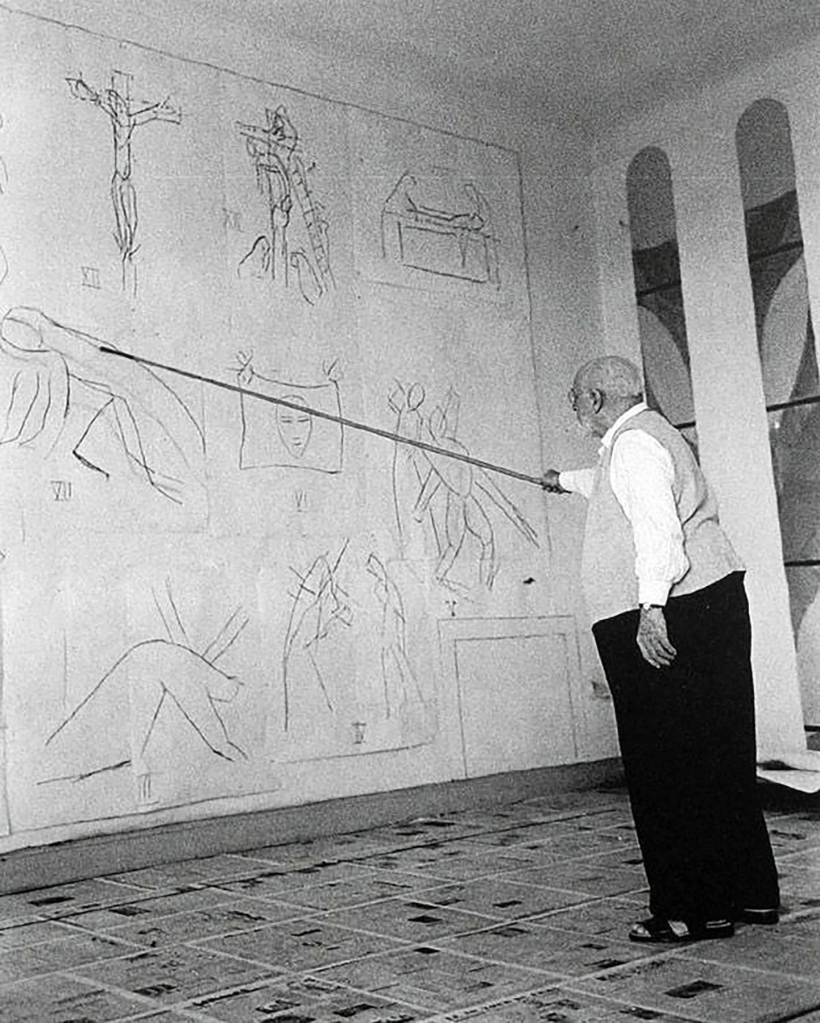
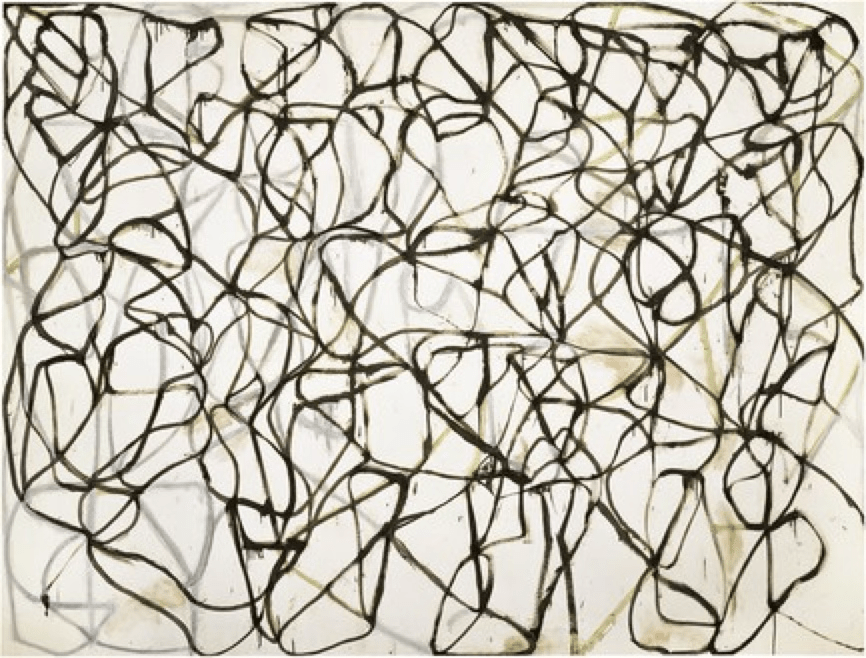
Continuing into the plastic realm, the painter Brice Marden, chose to use Matisse’s late drawing method of a brush filled with paint attached to an extension stick. Gestural paintings paralleling the images of a path coming down along a stream or a trail climbing up stairsteps and forks in the road were the central forms for his “Cold Mountain Series.”
Brice Marden working on his “Cold Mountain Series” Photograph by David Seidner.
“The path comes down along a lowland stream slips behind boulders and leafy hardwoods, reappears in a pine grove,
no farms around, just tidy cottages and shelters, gateways, rest stops, roofed but unwalled work space, —a warm damp climate;
a trail of climbing stairsteps forks upstream. Big ranges lurk behind these rugged little outcrops— these spits of low ground rocky uplifts layered pinnacles aslant, flurries of brushy cliffs receding, far back and high above, vague peaks. A man hunched over, sitting on a log another stands above him, lifts a staff, a third, with a roll of mats or a lute, looks on; a bit offshore two people in a boat.”5
Tang Yin “The Thatched Hut of Dreaming of an Immortal” (DETAIL) Early 16th Century, China Ink and color on paper 29.6 cm x 682.1 cm Freer Gallery of Art, Smithsonian Institution Washington, DC.
“I built my hut on top of Hsia Summit plowing and hoeing make up my day half a dozen terraced fields two or three hermit neighbors I made a pond for the moon and sell wood to buy grain an old man with few schemes I’ve told you all that I own.”6
These themes, inspired by the imagery from “Cold Mountain,” continued in the hands of more modern painters and poets. A letter from Henri Matisse, late in his life, to Mr. Henry Clifford, Director of the Philadelphia Museum of Art, expresses Matisse’s concern regarding younger artists who might mistake his work without going through the discipline necessary for the development of an artist.
Of the work of a mature artist, Matisse explained: “He will place it in accordance with a natural, unformulated and completely concealed drawing that will spring directly from his feeling; that which allowed Toulouse-Lautrec, at the end of his life, to exclaim, ‘At last, I no longer know how to draw.’”
“The painter who is just beginning thinks that he is painting from the heart. The artist who has completed his development also thinks that he is painting from the heart. Only the latter is right, because his training and his discipline allow him to accept impulses from within, which he can in part control.”7
Henri Matisse working on the design for “The Stations of the Cross” for the Vence Chapel, c. 1948-1950, Hotel Regina, Cimiez, France.
The later American artist, Brice Marden, took up Matisse’s challenge as well as the theme of “Cold Mountain” in an elegant and disciplined series from the 1980’s. Fluid pathways of ink come down along an abstract landscape, and leave a trail climbing upwards. With an entire foggy set of paths underneath.
Brice Marden “Cold Mountain 6 (Bridge)” 1989-1991 Oil on linen 108” x 144” San Francisco Museum of Modern Art
And finally, we come back to the original Zen saying but with an English folk rock twist: the song written and performed by Donovan Leitch, “There is a Mountain.”
“First there is a mountain, then there is no mountain, then there is. First there is a mountain, then there is no mountain, then there is.”
“Caterpillar sheds his skin to find a butterfly within. Caterpillar sheds his skin to find a butterfly within.”8
1 Friedman, Martin; Bartlett Hayes and Charles Millard; Charles Sheeler; The National Collection of Fine Arts and the Smithsonian Institution Press; Washington, DC; 1968; p. 97.
2 Stonehouse; Translated by Red Pine; The Mountain poems of Stonehouse; Copper Canyon Press; Port Townsend, Washington; 2014; p. 57.
3 Stonehouse; Translated by Red Pine; The Mountain poems of Stonehouse; Copper Canyon Press; Port Townsend, Washington; 2014; p. 153.
4 Pound Ezra; The Cantos; New Directions Publishing Corporation; New York, New York; 1979; p.244.
5 Snyder, Gary; Mountains and Rivers Without End; Counterpoint; Washington, DC; 1996; p. 5.
6 Stonehouse; Translated by Red Pine; The Mountain poems of Stonehouse; Copper Canyon Press; Port Townsend, Washington; 2014; p. 199.
7 Flam, Jack, ed.; Matisse on Art; University of California Press; Berkeley and Los Angeles; 1995; p. 183.
8 Leitch, Donovan; “There is a Mountain” Audio Recording; Peermusic Publishing, Licensed by LyricFind; London, United Kingdom; 1967.
“The importance of an artist is to be measured by the number of new signs he has introduced into the plastic language . . .”1
During the fall semester of 1964, my first year in art school, the Baltimore Museum of Art opened an exhibition titled “1914” in celebration of the 50th Anniversary of the museum’s founding: all of the work in this exhibition had been created in that year. It was such a special event and continues to hold a place in my memory.
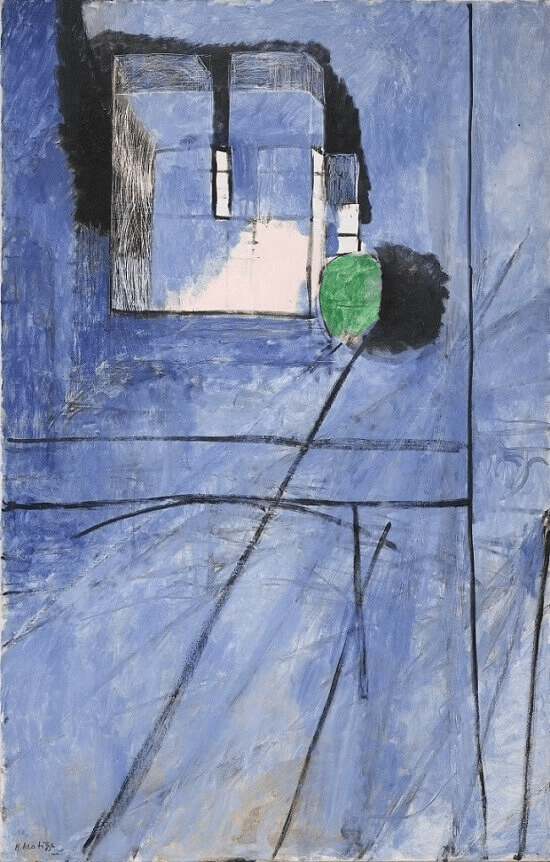
In particular, the Matisse painting “A View of Notre Dame” was shocking and effectively changed how and what we saw. First and foremost, it is not flat! Many people see it at first as a flat wall, with possibly a window in the upper left corner. However, the view from Matisse’s studio window clearly shows the wall from his apartment building on the right, the River Seine with a bridge crossing it in the middle distance, and finally the overall form of Notre Dame in the distance, with the sign for a tree just in front of it.
Henri Matisse “View of Notre Dame” 1914 Oil on canvas 58” x 37 1/8” Museum of Modern Art, New York
“In 1914, as in 1964, ‘today’ for one was not the same as ‘today’ for another. One neglects, the other attends the new. We see now, looking back, new doors were opened, some artists unfettered, new possibilities were seen, challenges made possible, the unfamiliar explored, and we recognize in the art of 1914 ourselves emerging.”2
During this time period Mr. Charles Parkhurst was the Director of the Baltimore Museum of Art and was primarily responsible for the “1914” exhibition. As many historians will remember, during World War II, he was also one of the Monuments Men who were in charge of the inventory and return of the many works of art that had been stolen by the Nazis. Beginning in 1943 they were acting as advisors on cultural resources and continued into 1946 when these duties were absorbed into other agencies.
From 1941 until Matisse’s death in 1953, the poet Louis Aragon and Henri Matisse were friends. Over these years, during ongoing conversations with Aragon, Matisse spoke of the importance of searching for his own personal signs for the many objects he was drawing and painting. And Aragon, for his part, spent nearly his last 30 years writing his book Henri Matisse a Novel!
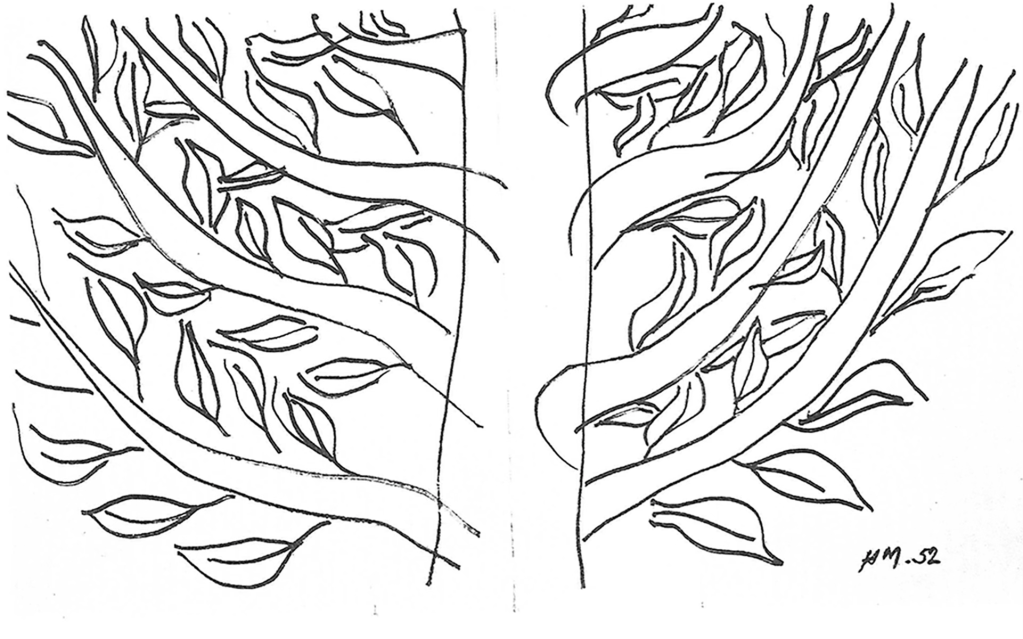
Henri Matisse “Tree” 1952 Brush and ink over charcoal on paper 5’ 3” x 9’ 3 13/16” Private Collection
“I have shown you, haven’t I these drawings I have been doing lately, learning to represent a tree, or trees? As if I’d never seen or drawn a tree. I can see one from my window. I have to learn, patiently, how the mass of the tree is made, then the tree itself, the trunk, the branches, the leaves. First the symmetrical way the branches are disposed on a single plane. Then the way the branches turn and cross in front of the trunk . . . Don’t misunderstand me: I don’t mean that, seeing the tree through me window, I work at copying it. The tree is also the sum total of its effects upon me. There’s no question of my drawing a tree that I see. I have before me an object that affects my mind not only as a tree but also in relation to all sorts of other feelings . . . I shan’t get free of my emotion by copying the tree faithfully, or by drawing its leaves one by one in the common language . . . But only after identifying myself with it. I have to create an object that resembles the tree. The sign for the tree, and not the sign that other artists may have found for the tree: those painters, for instance, who learned to represent foliage by drawing 33, 33, 33 . . . . This is the residuum of the expression of other artists. These others have invented their own sign.”3
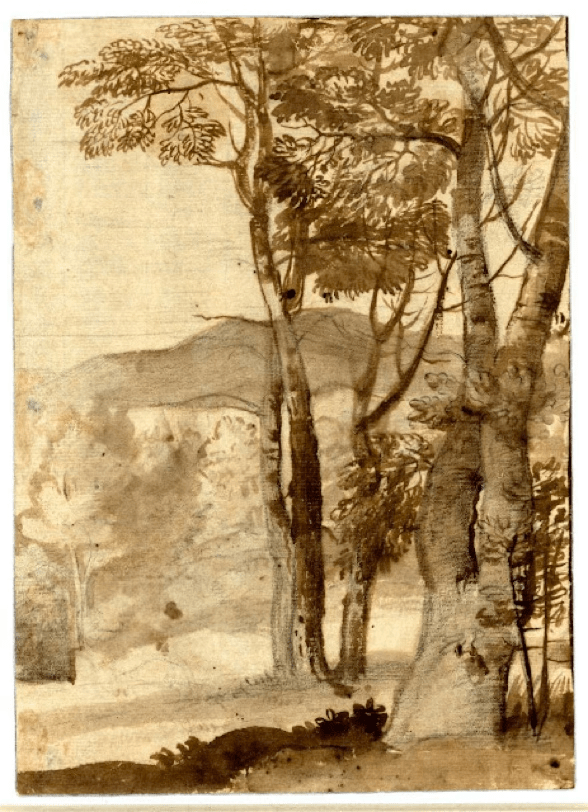
Claude Lorrain “Trees” c1650 Ink wash drawing The British Museum, London United Kingdom
In further conversations with Aragon, Matisse continues this discussion: “. . . and the residuum of another’s expression can never be related to one’s own feeling. For instance: Claude Lorrain and Poussin have ways of their own of drawing the leaves of a tree, they have invented their own way of expressing those leaves. So cleverly that people say they have drawn their trees leaf by leaf. It’s just a manner of speaking: in fact they may have represented fifty leaves out of a total two thousand. But the way they place the sign that represents a leaf multiplies the leaves in the spectator’s mind so that he sees two thousand of them . . . They had their personal language. Other people have learned that language since then, so that I have to find signs that are related to the quality of my own invention. These will be new plastic signs, which in their turn will be absorbed into the common language if what I say by their means has any importance for other people . . .”4
In letters and discussions with the French poet Louis Aragon, Henri Matisse would often describe his working process. It was not one of copying or imitating, but rather one of searching or discovering. One of abstracting: of noticing how a single line could completely change our understanding: like so many young American tourists who come to realize the differences between the numbers “1” and “7” when written in Europe.
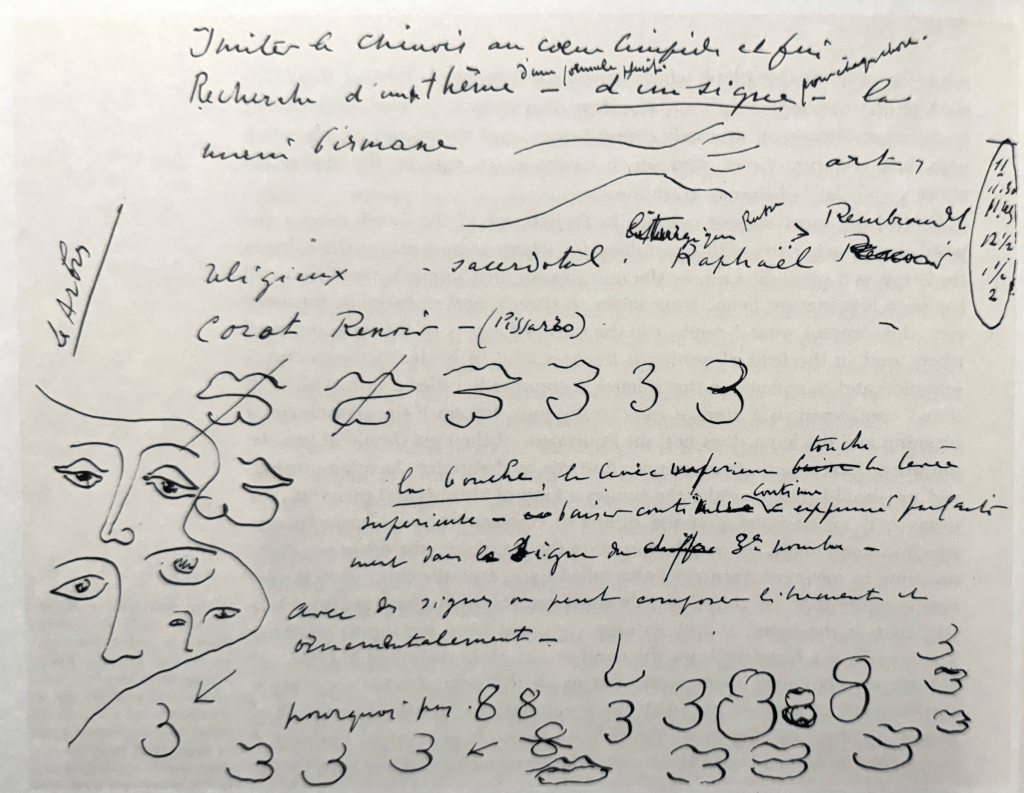
As for Matisse, early on he realized that numbers such as “2” and “3” or “8” could be used as a means in the process of abstracting. Of discovering or inventing signs. There is even a page of one of Matisse’s letters where he draws these numbers out in various configurations becoming noses and eye sockets, or upper and lower lips on the model.5
Henri Matisse “Page from a letter by Henri Matisse to Louis Aragon” 16 February 1942 Pen and ink on paper
For some of the most insightful writing on Matisse, research and background, one can do no better then the two volume biography The Unknown Matisse and Matisse the Master by Hilary Spurling; the collection of Matisse’s own words, Matisse On Art as edited by Jack Flam; and finally, the two volume Henri Matisse a Novel by the surrealist poet Louis Aragon.
So I will conclude with a short passage from Spurling’s second volume on Matisse, wherein he reflects upon his later work:
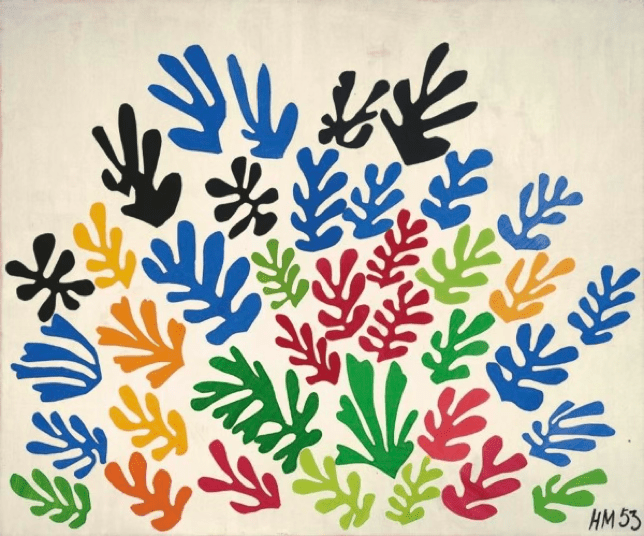
“Matisse was operating literally as well as metaphysically on the borders of perception. ‘I’m out of action because of having flirted for too long, more or less nonstop, with these enchanted colours,’ he had written to André Rouveyre at the end of 1943, when the paper cut-outs he made for Jazz brought his lifelong confrontation with colour to a climax. His Nice oculist (who had treated Monet in his last years in Paris) explained that the eye could not fabricate pigment fast enough to keep up with the speed and intensity of Matisse’s response to colour. The painter said he had achieved the same intensity before without being able to sustain it, like a juggler throwing his clubs so high he couldn’t catch them (‘I was perfectly capable of pinning down on canvas the colours that give me relief . . . but I had no way of keeping them at that pitch’).6
Henri Matisse “The Sheaf” 1953 Gouache on paper, cut an pasted, on paper. 115 3/4” x 137 3/4” Hammer Museum, University of California Los Angeles, California
1 Flam, Jack, editor; Matisse on Art; University of California Press; Berkeley and Los Angeles, California; 1995; p. 150.
2 Parkhurst, Charles, et al; 1914: An Exhibition of Paintings, Drawings and Sculpture; The Baltimore Museum of Art; Baltimore, Maryland; 1964; p. 7.
3 Flam, Jack, editor; Matisse on Art; University of California Press; Berkeley and Los Angeles, California; 1995; p. 149.
4 Flam, Jack, editor; Matisse on Art; University of California Press; Berkeley and Los Angeles, California; 1995; pp. 149-150.
5 Aragon, Louis; Jean Stewart, Translator; Henri Matisse a novel; Two Volumes; Harcourt Brace Jovanovich, Inc.; New York, New York; 1971-1972; vol. 1, p. 150.
6 Spurling, Hilary; Matisse the Master; Alfred A. Knopf; New York, New York; 2005; pp. 427-428.
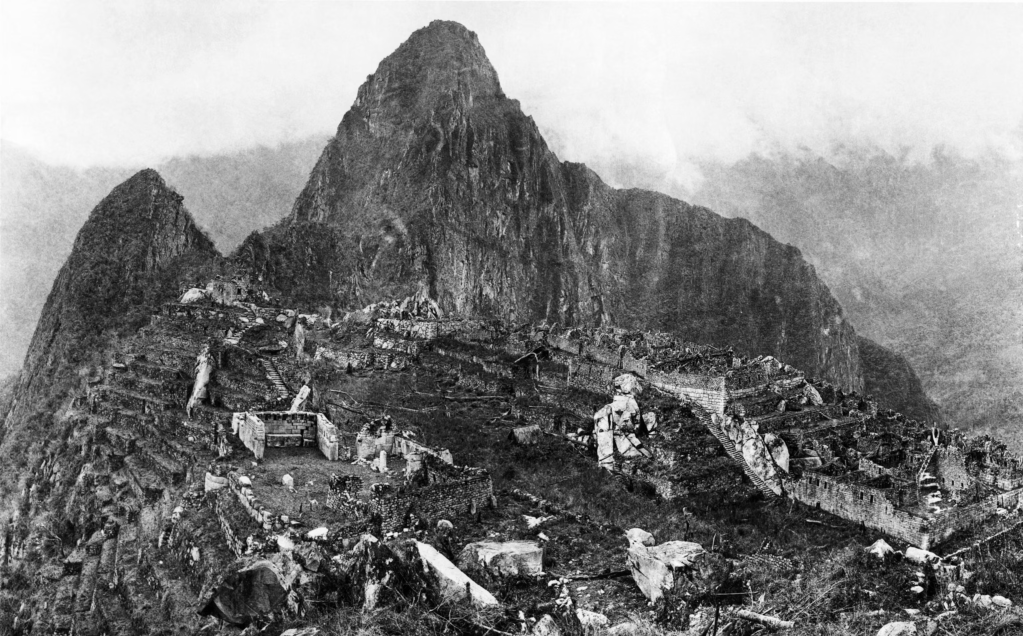
“The sanctuary was lost for centuries because this ridge is in the most inaccessible corner of the most inaccessible section of the central Andes. No part of the highlands of Peru is better defended by natural bulwarks—a stupendous canyon whose rock is granite, and whose precipices are frequently 1,000 feet sheer, presenting difficulties which daunt the most ambitious modern mountain climbers. Yet, here, in a remote part of the canyon on this narrow ridge flanked by tremendous precipices, a highly civilized people, artistic, inventive, well organized, and capable of sustained endeavor, at some time in the distant past built themselves a sanctuary for the worship of the sun.”1
Hiram Bingham “The story of Machu Picchu: the Peruvian expeditions of the National Geographic Society and Yale University” B&W photograph National Geographic Magazine, v. 27, Feb. 1915: p. 172.
Here are the observations and notations of Hiram Bingham upon his re-discovery of Machu Picchu through a series of expeditions, the first one sponsored by Yale University and the following ones by the National Geographic Society. Although the native Peruvian people had known of this place for years, many had already migrated into the area in and around Cusco. Bingham was able to hire a few guides and assistants for his explorations on each trip, and he kept very thorough journals and records, including photographs.
On our recent tour in late October 2025 we flew from Lima over the Andes and then down into the Sacred Valley and the city of Cusco. From there, a series of train rides and buses delivered us to the great city of Machu Picchu.
It truly felt like ancient footprints were everywhere, especially since many of the stairs were carved out of the living rock. Unfortunately hardly any two steps were of the same proportion or height. Using our hiking sticks and keeping our eyes on the path, we warned each other of rocks in the pathway and uneven steps, which often occurred when least expected.
It was only after climbing several sets of steep steps, keeping our eyes on both the walls and steps, that the views opened up on a larger plain and the surrounding structures.
There are many examples of literature inspired directly from this work of art, the great architectural site of Machu Picchu. The first of course is from Hiram Bingham’s direct observations following his re-discovery of this site in 1911-1912. Many others are more modern. Because of the three different languages spoken locally, Quechua, Aymara and Spanish, I have left the various spellings intact, so the mistaken names of some locations and the name Machu or Macchu are quoted as in the originals. These are not misspellings.
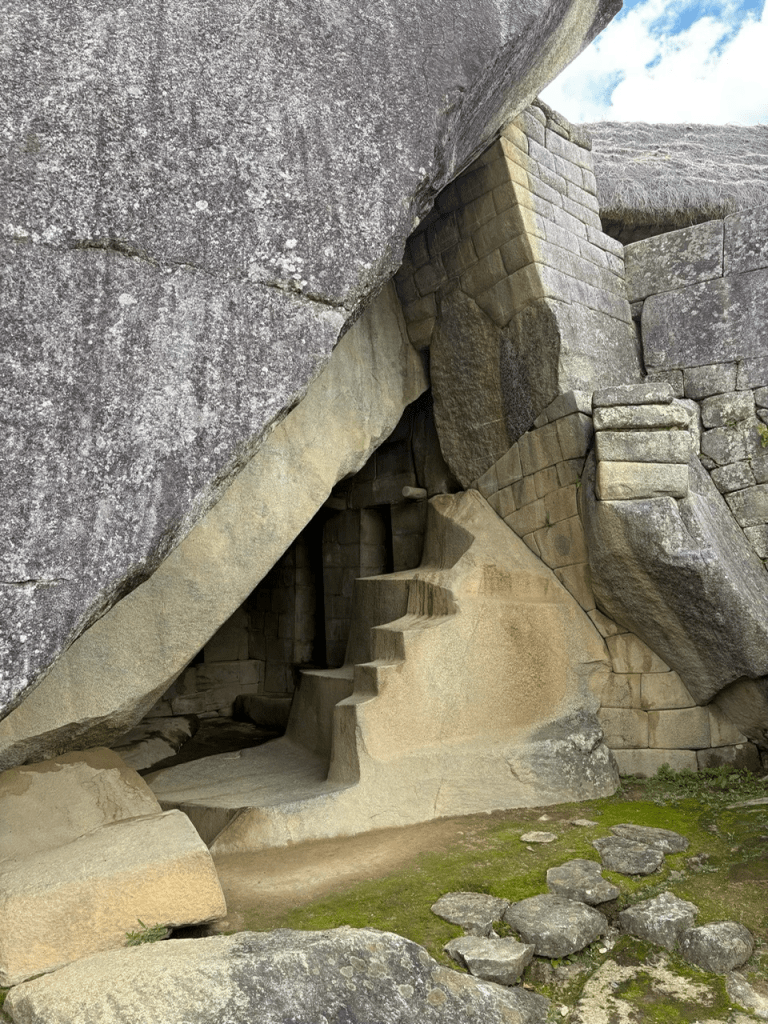
“Suddenly I found myself confronted with the walls of ruined houses built of the finest quality of Inca stone work. It was hard to see them for they were covered with trees and moss, the growth of centuries, but in the dense shadow, hiding in bamboo thickets and tangled vines, appeared here and there walls of white granite ashlars carefully cut and exquisitely fitted together. We scrambled along through the dense undergrowth, climbing over terrace walls and in bamboo thickets, where our guide found it easier than I did. Suddenly, without any warning, under a huge overhanging ledge the boy showed me a cave beautifully lined with the finest cut stone. It had evidently been a royal mausoleum. On top of this particular ledge was a semicircular building whose outer wall, gently sloping and slightly curved, bore a striking resemblance to the famous Temple of the Sun in Cuzco. This might also be a temple of the sun. It followed the natural curvature of the rock and was keyed to it by one of the finest examples of masonry I had ever seen. Further it was tied into another beautiful wall, made of very carefully matched ashlars of pure white granite, especially selected for its fine grain. Clearly, it was the work of a master artist. . . .”2
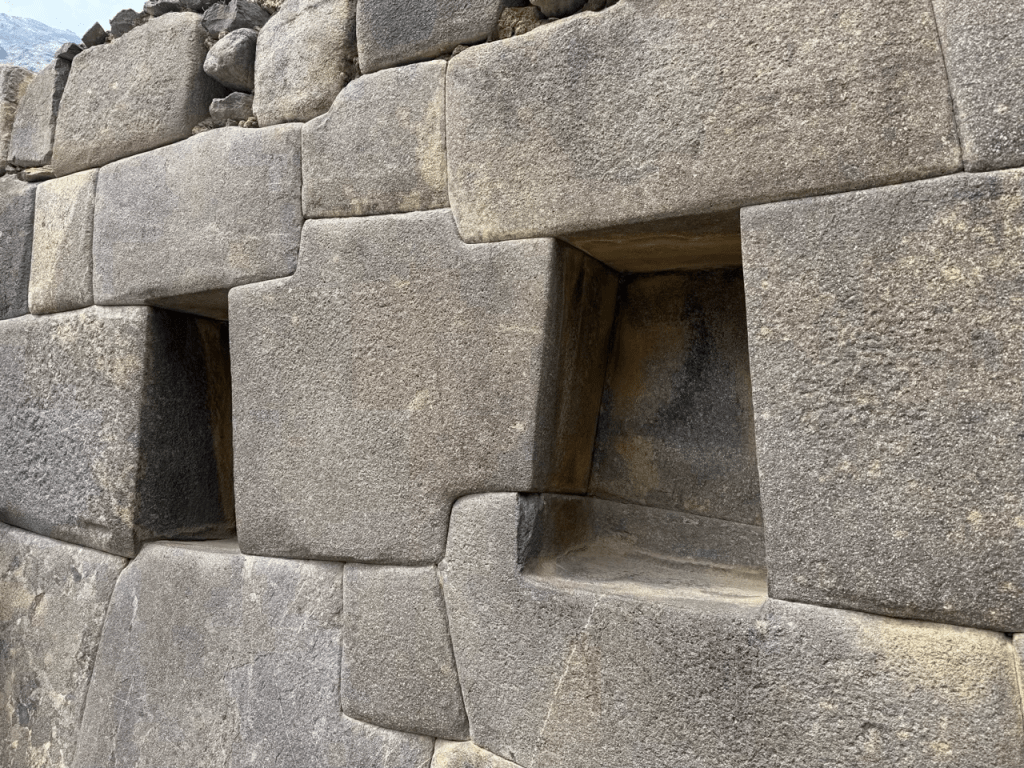
Tom Lundberg “The Inca Wall at Ollantaytambo, near Machu Picchu, Peru” 2025 Digital photograph
“. . . . The interior surface of the wall was broken by niches and square stone-pegs. The exterior surface was perfectly simple and unadorned. The lower courses, of particularly large ashlars, gave it a look of solidity. The upper courses, diminishing in size towards the top, lent grace and delicacy to the structure. The flowing lines, the symmetrical arrangement of the ashlars, and the gradual graduation of the courses, combined to produce a wonderful effect, softer and more pleasing than that of the marble temples of the Old World. Owing to the absence of mortar, there were no ugly spaces between the rocks. They might have grown together. On account of the beauty of the white granite this structure surpassed in attractiveness the best Inca walls in Cuzco, which had caused visitors to marvel for four centuries. It seemed like an unbelievable dream. Dimly, I began to realize that this wall and its adjoining semicircular temple over the cave were as fine as the finest stonework in the world.”3
Surprisingly, the second example is from a novel which is set in Machu Picchu by Mark Adams. In this novel, we have an editor/explorer and his colleagues in search of an adventure and comically retracing the journey of Hiram Bingham. As a footnote to all of this, there is the ironic possibility that a modern day cinema legend may have actually been based on Hiram Bingham.
“There’s an old kitchen maxim that squid should either be cooked for two minutes or two hours. A similar rule could be applied to Machu Picchu. With a good guide—there are dozens of them lingering by the front entrance—a visitor who’s short on time can see the highlights of Machu Picchu in two hours. A visit of two days, though, allows enough time to take in the site’s full majesty. Our plan was to devote one day to retracing Bingham’s 1911 footsteps, and a second to seeing some parts of the site that most people never get to.”4
“As a magazine editor, I knew the revised version of Bingham’s tale had the makings of a great story: hero adventurer exposed as villainous fraud. To get a clearer idea of what had really happened on that mountaintop in 1911, I took a day off and rode the train up to Yale. I spent hours in the library, leafing through Bingham’s leather-coated notebook in which Bingham had penciled his first impressions of Machu Picchu, any thoughts of the controversies fell away. Far more interesting was the story of how he had gotten to Machu Picchu in the first place. I’d heard that Bingham had inspired the character Indiana Jones, a connection that was mentioned—without much evidence—in almost every news story about the explorer in the last twenty years. Sitting in the neo-Gothic splendor of Yale’s Rare Books and Manuscripts Room, the Indy-Bingham connection made sense for the first time. Bingham’s search had been a geographic detective story, one that began as a hunt for the Lost City of the Incas but grew into an all-consuming attempt to solve the mystery of why such a spectacular granite city had been built in such a spellbinding location: high on a secluded mountain ridge, in the misty subtropical zone where the Andes meet the Amazon. Fifty years after Bingham’s death, the case had been reopened. And the clues were still out there to be examined by anyone with strong legs and a large block of vacation time.”5
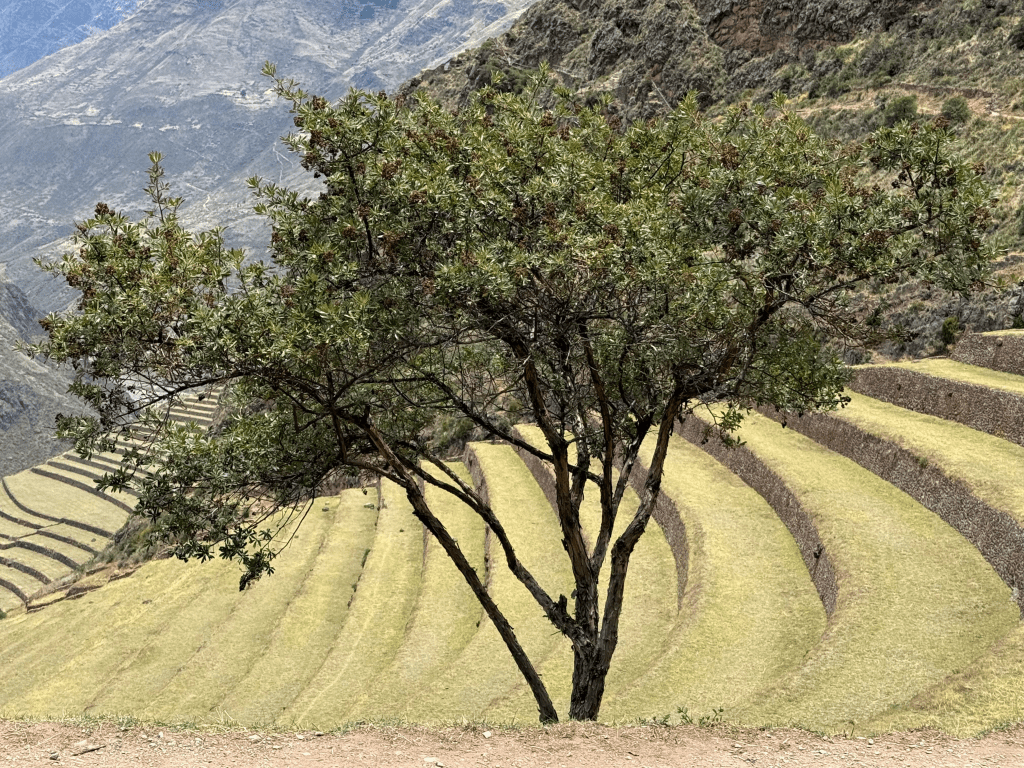
Richard Emery Nickolson “Trees and Terraces Surrounding the Area on the way up to Machu Picchu” 2025 Digital photograph
The final literary example is from Pablo Neruda, an epic lyrical poem imagined and inspired by Macchu Picchu, the wonder of its construction, and the labor and the hardships that it must have cost.
VI
“And then the stairs of the earth I ascended through the savage tangle of the lost jungles to you, Macchu Picchu. High city of stepped stones, sanctuary at long last of what the earth never hid away in its nightclothes. In you, like two parallel lines, the cradle of lightning and the cradle of man were rocked by a wind of thorns.
Mother of stone, sperm of condors.
High stone road of the human dawn.
Lost shovel in the primordial sand.
This was the home, this was the place: here the plump grains of maize climbed and like red hail came back down again.
Here the vicuña gave the gold thread to clothe love, tombs, mothers, the king, prayers, warriors.
Here the feet of men rested at night next to the feet of the eagle, in the high bloody lairs, and at first light they stepped with thunderous feet on the tense mist, and then tucked the earth and the stones until they would have known them even at night or in death.
I stare at the clothes and hands, the carvings of water in a sonorous hollow, the wall rubbed smooth by the touch of a face that with my eyes gazed at the earthly lights, that with my hands oiled the vanished planks: because everything, clothes, skin, dishes, words, wine, breads, went away, fell to the earth.
And the air came with its fingers of orange blossom over all of the sleepers: a thousand years of air, months, weeks of air, of a blue wind, of an iron mountain ridge, that was like a soft hurricane of footfalls polishing the solitary site of stone.”6
Richard Emery Nickolson “The Secret Chamber Beneath the Temple of the Sun at Machu Picchu” 2025 Digital photograph
Anne McKenzie Nickolson and Tom Lundberg had been classmates in the Graduate Textiles Program at Indiana University for a time in the mid-1970’s. After Tom moved to Ft. Collins, Colorado to teach at Colorado State University he met Marilyn Murphy who was a textile writer/editor and President of the Andean Textile Arts organization. Of course all three of them were interested in the 25th Annual Andean Textile Arts tour to Peru in October 2025, especially focussing on the communities in and around Cuzco and the Sacred Valley. Our tour guides were the brothers Raul and Wilson Jaimes who were so very knowledgeable on all of Peruvian history and culture.
I was equally excited about this tour, especially as it related to the communities in the Sacred Valley and the chance to follow in some of Hiram Bingham’s footsteps and visit Machu Picchu for two days. I immediately bought new ink pens and sketchbooks for the trip.
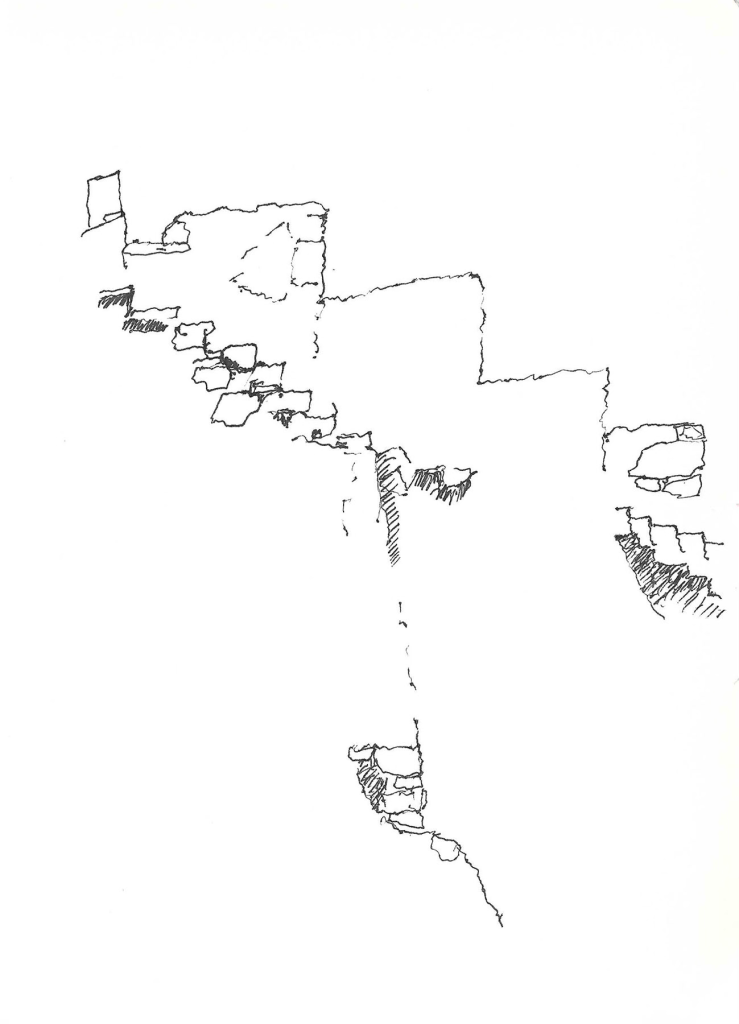
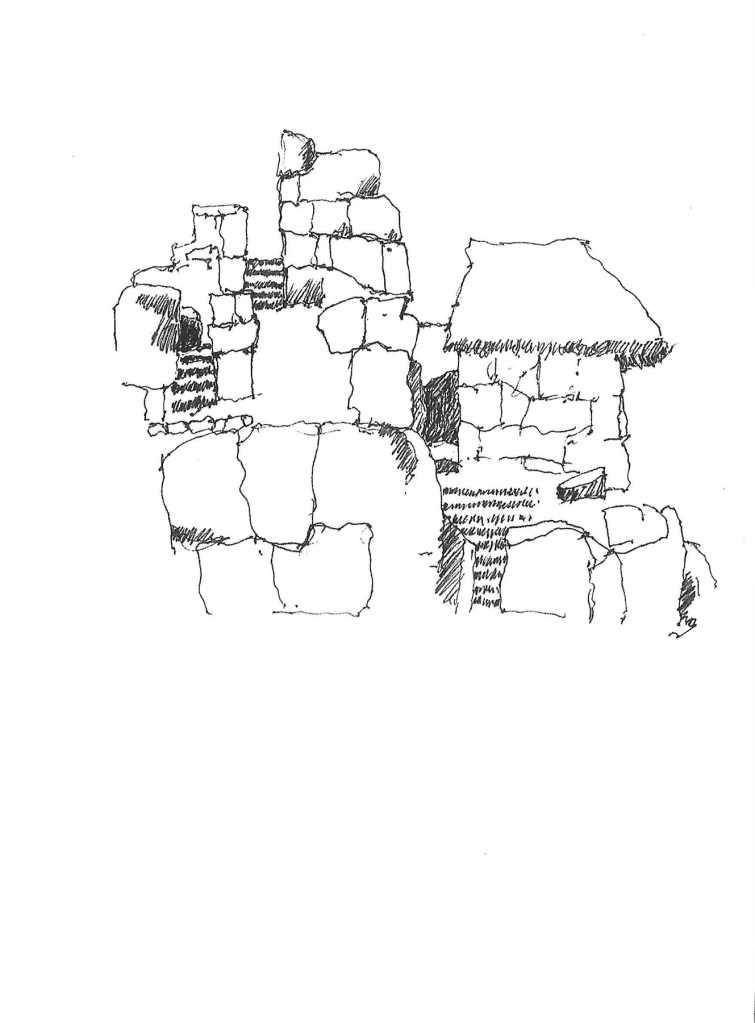
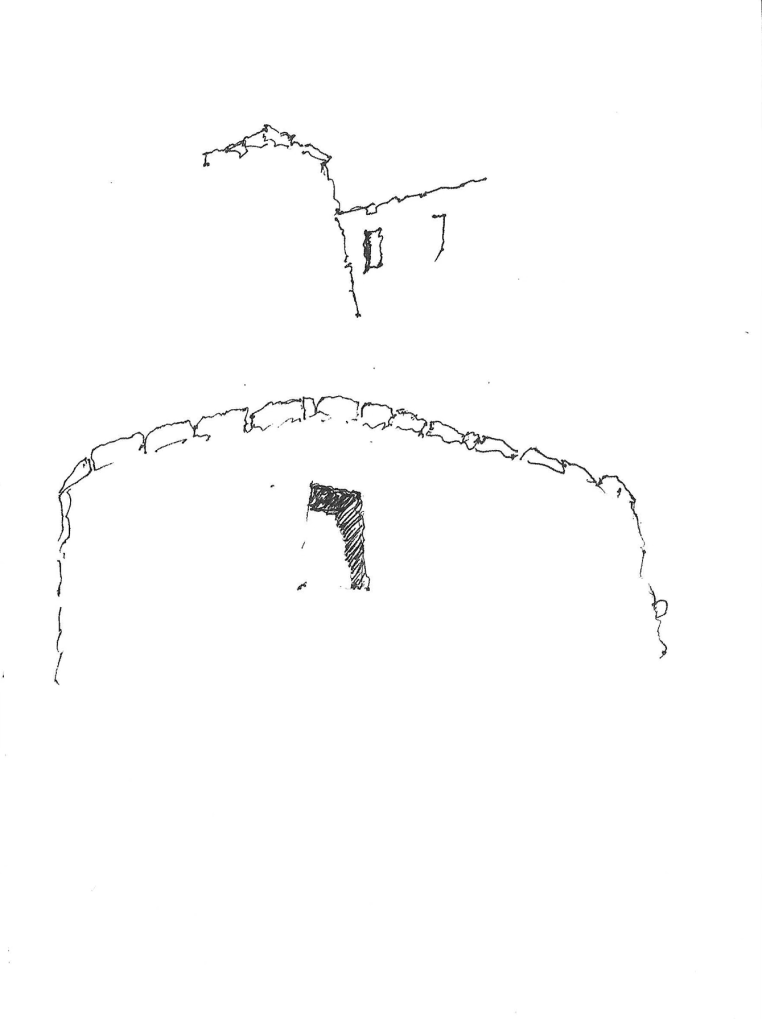
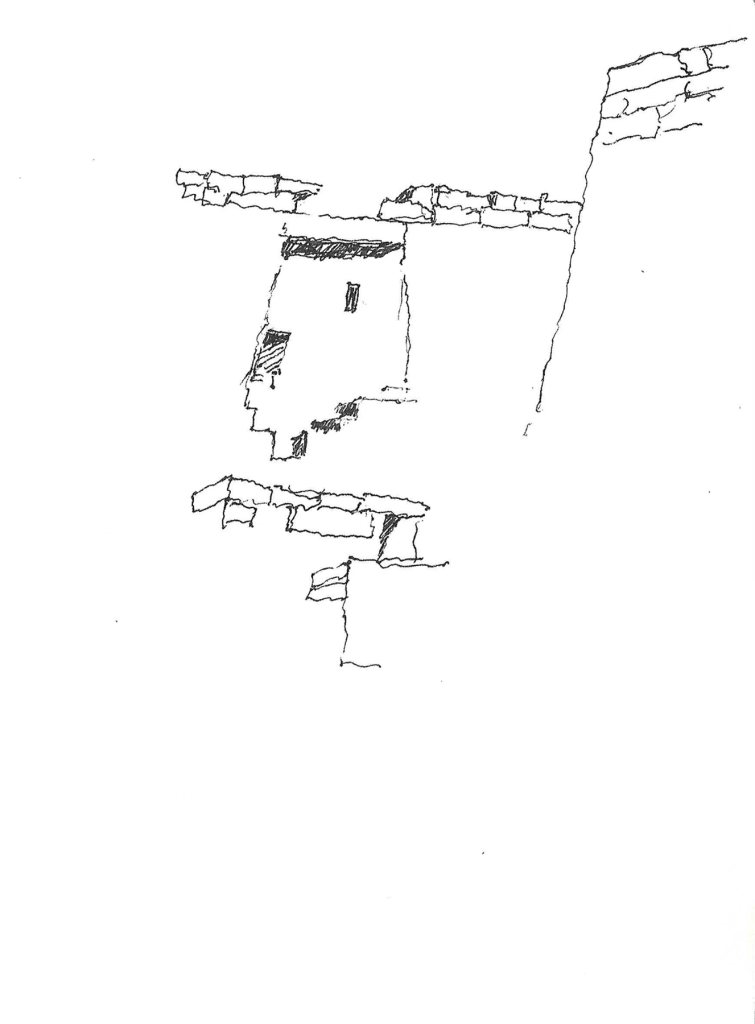
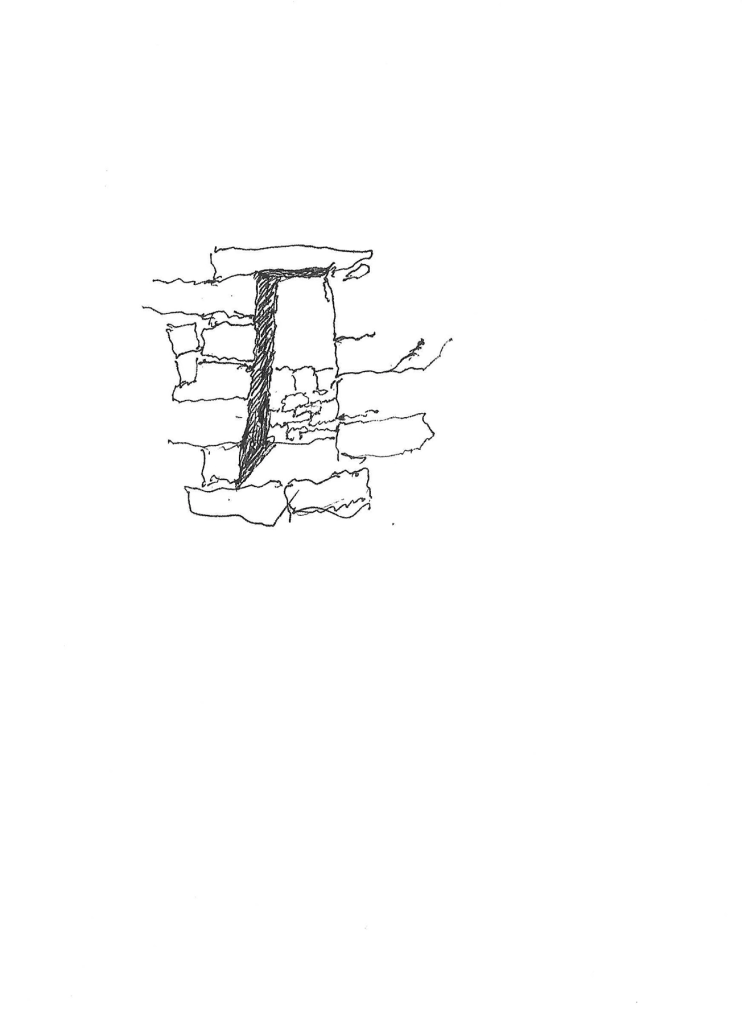
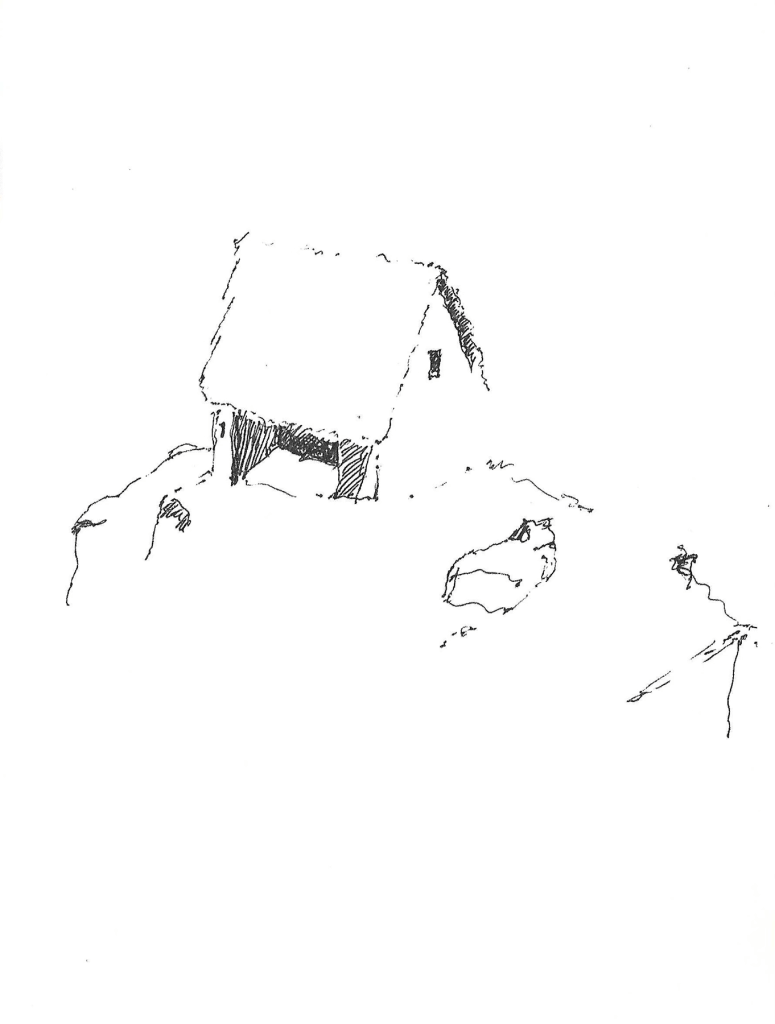
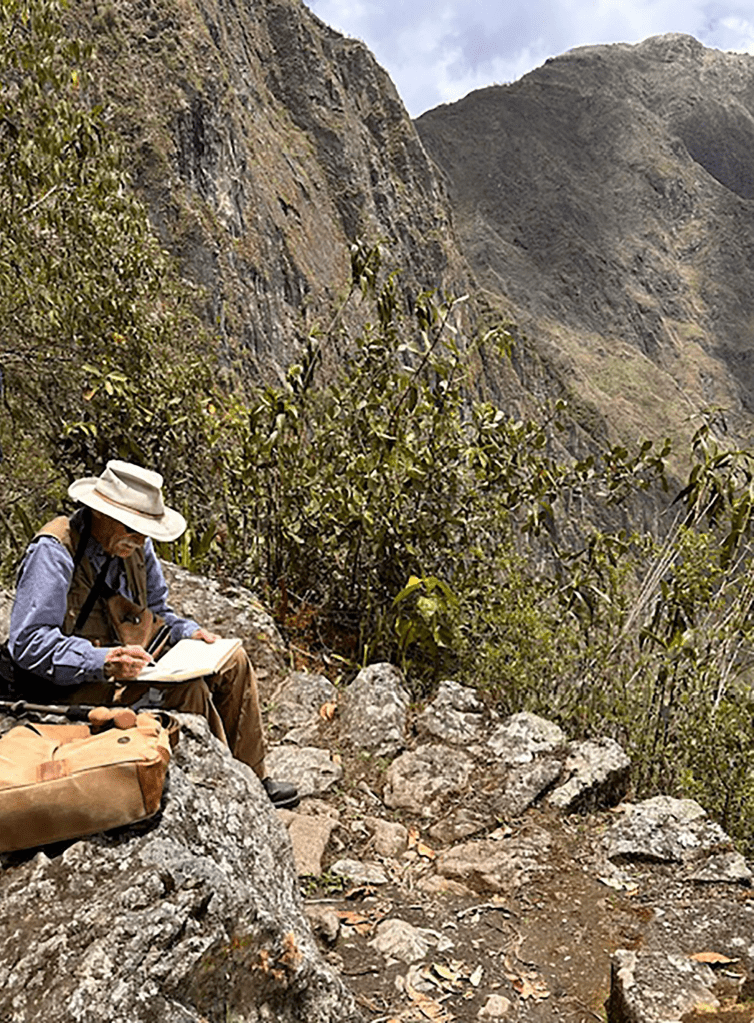
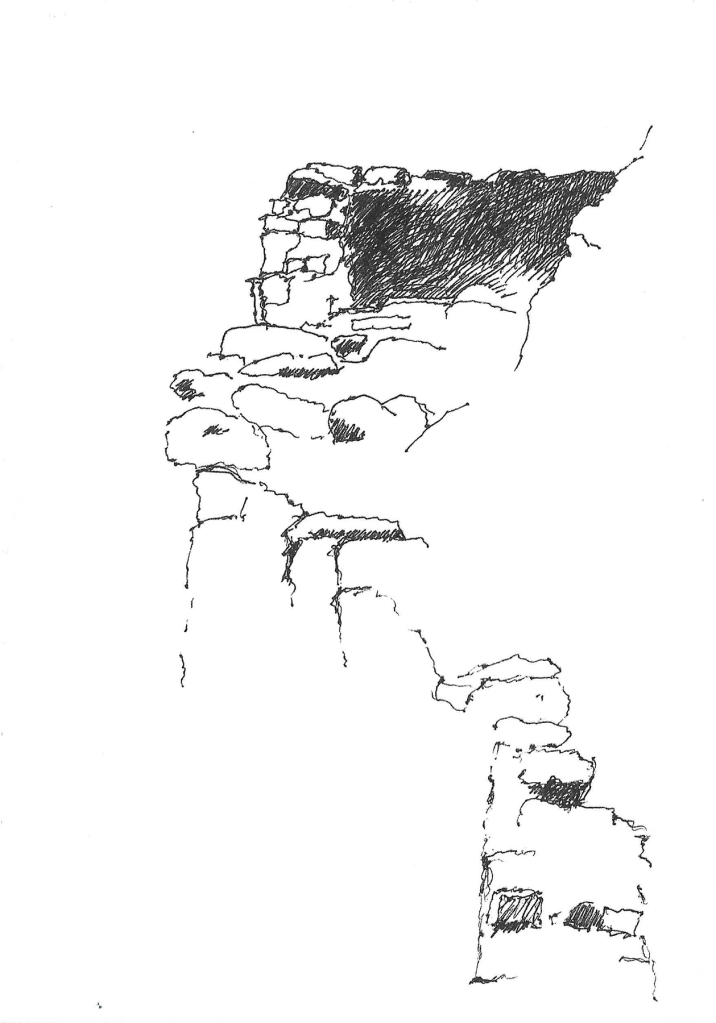
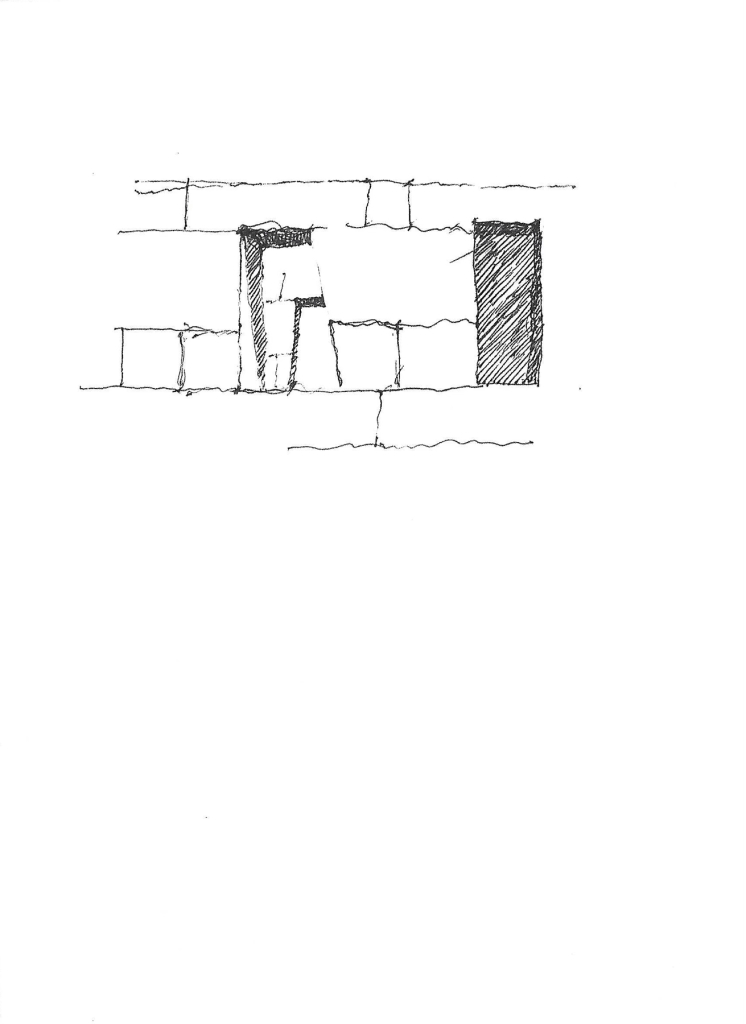
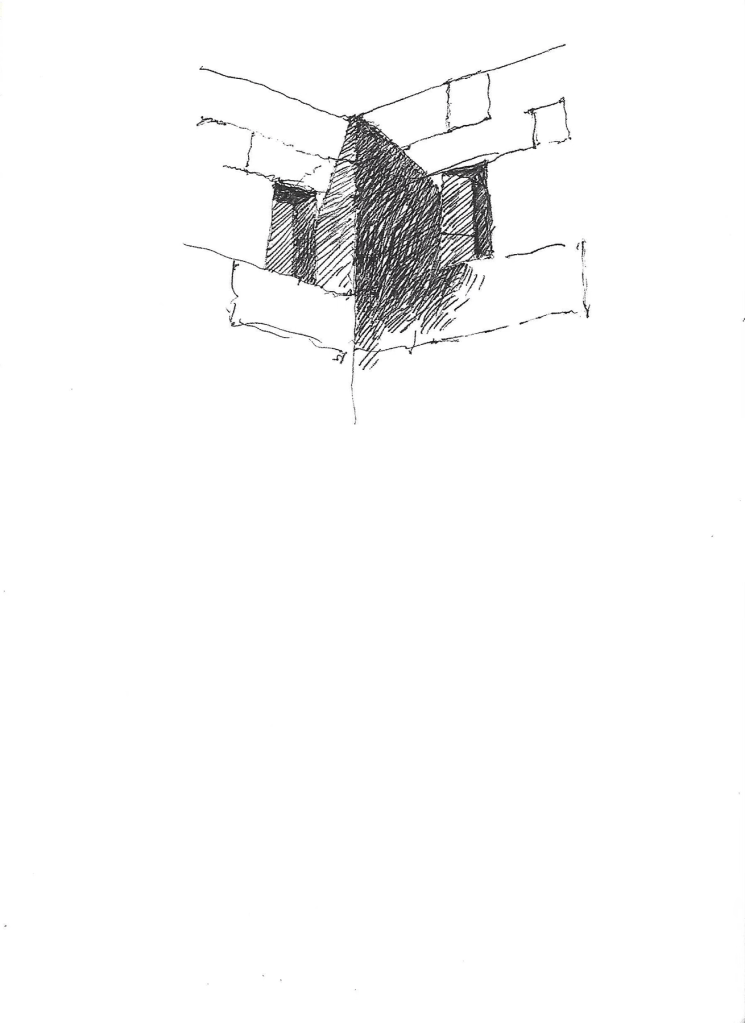
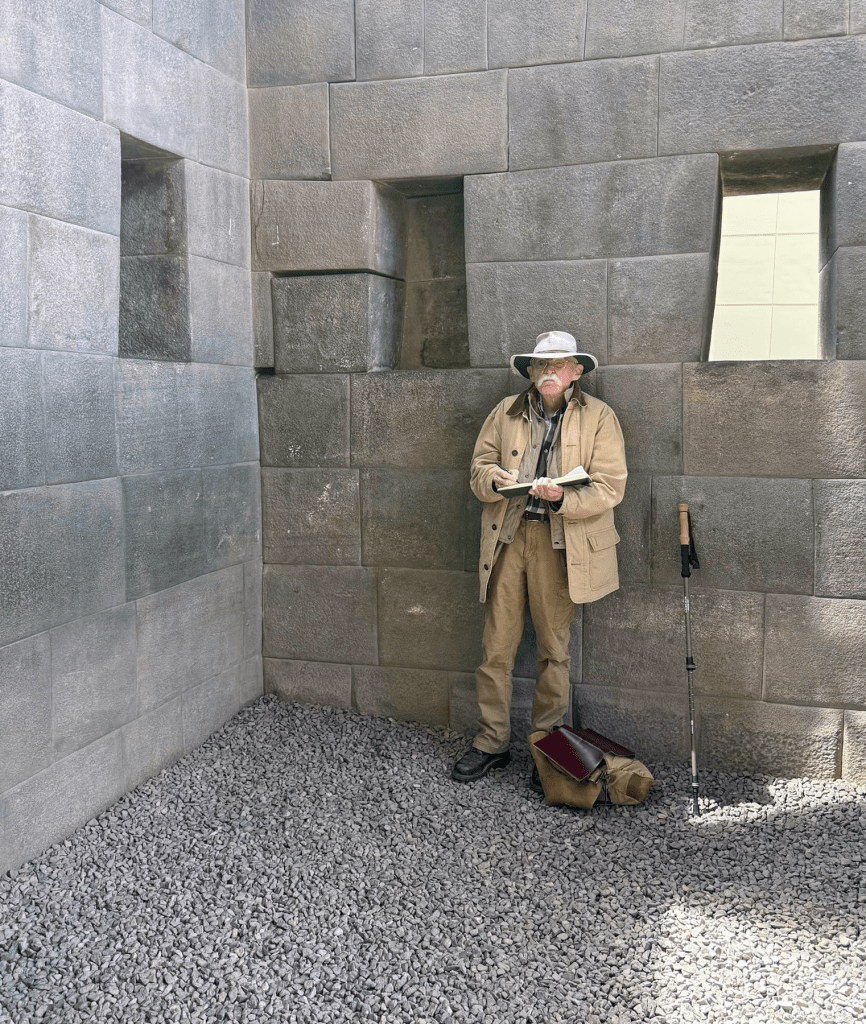
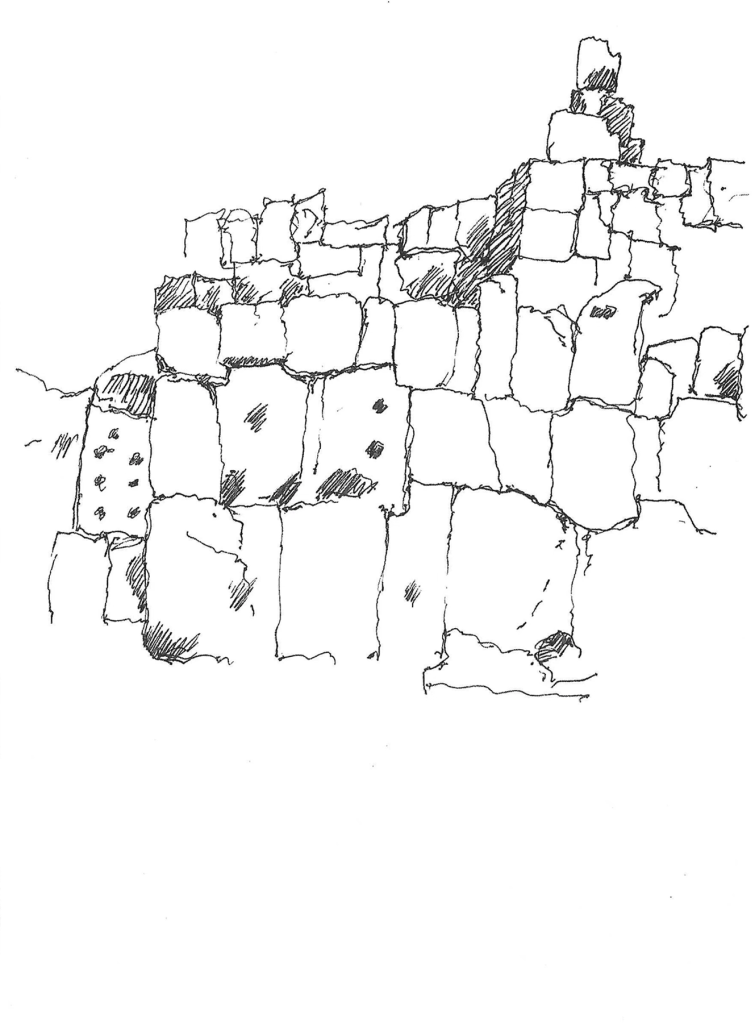
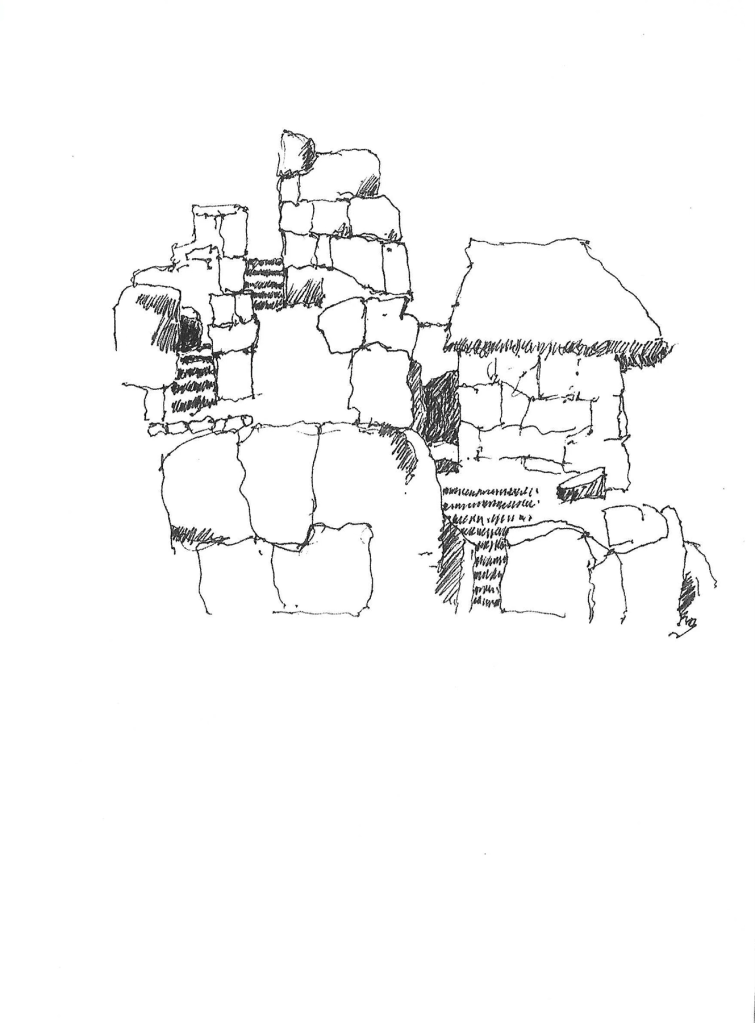
The drawing portfolio included below is in the exact order in which they were done, on site, “en plein air” in each case. They begin with the first and second days at Machu Picchu, and include my last drawing there on the high path leading to the Inca Bridge. The following ones are all at the Temple of the Sun in Cusco containing the original Incan walls with a museum built over top. The last two are on the lower plain with the Wall of the Giants, constructed with many 200 to 300 ton stones, followed by one last Grain Storage Shed, one of my fondest memories.
Richard Emery Nickolson “Terraces and Stairways” 27 October 2025 Pen & Ink on Paper 8 1/2” x 6”Richard Emery Nickolson “The First Grain Storage Shed” 27 October 2025 Pen & Ink on Paper 8 1/2” x 6”Richard Emery Nickolson “The Tower of the Sun at Machu Picchu w/Small Tower Above” 27 October 2025 Pen & Ink on Paper 8 1/2” x 6”Richard Emery Nickolson “The Stair-stepped Window” 28 October 2025 Pen & Ink on Paper 8 1/2” x 6”Richard Emery Nickolson “A Window Detail” 28 October 2025 Pen & Ink on Paper 8 1/2” x 6”Richard Emery Nickolson “The Second Grain Storage Shed” 28 October 2025 Pen & Ink on Paper 8 1/2” x 6”Kristen Thurber “The Artist Drawing Along the High Path Towards the Inca Bridge” 28 October 2025 Digital PhotographRichard Emery Nickolson “The High Path Towards the Inca Bridge” 28 October 2025 Pen & Ink on Paper 8 1/2” x 6”Richard Emery Nickolson “Two Windows and a Niche” 30 October 2025 Pen & Ink on Paper 8 1/2” x 6”Richard Emery Nickolson “Two Niches” 30 October 2025 Pen & Ink on Paper 8 1/2” x 6”Tom Lundberg “The Artist Drawing at the original Qorikancha site in Cusco” 30 October 2025 Digital PhotographRichard Emery Nickolson “The Giants of the Inca Wall at Sacsayhuaman outside of Cusco” 1 November 2025 Pen & Ink on Paper 8 1/2” x 6”Richard Emery Nickolson “The Third Grain Storage Shed at Sacsayhuaman outside of Cusco” 1 November 2025 Pen & Ink on Paper 8 1/2” x 6”
Finally, with special thanks, particularly to Tom Lundberg and Kristen Thurber for their sensitive documentary photographs during this whole expedition, and to Wilson Jaimes for his understanding, strength and assistance in walking me back down from the very high path near the Inca Bridge.
1 Bingham, Hiram; Lost City of the Incas; Weidenfeld & Nicolson Publishers; London; 1952 & 2003; p. 197.
2 Bingham, Hiram; Lost City of the Incas; Weidenfeld & Nicolson Publishers; London; 1952 & 2003; pp. 184-185.
3 Bingham, Hiram; Lost City of the Incas; Weidenfeld & Nicolson Publishers; London; 1952 & 2003; pp. 184-185.
4 Adams, Mark; Turn Right at Machu Picchu: Rediscovering the Lost City One Step at a Time; Dutton, Random House; New York, New York; 2011; p. 183.
5 Adams, Mark; Turn Right at Machu Picchu: Rediscovering the Lost City One Step at a Time; Dutton, Random House; New York, New York; 2011; p. 4.
6 Neruda, Pablo; Thomas Q. Morin, translation; The Heights of Machu Picchu; Copper Canyon Press; Port Townsend, Washington; 2015; Section VI, pp. 17 & 19.
My friend and colleague, Brett Waller, Director Emeritus of the Indianapolis Museum of Art, used to always mention to students and visitors that art museums were the birth-right of artists: explaining that historically, when many royal and private collections were first opened to the public as museums, they were linked to the local art academies and schools.
Artists such as Paul Cézanne and Alberto Giacometti both were sensitive to the importance of museums and their collections. It was Cézanne who stated many times that “. . . it was his ambition ‘to do Poussin again after nature’ and that he wanted to make of Impressionism ‘. . . something solid and enduring like the art of the museums.’”1
In his Sketchbook of Interpretive Drawings Alberto Giacometti shows us both the range and depth of how he looked at the great art of museums: “I began to copy long before even asking myself why I did it, probably in order to give reality to my predilections, much rather this painting here than that one there, but for many years I have known that copying is the best means for making me aware of what I see, the way it happens with my own work; I can know a little about the world there, a head, a cup, or a landscape, only by copying it.”2
Alberto Giacometti “Study after Pieter Breughel’s Hunters in the Snow” c. 1952 Ballpoint pen on paper 8 1/4” x 11 1/2” Annette and Alberto Giacometti Foundation, Paris and Zurich
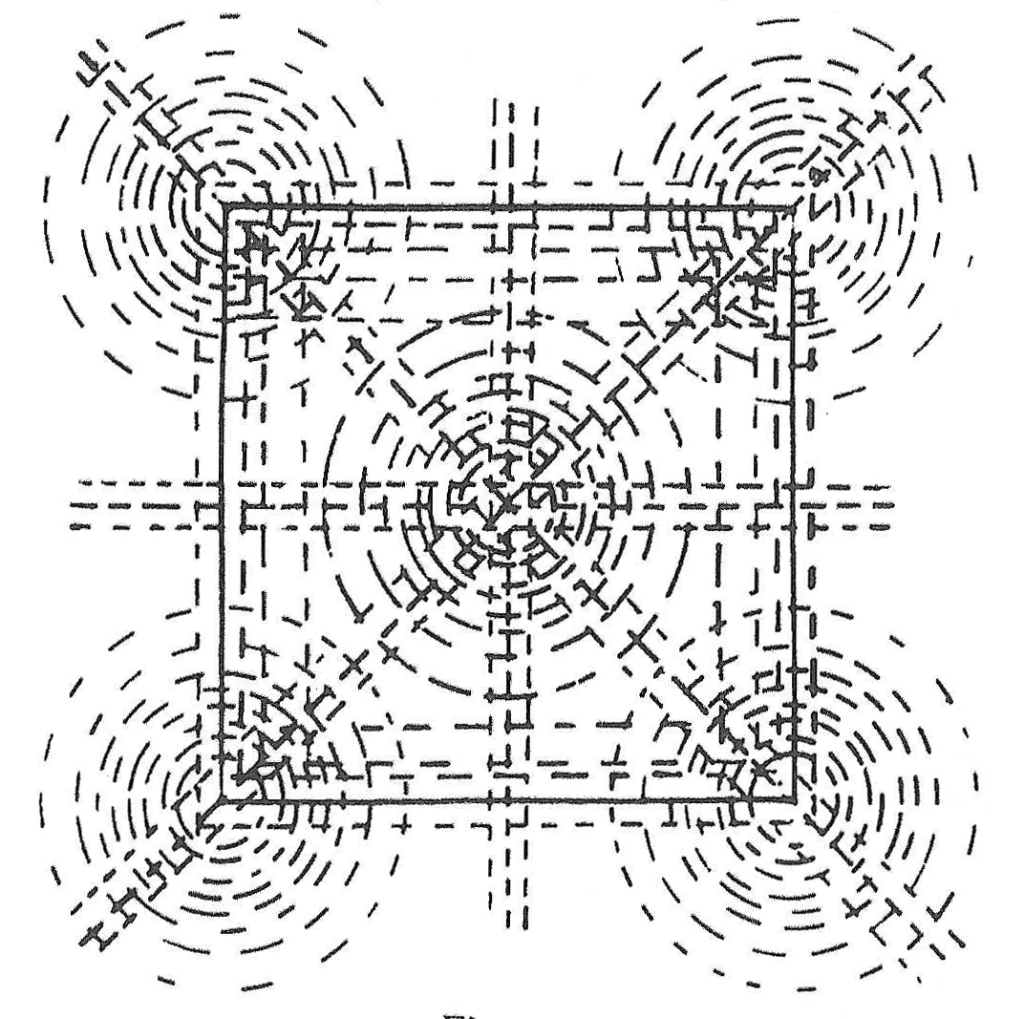
Through the writings of Rudolph Arnheim we have known of the ascending and descending angles and movements through out a painting.3 Also, we understand kinetic and haptic space as it runs through a work of art, leading our eye and mind through this very space.
Rudolph Arnheim “Structural Map” (Figure 3, p. 4) Art and Visual Perception 1971
Whether it is a snow covered hill leading us downward from the center left to the bottom right of the painting, or the path that the hunters are taking from the lower left upward into the center, or even the complimentary angles of the magpie gliding above the distant landscape and holding the upper part of the composition, we can feel the structural movement throughout.
It is this seeing, and experiencing of the thing that is most important, and this of course is exactly what William Carlos Williams achieved with this great painting “The Hunters in the Snow.”
Pieter Breughel the Elder “The Hunters in the Snow” 1565 Oil on wood panel 46” x 63 3/4” Kunsthistorisches Museum, Vienna
The Hunters in the Snow
“The over-all picture is winter icy mountains in the background the return
from the hunt it is toward evening from the left sturdy hunters lead in
their pack the inn-sign hanging from a broken hinge is a stag a crucifix
between his antlers the cold inn yard is deserted but for a huge bonfire
that flares wind-driven tended by women who cluster about it to the right beyond
the hill is a pattern of skaters Breughel the painter concerned with it all has chosen
a winter-struck bush for his foreground to complete the picture . . ”4
1 Chilvers, Ian, & John Glaves-Smith; A Dictionary of Modern and Contemporary Art; Oxford University Press; Oxford, United Kingdom; 2009; p. 132.
2 Carluccio, Luigi; Giacometti: A Sketchbook of Interpretive Drawings; Harry N. Abrams, Inc.; New York, New York; 1967; p. xi.
3 Arnheim, Rudolf; Art and Visual Perception: A Psychology of the Creative Eye; University of California Press; Berkeley and Los Angeles; 1971; p. 4.
4 Williams, William Carlos; Pictures from Brueghel and other poems; New Directions Publishing Corporation; New York, New York; 1967; p. 5.
“The humanity, the simple direct humanity of his figures—you feel like they’re real people that you can empathize with. He treats them with a certain dignity, it’s not like he’s trying to belittle them by making them seem so down-to-earth. He has respect for the ordinary person.”1
This is one of the many observations that my friend and colleague Stephanie Dickey has made regarding the work of Rembrandt van Rijn. She is one of the leading authorities on this artist, and was interviewed by Smithsonian Magazine on the anniversary of his 400th birth. She is unique amongst art historians, in my opinion, as she is so aware of, and sensitive to, the thought and painting processes of artists, not unlike the writing of the poet Robert Bly, who has himself had a life long interest and sensitivity to the work of painters and sculptors.
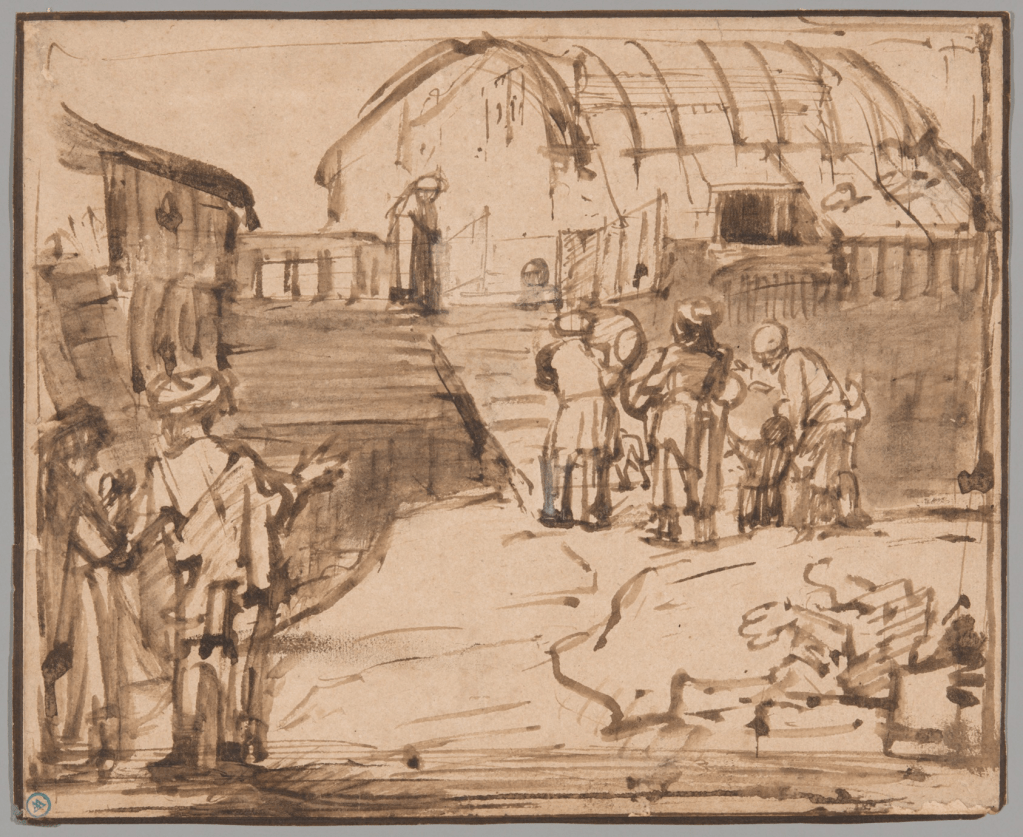
The Old St. Peter by Rembrandt
“Noah’s ship does not sail with its elephants forever. The crying of the monkeys breaks off and starts again. Even shame does not last a whole lifetime.”
Rembrandt van Rijn “Noah’s Ark” 1660 Pen & ink with brown washes 203mm x 248mm The Art Institute of Chicago, Chicago, Illinois.
“‘It was dark,’ Peter said. ‘We were alone. We had A single candle which shone on the steel breastplate Of the Roman soldier. The whole town was asleep.’
We are bubbles on the lips of our friends. Each time they turn their heads, we drift toward the Pole; We pass into the Many and return.
Who can say, ‘With God, the rest is nothing?’ Who can say, ‘I am a grandchild of the unfaithful?’ Who is able to wait one month to drink water?
We fell into weeping yesterday at five o’clock. We wept because slavery has returned; we wept Because the whole century has been a defeat.
Oh Peter! Peter! The night behind you is black. A beam of light falls on your outworn face. What can you do but lift up your hand for forgiveness?”2
Rembrandt van Rijn “The Apostle Peter” 1632 Oil on canvas 32.2” x 24.4” Nationalmuseum, Sweden
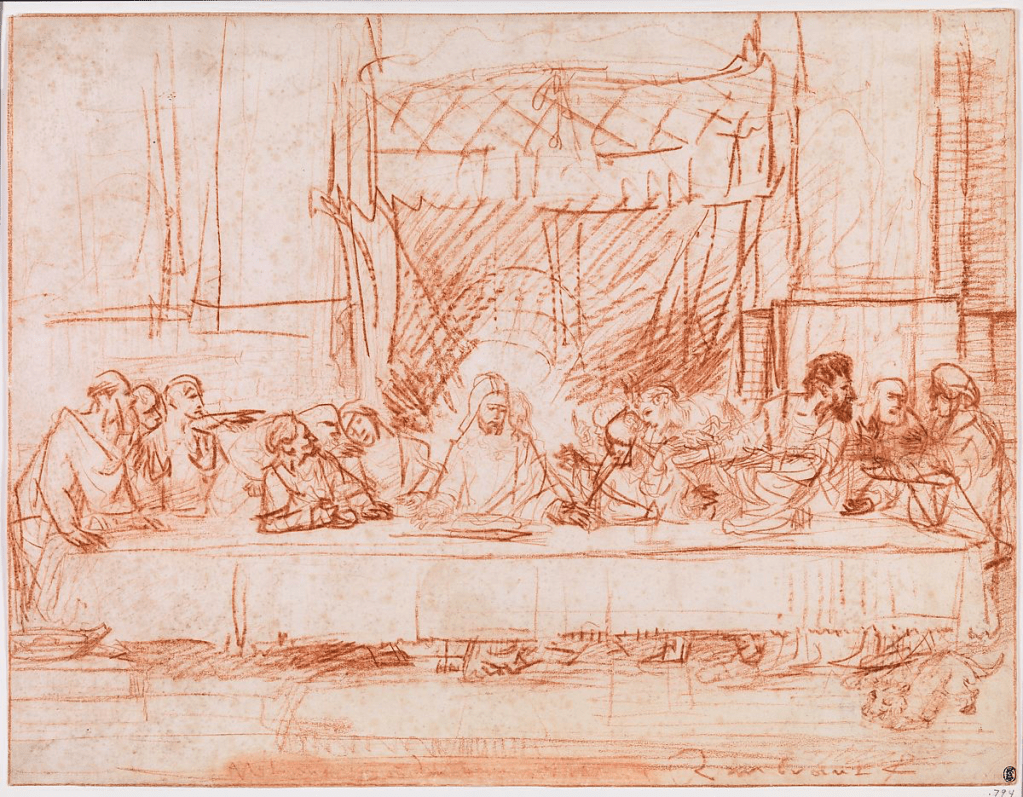
Rembrandt’s Brown Ink
“The sorrow of an old horse standing in the rain Goes on and on. The plane that crashes in the desert Holds shadows under its wings for thirty years.
Each time Rembrandt touches his pen to the page, So many barns and fences fly up. Perhaps that happens Because earth has pulled so many nights down.
When we hear a Drupad singer with his low voice Patiently waiting for the next breath, we know The universe can easily get along without us.
So much suffering has been stored in the amygdala That we know it won’t be long before we put Our heads down on the chopping block again.
Our thighs still remember all those smoky nights When we crouched for hours on the dusty plains Holding small-boned mammals into the fire.
How is it possible that so many nights of suffering Could be summed up by a sketch in brown ink Of Christ sitting at the table with Judas near?”3
Rembrandt van Reign “The Last Supper, after Leonardo da Vinci” 1634-1635 Red chalk 14 1/4” x 18 11/16” Robert Lehman Collection, The Metropolitan Museum of Art, New York, New York.
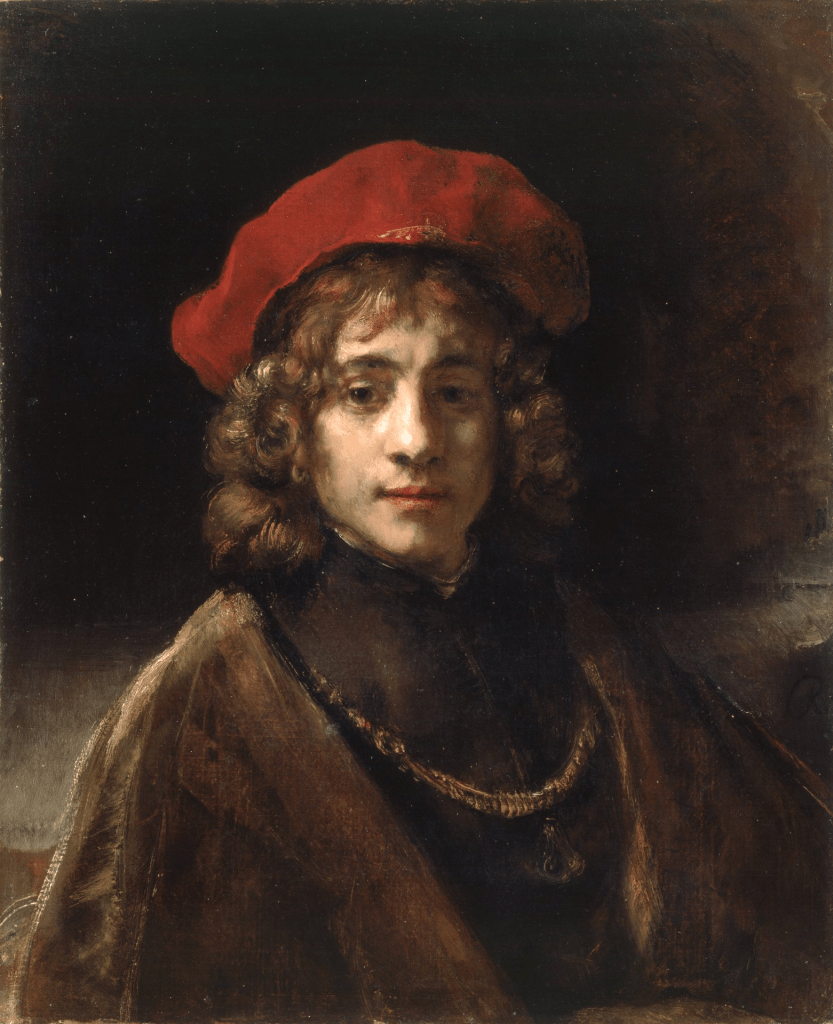
Rembrandt’s Portrait of Titus with a Red Hat
“It’s enough for light to fall on one half of a face. Let the other half belong to the restful shadow, The shadow the bowl of bread throws on the altar.
Some are like a horse’s eating place At the back of the barn where a single beam Of light comes down from a crack in the ceiling.
Painting bright colors may lie about the world. Too many windows cause the artist to hide. Too many well-lit necks call for the axe.
Beneath his red hat, Titus’s eyes hint to us How puzzled he is by the sweetness of the world— The way the dragonfly hurries to its death.
So many forces want to kill the young Male who has been blessed. The Holy Family Has to hide many times on the way to Egypt.
Titus receives a scattering of darkness. He’s baptized by water soaked in onions; The father protects his son by washing him in the night.”4
Rembrandt van Rijn “Portrait of Titus with Red Hat” 1657 Oil on canvas 68.5cm x57.3cm The Wallace Collection, London, The United Kingdom.
Everything he paints, he paints with a sense of light (a touch of light) and a tacit understanding of the sitter just across from him. The form is felt with each brushstroke, and handled with sensitivity as the light falls across the space/face. One may identify one of these paintings from across the gallery, even without seeing the didactic information posted on the nearby wall. Always recognizable. And this work has grown so much, almost mythologically, that it exists on a whole ‘nother level of culture. So the last word on this surely belongs to my colleague and friend Stephanie Dickey from her observations on 400 Years of Rembrandt. Rembrandt’s reputation has taken on a life of its own:
“One thing that really surprises me is the extent to which Rembrandt exists as a phenomenon in pop culture. You have this musical group called The Rembrandts, who wrote the theme song to Friends—‘I’ll Be There For You.’ There are Rembrandt restaurants, Rembrandt hotels, art supplies and other things that are more obvious. But then there’s Rembrandt toothpaste. Why on Earth would somebody name a toothpaste after this artist who’s known for his really dark tonalities? It doesn’t make a lot of sense. But I think it’s because his name has become synonymous with quality. It’s even a verb—there’s a term in underworld slang, ‘to be Rembrandted,’ which means to be framed for a crime. And people in the cinema world use it to mean pictorial effects that are overdone. He’s just everywhere, and people who don’t know anything, who wouldn’t recognize a Rembrandt painting if they tripped over it, you say the name Rembrandt and they already know that this is a great artist. He’s become a synonym for greatness.”5
Dr. Stephanie Dickey, Bader Chair in Northern Baroque Art, Queen’s University, Kingston, Ontario, Canada.
1 Amy, Crawford; An Interview with Stephanie Dickey, author of ‘Rembrandt at 400’; “Arts & Culture,” Smithsonian Magazine; 1 December 2006; Washington, DC; Archived 21 September 2018.
2 Bly, Robert; The Night Abraham Called to the Stars; Perennial/Harper Collins; New York; 2001; p. 75.
3 Bly Robert; My Sentence was a Thousand Years of Joy; Harper Perennial; New York, London, Toronto and Sydney; 2005; p. 35.
4 Bly, Robert; The Night Abraham Called to the Stars; Perennial/Harper Collins; New York; 2001; p. 39.
5 Amy, Crawford; An Interview with Stephanie Dickey, author of ‘Rembrandt at 400’; “Arts & Culture,” Smithsonian Magazine; 1 December 2006; Washington, DC; Archived 21 September 2018.
He is both a poet and an art critic. An important combination. He reminds me a bit of another great poet, who early on became a curator at the Museum of Modern Art in New York, Frank O’Hara. Both were so important as poets and as members of the larger art world. I am speaking about the writer John Yau, and especially his collection titled Borrowed Love Poems.
In order to follow up on these poems, I have recently been re-reading several books on three of the artists. These include: Lucy Lippard’s book on Eva Hesse1, Craig Burnett’s extended essay on Philip Guston: The Studio2, and the tribute to Frank O’Hara, In Memory of My Feelings by Russell Ferguson3. On the surface, these three artists seem to have nothing in common: they are people of such a great variety of ages and backgrounds, aesthetics and motivations. Yet the insistence and determination that each exhibited in their life’s work, their struggles for acceptance, and their ultimate recognition are important examples of the lives of painters and poets.
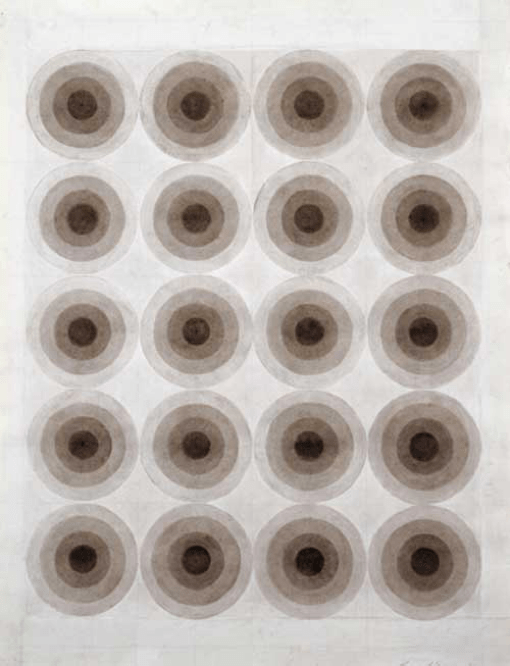
Eva Hesse “Untitled” 1966 Watercolor on paper 12” x 9” Private Collection, Estate of the artist.
Bowery Studio
“It is never just matter
Smooth as the paper holding them in its mouth
the circles float in their circles of ink
Solace is found in sameness as is the soul
should one cling to such matter
and such matters mean much to some
But the sum is not all
The circles float in their perfect mouths of ink
Where else am I to store them
The windows have their own tasks The sky brings its own table”4
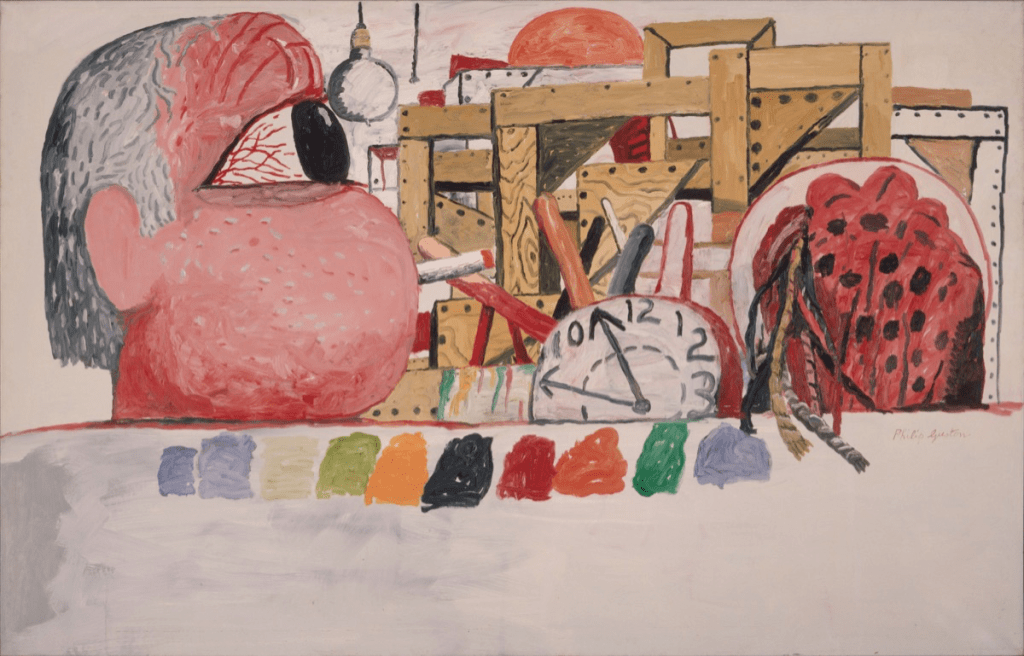
In writing about Hesse’s watercolors, Yau speaks of circles that float and a table that is brought in by the sky. On the other hand, Guston’s table is like a rock: piles of shoes and pyramids, books like stale bread, and light bulbs inhabiting and surrounding this table top landscape. And finally, a tribute to a fellow poet: in remembrance of Frank O’Hara, Yau laments the careers of well-groomed curators and artists, where images reflected in their windows offer sights of real flesh and blood. From three very different perspectives, we realize these are indeed descriptions of an important and ongoing dialogue amongst contemporary poets and painters.
Phillip Guston “The Painter’s Table” 1973 Oil on canvas 77 1/4” x 90” National Gallery of Art, Washington, DC.
Studio Dream
“Your face is a shoe or a pyramid
What do you do with a bandaged rock
clogged with muck tea kettle’s dented noggin
common clock cracked with arrows
One is up or down staring into book of stale bread
dotted slab and square cloud Does the world move closer
when you scratch black lines Bulb hangs its note above bed
Head and arms embrace dust inside web
Did you want to join me on the sofa watch my skull float out to sea
Old crust, stitched mitten You’ve got a big empty head
but no place to cram it”5
Phillip Guston “Studio Landscape” 1975 Oil on canvas 67” x 104” Estate of Philip Guston, Courtesy David McKee Gallery, New York
Broadcast from 791 Broadway
“Salacious, broken-nosed, bantamweight Animals don’t ring my doorbell bring me cookies and champagne biscuits as big as movie stars’ post-nuptial crumbs I am not another image of the Buddha preaching or the ornate clouds he manufactures for those in need of eternal wisdom I am not even his rapid flagship cousin part nugget, part fly I am a defection from the mind of an Abyssinian tram quill rising through the pages of the wall and wind you surround yourself in almost hard-headed enough to make an appearance at the Statue of Librettists because the Primogeniture Mink pleaded with me to grind for the people of New York and to squirt you with news of how powerfully afloat we feel in Heaven its many villas and huts copied from the terracotta model of Manhattan we carried into the snowy mountains of thought”
Alice Neal “Portrait of Frank O’Hara” 1960 Oil on canvas 33 3/4” x 16” National Portrait Gallery, Smithsonian Institution, Washington, DC.
“Since I left you, American art has received many stamps of approval I was commissioned to design by the School of Better Living Through Lusty Dancing and didn’t
Since I left you, smoother stools and life-like cats are being peddled by the curlicue gates of the Museum of Modern Fate
Since I left you, well-groomed curators have learned how to store their robes and purr without becoming overly philosophical, and artists have stopped skinny-dipping in the reflections carried past their windows on the shoulders of dead and dying poets disgusted perhaps by the sight of real flesh and blood
Since I left you, many other curious celebrations have taken place”6
Larry Rivers “Preparatory drawing for In Memory of My Feelings” 1967 Pencil on acetate 19” x 24 15/16” Gift of the artist Museum of Modern Art, New York
1 Lippard; Lucy; Eva Hesse; New York University Press; New York, New York; 1976.
2 Burnett, Craig; Philip Guston: The Studio; Afterall Books; London, United Kingdom; 2014.
3 Ferguson, Russell; In Memory of My Feelings: Frank O’Hara and American Art; University of California Press; Berkkeley, Los Angeles, London; 1999.
4 Yau, John; Borrowed Love Poems; Penguin Books; New York, New York; 2002; p. 15.
5 Yau, John; Borrowed Love Poems; Penguin Books; New York, New York; 2002; p. 16.
6 Yau, John; Borrowed Love Poems; Penguin Books; New York, New York; 2002; pp. 17-18.
No, this is not about The Boxtops, nor Joe Cocker’s cover of their mournful rock ballad from 1967, although there is a reference to a Broadway musical from 1953. This concerns any number of artists who moved to New York City during the early and middle years of the 20th Century. They came especially from the Mid-West. David Smith was one of them, having been born and raised in Decatur, Indiana. Often feeling homesick, there is a certain letter, in the form of a sculpture, which he imagined writing home.
A. Eriss “David Smith” B&W Photograph 1936 (p. 11; David Smith by David Smith.)
Smith first worked in offices in Washington, DC and New York, and later as a welder in a steelworks. He was simultaneously energized by the life and pace of the east coast and demoralized by the loneliness and solitude that he found there. “Yet lonesomeness is a state in which the creative artist must dwell much of the time….”1
This instantly reminded me of Rainer Maria Rilke and the advice he had written in a letter from Rome on 14 May 1904 to his younger poet friend: “This very wish will help you, if you use it quietly, and deliberately and like a tool, to spread out your solitude over wide country. People have (with the help of conventions) oriented all their solutions toward the easy and toward the easiest side of easy; but it is clear that we must hold to what is difficult; everything alive holds to it, everything in Nature grows and defends itself in its own way and is characteristically and spontaneously itself, seeks at all costs to be so and against all opposition. We know little, but that we must hold to what is difficult is a certainty that will not forsake us; it is good to be solitary, for solitude is difficult; that something is difficult must be a reason the more for us to do it.”2
David Smith was doubly aware of this I think. While many of his contemporaries were easily falling into camps based solely on media or subject matter, his stated goal was that this work was an attempt to bridge the gap between painting and drawing and sculpture: a most difficult project.
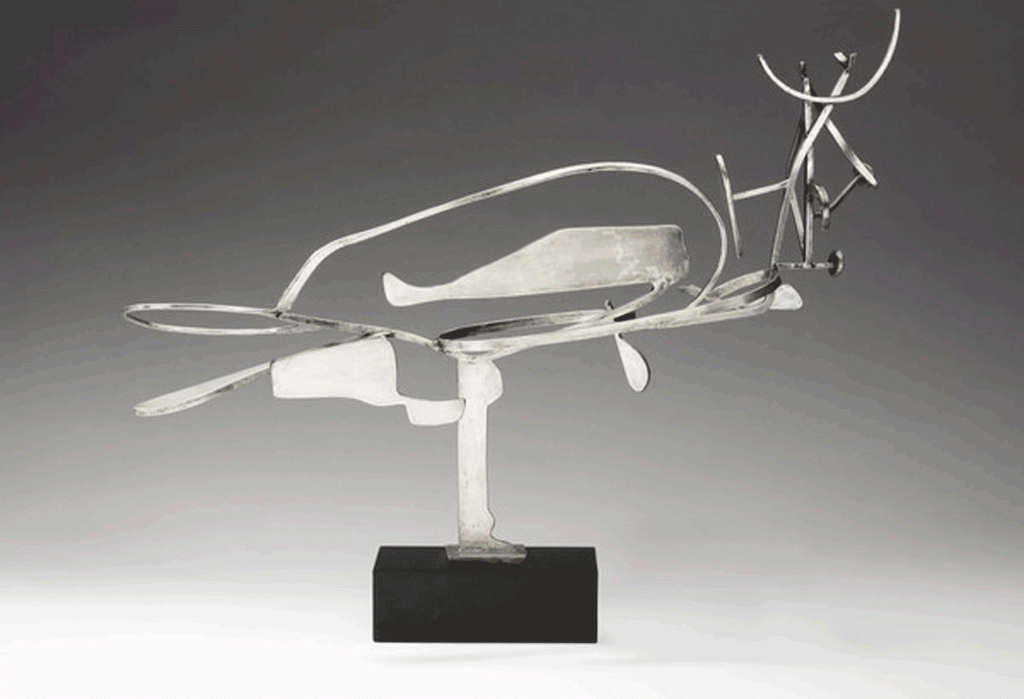
There are several examples of this work: severely linear pieces that often contain, or are made up of, an arrangement of attenuated forms and glyphs. A great example of this is a beautiful piece in the collection of the Indianapolis Museum of Art titled “The Egyptian Barnyard” and often described as a drawing in steel, or in this case, welded silver.
David Smith “Egyptian Barnyard” 1954 Wrought and soldered silver on wood base 14 1/2” x 24” x 5 1/2” Gift of Mr. and Mrs. James W. Alsdorf Indianapolis Museum of Art, Indianapolis, Indiana
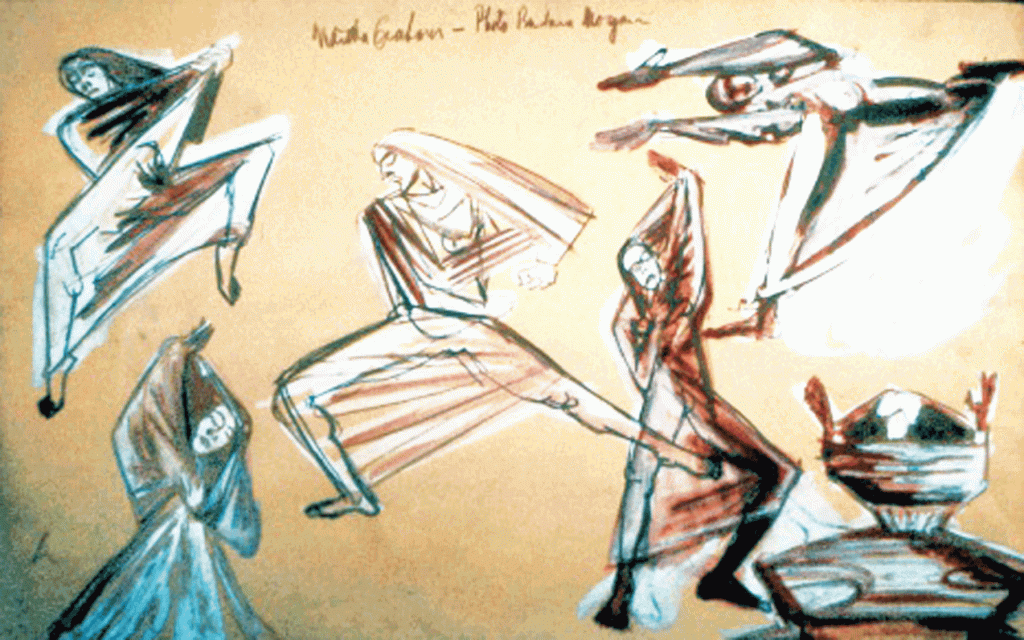
Although his work has often been held up as great formalist abstraction, there are specific examples of content inherent in many of Smith’s pieces. For instance, these figurative gesture drawings of the dancer Martha Graham.
David Smith “Studies of Martha Graham” 1938 12” x 19” Drawing on paper after a series of photographs by Barbara Morgan. Collection of Candida and Rebecca Smith.
There are also photographic references to his daughters running and tumbling through their back yard, portraits of other artists and characters, and even several pieces inspired directly from Alberto Giacometti’s early masterpiece “The Palace at 4:00 AM.”
David Smith “Interior for Exterior” 1939 Steel and bronze 18” x 22” x 23 1/4” Collection of Mr. and Mrs. Orin Raphael
Over the years, writers such as Cleve Gray3 and Edward F. Fry4 have provided hints as to the content of “The Letter.” In 1967 at the Yale-Norfolk Summer School of Music and Art it was Mr. Gray who lectured on David Smith, whose biography he had just finished editing. In one of the earliest exhibitions I had visited at the Guggenheim Museum in New York, it was the David Smith Retrospective of 1969 that made a lasting impression. Finally, during my freshman year in art school in Baltimore, an early winter 1965 visiting artist lecture by David Smith himself still rings true to me in all that he said.
David Smith “Sketchbook Study for The Letter” c. 1950 Pen and ink and pencil on paper David Smith Archives, III — 1283 New York, New York
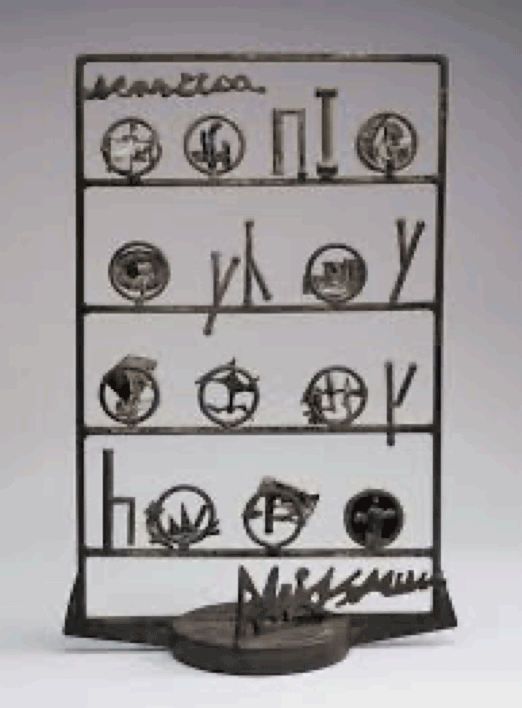
In order to decipher this letter, we can see in the drawing study a salutation in the top left corner and a signature at the lower right. In between we have the written body made up of a series of scrap railroad hardware “h’s” and “y’s” and “o’s” forming a message. The particular wording of this letter itself is borrowed from a 1953 song that was included in the Broadway musical “Wonderful Town.”
In short, two young girls, sisters Ruth and Eileen Sherwood from Columbus, Ohio, arrive in Greenwich Village determined to make it in the city, one as a writer, the other as an actress. From their basement apartment, they are shaken by blasts from the nearby construction of a new subway line, as well as late night knocks on their door by ‘customers’ of the former tenant known as Violet. They are stricken with homesickness, and musically ask: Why oh why oh, did we leave Ohio? This reference did indeed become the content of David Smith’s “Letter.”
“DEAR MOTHER”
“OH WHY, OH WHY OH, DID I EVER LEAVE O HI OH?”
“YOUR SON, DAVID SMITH”
David Smith “The Letter” 1950 Steel 37 3/4” x 22 7/8 x 11” The Munson-Williams-Proctor Institute Utica, New York
1 Clark, Trinkett; The Drawings of David Smith; International Exhibitions Foundation; Washington, DC; 1985; p. 20.
2 Rilke, Rainer Maria; Letters to a Young Poet; W. W. Norton & Company; New York, New York; 1934 & 1962; p. 53.
3 Gray, Cleve, ed.; David Smith by David Smith; Holt, Rinehart and Winston; New York, New York; 1968.
4 Fry, Edward F.; David Smith; The Solomon R. Guggenheim Museum; New York, New York; 1969.
In French, the sign along the roadside simply read: DANGER MORTAL! These were posted all along the winding coastal roads going out from the port at Le Palais. They covered most of the island. They were a very real warning as many of the island roads curved right along the coast, with precipitous and precarious views down from the cliffs, and across the inlets and bays. There were no guardrails.
We visited there in the summer of 1995 with our friend, the painter Holly Hughes and her mother Wanda, who at that time was the studio/office manager for the contemporary American painter Ellsworth Kelly. Wanda was armed with a map that had been given to her by Ellsworth so that we might find the ‘village’ where he had lived after WWII. Little did we know what a sight we were approaching?
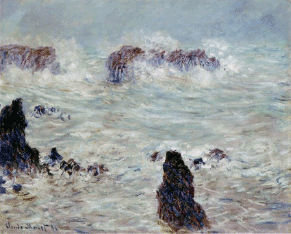
Claude Monet “Tempête, côtes de Belle-Ile” 1886 Oil on canvas 65.4 cm. x 81.5 cm. Musée d’Orsay, Paris, France
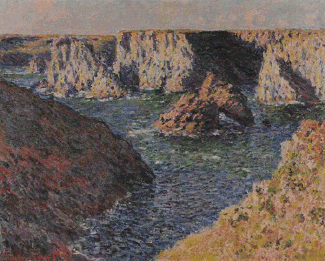
Over the years on Belle-Isle, the largest of the Breton Islands, many artists found in the isolation, the savage waves and tides, the inspiration that they were searching for. Claude Monet, Henri Matisse, the actress Sarah Bernhardt and her companion the painter Georges Clairin, the Irish painter John Peter Russell, were all attracted to this special place, and later of course, so was Ellsworth Kelly.
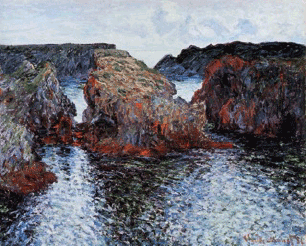
During the fall of 1886, from 12 September to 25 November to be exact, Claude Monet lived and worked on Belle-Isle. During this time he produced a series of 39 paintings, exploring the weather and the wildness of this place.
Not to be outdone by the painters, the contemporary poet Patricia Clark from Grand Rapids, Michigan, recently visited Paris and many of the great museums there. She noticed in particular the paintings by Monet at the Musée D’Orsay, and the potential for an ekphrastic experience. When I asked Clark about this, this is what she said:
“As for the poem about Monet’s Rochers — we did not go out to the place, alas! Would love to see it. I believe (memory is slippery!) we saw the painting at the Musee D’Orsay. My method — such as it is! — is to buy postcards of paintings that really move me. . . . Then there’s a catalog. But I know I have a postcard of this painting.”
“I think what drew me to it is that it’s not an image I’d seen that much. It seems rougher and less ‘pretty’ than many Monets. I kept it in front of me and then one day, I started to write about it. That’s about as much as I recall — of course, a writer can’t help but layer their own issues over what they look at — so that’s what happens, doesn’t it? I hope that comes through.”[i]
Claude Monet “Les rochers de Belle-Île” 1886 Oil on canvas 25 7/8″ x 32 1/8″ Musee des Beaux-Arts, Reims
“Les Rochers de Belle-Ille”
(after the painting by Claude Monet)
“No beach here—just the sea swirling in blue
deep blue and green
Both the sea and the rocks show age
It’s a tired scene of their coming together
each hour and day
The water’s force, erosion of all the softest parts
leaving only solid rock
This you could be crushed upon—the hardest
knowledge of all—
What is impervious to you, quite solidly indifferent
No escaping the sea
throws you repeatedly on the rocks of all you’re stupid about—
self-ignorance, deception, lies—
Instead someone calls this a scene, a landscape, seascape—
Claude Monet “Rochers a Belle-Île at Port Goulphor” 1886 Oil on canvas 26” x 32 3/16” Art Institute of Chicago, Chicago, Illinois
Following the end of WWII, from 1948 to 1954, the American artist and veteran Ellsworth Kelly visited and lived in several areas of France. In July 1949 he even rented a house on Belle-Ile-en-Mer for the summer and part of the fall. He had fallen in love with France and with its artists, especially Claude Monet and Henri Matisse.
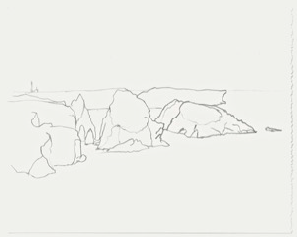
In 1965 Kelly returned to Belle-Isle with a specific purpose, to re-visit certain sites that Monet had painted and witness them directly, not just metaphorically. Later in his life, 2005, he returned to Belle-Isle for a last series of drawings, not abstracted from the rocks, but directly created from the sources.[iii]
Ellsworth Kelly “Port-Goulphar, Belle- Île” 2005 Pencil on paper 49.5 cm x 62.2 cm Estate of the artist.
It is a landscape that would challenge one’s imagination. From the earliest visitors to contemporary painters and poets, one can only wonder how they felt when approaching these vistas for the first time. Looking out on this frighteningly beautiful land, with its bays, inlets, needles, rocks, and steep cliffs, it is no wonder that this entire region of France would come to be described as Finistère: the end of the earth.
[i] Clark, Patricia; in an e-mail response to this writer; 9 January 2021; 9:52 AM.
[ii] Clark, Patricia; Self-Portrait with a Million Dollars; Terrapin Books; West Caldwell, New Jersey; 2020; pp. 36-37.
[iii] Bois, Yve-Alain, and Sarah Lees; Monet/Kelly; Sterling and Francine Clark Art Institute; Williamston, Massachusetts; and Yale University Press; New Haven and London; 2014.
In ancient times, as these stories, tales, and histories were spoken and traded, collected and written down, it was Homer who ultimately composed the epic poem The Iliad. In so doing, he chronicled the adventures of the Greek army, the sack of Troy and the heroic wanderings of the many participants across the seas.
In one section especially, he described at length the great warrior Achilles as he was preparing for his battles in the Trojan Wars. Achilles’ mother, Thetis, who had foreseen these upcoming events, commissioned the blacksmith Hêphaistos to forge a shield, with many layers and stories illuminated on its face. He, Achilles, would have a choice of living a long life in peace and relative obscurity, or going into battle, with imminent death awaiting, but having his name become legendary. We all know which of these paths he took.
It was Homer’s description of this amazing shield, going into great detail on all levels, which we accept today as the first and most important example of the ekphrastic tradition. In reading The Iliad over the years since that time, many artists and poets have tried to explicate these details, in both analytical and romantic ways.
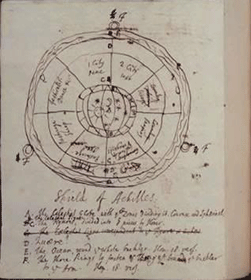
“Then, running round the shield-rim, triple-ply, he pictured all the might of the Ocean stream.”[i]
Alexander Pope “Diagram for Achilles’ Shield” (MS 4808) 1712-1724 Pen and ink on paper The British Library, London
In the eighteenth century Alexander Pope set out on a personal project to create a modern translation of Homer’s Iliad. It stretched out over a twelve-year period, and he supported himself during this time by selling subscriptions to this as a series. Along with this writing project, he attempted to reconstruct the design of Achilles’ shield, paying close attention to Homer’s descriptions. The drawings and diagrams that he created are now in the manuscript collection of the British Library. They give an excellent glimpse into this fictional work of art, and the Ocean stream that runs around its shield-rim.
Homer continues to describe the richness and imagination of the decoration for Achilles’ shield. In the lines below he lays out the scheme for this project, including several realms and worlds in which the story takes place.
“Durable fine bronze and tin he threw into the blaze with silver and with honorable gold, then mounted a big anvil in his block and in his right hand took a powerful hammer, managing with his tongs in his left hand.”
“His first job was a shield, a broad one, thick, well-fashioned everywhere. A shining rim he gave it, triple-ply, and hung from this a silver shoulder strap. Five welded layers composed the body of the shield. The maker used all his art adorning this expanse. He pictured on it earth, heaven, and sea, unwearied sun, moon waxing, and the stars that heaven bears for garland: Plêiades, Hyades, Orion in his might, the Great Bear, too, that some have called the Wain, pivoting there, attentive to Orion, and unbathed ever in the Ocean stream.”[ii]
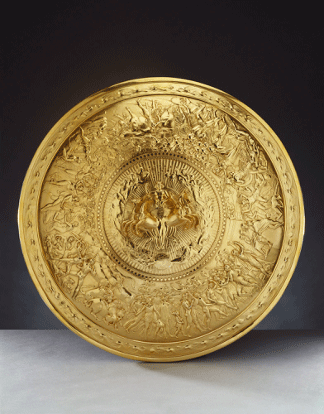
Later in history, the artisan John Flaxman was commissioned by the firm of Rundell, Brigge & Rundell in London to take Homer’s description of this shield, using the original Greek text and Alexander Pope’s translation, and using his own illustrations to reconstruct this great work of art. It includes all of the realms and landscapes as they are described, as well as the people and all of the characters as they interact, in both war and peace. To our modern eye, and mind, this shield may have been beautiful, however, it also would have been huge, impossible for a single warrior to wield.
John Flaxman (Commissioned by Philip Rundell) “Shield of Achilles” 1821 Silver gilt 90.5 x 90.5 x 18.0 cm The Queen’s Gallery, Buckingham Palace, United Kingdom
Coming closer to our own time, both W. H. Auden and Cy Twombly bring this imagery up to date. A contemporary rendering of this story by Auden alternates shorter and longer lines in its retelling. The following selected stanzas show Achilles’ mother, Thetis, looking over the shoulder of the blacksmith Hêphaistos during the process of the making of the shield. She seems to be checking on its progress, with special attention to the inclusion of the many details that will go into this narrative.
Auden however, sets a darker tone than the purely heroic one, including this description: “An artificial wilderness and a sky like lead.” Coming full circle, so to speak, the contemporary artist Cy Twombly re-visits this theme with a very energetic and abstract depiction of the shield. Insane scribblings perhaps, yet they are lyrical and beautiful, graphic expressions with the pure kinetic energy that enlivens Achilles’ shield.
The Shield of Achilles
“She looked over his shoulder For vines and olive trees, Marble well-groomed cities And ships upon untamed seas, But there on the shining metal His hands had put instead An artificial wilderness And a sky like lead.”
“She looked over his shoulder For ritual pieties, White flower-garlanded heifers, Libation and sacrifice, But there on the shining metal Where the altar should have been, She saw by his flickering forge-light Quite another scene.”
Cy Twombly “Fifty Days at Iliam: Shield of Achilles” 1978 Oil, crayon and graphite on canvas 75 1/2” x 67” Philadelphia Museum of Art, Philadelphia, Pennsylvania
“She looked over his shoulder For athletes at their games, Men and women in a dance Moving their sweet limbs Quick, quick, to music, But there on the shining shield His hands had set no dancing-floor But a weed-choked field.” “The thin-lipped armorer, Hephaestos, hobbled away, Thetis of the shining breasts Cried out in dismay At what the god had wrought To please her son, the strong Iron-hearted man-slaying Achilles Who would not live long.”[iii]
[i] Homer; The Iliad; Everyman’s Library and Alfred A. Knopf; New York, London and Toronto; 1992; p. 454, lines 607-608.
[ii] Homer; The Iliad; Everyman’s Library and Alfred A. Knopf; New York, London and Toronto; 1992; pp. 450-451, lines 479-497
[iii] Auden, W. H.; Collected Poems; Modern Library; New York, New York; 2007; pp. 594-596.
Somehow in the course of events we have been led to believe that the ‘modern’ has come to mean only formalist abstraction and minimalism. A smaller and smaller world defined by a very tight description. There are however, several important modern writers and artists who have paid special attention to the details of modern life, seeing in them the larger world and how these details might speak to us.
SUNDAY NIGHT “Make use of the things around you. This light rain Outside the window, for one. This cigarette between my fingers, These feet on the couch. The faint sound of rock-and-roll, The red Ferrari in my head. The woman bumping Drunkenly around the kitchen . . . Put it all in, Make use.”[i]
“Don’t forget when the phone was off the hook all day, every day.”[ii]
“When, at 12:24, I look at the clock that isn’t running and it tells the same time as the clock that is”[iii]
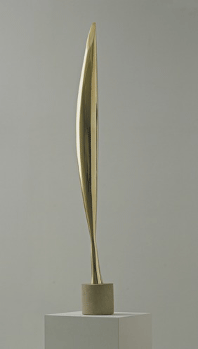
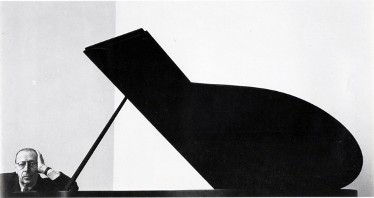
As we read the above observations, both Musa McKim and Raymond Carver look directly at the world surrounding us: a telephone lying off its hook, a broken alarm clock, a bag of sugar, or just the sun creating a glare on a sheet of white paper. Many of the same things that would catch the eye of an artist. The abstract form and shape of a grand piano, or the abstracted movement of a bird in space. All are examples of minimal imagery with maximum power that both poets and painters would employ.
Brancusi’s sculpture, straight out of a folk tradition, but unrecognzable to the Parisian elite, later became the sophisticated form that synthesized beauty, abstraction and content. There is the catch: abstraction and content. At first no one saw Brancusi’s pieces as birds, neither in space nor in flight. Today, however, they have become a symbol of just that.
Constantin Brancusi “Bird in Space” 1928 Bronze 54” x 8 ½” x 6 ½” Collection: Museum of Modern Art, New York
Not unlike the sculpture of Brancusi, the orchestral pieces of Igor Stravinsky synthesized classical music with jazz, folk and even the primal. Traditional painting had also gone through a similar synthesis of realism, cubism and pure plastic painting.
Arnold Newman “Igor Stravinsky, New York City” 1946 Black & White Photograph 12 1/16” x 22 5/16” National Portrait Gallery, Washington, DC.
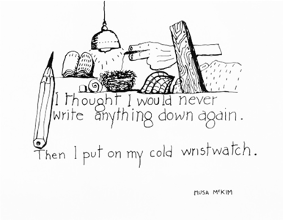
In the 1950’s and 60’s many young art students were taught by American abstract artists. Process and abstraction formed the content of most of the work at that time. But later, outside of academia, these artists were also confronted by the dilemma of what to do now? They were well versed in process, but struggled to find content. One artist however, set the most impressive example. Philip Guston at his Marlborough show in 1970 envisioned the end of one aspect of this process, and opened the gates and possibilities to new forms of imagery. Making use of the things around him.
By looking at certain details occurring in the world he single handedly opened the doors for himself, for poets, and later artists to come. These included Clarke Coolidge, Musa McKim, Raymond Carver, Robert Moskowitz, Elizabeth Murray, Susan Rothenberg and more.
“I thought I would never write anything down again. Then I put on my cold wristwatch.”[iv]
Philip Guston in collaboration with Musa McKim “I thought I would never write anything down again.” (UNDATED) Pen & ink drawing on paper 19” x 24” The Estate of Musa Guston
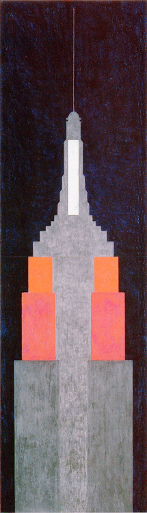
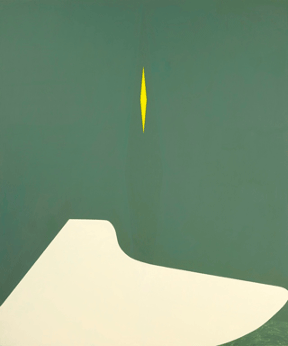
In the mid 1960’s Robert Moskowitz produced a series of small paintings of a simple corner of a room. Quiet, minimal, very abstract and infused with a new sense of content and space. Where the simplest shape or form of a thing could clearly speak.
He would later take this process, including both personal and universal images, and juxtapose them in subtle but provacotive ways. A corner of the Flatiron Building, or the tops of the Empire State Building and the World Trade Towers, for example. A simplified assortment of visual images, not unlike the sparse and provacotive language used by Raymond Carver and Musa McKim.
Robert Moskowitz “Untitled (Empire State)” 1980 Graphite and pastel on paper 106” x 31 1/4” Collection: Mr. and Mrs. Robert K. Hoffman, Dallas, Texas
“Talking about her brother Morris, Tess said: ‘The night always catches him. He never believes it’s coming.’”[v]
“When on TV I see my sister in a bit part in an old movie”[vi]
“Three men and a woman in wet suits. The door to their motel room is open and they are watching TV.”[vii]
“And below in the street they are rattling the Coca-Cola bottles”[viii]
Robert Moskowitz “Painting (For Duke Ellington)” 1977 Oil on canvas 90” x 75” Collection of Mary and Jim Parton, Great Falls, Virginia
His Bathrobe Pocket Stuffed With Notes “Duke Ellington riding in the back of his limo, somewhere in Indiana. He is reading by lamplight. Billy Strayhorn is with him, but asleep. The tires hiss on the pavement. The Duke goes on reading and turning the pages.”[ix]
[i] Carver, Raymond; “Sunday Night,” A New Path to the Waterfall; The Atlantic Monthly Press; New York, New York; 1989; p. 53.
[ii] Carver, Raymond; “His Bathrobe Pocket Stuffed With Notes,” A New Path to the Waterfall; The Atlantic Monthly Press; New York, New York; 1989; p. 66.
[iii] McKim, Musa; Alone With the Moon; The Figures; Great Barrington, Massachusetts; 1994; p. 105.
[iv] McKim, Musa; Alone With the Moon; The Figures; Great Barrington, Massachusetts; 1994; p. 121.
[v] Carver, Raymond; “His Bathrobe Pocket Stuffed With Notes,” A New Path to the Waterfall; The Atlantic Monthly Press; New York, New York; 1989; p. 64.
[vi] McKim, Musa; Alone With the Moon; The Figures; Great Barrington, Massachusetts; 1994; p. 105.
[vii] Carver, Raymond; “His Bathrobe Pocket Stuffed With Notes,” A New Path to the Waterfall; The Atlantic Monthly Press; New York, New York; 1989; p. 65.
[viii] McKim, Musa; Alone With the Moon; The Figures; Great Barrington, Massachusetts; 1994; p. 105.
[ix] Carver, Raymond; “His Bathrobe Pocket Stuffed With Notes,” A New Path to the Waterfall; The Atlantic Monthly Press; New York, New York; 1989; p. 66.