MATISSE ON ART: THE SIGNS FOR TREES

“The importance of an artist is to be measured by the number of new signs he has introduced into the plastic language . . .”1

During the fall semester of 1964, my first year in art school, the Baltimore Museum of Art opened an exhibition titled “1914” in celebration of the 50th Anniversary of the museum’s founding: all of the work in this exhibition had been created in that year. It was such a special event and continues to hold a place in my memory.

In particular, the Matisse painting “A View of Notre Dame” was shocking and effectively changed how and what we saw. First and foremost, it is not flat! Many people see it at first as a flat wall, with possibly a window in the upper left corner. However, the view from Matisse’s studio window clearly shows the wall from his apartment building on the right, the River Seine with a bridge crossing it in the middle distance, and finally the overall form of Notre Dame in the distance, with the sign for a tree just in front of it.
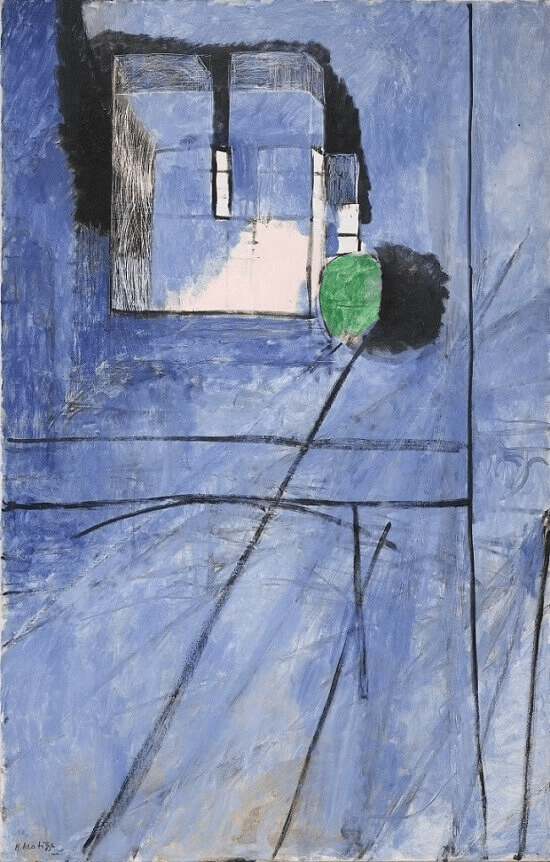
Henri Matisse
“View of Notre Dame”
1914
Oil on canvas
58” x 37 1/8”
Museum of Modern Art, New York

“In 1914, as in 1964, ‘today’ for one was not the same as ‘today’ for another. One neglects, the other attends the new. We see now, looking back, new doors were opened, some artists unfettered, new possibilities were seen, challenges made possible, the unfamiliar explored, and we recognize in the art of 1914 ourselves emerging.”2

During this time period Mr. Charles Parkhurst was the Director of the Baltimore Museum of Art and was primarily responsible for the “1914” exhibition. As many historians will remember, during World War II, he was also one of the Monuments Men who were in charge of the inventory and return of the many works of art that had been stolen by the Nazis. Beginning in 1943 they were acting as advisors on cultural resources and continued into 1946 when these duties were absorbed into other agencies.

From 1941 until Matisse’s death in 1953, the poet Louis Aragon and Henri Matisse were friends. Over these years, during ongoing conversations with Aragon, Matisse spoke of the importance of searching for his own personal signs for the many objects he was drawing and painting. And Aragon, for his part, spent nearly his last 30 years writing his book Henri Matisse a Novel!
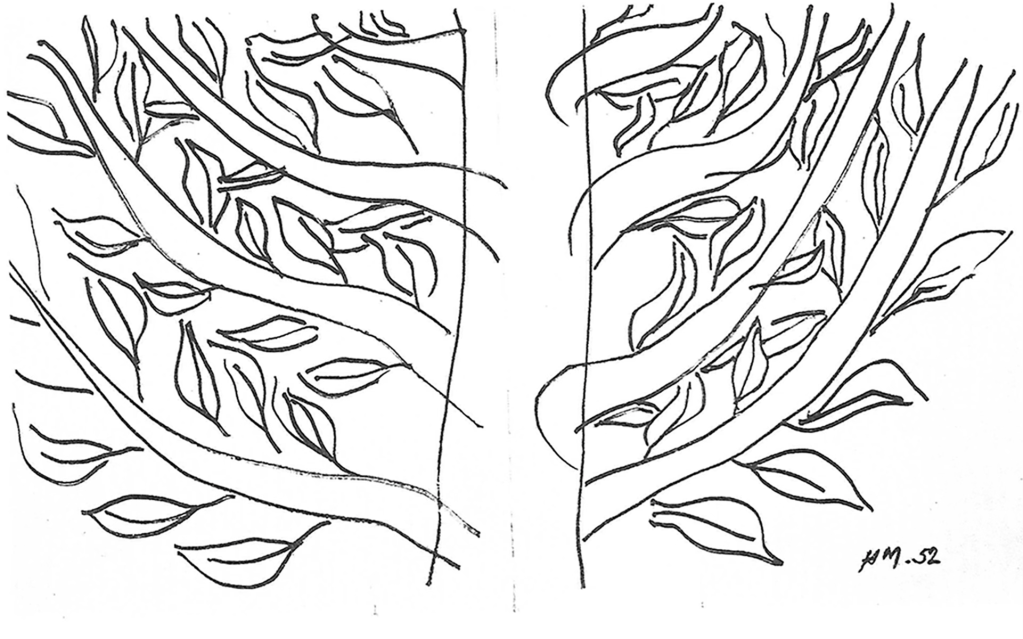
Henri Matisse
“Tree”
1952
Brush and ink over charcoal on paper
5’ 3” x 9’ 3 13/16”
Private Collection

“I have shown you, haven’t I these drawings I have been doing lately, learning to represent a tree, or trees? As if I’d never seen or drawn a tree. I can see one from my window. I have to learn, patiently, how the mass of the tree is made, then the tree itself, the trunk, the branches, the leaves. First the symmetrical way the branches are disposed on a single plane. Then the way the branches turn and cross in front of the trunk . . . Don’t misunderstand me: I don’t mean that, seeing the tree through me window, I work at copying it. The tree is also the sum total of its effects upon me. There’s no question of my drawing a tree that I see. I have before me an object that affects my mind not only as a tree but also in relation to all sorts of other feelings . . . I shan’t get free of my emotion by copying the tree faithfully, or by drawing its leaves one by one in the common language . . . But only after identifying myself with it. I have to create an object that resembles the tree. The sign for the tree, and not the sign that other artists may have found for the tree: those painters, for instance, who learned to represent foliage by drawing 33, 33, 33 . . . . This is the residuum of the expression of other artists. These others have invented their own sign.”3
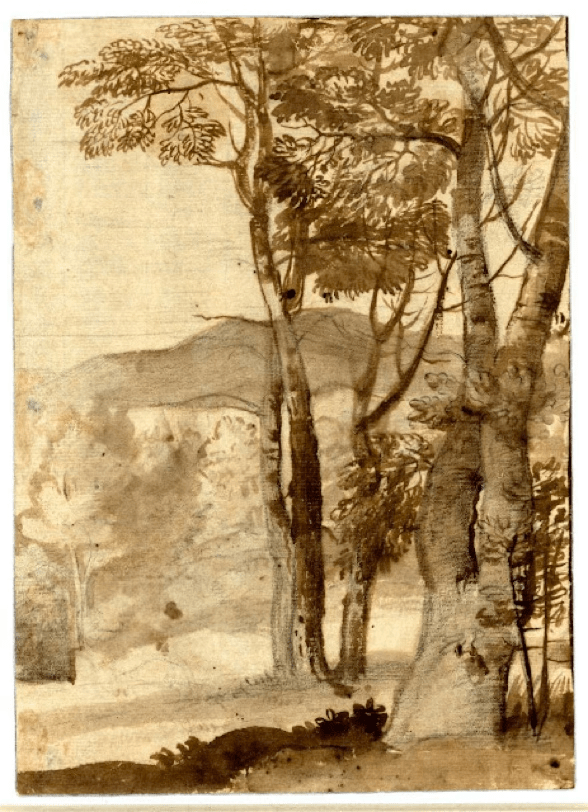
Claude Lorrain
“Trees”
c1650
Ink wash drawing
The British Museum, London
United Kingdom

In further conversations with Aragon, Matisse continues this discussion: “. . . and the residuum of another’s expression can never be related to one’s own feeling. For instance: Claude Lorrain and Poussin have ways of their own of drawing the leaves of a tree, they have invented their own way of expressing those leaves. So cleverly that people say they have drawn their trees leaf by leaf. It’s just a manner of speaking: in fact they may have represented fifty leaves out of a total two thousand. But the way they place the sign that represents a leaf multiplies the leaves in the spectator’s mind so that he sees two thousand of them . . . They had their personal language. Other people have learned that language since then, so that I have to find signs that are related to the quality of my own invention. These will be new plastic signs, which in their turn will be absorbed into the common language if what I say by their means has any importance for other people . . .”4

In letters and discussions with the French poet Louis Aragon, Henri Matisse would often describe his working process. It was not one of copying or imitating, but rather one of searching or discovering. One of abstracting: of noticing how a single line could completely change our understanding: like so many young American tourists who come to realize the differences between the numbers “1” and “7” when written in Europe.

As for Matisse, early on he realized that numbers such as “2” and “3” or “8” could be used as a means in the process of abstracting. Of discovering or inventing signs. There is even a page of one of Matisse’s letters where he draws these numbers out in various configurations becoming noses and eye sockets, or upper and lower lips on the model.5
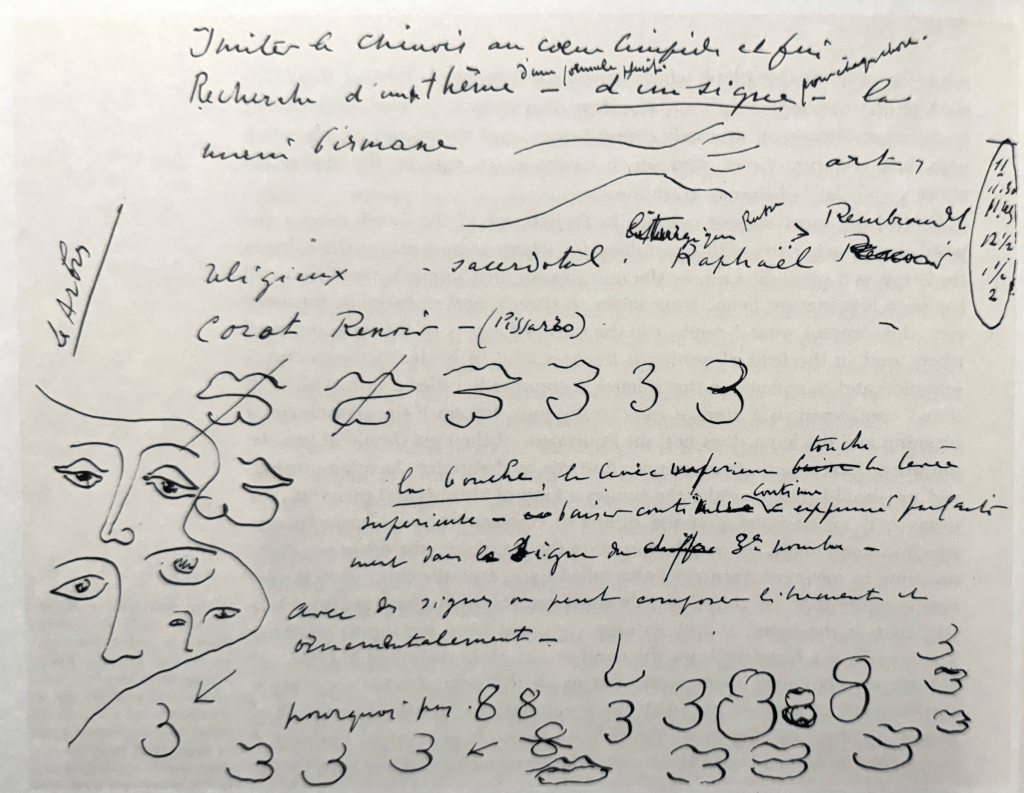
Henri Matisse
“Page from a letter by Henri Matisse to Louis Aragon”
16 February 1942
Pen and ink on paper

For some of the most insightful writing on Matisse, research and background, one can do no better then the two volume biography The Unknown Matisse and Matisse the Master by Hilary Spurling; the collection of Matisse’s own words, Matisse On Art as edited by Jack Flam; and finally, the two volume Henri Matisse a Novel by the surrealist poet Louis Aragon.

So I will conclude with a short passage from Spurling’s second volume on Matisse, wherein he reflects upon his later work:

“Matisse was operating literally as well as metaphysically on the borders of perception. ‘I’m out of action because of having flirted for too long, more or less nonstop, with these enchanted colours,’ he had written to André Rouveyre at the end of 1943, when the paper cut-outs he made for Jazz brought his lifelong confrontation with colour to a climax. His Nice oculist (who had treated Monet in his last years in Paris) explained that the eye could not fabricate pigment fast enough to keep up with the speed and intensity of Matisse’s response to colour. The painter said he had achieved the same intensity before without being able to sustain it, like a juggler throwing his clubs so high he couldn’t catch them (‘I was perfectly capable of pinning down on canvas the colours that give me relief . . . but I had no way of keeping them at that pitch’).6
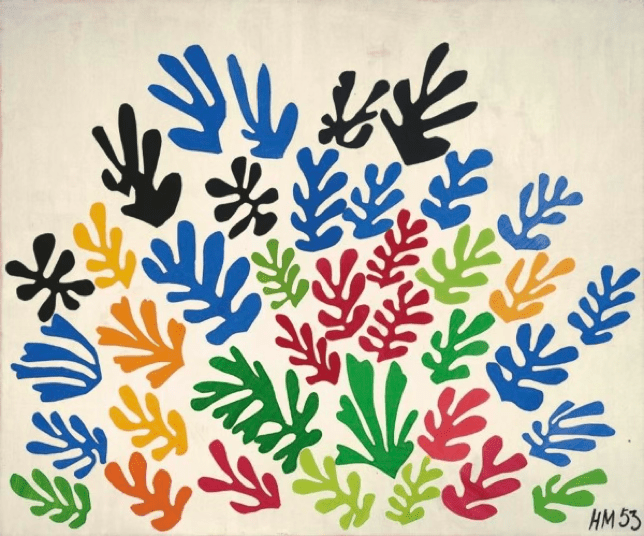
Henri Matisse
“The Sheaf”
1953
Gouache on paper, cut an pasted, on paper.
115 3/4” x 137 3/4”
Hammer Museum, University of California
Los Angeles, California

1 Flam, Jack, editor; Matisse on Art; University of California Press; Berkeley and Los Angeles, California; 1995; p. 150.

2 Parkhurst, Charles, et al; 1914: An Exhibition of Paintings, Drawings and Sculpture; The Baltimore Museum of Art; Baltimore, Maryland; 1964; p. 7.

3 Flam, Jack, editor; Matisse on Art; University of California Press; Berkeley and Los Angeles, California; 1995; p. 149.

4 Flam, Jack, editor; Matisse on Art; University of California Press; Berkeley and Los Angeles, California; 1995; pp. 149-150.

5 Aragon, Louis; Jean Stewart, Translator; Henri Matisse a novel; Two Volumes; Harcourt Brace Jovanovich, Inc.; New York, New York; 1971-1972; vol. 1, p. 150.

6 Spurling, Hilary; Matisse the Master; Alfred A. Knopf; New York, New York; 2005; pp. 427-428.

LOOKING AT GIACOMETTI

Here is a selection of writers who have taken their cue from the artist himself, Alberto Giacometti, in an intense looking at the world. In this case, the world is the one contained within the artist’s studio. From Jean Paul Sartre and Jacques Dupin, to David Sylvester and James Lord, these writers experienced first hand the work of the artist. Unique points of view, in fact, art historical primary sources. None of these selections are mere descriptions or illustrations, rather they are true ruminations and examples of literature which have been inspired directly by visual works of art and the artist who created them.

Alberto Giacometti
“Portrait of Jean Paul Sartre”
1949
Pencil on paper
28.5cm x 11.2cm
Fondation Giacometti, Paris, France

In his essay on “The Quest for the Absolute” Jean Paul Sartre famously observed that this work was real evidence of the existential predicament. It was included in the catalogue for Giacometti’s 1948 exhibition at the Pierre Matisse Gallery in New York: Giacometti’s first major exhibition after WWII, and his first at Pierre Matisse in fourteen years. Sartre wrote:

“So we must start again from scratch. After three thousand years the task of Giacometti and contemporary sculptors is not to add new works to the galleries but to prove that sculpture is possible. . . . It is necessary to push to the limits and see what can be done. If the undertaking should end in failure, it would be impossible, in the best cases, to decide whether this meant that the sculptor had failed or sculpture itself; others would come along, and they would have to begin anew. Giacometti himself is forever beginning anew. But this is not an infinite progression; there is a fixed boundary to be reached, a unique problem to be solved: how to make a man out of stone without petrifying him. It is an all-or-nothing quest: if the problem is solved, it matters little how many statues are made.”1

Herbert Matter
“Alberto Giacometti’s Portrait of Eli Lotar III”
1965
Gelatin silver print
14 3/4” x 19”
Gitterman Gallery, New York, New York.

Not just the writers, but many photographers took an interest in this work, continuing to pay attention to the changing vision and work of this artist. Both Henri Cartier-Bresson and Herbert Matter caught iconic images of Giacometti working in his studio and walking through the streets of Paris, and it was in this particular neighborhood that Jacques Dupin would visit Alberto Giacometti. His visits were recorded in the book “Giacometti: Three Essays” and the first of these essays, “Texts for an Approach” was actually translated by the New York School poet John Ashberry. Dupin wrote on both the artist’s earlier work and how it formed the ideas for the later work.

“His not stopping means that he never stops looking at and depicting what he sees, in any circumstances and at each minute of his life, even if he is not ‘working.’ In the café he draws on his newspaper, and if he has no newspaper, his finger still runs over the marble top of the table. . . . His not stopping means too that Giacometti can only present us the rough draft of an unaccomplished, unfinished undertaking. A reflection, an approximation of reality—of that absolute reality which haunts him—and which he pursues in a kind of amorous or homicidal fury. . . .”

Alberto Giacometti
“Jacques Dupin” (No Inscription)
1965
Oil on canvas
25.75″ x 21.25″
Fondation Giacometti, Paris, France.

“. . . His optimism is thus as disproportionate with regard to the relative as his pessimism is categorical with the absolute. Yet people readily accuse him of repeating himself, of marking time. . . . In returning untiringly to the bust of Diego, the standing woman, the walking man, the portrait of the same model, he may discourage the inattentive spectator, but his austere research allows him to concentrate his ways of approaching. The slower his walk toward his goal appears, the more rapid it actually is. Each acquisition is definitive, each progress irreversible. But progress plays only with imponderable elements. A single line can stop it a whole night and hold up the whole work with the question of the exactness of its inflection. Giacometti’s not stopping means also that he does not stop advancing.”2

In addition to Jacques Dupin, the writer David Sylvester made frequent visits to Giacometti’s studio. He began these visits in the late 1940’s and continued for over forty years, including a prolonged time, sitting for his own portrait. Sylvester’s writings feature several other important artists of the time, including Henry Moore, Francis Bacon, and René Magritte, as well as this important one on Alberto Giacometti. Two examples follow:

“The sight of towering granite, stark, greyly luminous, somehow weightless, soaring to jagged splintered summits, appears in images of fragile heads and figures which are also giving form to a vision of urban reality suddenly filled with ‘an unbelievable sort of silence’ where any head was ‘as if it were something simultaneously alive and dead’, every object ‘had its own place, its own weight, its own silence, even’, was separated from other objects by ‘immeasurable chasms of emptiness’. And we, confronting the embodiments of those coalesced sensations, feel a shock of recognition of ourselves and to our mutual separateness.”3

Alberto Giacometti
“Portrait of David Sylvester”
1960
Oil on canvas
45 11/16″ x 35 1/16”
Museum of Modern Art, New York, New York.

“Giacometti normally has several sculptures and paintings simultaneously in progress. The thickness of the paint on most of the canvases suggests that they have been worked at over a long period. . . . Those from memory are worked on in a way that is highly characteristic of Giacometti in that it reflects a curious combination of nagging self-criticism and a desire for spontaneity. While it is in progress, and this can be over a period of a couple of years,…..it is as if the process of creation consisted of a series of rehearsals and the final rehearsal was the performance, though the performer didn’t know till afterwards that this rehearsal was to be the performance.”4

Finally, the American writer James Lord, agreed to sit for his own portrait. During this time and unbeknownst to the artist, Lord made meticulous notes and took a photograph of the portrait he had been sitting for after each of its eighteen sittings. Here are two excerpts: one from the end of the first week of sittings, and the second from the very last day. It is as if each new sitting is a new attack, seeing everything again, and a new beginning.

“Giacometti looked forward to working on Sunday because the chances of being disturbed then by visitors were less than during the week. As soon as I arrived at the studio, he told me that he hadn’t gone to bed till five and had slept very badly. But he denied feeling at all tired, and we began work at once. ‘It’s going to go well today,’ he said. ‘There’s an opening. I’ve got to make a success of the head.’ I didn’t answer, and after a few minutes he added, ‘This morning when Diego came into my room I was overcome by the construction of his head. It was as though I’d never seen a head before.’”5

Alberto Giacometti
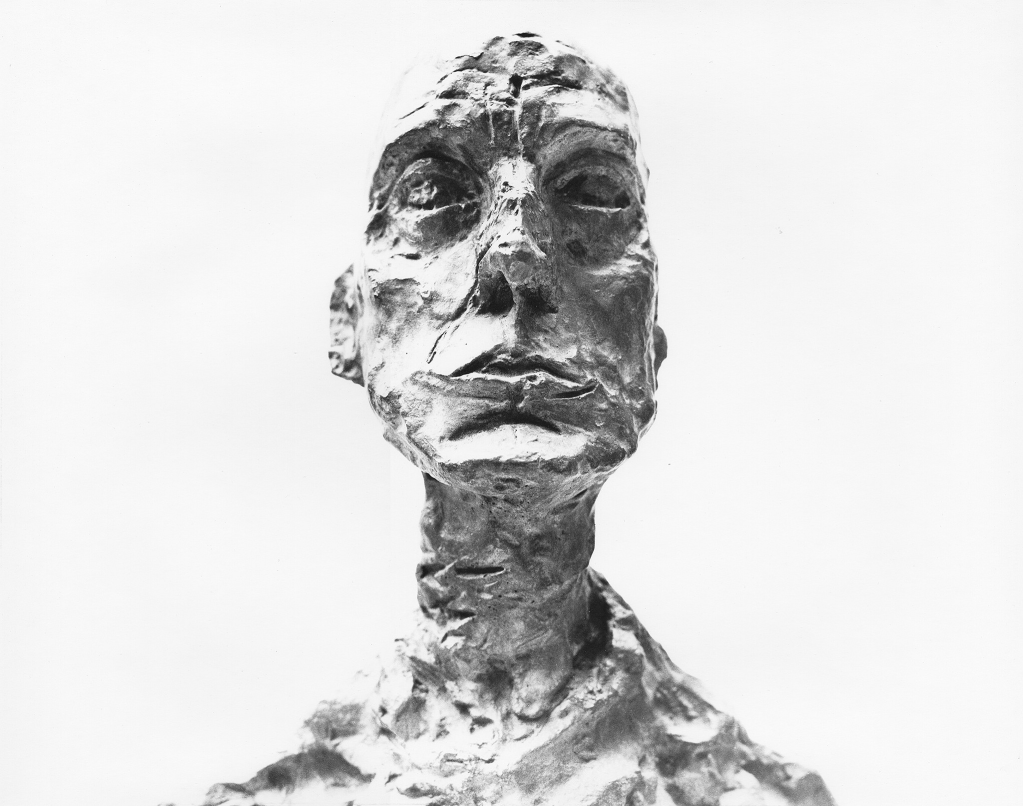
“Bust of Diego, Second Version”
1962-1964
Bronze
17.44″ x 10.78″ x 6.29”
Fondation Giacometti, Paris

James Lord visited Giacometti’s studio one last time to say goodbye. They had worked on his portrait for eighteen days, sometimes making progress, sometimes not. It is a beautifully written book, sensitive to both the artist and his working process. A Giacometti Portrait has now become a classic. Always inspiring to so many artists and students and so important in understanding the thinking and painting processes employed by Alberto Giacometti.

“We went to the café. In the street he said. ‘There has been, after all, a slight progress. There’s a very small opening. In two or three weeks I’ll have an idea if there’s any hope, any chance of going on. Two or three weeks, maybe less. I have a portrait of Caroline to do, then there’s the one of Annette. And I want to do some drawings, too. I never have time for drawings anymore. Drawing is the basis for everything, though. I’d like to do some still life. But we did make a little progress, didn’t we?’”6

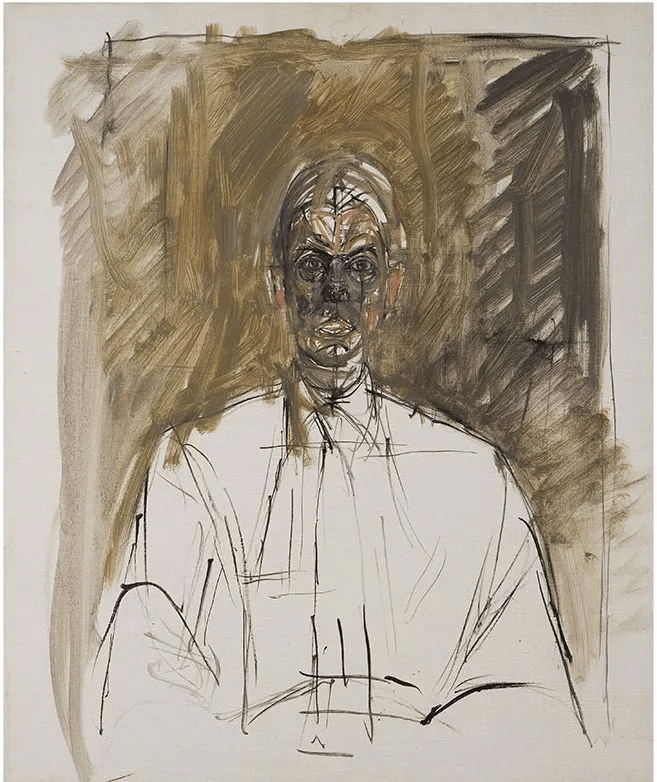
Alberto Giacometti
“Portrait of James Lord”
1964
Oil on canvas
45 5/8” x 31 3/4”
Collection of James Lord.

1 Sartre, Jean Paul; We Have only this Life to Live: Selected Essays 1939-1975; The New York Review of Books; New York, New York; 2013; p. 189.

2 Dupin, Jacques; Giacometti: Three Essays (translated by John Ashberry and Brian Evenson); Black Square Editions, Hammer Books; New York, New York; 2003; pp. 52-53.

3 Sylvester, David; Looking at Giacometti; Henry Holt and Company; New York, New York;1994; p. 113.

4 Sylvester, David; Looking at Giacometti; Henry Holt and Company; New York, New York;1994; p. 7.

5 Lord, James; A Giacometti Portrait; The Museum of Modern Art, New York, and Doubleday & Company; Garden City, New York; 1965; p. 28.

6 Lord, James; A Giacometti Portrait; The Museum of Modern Art, New York, and Doubleday & Company; Garden City, New York; 1965; p. 64.

MARIANNE MOORE AND THE FABLES OF LA FONTAINE

Since ancient times, certain stories have been handed down from one generation to another through the spoken word. They were collected by such writers as Ovid, Homer, Aesop; other later fabulist writers; and even Rumi. It was later that they were finally published. There are also times when pieces of writing, or works of art are not merely illustrations of each other, but are truly complementary, that they support one another. “The Fables of La Fontaine” are a great example of this.

Pierre Julien
“La Fontaine with the Manuscript of the Fox and the Grapes”
1785
Marble
5′ 8″ x 3′ 7 1/4″ x 4′ 2 3/4″
The Louvre, Paris, France

“The Fables of La Fontaine” were published from 1668 to 1694. Over these years several editions were illustrated by François Chauveau, Jean-Baptiste Oudry, and Gustave Doré: these becoming major works of art in their own right. They were translated into English by Walter Thornbury in 1868 and much later by the Imagist poet Marianne Moore in her “Late Poems from 1965 to 1972.”

As this ancient tradition of story telling spread throughout the world, several of Aesop’s Fables found their way from the West to the East. As Jelaluddin Rumi had himself been collecting similar stories, several of them were included in his late work the Masnavi. In more recent times, new translations of these have been undertaken by Coleman Barks, especially in his books on The Soul of Rumi and One-Handed Basket Weaving.

So the following is a selection of three poems. Two versions of the story of the friendship between a bear and a gardener: the first is Marianne Moore’s translation of La Fontaine’s “The Bear and the Garden-Lover” and the second one is Coleman Barks’ translation of “The Man with a Bear” by Rumi. The final selection is a short piece from Marianne Moore’s translations titled “The Fox and the Grapes.” The works of art by Gustave Doré, an Anonymous Persian Miniaturist, and François Chauveau.

The Bear and the Garden-Lover

“A bear with fur that appeared to have been licked backward
Wandered a forest once where he alone had a lair.
This new Bellerophon, hid by thorns which pointed outward,
Had become deranged. Minds suffer disrepair
When every thought for years has been turned inward.
We prize witty byplay and reserve is still better,
But too much of either and health has soon suffered.
No animal sought out the bear
In coverts at all times sequestered,
Until he had grown embittered
And, wearying of mere fatuity,
By now was submerged in gloom continually.
He had a neighbor rather near,
Whose own existence had seemed drear;
Who loved a parterre of which flowers were the core,
And the care of fruit even more.
But horticulturalists need, besides work that is pleasant,
Some shrewd choice spirit present.
When flowers speak, it is as poetry gives leave
Here in this book; and bound to grieve,
Since hedged by silent greenery to tend,
The gardener thought one sunny day he’d seek a friend.
Nursing some thought of the kind,
The bear sought a similar end
And the past just missed collision
Where their paths came in conjunction.
Numb with fear, how ever get away or stay here?
Better be a Gascon and disguise despair
In such a plight, so the man did not hang back or cower.
Lures are beyond a mere bear’s power
And this one said, ‘Visit my lair.’ The man said, ‘Yonder bower,
Most noble one, is mine; what could be friendlier
Than to sit on tender grass and share such plain refreshment
As native products laced with milk? Since it’s an embarrassment
To lack what lordly bears would have as daily fare,
Accept what if here.’ The bear appeared flattered.
Each found, as he went, a friend was what most mattered;
Before they’d neared the door, they were inseparable.
As confidant, a beast seems dull.
Best live alone if wit can’t flow,
And the gardener found the bear’s reserve a blow,
But conducive to work, without sounds to distract.
Having game to be dressed, the bear, as it puttered,
Diligently chased or slaughtered
Pests that filled the air, and swarmed, to be exact,
Round his all too weary friend who lay down sleepy—
Pests—well, flies, speaking unscientifically.
One time as the gardener had forgot himself in dream
And a single fly had his nose at its mercy,
The poor indignant bear who had fought it vainly,
Growled, ‘I’ll crush that trespasser; I have evolved a scheme.’
Killing flies was his chore, so as good as his word,
The bear hurled a cobble and made sure it was hurled hard,
Crushing a friend’s head to rid him of a pest.
With bad logic, fair aim disgraces us the more;
He’d murdered someone dear, to guarantee his friend rest.

Intimates should be feared who lack perspicacity;
Choose wisdom, even in an enemy.”1

Gustave Doré
Jean de La Fontaine’s “L’Ours et l’amateur des jardins”
1868
Wood engraving
Public Domain

“The Man with a Bear”

“For the man who saved the bear
from the dragon’s mouth, the bear
became a sort of pet.

When he would lie down to rest,
the bear would stand guard.

A certain friend passed by,
‘Brother how did this bear
get connected to you?’

He told the adventure with the dragon,
and the friend responded,
‘Don’t forget
what your companion is. This friend
is not human! It would be better
to choose one of your own kind.’

‘You’re just jealous of my unusual helper.
Look at his sweet devotion. Ignore
the bearishness!’

But the friend was not convinced,
‘Don’t go into the forest
with a comrade like this!
Let me go with you.’
‘I’m tired.
Leave me alone.’
The man began imagining
motives other than kindness for his friend’s concern.
‘He has made a bet with someone
that he can separate me from my bear.’ Or,
‘He will attack me when my bear is gone.’

He had begun to think like a bear!

So the human friends went different ways,
the one with his bear into a forest,
where he fell asleep again.

The bear stood over him
waving the flies away.

But the flies kept coming back,
which irritated the bear.

He dislodged a stone from the mountainside
and raised it over the sleeping man.

When he saw that the flies had returned
and settled comfortably on the man’s face,
He slammed the stone down, crushing
to powder the man’s face and skull.

Which proves the old saying:

IF YOU’RE FRIENDS
WITH A BEAR,
THE FRIENDSHIP
WILL DESTROY YOU.

WITH THAT ONE,
IT’S BETTER TO BE
ENEMIES.”2

Illustration contained in the Manuscript W.626.79B
“Masnavi-i ma’navi” by Jalal al-Din Rumi
1663
Ink and pigments on thin laid paper
10 7/16” x 5 7/8”
The Walters Art Museum,
Baltimore, Maryland.

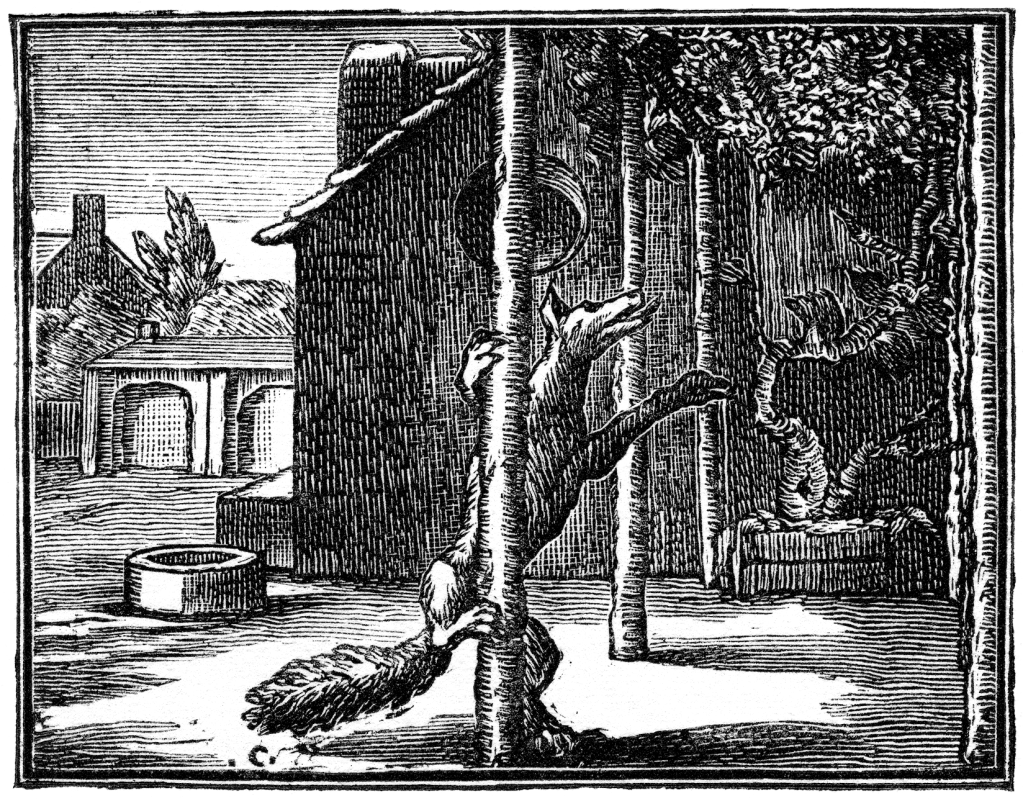
The Fox and the Grapes

“A fox of Gascon, through some say of Norman descent,
When stared till faint gazed up at a trellis to which grapes were tied—
Matured till they glowed with a purplish tint
As though there were gems inside.
Now grapes were what our adventurer on strained haunches chanced to crave
But because he could not reach the vine
He said, ‘These grapes are sour; I’ll leave them for some knave.’

Better, I think, than an embittered whine.”3

Francois Chauveau
“Illustration for the Fables de La Fontaine, Volume 1”
1668
Burin engraving
Claude Barbin & Denys Thierry,
Paris, France

1 Moore, Marianne; Grace Schulman, ed.; The Poems of Marianne Moore, Viking Penguin; New York, New York; 2003; pp. 370-371.

2 Barks, Coleman; RUMI One-Handed Basket Weaving Poems on the Theme of Work; MAYPOP; Athens, Georgia; pp. 23-24.

3 Moore, Marianne; Grace Schulman, ed.; The Poems of Marianne Moore, Viking Penguin; New York, New York; 2003; p. 365.

ASPHODEL, THAT GREENY FLOWER

As an extended reflection on the artist’s life and family history, his marriage, and with several references to other artists, William Carlos Williams chose to include this great poem at the very end of his last collection, Pictures from Brueghel and other poems, published in 1962.  It is sometimes referred to as the world’s darkest love poem. 

In the past, whenever I read “Asphodel” I had always thought of it as a written piece of surrealism:  an author speaking to his contemporaries while walking through a strange landscape.  He often mentions his wife Flossie and their friend Charlie Demuth, as well as other artists such as Goya and Cezanne.  Today, when I re-read these lines, I associate them with more contemporary artists, especially Alfred Leslie and Laurie Gatlin. 

I used to see certain paintings by Leslie at Allen Frumkin’s galleries in both Chicago and New York.  I would often make a connection to certain other events or stories.  With this one in particular, “7:00 AM News” I would always go right back to Williams and his observations regarding dreaded poetry and the news.  

“It is difficult to get the news from poems….”[i]

Alfred Leslie
“7:00 AM News”
1976
Oil on canvas
84” x 60”
Allan Frumkin Gallery, New York

Then there is that strange visual juxtaposition of flowers actually blooming in hell.  Totally surreal and I cannot help but think of the artist’s post card series created by Laurie Gatlin during the mid 1990’s.

I have recently re-discovered several of Dr. Gatlin’s post cards from this series, especially the ones quoting Dr. Williams and the Asphodel.  When I asked her about them, this is what she had to say: 

“I love that poem. I like the way it meanders through memory, and balances both loss and sorrow and love.  I started that postcard project when I was living alone for the first time – I got married young and never lived on my own – I went from my parents house to my husband’s house, and then we had a house with children, a noisy house, and when I separated from him and moved into my own apartment, I was both happy with the ability to be alone and also terribly lonely.  It’s hard to make that adjustment, and the way I coped was to reach out with my postcards. . . . So there were a lot of things in that poem that resonated with me, and re-reading it again today, I am more struck by the sense of looking back over a life lived. . . .” 

Laurie Gatlin
“Flowers in Hell”
1995
5 1/2” x 3 1/2”
Collage and acrylic medium on post card
Private collection, Indianapolis

“One of the things that strikes me about William Carlos Williams is the sense of rhythm in his works – not structured with regular meter, but it reads to me very much like a metered poem.  There’s also the sense of distance in most of his poems – a sense of standing apart, and I think that appeals to me. Of Asphodel is actually pretty personal as it speaks about his relationship with his wife, but so much of it is also observational and distant.  I think I appreciated both of those aspects at the time as well – the meter and the sense of distance/personal relationship.”[ii]

I have always agreed with these observations from Laurie Gatlin and I share her understanding of Williams’ poem and its meanings.  However, during all of this time I missed a crucial detail of what Williams was trying to say.  Only recently have I discovered classical references to this greeny flower.  In fact, Homer mentions this in several passages of The Odyssey.  While exploring Hades at the direction of Circe in order to consult the prophet Tiresias, Odysseus had met and talked with Achilles’ ghost and Minos, as well as Agamemnon, his own dead mother Autolycus, and of course Tiresias hinself.  He had been sent by Circe in order to question his former crew regarding the events wherein he was lost at sea and these mates had been killed.  All the while, during this visit, he noticed that there were fields and meadows of asphodels growing there.   

“Of asphodel, that greeny flower,
                  like a buttercup
                                    upon its branching stem—
save that it’s green and wooden—
                  I come, my sweet,
                                    to sing to you. 
We lived long together
                  a life filled,
                                    if you will,
with flowers.  So that
                  I was cheered
                                    when I came first to know
that there were flowers also
                  in hell.”[iii]

It turned out that Circe had instructed Odysseus two different times to travel to Hades for advice and guidance from his brothers in arms and from Tiresias. When he told Achilles that his son was actually still alive and had brought honor to his family, the ghost was overjoyed:    

“…after I told him this, Achilles’ ghost
took great swift-footed strides across the fields
of asphodel, delighted to have heard
about the glorious prowess of his son.”[iv]      

During these explorations Odysseus met and talked with many of the inhabitants of the underworld.  Whilst he was seeking to learn the routes out in order to return to Ithaca, his comrades in the underworld were seeking news of the outside world and they rushed to find any news that they could. 

“On open roads they crossed the Ocean stream,
went past the rock of Leucas and the gates
of Helius the Sun, and skittered through
the provinces of dreams, and soon arrived
in fields of asphodel, the home of shadows
who have been worn to weariness by life.”[v] 

Asphodel, That Greeny Flower
“Of asphodel, that greeny flower,
                  I come, my sweet,
                                    to sing to you!
My heart rouses
                  thinking to bring you news
                                    of something
that concerns you
                  and concerns many men.  Look at
                                    what passes for the new. 
You will not find it there but in
                  despised poems. 
                                    It is difficult
to get the news from poems
                  yet men die miserably every day
                                    for lack
of what is found there.”[vi]

Laurie Gatlin
“It is difficult to get the news”
1995
5 1/2” x 3 1/2”
Collage and acrylic medium on post card
Private collection, Indianapolis

“What power has love but forgiveness? 
                  In other words
                                    by its intervention
what has been done
                  can be undone. 
                                    What good is it otherwise? 
Because of this
                  I have invoked the flower
                                    in that
frail as it is
                  after winter’s harshness
                                    it comes again
to delect us. 
                  Asphodel, the ancients believed,
                                    in hell’s despite
was such a flower.”[vii]


[i] Williams, William Carlos; Pictures from Brueghel and other poems; New Directions Publishing Corporation; New York, New York; 1962; p. 161.

[ii] Gatlin, Laurie; in an artist’s statement and e-mail communication with this writer; 29 June 2020, 6:58 AM.

[iii] Williams, William Carlos; Pictures from Brueghel and other poems; New Directions Publishing Corporation; New York, New York; 1962; p. 153.

[iv] Homer; The Odyssey; (translated by Robert Fitzgerald and with an introduction by Seamus Heaney); Everyman’s Library and Alfred A. Knopf; New York, London, Toronto; 1910 & 1992; pp. 296-197, lines 538-541.

[v] Homer; The Odyssey; (translated by Robert Fitzgerald and with an introduction by Seamus Heaney); Everyman’s Library and Alfred A. Knopf; New York, London, Toronto; 1910 & 1992; p. 507, lines 11-16.

[vi] Williams, William Carlos; Pictures from Brueghel and other poems; New Directions Publishing Corporation; New York, New York; 1962; pp. 161-162.

[vii] Williams, William Carlos; Pictures from Brueghel and other poems; New Directions Publishing Corporation; New York, New York; 1962; pp. 169-170.

THE CUTTING PROW

“Everything must
Be arranged
To a hair’s breadth
In thunderclap
Order.”
Antonin Artaud, 1947[i]

In conversations with many of his friends over the years, especially with the poet Louis Aragon, Matisse often stated that:  “The importance of an artist is to be measured by the number of new signs he has introduced into the plastic language….”[ii]

It truly was a new world of signs and images that Matisse was creating.  Even as he was recovering from several surgeries late in life and confined to his bed or wheelchair, he kept working.  The philosopher Henri Focillon described this as a carving out of space or as the work of art creating its own space in the life of forms.  The Beat Generation poet Ed Sanders has also described this as ‘those scissors flashing in the world of forms’ or as a ‘cutting’ form.

As Artoud described this process it is a project dealing with arrangements to “a hair’s breadth.”  Later it would be suggested by Sanders that he wants it adjusted “This way and that, Minutitudinous!”

Or as Matisse himself has noted “The artist’s role is not to translate an observation, but to express the impact an object makes on his own nature:  the shock, the initial reaction.”[iii]

“A work of art is situated in space.  But it will not do to say it simply exists in space:  a work of art treats space according to its own needs, defines space and even creates such space as may be necessary to it.  The space of life is a known quantity to which life readily submits; the space of art is a plastic and changing material.”[iv]

THE CUTTING PROW:  FOR HENRI MATISSE

“The genius was 81
Fearful of blindness
Caught in a wheelchair
Staring at death

But the Angel of mercy
Gave him a year
To scissor some shapes
To soothe the scythe

And shriek! shriek!
Became
swawk! swawk!
The peace of
Scissors.

prow1
Helene Adant
“Matisse at work in his studio in Nice”
B&W Photograph
1952
Musee National d’Art Moderne, Paris

There was something besides
The inexpressible

Thrill

Of cutting a beautiful shape—-
For

Each thing had a ‘sign’
Each thing had a ‘symbol’
Each thing had a cutting form

-swawk swawkk___
to scissor seize.

‘One must study an object a long time,’
the genius said,
‘to know what its sign is.’

The scissors were his scepter
The cutting
Was as the prow of a barque
To sail him away.
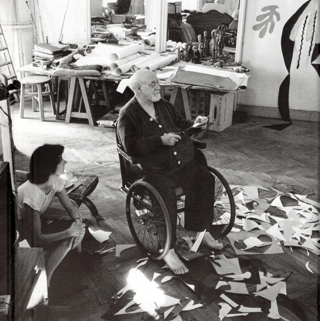
There’s a photograph
which shows him sitting in his wheelchair
bare foot touching the floor
drawing the crisscross steel
a shape in the gouache

His helper sits near him
Till he hands her the form
To pin to the wall

prow2
Helene Adant
“Paule Martin and Matisse in the Hotel Regina, Nice”
B&W Photograph
1952
Musee National d’Art Moderne, Paris

He points with a stick
How he wants it adjusted
This way and that,
Minutitudinous

The last blue iris blooms at
The top of its stalk
Scissors/scepter
Cutting prow

(sung)

Ah, keep those scissors flashing in the
World of Forms, Henri Matisse

The cutting of the scissors
Was the prow of a boat
To take him away
The last blue iris
Blooms at the top
On a warm spring day

prow3
Helene Adant
“Matisse in Vence with scissors and gouache cut-outs”
1947-1948
B&W Photograph
Cameraphoto, Venice

Ah, keep those scissors flashing
In the World of Forms, Henri Matisse

Sitting in a wheelchair
Bare feet touching the floor
Angel of Mercy
Pushed him over Next to Plato’s door

Scissor scepter cutting prow

ahh
swawk swawk

ahh swawk swawk

ahh swawk swawk.”[v]


[i] Artaud, Antonin, (Clayton Eshleman, translator); To Have Done with the Judgement of God; Black Sparrow Press; Los Angeles; 1975. p. 1.

[ii] Flam, Jack; Matisse on Art; University of California Press; Berkeley, Los Angeles, London; 1995; p. 150.

[iii] Schneider, Pierre; Matisse; Rizzoli International; New York, New York; 1984 and 2002; p. 355.

[iv] Focillon, Henri; The Life of Forms in Art; Zone Books; New York, New York; 1989; p. 65.

[v] Sanders, Ed; “The Cutting Prow,” Thirsting for Peace in a Raging Century; Coffee House Press; Minneapolis, Minnesota; 2009; pp. 151-153.

THE BLUE NUDE!

On this date in history, 31 December 1869, Henri Emile Benoit Matisse was born.  Although he studied for and passed the law examination in 1888, it was following an attack of appendicitis in 1889 that is mother gave him a set of paints during his recovery.  By 1891 he had decided to abandon his law career and to study painting.  In Paris he first began studies with Adolphe Bouguereau, but left the Academie Julian in frustration and ended up in the class of Gustave Moreau at the Ecole des Beaux-Arts.

Moreau’s studio encouraged expression and filled the needs of many young artists, including Albert Marquet, Georges Roualt, Henri Manquin, Jules Flandrin, and Charles Camoin.  It is here that Matisse began a life long process of experimentation and invention.  By 1905 he and his compatriots Maurice Vlaminck and Andre Derain were accused of being ‘wild beasts’ and during the teens his experimentation was debated on whether it was too cubist, or not cubist enough.  “The French Window” and the “View of Notre Dame” both from 1914 proved to be pushes into abstraction and invention completely different from what anyone else was doing at that time and for years to come.

Later during the era between World War I and World War II, Matisse would explore pattern space and abstraction through the use of textiles and architecture, and he would employ drawing and painting in this search for certain signs, which were abstracted from the things surrounding him in the studio.

In 1941 an illness and cancer surgery resulted in damaged abdominal muscles confining him to either his bed or wheel chair.  When others would have been happy to just repeat and imitate themselves, he invented one last means of working:  paper cut-outs that literally allowed him to carve with scissors and paper in space.  The series of “Acrobats” and “Blue Nudes” were the ultimate results of these experiments.

blue1
Henri Matisse
“Blue Nude III”
1952
Guache, paper collage
73.5 x 112 cm
Musee National d’Art Moderne,
Centre Georges Pompidou, Paris

The Blue Woman

“She dipped her hand in the sea.
It turned blue.
That pleased her.
She fell full-length into the sea.
She turned blue.
Blue in voice and silence.
The blue woman,
Many admired her
No-one loved her.”

Yannis Ritsos, 1966[i]

Finally, in a collection of writings titled “Thirsting for Peace in a Raging Century” the poet Ed Sanders paid tribute to Matisse and his paper cut-outs.  Sanders wrote:

“He couldn’t paint, he couldn’t sculpt.  He was confined to a wheelchair, and gripped with timor mortis.  From his bed at night he’d draw on the ceiling with a long stick with crayon attached.  Yet somehow he adjusted his creativity, finding a new mix of the muses, so that from the spring of 1952 through the spring of ’53, in his final creative months, Henri Matisse was able to produce some of the finest art of the century—works such as The Swimming Pool, Large Decoration with Masks, The Negress, Memory of Oceania, Women and Monkeys, and the smaller Blue Nude series.  He thought he could scissor the essence of a thing, it’s ‘sign’ as he termed it, as if he had vision in Plato’s world of Forms.”[ii]


[i] Berggruen, Olivier, and Max Hollein; Henri Matisse:  Drawing with Scissors; Prestel; Munich, Berlin, London and New York; 2006; p. 151.

[ii] Sanders, Ed; “Introduction to The Cutting Prow;” Thirsting for Peace in a Raging Century; Coffee House Press; Minneapolis, Minnesota; 2009; p. 202.