Patricia Clark and the Painters: Chapter 2

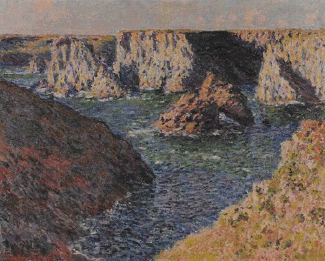
“Les Rochers de Belle-Ille”
(after the painting by Claude Monet)

“No beach here—just the sea
swirling in blue

deep blue and green

Both the sea and the rocks
show age

It’s a tired scene of their
coming together

each hour and day

The water’s force, erosion
of all the softest parts

leaving only solid rock

This you could be
crushed upon—the hardest

knowledge of all—

What is impervious to you, quite
solidly indifferent

No escaping the sea

throws you repeatedly on the rocks
of all you’re stupid about—

self-ignorance, deception, lies—

Instead someone calls this a scene,
a landscape, seascape—

yes, but first: crags of the mind, and soul.”1
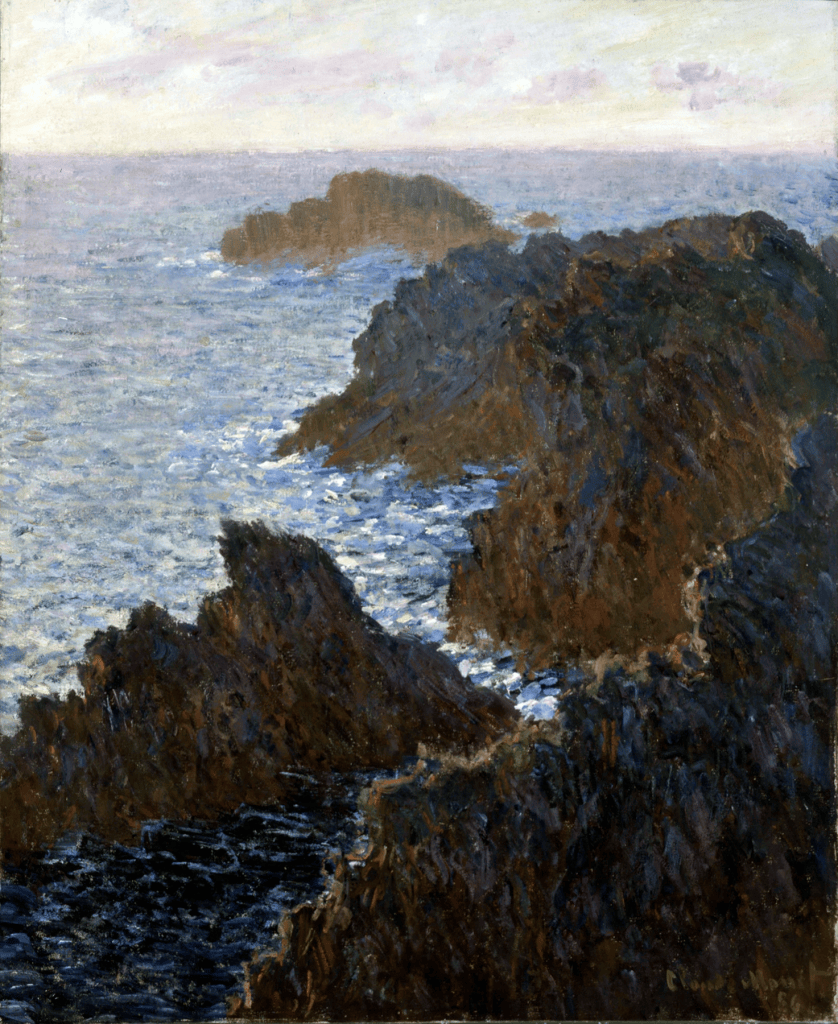
Claude Monet
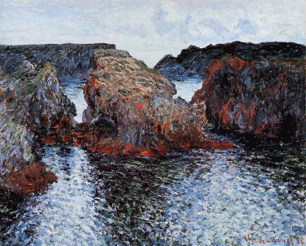
“Rocks at Belle-Isle, Port-Domois”
1886
Oil on canvas
28 1/2” x 23”
Saint Louis Art Museum, St. Louis, Missouri

In French, the sign along the roadside read simply: DANGER MORTAL! These were posted all along the winding coastal roads going out from the port at Le Palais. They covered most of the island. We visited there with our friend, the painter Holly Hughes and her mother Wanda, who at that time was the studio/office manager for Ellsworth Kelly. Wanda was armed with a map that had been given to her by Ellsworth so that we might find the ‘village’ where he had lived after WWII. Little did we know what a sight we were approaching!

Over the years many artists had found both the isolation and inspiration that they were searching for on Belle-Isle. Claude Monet, Henri Matisse, the actress Sarah Bernhardt and her companion the painter Georges Clairin, the Irish painter John Peter Russell, and of course Ellsworth Kelly were all attracted to this special place.
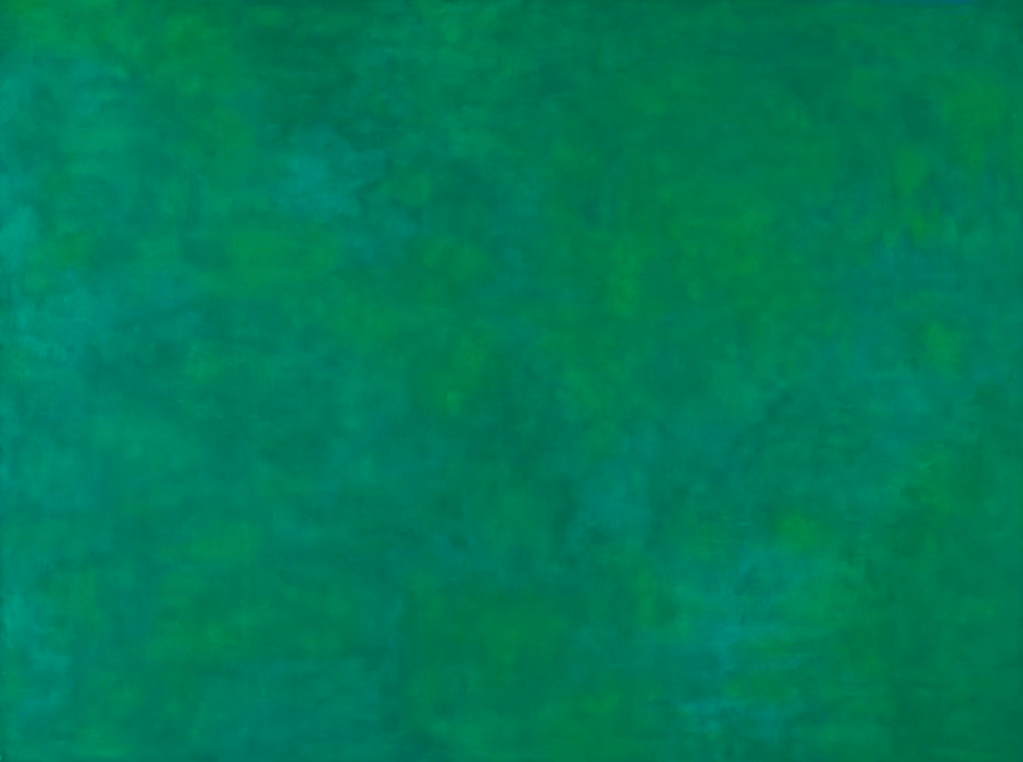
Ellsworth Kelly
“Tableau Vert”
1952
Oil on wood,
29 1/4” x 39 1/4” (74.3 x 99.7 cm).
The Art Institute of Chicago. Gift of the artist, 2009.51 © Ellsworth Kelly

The colors, which swirled later through the Giverny water-garden series, bring “Tableau Vert” to mind. Although Ellsworth Kelly’s painting was a one-off, his relationship with Monet continued and intensified. Kelly visited and lived in Belle-Isle in 1948-1949, 1965, 1977 and later in 2005.

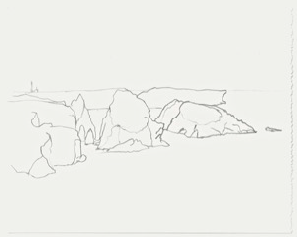
In 2005, Kelly came back one last time to the island and drew the same subjects, but in a changed style. The rocks are now more than traced shapes.

Regarding his later development Ellsworth Kelly wrote: “In 1951, I had begun to make paintings made up of joined panels, with each color on its own canvas, with only color and form as the content. I wanted to make visually engaging, impersonal works. Seeing the Nymphéas affirmed what I was doing.”2

“The day following the trip to Giverny, I painted Tableau Vert, my first monochrome. I had already made works with many color panels, but to make one color on a canvas was a challenge.”3
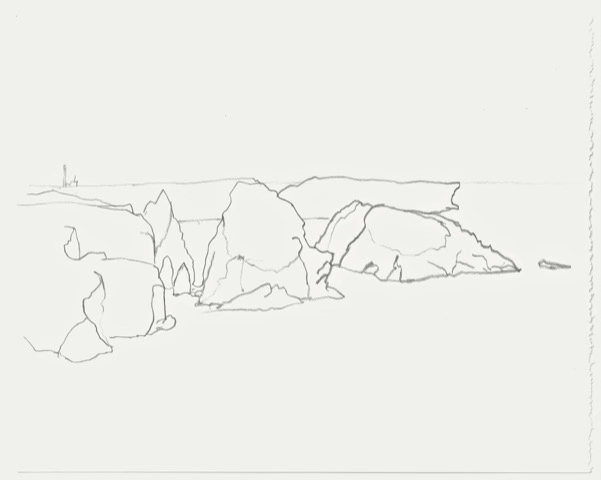
Ellsworth Kelly
“Port-Goulphar, Belle- Île”
2005
Pencil on paper
49.5 cm x 62.2 cm
Estate of the artist.

Interestingly, this vivacity may come partly because Kelly’s drawing hand in 2005, when he was in his early 80s, was less steady than it had been decades earlier, giving his lines a little shimmy. Also, he seemed to be less intent on distilling abstract essences from actual forms than in staying with the forms themselves, dwelling on their particularities, deliberating over their details.

During the fall of 1886, from 12 September to 25 November to be exact, Claude Monet lived and worked just off the coast of Brittany on Belle-île. During this time he produced a series of 39 paintings, exploring the weather and wildness of this island.

I can only imagine how these artists felt when approaching for the first time, these savage vistas. Steep cliffs that one would most certainly describe as the end of the earth (fin de terre), bays and inlets, needles and rocks that would challenge one’s imagination.

And now, the last word must go to Ellsworth Kelly: “Monet’s last paintings had a great influence on me, and even though my work doesn’t look like his, I feel I want the spirit to be the same.”4


1 Clark, Patricia; Self-Portrait with a Million Dollars; Terrapin Books; West Caldwell, New Jersey; 2020; pp. 36-37.

2 Bois,Yve-Alain and Sarah Lees; Monet/Kelly; 2014; Clark Art Institute; Williamstown, Massachusetts; Yale University Press, New Haven and London; p. 9.
3 Bois,Yve-Alain and Sarah Lees; Monet/Kelly; 2014; Clark Art Institute; Williamstown, Massachusetts; Yale University Press, New Haven and London; p. 9.
4 Bois,Yve-Alain and Sarah Lees; Monet/Kelly; 2014; Clark Art Institute; Williamstown, Massachusetts; Yale University Press, New Haven and London; p. 9.
PATRICIA CLARK AND THE PAINTERS:  Chapter 2 

In French, the sign along the roadside simply read:  DANGER MORTAL!  These were posted all along the winding coastal roads going out from the port at Le Palais.  They covered most of the island.  They were a very real warning as many of the island roads curved right along the coast, with precipitous and precarious views down from the cliffs, and across the inlets and bays.  There were no guardrails.   

We visited there in the summer of 1995 with our friend, the painter Holly Hughes and her mother Wanda, who at that time was the studio/office manager for the contemporary American painter Ellsworth Kelly.  Wanda was armed with a map that had been given to her by Ellsworth so that we might find the ‘village’ where he had lived after WWII.  Little did we know what a sight we were approaching?     

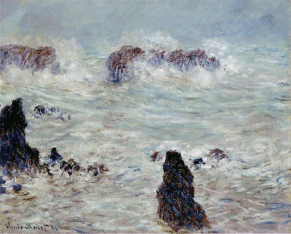
Claude Monet
“Tempête, côtes de Belle-Ile”
1886
Oil on canvas
65.4 cm. x 81.5 cm.
Musée d’Orsay, Paris, France

Over the years on Belle-Isle, the largest of the Breton Islands, many artists found in the isolation, the savage waves and tides, the inspiration that they were searching for.  Claude Monet, Henri Matisse, the actress Sarah Bernhardt and her companion the painter Georges Clairin, the Irish painter John Peter Russell, were all attracted to this special place, and later of course, so was Ellsworth Kelly.

During the fall of 1886, from 12 September to 25 November to be exact, Claude Monet lived and worked on Belle-Isle.  During this time he produced a series of 39 paintings, exploring the weather and the wildness of this place. 

Not to be outdone by the painters, the contemporary poet Patricia Clark from Grand Rapids, Michigan, recently visited Paris and many of the great museums there.  She noticed in particular the paintings by Monet at the Musée D’Orsay, and the potential for an ekphrastic experience.  When I asked Clark about this, this is what she said: 

“As for the poem about Monet’s Rochers — we did not go out to the place, alas! Would love to see it. I believe (memory is slippery!) we saw the painting at the Musee D’Orsay. My method — such as it is! — is to buy postcards of paintings that really move me. . . . Then there’s a catalog. But I know I have a postcard of this painting.”

“I think what drew me to it is that it’s not an image I’d seen that much. It seems rougher and less ‘pretty’ than many Monets. I kept it in front of me and then one day, I started to write about it. That’s about as much as I recall — of course, a writer can’t help but layer their own issues over what they look at — so that’s what happens, doesn’t it? I hope that comes through.”[i] 

Claude Monet
“Les rochers de Belle-Île”
1886
Oil on canvas
25 7/8″ x 32 1/8″
Musee des Beaux-Arts, Reims

“Les Rochers de Belle-Ille”

                  (after the painting by Claude Monet)

“No beach here—just the sea
swirling in blue

deep blue and green

Both the sea and the rocks
show age

It’s a tired scene of their
coming together

each hour and day

The water’s force, erosion
of all the softest parts

leaving only solid rock

This you could be
crushed upon—the hardest

knowledge of all—

What is impervious to you, quite
solidly indifferent

No escaping the sea

throws you repeatedly on the rocks
of all you’re stupid about—

self-ignorance, deception, lies—

Instead someone calls this a scene,
a landscape, seascape—

yes, but first:  crags of the mind, and soul.”[ii]

Claude Monet
“Rochers a Belle-Île at Port Goulphor”
1886
Oil on canvas
26” x 32 3/16”
Art Institute of Chicago, Chicago, Illinois

Following the end of WWII, from 1948 to 1954, the American artist and veteran Ellsworth Kelly visited and lived in several areas of France.   In July 1949 he even rented a house on Belle-Ile-en-Mer for the summer and part of the fall.  He had fallen in love with France and with its artists, especially Claude Monet and Henri Matisse. 

In 1965 Kelly returned to Belle-Isle with a specific purpose, to re-visit certain sites that Monet had painted and witness them directly, not just metaphorically.  Later in his life, 2005, he returned to Belle-Isle for a last series of drawings, not abstracted from the rocks, but directly created from the sources.[iii]

Ellsworth Kelly
“Port-Goulphar, Belle- Île”
2005
Pencil on paper
49.5 cm x 62.2 cm
Estate of the artist.

It is a landscape that would challenge one’s imagination.  From the earliest visitors to contemporary painters and poets, one can only wonder how they felt when approaching these vistas for the first time.  Looking out on this frighteningly beautiful land, with its bays, inlets, needles, rocks, and steep cliffs, it is no wonder that this entire region of France would come to be described as Finistère:  the end of the earth.


[i] Clark, Patricia; in an e-mail response to this writer; 9 January 2021; 9:52 AM. 

[ii] Clark, Patricia; Self-Portrait with a Million Dollars; Terrapin Books; West Caldwell, New Jersey; 2020; pp. 36-37.  

[iii] Bois, Yve-Alain, and Sarah Lees; Monet/Kelly; Sterling and Francine Clark Art Institute; Williamston, Massachusetts; and Yale University Press; New Haven and London; 2014.