CEPHALOPHORES: HEADLESS SAINTS AND MARTYRS IN FRANCE

This is going to be messy! In ancient times in Brittany, there were magicians and wise men and martyrs roaming the countryside, often secluding themselves in the nearby forests. In equal numbers of cases, there were heroic as well as villainous knights, many soon to become martyrs. So many of them were killed in battles or through torture, including beheadings over the years, that the early church had to invent a specific word for this: “cephalophores.”

Anonymous
“Saint Trémeur”
XVIIe Century
Bois polychrome
Chapelle Saint-Trémeur,
Bury, France

At the beginning of each Summer Session in 1995, 1997, 2000, and 2007, while teaching at the Pont-Aven School of Contemporary Art in Brittany, France, there would always be a school-wide orientation followed by field trips to the local churches and museums. All local institutions with regional collections filled with histories and legends.

During these trips, many of the local stories were passed down to us by word of mouth. One important story related how a certain figure had suffered a beheading in battle, whereupon he picked up his own head and carried it out into the Brocéliande Forest where Merlin the Magician supposedly lived. Merlin returned this young man’s head to its correct position so that revenge could be accomplished. It parallels so many other stories in the history of ‘cephalophores!’
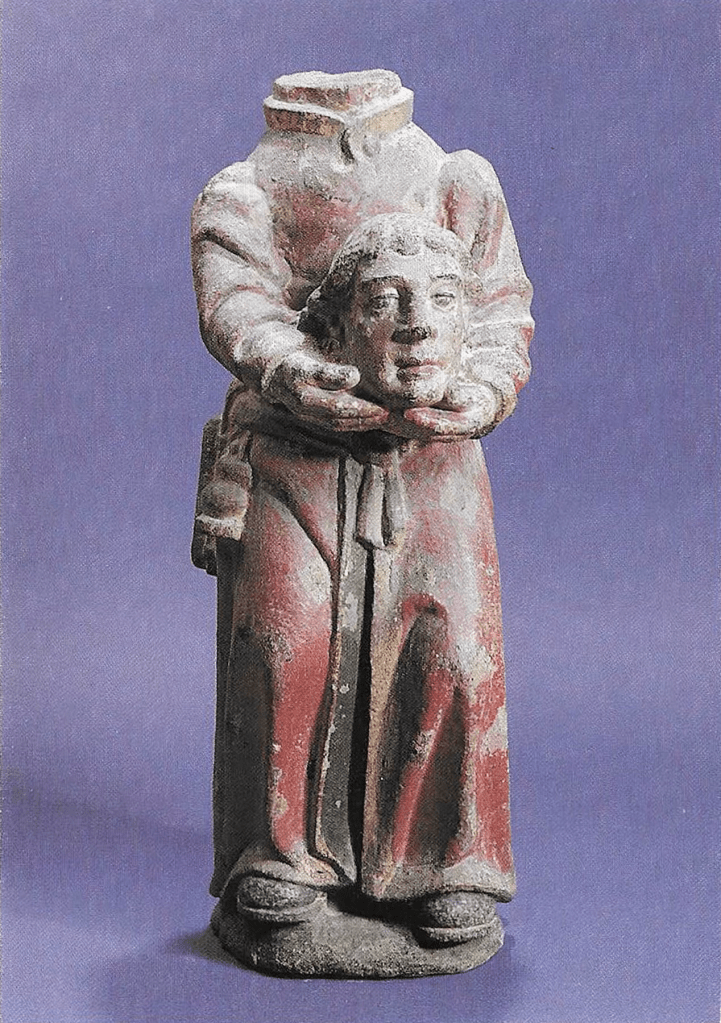
Anonymous
“Saint Trémeur”
XVIe Century
Pierre de kersanton
Le Musée Departmental Breton,
Quimper, France

In one of the local bookstores I discovered a small collection of stories titled Celtic Legends of Brittany containing many references to the local people and history. One especially was the story of Trémeur who was beheaded by his step-father Conmore. Conmore was totally against the Catholic Church and its proselytizing in the area. His wife Trephine had become interested in this new religion and so she was killed by her own husband.

“Years passed, when one day as Conmore was walking in the woods he came to the very spot where he had slain Trephine. There he found children playing, one of whom was called by his companions Tremeur. The name attracted his attention. He looked at the child and asked him his age.”

“‘I shall soon be nine’, he replied.”

“Conmore thought for a moment. He had the intuition, soon the certainty, that this child before him was the son of himself and Trephine. Quick as a flash he drew his sword and struck the child’s head off, as he had struck off the head of his mother, and then hastened away.”

“The little martyr, says the legend, when the tyrant was gone, took his head in his hands and carried it to the side of his mother’s tomb where she was sleeping. In the cemetery of St. Trephine is a chapel, of modern construction, covering the tomb of Tremeur, which is not far from that of his mother. Inside the church, five round stones emerge. The people declare they are the stones with which Tremeur was playing when he was struck down by his father.”1

The greatest story along these lines of course is that of St. Denis, the first bishop of Paris. There are several sculptural representations of St. Denis included in the collections of both the Musée Cluny and the Louvre as well on the walls of Notre Dame Cathedral in Paris.
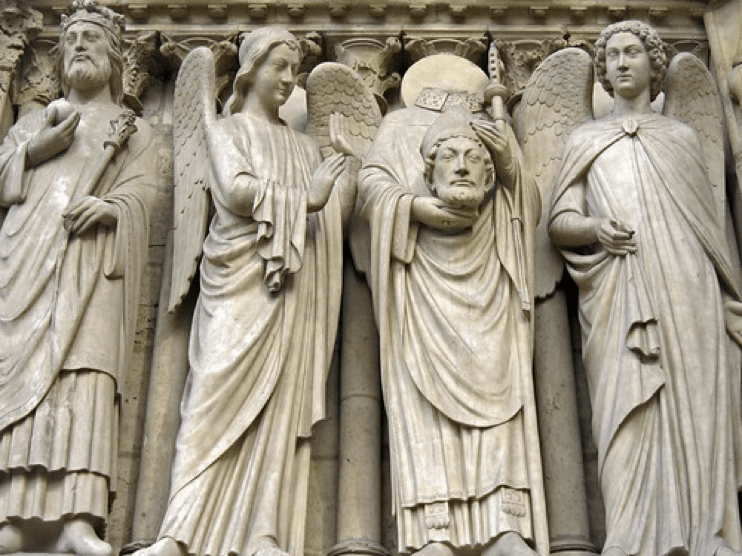
“Saint Denis”
From the outside walls of Notre Dame Cathedral
(after the major renovation of the 19th Century by Viollet-le-Duc)
Paris, France

During an anti-Christian period in Paris, St. Denis was evangelizing in the area when he was beheaded by the Romans on what is now Montmartre. It is said that he picked up his own head and continued his sermon as he walked across the city to the site he had chosen for his own grave. On this site he was buried in a small chapel.
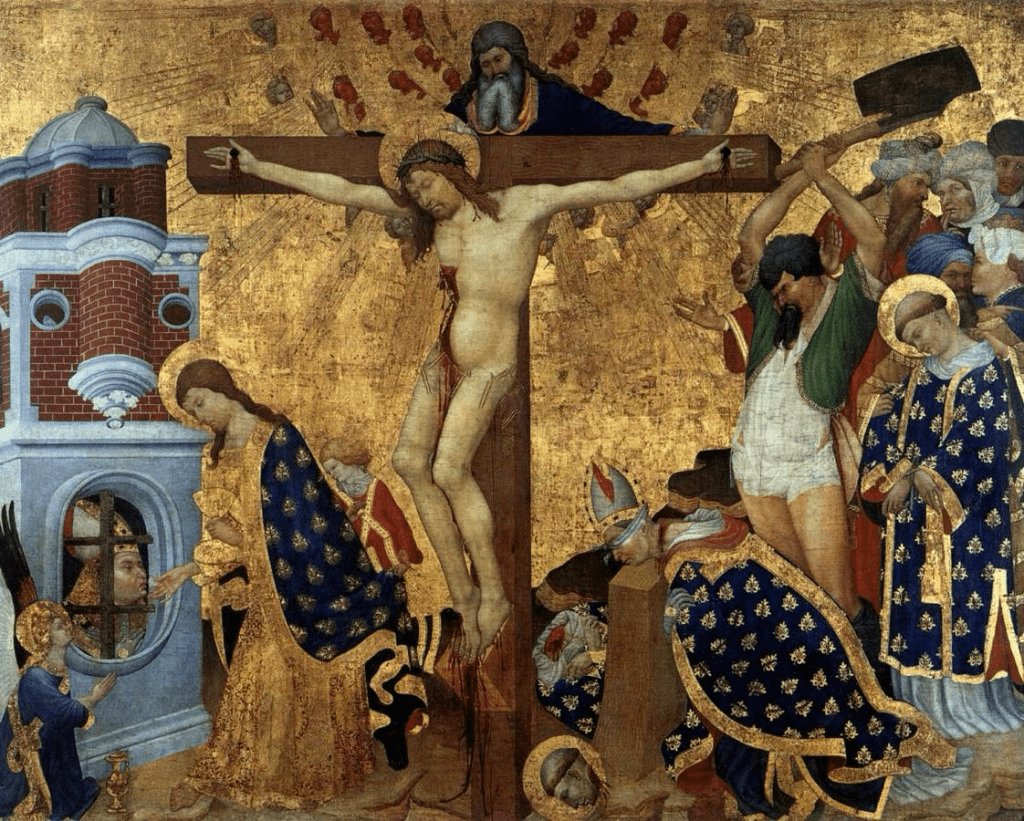
Henri Bellechose
“Calvary and the Martyrdom of St. Denis”
1415-1416
Tempera and gold leaf on canvas and panel
162cm x 211cm
Musée Louvre, Paris

Later this chapel was dedicated as an Abbey and the architect Suger was designated by the Pope to revitalize it. In the process it was dedicated as the Abbey of St. Denis in the town of the same name. As Abbot Suger designed the building and rebuilt the altar and the upper choir from 1135 to 1144, he clarified his theories on both light and structure, combining the old and the new in harmony, defining what would become Gothic Architecture. It became the resting place for many of the Kings of France and is now known as the Basilique Cathédrale de Saint-Denis.

Here, taken from the writings of Suger, is part of his vision for synthesizing the reconstruction of the chapel that St. Denis chose for his burial.

“The admirable power of one unique and supreme reason equalizes by proper composition the disparity between things human and Divine; and what seems mutually to conflict by inferiority of origin and contrariety of nature is conjoined by the single, delightful concordance of one superior, well-tempered harmony.”2

Abott Suger, Design and Architecture
Side Aisles, Transept’s, Upper Choir and Facade
1135-1144
St. Denis, France

In tribute to Saint Denis, here is what Abbot Suger had written into the Panel on the Altar Front in the Upper Choir at the Chapel of St. Denis:

“Great Denis, open the door of Paradise
And protect Suger through thy pious guardianship.”

“That which is signified pleases more than that which signifies.”3


1 Aubert, O.-L.; Celtics Legends of Brittany; COOP BREIZH; Spézet, Brittay, France; 1993; pp. 86-87.

2 Panofsky, Erwin (Translator and Editor); Abbot Suger: On the Abbey Church of St.-Denis and It’s Art Treasures; Princeton University Press, Princeton, New Jersey; 1946; p. 83.

3 Panofsky, Erwin (Translator and Editor); Abbot Suger: On the Abbey Church of St.-Denis and It’s Art Treasures; Princeton University Press, Princeton, New Jersey; 1946; p. 55.

PATRICIA CLARK, DEBORAH BUTTERFIELD AND JOAN MITCHELL

From Grand Rapids, Michigan to Baltimore, Maryland, the poet Patricia Clark is always searching for artists to study, and to be inspired by. In the last couple of years she has visited the work of two such artists. A newly installed sculpture by Deborah Butterfield on a rooftop balcony at Grand Valley State University at its Downtown Campus. And a few months later, on a trip to Baltimore, a pilgrimage of sorts to the Joan Mitchell Retrospective Exhibition at the Baltimore Museum of Art.

Just last year, 7 September 2023 to be exact, I attended a reading by Patricia Clark at the Poetry on Brick Street Series in Zionsville, Indiana. It was there, reading from a selection of her latest work, that I heard her read two new works, these ones on Deborah Butterfield and Joan Mitchell.

Joan Mitchell
“Weeds”
Installation view:
Joan Mitchell Retrospective Exhibition,
Baltimore Museum of Art,
2022

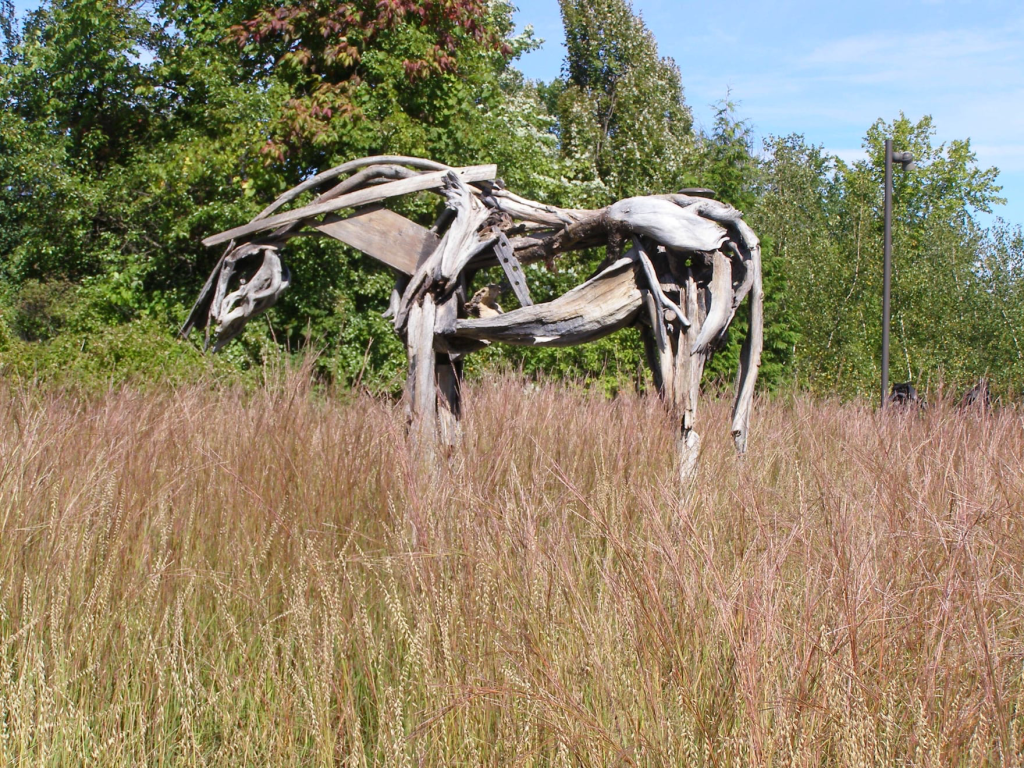
Situated in a prairie like setting at the Meijer Gardens and Sculpture Park in Grand Rapids is an isolated crazing horse by Deborah Butterfield1. It has a natural like stance and bend to its neck, standing in this open space. Further downtown, in fact near the very center of the city and elevated to the top of a Grand Valley State University classroom building, is another one of these pieces.

Deborah Butterfield
“Cabin Creek”
1999
Bronze
88” x 122.5: x 30.5”
Meijer Sculpture Garden and Park
Grand Rapids, Michigan

Char: Above the City
–for Nathan, Joel, and Alison

“On a rooftop downtown at the edge
of the building where they’ve planted succulents
stands a horse blackened by fire
called Char by its maker Deborah Butterfield.
The artist scoured a smoky ravaged forest
in California, picking up branches, limbs,
burnt saplings, then brought these to her studio
where she fashioned them into the shape of a horse.
During the process, taking weeks, Butterfield often dreams
of horses. This one grazing in a meadow
where red-tipped grass waved against its belly, seeds
catching in its long tail. Horse has become the artist’s
mirror self, a dream figure made manifest.
After the studio, a foundry, a way to cast
wood into metal, finally pouring
bronze for the final sculpture. The workers made marks
in metal to resemble wood, adding a patina black
as night sky. Char looks east into clouds
above our city, ignoring for past weeks
the haze from Canada wildfires, not pricking
its ears in terror or flipping its tail.
Char is more skeleton than mass, negative space
allowing us to glimpse what’s been ruined and where
we stand, on the edge, barely able to breathe.”2

Deborah Butterfield
“Char”
2021
Bronze
82.5″ x 102.5″ x 33″
Center for Interprofessional Health,
Grand Valley State University,
Grand Rapids, Michigan

In the Spring of 2019 I visited the Baltimore Art Museum in order to see the Joan Mitchell Retrospective3. It was the first time I had returned to Baltimore in so many years and certain sites were hard to remember. We arrived early, way before our scheduled entry time, not crowded at all so the guards waved us right on in. When I mentioned this to Patricia Clark later, back in the Mid-West, she stated that she and her husband Stanley Krohmer, who had also studied in Baltimore, were planning a very similar trip, and specifically to see the Joan Mitchell Retrospective.

One really important element to all of Mitchell’s work is her affinity with other artists and poets of her generation. Several of her paintings have inspired writers and writers have inspired her in both her paintings and her poem pastels.

These include James Schyler, Eileen Myles, Frank O’Hara and John Ashbery. Below is Patricia Clark’s poem in response to this exhibition.

Painter Joan Mitchell Pulls Me Up

“What was in the air was leaf-fall, the rot
of the year’s perennials and annuals, stems

and blossom ends done for, going back to earth.
I couldn’t move for being caught by the suck

of quicksand, a clump of blue feathers smacked
on a window from a hit. Here I am on a cold Friday

and to my amazement the painter Joan
Mitchell reaches for me, from her oil

on canvas, a diptych called Weeds,
grabbing a hold of me, saying ‘Here,

take my hand!’ There’s something about
her seeming riot of marks that’s giving

a calming and cooling effect. It’s cobalt blue,
orange, tawny, and flecked with white,

even a spot or two of sage, and I see
the trail-side at Huff Park with tall

teasel, Queen Anne’s lace, and a waving
frond of goldenrod or a flat-topped

white aster. Each year I’m caught watching
this awakening starting up in early spring,

a mere sprout or two at first, then
climbing, growing, a stem hoisting itself up

all season till it’s five feet high,
shedding petals, pollen and seeds. Not

a riot at all, a cyclic process of
great determination, genetics, chance . . .”

Joan Mitchell
“Weeds”
1976
Oil on canvas,
110 1/2” x 157 1/2”
Hirshhorn Museum and Sculpture Garden
Washington, DC.

“. . . weather, sunlight, rain. Right now,
I’m bowing to the botanical display and to two

canvasses of supreme order, remembering
our visit to the Baltimore Art Museum, August,

standing in front of the actual paintings,
work as sturdy and wrought

as any palace. Then we went walking off
in a pack for lunch, having salad and Chesapeake oysters

on the half-shell along with a crisp
citrus tasting wine. Good friends, fellow

artists, a couple more hands to pull me
out of quicksand. Where do we turn, lost

on that trail, or sinking? The Baltimore light
was pure lemon as we strolled through

the galleries pointing, talking, saying
look at that magenta, violet, sage, her vision,

her ability to make these marks. The gleam of it
lasting as long as the light, what we call a day.”4


1 Kuspit, Donald, and Marcia Tucker; Horses: The Art of Deborah Butterfield; Lowe Art Museum, University of Miami, Coral Gables, Florida, and Chronicle Books, San Francisco, California; 1992.

2 Clark, Patricia; “Char;” The Superstition Review; Arizona State University; Issue 32; Fall 2023.

3 Roberts, Sarah, and Katy Siegel, eds.; Joan Mitchell; Baltimore Museum of Art and the San Francisco Museum of Modern Art; Yale University Press, New Haven and London; 2020.

4 Clark, Patricia; “Painter Joan Mitchell Pulls Me Up;” Nelle; University of Alabama at Birmingham; Issue 7; 2024.

THE MIGHTY QUINN!

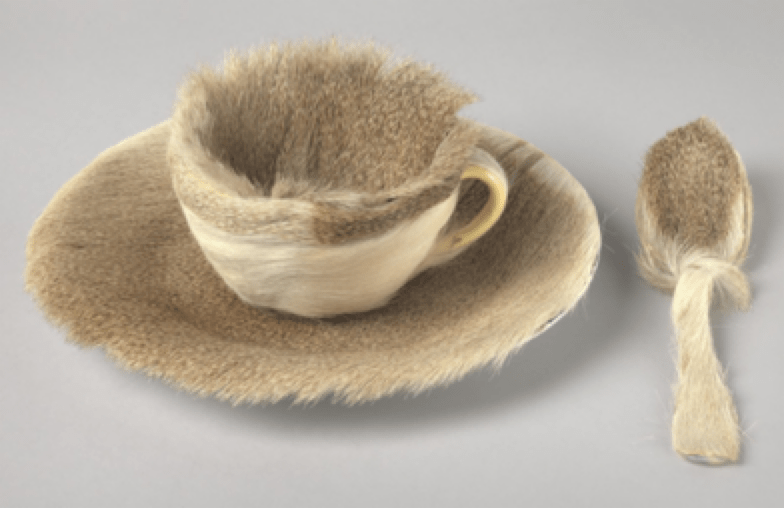
Surrealism and absurdity, fantasy and fiction, images come together in a variety of combinations. The range can be unbelievable: from Giotto’s painting of St. Francis Preaching to the Birds to a contemporary sculptural assemblage of a spoon and teacup lined with fur!1

“I like to do just like the rest, I like my sugar sweet
But guarding fumes and making haste
It ain’t my cup of meat. . . .”

Meret Oppenheim
“Object”
1936
Mixed media
32.7 cm x 7.3 cm
Museum of Modern Art, New York

“. . . Ev’rybody’s ’neath the trees
Feeding pigeons on a limb
But when Quinn the Eskimo gets here
All the pigeons gonna run to him.”2

Giotto di Bondone
“St. Francis Preaching to the Birds”
1296-1300
Fresco
Upper Church of St. Francis
Assisi, Italy

In one of his most important collections of poetry, the author and editor Robert Bly takes a look at this literature from so many angles. The Rag and Bone Shop of the Heart3 takes its title from the absurd poem “The Circus Animals’ Desertion” by William Butler Yeats:

“Now that my ladder’s gone,
I must lie down where all the ladders start,
in that foul rag and bone shop of the heart.”4

Included in the “Zaniness” section of this collection, Bly describes a song by Bob Dylan titled “The Mighty Quinn!” Packed full of silliness and surrealism, this mighty Eskimo is here to save us all.

“Nanook of the North”
1922
Lithographic Poster
Royal Pictures, Inc.

There is a subtle source for this story: an early short documentary film of 1922 from the Museum of Modern Art Film Library titled “Nanook of the North.” This film circulated around New York and beyond in the 1960’s, even making it to the Maryland Institute College of Art in Baltimore for a film series.

Several sources also point to the movie “The Savage Innocents” starring Anthony Quinn, playing the part of an Eskimo, as the inspiration for this song.

“The Savage Innocents”
Movie Poster
1960
40” x 27”

“Ev’rybody’s building the big ships and the boats
Some are building monuments
Others, jotting down notes
Ev’rybody’s in despair
Ev’ry girl and boy
But when Quinn the Eskimo gets here
Ev’rybody’s gonna jump for joy
Come all without, come all within
You’ll not see nothing like the mighty Quinn”5

“I like to do just like the rest, I like my sugar sweet
But guarding fumes and making haste
It ain’t my cup of meat
Ev’rybody’s ’neath the trees
Feeding pigeons on a limb
But when Quinn the Eskimo gets here
All the pigeons gonna run to him
Come all without, come all within
You’ll not see nothing like the mighty Quinn”6

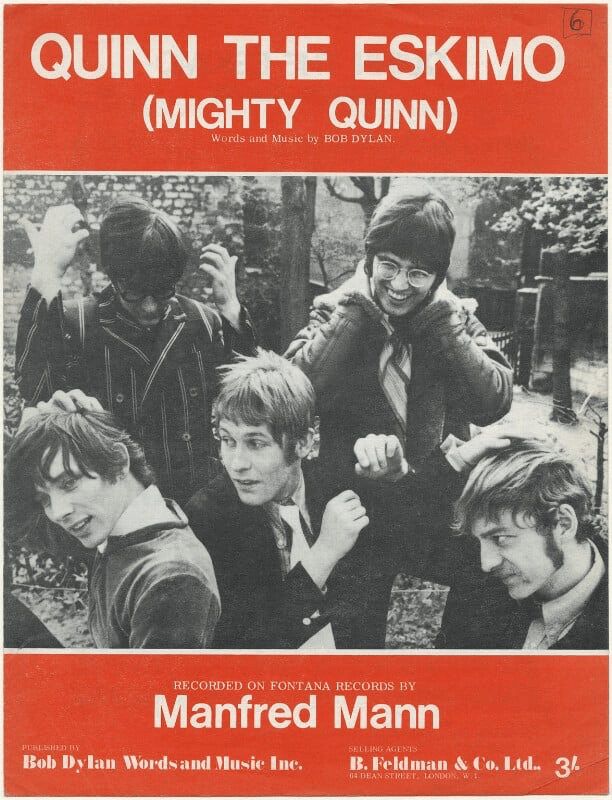
“Quinn the Eskimo” Sheet Music Cover
Words and Music, Bob Dylan,
Performed by Manfred Mann
1968
(Photographer Unknown)
11” x 8 1/2”
National Portrait Gallery
London, United Kingdom

Bob Dylan wrote this song in 1967 during the Basement Tapes Sessions however it was one of two outtakes at that time. Shortly afterwards, in 1968, it was picked up and famously recorded by the English group Manfred Mann. They used it often in live concerts and recorded several later versions, including an extended play one that lasted over ten minutes. Dylan’s original recording of the “Mighty Quinn” was finally included in the Biograph CD released in 1985.

“A cat’s meow and a cow’s moo, I can recite ’em all
Just tell me where it hurts yuh, honey
And I’ll tell you who to call
Nobody can get no sleep
There’s someone on ev’ryone’s toes
But when Quinn the Eskimo gets here
Ev’rybody’s gonna wanna doze
Come all without, come all within
You’ll not see nothing like the mighty Quinn”7

Although it may seem like double talk, writing in the absurd mode often gets more directly to the truth. As it happens in Bob Dylan, it also occurs in William Butler Yeats, who provides one last word:

“Players and painted stage took all my love,
And not those things that they were emblems of.”8

Anthony Quinn as the Eskimo Inuk
“The Savage Innocents”
Paramount Pictures,
Technicolor Film Still,
Nicholas Ray, Director
1960.

1 Dylan, Bob; “The Mighty Quinn” Words and Music; © 1968 by Dwarf Music; renewed in 1996 by Dwarf Music.

2 Dylan, Bob; “The Mighty Quinn” Words and Music; © 1968 by Dwarf Music; renewed in 1996 by Dwarf Music.

3 Bly, Robert; James Hillman and Michael Meade; The Rag and Bone Shop of the Heart: Poems for Men; Harper Perennial, Harper Collins Publishers; New Yrok, New York; 1992.

4 Rosenthal, M. L., ed.; Selected Poems and Two Plays of William Butler Yeats; The MacMillan Company; New York, New York; 1962; pp. 184-185.

5 Dylan, Bob; “The Mighty Quinn” Words and Music; © 1968 by Dwarf Music; renewed in 1996 by Dwarf Music.

6 Dylan, Bob; “The Mighty Quinn” Words and Music; © 1968 by Dwarf Music; renewed in 1996 by Dwarf Music.

7 Dylan, Bob; “The Mighty Quinn” Words and Music; © 1968 by Dwarf Music; renewed in 1996 by Dwarf Music.

8 Rosenthal, M. L., ed.; Selected Poems and Two Plays of William Butler Yeats; The MacMillan Company; New York, New York; 1962; p. 185.


LOOKING AT GIACOMETTI

Here is a selection of writers who have taken their cue from the artist himself, Alberto Giacometti, in an intense looking at the world. In this case, the world is the one contained within the artist’s studio. From Jean Paul Sartre and Jacques Dupin, to David Sylvester and James Lord, these writers experienced first hand the work of the artist. Unique points of view, in fact, art historical primary sources. None of these selections are mere descriptions or illustrations, rather they are true ruminations and examples of literature which have been inspired directly by visual works of art and the artist who created them.

Alberto Giacometti
“Portrait of Jean Paul Sartre”
1949
Pencil on paper
28.5cm x 11.2cm
Fondation Giacometti, Paris, France

In his essay on “The Quest for the Absolute” Jean Paul Sartre famously observed that this work was real evidence of the existential predicament. It was included in the catalogue for Giacometti’s 1948 exhibition at the Pierre Matisse Gallery in New York: Giacometti’s first major exhibition after WWII, and his first at Pierre Matisse in fourteen years. Sartre wrote:

“So we must start again from scratch. After three thousand years the task of Giacometti and contemporary sculptors is not to add new works to the galleries but to prove that sculpture is possible. . . . It is necessary to push to the limits and see what can be done. If the undertaking should end in failure, it would be impossible, in the best cases, to decide whether this meant that the sculptor had failed or sculpture itself; others would come along, and they would have to begin anew. Giacometti himself is forever beginning anew. But this is not an infinite progression; there is a fixed boundary to be reached, a unique problem to be solved: how to make a man out of stone without petrifying him. It is an all-or-nothing quest: if the problem is solved, it matters little how many statues are made.”1

Herbert Matter
“Alberto Giacometti’s Portrait of Eli Lotar III”
1965
Gelatin silver print
14 3/4” x 19”
Gitterman Gallery, New York, New York.

Not just the writers, but many photographers took an interest in this work, continuing to pay attention to the changing vision and work of this artist. Both Henri Cartier-Bresson and Herbert Matter caught iconic images of Giacometti working in his studio and walking through the streets of Paris, and it was in this particular neighborhood that Jacques Dupin would visit Alberto Giacometti. His visits were recorded in the book “Giacometti: Three Essays” and the first of these essays, “Texts for an Approach” was actually translated by the New York School poet John Ashberry. Dupin wrote on both the artist’s earlier work and how it formed the ideas for the later work.

“His not stopping means that he never stops looking at and depicting what he sees, in any circumstances and at each minute of his life, even if he is not ‘working.’ In the café he draws on his newspaper, and if he has no newspaper, his finger still runs over the marble top of the table. . . . His not stopping means too that Giacometti can only present us the rough draft of an unaccomplished, unfinished undertaking. A reflection, an approximation of reality—of that absolute reality which haunts him—and which he pursues in a kind of amorous or homicidal fury. . . .”

Alberto Giacometti
“Jacques Dupin” (No Inscription)
1965
Oil on canvas
25.75″ x 21.25″
Fondation Giacometti, Paris, France.

“. . . His optimism is thus as disproportionate with regard to the relative as his pessimism is categorical with the absolute. Yet people readily accuse him of repeating himself, of marking time. . . . In returning untiringly to the bust of Diego, the standing woman, the walking man, the portrait of the same model, he may discourage the inattentive spectator, but his austere research allows him to concentrate his ways of approaching. The slower his walk toward his goal appears, the more rapid it actually is. Each acquisition is definitive, each progress irreversible. But progress plays only with imponderable elements. A single line can stop it a whole night and hold up the whole work with the question of the exactness of its inflection. Giacometti’s not stopping means also that he does not stop advancing.”2

In addition to Jacques Dupin, the writer David Sylvester made frequent visits to Giacometti’s studio. He began these visits in the late 1940’s and continued for over forty years, including a prolonged time, sitting for his own portrait. Sylvester’s writings feature several other important artists of the time, including Henry Moore, Francis Bacon, and René Magritte, as well as this important one on Alberto Giacometti. Two examples follow:

“The sight of towering granite, stark, greyly luminous, somehow weightless, soaring to jagged splintered summits, appears in images of fragile heads and figures which are also giving form to a vision of urban reality suddenly filled with ‘an unbelievable sort of silence’ where any head was ‘as if it were something simultaneously alive and dead’, every object ‘had its own place, its own weight, its own silence, even’, was separated from other objects by ‘immeasurable chasms of emptiness’. And we, confronting the embodiments of those coalesced sensations, feel a shock of recognition of ourselves and to our mutual separateness.”3

Alberto Giacometti
“Portrait of David Sylvester”
1960
Oil on canvas
45 11/16″ x 35 1/16”
Museum of Modern Art, New York, New York.

“Giacometti normally has several sculptures and paintings simultaneously in progress. The thickness of the paint on most of the canvases suggests that they have been worked at over a long period. . . . Those from memory are worked on in a way that is highly characteristic of Giacometti in that it reflects a curious combination of nagging self-criticism and a desire for spontaneity. While it is in progress, and this can be over a period of a couple of years,…..it is as if the process of creation consisted of a series of rehearsals and the final rehearsal was the performance, though the performer didn’t know till afterwards that this rehearsal was to be the performance.”4

Finally, the American writer James Lord, agreed to sit for his own portrait. During this time and unbeknownst to the artist, Lord made meticulous notes and took a photograph of the portrait he had been sitting for after each of its eighteen sittings. Here are two excerpts: one from the end of the first week of sittings, and the second from the very last day. It is as if each new sitting is a new attack, seeing everything again, and a new beginning.

“Giacometti looked forward to working on Sunday because the chances of being disturbed then by visitors were less than during the week. As soon as I arrived at the studio, he told me that he hadn’t gone to bed till five and had slept very badly. But he denied feeling at all tired, and we began work at once. ‘It’s going to go well today,’ he said. ‘There’s an opening. I’ve got to make a success of the head.’ I didn’t answer, and after a few minutes he added, ‘This morning when Diego came into my room I was overcome by the construction of his head. It was as though I’d never seen a head before.’”5

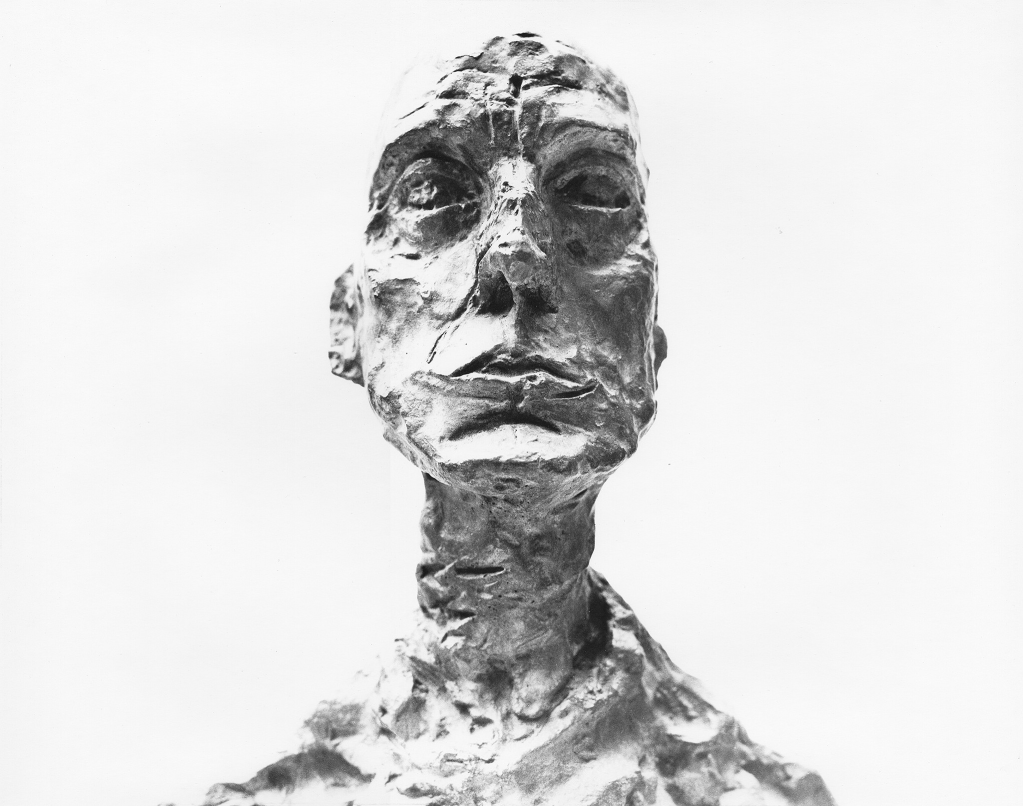
Alberto Giacometti
“Bust of Diego, Second Version”
1962-1964
Bronze
17.44″ x 10.78″ x 6.29”
Fondation Giacometti, Paris

James Lord visited Giacometti’s studio one last time to say goodbye. They had worked on his portrait for eighteen days, sometimes making progress, sometimes not. It is a beautifully written book, sensitive to both the artist and his working process. A Giacometti Portrait has now become a classic. Always inspiring to so many artists and students and so important in understanding the thinking and painting processes employed by Alberto Giacometti.

“We went to the café. In the street he said. ‘There has been, after all, a slight progress. There’s a very small opening. In two or three weeks I’ll have an idea if there’s any hope, any chance of going on. Two or three weeks, maybe less. I have a portrait of Caroline to do, then there’s the one of Annette. And I want to do some drawings, too. I never have time for drawings anymore. Drawing is the basis for everything, though. I’d like to do some still life. But we did make a little progress, didn’t we?’”6

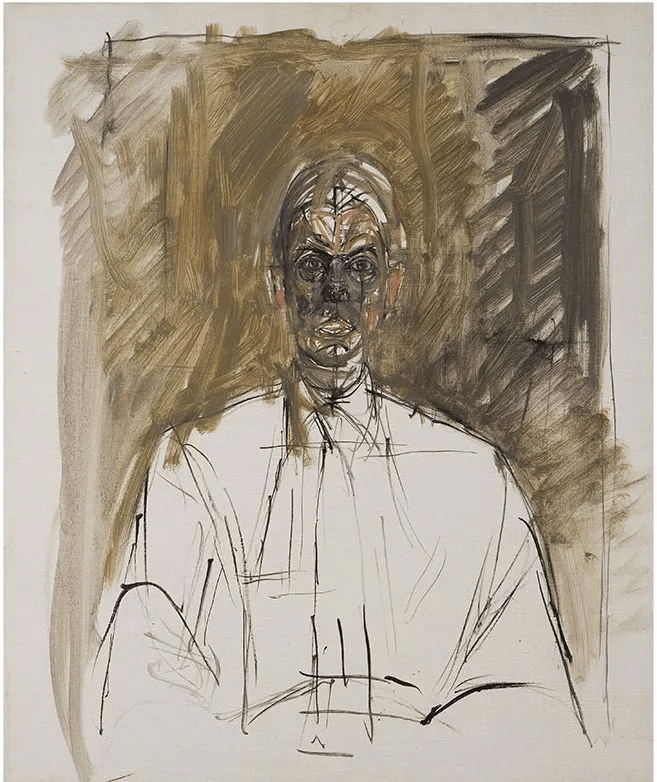
Alberto Giacometti
“Portrait of James Lord”
1964
Oil on canvas
45 5/8” x 31 3/4”
Collection of James Lord.

1 Sartre, Jean Paul; We Have only this Life to Live: Selected Essays 1939-1975; The New York Review of Books; New York, New York; 2013; p. 189.

2 Dupin, Jacques; Giacometti: Three Essays (translated by John Ashberry and Brian Evenson); Black Square Editions, Hammer Books; New York, New York; 2003; pp. 52-53.

3 Sylvester, David; Looking at Giacometti; Henry Holt and Company; New York, New York;1994; p. 113.

4 Sylvester, David; Looking at Giacometti; Henry Holt and Company; New York, New York;1994; p. 7.

5 Lord, James; A Giacometti Portrait; The Museum of Modern Art, New York, and Doubleday & Company; Garden City, New York; 1965; p. 28.

6 Lord, James; A Giacometti Portrait; The Museum of Modern Art, New York, and Doubleday & Company; Garden City, New York; 1965; p. 64.

PAINT IT BLACK

“She’s got everything she needs,
She’s an artist, she don’t look back.
She’s got everything she needs,
She’s an artist, she don’t look back.
She can take the dark out of the nighttime
And paint the daytime black.”1

Louise Nevelson
“Black Wall”
1959
Painted wood
2642mm x 2165mm x 648mm
The Tate Gallery, London, United Kingdom.

We might be reminded of a couple songs on this subject: the first one written by Bob Dylan and the other by Mick Jagger and Keith Richards. Or, we might think of Goya’s late Pinturas Negras from 1819 to 1823; or two individual bodies of monochromatic abstractions produced by Ad Reinhardt and Louise Nevelson during the 1960’s. All incorporating the color black. Additionally, poets such as Robert Bly, Lawrence Ferlinghetti and Edward Hirsch have described various uses of this same color. Hirsch especially has commented on this in one of the essays in his larger collection titled The Demon and the Angel. He quotes a statement from the painter Robert Motherwell, and takes note that there are both physical and technical as well as psychological reasons for using this specific color.

Aaron Siskind
“Installation view of the ‘Black or White’ Exhibition”2
1950
b&w photograph
14cm x 25cm
Archives of American Art,
Smithsonian Institution, Washington, DC.

“The New York painters discovered that they could use black pigments to create a feeling that was sometimes infernal, sometimes transcendent. They entered a zone of black hues that was both boldly contemporary and richly archaic. Black fit the spirit of urban painters who also embraced a Modernist Primitivism: ‘The chemistry of the pigments is interesting: ivory black, like bone black, is made from charred bones or horns, carbon black is burnt gas,’ Robert Motherwell explained in a catalog note to the 1950 show Black or White. ‘Sometimes I wonder, laying in a great black stripe on a canvas, what animal’s bones (or horns) are making the furrows of my picture.”3

In another collection, My Sentence was a Thousand Years of Joy, Robert Bly includes several examples of the ekphrastic tradition related to this subject. He speaks of Cézanne and Monet, as well as Giotto, Fra Lippi, Rembrandt, and especially Robert Motherwell.

For Robert Motherwell

“Hunter, give me your horse. I am going into sorrow again.
I’m looking for the dead people hidden in the grass.
Help me up. I am crazy about suffering again.

I see that I am walking in a dead man’s shoes.
I have been born so many times as an orphan. The thin fiddle
Strings stretched tight have saved me from suicide.

When Robert Motherwell lifts up his two black clouds
So that they float a few feet from each other,
I know grief is the one who tells me what to do.

The soul can never get enough of the taste of its sorrow.
I am a horse throwing his head sideways, galloping
Away from the place where the happy people live.

I don’t care anymore whether I am educated or not.
We have learned so much pain by not going to school.
Our lines suggest the luck lost between heartbeats.

We who love Motherwell’s black clouds may be insane,
But at least we know where to feed. We are close
Relatives of the birds that followed Jesus to Egypt.”4

Robert Motherwell
“Elegy to the Spanish Republic”
1962
Acrylic on canvas
71″ x 132 1/4”
Yale University Art Gallery,
New Haven, Connecticut

As poets over the years, Robert Bly, Edward Hirsch, and Lawrence Ferlinghetti have all been interested in their contemporaries who were painters, as the above examples by Hirsch and Bly illustrate. In the example below, one of his late prose poems, Ferlinghetti writes about the many transformative processes that painters often go through, inspired by a certain painting by Motherwell.

The Painter’s Dilemma

“There they all were still, the unfinished canvasses, all chimeras, chiaroscuro illusions, dead stick figures still to be brought to real life, with their numbered pigments upon the canvas ground where formed the limbs the figures the faces of longing, yearning dogs and hungry horses’ heads among them, the skulls with ears, liquid porches, spilling light, onto the canvas, pools of it forming into shape of eyes, but as soon as they were formed they ran down with too much turpentine and ran onto the dark dogs and horses, and they turned into echoes of laughter with every mocking sound a different color echoing about the canvas and transfiguring all its painted parts, horses’ penises turned to yellow flutes that fitted to manifolds that fitted into female plumbing that in turn dissolved and floated down streets as yellow sunlight, while numbered shadows melted and percolated up into the gutters of tilted houses. Hunger and passion were what was needed but this got lost in the whirl of paint, in the depths of the cave that every canvas became, and the brush could not reach the boundaries of being inside Plato’s Cave.”5

Robert Motherwell
“In Plato’s Cave”
1991
Acrylic on canvas
72″ x 96”
National Gallery of Art,
Washington, DC.

These have been several observations pertaining to this one subject, which are shared by Robert Bly and Robert Motherwell, Edward Hirsch and Lawrence Ferlinghetti. It is a specific theme and color range that occurs in various periods of art history. And in Rock ’n Roll. So it seems like some one should have the final word here. But it will come to this, shared by three writers and one painter: Mick Jagger and Keith Richards, Franz Kline for one of his great ‘black’ paintings, and last but not least: Robert Bly.

“I see a red door
And I want it painted black
No colors anymore
I want them to turn black. . . .”

“Maybe then, I’ll fade away
And not have to face the facts
It’s not easy facing up
When your whole world is black. . . .”

“I wanna see the sun
Blotted out from the sky
I wanna see it painted, painted, painted
Painted black. . . .”6

Franz Kline
“Untitled”
1952
Enamel on canvas
53 3/8” x 68”
Metropolitan Museum of Art
New York, New York.

“Some people say
A painting is a pitcher full of the invisible.”7

“I don’t know why these poems keep veering off
Toward darkness.”8


1 Dylan, Bob; “She Belongs to Me” from Writings and Drawings; Alfred A. Knopf, Inc.; New York, New York; 1973; p.159.

2 In this installation photograph of the exhibition “Black or White” by Aaron Siskind, the works shown are from left to right: “Dark Pond” by Willem de Kooning, 1948; “Granada” by Robert Motherwell, 1948-1949; and “Germania II” by Hans Hofmann, 1950. Kootz Gallery, New York, New York, 1950.

3 Hirsch, Edward; The Demon and the Angel: Searching for the Source of Artistic Inspiration; Harcourt, Inc.; New York, San Diego and London; 2002; p. 183.

4 Bly Robert; My Sentence was a Thousand Years of Joy; Harper Perennial; New York, London, Toronto and Sydney; 2005; p. 59.

5 Ferlinghetti, Lawrence; When I Look at Pictures, Peregrine Smith Books; Salt Lake City, Utah; 1990; p. 46.

6 Jagger, Mick, & Keith Richards; Aftermath: Paint It Black; Audio Recording; Decca Records & RCA Studios; Los Angeles, California; 1966.

7 Bly Robert; My Sentence was a Thousand Years of Joy; Harper Perennial; New York, London, Toronto and Sydney; 2005; p. 13.

8 Bly Robert; My Sentence was a Thousand Years of Joy; Harper Perennial; New York, London, Toronto and Sydney; 2005; p. 85.

MARIANNE MOORE AND THE FABLES OF LA FONTAINE

Since ancient times, certain stories have been handed down from one generation to another through the spoken word. They were collected by such writers as Ovid, Homer, Aesop; other later fabulist writers; and even Rumi. It was later that they were finally published. There are also times when pieces of writing, or works of art are not merely illustrations of each other, but are truly complementary, that they support one another. “The Fables of La Fontaine” are a great example of this.

Pierre Julien
“La Fontaine with the Manuscript of the Fox and the Grapes”
1785
Marble
5′ 8″ x 3′ 7 1/4″ x 4′ 2 3/4″
The Louvre, Paris, France

“The Fables of La Fontaine” were published from 1668 to 1694. Over these years several editions were illustrated by François Chauveau, Jean-Baptiste Oudry, and Gustave Doré: these becoming major works of art in their own right. They were translated into English by Walter Thornbury in 1868 and much later by the Imagist poet Marianne Moore in her “Late Poems from 1965 to 1972.”

As this ancient tradition of story telling spread throughout the world, several of Aesop’s Fables found their way from the West to the East. As Jelaluddin Rumi had himself been collecting similar stories, several of them were included in his late work the Masnavi. In more recent times, new translations of these have been undertaken by Coleman Barks, especially in his books on The Soul of Rumi and One-Handed Basket Weaving.

So the following is a selection of three poems. Two versions of the story of the friendship between a bear and a gardener: the first is Marianne Moore’s translation of La Fontaine’s “The Bear and the Garden-Lover” and the second one is Coleman Barks’ translation of “The Man with a Bear” by Rumi. The final selection is a short piece from Marianne Moore’s translations titled “The Fox and the Grapes.” The works of art by Gustave Doré, an Anonymous Persian Miniaturist, and François Chauveau.

The Bear and the Garden-Lover

“A bear with fur that appeared to have been licked backward
Wandered a forest once where he alone had a lair.
This new Bellerophon, hid by thorns which pointed outward,
Had become deranged. Minds suffer disrepair
When every thought for years has been turned inward.
We prize witty byplay and reserve is still better,
But too much of either and health has soon suffered.
No animal sought out the bear
In coverts at all times sequestered,
Until he had grown embittered
And, wearying of mere fatuity,
By now was submerged in gloom continually.
He had a neighbor rather near,
Whose own existence had seemed drear;
Who loved a parterre of which flowers were the core,
And the care of fruit even more.
But horticulturalists need, besides work that is pleasant,
Some shrewd choice spirit present.
When flowers speak, it is as poetry gives leave
Here in this book; and bound to grieve,
Since hedged by silent greenery to tend,
The gardener thought one sunny day he’d seek a friend.
Nursing some thought of the kind,
The bear sought a similar end
And the past just missed collision
Where their paths came in conjunction.
Numb with fear, how ever get away or stay here?
Better be a Gascon and disguise despair
In such a plight, so the man did not hang back or cower.
Lures are beyond a mere bear’s power
And this one said, ‘Visit my lair.’ The man said, ‘Yonder bower,
Most noble one, is mine; what could be friendlier
Than to sit on tender grass and share such plain refreshment
As native products laced with milk? Since it’s an embarrassment
To lack what lordly bears would have as daily fare,
Accept what if here.’ The bear appeared flattered.
Each found, as he went, a friend was what most mattered;
Before they’d neared the door, they were inseparable.
As confidant, a beast seems dull.
Best live alone if wit can’t flow,
And the gardener found the bear’s reserve a blow,
But conducive to work, without sounds to distract.
Having game to be dressed, the bear, as it puttered,
Diligently chased or slaughtered
Pests that filled the air, and swarmed, to be exact,
Round his all too weary friend who lay down sleepy—
Pests—well, flies, speaking unscientifically.
One time as the gardener had forgot himself in dream
And a single fly had his nose at its mercy,
The poor indignant bear who had fought it vainly,
Growled, ‘I’ll crush that trespasser; I have evolved a scheme.’
Killing flies was his chore, so as good as his word,
The bear hurled a cobble and made sure it was hurled hard,
Crushing a friend’s head to rid him of a pest.
With bad logic, fair aim disgraces us the more;
He’d murdered someone dear, to guarantee his friend rest.

Intimates should be feared who lack perspicacity;
Choose wisdom, even in an enemy.”1

Gustave Doré
Jean de La Fontaine’s “L’Ours et l’amateur des jardins”
1868
Wood engraving
Public Domain

“The Man with a Bear”

“For the man who saved the bear
from the dragon’s mouth, the bear
became a sort of pet.

When he would lie down to rest,
the bear would stand guard.

A certain friend passed by,
‘Brother how did this bear
get connected to you?’

He told the adventure with the dragon,
and the friend responded,
‘Don’t forget
what your companion is. This friend
is not human! It would be better
to choose one of your own kind.’

‘You’re just jealous of my unusual helper.
Look at his sweet devotion. Ignore
the bearishness!’

But the friend was not convinced,
‘Don’t go into the forest
with a comrade like this!
Let me go with you.’
‘I’m tired.
Leave me alone.’
The man began imagining
motives other than kindness for his friend’s concern.
‘He has made a bet with someone
that he can separate me from my bear.’ Or,
‘He will attack me when my bear is gone.’

He had begun to think like a bear!

So the human friends went different ways,
the one with his bear into a forest,
where he fell asleep again.

The bear stood over him
waving the flies away.

But the flies kept coming back,
which irritated the bear.

He dislodged a stone from the mountainside
and raised it over the sleeping man.

When he saw that the flies had returned
and settled comfortably on the man’s face,
He slammed the stone down, crushing
to powder the man’s face and skull.

Which proves the old saying:

IF YOU’RE FRIENDS
WITH A BEAR,
THE FRIENDSHIP
WILL DESTROY YOU.

WITH THAT ONE,
IT’S BETTER TO BE
ENEMIES.”2

Illustration contained in the Manuscript W.626.79B
“Masnavi-i ma’navi” by Jalal al-Din Rumi
1663
Ink and pigments on thin laid paper
10 7/16” x 5 7/8”
The Walters Art Museum,
Baltimore, Maryland.

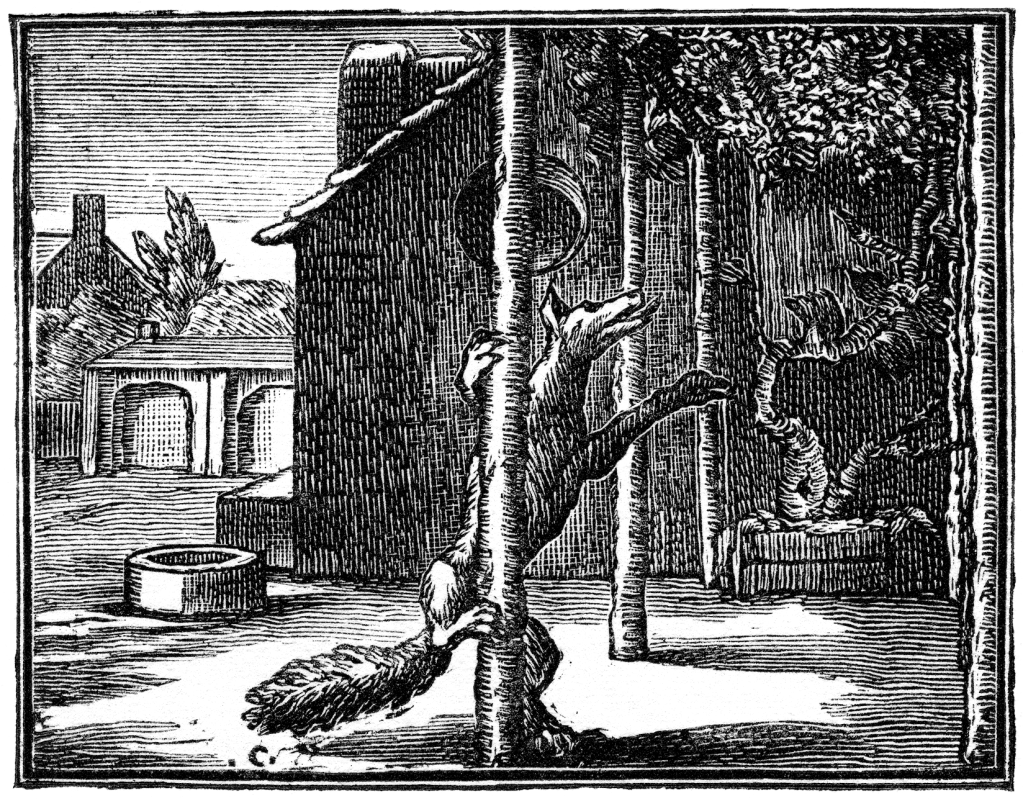
The Fox and the Grapes

“A fox of Gascon, through some say of Norman descent,
When stared till faint gazed up at a trellis to which grapes were tied—
Matured till they glowed with a purplish tint
As though there were gems inside.
Now grapes were what our adventurer on strained haunches chanced to crave
But because he could not reach the vine
He said, ‘These grapes are sour; I’ll leave them for some knave.’

Better, I think, than an embittered whine.”3

Francois Chauveau
“Illustration for the Fables de La Fontaine, Volume 1”
1668
Burin engraving
Claude Barbin & Denys Thierry,
Paris, France

1 Moore, Marianne; Grace Schulman, ed.; The Poems of Marianne Moore, Viking Penguin; New York, New York; 2003; pp. 370-371.

2 Barks, Coleman; RUMI One-Handed Basket Weaving Poems on the Theme of Work; MAYPOP; Athens, Georgia; pp. 23-24.

3 Moore, Marianne; Grace Schulman, ed.; The Poems of Marianne Moore, Viking Penguin; New York, New York; 2003; p. 365.

ST. GEORGE AND THE DRAGON

Raphael’s painting of “St. George and the Dragon” from the collection of the National Gallery of Art is an unforgettable image. It is an heroic and monstrous image contained within a very small sized painting. The figure is astride his horse, they are fighting as one, vanquishing this beast, with a panoramic landscape framing the whole image. It is a classic theme, echoed by many artists.

Raphael
“Saint George and the Dragon”
1505
Oil on wood
11.2″ x 8.5″
National Gallery of Art, Washington, DC.

As in the ‘folk tradition’ in music, one artist will set out a theme, which is later taken up and elaborated upon, by later artists. The ideas and images continue to grow and develop over time. The 15th Century German artist Bernt Notke and the 20th Century American poet Robert Bly are two important examples of this process.

Taking its inspiration from the sculptural group of the same name by the German artist Bernt Notke, “St. George and the Dragon” is an excellent example of the ekphrastic tradition. Robert Bly is literally reading this sculpture from top to bottom: from the boyish expression on the face of this knight down to the horrific vestige of the monster on his death bed.

Over the years, the poet Robert Bly made several appearances at the Butler University Visiting Writers Program here in Indianapolis, including 1989, 1994, 1999 and 2003. I have continued to follow his work over these years, and had it not been for these visits, I would never have heard of, nor read about, this artist and this particular piece of sculpture.

Bernt Notke was an eastern German painter, printmaker and sculptor who lived from 1440 to 1509. During his lifetime he lived and worked in Lassahn and Lübeck, several other areas near the Baltic Sea, and made intermittent visits to Sweden. It was in Stockholm in 1489 that he produced his most important work, “St. George and the Dragon” for the City Church, now known as the Cathedral of St. Nickolas.

Robert Bly has often studied and written about works of visual art. These have included both Bernt Notke’s “St. George and the Dragon” and Albrecht Durer’s etching of “Two Middle Aged Lovers.”1 Bly has not just referred to earlier German artists: many others have included ancient examples of an Egyptian figure of “Isis” and a Mycenean “Ecstatic Mother,”2 both at the Louvre. He also references Pieter Breughel’s painting of a Flemish pageant3 (now only known to us as a woodcut printed by an anonymous artist in 1566), as well as the great series of “Haystacks” painted by Claude Monet. Bly always seems to be attracted to the heroic and the universal and how they both are intertwined with the personal and everyday existence of his subjects.

Bernt Notke
“St. George and the Dragon”
1489
Bronze replica of the original wood and mixed media.
3.75 meters high, 6 meters including base.
The Cathedral Church of St. Nicholas,
Stockholm, Sweden

St. George and the Dragon

A sculpture made by Bernt Notke
in 1489 for Stockholm Cathedral

“The dragon is losing.
He fights on his back
Fiercely, as when a child
Lifts his four feet
To hold off
The insane parent.
His claws grasp
The wooden lance that has
Pierced his thorny
Breast. . . . But too late. . . .

As children, we knew ours
Was a muddy greatness.
We knew our part
Lay with the dragon.

And this girlish knight?
Oh I know him.
I read the New
Testament as I lay
Naked on my bed
As a boy. The knight
Rises up radiant
With his forehead
Eye that sees past
The criminal’s gibbet
To the mindful
Towers of the spirit city.
But I now hate
This solar boy
Whom I have been.

This solar knight
Grows victorious
All over the world.
And the dragon? He
Is the great spirit
The alchemists knew of.
He is Joseph, sent down
To the well. Grendel,
What we have forgotten,
Without whom is nothing.”5

And as a footnote to all of this, I remember a painting from several years ago by the contemporary artist, Ellen Fischer. It is an abstracted version of St. George based on that Raphael painting mentioned above from the National Gallery. Many of Fischer’s earlier paintings incorporate the playful placement and movement of a variety of objects on and around the picture plane.

In this particular painting, “St. George and the Dragon,” she includes all of the elements from the original with slightly differing placements. This painting however, stands out as very tightly constructed: horse and rider fused as one, the shadow of the leg and tail of the monster just below the middle of the horse. It gives us an interior intensity complimented with the perfect placement of the various elements.

When I asked her about this, this was her response:

“I made St. George and his horse one and the same! See the princess in the background with the red dress? She is in the distance in my painting, too—iconography is the same in every picture I can think of—I’ve always loved St. George’s heroic, plump white horse, who appears to be as much into the fight as St. George, swinging its hooves at the dragon!”6

Ellen Fischer
“St. George and the Dragon”
c. 1977-1978
Oil on canvas
48″ x 60”
Collection of the artist

1 Bly, Robert; Eating the Honey of Words; Harper Collins Publishers; New York, New York; 1999; pp. 119 & 202-203.

2 Bly, Robert; Sleepers Joining Hands; Harper Collins Publishers; New York, New York; 1991; pp. 35 & 45.

3 Bly, Robert; Iron John; Adddison-Wesley Publishing Company, Inc.; New York, New York; 1990; pp. 244-245.

4 Bly, Robert; The Night Abraham Called to the Stars; Harper Collins Publishers; New York, New York; 2002; p. 15.

5 Bly, Robert; “St. George and the Dragon” from Eating the Honey of Words; Harper Collins Publishers; New York, New York; 1999; pp. 202-203.

6 Fischer, Ellen; “A statement on St. George and the Dragon;” E-MAIL communication with this author; 14 April 2022, 7:58am.

WISLAWA SZYMBORSKA: THREE POEMS

In the conclusion of his book, Vermeer in Bosnia, Lawrence Weschler writes about two of Wislawa Szymborska’s poems: “In Praise of Dreams” from 1986, and “Maybe All This” from 1993. From the first poem he notes that Szymborska wrote: “In my dream . . . I paint like Vermeer of Delft.” And in the second one, he speculates: “. . . the picture Szymborska’s words have in mind must be something very like Vermeer’s Lacemaker. How marvelously, at any rate, the poem helps elucidate the painting, and vice versa.”1 To my mind, this is one of the most important functions of the ekphrastic tradition.

In her collected work, Wislawa Szymborska provides us with several examples of this tradition. One especially is a diminutive poem, of only six lines describing a diminutive painting of a milkmaid by Vermeer. When this was written, the author was surely reflecting upon earlier wars and invasions in Europe, especially in her homeland of Poland. Today however, it has taken on a new and timely meaning related to the Ukraine.2

In earlier work, Szymborska takes a more generalized view through a museum, taking note of certain historic objects: an antique plate, a necklace, gloves and shoes, swords, and even a lute. She alludes to the scene without illustrating it.

In another poem she doesn’t literally show the ‘Tower of Babel’ as it was painted by Pieter Brueghel, but she does set up a dialogue between two of its inhabitants. There are two different type faces printed throughout this conversation: Italic for the first one, and ROMAN for the second. Although they are both placed together on the ensuing lines, they clearly do not communicate in any logical way. The speaking in different languages and at cross purposes has begun.3

In several other poems however, Szymborska takes a cue directly from the works of art. These include an ancient Greek sculptural fragment, and paintings by both Pieter Brueghel and Johannes Vermeer.

BRUEGHEL’S TWO MONKEYS

“This is what I see in my dreams about final exams:
two monkeys, chained to the floor, sit on the windowsill,
the sky behind them flutters,
the sea is taking its bath.

The exam is History of Mankind.
I stammer and hedge.

One monkey stares and listens with mocking disdain,
the other seems to be dreaming away—
but when it’s clear I don’t know what to say
he prompts me with a gentle

clinching of his chain.”4

Pieter Brueghel
“Two Monkeys”
1562
Oil on wooden panel
20cm x 23cm
Gemaldegalerie, Berlin, Germany

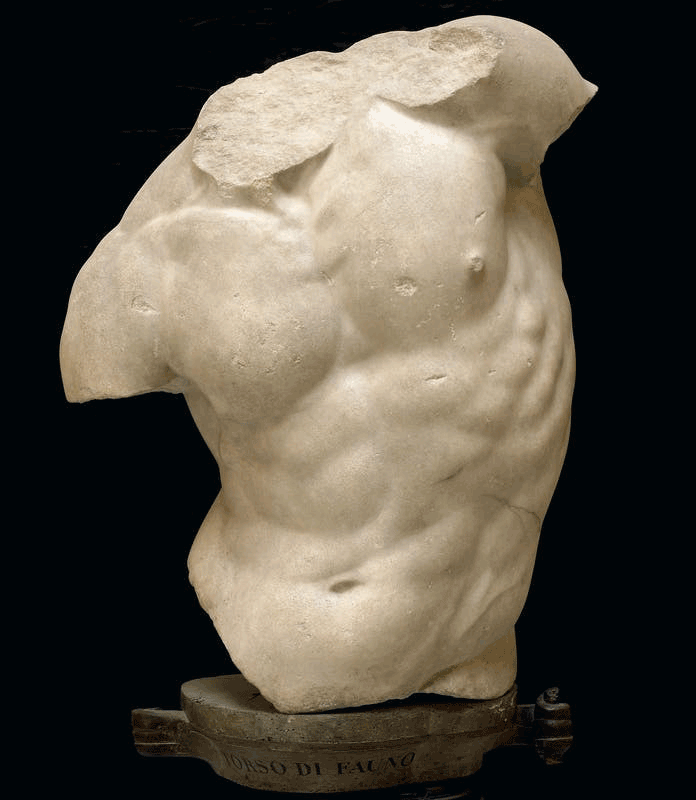
GREEK STATUE

“With the help of people and the other elements
time hasn’t done a bad job on it.
It first removed the nose, then the genitalia,
next, one by one, the toes and fingers,
over the years the arms, one after the other,
the left thigh, the right,
the shoulders, hips, head, and buttocks,
and whatever dropped off has since fallen to pieces,
to rubble, to gravel, to sand.

When someone living dies that way
blood flows at every blow.

But marble statues die white
and not always completely.

From the one under discussion only the torso lingers
and it’s like a breath held with great effort,
since now it must
draw
to itself
all the grace and gravity of what was lost.

And it does,
for now it does,
it does and it dazzles,
it dazzles and endures—

Time likewise merits some applause here,
since it stopped work early,
and left some for later.”5

“The Gaddi Torso”
1st Century BC.
Marble
84cm high
The Uffizi Galleries, Florence, Italy

Perhaps works of art actually do survive, in one way or another, in one form or another, in order to remind us of what is important. They need not follow the dictates of ‘socialist realism’ nor the fashions of ‘post-modernism’ and so many other contemporary isms. What we end up experiencing is the persistence of each artist, their story and how they want to tell it, even if it ends up being only a fragment, or a whisper. The artist’s voice, carried through even in a fragment, is an antidote to the craziness of our world during these times.

Johannes Vermeer
“The Milkmaid”
1658-1660
Oil on canvas
17 7/8” x 16”
Rijksmuseum, Amsterdam,
The Netherlands.

VERMEER

“As long as that woman from the Rijksmuseum
in painted silence and concentration
keeps pouring milk day after day
from the jug to the bowl
the World hasn’t earned
the world’s end.”6


1 Weschler, Lawrence; Vermeer in Bosnia; Vintage Books, A Division of Random House, Inc.; New York, New York; 2004; p. 403.

2 Szymborska, Wiesława; Poems New and Collected 1957-1997; (Translated by Clare Cavanagh and Stanisław Baranczak); Harcourt Brace & Company; New York, San Diego, London; 1998; p. 30.

3 Szymborska, Wiesława; Poems New and Collected 1957-1997; (Translated by Clare Cavanagh and Stanisław Baranczak); Harcourt Brace & Company; New York, San Diego, London; 1998; p. 57.

4 Szymborska, Wiesława; Poems New and Collected 1957-1997; (Translated by Clare Cavanagh and Stanisław Baranczak); Harcourt Brace & Company; New York, San Diego, London; 1998; p. 15.

5 Szymborska, Wisława; Here; (Translated by Clare Cavanagh and Stanisław Baranczak); Houghton Mifflin Harcourt; Boston, New York; 2010; p. 77.

6 Szymborska, Wisława; Here; (Translated by Clare Cavanagh and Stanisław Baranczak); Houghton Mifflin Harcourt; Boston, New York; 2010; p. 55.

The Letter

No, this is not about The Boxtops, nor Joe Cocker’s cover of their mournful rock ballad from 1967, although there is a reference to a Broadway musical from 1953. This concerns any number of artists who moved to New York City during the early and middle years of the 20th Century. They came especially from the Mid-West. David Smith was one of them, having been born and raised in Decatur, Indiana. Often feeling homesick, there is a certain letter, in the form of a sculpture, which he imagined writing home.

A. Eriss
“David Smith”
B&W Photograph
1936
(p. 11; David Smith by David Smith.)

Smith first worked in offices in Washington, DC and New York, and later as a welder in a steelworks. He was simultaneously energized by the life and pace of the east coast and demoralized by the loneliness and solitude that he found there. “Yet lonesomeness is a state in which the creative artist must dwell much of the time….”1

This instantly reminded me of Rainer Maria Rilke and the advice he had written in a letter from Rome on 14 May 1904 to his younger poet friend: “This very wish will help you, if you use it quietly, and deliberately and like a tool, to spread out your solitude over wide country. People have (with the help of conventions) oriented all their solutions toward the easy and toward the easiest side of easy; but it is clear that we must hold to what is difficult; everything alive holds to it, everything in Nature grows and defends itself in its own way and is characteristically and spontaneously itself, seeks at all costs to be so and against all opposition. We know little, but that we must hold to what is difficult is a certainty that will not forsake us; it is good to be solitary, for solitude is difficult; that something is difficult must be a reason the more for us to do it.”2

David Smith was doubly aware of this I think. While many of his contemporaries were easily falling into camps based solely on media or subject matter, his stated goal was that this work was an attempt to bridge the gap between painting and drawing and sculpture: a most difficult project.

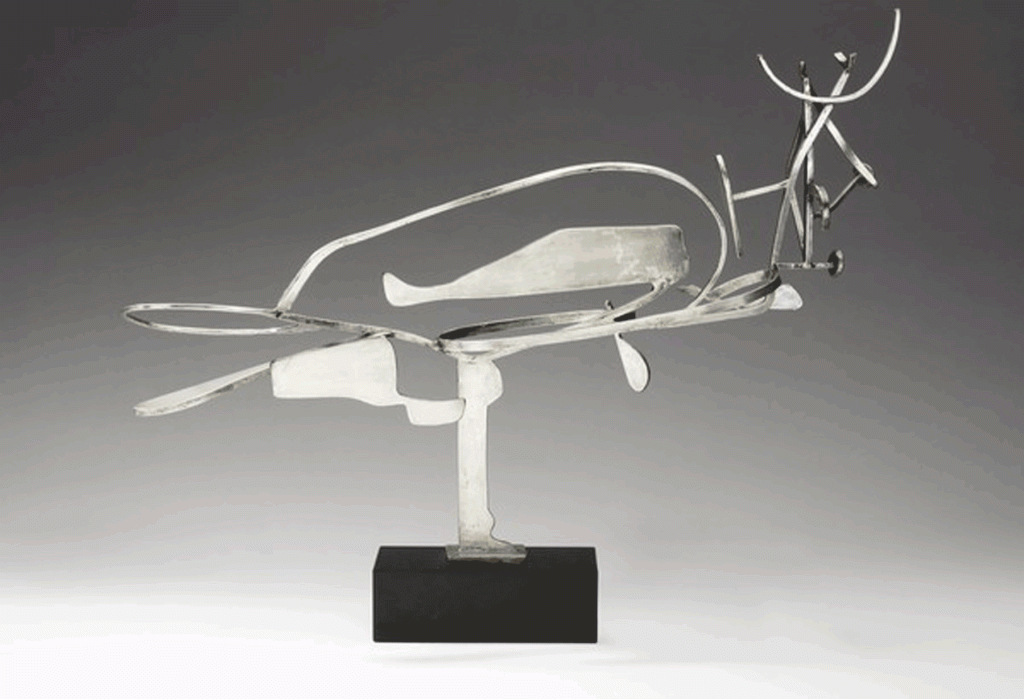
There are several examples of this work: severely linear pieces that often contain, or are made up of, an arrangement of attenuated forms and glyphs. A great example of this is a beautiful piece in the collection of the Indianapolis Museum of Art titled “The Egyptian Barnyard” and often described as a drawing in steel, or in this case, welded silver.

David Smith
“Egyptian Barnyard”
1954
Wrought and soldered silver on wood base
14 1/2” x 24” x 5 1/2”
Gift of Mr. and Mrs. James W. Alsdorf
Indianapolis Museum of Art, Indianapolis, Indiana

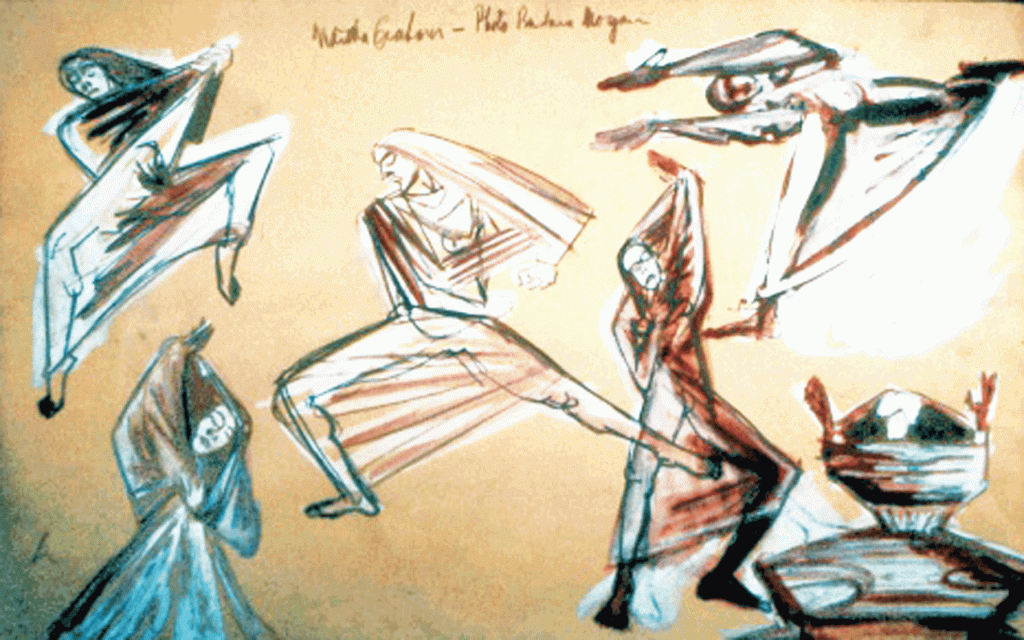
Although his work has often been held up as great formalist abstraction, there are specific examples of content inherent in many of Smith’s pieces. For instance, these figurative gesture drawings of the dancer Martha Graham.

David Smith
“Studies of Martha Graham”
1938
12” x 19”
Drawing on paper after a series of photographs by
Barbara Morgan.
Collection of Candida and Rebecca Smith.

There are also photographic references to his daughters running and tumbling through their back yard, portraits of other artists and characters, and even several pieces inspired directly from Alberto Giacometti’s early masterpiece “The Palace at 4:00 AM.”

David Smith
“Interior for Exterior”
1939
Steel and bronze
18” x 22” x 23 1/4”
Collection of Mr. and Mrs. Orin Raphael

Over the years, writers such as Cleve Gray3 and Edward F. Fry4 have provided hints as to the content of “The Letter.” In 1967 at the Yale-Norfolk Summer School of Music and Art it was Mr. Gray who lectured on David Smith, whose biography he had just finished editing. In one of the earliest exhibitions I had visited at the Guggenheim Museum in New York, it was the David Smith Retrospective of 1969 that made a lasting impression. Finally, during my freshman year in art school in Baltimore, an early winter 1965 visiting artist lecture by David Smith himself still rings true to me in all that he said.

David Smith
“Sketchbook Study for The Letter”
c. 1950
Pen and ink and pencil on paper
David Smith Archives, III — 1283
New York, New York

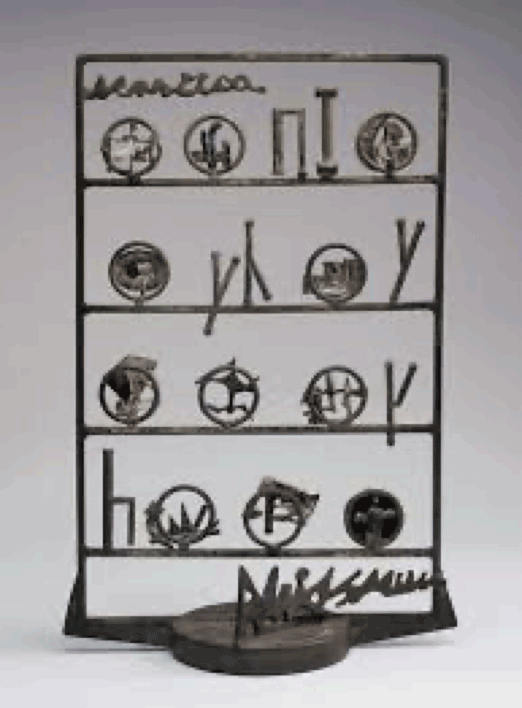
In order to decipher this letter, we can see in the drawing study a salutation in the top left corner and a signature at the lower right. In between we have the written body made up of a series of scrap railroad hardware “h’s” and “y’s” and “o’s” forming a message. The particular wording of this letter itself is borrowed from a 1953 song that was included in the Broadway musical “Wonderful Town.”

In short, two young girls, sisters Ruth and Eileen Sherwood from Columbus, Ohio, arrive in Greenwich Village determined to make it in the city, one as a writer, the other as an actress. From their basement apartment, they are shaken by blasts from the nearby construction of a new subway line, as well as late night knocks on their door by ‘customers’ of the former tenant known as Violet. They are stricken with homesickness, and musically ask: Why oh why oh, did we leave Ohio? This reference did indeed become the content of David Smith’s “Letter.”

“DEAR MOTHER”

“OH WHY,
OH WHY OH,
DID I EVER LEAVE
O HI OH?”

“YOUR SON, DAVID SMITH”

David Smith
“The Letter”
1950
Steel
37 3/4” x 22 7/8 x 11”
The Munson-Williams-Proctor Institute
Utica, New York

1 Clark, Trinkett; The Drawings of David Smith; International Exhibitions Foundation; Washington, DC; 1985; p. 20.

2 Rilke, Rainer Maria; Letters to a Young Poet; W. W. Norton & Company; New York, New York; 1934 & 1962; p. 53.

3 Gray, Cleve, ed.; David Smith by David Smith; Holt, Rinehart and Winston; New York, New York; 1968.

4 Fry, Edward F.; David Smith; The Solomon R. Guggenheim Museum; New York, New York; 1969.

BARBARA FRITCHIE AND THE AMERICAN FLAG

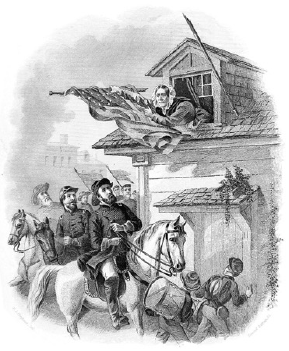
In American history classes in high school we learned of the story of a woman who insisted on waving her country’s flag during the Civil War even as a Confederate general was leading his troops in retreat through the town of Frederick, Maryland and back into northern Virginia.  We knew her name to be Barbra Fritchie, but several other spellings were used, including Frietchie and Frietschie.

“Barbara Fritchie”
Steel plate engraving
1867[i]

At that time, Miz Fritchie was ninety years old, and although she occasionally cheered on Union Army troops, it may have been a woman in nearby Middletown who actually waved the flag in this particular incident as Confederate soldiers passed by.

To add to the confusion, John Greenleaf Whittier had only heard of this incident through other reports and constructed his narrative from a distance.  Although Lee is mentioned early in the poem, it was Stonewall Jackson who was actually leading Lee’s army.  Flags may have also been waved at A. P. Hill and Ambrose Burnside as their armies passed through this area during those times.  Be that as it may, Whittier’s poem honoring Barbara Frietchie became a tribute to the local community in Frederick as well as an inspiration to abolitionists across the land.  

In more recent times, several contemporary artists have taken up this theme: weaving and waving the American flag in and out of their work.  It is not just a gimmick, and it does eliminate some of the clichés that surround the use of the American flag.  These pieces re-establish some of the flag’s symbolic potential and point to the irony that its use implies in these current times.  Three such artists are:  Sonya Clark, Donald Lipski, and Thornton Dial.  The descriptions written concerning these pieces, as well as the artists’ own statements provide lyrical interpretations regarding this work. 

Discussing the process of un-weaving, combining and re-weaving certain flags for an exhibition at the Craft in America Center in Los Angeles in 2020, Sonya Clark stated:  “We are at a chapter in our history that once again acknowledges how racial injustice is deeply woven into the fabric of this nation.  We are at a turning point. We must unravel those strands of injustice.”[ii] 

In an essay accompanying a Donald Lipski exhibition at the Fabric Workshop in 1991, the poet and critic John Yau observed:  “In his most recent work—Who’s Afraid of Red, White & Blue?—Lipski continues to apply a wide range of specific, usually repetitive processes, to the American flag.  In ‘Flag balls,’ with the help of others, he rolled thousands of yards of continuously printed flag material into giant spheres.  In doing so, he extends the process in which a flag achieves a greater dimension, reminding viewers that we are all part of a larger pattern.”[iii] 

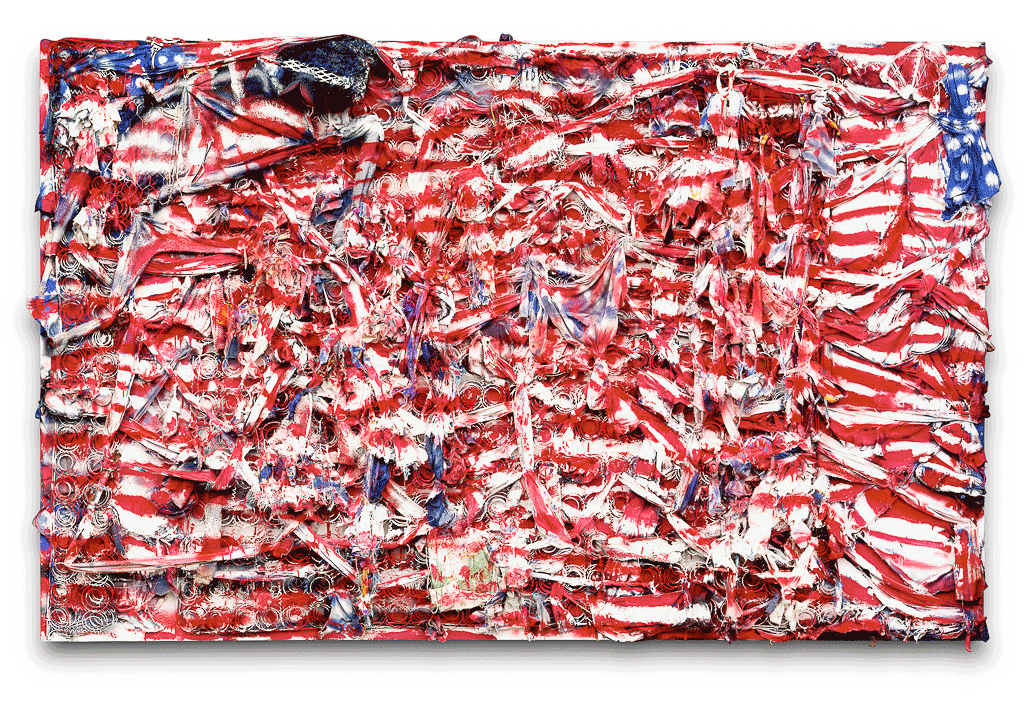
And last, but not least, there is the very title that Thornton Dial chose for the piece included in his exhibition at the Indianapolis Museum of Art in 2003.  It beautifully summarizes and states the purpose of his work:  “Don’t matter how raggly the flag, It Still Got to Tie Us Together.” 

So here is the entire poem, written by John Greenleaf Whittier, on the flag waving done by Miz Barbara Fritchie during the Civil War, interspersed with examples of these three contemporary American artists.                

Sonya Clark
“these days this history this country”
2019
Unwoven and rewoven commercially printed flags
(American & Confederate Battle Flags)
10” x 7”
Image © Sonya Clark, 2019

Barbara Frietchie

“Up from the meadows rich with corn,
Clear in the cool September morn,

The clustered spires of Frederick stand
Green-walled by the hills of Maryland.

Round about them orchards sweep,
Apple- and peach-tree fruited deep,

Fair as a garden of the Lord
To the eyes of the famished rebel horde,

On that pleasant morn of the early fall
When Lee marched over the mountain wall,—

Over the mountains winding down,
Horse and foot, into Frederick town.

Forty flags with their silver stars,
Forty flags with their crimson bars,

Flapped in the morning wind: the sun
Of noon looked down, and saw not one.

Up rose old Barbara Frietchie then,
Bowed with her fourscore years and ten;

Bravest of all in Frederick town,
She took up the flag the men hauled down;

In her attic window the staff she set,
To show that one heart was loyal yet.”

Donald Lipsky
“Who’s Afraid of Red, White & Blue?  Flag Ball #2”
1990
Muslin 
(One of thirteen balls, each 32” in diameter)
Courtesy of The Fabric Workshop
Philadelphia, Pennsylvania

“Up the street came the rebel tread,
Stonewall Jackson riding ahead.

Under his slouched hat left and right
He glanced: the old flag met his sight.

“Halt!”— the dust-brown ranks stood fast.
“Fire!”— out blazed the rifle-blast.

It shivered the window, pane and sash;
It rent the banner with seam and gash.

Quick, as it fell, from the broken staff
Dame Barbara snatched the silken scarf;

She leaned far out on the window-sill,
And shook it forth with a royal will.

‘Shoot, if you must, this old gray head,
But spare your country’s flag,’ she said.

A shade of sadness, a blush of shame,
Over the face of the leader came;

The nobler nature within him stirred
To life at that woman’s deed and word:

‘Who touches a hair of yon gray head
Dies like a dog! March on!’ he said.

All day long through Frederick street
Sounded the tread of marching feet:

All day long that free flag tost
Over the heads of the rebel host.

Ever its torn folds rose and fell
On the loyal winds that loved it well;

And through the hill-gaps sunset light
Shone over it with a warm good-night.

Barbara Frietchie’s work is o’er,
And the Rebel rides on his raids no more.

Honor to her! and let a tear
Fall, for her sake, on Stonewall’s bier.

Over Barbara Frietchie’s grave
Flag of Freedom and Union, wave!

Peace and order and beauty draw
Round thy symbol of light and law;

And ever the stars above look down
On thy stars below in Frederick town!”[iv]

Thronton Dial
“Don’t matter how raggly the flag, It Still Got to Tie Us Together“
2003
Mattress coils, chicken wire, clothing, can lids, found metal, plastic twine, wire, Splash Zone compound, enamel, and spray paint on canvas on wood.
71” x 114” x 8”
Indianapolis Museum of Art, Indianapolis, Indiana


[i] Brockett, L. P. and Mary C. Vaughan; Woman’s Work in the Civil War: a Record of Heroism, Patriotism and Patience; Zeigler, McCurdy & Co.; Philadelphia, Pennsylvania; 1867; p. 10.

[ii] Clark, Sonya; From the artist’s statement for the “Democracy 2020 Exhibition:  Craft & the Election;” Craft in America Center; Los Angeles, California; 2020.

[iii] Stroud, Marion Boulton, et al; Donald Lipski:  Who’s Afraid of Red, White & Blue?; The Fabric Workshop; Philadelphia, Pennsylvania; 1991; Unpagenated.

[iv] Whittier, John Greenleaf; “Barbara Frietchie;” The Atlantic Monthly; Boston, Massachusetts; October 1863.