SEAN SCULLY: A PROSE POEM

At the Cincinnati Art Museum near the end of the summer of 2006 there was a special exhibition of paintings by the Irish painter Sean Scully titled “Wall of Light.” It originated at the Phillips Collection in Washington, DC, in late 2005 and included approximately eighty paintings and thirty works on paper including drawings, watercolors, and photographs.

One particular photograph of an old farm shack made from stacked stone featured a beautiful façade complete with light, shadow, texture: some of the very things that Scully looks at and draws from outside of his studio, in the real world. And certain writers have noted how the elements in Scully’s paintings are placed as if they were bricks or stones.
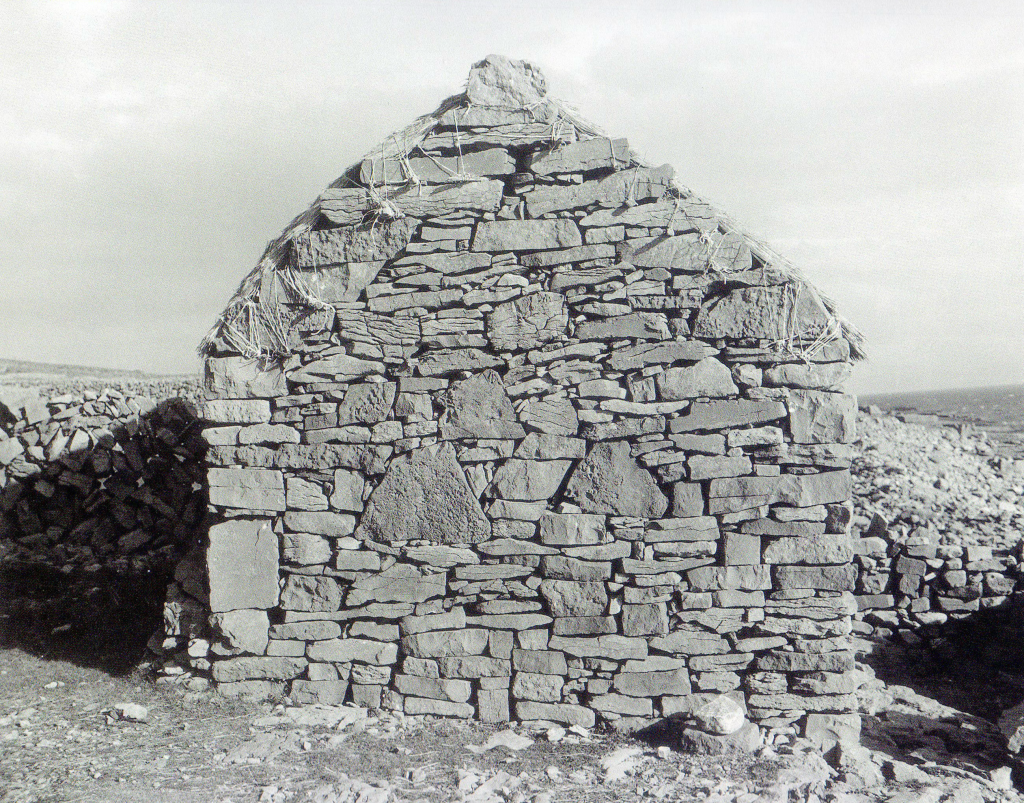
Sean Scully
“Stone Shack End”
1994
Gelatin silver print
16” x 20”
Collection of the artist.

John Yau’s description of Scully’s painted surfaces is one example: “The rhythmic brushstrokes—ranging from feathery to matter-of-fact—and the layers of paint (running from thin to pasty) are visceral, even as light seeps through the interstices or flares where the slabs of caressed color don’t touch. The surface is neither uniform nor packed solid; it breathes. The bricks of color and the luminous spaces between them are equally important, with neither trumping the other.”1
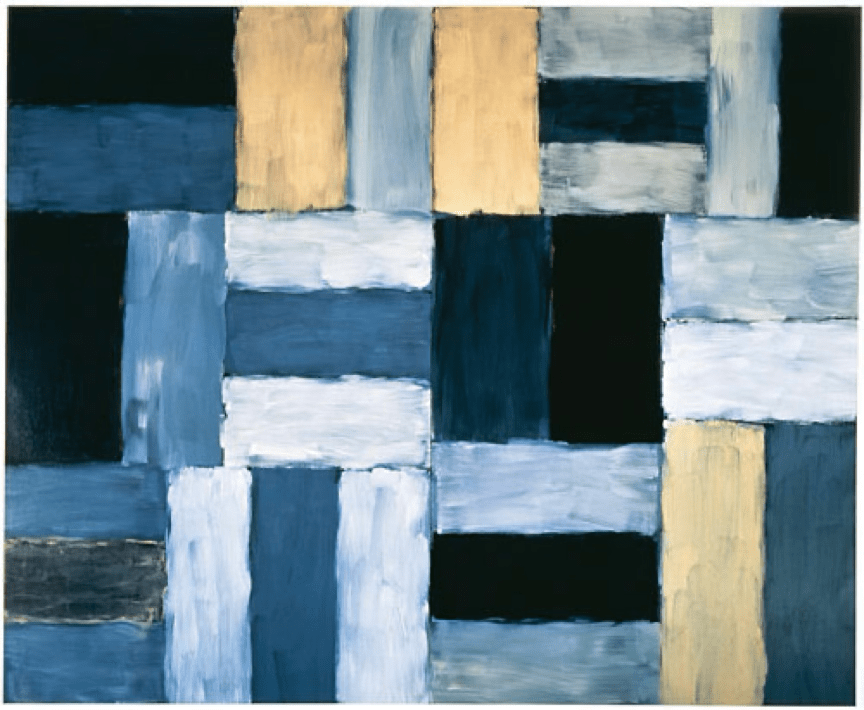
Sean Scully
“Wall of Light: Desert Night”
1999
Oil on canvas
108”x 132”
Modern Art Museum of Fort Worth
Fort Worth, Texas

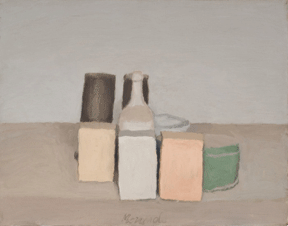
Stephen Bennett Phillips, writing for the Phillips Collection in Washington, DC, has also observed: “Compositionally, within the Wall of Light series, Scully’s tendency has been to become increasingly asymmetrical and off-kilter. His longstanding focus on stripes—short ones in the case of the Wall of Lights paintings—can be compared with Giorgio Morandi’s lifelong study of a narrow range of still-life forms. In fact, Scully’s brick-like forms are directly analogous to blocks and voids that appear in Morandi’s still lifes.”2

Giorgio Morandi
“Still Life”
1953
Oil on canvas
8” x 15 1/8”
The Phillips Collection, Washington, DC.

In the book by John Yau titled Sean Scully: Night and Day, it seems to me that Yau is not just writing a curator’s statement, or a critical essay but going much further, as a poet would. Using sensitive descriptions of the paintings, along with insightful analysis, he arrives at a synthesis of lyrical and critical reflections on these works of art. Yau has, in essence, created an extended prose poem, whose subject is this series by Scully. The literary pieces that grow out of these paintings, following reflection, lead us to a new vision and understanding of these very pieces.

One summer John Yau and his family spent a week on the Dingle Peninsula in western Ireland. The local architecture especially attracted them, from the great Gallarus Oratory down to the many local stone barns and sheds. Later that year, Yau interviewed Sean Scully in preparation for his book on the subject of Night and Day. The writing on Scully’s work contained many references to these buildings and walls and analogies to the process of building up layers of paint as if they were bricks and stones.

“. . . the irregularly shaped stones had to be fitted together. In a way that is breathtaking and inspiring, the people who built the Gallarus Oratory made improvisation and necessity inseparable. A similar indivisibility animates Scully’s work.”3

“Scully builds his compositions out of what he calls ‘bricks’ of rich and often dusty color, but, like the anonymous stonemasons of the Oratory, is similarly committed to improvisation within the indispensable structures he discovers for himself. Whatever the inspiration for a painting might be—and these have ranged from specific landscapes seen in a particular light to a favorite novel and works of art—the tension between obligation and invention is central to Scully’s practice.”4

Sean Scully
“Night and Day”
2012
Oil on aluminum
110” x 320”
Courtesy Cheim & Read, New York

Night and Day is a combination of rhythm and dissonance, with the alternating dark and light bands introducing a rhythmic, percussive aspect into the viewer’s visual experience.”5

“Even as I take note of the repetition, and recognize the changing parameters of the stacked, horizontal bands, I become increasingly sensitive to the shifts and modulations in tonality spanning Night and Day. The dusty, dirty, pale grays evoke certain streets in large cities, foggy mornings, wintry skies, and frozen lakes. The darker gray bands—ranging from slate and to ash, interrupted by midnight black—conjure a changing nocturnal domain. Evocative of winter, especially in northern climates, where the sun appears briefly, if at all, Night and Day thrives in contradiction; it is chilly and soft, warm and aloof.”6

Amongst his own writings, the artist Sean Scully has offered several observations and descriptions of the work of other artists, especially Mark Rothko, Vincent van Gogh, and Giorgio Morandi. One example here, is Scully writing about Morandi: “Morandi paints like no other, before or since. His brushstroke is in complete philosophical agreement with the subject, the scale and the color of his paintings. It is expressive, though it is modest, and not so expressionistic as to disturb the senses of meditative silence that inhabits all his works.”7

Giorgio Morandi
“Still Life”
1953-54
Oil on canvas
26cm x 70cm
Museo di Arte Moderna e Contemporanea
di Trento e Rovereto, Giovanardi Collection.

1 Yau, John; Sean Scully: Night and Day; Cheim & Read; New York, New York; 2013; (unpaginated).

2 Phillips, Stephen Bennett, et. al.; Sean Scully: Wall of Light; The Phillips Collection; Washington, D.C. and Rizzoli International Publications; New York, New York; 2005; p. 43.

3 Yau, John; Sean Scully: Night and Day; Cheim & Read; New York, New York; 2013; (unpaginated).

4 Yau, John; Sean Scully: Night and Day; Cheim & Read; New York, New York; 2013; (unpaginated).

5 Yau, John; Sean Scully: Night and Day; Cheim & Read; New York, New York; 2013; (unpaginated).

6 Yau, John; Sean Scully: Night and Day; Cheim & Read; New York, New York; 2013; (unpaginated).

7 Ingleby, Florence, ed.; Sean Scully: Resistance and Persistence, Selected Writings; Merrell Publishers Limited; London and New York; 2006; p. 15.

GIORGIO MORANDI AND THE TALKING ETERNITY BLUES

Amongst painters and printmakers, there is a great deal of admiration for the work of Giorgio Morandi.  Even from artists whose work does not necessarily look like a Morandi, there is still a genuine interest in and respect for this work and its subtle power.  Many artists often observe that he is a “painter’s painter” in the very best sense of these words.

morandi
Frank Gehry
“Winton Guest House”
1982-1987
Wayzata, Minnesota

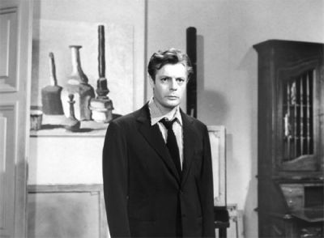
However, I was later surprised to discover that many other professions share this admiration, including several poets and even one contemporary architect, Frank Gehry, whose Winton Guest House echoes several Morandi still life forms.  And let us not forget the Italian surrealist filmmaker, Federico Fellini, and his references to Morandi’s work in the classic film “La Dolce Vita!”

morandi2
Federico Fellini
Film still from “La Dolce Vita”
1960
Featuring Marcello Mastroianni, Anita Ekberg, Anouk Aimee, et al.
Cineriz/Pathe Consortium Cinema

Earlier this year, on a visit with family and friends in Florida, I happened upon the Vero Beach Book Center hosting a reading by the Poet Laureate of Indian River County, Sean Sexton.  He also mentioned Morandi in several instances:  both his paintings and his etchings.  When I asked him about his interest in Morandi this is how he responded:

“The poem ‘Disparate’ lays out my visit to the Metropolitan Museum of Art to see the Morandi show . . . and observations from a noonday repast in the cafeteria, just a flight of stairs down out of the show. . . . The works collectively comprise something so completely outside convention and the sources that inspired them and succeed in what they present as a whole.”[i]

morandi3
Giorgio Morandi
“Still Life”
1956
Oil on canvas
Private Collection, Switzerland

“Disparate”
“The girls in the museum cafeteria titter in
pleasant gossip, coiffed and garbed alike
in gold, cashmere, and silk.  Each face keeps
the same joy in this holiday escape from dailiness,
as their secret society, founded upon commiseration,
excludes a Venus in synthetic leopard wrap the next
table over, her long, raven hair mussed as if
she’d just stepped from a baroque bedchamber.
She has nothing to say to them (nor do they ask),
but sits attending an old, blind Tobit and his
wife sipping water and taking a frugal repast.

Morandi’s lonely bottles hang in galleries upstairs,
paintings in lush pink butter and almond paste,
and the most exquisite greys in art.  On a wall placard
is a quote from his ending days:
“If only you knew Longhi, how badly I want to work,
I have so many ideas I wish to develop…”
In quiet and solitude he kept at his métier, sharing
the family apartment with his three unmarried sisters,
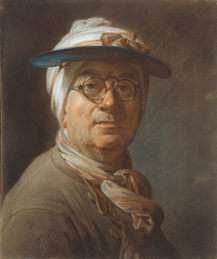
seeking only the recognition of his peers—the leering Chardin,
rag tied round his bespectacled head, stolid Piero, mercurial
Caravaggio, and the intractable, enraptured, Cezanne.”[ii]

morandi4
Jean Baptiste Simeon Chardin
“Self-Portrait with a Visor”
c. 1776
Pastel on blue laid paper, mounted on canvas
457mm x 374mm
The Art Institute of Chicago,
Chicago, Illinois

Several years ago at the Butler University Visiting Writers’ Series I heard the poet Charles Wright read from his work.  I was impressed with the range and depth of his work, and especially several of his remarks mentioning both Piet Mondrian and Giorgio Morandi, two of my own personal favorites.

Giorgio Morandi’s work is often difficult on many levels.  For first time viewers it is so simple, even mundane, that they wonder what is the big deal?  For the experienced viewer, they become more complicated, utilizing formal devices and placement to create subtle but powerful tensions.  And for others, perhaps only painters and poets, these pieces become mystical.

This is such a powerful element in his work, that in one recent five-year period (from 2004 to 2009) there were three major exhibitions in celebration of his work:  at both the Metropolitan Museum[iii] in New York, the one Sean Sexton mentioned above, and the Phillips Collection[iv] in Washington, DC, and a small but highly successful presentation at the Lucas Schoormans Gallery, also in New York.

In the catalogue for that exhibition, Schoormans wrote:  “At first glance, the works may appear quiet, contemplative, but once the viewer engages with them, one realizes that they are anything but.  Instead, it becomes apparent that they seem to affirm only one thing:  that nothing is certain, and permanently subject to change.  Embracing this message, Morandi presents the viewer with endless variations, at times with the subtlest of shifts in tonal values and composition, and thereby he becomes the architect of a world as finely calibrated and rigorously constructed as any great work of art, or perhaps a piece of music – think Bach’s Well Tempered Piano:  a monumental under-statement, of riveting and stimulating beauty that allows us a notion of the sublime.”[v]

“Giorgio Morandi and the talking eternity blues”
“Late April in January, seventy-some-odd degree.
The entry of Giorgio Morandi in The Appalachian Book of the Dead
Begins here, without text, without dates—
A photograph of the master contemplating four of his objects,
His glasses pushed high on his forehead,
his gaze replaced and pitiless.”

morandi5
Herbert List
“Portrait of Giorgio Morandi”
B&W photograph
1953
Collection of Herbert List Estate,
Hamburg, Germany

“The dove, in summer, coos sixty times a minute, one book says.
Hard to believe that,
even in this unseasonable heat,
A couple of them appearing and silent in the bare tree
Above me.
Giorgio Morandi doesn’t blink an eye
As sunlight showers like sulphur grains across his face.
There is an end to language.

There is an end to handing out the names of things,
Clouds moving south to north along the Alleghenies
And Blue Ridge, south to north on the wind.
Eternity, unsurprisingly, doesn’t give this a take,
Eternity’s comfortless, a rock and a hard ground.

Now starless, Madonnaless, Morandi
Seems oddly comforted by the lack of comforting,
A proper thing in its proper place,
Landscape subsumed, language subsumed,
the shadow of God
Liquid and indistinguishable.”[vi]

morandi6
Giorgio Morandi
“Still Life”
1953
Oil on canvas
8” x 15 7/8”
The Phillips Collection,
Washington, DC.


[i] Sexton, Sean; “An Artist’s Statement” contained in an e-mail to this writer, 10 March 2019, 9:36pm.

[ii] Sexton, Sean; May Darkness Restore; Press 53; Winston-Salem, North Carolina; 2019; p. 32.

[iii] Bandera, Maria Cristina, and Renato Miracco; Morandi 1890-1946; The Metropolitan Museum of Art and SKIRA; New York, New York, and Milano, Italy; 2008.

[iv] Fergonzi, Flavio, and Elisabetta Barisoni; Morandi:  Master of Modern Still Life; The Phillips Collection; Washington, DC; 2009

[v] Mattioli-Rossi, Laura; Giorgio Morandi Late Paintings 1950-1964; Lucas Schoormans Gallery; New York, New York; 2004; p. 3.

[vi] Wright, Charles; Negative Blue; Farrar, Straus and Giroux; New York, New York; 2000; p. 167.