“Discobolus” Roman copy after a Greek original, c. 450 BC. Lifesize Marble Museo delle Terme, Rome
It is an icon, some would even call it a cliché, one of the many great sculptures from the ancient Greeks that have been handed down to us through Roman copies. It has, however, lasted throughout all of these years, and no doubt will continue. It may not be relevant, but it was and is influential. During all of its history artists have studied these pieces and writers have been inspired by them, including a most important San Francisco Bay Area poet.
From classical Greek sculpture to Goya, from Marc Chagall to Charlie Chaplin, and even from Morris Graves to Edward Hopper, the poet Lawrence Ferlinghetti has always written about a variety of artists. He also speaks of both the detail and the overall, both the immediate and the historical. He notices the calipers in the hands of the sculptor as well as the ramifications for an articulated detail that carries us over the centuries.
“Discobolus” or the “Discus Thrower” is of course a marble copy of the original bronze Greek sculpture by Myron. And, at one time or another, it has made its way, through academic castings and copies, into almost every art school in the world. This is where Vincent Van Gogh first encountered it in a drawing class in Antwerp in 1886.
“Students at the Antwerp academy were expected to work three or four days on a single drawing, so that during his six-week stay Van Gogh probably executed about a dozen sheets. We know both from his letters and from eyewitness accounts that he copied several different sculptures, but this study from a cast of the Discus Thrower (ca. 450 B.C.) by Myron of Eleutherai is the only example to have survived.”[ii]
Vincent Van Gogh “The Discus Thrower” 1886 Black chalk on paper 22 1/8” x 17 1/2” Van Gogh Museum, Amsterdam
Most recently, from Pop Art to the Post-Modern, we encounter themes and variations played out in an art historical context. Ned Rifkin in writing about the artist Robert Moskowitz’s borrowing of sculptural imagery from Brancusi’s “Bird in Space” to Rodin’s “The Thinker” and even to the Roman copy of the “Discus Thrower” has observed:
“Moskowitz reduced the barely recognizable image to a hard edged outline. . . . It becomes. . . its vestigal shadow and reads not as an experience of form in space but as a sign.”
“Certainly, the artist is making a statement about self-consciousness while also reinventing the form. It definitely uses that known image and says, ‘What does it mean now?’” [iii]
Robert Moskowitz “Bowler” 1984 Pastel on paper 108” x 44 5/8” Mr. and Mrs. Harry W. Anderson, San Francisco, California
[i] Ferlinghetti, Lawrence; A Coney Island of the Mind; New Directions Publishing Company; New York, New York; 1958; p. 79.
[ii] Ives, Colta, Susan Alyson Stein, et al; Vincent Van Gogh: The Drawings; The Metropilitan Museum of Art, New York, and the Van Gogh Museum, Amsterdam; Yale University Press, New Haven and London; 2005; p. 126.
[iii] Rifkin, Ned; Robert Moskowitz; Hirshhorn Museum and Sculpture Garden in association with Thames and Hudson; New York, New York; 1989; p. 42.
“…even though I have so profound an admiration for the beauty of Chartres, I realize strongly that it belongs to a culture, a tradition, a people of which I am not a part….It seems to be a persistent necessity for me to feel a sense of derivation from the country in which I live and work.”[i]
Charles Sheeler “Chartres Cathedral” 1929 B&W photograph 9” x 7” The Lane Collection, Charles Sheeler Archives Museum of Fine Arts, Boston, Massachusetts
I have often had a similar feeling as that expressed by Charles Sheeler above. As an American I have always felt that my voice and vision should grow out of my own country and experience. However, I had not counted on participating in a graduate art history seminar at Indiana University on Gothic Architecture and seeing, for the first time, a beautiful little book titled “The Sketchbook of Villard de Honnecourt” that had been edited by Theodore Bowie.[ii] Many years later, searching through the ‘librairie’ at the Musee Cluny in Paris, I purchased a more recent and larger edition of the same title.
Villard de Honnecourt may have been an architect, or possibly an itinerant designer or draughtsman. Some historians have described him as the Leonardo da Vinci of the dark-ages. In any event, he did produce a sketchbook full of drawings and devices that changed how we see the world. They were at least a ‘pattern book’ or stylistic guide to the articulation of Gothic facades and interiors.[iii] These drawings by Honnecourt were not the only reason, but they were one of the reasons that allowed this new ‘gothic’ style to spread throughout Europe.
Villard de Honnecourt “Double Row of Flying Buttresses, Rheims Cathedral VI” (The Sketchbook of Villard de Honnecourt, [C.LXIV]) 1230 Pen & ink on paper 9.25” x 6.1” Bibliotheque Nationale, ParisThese little drawings are focused, insightful, powerfully structural, filled with character and attention to detail, and I always think of them immediately whenever I hear of the writer Raymond Carver or read about his short story “Cathedral.”
In this story, a young couple is surprised by a visit from a friend of the wife, an old blind man for whom she had worked several years ago. She did his reading for him and other chores. He was in town taking care of some business after the death of his wife and he wanted to ‘see’ them again.
The husband was a bit leery of this old man and his unexpected visit, as it was his wife who had been close to him. They had dinner and a few drinks and afterwards they watched a program on Gothic Cathedrals on TV. The wife had soon gone to sleep, leaving the two men in the living room, when the old blind man came up with this suggestion: would the young man teach him how to draw a cathedral? All that he really new about these things was what he had just heard on the TV program and didn’t know what they really looked like.
This young man, totally disoriented and slightly tipsy, searched the house for papers and pens and drawing materials and spread them all out on the living room floor.
“The blind man got down from the sofa and sat next to me on the carpet.”
“He ran his fingers over the paper. He went up and down the sides of the paper. The edges, even the edges. He fingered the corners.”
“‘All right,’ he said. ‘All right, let’s do her.’”
“He found my hand, the hand with the pen. He closed his hand over my hand. ‘Go ahead, bub, draw,’ he said. ‘Draw. You’ll see. I’ll follow along with you. It’ll be okay. Just begin now like I’m telling you. You’ll see. Draw,’ the blind man said.”
Villard de Honnecourt “Exterior and Interior Elevations, Rheims Cathedral IV” (The Sketchbook of Villard de Honnecourt, [C.LXII]) 1230 Pen & ink on paper 9.25” x 6.1” Bibliotheque Nationale, Paris“The blind man said, ‘We’re drawing a cathedral….Press hard,’ he said to me. That’s right. That’s good,’ he said.”
“‘You got it, bub. I can tell. You didn’t think you could. But you can, can’t you? You’re cooking with gas now.’”
“‘Close your eyes now,’ the blind man said to me.
I did it. I closed them just like he said.
‘Are they closed?’ he said. ‘Don’t fudge.’
‘They’re closed,’ I said.
‘Keep them that way,’ he said. He said, ‘Don’t stop now. Draw.”
Villard de Honnecourt “North Tower of Laon Cathedral” (The Sketchbook of Villard de Honnecourt, [C.XIX]) 1230 Pen & ink on paper 9.25” x 6.1” Bibliotheque Nationale, Paris“So we kept on with it. His fingers rode my fingers as my hand went over the paper. It was like nothing else in my life up to now.”
“Then he said, ‘I think that’s it. I think you got it,’ he said. ‘Take a look. What do you think?’”
“But I had my eyes closed. I thought I’d keep them that way for a little longer. I thought it was something I ought to do.”[iv]
[i] Tsujimoto, Karen; Images of America: Precisionist Painting and Modern Photography; San Francisco Museum of Modern Art and the University of Washington Press; Seattle & London; 1982; p. 85. (Statement made by Sheeler on his series of photographs of Chartres Cathedral, originally published in Constance Rourke; Charles Sheeler: Artist in the American Tradition; New York, New York; Harcourt, Brace; 1938; p. 130).
[ii] Bowie, Theodore; The Sketchbook of Villard de Honnecourt; Indiana University Press; Bloomington and London; 1959.
[iii] von Simpson, Otto; The Gothic Cathedral: Origins of Gothic Architecture and the Medieval Concept of Order; Harper & Row Publishers; New York and Evanston; 1962; p. 198.
[iv] Carver, Raymond; “Cathedral” Where I’m Calling From; Atlantic Monthly Press; New York, New York; 1991; pp. 306-307.
“Today he is hardly likely to find himself unless he is a non-conformist and a rebel. To say this is neither dangerous nor new. It is what society really expects of its artists. For today the artist has, whether he likes it or not, inherited the combined functions of hermit, pilgrim, prophet, priest, shaman, sorcerer, soothsayer, alchemist, and bonze.”[i]
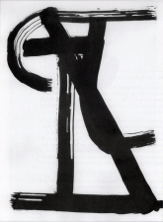
This is what Thomas Merton had to say about contemporary artists and writers. He had multiple points of view regarding this position: as a poet himself, as a Trappist monk at the Abbey of Gethsemani in Lexington, Kentucky, as a student of calligraphy and as a colleague and friend to others in the field, including Ad Reinhart, John Cage, D. T. Suzuki and Jacques Maritain.
Thomas Merton “Untitled” (Sorcerer, soothsayer, alchemist) c. 1963 Brush and India ink on paper 10 1/4” x 7 1/2” The Thomas Merton Center, Bellarmine University, Louisville, Kentucky
In the beginning years of the 20th century Henri Matisse began thinking and writing about the importance of signs. He saw this especially in the pen and ink drawings of Vincent van Gogh, which were an early influence on him, as well as in certain examples of calligraphy from Oriental art.
Henri Matisse “Standing Nude, Arms Covering her Face” 1901-1903 Ink on paper 10 3/8” x 8” Gift of Edward Steichen Museum of Modern Art, New York
In these same years the poet Ezra Pound was sent a manuscript that had been written by the scholar Ernest Fenollosa who had been studying the origins of the Japanese and Chinese alphabets, whose characters had originally been drawings!
“Chinese poetry has the unique advantage of combining both elements. It speaks at once with the vividness of painting, and with the mobility of sounds.”[ii]
Ezra Pound called this the ‘ideogramic method’ and used what he had learned from Fenollosa to define and clarify the quality known as ‘economy of means’ that is so important to both painters and poets. This also led directly to the invention of ‘Imagist Poetry’ that is characterized by clarity and directness.
In letters and conversations with Louis Aragon throughout his lifetime Henri Matisse often explained that: “The sign is determined at the moment I use it and for the object of which it must form a part. For this reason I cannot determine in advance signs which never change and which would be like writing: that would paralyze the freedom of my invention.”[iv]
Henri Matisse “Acrobat” 1952 Brush and ink on paper 41 3/8” x 29 1/2” Private Collection
Aragon helped to ‘translate’ many of Matisse’s statements, paintings and drawings, into literature through his essay ‘Matisse en France’ from 1942-43 and the two volume ‘Matisse: A Novel’ from 1972.
Similar concerns can be seen in the works of Henri Michaux working in Paris and Thomas Merton working in Lexington, Kentucky. They were both interested in painting and poetry, through which they each investigated the use of signs.
“To abstract means to free oneself, to come disentangled.”
“The hand should be empty, should in no way hinder what’s flowing into it.”
“Only the ‘exact placement,’ the ‘just proportion’ matter.”[v]
Henri Michaux “Untitled (Mouvements)” c. 1950-51 India ink on paper 12 5/8” x 9 1/2” Private collection
More recently, in an interview with Janie C. Lee at the Whitney Museum of American Art on 21 May 1998, Brice Marden described some of his work in the “St. Bart’s 1985-86 Series” in this way: “The whole history of the life is right there on the surface. These drawings were all started as individual sheets in a book. Then I took the book apart and started putting them together in different sequences. Some I reworked, putting two sheets on
Brice Marden “St. Bart’s 1985-86 N.Y. 3” 1985-1986 Ink and gouache on paper 7 5/16” x 7 7/8” Whitney Museum of American Art, New York
each page . . . . Top to bottom and across to the left. I was following the Chinese calligraphic method. It was easier for me because I’m left handed, so if I work from right to left, I don’t run the chance of smudging the ink or some marking. These were very early calligraphy-based drawings.”[vi]
The effects of Matisse’s experiments along with Fenollosa’s observations have been wide ranging: from the paintings of Henri Michaux to the calligraphies of Thomas Merton, to Brice Marden’s recent drawings and even to a few of my own students over the years, especially the work of Rene Gonzalez.
Rene Gonzales “The Civil War Cannon” Pen & ink on paper 8 1/2” x 11” 1997 Courtesy of the artist
“Yes, I remember these drawings very well…they were an automatic drawing series. I had been studying a lot of Motherwell at that time and watched a documentary on his Reconciliation Elegy work. In it, he described a process where he would sit down with a stack of paper and ink and a brush and just knock out gestures with no edits or reworks. He could then look at 50 to 100 drawings on the floor and begin to select the ones he wanted to investigate further. The series of drawings I did went through a similar process and only a few were then selected as the actual compositions to my paintings. I believe they were either 8 1/2 x 11 or smaller but I do not remember.”[vii]
Rene Gonzales “An M-16” Pen & ink on paper 8 1/2” x 11” 1997 Courtesy of the artist
“The freedom of the artist is to be sought precisely in the choice of his work and not in the choice of the role as ‘artist’ which society asks him to play.”[viii]
[i] Lipsey, Robert; Angelic Mistakes: The Art of Thomas Merton; New Seeds Publishing; Boston & London; 2006; p. 100.
[ii] Fenollosa, Ernest and Ezra Pound, ed.; The Chinese Written Character as a Medium for Poetry; City Lights Books; San Francisco, California; 1936; p. 9.
[iii] This example has been published in both Fenollosa (p. 8) and Michaux (p. 43). It shows three characters, all containing legs. To the right the ideogram for ‘horse’ with four legs underneath. In the center is an ‘eye’ being carried by two legs. And on the left the image of a man. As both authors explain, these images taken together produce the line: “man sees horse.”
[iv] Schneider, Pierre; Matisse; Rizzoli International; New York, New York; 1984 and 2002; p. 576.
[v] Michaud, Henri; translated by Gustaf Sobin; Henri Michaux: Ideograms in China; New Directions Publishing Corporation; New York, New York; 1975; (unpaginated).
[vi] Lee, Janie C.; Brice Marden Drawings; The Whitney Museum of American Art and Harry N. Abrams, Inc.; New York, New York; 1998; p. 19.
[vii] From E-MAIL communications between the artist and this writer on 14 January and 27 January 2017.
[viii] Lipsey, Robert; Angelic Mistakes: The Art of Thomas Merton; p. 100.
[ix] This last example is taken from Fenollosa (p. 40). It shows a ‘mouth’ on the lower right with words and tongue coming out of it. On the left is the figure of a ‘man.’ Taken together, they form the sign: “a man standing beside his word, truth.”
In the New Testament both Matthew and Luke relate the story of Jesus being confronted and questioned by the Pharisees, who were pretending to be ‘teachers’ and trying to catch this young man in his own teachings. When questioned by his disciples later, Jesus described the Pharisees like this:
“. . . they are blind guides. And if a blind man leads a blind man, both will fall into a pit.”[i]
Pieter Breughel the Elder “The Parable of the Blind” 1568 Distemper on linen canvas 86 cm x 154 cm Museo di Capadimonte, Naples, Italy
It was a powerful image that caught the imagination of many Northern Renaisance artists, especially Pieter Breughel the Elder. Later still, it continued to influence writers such as Charles Baudelaire and William Carlos Williams, who included this subject in his final collection, Pictures from Brueghel, which won the Pulitzer Prize for Poetry in 1963, just two months after that author’s death.
“This horrible but superb painting
the parable of the blind
without a red
in the composition shows a group
of beggars leading
each other diagonally downward
across the canvas
from one side
to stumble finally into a bog
where the picture
and the composition ends back
of which no seeing man
is represented the unshaven
features of the des-
titute with their few
pitiful possessions a basin
to wash in a peasant
cottage is seen and a church spire
the faces are raised
as toward the light
there is no detail extraneous
to the composition one
follows the others stick in
hand triumphant to disaster” [ii]
Paintings by Pieter Breughel and poems by William Carlos Williams have continued to inspire and influence artists and writers today. “Referring to a group of figural drawings he had begun around 1963, Willem de Kooning would say in 1975, ‘I draw while painting, and I don’t know the difference between painting and drawing. The drawings that interest me most are made with eyes closed.’”[iii]
They all looked like scratches, these drawings that de Kooning called ‘blind’ drawings. We first saw them in an exhibition at the Contemporary Arts Center[iv] in Cincinnati, Ohio in 1979. At the time, this exhibition was known as “Recent de Kooning” and featured paintings, drawings, and sculptures completed since 1969.
Willem de Kooning “Blind Drawing” 1969 Ink on paper 26” x 18 7/8” Estate of the artist
What we didn’t know at the time, was that de Kooning completed these drawings in a vertical format and later rotated them 90 or 180 degrees in order to further dissorient the viewer. When re-oriented to their original format certain details emerge: these details include several clear references to Breughel’s great painting, “The Parable of the Blind.”
Pieter Breughel the Elder “The Parable of the Blind” DETAIL
You wouldn’t believe the number of art students who in studying this painting will draw all of the figures straight across the page from left to right, all in a line, and all horizontally. Totally ignoring the descending diagonal from the upper left to the lower right. This of course flattens both the movement and the composition.
Casey Roberts “Study #1 from The Parable of the Blind” 1993-1994 Brush and ink on paper 18” x 24” Courtesy of the artist, Indianapolis, Indiana
One younger artist who noticed this right away was Casey Roberts. Examples of his brush and ink drawings above and below, clearly show that he saw this diagonal movement and took it to a contemporary conclusion. As long time faculty members in various art schools around the country we could all probably be described as the blind leading the blind. An all encompassing metaphor.
Casey Roberts “Study #2 from The Parable of the Blind” 1993-1994 Brush and ink on paper 18” x 24” Courtesy of the artist, Indianapolis, Indiana
[i] “Matthew 15:13-14” The Holy Bible: Revised Standard Version; Thomas Nelson & Sons; New York, Toronto, Edinbugh; 1952; p. 770.
[ii] Williams, William Carlos; Pictures from Brueghel and other poems; New Directions Publishing Corporation; New York, New York; 1967; p. 11.
[iii] Elderfield, John, et al; de Kooning a Retrospective; The Museum of Modern Art; New York, New York; 2011; p. 369.
[iv] Cowart, Jack, and Sanford Sivits Shaman; de Kooning 1969-1978; University of Northern Iowa; Cedar Falls, Iowa; 1978.
“In the Palace at 4 A.M. you walk from one room to the next by going through the walls. You don’t need to use the doorways. There is a door, but it is standing open, permanently. If you were to walk through it and didn’t like what was on the other side you could turn and come back to the place you started from. What is done can be undone.”[i]
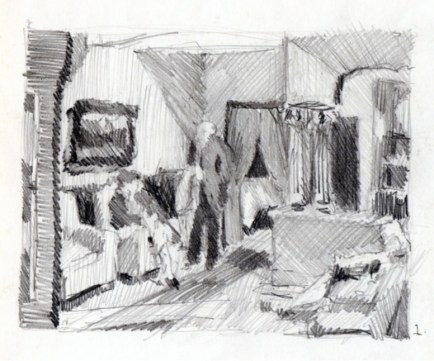
Alberto Giacometti “My Studio” 1932 Pencil on paper 12 9/16” x 18 7/16” Kupferstichkabinett, Kunstmuseum, Basel
In a drawing of the interior of his studio in 1932, we can see an in progress state of this sculpture sitting squarely in the middle ground. Alberto Giacometti completed the “Palace at 4:00 AM” sometime in 1933 and by 1936 it had been purchased by the Museum of Modern Art in New York for its permanent collection.
“This object took shape little by little in the late summer of 1932; it revealed itself to me slowly, the various parts taking their exact form and their precise place within the whole. By autumn it had attained such reality that its actual execution in space took no more than one day.
It is related without any doubt to a period in my life that had come to an end a year before, when for six whole months hour after hour was passed in the company of a woman who, concentrating all life in herself, magically transformed my every moment. We used to construct a fantastic palace at night—days and nights had the same color, as if everything happened just before daybreak; throughout the whole time I never saw the sun—a very fragile palace of matchsticks.
At the slightest false move a whole section of this tiny construction would collapse.
We would always begin it over again.
Alberto Giacometti “The Palace at 4:00 AM” 1932-1933 Wood, glass, wire and string 25” high Museum of Modern Art, New York
I don’t know why it came to be inhabited by a spinal column in a cage—the spinal column this woman sold me one of the very first nights I met her on the street—and by one of the skeleton birds that she saw the very night before the morning in which our life together collapsed—the skeleton birds that flutter with cries of joy at four o’clock in the morning very high above the pool of clear, green water where the extremely fine, white skeletons of fish float in the great unroofed hall.
In the middle there rises the scaffolding of a tower, perhaps unfinished or, since its top has collapsed, perhaps also broken.
On the other side there appeared the statue of a woman, in which I recognize my mother, just as she appears in my earliest memories. The mystery of her long black dress touching the floor troubled me;
it seemed to me like a part of her body, and aroused in me a feeling of fear and confusion. All the rest has vanished, and escaped my attention. This figure stands out against the curtain that is repeated three times, the very curtain I saw when I opened my eyes for the first time . . . .
I can’t say anything about the red object in front of the board;
Although Giacometti’s statement is a piece of surrealist writing in and of itself, it is a very lyrical story. As is the original sculpture. Its effect on the art world was almost immediate. At least three pieces by David Smith can trace their roots to this piece: “Home of the Welder” from 1945, “Interior for Exterior” from 1939, and “Interior” from 1937.
David Smith “Interior” 1937 Painted steel and bronze 15 1/2” x 26” x 6” Weatherspoon Art Gallery, University of North Carolina at Greensboro
Between 1935 and 1966 the sculptor Isamu Noguchi designed a total of twenty stage sets for the Martha Graham Dance Company. Sometime in the early 1940’s the choreographer approached the sculptor, proposing that he design the stage set for a new ballet. She insisted that he accompany her, right then and there, to the Museum of Modern Art to view Alberto Giacometti’s sculpture “The Palace at 4:00 AM.” Noguchi knew in an instant what Ms. Graham was asking of him and the quality of space that she was looking for. He agreed immediately to a stage design based on this piece and working with the composer Aaron Copeland the three of them produced one of the most important ballets of the 20th Century: “Appalachian Spring.”[iii]
Isamu Noguchi “Stage set for the Martha Graham ballet Appalachian Spring” Wood and paint on canvas 1944 The Isamu Noguchi Garden Museum, Long Island City, New York
The influence of this piece has continued to this day and has crossed over many boundaries and disciplines. In his novel of 1996, So Long, See You Tomorrow, William Maxwell uses this sculpture as both a reference and a structure for his writing. He weaves it in and out of the story in the same way that his characters, two young boyhood friends, weave their own way through growing up in the small town in Lincoln, Illinois.
“When, wandering through the Museum of Modern Art, I come upon the piece of sculpture by Alberto Giacometti with the title ‘Palace at 4 a.m.,’ I always stand and look at it—partly because it reminds me of my father’s new house in its unfinished state and partly because it is so beautiful”
“I seem to remember that I went to the new house one winter day and saw snow descending through the attic to the upstairs bedrooms. It could also be that I never did any such thing, for I am fairly certain that in a snapshot album I have lost track of there was a picture of the house taken in the circumstances I have just described, and it is possible that I am remembering that rather than the actual experience. What we, or at any rate what I, refer to confidently as memory—meaning a moment, a scene, a fact that has been subjected to a fixative and thereby rescued from oblivion—is really a form of storytelling that goes on continually in the mind and often changes with the telling. Too many conflicting emotional interests are involved for life ever to be wholly acceptable, and possibly it is the work of the storyteller to rearrange things so that they conform to this end.”[iv]
[i] Maxwell, William; So Long, See You Tomorrow; Vintage International; New York, New York; 1996; pp. 131-132.
[ii] Selz, Peter; Alberto Giacometti; The Museum of Modern Art and Doubleday & Company; New York, New York; 1965; p. 44.
[iii] Graham, Martha; Blood Memory: An Autobiography; Doubleday; New York, New York; 1991; p. 223.
[iv] Maxwell, William; So Long, See You Tomorrow; pp. 25-27.
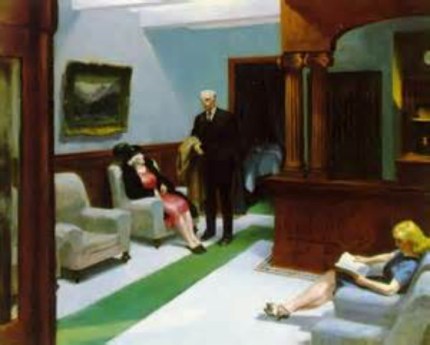
“Edward Hopper’s art is highly provocative and often disturbing. His contemplative figures appear to be alienated from society and to occupy a world devoid of interaction and communication. They never smile or frown, and their attitudes and expressions suggest unapproachableness. These introspective figures convey an inner turmoil that can provide questions about relationships, the roles people play in society, and the meaning of life.”[i]
Edward Hopper “Sketch for Hotel Lobby” 1943 Conte crayon and graphite on paper 8 7/16″ x 10 15/16″ Josephine N. Hopper Bequest, Whitney Museum of American Art, New York
When studying several of Hopper’s sketches for this painting, it becomes clear that he was really searching, working out the space and placement for the lobby and the people inhabiting that space. Five or six different figures were placed in various positions within the composition, including one, a desk clerk, who is hidden in the background behind a lamp in the office. Figures of both men and women are substituted for each other in order to achieve the balance that he desired.
D.W. Hardwick “Study #2 from the Hotel Lobby” 1976 Graphite on paper 6″ x 8″ Private Collection, Indianapolis, Indiana
For many years of my teaching career, we would visit the Indianapolis Museum of Art and draw directly from the objects in their collection. There are several works by Edward Hopper housed there, including “American Landscape,” “New York, New Haven and Hartford” and the “Hotel Lobby” from 1943. Especially important in this learning process is to discover the underlying architecture of any work of art, not just the surface illusions. Two such examples are shown above and below this paragraph. Drawings made on the spot in the museum and showing both space and movement and the tonal juxtapositions that occur in the original. They were completed by Darryl W. Hardwick during the summer session of 1976.
D.W. Hardwick “Study #1 from the Hotel Lobby” 1976 Graphite on paper 6″ x 8″ Private Collection, Indianapolis, Indiana
The poet Raymond Carver in his collection titled Ultramarine of 1987 took on a similar subject. Not directly written after this painting, the parallels however are so striking that one might do a double take. A quiet, perfectly still scene, with the various characters going about their daily routines. Structured and written to lead us into this particular space. Introspective, with the possibility of great turmoil.
“In the Lobby of the Hotel del Mayo”
“The girl in the lobby reading a leather-bound book.
The man in the lobby using a broom.
The boy in the lobby watering plants.
The desk clerk looking at his nails. The woman in the lobby writing a letter.
The old man in the lobby sleeping in his chair.
The fan in the lobby revolving slowly overhead.
Another hot Sunday afternoon.
Suddenly, the girl lays her finger between the pages of her book.
The man leans on his broom and looks.
The boy stops in his tracks.
The desk clerk raises his eyes and stares.
The woman quits writing.
The old man stirs and wakes up.
What is it?
Someone is running up from the harbor.
Someone who has the sun behind him.
Someone who is barechested.
Waving his arms.
It’s clear something terrible has happened.
The man is running straight for the hotel.
His lips are working themselves into a scream.
Everyone in the lobby will recall their terror.
Everyone will remember this moment for the rest of their lives.”[ii]
Edward Hopper “Hotel Lobby” 1943 Oil on canvas 32 1/4″ x 40 3/4″ Williams Ray Adams Memorial Collection, Indianapolis Museum of Art, Indianapolis, Indiana
[i] Warkel, Harriet G.; Paint to Paper: Edward Hopper’s Hotel Lobby; Indianapolis Museum of Art; Indianapolis, Indiana; 2008; p. 11.
[ii] Carver, Raymond; “In the Lobby of the Hotel del Mayo,” Ultramarine: Poems; Random House; New York, New York; 1987; pp. 75-76.
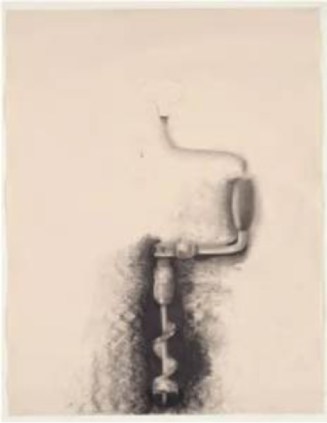
Jim Dine “Untitled (Pliers)” 1973 Graphite, charcoal and crayon on paper 25 5/8″ x 19 3/4″ Museum of Modern Art, New York
“I love the tools made for mechanics. I stop at the windows of hardware stores. If I could only find an excuse to buy many more of them than I have already bought on the pretense that I might have use for them! They are so beautiful, so simple and plain and straight to their meaning. There is no ‘Art’ about them, they have not been made beautiful, they are beautiful.”
“Someone has defined a work of art as a ‘thing beautifully done.’ I like it better if we cut away the adverb and preserve the word ‘done,’ and let it stand alone in its fullest meaning. Things are not done beautifully. The beauty is an integral part of their being done.”[i]
Jim Dine “Untitled (Brace and Bit)” 1973 Graphite, charcoal and crayon on paper 25 5/8″ x 19 3/4″ Museum of Modern Art, New York
A wrench, a brace or a pair of pliers, along with pencils and brushes, are all literal extensions of the human hand. Metaphorically, as artists we also speak of finding our own hand, or discovering one’s touch. Poets speak of finding their own voice. This is often a difficult process, which takes a lot of work. To accomplish this work, we use the tools that are near at hand.
This idea has echoes both across and beyond our borders. Whether it might be the great simplicity in a Shaker building or chair, or the profound Japanese insight into beauty, the tools that allow us to produce the hand-made object are of utmost importance.
In his great treatise on craftsmanship and the making of certain objects, Soetsu Yanagi wrote that: “They are made without obsessive consciousness of beauty; thus we catch a glimpse of what is meant by ‘no-mindedness,’ whereby all things become simplified, natural, and without contrivance.”[ii]
Similarly, Faith and Edward Demming Andrews have observed the work and the laws of the Shakers: “All beauty that has not a foundation in use, soon grows distasteful, and needs continual replacement with something new. That which has in itself the highest use possesses the greatest beauty.”[iii]
Richard Emery Nickolson “Dwelling House Interior, Hancock Shaker Village” Color photograph 1978 Hancock, Massachusetts
“The craftsmanship of the Shakers was an integral part of the life and thought of a humble but consecrated folk. They did not think of the work of their hands—in building, in joinery, in industrial pursuit of every kind—as an art, something special or exclusive, but rather as the right way of sustaining their church order, the ideal of a better society. For them the machine or tool was a ‘servant force.’ It was the purpose of work which was important. This led to a manner of work, which in turn gave a common character—an integrity, a harmony, a subtle but identifiable quality to all the labor of their hands.”[iv]
Richard Emery Nickolson “Dwelling House Interior, Hancock Shaker Village” Color photograph 1978 Hancock, Massachusetts
And in the end, it is a reminder to all artists that “The thing shines, not the maker.…and therefore whatever is made is lovely.”[v]
[i] Henri, Robert; The Art Spirit, Basic Books, New York, New York; 2007; p. 53.
[ii] Yanagi, Soetsu; The Unknown Craftsman; Kodansha International; Tokyo, New York and London; 1972 & 1989; p. 203.
[iii] Andrews, Edward Deming, and Faith Andrews; Religion in Wood: A Book of Shaker Furniture; Indiana University Press; Bloomington and London; 1966; p. 15.
[iv] Andrews, Edward Deming, and Faith Andrews; Religion in Wood: A Book of Shaker Furniture; p. 14.
[v] Yanagi, Soetsu; The Unknown Craftsman; p. 200.
“The early sixteenth-century Belgian painter called, for want of his real name, The Master of the Embroidered Leaf.
Those dead birds on the porch when I opened up the house after being away for three months.
Remember Haydn’s 104 symphonies. Not all of them were great. But there were 104 of them.”[i]
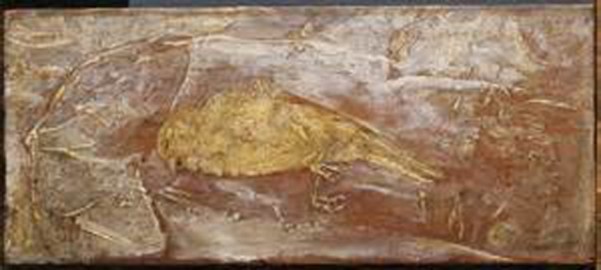
Albert Pinkham Ryder “Dead Bird” 1890’s Oil on wood panel 4 3/8” x 10” The Phillips Collection, Washington, DC.
This terrible but beautiful image of a dead bird has always been one of the most haunting paintings in the Phillips Collection in Washington, DC. Just over four inches high it is an important example of works of art that are intimate in size and grand in spirit. Their effect remains with the viewer long after stepping outside of the museum.
Raymond Carver used this technique on several occasions in his work, especially in his collection A New Path to the Waterfall. Small statements, snippets really, are concise and to the point. 16th Century illuminations, dead birds on the front porch, or an incident involving Billy Strayhorn and Duke Ellington all incorporate the painterly criteria of ‘economy of means.’ Compression.
Georgia O’Keeffe’s “Red and Pink Rocks with Teeth” at the Art Institute of Chicago, Jan Vermeer’s “Girl in the Red Hat” at the National Gallery in Washington and Ryder’s “Dead Bird” mentioned above are all small in size but powerful in scale. Why should this be? Perhaps it was the desire of certain figurative painters and Imagist poets for the significant detail: to rivet the universal with the particular. Or, the suggestion made several times by William Carlos Williams throughout his epic poem Patterson to “Say it! No ideas, but in things.”[ii]
Whether it was the search for an American idiom or a single image out of the mass of chaos, Williams would ask of us: “What common language to unravel?”[iii] For both the poet and the painter it would be the process of finding one’s own vision or voice coming out of “…a mass of detail to interrelate on a new ground…pulling the disparate together to clarify and compress.”[iv]
“Because the sun was behind them
their shadows came first and then
the birds themselves.”[v]
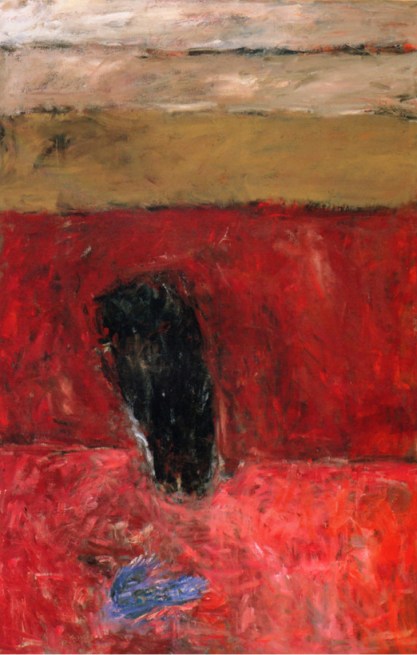
Susan Rothenberg “Blue Bird Wings” 1989 Oil on canvas 65″x43″ Private collection
To make an image or an object one’s own is to have a signature that comes out of the process of creating that image. Idiosyncratic imagery, like that in Ryder’s painting, has been the trademark of a certain few artists: as in the work of Musa McKim or Leonard Baskin or Susan Rothenberg; Raymond Carver or Kim Fuelling or Michael Ondaatje. These images will speak for themselves, as any real painting or drawing or poem will.
Leonard Baskin “Dead Bird” c. 1950’s Woodcut 1” x 2” Michelson Galleries, Northampton, Massachusetts
“Through the Boughs”
“Down below the window, on the deck, some ragged-looking birds gather at the feeder. The same birds, I think, that come every day to eat and quarrel. Time was, time was, they cry and strike at each other. It’s nearly time, yes. The sky stays dark all day, the wind is from the west and won’t stop blowing. . . . Give me your hand for a time. Hold on to mine. That’s right, yes. Squeeze hard. Time was we thought we had time on our side. Time was, time was, those ragged birds cry.”[vi]
Kim Fuelling “Fallen Bird” c. 1998 Graphite on paper 8” x 10” Courtesy of the artist, Zionville, North Carolina
“Application for a Driving License”
“Two birds loved
in a flurry of red feathers
like a burst cottonball,
continuing while I drove over them.
[i] Carver, Raymond; “His Bathrobe Pockets Stuffed with Notes;” A New Path to the Waterfall; The Atlantic Monthly Press; New York, New York; 1989; pp. 64-66.
[ii] Williams, William Carlos; Patterson; New Directions Publishing Corporation; New York, New York; 1992; p. 7.
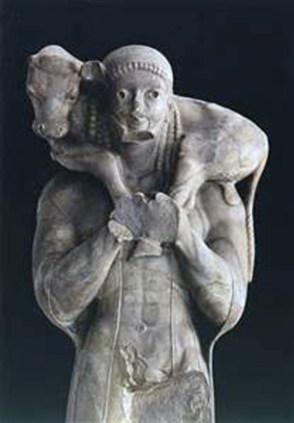
“The Calf Bearer” c. 570 BC Marble 65″ high Acropolis Museum, Athens
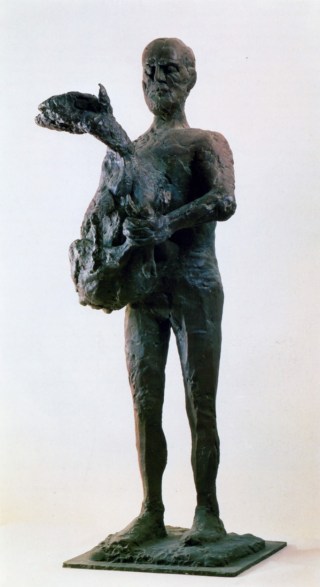
It could have been a reference to an ancient or biblical theme, the good shepherd or the calf bearer. An image of a man carrying a calf or a sheep on his shoulders, having just rescued it, and returning it to the flock. Pablo Picasso used many such themes and ideas in his work, however, he usually denied it in reference to this particular piece. “The man could just as well be carrying a pig as a sheep! There is no symbolism in it. It is just something beautiful.”[i]
Pablo Picasso “The Man with the Sheep” 1943 Bronze 222.5 x 78 x 78 cm Musee Picasso, Paris
Shifting back and forth from serious to playful, perhaps he is being sly or evasive? Or surrealistic and poetic like his friend of more than forty years, Max Jacob? Picasso and Jacob met in 1901 and became fast friends. Jacob was the first Parisian to teach Picasso French. And, as an early art critic, he wrote enthusiastically about Picasso’s work. Jacob was also a painter, cubist/surrealist poet, bon vivant, homosexual and a Jew. As described by Roger Shattuck, the beginning of the 20th Century was an exhilerating time: “In its early demonstrations the avant-garde remained a true community, loyal to itself and to its time…. Painters, writers, and musicians lived and worked together and tried their hands at each other’s arts in an atmosphere of perpetual collaboration.”[ii]
“When you paint a picture, it completely changes with each brushtroke, turning like a cylinder, almost interminably. When it stops turning, it’s finished. My latest was a Tower of Babel made of lighted candles.”[iii]
Max Jacob was originally from Quimper in Brittany, France. A street, a bridge, a high school and even the courtyard of the house at 8, rue de Parc, in Quimper bear his name. The Musee des Beaux-Arts in Quimper even has a room dedicated to Jacob featuring his drawings, paintings, and manuscripts. It was there, during the summer of 1997 that I first learned about several details of his life. In Quimper and in Paris during the summer of 1994—the 50th anniversary of Jacob’s death, there was an exhibition documenting this almost lifelong friendship between Max Jacob and Pablo Picasso.
“All it takes is a five-year-old in pale overalls drawing in a coloring book for a door to open into the light, for the house to be built again and the ochre hillside covered with flowers.”[iv]
Pablo Picasso “Study for The Man with the Sheep” 1943 Pen and ink with washes on paper 51 1/8″ x 20″ Musee Picasso, Paris
Picasso claims to have completed “The Man with the Sheep” in a burst of spontaneous energy in just one day. It was first in plaster, with the legs a bit too thin to support the upper half, so he and an assistant hoisted it up with ropes, he finished what needed to be done, and then had it cast in bronze right away. However, there are several drawings made as studies for this piece from the previous year. Not only was the position of the sheep not to his liking, but the head of the figure went through several stages: a younger man, then an older one; a clean shaven figure, then a bearded one, and so on.
Pablo Picasso “Studies for The Man with the Sheep” 1942 Pen and ink on paper Musee Picasso, ParisRobert Capa “Picasso in the Grands-Augustins studio, with ‘Man With a sheep’ plaster version” 1944 B&W photograph Musee Picasso, Paris
At the end he, Picasso, modelled the face of his friend Max Jacob onto this figure. When the piece had been cast, Picasso placed it at the top of the stairs to his studio on the rue des Grands-Augustins. Often SS Officers would climb just to the top of the stairs in surprise inspections and be met by the “Man Holding a Sheep.” They looked quickly around and returned down to the street, not realizing that Jacob had been looking down on them. Max Jacob had been arrested by the SS earlier, and was in the process of being shipped to Auschwitz, however, he died from bronchial pneumonia while in one of the deportation camps at Drancy, France.
“The Yellow Star Again”
“Are those beets your dog’s eating?”
“No, it’s a Jew who fell in the snow.”
“They could find some other place to faint instead of my sidewalk.”[v]
[i] Bernadac, Marie-Laure; Picasso Museum, Paris: The Masterpieces; Reunion des Musees Nationaux and Prestel; Paris and munich; 1991; p. 162.
[ii] Shattuck, Roger; The Banquet Years: The Origins of the Avant-Garde in France 1885 to World War I; Vintage Books, Random House; New York, New York; 1968; p. 28.
[iii] Kulik, William, editor and translater; The Selected Poems of Max Jacob; Oberlin College Press; Oberlin, Ohio; 1999; p. 57.
[iv] Kulik, William, editor and translater; The Selected Poems of Max Jacob; p. 129.
[v] Kulik, William, editor and translater; The Selected Poems of Max Jacob; p. 122.
“Here is the test of wisdom,
Wisdom is not finally tested in schools,
Wisdom cannot be pass’d from one having it to another not having it,
Wisdom is of the soul, is not susceptible of proof, is its own proof,
Applies to all stages and objects and qualities and is content,
Is the certainty of the reality and immortality of things, and the excellence of things;
Something there is in the float of the sight of things that provokes it out of the soul.”[i]
Richard Emery Nickolson “Le geant du Manio, c.6,000-4,000BC, Carnac, France” Color photograph 1997
Our students at the Pont-Aven School of Contemporary Art in 1995 and 1997 often asked us, having seen pre-historic sites for the first time: how did these people know that they could build something that would last over a thousand years? The site of the Alignements at Carnac in Brittany, France is possibly one or two thousand years older than Stonehenge and constructed by what we now know to be a pre-Druidic culture. Stone constructions known as dolmens are found throughout Brittany and in Carnac proper there are alignements of stones, as many as two or three thousand, always arranged on an east to west axis, which allows for each stone to annually throw its shadow on its neighbor at both sunrise and sunset during the summer solstice.
“That grosbois is oak, ash, elm,
beech, horsbeche & hornbeam
but of acorns tithe shall be paid
For every lamb a penny
time out of mind
one lira per sheep nel Tirolo
sale must be in place overt
not in a backe-room
& between sun-up & sun-down
dies solaris
ut pena ad paucos
metus ad omnes perveniat
of 2 rights the more ancient preferred
caveat emptor.”[ii]
Richard Emery Nickolson “Newspaper Rock, c. 100BC-1500AD, Moab, Utah” Color photograph 1999
Following my teaching assignments in France in 1995 and 1997 we went on several family trips to Alaska and Canada and to the Four Corners area of the lower forty-eight. Near Moab, Utah there is the site known as Newspaper Rock, which contains dozens of images inscribed into the surface of the rock face over hundreds of years. There are examples of at least three successive Native American cultures, including Anasazi, Navajo and Ute. They are pictographs and petroglyhps: images full of meaning. Similar images seem to appear in several other cultures around the world. In Wrangell Bay, Alaska, there are stones containing petroglyphs which can be seen only at low tide. They are approximately 8,000 years old and carved by the ancesters of today’s Tlingit people.
Richard Emery Nickolson “Petroglyph, c. 6,000BC, Wrangell Bay, Alaska” Color photograph 1996
“What do you think endures? . . . .”
“A great city is that which has the greatest men and women,
If it be a few ragged huts it is still the greatest city in the whole world.”
“Than this nothing has better served, it has served all,
Served the fluent-tongued and subtle-sensed Greek, and long ere the Greek,
Served in building the buildings that last longer than any, . . . .
Served the mound-raiser on the Mississippi. . . .
Served the Albic temples in woods or on plains, with unhewn pillars and the druids. . . .
Served those who time out of mind made on the granite walls rough sketches of the sun, moon, stars, ships, ocean waves,
Richard Emery Nickolson “Newspaper Rock, c. 100BC-1500AD, Moab, Utah” Color photograph 1999
Served the paths of the irruptions of the Goths. . . .
Served the long distant Kelt. . . .
Served the making of helms for the galleys of pleasure and the making of those for war,
Served all great works on land and all great works on the sea,
For the medieval ages and before the medieval ages,
Served not the living only then as now, but served the dead.”[iii]
Time out of mind.
[i] Whitman, Walt; Selected Poems; Gramercy Books; New York, New York and Avenel, New Jersey; 1992; p. 153.
[ii] Pound, Ezra; The Cantos of Ezra Pound; New Directions Publishing Corporation; New York, New York; 1979; p. 769.