One might say that her work, both paintings and writings, go far past the literal and mimetic functions and into the realm of the metaphorical. These writings are not unlike many other modern essayists, such as Susan Sontag and John Berger, or Suzi Gablik and Albert Camus. Samia Halaby’s reflections regarding her artistic life and personal experience, are examples of fully developed analytical and lyrical statements, and they are written after the paintings, in response to the paintings.
“Learning to see with our invaluable eyes is a socially educated process. Heightened focus on the art of seeing can be a rare pleasure. As a painter, I think about how things look and how our own size and movement affects what we see and how we understand what we see. I pay special attention to the boundaries of things, their intersection, texture, density, weight, gestation, movement, speed, and their relative distance to each other and to me as I am looking at them. The difference in speed between near and far things relative to our motion, the time it takes for an object to move from one location to another, how such movement defines space, and how space is translatable into time, are all essential considerations in my visual thinking.”
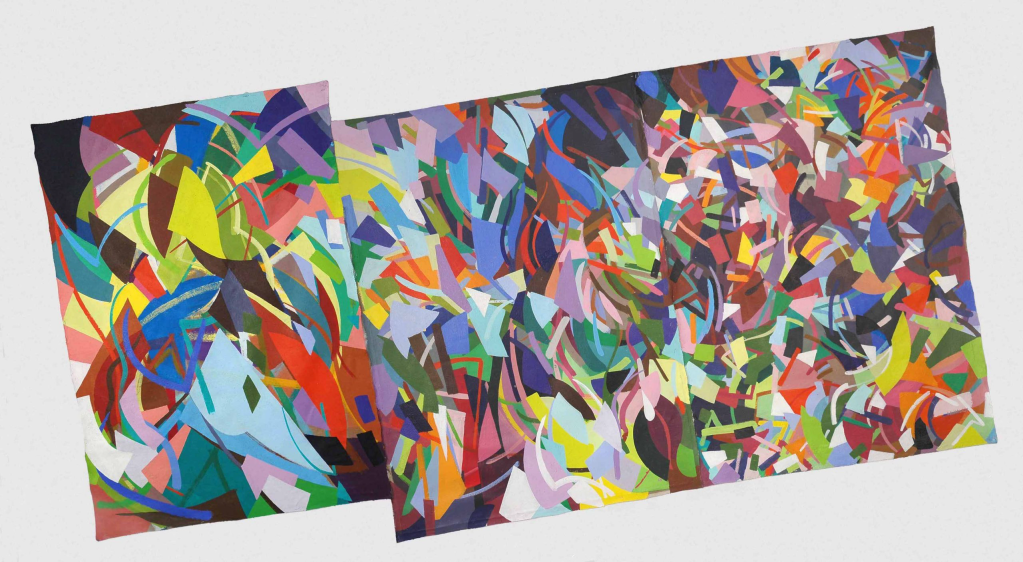
“Centers of Energy”
1989
Acrylic on canvas
60” x 115”
Collection of the artist, New York.
One could construct a drawing or a painting using triangles and compasses for the geometric shapes and arches, or just use the kinetic movement of one’s arm: the shoulder as the center point and the sweep of an arm as the arch. The human body as the instrument for the creation of any number of broad gestures! Movement, but neither blind nor arbitrary: totally natural and intentional.
Here is a local story that comes to us now as being of international importance. The artist, Samia Halaby, was born in Jerusalem, Palestine in 1936. Her family later moved to Beirut, Lebanon in 1949 and then on to Cincinnati, Ohio in 1951. This young artist studied at the University of Cincinnati, Michigan State University, and finally at Indiana University, where she received an MFA degree in 1963.
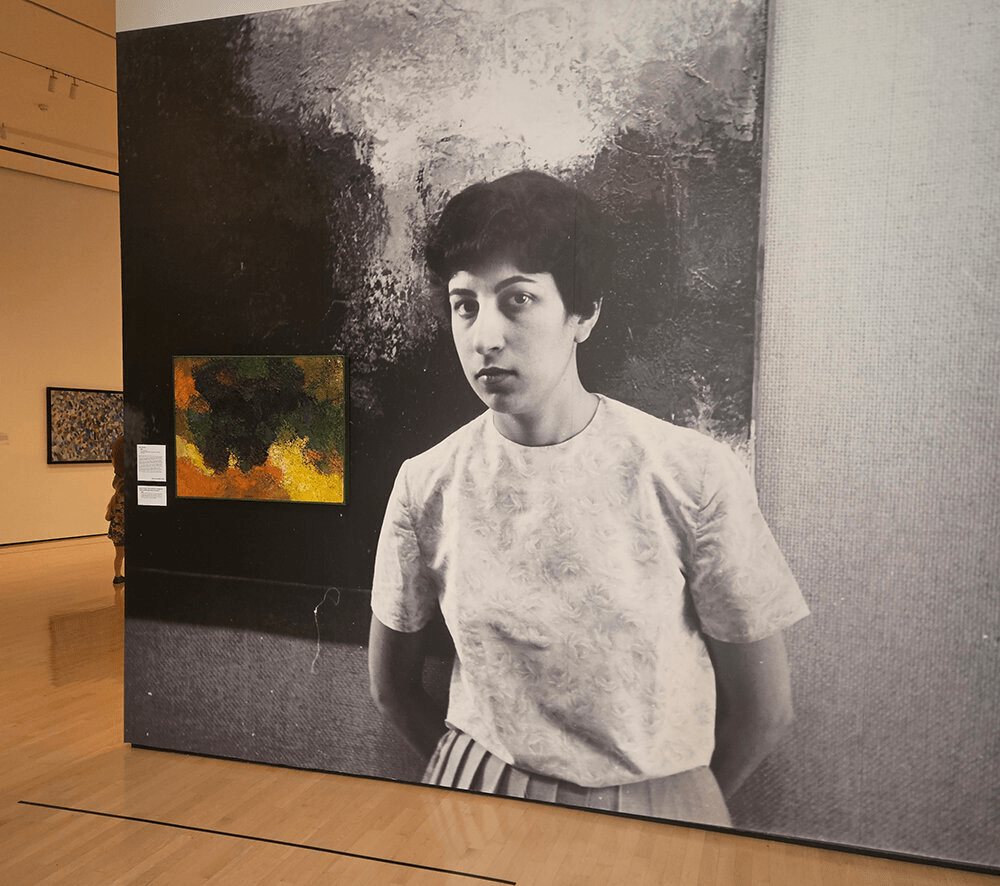
Courtesy the Eli and Edythe Broad Art Museum,
Michigan State University,
East Lansing, Michigan
2024.
One of the earlier paintings from her MFA Exhibition at Indiana University is titled “The Apron, After Gorky’s Mother” and is abstracted from an important earlier painting by Arshille Gorky. This leads us to recognize that many of Halaby’s paintings are indeed abstracted from her immediate world of experience. “Angels and Butterflies” and an “Olive Grove in my Studio” or the “Train Ride from New York to New Haven” are other specific examples. Whether the natural landscape or other more urban landscapes, this sense of space occurs throughout all of her work.
There are two very contradictory definitions to the word “abstract.” The first over used one is in the form of an adjective that usually means anything that is not understood, or un-recognizable. The second one is much stronger, it is in the form of a verb, it is an action. In this form it means to abstract, as in seeing one thing and then abstracting from there. This is more difficult. And this brings me right to the work of Samia Halaby.

“Angels and Butterflies”
2010
Acrylic on linen
80 3/4” x 78 3/4”
Collection of the artist.
Copyright by Samia Halaby 2023
Regarding one specific painting: “Angels and Butterflies” is described in the catalogue as “A kaleidoscope of interacting, reflecting, and refracting lines, shapes, and colors mimic the flapping wings of a butterfly as it glides through the sky. ‘Angels and Butterflies’ reflects Halaby’s analytical approach to painting that examines processes of motion and growth while investigating how space is depicted in paintings. . . . Rather than depicting a particular moment, Halaby paints the general principles of movement, exemplifying the artist’s long-standing belief that abstraction is a means of expressing general principles.”
The two sister exhibitions “Centers of Energy” and “Eye Witness” were curated by Elliot Josephine Leila Reichert and Rachel Winter respectively. Unfortunately, the first part of this exhibition was cancelled earlier this year from being shown at the Sidney and Lois Eskenazi Art Museum at Indiana University by University President Pamela Whitten. One of a series of decisions by the university administration that brought an Indiana University Faculty ‘vote of no confidence’ at their next full faculty meeting. It is especially sad for us in Indiana, as several examples of Halaby’s paintings are contained in the collections of both the Indianapolis Museum of Art and the Eskenazi Art Museum of Indiana University. And for me personally as one of Samia Halaby’s former graduate teaching assistants in the Fundamental Studio Program at Indiana University during the spring semester of 1972.
“The nature of abstraction allows a viewer to recall many different memories and experiences. It occurs to me that Takheel I is like the scattered yellow leaves in the Vancouver Island forest. A painting proves itself to me when a viewer recognizes their own experience in it. Abstraction is not about the person of the artist or his individualism, but rather about the far more difficult, and thus more satisfying, ambition to invent a visual language capable of containing exchangeable knowledge. Of course, the uniqueness of painting is that this shared knowledge is a visual one.”

“Takheel I”
2013
Acrylic on canvas
48” x 66”
Courtesy Ayyam Gallery, London.
“I can write with some degree of clarity only after the fact. The first brush mark guides other parts and interacts with them to initiate the growth process. The initial stage becomes a suggestion for the whole of the painting. The discourse between all the parts, from the general to the intermediate and most specific parts continues until it all seems to work—to meet a visual idea that we as artists, ourselves shaped by society, can accept as a good painting. Then we show it to others and a new social process begins resulting from their acceptance or critique. It is as though the process of change is echoed in the dual act of painting and seeking input. Artists making pictures, in and for society, are like a growing tree giving fruit. Paintings are the fruits of the interaction of artists and society.”
Near the end of the exhibition on one of the museum walls is the artist’s own question to herself: “How do I look at the world, right here, right now, and how shall I move and remember in order to make a painting of our time?”
“I look hard, hoping to avoid the backwardness of post-modernism that dominates the world of art fashion. To see and reflect even a small fragment of the world in the forms of revolutionary twentieth-century painting is as exciting as the clear air and the sun-shine. I think that I see it. Maybe I see how I might do it. But taking it all to the studio is not easily done.”
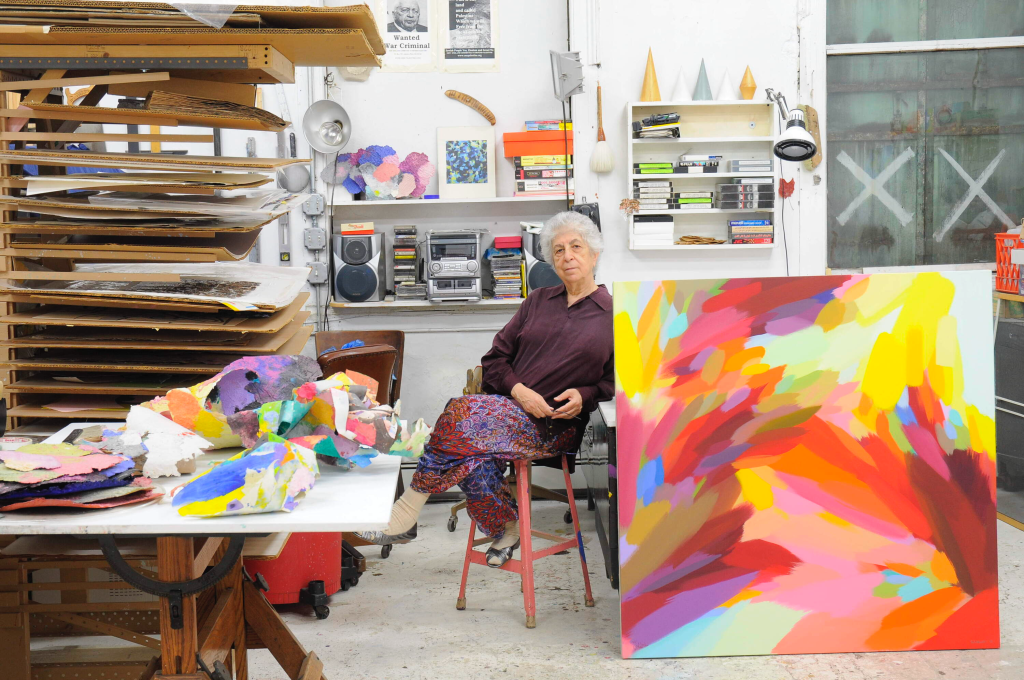
Tribeca, New York City.
Photo copyright by Samia Halaby 2023.
“Samia Halaby: Eye Witness” is currently on view at the Eli and Edyth Broad Art Museum at Michigan State University in East Lansing, Michigan and will run through 15 December 2024. Always Free and Open to All.
1 Halaby, Samia A.; Growing Shapes: Aesthetic Insights of an Abstract Painter; Palestine Books, Inc. in collaboration with Ayyum Gallery; Wooster,Ohio; 2016; p. 5.
2 Reichert, Elliot Josephine Leila, and Rachel Winter; Samia Halaby: Centers of Energy; Hirmer Publishers, Munich and Sidney and Lois Eskenazi Museum of Art, Bloomington; 2023; p. 114.
3 Farhat, Maymanah; Samia Halaby: Five Decades of Painting and Innovation; Booth-Clibborn Editions; London, United Kingdom; 2013; p. 350.
4 Halaby, Samia A.; Growing Shapes: Aesthetic Insights of an Abstract Painter; Palestine Books, Inc. in collaboration with Ayyum Gallery; Wooster,Ohio; 2016; p. 17.
5 Halaby, Samia A.; Growing Shapes: Aesthetic Insights of an Abstract Painter; Palestine Books, Inc. in collaboration with Ayyum Gallery; Wooster,Ohio; 2016; p. 102.
 BRIDGING THE GAP
Thanks once again for another insightful and engaging discussion of abstraction and the work of Hallaby in particular. Brilliant!
LikeLike
Thank you so much Stan. I actually thought of you several times while viewing this work. So important and refreshing! And energetic!
LikeLike