THE DAY IT RAINED ON ANNE FRANK’S HOUSE

“So we walked in the pouring rain, Daddy, Mummy, and I, each with a school satchel and shopping bag filled to the brim with all kinds of things thrown together anyhow.

We got sympathetic looks from people on their way to work.  You could see by their faces how sorry they were they couldn’t offer us a lift; the gaudy yellow star spoke for itself.

Only when we were on the road did Mummy and Daddy begin to tell me bits and pieces about the plan.  For months as many of our goods and chattels and necessities of life as possible had been sent away and they were sufficiently ready for us to have gone into hiding of our own accord on July 16.  The plan had to be speeded up ten days because of the call-up, so our quarters would not be so well organized, but we had to make the best of it.  The hiding place itself would be in the building where Daddy has his office.”

Thursday, 9 July, 1942.[i]

anne
Carel Blazer
“Front view of the house,
Victor (Kraler) Kugler’s office and business”
1954
B&W photograph
Anne Frank House Museum, Amsterdam
The Netherlands

Above are some of the entries from Anne Frank’s Diary, made on the first day of her family’s hiding.  Below are the notes that she made a year and a half later.  One cannot imagine what they were really experiencing during those times, even after reading the Diary.

One summer Anne McKenzie Nickolson and I visited several major cities in Europe, including Copenhagen, Hamburg, Antwerp, Amsterdam, Bruges and Brussels.  It was almost a year after the 9/11 attacks and security was evident everywhere, even walking down Vermeerstraat, or visiting the Rembrandthuis in Amsterdam, but especially while visiting the Anne Frank House Museum on 13 June 2002.  Somber.  It was not raining that day, nor was the sky grey, but still it was somber.

In just two days we visited three important museums:  the Rembrandt House, the Anne Frank House Museum, and the Vincent van Gogh Museum.  Each one was organized in chronological order, including Rembrandt’s studio and Anne Frank’s attic, so that going through them felt like walking through their lives.  Especially the photographs and posters still glued to the walls of Anne Frank’s room.

Coming out of the museum, we walked along the canals and around the block in order to completely see the outside of the house and annex.  Amsterdam is a beautiful city, tree lined streets and canals, with many references to its great artists and historical events.  Later, looking through the Anne Frank House Museum Guide Book, I found the axonometric diagram for both the house and the annex.  It is a beautiful rendering in its own right, and gives one a clear idea and sense of the place.

anne2
Eric van Rootselaar
“Anne Frank House, cross-section house and annex”
(Axonometric projection)
2001
Anne Frank House Museum, Amsterdam
The Netherlands

“When someone comes in from outside, with the wind on their clothes and the cold on their faces, then I could bury my head in the blankets to stop myself thinking:  ‘When will we be granted the privilege of smelling fresh air?’  And because I must not bury my head in the blankets, but the reverse—I must keep my head high and be brave, the thoughts will come, not once, but oh, countless times.  Believe me, if you have been shut up for a year and a half, it can get too much for you some days.  In spite of all justice and thankfulness, you can’t crush your feelings.  Cycling, dancing, whistling, looking out into the world, feeling young, to know that I am free—that’s what I long for, still, I mustn’t show it, because I sometimes think if all eight of us began to pity ourselves, or went about with discontented faces, where would it lead us?  I . . . . don’t know, and I couldn’t talk about it to anyone, because then I know I should cry.  Crying can bring such relief.”

Friday, 24 December, 1943[ii]

anne3
Carel Blazer
“Back view of the house, location of the Secret Annex”
1954
B&W photograph
Anne Frank House Museum, Amsterdam
The Netherlands

“It Is Raining on the House of Anne Frank”
                                                                        Linda Pastan

“It is raining on the house
of Anne Frank
and on the tourists
herded together under the shadow
of their umbrellas,
on the perfectly silent
tourists who would rather be
somewhere else
but who wait here on stairs
so steep they must rise
to some occasion
high in the empty loft,
in the quaint toilet,
in the skeleton
of a kitchen
or on the map—
each of its arrows
a barb of wire—
with all the dates, the expulsions,
the forbidding shapes
of continents.
And across Amsterdam it is raining
on the Van Gogh Museum
where we will hurry next
to see how someone else
could find the pure
center of light
within the dark circle
of his demons.”[iii]

anne4
“Entrance, visitor queues in the rain”
(File Photograph)
Vincent Van Gogh Museum
Museumplein, Amsterdam
The Netherlands

[i] Frank, Anne; The Diary of a Young Girl; Bantam, Doubleday and Random House; New York, New York; 1993; p. 16.

[ii] Frank, Anne; The Diary of a Young Girl; Bantam, Doubleday and Random House; New York, New York; 1993; pp. 123-124.

[iii] Pastan, Linda; “It Is Raining on the House of Anne Frank” Carnival Evening:  New and Selected Poems 1968-1998; W. W. Norton & Company; New York and London; 1998; p. 96.

THE FLIGHT OF ICARUS!

matisse
Henri Matisse
“The Fall of Icarus”
1943
Gouache on paper cut out, collaged on canvas
35 x 26.5 cm
Private Collection

“‘I warn you,’ Daedalus had said, ‘not to fly so low that the mist or fog weighs down your wings, nor so high that the sun scorches you:  fly between the two!  Avoid too much heat and too much damp, too much dryness and too much cold.  Keep to the center of their wheel.  Don’t look at Bootes or Helice, or at Orion’s drawn sword.  Take me as your guide and follow!”

“But Icarus grows excited.  He forgets the advice.  Soon he masters the beating of his wings and swoops in wide, playful circles above the sea.  Does Minos see him laughing and dancing on the invisible crest of the world?  Like a swimmer, turning his back on the cries from shore, he is already far at sea.  He has tired of following his father’s shoulders, his snowy wings and shock of hair.  He enters into glory as into a garden, a garden of flames that surrounds him; and he breathes in.  ‘O Sun!  Father!’ he cries to the encircling fire.  Once more he kicks on the wind!  Again he beats his wings on the torrid wave of the wind!  Once more he thrusts up into the light!”[i]

We know of course, how this is going to end:  wings and wax melting, bursting into flames, and finally falling into the sea below.  Deadalus, the great engineer and inventor, who had constructed these devices for himself and his son, Icarus, had been imprisoned by King Minos in the very dungeon he had constructed for the Minitaur on orders from this king.

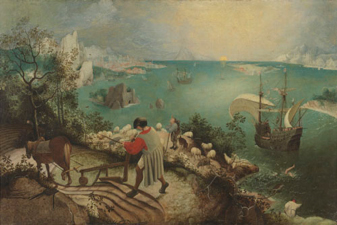
The excitement and enthusiasm of this young man overshadowed the warnings of his father, to stay the course.  It is an ancient moral tale from Ovid that has fascinated many generations of painters and poets:  from Pieter Breughel (both the Elder and the Younger) to Henri Matisse and from William Carlos Williams to Claude-Henri Rocquet.

Many years ago, in literature and composition classes in Baltimore we were  exposed to both classic and contemporary writers, especially Allen Ginsberg and Denise Levertov, Ed Sanders and Susan Sontag.  Ezra Pound, T. S. Elliot, Dylan Thomas and Marianne Moore were always mentioned as well, but William Carlos Williams was often sited only as a footnote.  Sometimes at night I would hit the library and find the new (at the time) two volume edition of Williams’ Collected Poems on the reserve shelf.  I read through the entire collection several times that semester.

I have read that Williams himself was aware of and frustrated by the lack of greater recognition his work was afforded at that time.  He continued to write nonetheless, and his last collection, “Pictures from Breughel” proved beyond a doubt his importance.  Three months after his death, Williams was awarded the Pulitzer Prize for Poetry for this collection.  His deep seeing, attention to detail and sensitivity towards Breughel’s work have continued to influence many younger painters and poets.

II    LANDSCAPE WITH THE FALL OF ICARUS

“According to Brueghel
when Icarus fell
it was spring

a farmer was ploughing
his field
the whole pageantry

of the year was
awake tingling
near

the edge of the sea
concerned
with itself

sweating in the sun
that melted
the wings’ wax

unsignificantly
off the coast
there was

a splash quite unnoticed
this was
Icarus drowning”[ii]

matisse2
Pieter Bruegel
“La chute d’Icare”
Oil on panel
1562-1563
73.5 x 112 cm
Musee Royaux des Beaux-Arts de Belgique, Brussels


[i] Rocquet, Claude-Henri; Bruegel or the Workshop of Dreams; The University of Chicago Press; Chicago and London; 1991.  (p. 122).

[ii] Williams, William Carlos; “Landscape With the Fall of Icarus,” Pictures from Breughel; New Directions Publishing Corporation; New York, New York; 1962; p. 4.

ARE WE CLIMBING JACOB’S LADDER?

“And he came to a certain place, and stayed there that night, because the sun had set.  Taking one of the stones of the place, he put it under his head and lay down in that place to sleep.  And he dreamed that there was a ladder set up on the earth, and the top of it reached to heaven; and behold, the angels of God were ascending and descending on it!  And behold, the Lord stood

above it and said, ‘I am the Lord, the God of Abraham your father and the God if Isaac; the land on which you lie I will give to you and to your descendants; and your descendants shall be like the dust of the earth, and you shall spread abroad to the west and to the east and to the north and to the

ladder1
Attavante
“Le songe de Saint Romuald et l’Echelle des moines”[i]
1502
Miniature on parchment
44 cm. x 34 cm.
Wildenstein Collection of Illuminations
Musee Marmottan, Paris
south; and by you and your descendants shall all the families bless themselves.  Behold, I am with you and will keep you wherever you go, and will bring you back to this land; for I will not leave you until I have done that of which I have spoken to you.’  Then Jacob awoke from his sleep and said, ‘Surely the Lord is in this place….This is none other than the house of God, and this is the gate of heaven.’”[ii]

The Jacob’s Ladder

“The stairway is not
a thing of gleaming strands
a radiant evanescence for angels’ feet that
only glance in their
tread, and
need not touch the stone.

It is of stone.
A rosy stone that takes
a glowing tone of softness
only because behind it the sky is a
doubtful,
a doubting night gray.

A stairway of sharp
angles, solidly built.
One sees that the angels must spring
down from one step to the next giving a
little
lift of wings:

and a man climbing
must scrape his knees and bring
the grip of his hands into play. The cut
stone
consoles his groping feet. Wings brush past
him.
The poem ascends.”[iii]

There are many literary references and historical illustrations to the passage of people and angels traveling between Heaven and Earth.  There are also contemporary examples such as the one above by Denise Levertov and one at the end of this essay by Bob Dylan.  In literature these draw upon the Old Testament story of the Dream of Jacob. In music there is a major source for this in the great American Southern Baptist spiritual:  “Jacob’s Ladder.”

“We are climbing Jacob’s ladder.
We are climbing Jacob’s ladder.
We are climbing Jacob’s ladder,

Soldiers of the cross.
Every rung goes higher and higher.
We are brothers, and sisters, all.”[iv]

It was one of the first African American spirituals to become popular with both black and white citizens of the south.  There is no record of when it was written or who wrote it, but it came into being sometime between 1750 and 1825, and was known as a call and response song amongst slaves.  The ladder quickly became one of many symbols for the means of escaping slavery.

As is typical with folk traditions, this song was handed down through generations and verses were added and changed to reflect more recent times.  Significant versions from the 20th Century include recordings by Paul Robeson, Pete Seeger and most recently by Bruce Springsteen during his “Seeger Sessions.”

ladder2
Georgia O’Keeffe
“Ladder to the Moon”
1958
Oil on canvas
40 3/16” x 30 1/4”
The Whitney Museum of American Art, New York

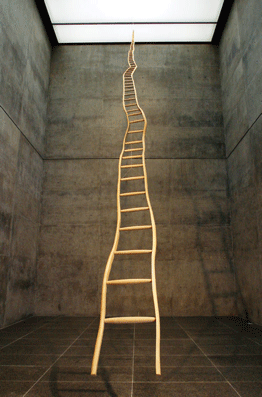
In the visual arts as well, this imagery has wide ranging uses, from medieval manuscript illuminations to pieces of surrealism and even to contemporary sculpture.  The “Dream of Romuald with the stairs of the Monks” from an Italian book illumination at the Marmottan-Monet Museum in Paris is a reference to the story of Jacob’s Ladder.  Many early 20th Century artists incorporated this imagery into their work, from realists to surrealists, from Georgia O’Keeffe to Joan Miro and most recently, Martin Puryear, who has used the ladder form in his sculpture dedicated to Booker T. Washington.

ladder3
Martin Puryear
“Ladder for Booker T. Washington”
1996
Wood (ash and maple)
432” x 22 3/4” x 3”
The Modern Art Museum of Fort Worth, Texas

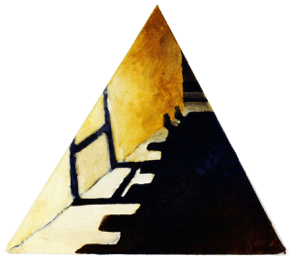
Finally, a young artist here in Indiana has for several years been employing severe and unusual views of many ordinary and everyday objects.  Having studied at the Herron School of Art in Indianapolis, the Pont-Aven School of Contemporary Art in Pont-Aven, France and the Arizona State University in Tempe, Sarah Jones has always had an eye for the unique angle of things.

ladder4
Sarah K. Jones
“Ladder #2”
1993
Oil on canvas
12” x 12”
Courtesy of the artist

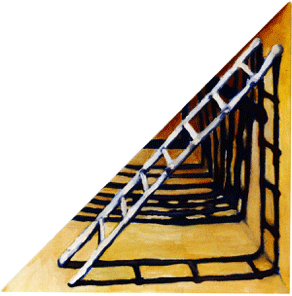
The dramatic placement and situation of certain objects is combined with her own personal point of view towards these things.  Her paintings above and below best illustrate this, as does her own statement regarding how they came about.

ladder5
Sarah K. Jones
“Ladder #3”
1993
Oil on canvas
12” x 12”
Courtesy of the artist

“The paintings came about after a summer spent in the four corners region. I was working on a ranch in Durango, CO and took weekend trips to places like Mesa Verde, Taos, and Albuquerque. It was my first trip west of the Mississippi and I was fascinated by the differences in landscape and even quality of light compared to Indiana. The images which inspired the paintings were taken at Taos Pueblo. The sky was SO blue. The light was SO bright. The shadows were SO strong. I loved the clean lines of the buildings and the shadow patterns made by ladders leaning against the adobe buildings. They formed lovely right angle triangles: building= side 1, ladder = side 2 and shadow of ladder falling across the ground = side 3.”[v]

ladder6
Sarah Kathryn Jones
“Ladder #1”
1993
Oil on canvas
12” x 12”
Courtesy of the artist

Finally, I am reminded of a certain theme that runs through much of the writing of William Carlos Williams:  primarily in his epic poem “Patterson” and secondly in an essay on the work of the artist Charles Sheeler.  He mentions several times that we should “Say it!  No ideas but in things!”[vi]  And further, he observes that “It is in things that for the artist power lies….”[vii]  So, it is in both poetry and painting that a single object might become a powerful image.

“May God bless and keep you always
May your wishes all come true
May you always do for others
And let others do for you
May you build a ladder to the stars
And climb on every rung
And may you stay forever young”[viii]


[i] Translated as “The Dream of St. Romuald and the Ladder of the Monks” this is a piece from the Wildenstein Collection of historic manuscript illuminations at the Marmottan-Monet Museum in Paris. One historian, Peter Damian, has noted that St. Romuald’s Dream is also a conflation of the legend of Jacob’s Dream.

[ii] “Genesis 28:11-17” The Holy Bible:  Revised Standard Version; Thomas Nelson & Sons; New York, Toronto, Edinburgh; 1952; p. 21.

[iii] Levertov, Denise; Selected Poems; New Directions Publishing Corporation; New York, New York; 2002; p. 25.

[iv] Springsteen, Bruce; “Jacob’s Ladder” The Seeger Sessions; Audio Recording, Columbia Records and Sony Entertainment; New York, New York; 1998 & 2006.

[v] Jones, Sarah; An artist’s statement regarding her “Ladder Paintings” as contained in an e-mail correspondence with this writer, 16 May 2017.

[vi] Williams, William Carlos; Patterson; New Directions Publishing Corporation; New York, New York; 1992; pp. 6 & 9.

[vii] Williams, William Carlos; Selected Essays; New Directions Publishing Corporation; New York, New York; 1969; p. 234.

[viii] Dylan, Bob; “Forever Young” Planet Waves; Audio Recording, Columbia Records and Sony Entertainment; New York, New York; 1974 & 2004.

LAY LADY DAY!

“Lady Day got diamond eyes
She sees the truth behind the lies….”[i]

holiday
Sid Grossman,
“Portrait of Billie Holiday”
Gelatin silver print, 1948,
13 3/16” x 10 11/16”
National Portrait Gallery, Smithsonian Institution,
Washington, DC.

Her real name was Eleanora Fagan Gough, born in Philadelphia in 1915.  She spent most of her childhood in Baltimore raised by relatives.  She took the name ‘Billie’ in honor of her favorite actress Billie Dove and the name ‘Holiday’ from Clarence Holiday, her probable father.  Her only training as a teenager was singing along with phonograph records at her aunt’s house.  She was discovered by John Hammond and made her first recording with Benny Goodman in 1933.

Billie Holiday would later record and work with Louis Armstrong, Count Bassie, Artie Shaw and Lester Young.  Many of her contemporaries noted that she made each and every song her own, took them to unheard of heights and depths, bursting into the open air.

Her memory has been celebrated in the song “Angel of Harlem” by the rock band U2 and by the American sculptor Mark di Suvero in a monumental piece “For Lady Day” in south Chicago and perhaps most poignantly by the New York School poet Frank O’Hara upon reading of her death in 1959.

“The Day Lady Died”

“It is 12:20 in New York a Friday
three days after Bastille day, yes
it is 1959 and I go get a shoeshine
because I will get off
the 4:19 in Easthampton
at 7:15 and then go straight to dinner
and I don’t know the people who will feed me

I walk up the muggy street beginning to sun
and have a hamburger and a malted and buy
an ugly NEW WORLD WRITING to see what the poets
in Ghana are doing these days

I go on to the bank
and Miss Stillwagon (first name Linda I once heard)
doesn’t even look up my balance for once in her life
and in the GOLDEN GRIFFIN I get a little Verlaine
for Patsy with drawings by Bonnard although I do
think of Hesiod, trans. Richmond Lattimore or
Brendan Behan’s new play or Le Balcon or Les Nègres
of Genet, but I don’t, I stick with Verlaine
after practically going to sleep with quandariness

and for Mike I just stroll into the PARK LANE
Liquor Store and ask for a bottle of Strega and
then I go back where I came from to 6th Avenue
and the tobacconist in the Ziegfeld Theatre and
casually ask for a carton of Gauloises and a carton
of Picayunes, and a NEW YORK POST with her face on it

and I am sweating a lot by now and thinking of
leaning on the john door in the 5 SPOT
while she whispered a song along the keyboard
to Mal Waldron and everyone and I stopped breathing”[ii]

holiday2
Mark di Suvero
“For Lady Day”
1968-1969
30’ x 18’
Railroad tank car, I-beams and cable
Nathan Manilow Sculpture Park
Governor’s State University,
University Park, Illinois

Finally, in describing this piece in tribute to Billie Holiday and the emergence of a new sculptural space, the critic Peter Schjeldahl has obsered:  “The colosal ‘drawing in space’ with assembled elements—a specialty of the Manilow park, whose ‘For Lady Day’ by Mark di Suvero is a masterpiece of the mode—burst the boundaries of the traditional gallery and garden display and entered the open air.”[iii]


[i] U2; “Angel of Harlem,” Rattle and Hum; audio recording 422-842 299-2; Island Records; New York, New York; 1988.

[ii] O’Hara, Frank; Lunch Poems; City Lights Books; San Francisco, California; 1964 & 2014; p. 21.

[iii] Manilow, Lewis, et al; The Nathan Manilow Sculpture Park; Governors State University Foundation; University Park, Illinois; 1987.  (Including the essay “A Park for the Prairie God” by Peter Schjeldahl); p. 11.

WHY I AM NOT A PAINTER

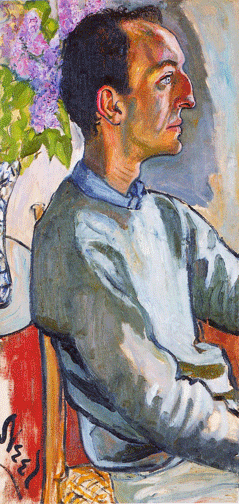
ohara1
Alice Neel
“Frank O’Hara”
Oil on canvas
1960
34” x 16 1/8”
National Portrait Gallery, Smithsonian Institution,
Washington, DC.

He started out manning the front desk at the Museum of Modern Art in New York right after finishing up graduate school at the University of Michigan in 1951.  He soon became an Assistant Curator and later an Associate Curator of Painting and Sculpture.

He would often take off for lunch and scribble notes in the park while he ate a sandwich, or he would walk around the block, stop in at the Ollivetti Shop pretending to test out the latest typewriter and type out 10 or 15 lines on a sheet of paper and then return to his office.  “Lunch Poems” he would later call them.[i]

Although his degrees were in creative writing, Frank O’Hara had a keen eye and a contagious smile and soon met many of the other younger painters and poets in New York.  Amongst his new circle of friends and associates were Grace Hartigan, Kenneth Koch, John Ashbery and Larry Rivers, James Schuyler, Jane Freilicher and Fairfield Porter, Michael Goldberg, Alfred Leslie and Joan Mitchell.  He would often collaborate with several of these painters, especially Larry Rivers, Michael Goldberg, and Grace Hartigan.  One important example of this was the series of Hartigan’s paintings and O’Hara’s poems titled “Oranges” exhibited and published through Tibor de Nagy in 1953.[ii]

ohara2
Grace Hartigan
“Oranges No. 1”
1952
Oil on paper
44 1/4” x 33 1/2”
Poetry and Rare Books Collection
State University of New York
Buffalo, New York


“WHY I AM NOT A PAINTER”
“I am not a painter, I am a poet.
Why?  I think I would rather be
a painter, but I am not.  Well,

for instance, Mike Goldberg
is starting a painting.  I drop in.
‘Sit down and have a drink’ he
says.  I drink:  we drink.  I look
up. ‘You have SARDINES in it.’
‘Yes, it needed something there.’
‘Oh.’  I go and the days go by
and I drop in again.  The painting
is going on, and I go, and the days
go by.  I drop in.  The painting is
finished.  ‘Where’s the SARDINES?’
All that’s left is just
letters.  ‘It was too much,’ Mike says.

But me?  One day I am thinking of
a color:  orange.  I write a line
about orange.  Pretty soon it is a
whole page of words, not lines.
Then another page.  There shoud be
so much more, not of orange, of
words, of how terrible orange is
and life.  Days go by.  It is even in
prose, I am a real poet.  My poem
is finished and I haven’t mentioned
orange yet.  It’s twelve poems, I call
it ORANGES.  And one day in a gallery
I see Mike’s painting, called SARDINES.”[iii]

ohara3
Michael Goldberg
“Sardines”
1955
Oil and adhesive tape on canvas
80 3/4” x 66”
National Museum of American Art
Smithsonian Institution, Washington, DC.


[i] O’Hara, Frank; Lunch Poems; City Lights Books; San Francisco, California; 2014.

[ii] Perloff, Marjorie; Frank O’Hara:  Poet among Painters; The University of Chicago Press; Chicago and London; 1998, pp. 76-77.

[iii] Allen, Donald, ed.; The Collected Poems of Frank O’Hara; University of California Press; Berkeley, Los Angeles, and London; 1995; pp. 261-262.

THE CUTTING PROW

“Everything must
Be arranged
To a hair’s breadth
In thunderclap
Order.”
Antonin Artaud, 1947[i]

In conversations with many of his friends over the years, especially with the poet Louis Aragon, Matisse often stated that:  “The importance of an artist is to be measured by the number of new signs he has introduced into the plastic language….”[ii]

It truly was a new world of signs and images that Matisse was creating.  Even as he was recovering from several surgeries late in life and confined to his bed or wheelchair, he kept working.  The philosopher Henri Focillon described this as a carving out of space or as the work of art creating its own space in the life of forms.  The Beat Generation poet Ed Sanders has also described this as ‘those scissors flashing in the world of forms’ or as a ‘cutting’ form.

As Artoud described this process it is a project dealing with arrangements to “a hair’s breadth.”  Later it would be suggested by Sanders that he wants it adjusted “This way and that, Minutitudinous!”

Or as Matisse himself has noted “The artist’s role is not to translate an observation, but to express the impact an object makes on his own nature:  the shock, the initial reaction.”[iii]

“A work of art is situated in space.  But it will not do to say it simply exists in space:  a work of art treats space according to its own needs, defines space and even creates such space as may be necessary to it.  The space of life is a known quantity to which life readily submits; the space of art is a plastic and changing material.”[iv]

THE CUTTING PROW:  FOR HENRI MATISSE

“The genius was 81
Fearful of blindness
Caught in a wheelchair
Staring at death

But the Angel of mercy
Gave him a year
To scissor some shapes
To soothe the scythe

And shriek! shriek!
Became
swawk! swawk!
The peace of
Scissors.

prow1
Helene Adant
“Matisse at work in his studio in Nice”
B&W Photograph
1952
Musee National d’Art Moderne, Paris

There was something besides
The inexpressible

Thrill

Of cutting a beautiful shape—-
For

Each thing had a ‘sign’
Each thing had a ‘symbol’
Each thing had a cutting form

-swawk swawkk___
to scissor seize.

‘One must study an object a long time,’
the genius said,
‘to know what its sign is.’

The scissors were his scepter
The cutting
Was as the prow of a barque
To sail him away.
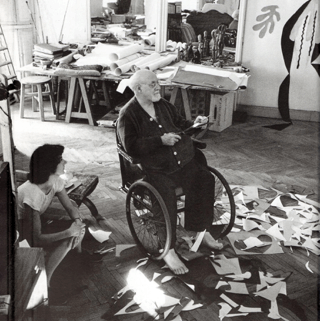
There’s a photograph
which shows him sitting in his wheelchair
bare foot touching the floor
drawing the crisscross steel
a shape in the gouache

His helper sits near him
Till he hands her the form
To pin to the wall

prow2
Helene Adant
“Paule Martin and Matisse in the Hotel Regina, Nice”
B&W Photograph
1952
Musee National d’Art Moderne, Paris

He points with a stick
How he wants it adjusted
This way and that,
Minutitudinous

The last blue iris blooms at
The top of its stalk
Scissors/scepter
Cutting prow

(sung)

Ah, keep those scissors flashing in the
World of Forms, Henri Matisse

The cutting of the scissors
Was the prow of a boat
To take him away
The last blue iris
Blooms at the top
On a warm spring day

prow3
Helene Adant
“Matisse in Vence with scissors and gouache cut-outs”
1947-1948
B&W Photograph
Cameraphoto, Venice

Ah, keep those scissors flashing
In the World of Forms, Henri Matisse

Sitting in a wheelchair
Bare feet touching the floor
Angel of Mercy
Pushed him over Next to Plato’s door

Scissor scepter cutting prow

ahh
swawk swawk

ahh swawk swawk

ahh swawk swawk.”[v]


[i] Artaud, Antonin, (Clayton Eshleman, translator); To Have Done with the Judgement of God; Black Sparrow Press; Los Angeles; 1975. p. 1.

[ii] Flam, Jack; Matisse on Art; University of California Press; Berkeley, Los Angeles, London; 1995; p. 150.

[iii] Schneider, Pierre; Matisse; Rizzoli International; New York, New York; 1984 and 2002; p. 355.

[iv] Focillon, Henri; The Life of Forms in Art; Zone Books; New York, New York; 1989; p. 65.

[v] Sanders, Ed; “The Cutting Prow,” Thirsting for Peace in a Raging Century; Coffee House Press; Minneapolis, Minnesota; 2009; pp. 151-153.

THE BLUE NUDE!

On this date in history, 31 December 1869, Henri Emile Benoit Matisse was born.  Although he studied for and passed the law examination in 1888, it was following an attack of appendicitis in 1889 that is mother gave him a set of paints during his recovery.  By 1891 he had decided to abandon his law career and to study painting.  In Paris he first began studies with Adolphe Bouguereau, but left the Academie Julian in frustration and ended up in the class of Gustave Moreau at the Ecole des Beaux-Arts.

Moreau’s studio encouraged expression and filled the needs of many young artists, including Albert Marquet, Georges Roualt, Henri Manquin, Jules Flandrin, and Charles Camoin.  It is here that Matisse began a life long process of experimentation and invention.  By 1905 he and his compatriots Maurice Vlaminck and Andre Derain were accused of being ‘wild beasts’ and during the teens his experimentation was debated on whether it was too cubist, or not cubist enough.  “The French Window” and the “View of Notre Dame” both from 1914 proved to be pushes into abstraction and invention completely different from what anyone else was doing at that time and for years to come.

Later during the era between World War I and World War II, Matisse would explore pattern space and abstraction through the use of textiles and architecture, and he would employ drawing and painting in this search for certain signs, which were abstracted from the things surrounding him in the studio.

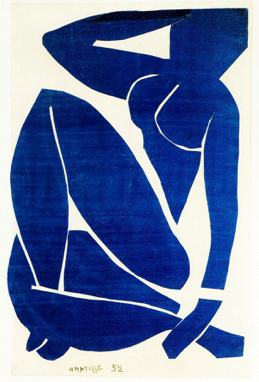
In 1941 an illness and cancer surgery resulted in damaged abdominal muscles confining him to either his bed or wheel chair.  When others would have been happy to just repeat and imitate themselves, he invented one last means of working:  paper cut-outs that literally allowed him to carve with scissors and paper in space.  The series of “Acrobats” and “Blue Nudes” were the ultimate results of these experiments.

blue1
Henri Matisse
“Blue Nude III”
1952
Guache, paper collage
73.5 x 112 cm
Musee National d’Art Moderne,
Centre Georges Pompidou, Paris

The Blue Woman

“She dipped her hand in the sea.
It turned blue.
That pleased her.
She fell full-length into the sea.
She turned blue.
Blue in voice and silence.
The blue woman,
Many admired her
No-one loved her.”

Yannis Ritsos, 1966[i]

Finally, in a collection of writings titled “Thirsting for Peace in a Raging Century” the poet Ed Sanders paid tribute to Matisse and his paper cut-outs.  Sanders wrote:

“He couldn’t paint, he couldn’t sculpt.  He was confined to a wheelchair, and gripped with timor mortis.  From his bed at night he’d draw on the ceiling with a long stick with crayon attached.  Yet somehow he adjusted his creativity, finding a new mix of the muses, so that from the spring of 1952 through the spring of ’53, in his final creative months, Henri Matisse was able to produce some of the finest art of the century—works such as The Swimming Pool, Large Decoration with Masks, The Negress, Memory of Oceania, Women and Monkeys, and the smaller Blue Nude series.  He thought he could scissor the essence of a thing, it’s ‘sign’ as he termed it, as if he had vision in Plato’s world of Forms.”[ii]


[i] Berggruen, Olivier, and Max Hollein; Henri Matisse:  Drawing with Scissors; Prestel; Munich, Berlin, London and New York; 2006; p. 151.

[ii] Sanders, Ed; “Introduction to The Cutting Prow;” Thirsting for Peace in a Raging Century; Coffee House Press; Minneapolis, Minnesota; 2009; p. 202.

DEAD BIRDS

“His Bathrobe Pockets Stuffed with Notes”

“The early sixteenth-century Belgian painter called, for want of his real name, The Master of the Embroidered Leaf.

Those dead birds on the porch when I opened up the house after being away for three months.

Remember Haydn’s 104 symphonies. Not all of them were great. But there were 104 of them.”[i]

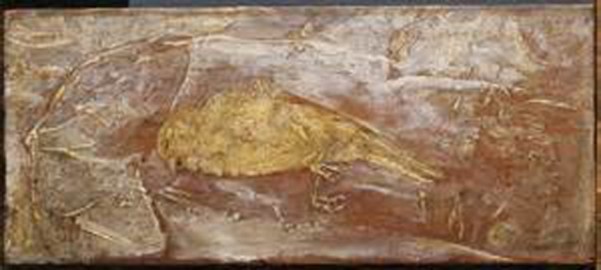
deadbird1
Albert Pinkham Ryder
“Dead Bird”
1890’s
Oil on wood panel
4 3/8” x 10”
The Phillips Collection, Washington, DC.

This terrible but beautiful image of a dead bird has always been one of the most haunting paintings in the Phillips Collection in Washington, DC. Just over four inches high it is an important example of works of art that are intimate in size and grand in spirit. Their effect remains with the viewer long after stepping outside of the museum.

Raymond Carver used this technique on several occasions in his work, especially in his collection A New Path to the Waterfall. Small statements, snippets really, are concise and to the point. 16th Century illuminations, dead birds on the front porch, or an incident involving Billy Strayhorn and Duke Ellington all incorporate the painterly criteria of ‘economy of means.’ Compression.

Georgia O’Keeffe’s “Red and Pink Rocks with Teeth” at the Art Institute of Chicago, Jan Vermeer’s “Girl in the Red Hat” at the National Gallery in Washington and Ryder’s “Dead Bird” mentioned above are all small in size but powerful in scale. Why should this be? Perhaps it was the desire of certain figurative painters and Imagist poets for the significant detail: to rivet the universal with the particular. Or, the suggestion made several times by William Carlos Williams throughout his epic poem Patterson to “Say it! No ideas, but in things.”[ii]

Whether it was the search for an American idiom or a single image out of the mass of chaos, Williams would ask of us: “What common language to unravel?”[iii] For both the poet and the painter it would be the process of finding one’s own vision or voice coming out of “…a mass of detail to interrelate on a new ground…pulling the disparate together to clarify and compress.”[iv]

“Because the sun was behind them
their shadows came first and then
the birds themselves.”[v]

deadbird2
Susan Rothenberg
“Blue Bird Wings”
1989
Oil on canvas
65″x43″
Private collection

To make an image or an object one’s own is to have a signature that comes out of the process of creating that image. Idiosyncratic imagery, like that in Ryder’s painting, has been the trademark of a certain few artists: as in the work of Musa McKim or Leonard Baskin or Susan Rothenberg; Raymond Carver or Kim Fuelling or Michael Ondaatje. These images will speak for themselves, as any real painting or drawing or poem will.

deadbird3
Leonard Baskin
“Dead Bird”
c. 1950’s
Woodcut
1” x 2”
Michelson Galleries, Northampton, Massachusetts

“Through the Boughs”

“Down below the window, on the deck, some ragged-looking birds gather at the feeder. The same birds, I think, that come every day to eat and quarrel. Time was, time was, they cry and strike at each other. It’s nearly time, yes. The sky stays dark all day, the wind is from the west and won’t stop blowing. . . . Give me your hand for a time. Hold on to mine. That’s right, yes. Squeeze hard. Time was we thought we had time on our side. Time was, time was, those ragged birds cry.”[vi]

deadbird4
Kim Fuelling
“Fallen Bird”
c. 1998
Graphite on paper
8” x 10”
Courtesy of the artist, Zionville, North Carolina

“Application for a Driving License”

“Two birds loved
in a flurry of red feathers
like a burst cottonball,
continuing while I drove over them.

I am a good driver, nothing shocks me.”[vii]


[i] Carver, Raymond; “His Bathrobe Pockets Stuffed with Notes;” A New Path to the Waterfall; The Atlantic Monthly Press; New York, New York; 1989; pp. 64-66.

[ii] Williams, William Carlos; Patterson; New Directions Publishing Corporation; New York, New York; 1992; p. 7.

[iii] Williams, William Carlos; Patterson; p. 9.

[iv] Williams, William Carlos; Patterson; p. 19.

[v] McKim, Musa; Alone With the Moon, Selected Writings; The Figures; Great Barrington, Massachusetts; 1994; p. 137.

[vi] Carver, Raymond; “Through the Boughs;” A New Path to the Waterfall; p. 120.

[vii] Ondaatje, Michael; “Application for a Driving License;” The Cinnamon Peeler; Vintage International; New York, New York; 1997; p. 14.

EXPHRASTICS

“Someone, I tell you, in another time,
will remember us.”[i]

Ekphrasis or ecphrasis, from the Greek: a description of a work of art, either real or imaginary, produced as a rhetorical exercise; often used in the adjectival form, ekphrastic, a graphic, often dramatic, description of a visual work of art.

keats
John Keats
“Tracing of an engraving of the Sosibios vase”
1819
Ink on paper
The Louvre, Paris, France

From ancient times to the 20th century there has been an interdisciplinary dance played out between poets and painters. The idea of writing a poem or a play that was descriptive of, or inspired by a work of visual art was in fact invented by the Greeks. Homer’s description of the Shield of Achilles in the 18th Book of The Illiad being one of the first examples.

“Then first he form’d the immense and solid shield;
Rich various artifice emblazed the field;
Its utmost verge a threefold circle bound;
A silver chain suspends the massy round;
Five ample plates the broad expanse compose,
And godlike labours on the surface rose.
There shone the image of the master-mind:
There earth, there heaven, there ocean he design’d;
The unwearied sun, the moon completely round;
The starry lights that heaven’s high convex crown’d;
The Pleiads, Hyads, with the northern team;
And great Orion’s more refulgent beam;
To which, around the axle of the sky,
The Bear, revolving, points his golden eye,
Still shines exalted on the ethereal plain,
Nor bathes his blazing forehead in the main.”[ii]

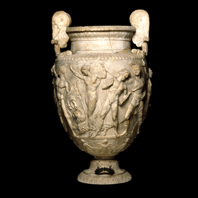
This was of course, a literary fiction based totally on a plastic fiction, made real through the art of storytelling. The Romantic poet John Keats harks back to classic examples with his “Ode on a Grecian Urn.” Published anonymously in the January 1820, Number 15 issue of the magazine “Annals of the Fine Arts” it is an elegaic description on this single object. Early speculation centered around the fact that Keats had based his poem on a specific vase, either “The Sosibios Vase” at the Louvre in Paris or later on “The Townley Urn” at the British Museum in London. Nowadays it is considered that his work is more of a synthesis of several objects.

townley
“The Townley Urn”
100-200AD
Marble
H:1.06 metres
The British Museum, London

“Thou still unravish’d bride of quietness,
Thou foster-child of silence and slow time,
Sylvan historian, who canst thus express
A flowery tale more sweetly than our rhyme:
What leaf-fring’d legend haunts about thy shape
Of deities or mortals, or of both,
In Tempe or the dales of Arcady?
What men or gods are these? What maidens loth?
What mad pursuit? What struggle to escape?
What pipes and timbrels? What wild ecstasy?”

“O Attic shape! Fair attitude! with brede
Of marble men and maidens overwrought,
With forest branches and the trodden weed;
Thou, silent form, dost tease us out of thought
As doth eternity: Cold Pastoral!
When old age shall this generation waste,
Thou shalt remain, in midst of other woe
Than ours, a friend to man, to whom thou say’st,
Beauty is truth, truth beauty,—that is all
Ye know on earth, and all ye need to know.”[iii]

Keats ends his poem with an observation that has become an everlasting philosophical debate: “Beauty is truth, truth beauty.” From artists’ arguments in cafes and bars to doctoral dissertation defenses, it has become an ongoing discussion. Whether writing directly from a work of art as the primary source, as Keats has done, or inventing an image and then writing about it, this form of inspiration flows directly from the visual artist to the writer. In some more recent cases the artist seizes upon an image written by a poet and then makes a drawing or painting.

Near the end of his life, the 20th century abstract painter Philip Guston chose an entire new direction for his work, seeming to reject everything he had created before. He got himself hated by many former friends, but not everyone. Younger poets and painters recognized this new figuration, not as a retreat back into a mimetic mode, but as a venture into a new plastic and literary arena. His late drawings and paintings are a rare example of real dialogue between one painter and several contemporary poets. These poets included: Clark Coolidge, Bill Bergson, Musa McKim, Anne Waldman, William Corbett, Frank O’Hara and Stanley Kunitz.

guston
Philip Guston
“Untitled (Book)”
1968
Goache on paper board
51 cm x 76 cm
Estate of the artist

A generation later, young painters who had studied exclusively with abstract artists in school struggled to find their own voices and visions. It seemed like a dead end to continue without a subject, or subject matter. At first they were accused of producing ‘bad’ painting. With a few more artists testing these waters they became known as ‘New Image’ painters and even ‘neo-expressionists.’ Amongst these artists were: Susan Rothenberg, Robert Moskowitz, Elizabeth Murray and Neil Jenney. All were working, in no small part, thanks to the doors that Philip Guston had opened.

“Henceforth a painting was a legible record of all the decisions, whether tentative or assured, that went into its conception and realization. The issue was not one of speed . . . but rather one of the immediacy and responsiveness of process, the simultaneity of thinking and making.”
Philip Guston [iv]


[i] Sappho; “No Oblivion,” The Complete Poems of Sappho (translated by Willis Barnstone); Shambala Publications; Boston & London; 2011; [147].

[ii] Translated by Alexander Pope. This poem is in the public domain.

[iii] Keats, John; John Keats: The Major Works; Oxford University Press; Oxford & New York; 1990 & 2001; pp. 288-289.

[iv] Storr, Robert; Philip Guston; Abbeville Press; New York, New York; 1986; p. 25.