My friend and colleague, Brett Waller, Director Emeritus of the Indianapolis Museum of Art, used to always mention to students and visitors that art museums were the birth-right of artists: explaining that historically, when many royal and private collections were first opened to the public as museums, they were linked to the local art academies and schools.
Artists such as Paul Cézanne and Alberto Giacometti both were sensitive to the importance of museums and their collections. It was Cézanne who stated many times that “. . . it was his ambition ‘to do Poussin again after nature’ and that he wanted to make of Impressionism ‘. . . something solid and enduring like the art of the museums.’”1
In his Sketchbook of Interpretive Drawings Alberto Giacometti shows us both the range and depth of how he looked at the great art of museums: “I began to copy long before even asking myself why I did it, probably in order to give reality to my predilections, much rather this painting here than that one there, but for many years I have known that copying is the best means for making me aware of what I see, the way it happens with my own work; I can know a little about the world there, a head, a cup, or a landscape, only by copying it.”2
Alberto Giacometti “Study after Pieter Breughel’s Hunters in the Snow” c. 1952 Ballpoint pen on paper 8 1/4” x 11 1/2” Annette and Alberto Giacometti Foundation, Paris and Zurich
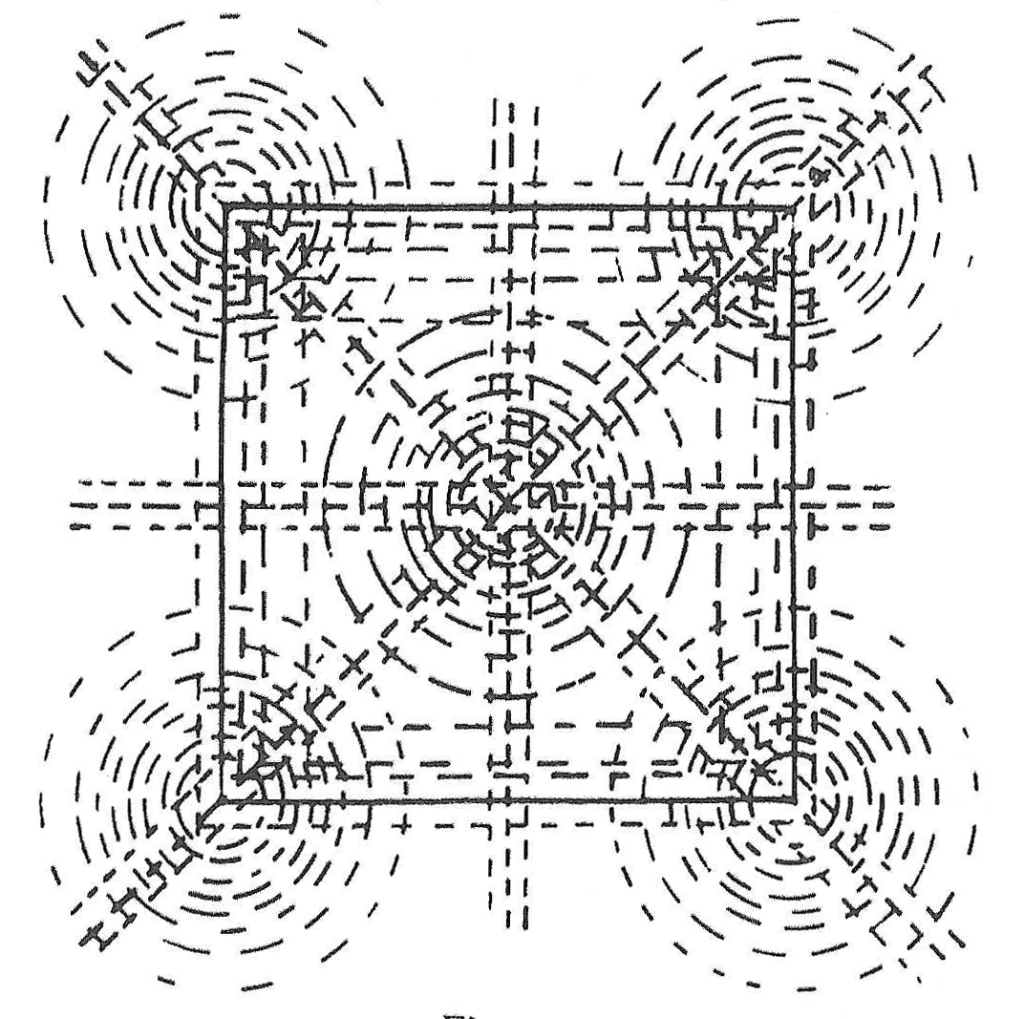
Through the writings of Rudolph Arnheim we have known of the ascending and descending angles and movements through out a painting.3 Also, we understand kinetic and haptic space as it runs through a work of art, leading our eye and mind through this very space.
Rudolph Arnheim “Structural Map” (Figure 3, p. 4) Art and Visual Perception 1971
Whether it is a snow covered hill leading us downward from the center left to the bottom right of the painting, or the path that the hunters are taking from the lower left upward into the center, or even the complimentary angles of the magpie gliding above the distant landscape and holding the upper part of the composition, we can feel the structural movement throughout.
It is this seeing, and experiencing of the thing that is most important, and this of course is exactly what William Carlos Williams achieved with this great painting “The Hunters in the Snow.”
Pieter Breughel the Elder “The Hunters in the Snow” 1565 Oil on wood panel 46” x 63 3/4” Kunsthistorisches Museum, Vienna
The Hunters in the Snow
“The over-all picture is winter icy mountains in the background the return
from the hunt it is toward evening from the left sturdy hunters lead in
their pack the inn-sign hanging from a broken hinge is a stag a crucifix
between his antlers the cold inn yard is deserted but for a huge bonfire
that flares wind-driven tended by women who cluster about it to the right beyond
the hill is a pattern of skaters Breughel the painter concerned with it all has chosen
a winter-struck bush for his foreground to complete the picture . . ”4
1 Chilvers, Ian, & John Glaves-Smith; A Dictionary of Modern and Contemporary Art; Oxford University Press; Oxford, United Kingdom; 2009; p. 132.
2 Carluccio, Luigi; Giacometti: A Sketchbook of Interpretive Drawings; Harry N. Abrams, Inc.; New York, New York; 1967; p. xi.
3 Arnheim, Rudolf; Art and Visual Perception: A Psychology of the Creative Eye; University of California Press; Berkeley and Los Angeles; 1971; p. 4.
4 Williams, William Carlos; Pictures from Brueghel and other poems; New Directions Publishing Corporation; New York, New York; 1967; p. 5.
In the past few years two new books have come out specifically related to art museums and their guards. All the Beauty in the World was written by Patrick Bringley, a long time guard at the Metropolitan Museum of art. The second was the exhibition and its catalogue that had been written and curated by a group of guards at the Baltimore Museum of Art, literally titled Guarding the Art. Providing both insider and intimate views of these great collections, we are given a deeper understanding of these works, not always available to the average visitor.
In later years, Grace Hartigan, Raoul Middleman, and Clyfford Still all had migrated from New York to Baltimore. The first critical responses to these moves were not positive, like moving totally out of the ‘art world’ of New York and becoming anonymous. However, they each found a new home in Baltimore and its own community of artists. And the Baltimore Museum of Art has an especially good selection of Hartigan’s work.
Grace Hartigan “Interior, ‘The Creeks’” 1957 Oil on canvas 90 7/16” x 96 1/4” The Baltimore Museum of Art, Baltimore, Maryland
Describing Grace Hartigan’s work, Rob Kempton wrote: “As your eyes move around the canvas, something new and unknowable appears and pulls you in, never releasing its grip. . . .When Hartigan moved from New York City to Long Island in 1957, author Mary Gabriel noted Hartigan ‘returned to pure abstraction.’ In her new home, she sought to learn more from herself and nature, so this work feels personal and charged. As Hartigan built her canvas with paint, she juxtaposed bold opaque colors against thin translucent washes to create tension—a push-pull feeling. Here, instinct and energy merge through brilliant palette knife scraping and confident brushstrokes.”1
Hale Woodruff, who studied from 1920 to 1924 at the John Herron Art Institute in Indianapolis (later known as the Herron School of Art), established himself as a mature artist in both Washington, D.C., and New York City. We actually met when he received an honor for his work here in Indianapolis in the mid-seventies. And Mr. Woodruff’s work was especially featured at the opening of the National African American Museum in Washington, D.C.
Guard Kellen Johnson made this observation: “Following World War I (1914-1918), many Americans found it very difficult to find work at home and oftentimes had to relocate to Europe to find their fame and fortune.”
“Hale Woodruff captured this rustic scenery in a traditionally horizontal landscape format, though his modernist approach is still prevalent. The painting is mostly characterized by its vigorous brushstrokes, with green willow trees in the foreground distinctly orchestrated into their own strongly rhythmic pattern. In 1928, Woodruff won third place in the short-lived William E. Harrison Foundation Awards for Distinguished Achievement Among Negroes. He used the hundred-dollar prize to book a one-way ticket to finish his art studies in Paris; Normandy Landscape was painted during this trip.”2
Hale Woodruff “Normandy Landscape” 1928 Oil on canvas 21 1/4” x 25 5/8” The Baltimore Museum of Art, Baltimore, Maryland
I first became aware of Sam Gilliam’s work at one of the smaller galleries inside the Phillips Collection in Washington, D.C. The Phillips always reserved one small gallery up on the third floor for local artists, especially the Washington School of Color Painters. It was there that I first saw the work of Morris Louis, Kenneth Nolan, and the younger artist, Sam Gilliam.
Responding to Gilliam’s painting, Dominic Mallari wrote: “Bursts of color, rings of noise, and the sound of music emanate from Blue Edge. Sam Gilliam speaks highly of his jazz influences, and so do his works of art. Gilliam moved to Washington, D.C., during the 1960s Civil Rights Movement. It is there where he produced many of his paintings. While in D.C., he listened to celebrated jazz musicians such as saxophonist John Coltrane and pianist Thelonious Monk, which pushed his painting style higher and higher. Blue Edge is a premier example of such works. . . .When I look at this painting, I imagine a melodic mess, like hearing the instrumental ballets of musicians. Each stroke of color fights to take center stage. The painting is powerful yet somehow contained, waiting to be seen and heard; always a masterpiece. Hang in there, take it in, and mind the edge.”3
Sam Gilliam “Blue Edge” 1971 Acrylic on canvas 71 7/8” x 71 3/4” The Baltimore Museum of Art
Traveling north from Baltimore to New York City we are shown the daily life of another museum guard, Mr. Patrick Bringley, at the Metropolitan Museum of Art. Bringley chronicles his experiences from his initial orientation and his first tours of duty to final reflections on his career. From local Americana selections to the great masterpieces of European art, his words strike true to this important collection and its mission.
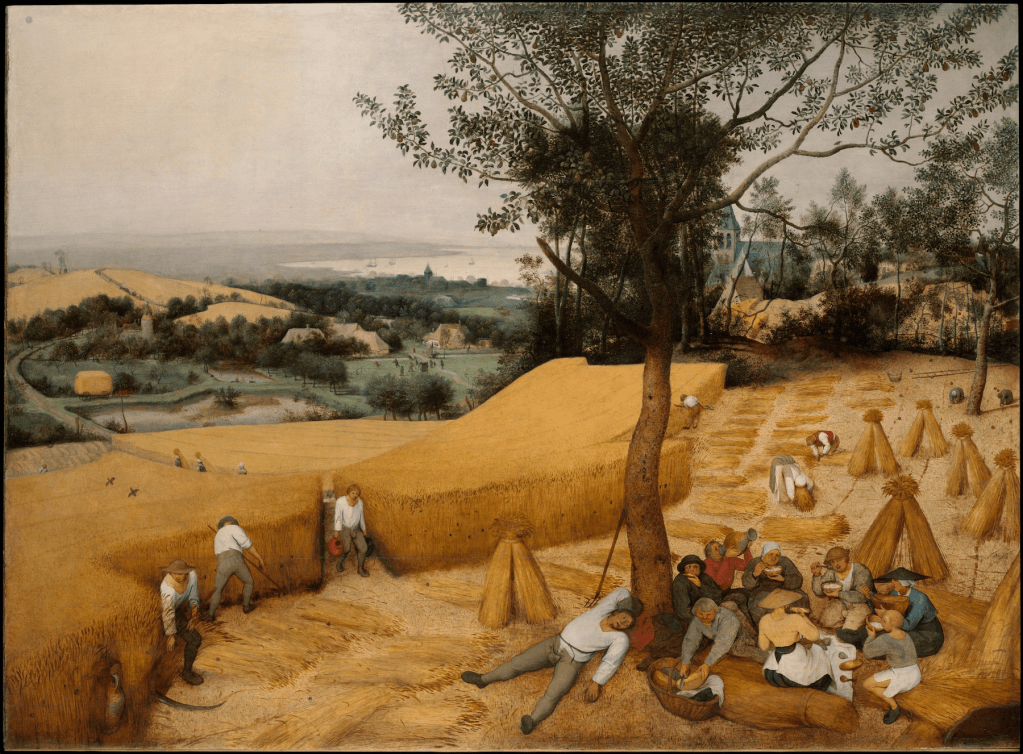
“Looking at Bruegel’s masterpiece I sometimes think: here is a painting of literally the most commonplace thing on earth. Most people have been farmers. Most of these have been peasants. Most lives have been labor and hardship punctuated by rest and the enjoyment of others. It is a scene that must have been so familiar to Pieter Bruegel it took an effort to notice it. But he did notice it. And he situated this little, sacred, ragtag group at the fore of his vast, outspreading world.”
“I am sometimes not sure which is the more remarkable: that life lives up to great paintings, or that great paintings live up to life.”4
Pieter Breughel “The Harvesters” 1565 Oil on wood 46 7/8” x 63 3/4” Metropolitan Museum of Art, New York
On his daily rounds throughout the museum, Bringley takes us in and out of the many hidden nooks and crannies of the building.
“Just below the main painting galleries, there is a mezzanine that is one of the strangest, most eclectic places in the whole museum. The ‘visible storage’ area houses tens of thousands of objects that haven’t found a place in the galleries proper. Without much signage, visitors navigate long narrow channels flanked by tall glass cases presenting a jumble of Americana from the past four hundred years. If you like tables, here are dining tables, tea tables, worktables, card tables, and chamber tables. If you favor clocks, it offers tall clocks, shelf clocks, wall clocks, acorn clocks, lighthouse clocks, banjo clocks, and lyre clocks. The mezzanine is the one area of the Met where visitors declare objects to be ‘just like the one Aunt Barb has.’ It’s a place to take a break from hallowed masterpieces and enjoy the company of looking glasses, sugar nippers, and firemen’s leather helmets and shields.”5
United Society of Believers “Dining Table” 1800-1825 Pine, maple, and basswood 28 1/2” x 31 1/4” x 96 1/2” Metropolitan Museum of Art, New York
So, hidden away in all of this attic-like assembly is a beautifully simple Shaker Dining Table. Unadorned, spiritual. And, if we were to return to the painting galleries upstairs, especially the 20th Century American galleries, we might discover Charles Sheeler’s interior “Americana” from 1931, that contains this very table in use in his own home and the subject of this painting.
Charles Sheeler “Americana” 1931 Oil on canvas 48” x 36” Metropolitan Museum of Art, New York
1 Sims, Lowery Stokes, Hakim Bishara, et al; Guarding the Art; The Baltimore Museum; Baltimore, Maryland; 2022; p. 70.
2 Sims, Lowery Stokes, Hakim Bishara, et al; Guarding the Art; The Baltimore Museum; Baltimore, Maryland; 2022; p. 64.
3 Sims, Lowery Stokes, Hakim Bishara, et al; Guarding the Art; The Baltimore Museum; Baltimore, Maryland; 2022; p. 82.
4 Bringley, Patrick; All the Beauty in the World: The Metropolitan Museum of Art and Me; Simon & Schuster; New York, New York; 2023; p. 87-88.
5 Bringley, Patrick; All the Beauty in the World: The Metropolitan Museum of Art and Me; Simon & Schuster; New York, New York; 2023; p. 129.
In the conclusion of his book, Vermeer in Bosnia, Lawrence Weschler writes about two of Wislawa Szymborska’s poems: “In Praise of Dreams” from 1986, and “Maybe All This” from 1993. From the first poem he notes that Szymborska wrote: “In my dream . . . I paint like Vermeer of Delft.” And in the second one, he speculates: “. . . the picture Szymborska’s words have in mind must be something very like Vermeer’s Lacemaker. How marvelously, at any rate, the poem helps elucidate the painting, and vice versa.”1 To my mind, this is one of the most important functions of the ekphrastic tradition.
In her collected work, Wislawa Szymborska provides us with several examples of this tradition. One especially is a diminutive poem, of only six lines describing a diminutive painting of a milkmaid by Vermeer. When this was written, the author was surely reflecting upon earlier wars and invasions in Europe, especially in her homeland of Poland. Today however, it has taken on a new and timely meaning related to the Ukraine.2
In earlier work, Szymborska takes a more generalized view through a museum, taking note of certain historic objects: an antique plate, a necklace, gloves and shoes, swords, and even a lute. She alludes to the scene without illustrating it.
In another poem she doesn’t literally show the ‘Tower of Babel’ as it was painted by Pieter Brueghel, but she does set up a dialogue between two of its inhabitants. There are two different type faces printed throughout this conversation: Italic for the first one, and ROMAN for the second. Although they are both placed together on the ensuing lines, they clearly do not communicate in any logical way. The speaking in different languages and at cross purposes has begun.3
In several other poems however, Szymborska takes a cue directly from the works of art. These include an ancient Greek sculptural fragment, and paintings by both Pieter Brueghel and Johannes Vermeer.
BRUEGHEL’S TWO MONKEYS
“This is what I see in my dreams about final exams: two monkeys, chained to the floor, sit on the windowsill, the sky behind them flutters, the sea is taking its bath.
The exam is History of Mankind. I stammer and hedge.
One monkey stares and listens with mocking disdain, the other seems to be dreaming away— but when it’s clear I don’t know what to say he prompts me with a gentle
clinching of his chain.”4
Pieter Brueghel “Two Monkeys” 1562 Oil on wooden panel 20cm x 23cm Gemaldegalerie, Berlin, Germany
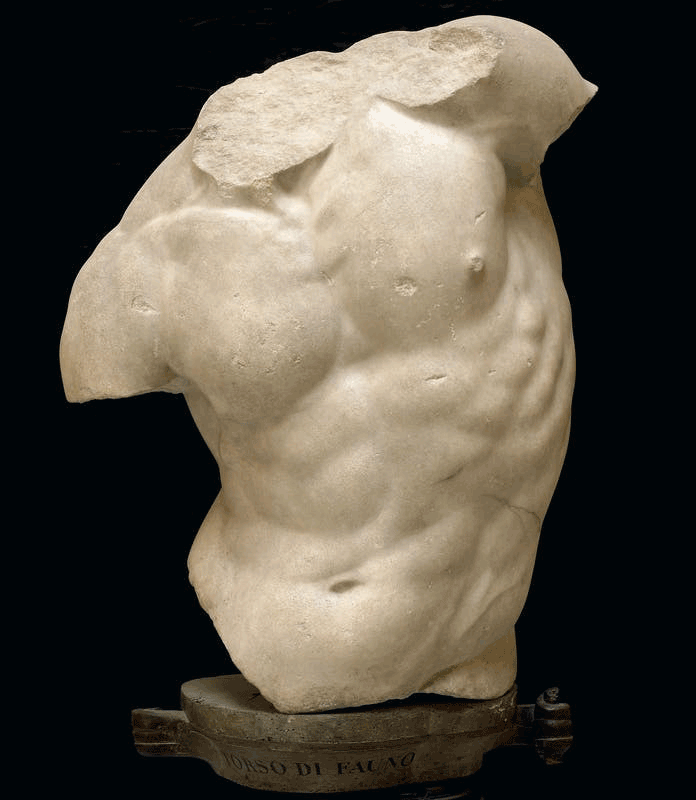
GREEK STATUE
“With the help of people and the other elements time hasn’t done a bad job on it. It first removed the nose, then the genitalia, next, one by one, the toes and fingers, over the years the arms, one after the other, the left thigh, the right, the shoulders, hips, head, and buttocks, and whatever dropped off has since fallen to pieces, to rubble, to gravel, to sand.
When someone living dies that way blood flows at every blow.
But marble statues die white and not always completely.
From the one under discussion only the torso lingers and it’s like a breath held with great effort, since now it must draw to itself all the grace and gravity of what was lost.
And it does, for now it does, it does and it dazzles, it dazzles and endures—
Time likewise merits some applause here, since it stopped work early, and left some for later.”5
“The Gaddi Torso” 1st Century BC. Marble 84cm high The Uffizi Galleries, Florence, Italy
Perhaps works of art actually do survive, in one way or another, in one form or another, in order to remind us of what is important. They need not follow the dictates of ‘socialist realism’ nor the fashions of ‘post-modernism’ and so many other contemporary isms. What we end up experiencing is the persistence of each artist, their story and how they want to tell it, even if it ends up being only a fragment, or a whisper. The artist’s voice, carried through even in a fragment, is an antidote to the craziness of our world during these times.
Johannes Vermeer “The Milkmaid” 1658-1660 Oil on canvas 17 7/8” x 16” Rijksmuseum, Amsterdam, The Netherlands.
VERMEER
“As long as that woman from the Rijksmuseum in painted silence and concentration keeps pouring milk day after day from the jug to the bowl the World hasn’t earned the world’s end.”6
1 Weschler, Lawrence; Vermeer in Bosnia; Vintage Books, A Division of Random House, Inc.; New York, New York; 2004; p. 403.
2 Szymborska, Wiesława; Poems New and Collected 1957-1997; (Translated by Clare Cavanagh and Stanisław Baranczak); Harcourt Brace & Company; New York, San Diego, London; 1998; p. 30.
3 Szymborska, Wiesława; Poems New and Collected 1957-1997; (Translated by Clare Cavanagh and Stanisław Baranczak); Harcourt Brace & Company; New York, San Diego, London; 1998; p. 57.
4 Szymborska, Wiesława; Poems New and Collected 1957-1997; (Translated by Clare Cavanagh and Stanisław Baranczak); Harcourt Brace & Company; New York, San Diego, London; 1998; p. 15.
5 Szymborska, Wisława; Here; (Translated by Clare Cavanagh and Stanisław Baranczak); Houghton Mifflin Harcourt; Boston, New York; 2010; p. 77.
6 Szymborska, Wisława; Here; (Translated by Clare Cavanagh and Stanisław Baranczak); Houghton Mifflin Harcourt; Boston, New York; 2010; p. 55.
Henri Matisse “The Fall of Icarus” 1943 Gouache on paper cut out, collaged on canvas 35 x 26.5 cm Private Collection
“‘I warn you,’ Daedalus had said, ‘not to fly so low that the mist or fog weighs down your wings, nor so high that the sun scorches you: fly between the two! Avoid too much heat and too much damp, too much dryness and too much cold. Keep to the center of their wheel. Don’t look at Bootes or Helice, or at Orion’s drawn sword. Take me as your guide and follow!”
“But Icarus grows excited. He forgets the advice. Soon he masters the beating of his wings and swoops in wide, playful circles above the sea. Does Minos see him laughing and dancing on the invisible crest of the world? Like a swimmer, turning his back on the cries from shore, he is already far at sea. He has tired of following his father’s shoulders, his snowy wings and shock of hair. He enters into glory as into a garden, a garden of flames that surrounds him; and he breathes in. ‘O Sun! Father!’ he cries to the encircling fire. Once more he kicks on the wind! Again he beats his wings on the torrid wave of the wind! Once more he thrusts up into the light!”[i]
We know of course, how this is going to end: wings and wax melting, bursting into flames, and finally falling into the sea below. Deadalus, the great engineer and inventor, who had constructed these devices for himself and his son, Icarus, had been imprisoned by King Minos in the very dungeon he had constructed for the Minitaur on orders from this king.
The excitement and enthusiasm of this young man overshadowed the warnings of his father, to stay the course. It is an ancient moral tale from Ovid that has fascinated many generations of painters and poets: from Pieter Breughel (both the Elder and the Younger) to Henri Matisse and from William Carlos Williams to Claude-Henri Rocquet.
Many years ago, in literature and composition classes in Baltimore we were exposed to both classic and contemporary writers, especially Allen Ginsberg and Denise Levertov, Ed Sanders and Susan Sontag. Ezra Pound, T. S. Elliot, Dylan Thomas and Marianne Moore were always mentioned as well, but William Carlos Williams was often sited only as a footnote. Sometimes at night I would hit the library and find the new (at the time) two volume edition of Williams’ Collected Poems on the reserve shelf. I read through the entire collection several times that semester.
I have read that Williams himself was aware of and frustrated by the lack of greater recognition his work was afforded at that time. He continued to write nonetheless, and his last collection, “Pictures from Breughel” proved beyond a doubt his importance. Three months after his death, Williams was awarded the Pulitzer Prize for Poetry for this collection. His deep seeing, attention to detail and sensitivity towards Breughel’s work have continued to influence many younger painters and poets.
II LANDSCAPE WITH THE FALL OF ICARUS
“According to Brueghel
when Icarus fell
it was spring
a farmer was ploughing
his field
the whole pageantry
of the year was
awake tingling
near
the edge of the sea
concerned
with itself
sweating in the sun
that melted
the wings’ wax
unsignificantly
off the coast
there was
a splash quite unnoticed
this was
Icarus drowning”[ii]
Pieter Bruegel “La chute d’Icare” Oil on panel 1562-1563 73.5 x 112 cm Musee Royaux des Beaux-Arts de Belgique, Brussels
[i] Rocquet, Claude-Henri; Bruegel or the Workshop of Dreams; The University of Chicago Press; Chicago and London; 1991. (p. 122).
[ii] Williams, William Carlos; “Landscape With the Fall of Icarus,” Pictures from Breughel; New Directions Publishing Corporation; New York, New York; 1962; p. 4.







 BRIDGING THE GAP