“Here is the test of wisdom,
Wisdom is not finally tested in schools,
Wisdom cannot be pass’d from one having it to another not having it,
Wisdom is of the soul, is not susceptible of proof, is its own proof,
Applies to all stages and objects and qualities and is content,
Is the certainty of the reality and immortality of things, and the excellence of things;
Something there is in the float of the sight of things that provokes it out of the soul.”[i]

“Le geant du Manio, c.6,000-4,000BC, Carnac, France”
Color photograph
1997
Our students at the Pont-Aven School of Contemporary Art in 1995 and 1997 often asked us, having seen pre-historic sites for the first time: how did these people know that they could build something that would last over a thousand years? The site of the Alignements at Carnac in Brittany, France is possibly one or two thousand years older than Stonehenge and constructed by what we now know to be a pre-Druidic culture. Stone constructions known as dolmens are found throughout Brittany and in Carnac proper there are alignements of stones, as many as two or three thousand, always arranged on an east to west axis, which allows for each stone to annually throw its shadow on its neighbor at both sunrise and sunset during the summer solstice.
“That grosbois is oak, ash, elm,
beech, horsbeche & hornbeam
but of acorns tithe shall be paid
For every lamb a penny
time out of mind
one lira per sheep nel Tirolo
sale must be in place overt
not in a backe-room
& between sun-up & sun-down
dies solaris
ut pena ad paucos
metus ad omnes perveniat
of 2 rights the more ancient preferred
caveat emptor.”[ii]
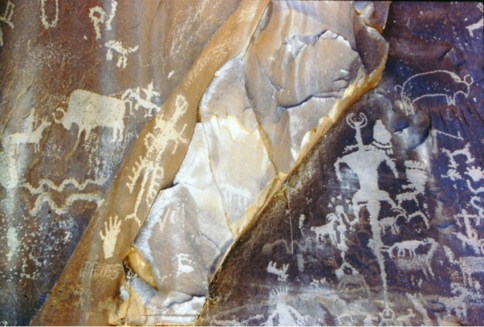
“Newspaper Rock, c. 100BC-1500AD, Moab, Utah”
Color photograph
1999
Following my teaching assignments in France in 1995 and 1997 we went on several family trips to Alaska and Canada and to the Four Corners area of the lower forty-eight. Near Moab, Utah there is the site known as Newspaper Rock, which contains dozens of images inscribed into the surface of the rock face over hundreds of years. There are examples of at least three successive Native American cultures, including Anasazi, Navajo and Ute. They are pictographs and petroglyhps: images full of meaning. Similar images seem to appear in several other cultures around the world. In Wrangell Bay, Alaska, there are stones containing petroglyphs which can be seen only at low tide. They are approximately 8,000 years old and carved by the ancesters of today’s Tlingit people.
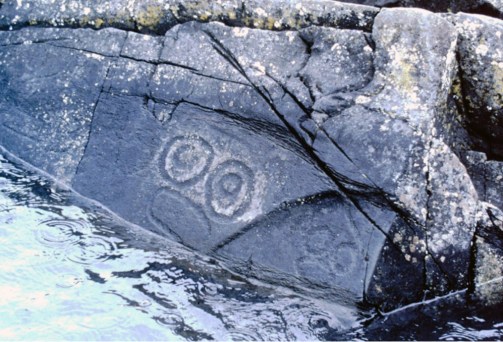
“Petroglyph, c. 6,000BC, Wrangell Bay, Alaska”
Color photograph
1996
“What do you think endures? . . . .”
“A great city is that which has the greatest men and women,
If it be a few ragged huts it is still the greatest city in the whole world.”
“Than this nothing has better served, it has served all,
Served the fluent-tongued and subtle-sensed Greek, and long ere the Greek,
Served in building the buildings that last longer than any, . . . .
Served the mound-raiser on the Mississippi. . . .
Served the Albic temples in woods or on plains, with unhewn pillars and the druids. . . .
Served those who time out of mind made on the granite walls rough sketches of the sun, moon, stars, ships, ocean waves,
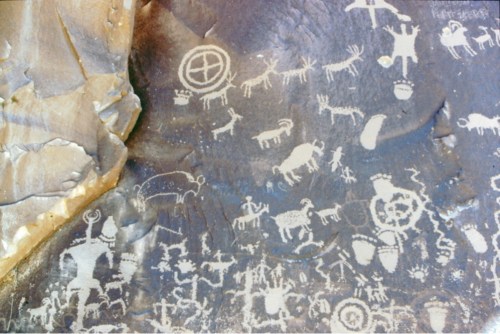
“Newspaper Rock, c. 100BC-1500AD, Moab, Utah”
Color photograph
1999
Served the paths of the irruptions of the Goths. . . .
Served the long distant Kelt. . . .
Served the making of helms for the galleys of pleasure and the making of those for war,
Served all great works on land and all great works on the sea,
For the medieval ages and before the medieval ages,
Served not the living only then as now, but served the dead.”[iii]
Time out of mind.
[i] Whitman, Walt; Selected Poems; Gramercy Books; New York, New York and Avenel, New Jersey; 1992; p. 153.
[ii] Pound, Ezra; The Cantos of Ezra Pound; New Directions Publishing Corporation; New York, New York; 1979; p. 769.
[iii] Whitman; Selected Poems; pp. 131-134.



 BRIDGING THE GAP