Henri Matisse “The Fall of Icarus” 1943 Gouache on paper cut out, collaged on canvas 35 x 26.5 cm Private Collection
“‘I warn you,’ Daedalus had said, ‘not to fly so low that the mist or fog weighs down your wings, nor so high that the sun scorches you: fly between the two! Avoid too much heat and too much damp, too much dryness and too much cold. Keep to the center of their wheel. Don’t look at Bootes or Helice, or at Orion’s drawn sword. Take me as your guide and follow!”
“But Icarus grows excited. He forgets the advice. Soon he masters the beating of his wings and swoops in wide, playful circles above the sea. Does Minos see him laughing and dancing on the invisible crest of the world? Like a swimmer, turning his back on the cries from shore, he is already far at sea. He has tired of following his father’s shoulders, his snowy wings and shock of hair. He enters into glory as into a garden, a garden of flames that surrounds him; and he breathes in. ‘O Sun! Father!’ he cries to the encircling fire. Once more he kicks on the wind! Again he beats his wings on the torrid wave of the wind! Once more he thrusts up into the light!”[i]
We know of course, how this is going to end: wings and wax melting, bursting into flames, and finally falling into the sea below. Deadalus, the great engineer and inventor, who had constructed these devices for himself and his son, Icarus, had been imprisoned by King Minos in the very dungeon he had constructed for the Minitaur on orders from this king.
The excitement and enthusiasm of this young man overshadowed the warnings of his father, to stay the course. It is an ancient moral tale from Ovid that has fascinated many generations of painters and poets: from Pieter Breughel (both the Elder and the Younger) to Henri Matisse and from William Carlos Williams to Claude-Henri Rocquet.
Many years ago, in literature and composition classes in Baltimore we were exposed to both classic and contemporary writers, especially Allen Ginsberg and Denise Levertov, Ed Sanders and Susan Sontag. Ezra Pound, T. S. Elliot, Dylan Thomas and Marianne Moore were always mentioned as well, but William Carlos Williams was often sited only as a footnote. Sometimes at night I would hit the library and find the new (at the time) two volume edition of Williams’ Collected Poems on the reserve shelf. I read through the entire collection several times that semester.
I have read that Williams himself was aware of and frustrated by the lack of greater recognition his work was afforded at that time. He continued to write nonetheless, and his last collection, “Pictures from Breughel” proved beyond a doubt his importance. Three months after his death, Williams was awarded the Pulitzer Prize for Poetry for this collection. His deep seeing, attention to detail and sensitivity towards Breughel’s work have continued to influence many younger painters and poets.
II LANDSCAPE WITH THE FALL OF ICARUS
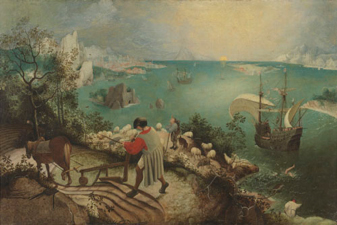
“According to Brueghel
when Icarus fell
it was spring
a farmer was ploughing
his field
the whole pageantry
of the year was
awake tingling
near
the edge of the sea
concerned
with itself
sweating in the sun
that melted
the wings’ wax
unsignificantly
off the coast
there was
a splash quite unnoticed
this was
Icarus drowning”[ii]
Pieter Bruegel “La chute d’Icare” Oil on panel 1562-1563 73.5 x 112 cm Musee Royaux des Beaux-Arts de Belgique, Brussels
[i] Rocquet, Claude-Henri; Bruegel or the Workshop of Dreams; The University of Chicago Press; Chicago and London; 1991. (p. 122).
[ii] Williams, William Carlos; “Landscape With the Fall of Icarus,” Pictures from Breughel; New Directions Publishing Corporation; New York, New York; 1962; p. 4.
“Nothing is hollow or waste to the imagination of Marianne Moore….For I don’t think there is a better poet writing in America today or one who touches so deftly so great a range of our thought….So that in looking at some apparently small object one feels the swirl of great events.”[i]
This is what William Carlos Williams wrote about his friend and colleague Marianne Moore in an article regarding her work for the Quarterly Review of Literature in 1948. This particular issue of the Quarterly Review was published in honor of Miss Moore.
Marianne Moore was born in Brooklyn, New York in 1887 and lived most of her life there. Miss Moore studied at the University of Pennsylvania and worked as a professional librarian, with the other half of her career as a poet. Along the way, she met and shared aesthetic interests with other fellow poets including Ezra Pound and William Carlos Williams. On a rare trip overseas to London and the British Museum with her mother in 1911 she discovered a small Egyptian blown glass sculpture in the form of a fish, which later became an important example of the ekphrastic tradition. She has also written sensitively about Leonardo da Vinci’s “Saint Jerome and His Lion” and “Rodin’s Penseur.”
Ellen Fischer “Kodak and Mirror” 2016 Oil on panel 12” x 9” (Courtesy of the artist
Ellen Fischer was born in Oak Park, Illinois in 1956. She studied at the Herron School of Art in Indianapolis, the Skowhegan School of Painting and Sculpture in Maine, and at the School of the Art Institute of Chicago. She has served as a curator at both the Greater Lafayette Museum of Art in Indiana and the Vero Beach Museum of Art in Florida. The other half of her career over these years was of course as a studio artist.
These two could have been sisters, or distant cousins, perhaps not from the exact same family, but from across the spread of time. They share several aesthetic, intellectual and spiritual traditions even though one was an Imagist poet and the other is a contemporary painter. Both women have worked with great independence and determination.
On several occasions I have accompanied Ms. Fischer to art museums, galleries, antique stores and markets in Central Florida. The same eyes that look so intensely at works of art are also used to search out a find or two at the local flea market or Goodwill Store. Her juxtapositions are always surprising and provocative, bringing out the best in every object.
Quietly creating these still lives, flooding them with light and satire and curiosity, Ms. Fischer has assembled a body of work that speaks of human hands and activities. It is exactly what Miss Moore advocated when she mentioned how one object shouldn’t diminish or reduce another: one thing being great because another is small.
Ellen Fischer “Hanging Machete” 2016 Oil on panel 12” x 9” (Courtesy of the artist
Although many of these objects are old and discarded, they are not, to my mind, nostalgic. They are unusual in form and antique in the sense that they carry with them a certain history, or an untold story that may have already been lost, only now to be participants in a totally new story.
When I recently asked Ms. Fischer about her work and her selection of subjects, this was her response:
“YES, I see things at Goodwill and thrift stores and flea markets, and buy them. I know right away that I have to have them, and that I will paint them. The meat cleaver was purchased at the St. Vincent DePaul shop here in Vero. Two friends were with me and I had nothing to buy. When they were checking out, I saw it in a case on the other side of the cash register and asked to see it.”
“Well, once something like that is in your hands you can’t let it go. I paid way more for that cleaver than I usually spend on anything in the thrift store– $10.00!”
“I had done a few paintings with sharp objects in them, and wanted to do more. The cleaver interested me as an object to paint. It did lie around the studio for a few months before I used it, but I never stopped thinking about it, in a general way.”
“It seemed natural to use the little Parian ware ‘Ma Kettle’ figure with it– she is holding an ax, you may have noticed, and has a pig at her side….And she was just the right size to hide behind the blade.”
Ellen Fischer “A Close Call” 2016 Oil on panel 12” x 9” (Private collection Indianapolis)
“Always best when a still life comes together spontaneously. I don’t think you can force objects to go together that don’t belong together, no matter how you juggle them.”
“Sometimes I have played around with objects, positioning them this way and that to see how they might work, but if it doesn’t happen within a reasonable amount of time, I keep the object I am most interested in painting on the table and try different objects with it.”
“I have to feel strongly about the objects in the first place to want to paint them.”[ii]
Because of her interest in various works of art, Marianne Moore was often questioned about her writing and collecting. She struggled to defend the directness of her own work and to explain what she saw in the work of others, both poets and painters. Finally having had enough, she made her own statement regarding what she indeed looked for.
Here is Miss Moore’s response regarding her collection of art and objects:
“When I Buy Pictures
or what is closer to the truth,
when I look at that of which I may regard myself as the imaginary possessor,
I fix upon what would give me pleasure in my average moments:
the satire upon curiosity in which no more is discernible
than the intensity of the mood;
or quite the opposite–the old thing, the medieval decorated hat-box,
in which there are hounds with waists diminishing like the waist of the hour-glass,
and deer and birds and seated people;
it may be no more than a square of parquetry; the literal biography perhaps,
in letters standing well apart upon a parchment-like expanse;
an artichoke in six varieties of blue; the snipe-legged hieroglyphic in three parts;
the silver fence protecting Adam’s grave, or Michael taking Adam by the wrist.
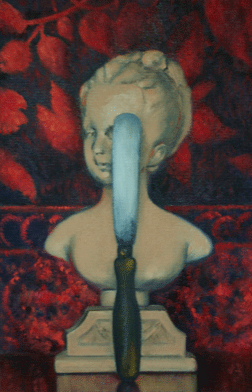
Ellen Fischer “Bust with Palette Knife” 2016 Oil on panel 12” x 9” (Courtesy of the artist)
Too stern an intellectual emphasis upon this quality or that detracts from one’s enjoyment.
It must not wish to disarm anything; nor may the approved triumph easily be honored–
that which is great because something else is small.
It comes to this: of whatever sort it is,
it must be ‘lit with piercing glances into the life of things’;
it must acknowledge the spiritual forces which have made it.”[iii]
[i] Williams, William Carlos; “Marianne Moore” Selected Essays; New Directions Publishing Corporation; New York, New York; 1969; pp. 292-294.
[ii] Fischer, Ellen; An artist’s statement regarding “Close Call” and other still life elements as contained in an e-mail correspondence with this writer, 21 June 2017.
[iii] Schulman, Grace, ed.; The Poems of Marianne Moore; Viking; New York, New York; 2003; p. 144.
“And he came to a certain place, and stayed there that night, because the sun had set. Taking one of the stones of the place, he put it under his head and lay down in that place to sleep. And he dreamed that there was a ladder set up on the earth, and the top of it reached to heaven; and behold, the angels of God were ascending and descending on it! And behold, the Lord stood
above it and said, ‘I am the Lord, the God of Abraham your father and the God if Isaac; the land on which you lie I will give to you and to your descendants; and your descendants shall be like the dust of the earth, and you shall spread abroad to the west and to the east and to the north and to the
Attavante “Le songe de Saint Romuald et l’Echelle des moines”[i] 1502 Miniature on parchment 44 cm. x 34 cm. Wildenstein Collection of Illuminations Musee Marmottan, Parissouth; and by you and your descendants shall all the families bless themselves. Behold, I am with you and will keep you wherever you go, and will bring you back to this land; for I will not leave you until I have done that of which I have spoken to you.’ Then Jacob awoke from his sleep and said, ‘Surely the Lord is in this place….This is none other than the house of God, and this is the gate of heaven.’”[ii]
The Jacob’s Ladder
“The stairway is not
a thing of gleaming strands
a radiant evanescence for angels’ feet that
only glance in their
tread, and
need not touch the stone.
It is of stone.
A rosy stone that takes
a glowing tone of softness
only because behind it the sky is a
doubtful,
a doubting night gray.
A stairway of sharp
angles, solidly built.
One sees that the angels must spring
down from one step to the next giving a
little
lift of wings:
and a man climbing
must scrape his knees and bring
the grip of his hands into play. The cut
stone
consoles his groping feet. Wings brush past
him.
The poem ascends.”[iii]
There are many literary references and historical illustrations to the passage of people and angels traveling between Heaven and Earth. There are also contemporary examples such as the one above by Denise Levertov and one at the end of this essay by Bob Dylan. In literature these draw upon the Old Testament story of the Dream of Jacob. In music there is a major source for this in the great American Southern Baptist spiritual: “Jacob’s Ladder.”
“We are climbing Jacob’s ladder.
We are climbing Jacob’s ladder.
We are climbing Jacob’s ladder,
Soldiers of the cross.
Every rung goes higher and higher.
Every rung goes higher and higher.
Every rung goes higher and higher.
We are brothers, and sisters, all.”[iv]
It was one of the first African American spirituals to become popular with both black and white citizens of the south. There is no record of when it was written or who wrote it, but it came into being sometime between 1750 and 1825, and was known as a call and response song amongst slaves. The ladder quickly became one of many symbols for the means of escaping slavery.
As is typical with folk traditions, this song was handed down through generations and verses were added and changed to reflect more recent times. Significant versions from the 20th Century include recordings by Paul Robeson, Pete Seeger and most recently by Bruce Springsteen during his “Seeger Sessions.”
Georgia O’Keeffe “Ladder to the Moon” 1958 Oil on canvas 40 3/16” x 30 1/4” The Whitney Museum of American Art, New York
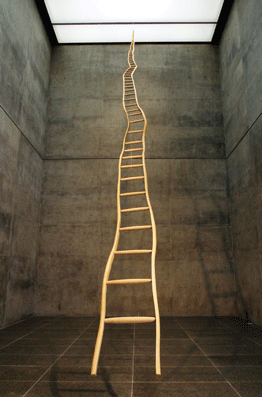
In the visual arts as well, this imagery has wide ranging uses, from medieval manuscript illuminations to pieces of surrealism and even to contemporary sculpture. The “Dream of Romuald with the stairs of the Monks” from an Italian book illumination at the Marmottan-Monet Museum in Paris is a reference to the story of Jacob’s Ladder. Many early 20th Century artists incorporated this imagery into their work, from realists to surrealists, from Georgia O’Keeffe to Joan Miro and most recently, Martin Puryear, who has used the ladder form in his sculpture dedicated to Booker T. Washington.
Martin Puryear “Ladder for Booker T. Washington” 1996 Wood (ash and maple) 432” x 22 3/4” x 3” The Modern Art Museum of Fort Worth, Texas
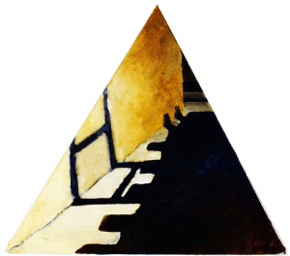
Finally, a young artist here in Indiana has for several years been employing severe and unusual views of many ordinary and everyday objects. Having studied at the Herron School of Art in Indianapolis, the Pont-Aven School of Contemporary Art in Pont-Aven, France and the Arizona State University in Tempe, Sarah Jones has always had an eye for the unique angle of things.
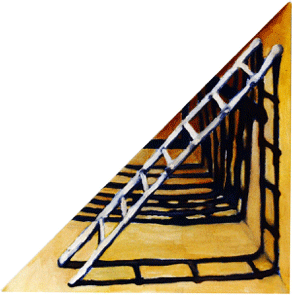
Sarah K. Jones “Ladder #2” 1993 Oil on canvas 12” x 12” Courtesy of the artist
The dramatic placement and situation of certain objects is combined with her own personal point of view towards these things. Her paintings above and below best illustrate this, as does her own statement regarding how they came about.
Sarah K. Jones “Ladder #3” 1993 Oil on canvas 12” x 12” Courtesy of the artist
“The paintings came about after a summer spent in the four corners region. I was working on a ranch in Durango, CO and took weekend trips to places like Mesa Verde, Taos, and Albuquerque. It was my first trip west of the Mississippi and I was fascinated by the differences in landscape and even quality of light compared to Indiana. The images which inspired the paintings were taken at Taos Pueblo. The sky was SO blue. The light was SO bright. The shadows were SO strong. I loved the clean lines of the buildings and the shadow patterns made by ladders leaning against the adobe buildings. They formed lovely right angle triangles: building= side 1, ladder = side 2 and shadow of ladder falling across the ground = side 3.”[v]
Sarah Kathryn Jones “Ladder #1” 1993 Oil on canvas 12” x 12” Courtesy of the artist
Finally, I am reminded of a certain theme that runs through much of the writing of William Carlos Williams: primarily in his epic poem “Patterson” and secondly in an essay on the work of the artist Charles Sheeler. He mentions several times that we should “Say it! No ideas but in things!”[vi] And further, he observes that “It is in things that for the artist power lies….”[vii] So, it is in both poetry and painting that a single object might become a powerful image.
“May God bless and keep you always
May your wishes all come true
May you always do for others
And let others do for you
May you build a ladder to the stars
And climb on every rung
And may you stay forever young”[viii]
[i] Translated as “The Dream of St. Romuald and the Ladder of the Monks” this is a piece from the Wildenstein Collection of historic manuscript illuminations at the Marmottan-Monet Museum in Paris. One historian, Peter Damian, has noted that St. Romuald’s Dream is also a conflation of the legend of Jacob’s Dream.
[ii] “Genesis 28:11-17” The Holy Bible: Revised Standard Version; Thomas Nelson & Sons; New York, Toronto, Edinburgh; 1952; p. 21.
[iii] Levertov, Denise; Selected Poems; New Directions Publishing Corporation; New York, New York; 2002; p. 25.
[iv] Springsteen, Bruce; “Jacob’s Ladder” The Seeger Sessions; Audio Recording, Columbia Records and Sony Entertainment; New York, New York; 1998 & 2006.
[v] Jones, Sarah; An artist’s statement regarding her “Ladder Paintings” as contained in an e-mail correspondence with this writer, 16 May 2017.
[vi] Williams, William Carlos; Patterson; New Directions Publishing Corporation; New York, New York; 1992; pp. 6 & 9.
[vii] Williams, William Carlos; Selected Essays; New Directions Publishing Corporation; New York, New York; 1969; p. 234.
[viii] Dylan, Bob; “Forever Young” Planet Waves; Audio Recording, Columbia Records and Sony Entertainment; New York, New York; 1974 & 2004.
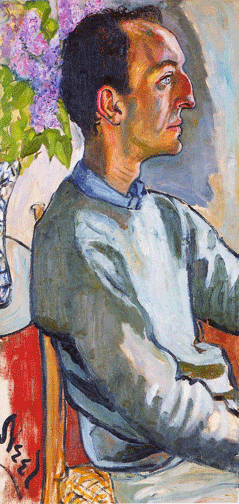
Alice Neel “Frank O’Hara” Oil on canvas 1960 34” x 16 1/8” National Portrait Gallery, Smithsonian Institution, Washington, DC.
He started out manning the front desk at the Museum of Modern Art in New York right after finishing up graduate school at the University of Michigan in 1951. He soon became an Assistant Curator and later an Associate Curator of Painting and Sculpture.
He would often take off for lunch and scribble notes in the park while he ate a sandwich, or he would walk around the block, stop in at the Ollivetti Shop pretending to test out the latest typewriter and type out 10 or 15 lines on a sheet of paper and then return to his office. “Lunch Poems” he would later call them.[i]
Although his degrees were in creative writing, Frank O’Hara had a keen eye and a contagious smile and soon met many of the other younger painters and poets in New York. Amongst his new circle of friends and associates were Grace Hartigan, Kenneth Koch, John Ashbery and Larry Rivers, James Schuyler, Jane Freilicher and Fairfield Porter, Michael Goldberg, Alfred Leslie and Joan Mitchell. He would often collaborate with several of these painters, especially Larry Rivers, Michael Goldberg, and Grace Hartigan. One important example of this was the series of Hartigan’s paintings and O’Hara’s poems titled “Oranges” exhibited and published through Tibor de Nagy in 1953.[ii]
Grace Hartigan “Oranges No. 1” 1952 Oil on paper 44 1/4” x 33 1/2” Poetry and Rare Books Collection State University of New York Buffalo, New York
“WHY I AM NOT A PAINTER”
“I am not a painter, I am a poet.
Why? I think I would rather be
a painter, but I am not. Well,
for instance, Mike Goldberg
is starting a painting. I drop in.
‘Sit down and have a drink’ he
says. I drink: we drink. I look
up. ‘You have SARDINES in it.’
‘Yes, it needed something there.’
‘Oh.’ I go and the days go by
and I drop in again. The painting
is going on, and I go, and the days
go by. I drop in. The painting is
finished. ‘Where’s the SARDINES?’
All that’s left is just
letters. ‘It was too much,’ Mike says.
But me? One day I am thinking of
a color: orange. I write a line
about orange. Pretty soon it is a
whole page of words, not lines.
Then another page. There shoud be
so much more, not of orange, of
words, of how terrible orange is
and life. Days go by. It is even in
prose, I am a real poet. My poem
is finished and I haven’t mentioned
orange yet. It’s twelve poems, I call
it ORANGES. And one day in a gallery
I see Mike’s painting, called SARDINES.”[iii]
Michael Goldberg “Sardines” 1955 Oil and adhesive tape on canvas 80 3/4” x 66” National Museum of American Art Smithsonian Institution, Washington, DC.
[i] O’Hara, Frank; Lunch Poems; City Lights Books; San Francisco, California; 2014.
[ii] Perloff, Marjorie; Frank O’Hara: Poet among Painters; The University of Chicago Press; Chicago and London; 1998, pp. 76-77.
[iii] Allen, Donald, ed.; The Collected Poems of Frank O’Hara; University of California Press; Berkeley, Los Angeles, and London; 1995; pp. 261-262.
“Today he is hardly likely to find himself unless he is a non-conformist and a rebel. To say this is neither dangerous nor new. It is what society really expects of its artists. For today the artist has, whether he likes it or not, inherited the combined functions of hermit, pilgrim, prophet, priest, shaman, sorcerer, soothsayer, alchemist, and bonze.”[i]
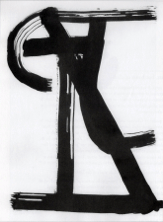
This is what Thomas Merton had to say about contemporary artists and writers. He had multiple points of view regarding this position: as a poet himself, as a Trappist monk at the Abbey of Gethsemani in Lexington, Kentucky, as a student of calligraphy and as a colleague and friend to others in the field, including Ad Reinhart, John Cage, D. T. Suzuki and Jacques Maritain.
Thomas Merton “Untitled” (Sorcerer, soothsayer, alchemist) c. 1963 Brush and India ink on paper 10 1/4” x 7 1/2” The Thomas Merton Center, Bellarmine University, Louisville, Kentucky
In the beginning years of the 20th century Henri Matisse began thinking and writing about the importance of signs. He saw this especially in the pen and ink drawings of Vincent van Gogh, which were an early influence on him, as well as in certain examples of calligraphy from Oriental art.
Henri Matisse “Standing Nude, Arms Covering her Face” 1901-1903 Ink on paper 10 3/8” x 8” Gift of Edward Steichen Museum of Modern Art, New York
In these same years the poet Ezra Pound was sent a manuscript that had been written by the scholar Ernest Fenollosa who had been studying the origins of the Japanese and Chinese alphabets, whose characters had originally been drawings!
“Chinese poetry has the unique advantage of combining both elements. It speaks at once with the vividness of painting, and with the mobility of sounds.”[ii]
Ezra Pound called this the ‘ideogramic method’ and used what he had learned from Fenollosa to define and clarify the quality known as ‘economy of means’ that is so important to both painters and poets. This also led directly to the invention of ‘Imagist Poetry’ that is characterized by clarity and directness.
In letters and conversations with Louis Aragon throughout his lifetime Henri Matisse often explained that: “The sign is determined at the moment I use it and for the object of which it must form a part. For this reason I cannot determine in advance signs which never change and which would be like writing: that would paralyze the freedom of my invention.”[iv]
Henri Matisse “Acrobat” 1952 Brush and ink on paper 41 3/8” x 29 1/2” Private Collection
Aragon helped to ‘translate’ many of Matisse’s statements, paintings and drawings, into literature through his essay ‘Matisse en France’ from 1942-43 and the two volume ‘Matisse: A Novel’ from 1972.
Similar concerns can be seen in the works of Henri Michaux working in Paris and Thomas Merton working in Lexington, Kentucky. They were both interested in painting and poetry, through which they each investigated the use of signs.
“To abstract means to free oneself, to come disentangled.”
“The hand should be empty, should in no way hinder what’s flowing into it.”
“Only the ‘exact placement,’ the ‘just proportion’ matter.”[v]
Henri Michaux “Untitled (Mouvements)” c. 1950-51 India ink on paper 12 5/8” x 9 1/2” Private collection
More recently, in an interview with Janie C. Lee at the Whitney Museum of American Art on 21 May 1998, Brice Marden described some of his work in the “St. Bart’s 1985-86 Series” in this way: “The whole history of the life is right there on the surface. These drawings were all started as individual sheets in a book. Then I took the book apart and started putting them together in different sequences. Some I reworked, putting two sheets on
Brice Marden “St. Bart’s 1985-86 N.Y. 3” 1985-1986 Ink and gouache on paper 7 5/16” x 7 7/8” Whitney Museum of American Art, New York
each page . . . . Top to bottom and across to the left. I was following the Chinese calligraphic method. It was easier for me because I’m left handed, so if I work from right to left, I don’t run the chance of smudging the ink or some marking. These were very early calligraphy-based drawings.”[vi]
The effects of Matisse’s experiments along with Fenollosa’s observations have been wide ranging: from the paintings of Henri Michaux to the calligraphies of Thomas Merton, to Brice Marden’s recent drawings and even to a few of my own students over the years, especially the work of Rene Gonzalez.
Rene Gonzales “The Civil War Cannon” Pen & ink on paper 8 1/2” x 11” 1997 Courtesy of the artist
“Yes, I remember these drawings very well…they were an automatic drawing series. I had been studying a lot of Motherwell at that time and watched a documentary on his Reconciliation Elegy work. In it, he described a process where he would sit down with a stack of paper and ink and a brush and just knock out gestures with no edits or reworks. He could then look at 50 to 100 drawings on the floor and begin to select the ones he wanted to investigate further. The series of drawings I did went through a similar process and only a few were then selected as the actual compositions to my paintings. I believe they were either 8 1/2 x 11 or smaller but I do not remember.”[vii]
Rene Gonzales “An M-16” Pen & ink on paper 8 1/2” x 11” 1997 Courtesy of the artist
“The freedom of the artist is to be sought precisely in the choice of his work and not in the choice of the role as ‘artist’ which society asks him to play.”[viii]
[i] Lipsey, Robert; Angelic Mistakes: The Art of Thomas Merton; New Seeds Publishing; Boston & London; 2006; p. 100.
[ii] Fenollosa, Ernest and Ezra Pound, ed.; The Chinese Written Character as a Medium for Poetry; City Lights Books; San Francisco, California; 1936; p. 9.
[iii] This example has been published in both Fenollosa (p. 8) and Michaux (p. 43). It shows three characters, all containing legs. To the right the ideogram for ‘horse’ with four legs underneath. In the center is an ‘eye’ being carried by two legs. And on the left the image of a man. As both authors explain, these images taken together produce the line: “man sees horse.”
[iv] Schneider, Pierre; Matisse; Rizzoli International; New York, New York; 1984 and 2002; p. 576.
[v] Michaud, Henri; translated by Gustaf Sobin; Henri Michaux: Ideograms in China; New Directions Publishing Corporation; New York, New York; 1975; (unpaginated).
[vi] Lee, Janie C.; Brice Marden Drawings; The Whitney Museum of American Art and Harry N. Abrams, Inc.; New York, New York; 1998; p. 19.
[vii] From E-MAIL communications between the artist and this writer on 14 January and 27 January 2017.
[viii] Lipsey, Robert; Angelic Mistakes: The Art of Thomas Merton; p. 100.
[ix] This last example is taken from Fenollosa (p. 40). It shows a ‘mouth’ on the lower right with words and tongue coming out of it. On the left is the figure of a ‘man.’ Taken together, they form the sign: “a man standing beside his word, truth.”
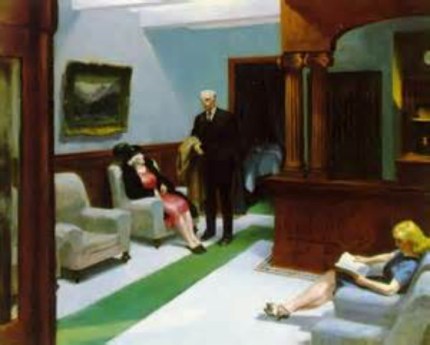
“Edward Hopper’s art is highly provocative and often disturbing. His contemplative figures appear to be alienated from society and to occupy a world devoid of interaction and communication. They never smile or frown, and their attitudes and expressions suggest unapproachableness. These introspective figures convey an inner turmoil that can provide questions about relationships, the roles people play in society, and the meaning of life.”[i]
Edward Hopper “Sketch for Hotel Lobby” 1943 Conte crayon and graphite on paper 8 7/16″ x 10 15/16″ Josephine N. Hopper Bequest, Whitney Museum of American Art, New York
When studying several of Hopper’s sketches for this painting, it becomes clear that he was really searching, working out the space and placement for the lobby and the people inhabiting that space. Five or six different figures were placed in various positions within the composition, including one, a desk clerk, who is hidden in the background behind a lamp in the office. Figures of both men and women are substituted for each other in order to achieve the balance that he desired.
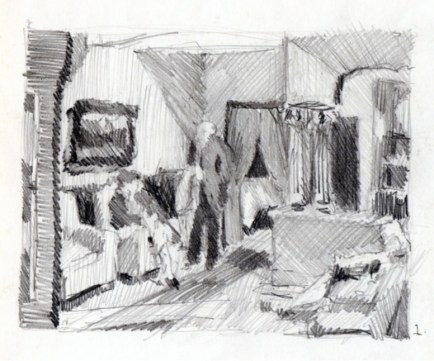
D.W. Hardwick “Study #2 from the Hotel Lobby” 1976 Graphite on paper 6″ x 8″ Private Collection, Indianapolis, Indiana
For many years of my teaching career, we would visit the Indianapolis Museum of Art and draw directly from the objects in their collection. There are several works by Edward Hopper housed there, including “American Landscape,” “New York, New Haven and Hartford” and the “Hotel Lobby” from 1943. Especially important in this learning process is to discover the underlying architecture of any work of art, not just the surface illusions. Two such examples are shown above and below this paragraph. Drawings made on the spot in the museum and showing both space and movement and the tonal juxtapositions that occur in the original. They were completed by Darryl W. Hardwick during the summer session of 1976.
D.W. Hardwick “Study #1 from the Hotel Lobby” 1976 Graphite on paper 6″ x 8″ Private Collection, Indianapolis, Indiana
The poet Raymond Carver in his collection titled Ultramarine of 1987 took on a similar subject. Not directly written after this painting, the parallels however are so striking that one might do a double take. A quiet, perfectly still scene, with the various characters going about their daily routines. Structured and written to lead us into this particular space. Introspective, with the possibility of great turmoil.
“In the Lobby of the Hotel del Mayo”
“The girl in the lobby reading a leather-bound book.
The man in the lobby using a broom.
The boy in the lobby watering plants.
The desk clerk looking at his nails. The woman in the lobby writing a letter.
The old man in the lobby sleeping in his chair.
The fan in the lobby revolving slowly overhead.
Another hot Sunday afternoon.
Suddenly, the girl lays her finger between the pages of her book.
The man leans on his broom and looks.
The boy stops in his tracks.
The desk clerk raises his eyes and stares.
The woman quits writing.
The old man stirs and wakes up.
What is it?
Someone is running up from the harbor.
Someone who has the sun behind him.
Someone who is barechested.
Waving his arms.
It’s clear something terrible has happened.
The man is running straight for the hotel.
His lips are working themselves into a scream.
Everyone in the lobby will recall their terror.
Everyone will remember this moment for the rest of their lives.”[ii]
Edward Hopper “Hotel Lobby” 1943 Oil on canvas 32 1/4″ x 40 3/4″ Williams Ray Adams Memorial Collection, Indianapolis Museum of Art, Indianapolis, Indiana
[i] Warkel, Harriet G.; Paint to Paper: Edward Hopper’s Hotel Lobby; Indianapolis Museum of Art; Indianapolis, Indiana; 2008; p. 11.
[ii] Carver, Raymond; “In the Lobby of the Hotel del Mayo,” Ultramarine: Poems; Random House; New York, New York; 1987; pp. 75-76.
“The early sixteenth-century Belgian painter called, for want of his real name, The Master of the Embroidered Leaf.
Those dead birds on the porch when I opened up the house after being away for three months.
Remember Haydn’s 104 symphonies. Not all of them were great. But there were 104 of them.”[i]
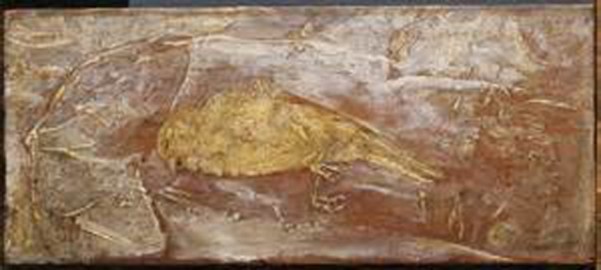
Albert Pinkham Ryder “Dead Bird” 1890’s Oil on wood panel 4 3/8” x 10” The Phillips Collection, Washington, DC.
This terrible but beautiful image of a dead bird has always been one of the most haunting paintings in the Phillips Collection in Washington, DC. Just over four inches high it is an important example of works of art that are intimate in size and grand in spirit. Their effect remains with the viewer long after stepping outside of the museum.
Raymond Carver used this technique on several occasions in his work, especially in his collection A New Path to the Waterfall. Small statements, snippets really, are concise and to the point. 16th Century illuminations, dead birds on the front porch, or an incident involving Billy Strayhorn and Duke Ellington all incorporate the painterly criteria of ‘economy of means.’ Compression.
Georgia O’Keeffe’s “Red and Pink Rocks with Teeth” at the Art Institute of Chicago, Jan Vermeer’s “Girl in the Red Hat” at the National Gallery in Washington and Ryder’s “Dead Bird” mentioned above are all small in size but powerful in scale. Why should this be? Perhaps it was the desire of certain figurative painters and Imagist poets for the significant detail: to rivet the universal with the particular. Or, the suggestion made several times by William Carlos Williams throughout his epic poem Patterson to “Say it! No ideas, but in things.”[ii]
Whether it was the search for an American idiom or a single image out of the mass of chaos, Williams would ask of us: “What common language to unravel?”[iii] For both the poet and the painter it would be the process of finding one’s own vision or voice coming out of “…a mass of detail to interrelate on a new ground…pulling the disparate together to clarify and compress.”[iv]
“Because the sun was behind them
their shadows came first and then
the birds themselves.”[v]
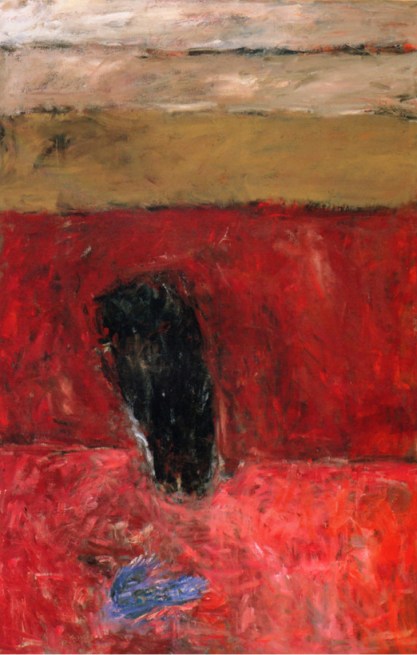
Susan Rothenberg “Blue Bird Wings” 1989 Oil on canvas 65″x43″ Private collection
To make an image or an object one’s own is to have a signature that comes out of the process of creating that image. Idiosyncratic imagery, like that in Ryder’s painting, has been the trademark of a certain few artists: as in the work of Musa McKim or Leonard Baskin or Susan Rothenberg; Raymond Carver or Kim Fuelling or Michael Ondaatje. These images will speak for themselves, as any real painting or drawing or poem will.
Leonard Baskin “Dead Bird” c. 1950’s Woodcut 1” x 2” Michelson Galleries, Northampton, Massachusetts
“Through the Boughs”
“Down below the window, on the deck, some ragged-looking birds gather at the feeder. The same birds, I think, that come every day to eat and quarrel. Time was, time was, they cry and strike at each other. It’s nearly time, yes. The sky stays dark all day, the wind is from the west and won’t stop blowing. . . . Give me your hand for a time. Hold on to mine. That’s right, yes. Squeeze hard. Time was we thought we had time on our side. Time was, time was, those ragged birds cry.”[vi]
Kim Fuelling “Fallen Bird” c. 1998 Graphite on paper 8” x 10” Courtesy of the artist, Zionville, North Carolina
“Application for a Driving License”
“Two birds loved
in a flurry of red feathers
like a burst cottonball,
continuing while I drove over them.
[i] Carver, Raymond; “His Bathrobe Pockets Stuffed with Notes;” A New Path to the Waterfall; The Atlantic Monthly Press; New York, New York; 1989; pp. 64-66.
[ii] Williams, William Carlos; Patterson; New Directions Publishing Corporation; New York, New York; 1992; p. 7.
Between 1902 and 1914 the poet Rainer Maria Rilke lived in Paris to work on a monograph and to act for a short time as the secretary for the sculptor August Rodin. It was Rodin who introduced him to other Parisian artists of the time, including Paul Cezanne. Influenced by the physicality of many of the paintings and sculptures he saw, Rilke developed a new style, which he called the “object poem.” This form of writing sought to capture the plastic presence of a physical object and resulted in imaginative interpretations of certain works of art.
Rilke began writing the “Duino Elegies” in 1912 while a guest of Princess Marie von Thurn und Taxis at the Duino Castle near Trieste. For the next ten years however, the “Elegies” remained incomplete whilst Rilke fell frequently in and out of a depression partially caused by the events of World War I.
In 1915, while he was living in Munich and finding it difficult to secure suitable housing, Rilke asked Hertha Koenig if he might live for a while in her house while she and her family were in the country. His request was granted, and he lived there from June until October 1915. Sometime in 1914 Frau Koenig had purchased Picasso’s painting “The Family of Saltimbanques” and this is where Rilke was privileged to have lived with this painting for five months.
Later, in the summer of 1921 Rilke took up residence at the Château de Muzot, as the guest of another patron. Within the space of a few days in February 1922, he completed the Duino cycle, begun years earlier. The final section to be completed was the Fifth Elegy, which was dedicated to Frau Hertha von Koenig and based on this rose period masterpiece: “The Family of Saltimbanques.”
Pablo Picasso “Family of Saltimbanques” 1905 Oil on canvas 83 3/4″ x 90 3/8″ The Chester Dale Collection, National Gallery of Art, Washington, DC
“But tell me, who are they, these acrobats, even a little
more fleeting than we ourselves,–so urgently, ever since childhood
wrung by an (oh, for the sake of whom?)
never-contented will? That keeps on wringing them,
bending them, slinging them, swinging them,
throwing them and catching them back; as though from an oily
smoother air, they come down on the threadbare
carpet, thinned by their everlasting
upspringing, this carpet forlornly
lost in the cosmos.
Laid on there like a plaster, as though the suburban
sky had injured the earth.”[i]
“There, the withered wrinkled lifter,
old now and only drumming,
shriveled up in his mighty skin as though it had once contained
two men, and one were already
lying in the churchyard, and he had outlasted the other,
deaf and sometimes a little strange.”[ii]
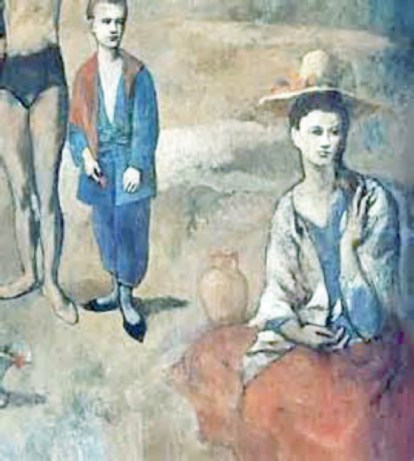
Who are they? They have become one and the same color as the sand and sawdust beneath their feet. Almost ghosts. It is a huge painting at the National Gallery with figures almost life size who know how to keep secrets. Even the painting itself has a secret: look for the water jug just behind the woman in the lower right, and the pointed stance of the young acrobat to her left, below that and just beneath the surface is a ghost of a leg, a pentimento of another earlier figure, now painted out of the picture. This lost figure, as well as the surviving ones are all ghosts now, inhabiting the rose desert of Rilke’s poem, but not always adding up to zero.
Pablo Picasso “Family of Saltimbanques” (DETAIL) 1905 Oil on canvas 83 3/4″ x 90 3/8″ The Chester Dale Collection, National Gallery of Art, Washington, DC
“And the yonger, the man, like the son of a neck
and a nun: so taughtly and smartly filled
with muscle and simpleness.”[iii]
“And then, in this wearisome nowhere, all of a sudden,
the ineffable spot where the pure too-little
incomprehensibly changes,–springs round
into that empty too-much?
Where the many-digited sum
solves into zero?”[iv]
[i] Rilke, Rainer Maria; The Duino Elegies, translated by J. B. Leishman and Stephen Spender; W. W. Norton & Company; New York, New York; 1963; p. 47.
[ii] Rilke, Rainer Maria; The Duino Elegies; p. 49.
[iii] Rilke, Rainer Maria; The Duino Elegies; p. 49.
[iv] Rilke, Rainer Maria; The Duino Elegies; p. 53.
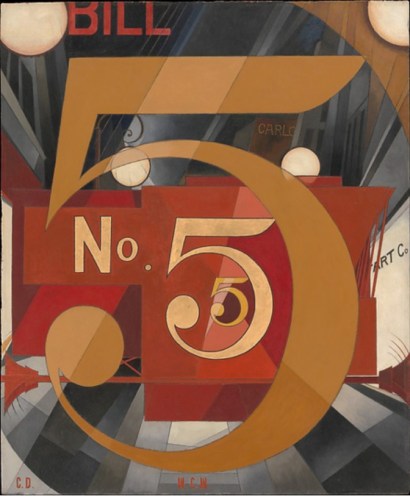
There is a story regarding the poet William Carlos Williams and the painter Marsden Hartley that recounts an early shared experience. Dr. Williams was working at the time at the Post Graduate Clinic in New York and after his shift had made arrangements to visit Hartley’s studio. Hartley however, was either late or had totally forgotten the appointment and Williams sat for a few minutes on the stoop in front of the building. It was getting dark, streetlights were coming on and firetrucks were racing past. Williams got out a piece of paper and wrote down, or sketched out, the entire scene. It became his poem “The Great Figure” and was published as part of his collection Sour Grapes in 1921.
A few years later Charles Demuth began a series of eight abstract “poster portraits” as tributes to other modern American artists, amongst them were Georgia O’Keeffe, John Marin and Arthur Dove. Although these were not literal likenesses, Demuth created these portraits using imagery that related to each sitter. In William Carlos Williams’ case urban sights and sounds, cubist directional lines and a number on the side of a passing firetruck are all incorporated into this one particular painting.
Charles Demuth “I Saw the Figure 5 in Gold” 1928 Oil, graphite, ink, and gold leaf on paperboard 35 1/2″ x 30″ Metropolitan Museum of Art, Alfred Stieglitz Collection
“The Great Figure”
“Among the rain
and lights
I saw the figure 5
in gold
on a red
firetruck
moving
tense
unheeded
to gong clangs
siren howls
and wheels rumbling
through the dark city”[i]
Williams’ poem became a classic example of the new writing in America known as Imagism. Charles Demuth’s painting was purchased by Alfred Stieglitz and later donated to the Metropolitan Museum of Art in New York. And later still, during the Pop Art period, Robert Indiana appropriated this image for a series of his own paintings and silkscreen prints titled the “American Dream.” Examples of these works are now in the collection of the Indianapolis Museum of Art.
Robert Indiana “The American Dream” 1971 Screen print 39″ x 32″ Indianapolis Museum of Art
[i] Williams, William Carlos; The Collected Poems: Volume I; New Directions Publishing Corporation; New York, New York; 1986; p. 174.
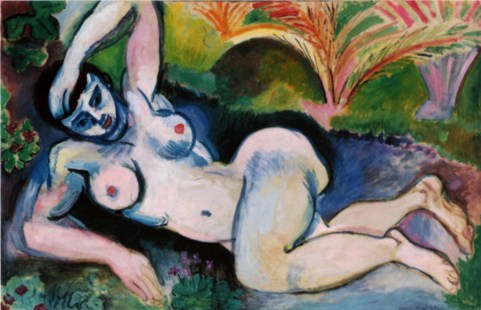
At the Salon of 1907 in Paris, the critic Louis Vauxcelles described the “Blue Nude” as: “A nude woman, ugly, spread out on opaque blue grass under some palm trees.”[i]
In 1913 in New York and Chicago the Armory Show was a catalyst for derision of both European and modern art by the general American population. It was of course the first exposure of works by Cezanne, Picasso, Matisse, and even Ingres to the American public. This exhibition also included selected contemporary American artists, including several who were associated with Alfred Stieglitz and his gallery.
Henri Matisse’s early painting, “Blue Nude, a Souvenir of Biskra” from 1907 was one of the pieces to cause a public stir. At the close of the exhibition at the Art Institute of Chicago in 1913, the students rioted and burned both the painting and Matisse in effigy on the steps of the museum.
Henri Matisse “Blue Nude, Souvenir of Biskra” 1907 36 1/4″ x 55 1/4″ Oil on canvas Baltimore Museum of Art, The Cone Collection, formed by Dr. Claribel Cone and Miss Etta Cone of Baltimore, Maryland
The painting had been purchased by Leo Stein in Paris at the 1907 Salon. Later it was purchased by the American collector John Quinn, whose estate in turn sold it to Etta and Claribel Cone of Baltimore, where it remains in the collection of the Baltimore Museum of Art.
The Blue Nude was also featured in an exhibition at Stieglitz’s gallery in 1921, where it was seen by the American poet William Carlos Williams. His prose poem, inspired by this painting, may be one of the first positive pieces of writing regarding the “Blue Nude.”
“A Matisse in New York”
“On the french grass, in that room on Fifth Ave., lay that woman who had never seen my own poor land.”
“So he painted her. The sun had entered his head in the color of sprays of flaming palm leaves. They had been walking for an hour or so after leaving the train. They were hot. She had chosen the place to rest and he had painted her resting, with interest in the place she had chosen.”
“It was the first of summer. Bare as was his mind of interest in anything save the fullness of his knowledge, into which her simple body entered as into the eye of the sun himself, so he painted her.”
“No man in my country has seen a woman naked and painted her as if he knew anything except that she was naked. No woman in my country is naked except at night.”
“In the french sun, on the french grass in a room on Fifth Ave., a french girl lies and smiles at the sun without seeing us.”[ii]
More recently, in 1993 the English writer A. S. Byatt has taken a similar approach to this subject in The Matisse Stories, a series of short stories each inspired by one of Matisse’s paintings. This time, it is the “Large Reclining Nude” also known as the “Pink Nude” purchased in 1936 directly from the artist by Etta Cone and donated to the Baltimore Museum of Art through the Cone Sisters’ bequest in 1950.
Dr. Claribel Cone’s will stated that the Baltimore Museum of Art should receive the bequest of their collection provided that “…the spirit of appreciation for modern art in Baltimore became improved.”[iii]
Henri Matisse “Large Reclining Nude” 1935 26 1/8″ x 36 3/4″ Oil on canvas Baltimore Museum of Art, The Cone Collection, formed by Dr. Claribel Cone and Miss Etta Cone of Baltimore, Maryland
“She had walked in one day because she had seen the Rosy Nude through the plate glass. That was odd, she thought, to have that lavish and complex creature stretched voluptuously above the coat rack, where one might have expected the stare, silver and supercilious or jetty and frenzied, of the model girl. They were all girls now, not women. The rosy nude was pure flat colour, but suggested mass. She had huge haunches and a monumental knee, lazily propped high. She had round breasts, contemplations of the circle, reflections on flesh and its fall. . . . She had asked cautiously for a cut and blow-dry.”[iv]
In conversations with his friends and fellow artists over the years, especially with the poet Louis Aragon, Matisse often stated that: “The importance of an artist is to be measured by the number of new signs he has introduced into the plastic language…”[v]
[i] Flam, Jack; Matisse in the Cone Collection: The Poetics of Vision; The Baltimore Museum of Art; Baltimore, Maryland; 2001; pp. 41-42.
[ii] Tashjian, Dickran; William Carlos Williams and the American Scene 1920-1940; Whitney Museum of American; New York, New York; 1978; 29-31.










 [ix]
[ix]





 BRIDGING THE GAP