THREE BATHERS, TWO HENRYS & ONE CEZANNE

It is a monstrous painting.  Huge when first encountered in the galleries of the Philadelphia Museum of Art, approximately seven feet high and eight feet across, impossible to be taken in all at once.  Cezanne worked on this subject through many years and versions, always searching for the solution he had imagined.
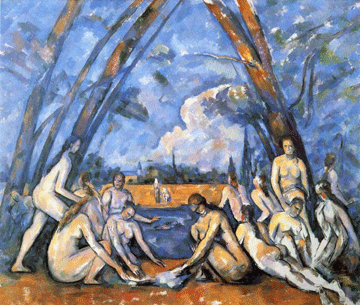
henry1
Paul Cezanne
“The Large Bathers”
1900-1906
6’ 10 7/8” x 8’ 2 3/4”
Oil on canvas
Philadelphia Museum of Art

We can see from several smaller studies how Cezanne’s ideas developed and grew over time.  Two or three figures in one, three to five figures in another, numerous combinations and variations.  This work was really important to Cezanne, but it was even more important to artists who followed him.  Significantly amongst those in later generations were both Henry Moore and Henri Matisse.  Each of them had actually owned smaller versions of Cezanne’s “Bathers.”

henry2
Paul Cezanne
“Three Bathers”
c. 1875
Oil on canvas
12” x 13”
The Henry Moore Foundation

“I now own a small Cezanne Bathers painting, and in talking about it to friends, I have often said, ‘look what a romantic idea Cezanne had of women,’ and, ‘how fully he realised (sic) the three-dimensional world.’  I felt that I could easily make sculptures of his figures.”

“Stephen Spender in a letter to me said, ‘your idea of showing that you could make sculptures of the Cezanne figures is fascinating.  Why don’t you do it?’  Soon after his letter, I felt like proving it, and modeled each of the three figures in plasticine, taking about an hour in all.  My idea was to show their existence completely in space, and perhaps to photograph them or make drawings, as it were, from behind the picture, showing them from all sides and demonstrating that they had been conceived by Cezanne in full three dimensions.”
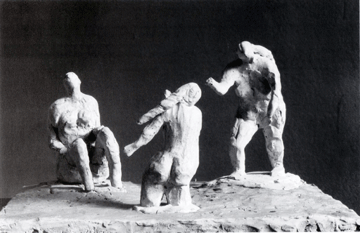
henry3
Henry Moore
“Three Bathers—After Cezanne”
1978
Bronze
1. 30.5 cm. (length 12”)
The Henry Moore Foundation

“I enjoyed the whole of this experience.  I had thought I knew our ‘Bathers’ picture completely, having lived with it for twenty years.  But this exercise—modelling the figures and drawing them from different views—has taught me more than any amount of just looking at the picture.”

“This example shows that working from the object—modelling or drawing it—makes you look much more intensely than ever you do if you just look at something for pleasure.”[i]

There is a popularly held misconception that artists are bad writers, although to this day we are constantly required to submit an “artist’s statement” for any and every thing we do.  However, from the number of letters written back and forth amongst artists, from entries written in their notebooks and journals, and explanations that many curators require from the artists they are celebrating, it is clear that visual artists are also very articulate with regards to the written word.

Here are two examples, from Henry Moore above and Henri Matisse below, reflecting their personal thoughts and observations on several versions of Paul Cezanne’s “Bathers.”  They write clearly and straightforwardly regarding these paintings, all the while rediscovering how important Cezanne’s work actually was.

Henry Moore has worked with the pure plastic sense of both painting and sculpture and the process of articulating form in space.  This is evident in all of his later work, and his many figurative pieces.

Henri Matisse is drawing from the Cezanne and searching for a more complete realization of a composition as seen over several years.  Amongst several examples this would lead to his great “Bathers by a River” of 1917 at the Art Institute of Chicago.
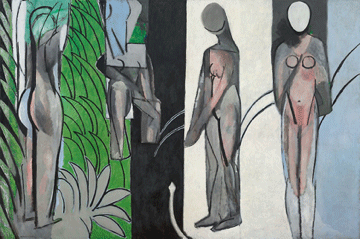
henry4
Henri Matisse
“Bathers by a river”
1909-1917
Oil on canvas
102 1/2” x 154 3/16”
Charles H. and Mary F. S. Worcester Collection
The Art Institute of Chicago

In 1899 Henri Matisse purchased “Three Bathers” by Cezanne from the Parisian art dealer Vollard.  He kept it in his possession until 1936 when he donated it to the Petit Palais in Paris.  On 10 November 1936 he wrote this letter to Raymond Escholier, the director of the museum:

“Allow me to tell you that this picture is of the first importance in the work of Cezanne because it is a very dense, very complete realization of a composition that he carefully considered in several canvases which, though now in important collections, are only the studies that culminated in this work.”

“In the thirty-seven years I have owned this canvas, I have come to know it quite well, though not entirely, I hope; it has sustained me morally in the critical moments of my venture as an artist; I have drawn from it my faith and my perseverance; for this reason, allow me to request that it be placed so that it may be seen to its best advantage.  For this it needs both light and adequate space.  It is rich in color and surface, and seen at a distance it is possible to appreciate the sweep of its lines and the exceptional sobriety of its relationships.”

“I know that I do not have to tell you this, but nevertheless I think it is my duty to do so; please accept these remarks as the excusable testimony of my admiration for this work which has grown increasingly greater ever since I have owned it.  Allow me to thank you for the care that you will give it, for I hand it over to you with complete confidence. . . .”[ii]
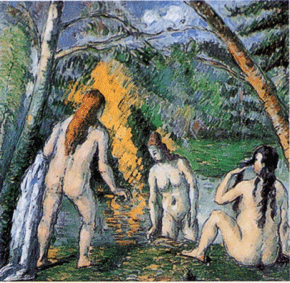
henry5
Paul Cezanne
“Three Bathers”
1879-1882
Oil on canvas
55 cm. x 52 cm.
Gift of Henri Matisse to the Petit Palais,
the City Museum of Paris in 1936


[i] Wilkinson, Alan, ed; Henry Moore:  Writings and Conversations; University of California Press; Berkeley and Los Angeles; 2002; pp. 307-309.

[ii] Flam, Jack; Matisse on Art; University of California Press; Berkeley, Los Angeles and London; 1995; p. 124.

AIN’T IT JUST LIKE THE NIGHT

“Here are some clues to The Meaning of Night.”  This is how the poet Linda Pastan begins her meditation on the painting of the same name by Rene Magritte.  It is somewhat of a challenge, as Magritte’s paintings are almost always enigmatic, offering few clear narratives or clues.  Although they are full with imagery and fantasy, they also leave the viewer, more often than not, with more questions than answers.

A dark gray beach scene inhabited by two men in bowler hats, bits and pieces of sea foam strewn across the beach, and a strange configuration, or is it an accumulation of female body parts, seeming to float near the center right of the composition?  It seems like a riddle of imagery but without any clear indication of where an answer might be found.  The secrets of the night are the true inhabitants of Magritte’s world.

magritte1
Rene Magritte
“The Meaning of Night (Le sens de la nuit)”
1927
Oil on canvas
54 1/2” x 41 1/2”
The Menil Collection,
Houston, Texas


Le Sens de la Nuit
         Magritte, oil on canvas, 1927

“Here are some clues
to The Meaning of Night:
pieces of bright foam estranged
from the sea; a woman wrapped
in a cage of wrinkled shapes;
the formal back of one man twinned
to the front of another—
or are they really the same man,
and could he be the undertaker of day?

If there is a meaning to night
is it contained here, or must we search
through the dreams that lap
behind our closed lids as we sleep
like the small waves in this painting
which, when the day is over
and the museum shuts down,
go back to the dark sea
they came from?”[i] 

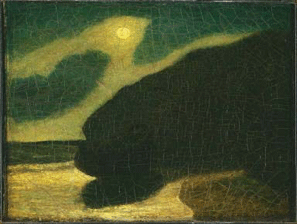
Many artists and writers have alluded to, or incorporated directly into their work, the meanings and secrets of the night.  The nighttime references in these poems and paintings are just as lyrical and enigmatic.  Albert Pinkham Ryder’s nocturnal landscapes instantly come to mind, as well as others that might not be so obvious.

magritte2
Albert Pinkham Ryder
“Moonlit Cove”
1880’s
Oil on canvas
14 1/8” x 17 1/8”
The Phillips Collection, Washington, DC.


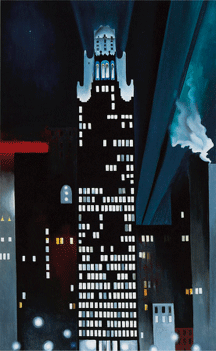
In the early 20th Century Georgia O’Keeffe often used views of New York City at night, from in and around the Shelton and Radiator Buildings:  city lights reflecting off of the buildings and up into the sky while echoing radiators and heat pipes rattling throughout the night.

magritte3
Geogia O’Keeffe
“The Radiator Building—Night, New York”
1927
Oil on canvas
121.9 cm x 76.2 cm
Fisk University Galleries
Nashville, Tennessee


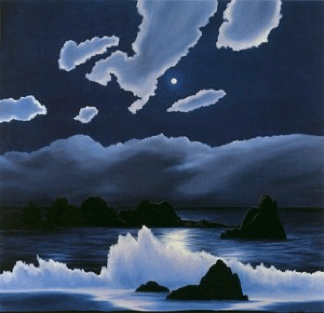
In 1968 Bob Dylan used this reference in the opening lines of one of his masterpieces, “Visions of Johanna.”  And later still the contemporary painter April Gornik used images of night in several of her hauntingly lyrical and monumental paintings.

magritte4
April Gornik
“Pulling Moon”
1983
Oil on canvas
76” x 80”
Courtesy of the artist.


“Ain’t it just like the night to play tricks when you’re tryin’ to be so quiet?
We sit here stranded, though we’re all doin’ our best to deny it
And Louise holds a handful of rain, temptin’ you to defy it
Lights flicker from the opposite loft
In this room the heat pipes just cough
The country music station plays soft
But there’s nothing, really nothing to turn off
Just Louise and her lover so entwined
And these visions of Johanna that conquer my mind”[ii]


[i] Pastan, Linda; Carnival Evening:  New and Selected Poems 1968-1998; W. W. Norton & Company; New York and London; 1998; p.5.

[ii] Dylan, Bob; “Visions of Johanna” from Writings and Drawings; Alfred A. Knopf, Inc.; New York, New York; 1973; pp. 207-208.

GIORGIO MORANDI AND THE TALKING ETERNITY BLUES

Amongst painters and printmakers, there is a great deal of admiration for the work of Giorgio Morandi.  Even from artists whose work does not necessarily look like a Morandi, there is still a genuine interest in and respect for this work and its subtle power.  Many artists often observe that he is a “painter’s painter” in the very best sense of these words.

morandi
Frank Gehry
“Winton Guest House”
1982-1987
Wayzata, Minnesota

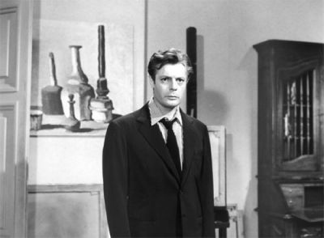
However, I was later surprised to discover that many other professions share this admiration, including several poets and even one contemporary architect, Frank Gehry, whose Winton Guest House echoes several Morandi still life forms.  And let us not forget the Italian surrealist filmmaker, Federico Fellini, and his references to Morandi’s work in the classic film “La Dolce Vita!”

morandi2
Federico Fellini
Film still from “La Dolce Vita”
1960
Featuring Marcello Mastroianni, Anita Ekberg, Anouk Aimee, et al.
Cineriz/Pathe Consortium Cinema

Earlier this year, on a visit with family and friends in Florida, I happened upon the Vero Beach Book Center hosting a reading by the Poet Laureate of Indian River County, Sean Sexton.  He also mentioned Morandi in several instances:  both his paintings and his etchings.  When I asked him about his interest in Morandi this is how he responded:

“The poem ‘Disparate’ lays out my visit to the Metropolitan Museum of Art to see the Morandi show . . . and observations from a noonday repast in the cafeteria, just a flight of stairs down out of the show. . . . The works collectively comprise something so completely outside convention and the sources that inspired them and succeed in what they present as a whole.”[i]

morandi3
Giorgio Morandi
“Still Life”
1956
Oil on canvas
Private Collection, Switzerland

“Disparate”
“The girls in the museum cafeteria titter in
pleasant gossip, coiffed and garbed alike
in gold, cashmere, and silk.  Each face keeps
the same joy in this holiday escape from dailiness,
as their secret society, founded upon commiseration,
excludes a Venus in synthetic leopard wrap the next
table over, her long, raven hair mussed as if
she’d just stepped from a baroque bedchamber.
She has nothing to say to them (nor do they ask),
but sits attending an old, blind Tobit and his
wife sipping water and taking a frugal repast.

Morandi’s lonely bottles hang in galleries upstairs,
paintings in lush pink butter and almond paste,
and the most exquisite greys in art.  On a wall placard
is a quote from his ending days:
“If only you knew Longhi, how badly I want to work,
I have so many ideas I wish to develop…”
In quiet and solitude he kept at his métier, sharing
the family apartment with his three unmarried sisters,
seeking only the recognition of his peers—the leering Chardin,
rag tied round his bespectacled head, stolid Piero, mercurial
Caravaggio, and the intractable, enraptured, Cezanne.”[ii]

morandi4
Jean Baptiste Simeon Chardin
“Self-Portrait with a Visor”
c. 1776
Pastel on blue laid paper, mounted on canvas
457mm x 374mm
The Art Institute of Chicago,
Chicago, Illinois

Several years ago at the Butler University Visiting Writers’ Series I heard the poet Charles Wright read from his work.  I was impressed with the range and depth of his work, and especially several of his remarks mentioning both Piet Mondrian and Giorgio Morandi, two of my own personal favorites.

Giorgio Morandi’s work is often difficult on many levels.  For first time viewers it is so simple, even mundane, that they wonder what is the big deal?  For the experienced viewer, they become more complicated, utilizing formal devices and placement to create subtle but powerful tensions.  And for others, perhaps only painters and poets, these pieces become mystical.

This is such a powerful element in his work, that in one recent five-year period (from 2004 to 2009) there were three major exhibitions in celebration of his work:  at both the Metropolitan Museum[iii] in New York, the one Sean Sexton mentioned above, and the Phillips Collection[iv] in Washington, DC, and a small but highly successful presentation at the Lucas Schoormans Gallery, also in New York.

In the catalogue for that exhibition, Schoormans wrote:  “At first glance, the works may appear quiet, contemplative, but once the viewer engages with them, one realizes that they are anything but.  Instead, it becomes apparent that they seem to affirm only one thing:  that nothing is certain, and permanently subject to change.  Embracing this message, Morandi presents the viewer with endless variations, at times with the subtlest of shifts in tonal values and composition, and thereby he becomes the architect of a world as finely calibrated and rigorously constructed as any great work of art, or perhaps a piece of music – think Bach’s Well Tempered Piano:  a monumental under-statement, of riveting and stimulating beauty that allows us a notion of the sublime.”[v]

“Giorgio Morandi and the talking eternity blues”
“Late April in January, seventy-some-odd degree.
The entry of Giorgio Morandi in The Appalachian Book of the Dead
Begins here, without text, without dates—
A photograph of the master contemplating four of his objects,
His glasses pushed high on his forehead,
his gaze replaced and pitiless.”

morandi5
Herbert List
“Portrait of Giorgio Morandi”
B&W photograph
1953
Collection of Herbert List Estate,
Hamburg, Germany

“The dove, in summer, coos sixty times a minute, one book says.
Hard to believe that,
even in this unseasonable heat,
A couple of them appearing and silent in the bare tree
Above me.
Giorgio Morandi doesn’t blink an eye
As sunlight showers like sulphur grains across his face.
There is an end to language.

There is an end to handing out the names of things,
Clouds moving south to north along the Alleghenies
And Blue Ridge, south to north on the wind.
Eternity, unsurprisingly, doesn’t give this a take,
Eternity’s comfortless, a rock and a hard ground.

Now starless, Madonnaless, Morandi
Seems oddly comforted by the lack of comforting,
A proper thing in its proper place,
Landscape subsumed, language subsumed,
the shadow of God
Liquid and indistinguishable.”[vi]

morandi6
Giorgio Morandi
“Still Life”
1953
Oil on canvas
8” x 15 7/8”
The Phillips Collection,
Washington, DC.


[i] Sexton, Sean; “An Artist’s Statement” contained in an e-mail to this writer, 10 March 2019, 9:36pm.

[ii] Sexton, Sean; May Darkness Restore; Press 53; Winston-Salem, North Carolina; 2019; p. 32.

[iii] Bandera, Maria Cristina, and Renato Miracco; Morandi 1890-1946; The Metropolitan Museum of Art and SKIRA; New York, New York, and Milano, Italy; 2008.

[iv] Fergonzi, Flavio, and Elisabetta Barisoni; Morandi:  Master of Modern Still Life; The Phillips Collection; Washington, DC; 2009

[v] Mattioli-Rossi, Laura; Giorgio Morandi Late Paintings 1950-1964; Lucas Schoormans Gallery; New York, New York; 2004; p. 3.

[vi] Wright, Charles; Negative Blue; Farrar, Straus and Giroux; New York, New York; 2000; p. 167.

A CARNIVAL EVENING

“Un soir de carnival” has always been for me one of the most enigmatic paintings produced by Henri Rousseau.  A seemingly typical moonlit landscape is inhabited by two figures, supposedly on their way to a costume ball.  Or are they lost in a forest?  And, are they unaware of the shadowy cabin in the background, with a ghostlike face staring out at this scene?

The majority of his other landscapes depict exotic and naïve scenes and situations that invite us in to his personal and fantastical world.  This painting, however, relies upon all of the same elements and yet it is disturbing.  The unfamiliar?  The threatening?  The dark and looming landscape?

“At intervals during his steady production of works that record the mutual attunement of landscape and the human figure, Rousseau painted canvases that surpass both landscape and portraiture.  All are large compositions in which a distinct feeling of awe and catastrophe has intensified his style without basically modifying it.  Their thematic content is uniform:  in either a totally barren or an unnaturally verdant countryside, a living creature confronts a mysterious presence.  Rousseau did not himself separate these paintings from the rest of his production, yet in them he contrives to express an almost undefinable experience.”[i]

This is how Roger Shattuck describes some of these qualities in Rousseau’s work, especially a handful of larger and more enigmatic paintings.  This feeling has not been lost on the poet Linda Pasten in her collection titled, Carnival Evening:  New and Selected Poems which includes several ekphrastic examples including:  “Le Sens de la Nuit, Magritte, 1927,” and “Still Life,” and a “Detail from the Altarpiece at Ghent.”

rousseau1
Henri Rousseau
“Carnival Evening”
1886
Oil on canvas
46 3/16” x 35 1/4”
Louis E. Stern Collection
Philadelphia Museum of Art


Carnival Evening
         Henri Rousseau, oil on canvas

“Despite the enormous evening sky
spreading over most of the canvas,
its moon no more
than a tarnished coin, dull and flat,
in a devalued currency;

despite the trees, so dark themselves,
stretching upward like supplicants,
utterly leafless; despite what could be
a face, rinsed of feeling, aimed
in their direction,

the two small figures
at the bottom of this picture glow
bravely in their carnival clothes,
as if the whole darkening world
were dimming its lights for a party.”[ii]


[i] Shattuck, Roger; The Banquet Years; Vintage Books, A Division of Random House; New York, New York; 1968; p. 91.

[ii] Pastan, Linda; Carnival Evening:  New and Selected Poems 1968-1998; W. W. Norton & Company; New York and London; 1998; p. 39.

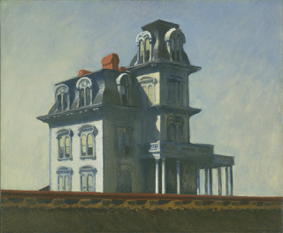
A HOUSE BY THE RAILROAD TRACKS

From the Sheldon Swope Art Museum in Terre Haute, Indiana to the Museum of the Art Institute of Chicago and from the Museum of Modern Art in New York across town to the Whitney Museum of American Art, we can discover several iconic images of American life, all produced by the same artist:  Edward Hopper.

Their sense of place and history not only documents an era in our national life, but also evokes the feel and texture of those years.  These images have intrigued and inspired a variety of American poets and painters including both Edward Hirsch and Phillip Koch.  They have also become iconic images that stand in for a much larger and more complex sense of our country:  rooftops and storefronts, bridges and lighthouses, and of course railroad tracks and isolation.

For Phillip Koch many of these images are reminders of his own childhood and studies in art school, especially in New York, Ohio, and Indiana.  Seeing and confronting Hopper’s paintings are one of the most important ways of learning, not only about them, but also about painting in general.

When I asked Phillip Koch about Hopper’s painting “House by the Railroad” this was his response:

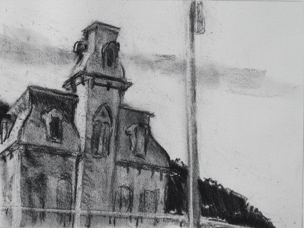
“I’ve loved that painting for years and in March of 2015 made a special trip up to Haverstraw, NY (just north of Hopper’s hometown of Nyack, NY) as I knew the building Hopper had worked from was still standing and little changed from his day. The house is high up on a hill overlooking the Hudson River. There is a railroad track just down the hill a bit from the house, and still farther down the hill a road where Hopper stood and envisioned his painting.”

tracks
Phillip Koch
“Haverstraw”
2015
Vine charcoal on paper
10 1/2” x 14”
Collection of the artist, Baltimore, Maryland

“This is Haverstraw, vine charcoal, 10 1/2 x 14 inches, 2015, that I did from nearly the exact same spot where Hopper stood to do his House by the Railroad.  I didn’t include the railroad tracks though they are still there and in use, just as in Hopper’s day. If you compare Hopper’s oil to my version, you can see Hopper felt free to invent some additional architectural features to make his structure more interesting (realist that he was, he loved to play around with his subjects and add and subtract forms at will.)”[i]

For the poet Edward Hirsch, Hopper’s paintings frame a mid-western sense of isolation:  spatial and psychological conditions.  Hirsch often personifies the typical American storefront, or an old house façade, giving them human expressions:  these are some of the classic human conditions that poets constantly deal with, playing with only light and shadow and words and rhythms in order to intensify and exaggerate a mythical presence.

What follows here, is Hirsch’s articulate and sensitive meditation on Edward Hopper’s great painting, “House by the Railroad” from 1925:

Edward Hopper and the House by the Railroad 

“Out here in the exact middle of the day,
This strange, gawky house has the expression
Of someone being stared at, someone holding
His breath underwater, hushed and expectant;

This house is ashamed of itself, ashamed
Of its fantastic mansard rooftop
And its pseudo-Gothic porch, ashamed
of its shoulders and large, awkward hands.

But the man behind the easel is relentless.
He is as brutal as sunlight, and believes
The house must have done something horrible
To the people who once lived here

Because now it is so desperately empty,
It must have done something to the sky
Because the sky, too, is utterly vacant
And devoid of meaning. There are no

Trees or shrubs anywhere—the house
Must have done something against the earth.
All that is present is a single pair of tracks
Straightening into the distance. No trains pass.

tracks2
Edward Hopper
“House by the Railroad”
1925
Oil on canvas
24” x 29”
(Anonymous Gift)
Museum of Modern Art, New York

Now the stranger returns to this place daily
Until the house begins to suspect
That the man, too, is desolate, desolate
And even ashamed. Soon the house starts

To stare frankly at the man. And somehow
The empty white canvas slowly takes on
The expression of someone who is unnerved,
Someone holding his breath underwater.

And then one day the man simply disappears.
He is a last afternoon shadow moving
Across the tracks, making its way
Through the vast, darkening fields.

This man will paint other abandoned mansions,
And faded cafeteria windows, and poorly lettered
Storefronts on the edges of small towns.
Always they will have this same expression,

The utterly naked look of someone
Being stared at, someone American and gawky.
Someone who is about to be left alone
Again, and can no longer stand it.”[ii]


[i] Koch, Philip; An artist’s statement contained in an e-mail correspondence with this writer; 19 November 2017.

[ii] Hirsch, Edward; “Edward Hopper and the House by the Railroad (1925)” Wild Gratitude; Alfred A. Knopf Publishers; New York, New York; 1986; pp. 13-14.

WHISPERS OF EDWARD HOPPER IN THE GALLERIES OF THE IMAGINARY MUSEUM

I first met Joseph Stanton in the Conference Rooms at the Algonquin Hotel in New York City in October of 2004 during a series of discussions related to both the fine and liberal arts.[i]  Speaking as both a poet and art historian, Stanton approached Edward Hopper’s work from a critical point of view, while not forgetting the narrative lyricism contained therein.

Stanton’s collection of poems titled “Imaginary Museum” is an excellent example of the ekphrastic tradition.  He has created a museum of sorts that includes several ‘wings’ housing the various collections.  Both, Eastern and Western cultures, as well as references to Pieter Brueghel and Edward Hopper are featured amongst the galleries of this museum.

hopper
Edward Hopper
“Approaching a City”
1946
Oil on canvas
27 1/8” x 36”
The Phillips Collection, Washington, DC.

Approaching a City                  

“The way into the city is a darkness
that opens to a shadowed underground.
There are thoughts we approach but do not express.

With so much ahead we try to think of less,
knowing how clocks will turn us round and round.
The way into the city is a darkness

that remembers what we cannot confess:
that shadows shape what our lives have found.
A thought we can approach but not express

suggests that the future must be a guess –
a lie we must pass through or go around.
Yet the city’s inclination to darkness

should come as no surprise and no distress.
The light that strikes against wall and ground
is a thought we approach without express

prospects for joy or grief or tenderness,
keeping in mind the sky’s pale-blue surround.
There is no way into the city’s darkness,
which we have approached but not expressed.”[ii]

There are many examples of ekphrastic writing that are inspired by, but not necessarily literal descriptions of works of art.  For example, many works by Agnes Martin have inspired writers over the years, however this is in a very general sense, and often not related to any one specific work.  On the other hand, Edward Hopper’s painting of the “Nighthawks” has been the source for a great deal of writing, very specifically.  So, I recently asked Joseph Stanton about this and about his personal writing process.  Here is his reply:

“To answer your question, I focus very intensely on specific artworks, but I do not force myself to write about them in any particular way. Often I spend many months looking at reproductions of artworks to which I would like to respond without writing much of anything.  Also, because I teach art history, I live with my thoughts about the artworks in multiple ways. My procedure in such a case is to read and/or reread everything I can find about the artworks and the artist . . . . Sometimes I come up with a poem, sometimes I don’t . . . . Most of the research of course does not end up in the poem; sometimes none of it does . . . . The excesses that do not end up in poems or articles are enrichments to my teaching. In my role as an art historian, no amount of information or reflection on artworks is wasted. It is all grist for the mill.”[iii]

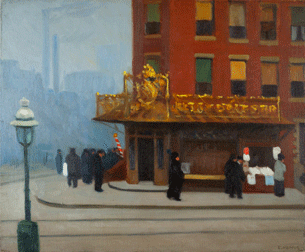
hopper1
Edward Hopper
“New York Corner, or Corner Saloon”
1913
Oil on canvas
24” x 29”
Cantor Arts Center, Stanford University
Stanford, California

New York Corner              

“This saloon faces
a murderous expanse
of intersection.
Let’s drink
to that.”[iv]

Above and below are selections from the Hopper Collection of the Imaginary Museum.  We will be saving the “Night Hawks” and “The House by the Railroad Tracks” amongst others for later installments.  These current examples are indeed a set of whispers, less popular works perhaps, but clearly ones where the voices of both the poet and the painter are coming into focus.

hopper2
Edward Hopper
“Drug Store”
1927
Oil on canvas
29” x 40”
Museum of Fine Arts, Boston, Massachusetts.

Drugstore                                 

“A drugstore window
in 1927:
jarred red light and blue
islanded in the silent street –
one war ahead, one war behind.”[v]

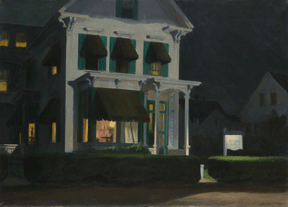
hopper3
Edward Hopper
“Rooms for Tourists”
1945
Oil on canvas
30 1/4” x 42 1/8”
Yale University Art gallery, New Haven, Connecticut

Rooms for Tourists                   

“Sometimes
all we need to know about
cozy, bright rooms is
that we have been
left outside.”[vi]

hopper4
Edward Hopper
“Cape Cod Evening”
1939
Oil on canvas
30 1/4” x 40 1/4”
National Gallery of Art, Washington, DC.

Cape Cod Evening                    

“The moment’s center
sees a dog poised in tall grass,
ears tuned to autumn’s
stiff breeze:  he sniffs bitter air
as if it were just weather.”[vii]

hopper5
Edward Hopper
“Solitude”
1944
Oil on canvas
32” x 50”
Private Collection

Solitude                             

“The sadness of horizon
is a matter of perspective,
the point being the vanishing
where lines converge
only because we see them to.

That vision is delusion
saves us from nothing.
Seeing’s myth
conceals a truth:

though there is no point
to vanishing,
we will all vanish anyway.”[viii]


[i] The Eighteenth Annual National Conference on Liberal Arts and the Education of Artists, sponsored by the School of Visual Arts in New York, New York.  The topic of Stanton’s paper was “Retrospection on a Gallery of Hopper Poems” and looked especially at Hopper’s paintings as narratives.  20-22 October 2004.

[ii] Stanton, Joseph; Imaginary Museum; Time Being Books; St. Louis, Missouri; 1999; p. 93.

[iii] Stanton, Joseph; An artist’s statement contained in an e-mail communication with this writer on 27 November 2018.

[iv] Stanton, Joseph; Imaginary Museum; p. 94.

[v] Stanton, Joseph; Imaginary Museum; p. 97.

[vi] Stanton, Joseph; Imaginary Museum; p. 107.

[vii] Stanton, Joseph; Imaginary Museum; p. 109.

[viii] Stanton, Joseph; Imaginary Museum; p. 110.

ART HISTORY, CHICAGO!

It was my first year of graduate school at Indiana University in Bloomington and there was a field trip from there up to visit the Art Institute of Chicago.  The major exhibition was a collection of Modern Masters from the Pushkin Museum of Fine Arts in Moscow, including Matisse’s painting of “Nasturtiums with Dance, II” from 1912.  It remains one of my all time favorites, even to this day.  However, what I was not totally prepared for was the extent of the permanent collection in Chicago.

So many pieces that I had read about in art history books and now saw in person:  from Corneille de Lyon and El Greco to Cezanne, Renoir, Manet and Monet, Georgia O’Keeffe and Alfred Stieglitz.  This experience brought back many memories, especially me youthful visits to the National Gallery of Art and the Baltimore Museum of Art.

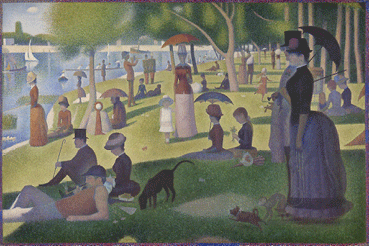
Recently in reading more about this work, and the work of contemporary poets, I came across this insightful piece by Thomas Lynch surveying this collection in Chicago.  It is like a walking and talking tour of the Impressionist wing of the Art Institute.

chicago
Georges Seurat’s
“Sunday Afternoon on the Island of La Grande Jatte”
1884-1886
Oil on canvas
81 3/4” x 121 1/4”
Museum of the Art Institute of Chicago


“Art History, Chicago”

“It’s not so much a Sunday Afternoon
on the Island of La Grande Jatte as the point
of order according to Seurat –-
that bits of light and color, oil paints
aligned in dots become the moment caught,
verbs slowed to a standstill, the life examined.
We step back wide-eyed for a better look:
an assemblage of Parisian suburbanites
in Sunday dress, top hats and parasols,
are there among the trees beside the river.
There are girls and women, men and dogs
in random attitudes of ease and leisure.
A stretch of beach, boats in the blue water,
a woman with a monkey on a leash,
a stiff man beside her, a mother and daughter,
that little faceless girl who seems to look at us.
And everyone is slightly overdressed except
for a boatman stretched out in the shade.
He smokes his pipe and waits for passengers.

chicago1
Gustave Caillebotte’s
“Paris Street, A Rainy Day”
1877
Oil on canvas,
83 1/2” x 108 3/4”
Museum of the Art Institute of Chicago


But I have never been to Paris.
I’ve never holidayed beside the Seine
nor strolled with a French girl in the gray morning
as in this Paris Street, A Rainy Day
Gustave Caillebotte’s earlier masterpiece
three galleries down in this collection.
So I do not know these cobblestones, this street,
this corner this couple seems intent on turning.
But I have walked with a woman arm in arm
holding an umbrella in a distant city,
and felt the moment quicken, yearning for
rainfall or a breeze off the river or
the glistening flesh of her body in water
the way this woman’s is about to be
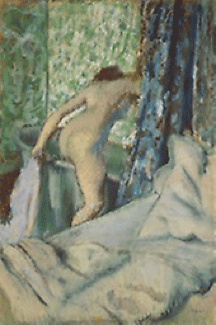
that Degas has painted in The Morning Bath.
She rises from her bed, removes her camisole
and steps into the tub a hundred years ago.

chicago2
Edgar Degas
“The Morning Bath”
1887-1890
Pastel on off-white laid paper mounted on board
706 x 433 mm
Museum of the Art Institute of Chicago

History’s a list of lovers and cities,
a mention of the weather, names and dates
of meetings in libraries and museums
of walks by the sea, or through a city,
late luncheons, long conversations, memories
of what happened or what didn’t happen.
But art is a brush of a body on your body,
the permanent impression that the flesh
retains of courtesies turned intimate;
the image and likeness, the record kept
of figures emergent in oil or water
by the river, in the rain or in the bath
when, luminous with love and its approval,
that face, which you hardly ever see,
turns its welcome towards you yet again.”[i]


[i] Lynch, Thomas; Still Life in Milford; W. W. Norton & Company; New York, New York; 1998; pp. 19-20.

STILL, THERE’S LIFE IN MILLFORD!

The artist Lester Johnson was born in Minneapolis, Minnesota in 1919 and died in Southampton, New York in 2010.  He studied at the Minneapolis School of Art and the Art Institute of Chicago.  He moved to New York City in 1947 and then to Milford, Connecticut in 1964 after accepting a teaching position at the Yale University School of Art and Architecture.  Although he remained a figurative painter, he did adopt many of the concerns and issues shared by the abstract expressionist artists of the time.

Johnson’s work is represented in the collections of the Baltimore Museum of Art and the Art Institute of Chicago; The Walker Art Center in Minneapolis, Minnesota; Yale University Art Gallery, New Haven, Connecticut; the Museum of Modern Art, the Whitney Museum of American Art and the Guggenheim Museum in New York; and the Hirshhorn Museum and Sculpture Garden and the Smithsonian American Art Museum in Washington, DC.

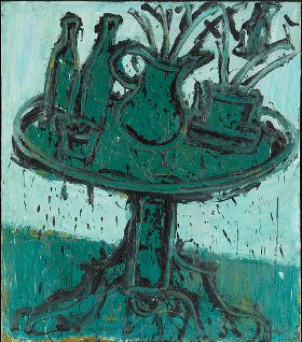
millford
LESTER JOHNSON
“Millford Still Life”
1965
Oil on canvas
48” x 42”
Harvard Museums/Fogg Museum of Art
Cambridge, Massachusetts


Thomas Lynch was born in 1948 in Detroit, Michigan.  He attended the Brother Rice High School in Bloomfield Hills, Michigan and later attended university and mortuary school, from which he graduated in 1973.  He took over his father’s funeral business in Milford, Michigan in 1974.

He has held teaching positions at Wayne State University in Detroit, the Creative Writing Program at the University of Michigan in Ann Arbor, and the Candler School of Theology, Emory University in Atlanta, Georgia.

Thomas Lynch’s poems and stories have appeared in The Atlantic, the New York Times and the Times of London, the New Yorker, Poetry, the Paris Review, the Los Angeles Times, the Irish Times, Esquire, Newsweek and the Washington Post.

His writing draws upon autobiographical incidents, memories and other elements of daily life.  Focusing on many of those experiences from his life outside of the literary world and on the routines of small town life in Michigan, he often transforms a local detail into a universal symbol.

Thomas Lynch still lives and works in Milford, Michigan, where he is the Funeral Director.

This is confusing, as one lives in Milford, Michigan and the other lived in Milford, Connecticut, and when they write or paint about a ‘still life in Millford’ I still don’t quite know where I am.

The paintings are in collections in both Ann Arbor, Michigan and Cambridge, Massachusetts, while the objects depicted could be from anywhere, any small town junk shop or flea market.  The poetic structures are strict, but with variations.  As are the still lives.

Johnson arranges everyday objects in each composition, incorporating expressionist paint handling while maintaining figurative content.  Lynch employs a strict eight line form – ten to twelve syllable beats to each line – but then varies the last line to surprising rhythms, wording and imagery.


Still Life in Milford—Oil on Canvas by Lester Johnson”

“You’re lucky to live in a town like this
with art museums and Indian food
and movie houses showing foreign films
and grad students and comely undergrads.
Years back I’d often make a half-hour trip.
It was good for my creative juices
to browse the holy books at Shaman Drum.
Still, life in Milford isn’t all that bad.

We have two trendy restaurants and a bar
well known by locals for its Coney dogs.
We have a bookshop now.  We even have
a rush hour, art fairs and bon vivants.
And a classic car show every October—
mostly muscle cars—Dodges, Chevys, Fords.
No psychic healers yet or homeopaths.
Still, life in Milford has a certain ambiance,

more Wyeth than Picasso, to be sure,
more meatloaf and potatoes than dim-sum.  Fact is,
at first I thought this Lester Johnson was
a shirttail cousin of the Johnson brothers—
long-standing members of the Chamber of Commerce
in Milford, Michigan, like me.  In fact
his only connection to these parts was
Still Life in Milford, gathering dust here

in the basement of the art museum.
His own Milford’s somewhere back east, near Yale—
the day job, teaching, he could never quit
the way that Robert Frost taught English here
and Donald Hall before the muse in them
escaped their offices in Angell Hall.
They were last seen running and maybe running still.
Life in Milford, Michigan, is similar.”

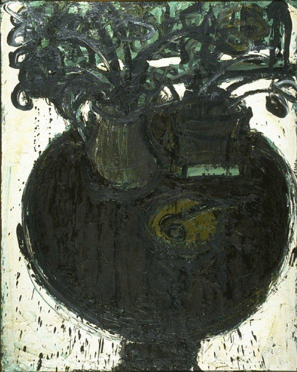
millford2
LESTER JOHNSON
“Millford Still Life”
1965
Oil on canvas
44 5/16” x 36”
University of Michigan, Museum of Art
Ann Arbor, Michigan

“I have steady work, a circle of friends
and lunch on Thursdays with the Rotary.
I have a wife, unspeakably beautiful,
a daughter and three sons, a cat, a car,
good credit, taxes and mortgage payments
and certain duties here.  Notably,
when folks get horizontal, breathless, still:
life in Milford ends.  They call.  I send a car.

Between the obsequies I play with words.
I count the sounds and syllables and rhymes.
I try to give it shape and sense, like so:
eight stanzas of eight lines apiece, let’s say
ten syllables per line or twelve.  Just words.
And if rhyming’s out of fashion, I fashion rhymes
that keep their distance, fours lines apart, like so.
Still, life in Milford keeps repeating.  Say

I’m just like Lester, just like Frost and Hall:
I covet the moment in which nothing moves
and crave the life free of life’s distractions.
A bucket of flowers on a table.
A vase to arrange the flowers in.  A small
pipe—is it?—smoldering in an ashtray to
suggest the artist and impending action.
Still Life in Milford seems a parable

on the human hunger for creation.
The flowers move from bucket to vase
like moving words at random into song—
the act of ordering is all the same—
the ordinary becomes a celebration.
Whether paper, canvas, ink or oil paints,
once finished we achieve a peace we call
Still Life in Milford.  Then we sign our names.”[i]


[i] Lynch, Thomas; Still Life in Milford; W. W. Norton & Company; New York, New York; 1998; pp. 134-136.

PATRICIA CLARK AND THE PAINTERS

In the ekphrastic tradition, painting and poetry are considered as parallel disciplines:  incorporating imagery and metaphor while combining imagination and transformation.  Differing in the use of line and color in one and words and rhythms in the other.  Each begins with the mimetic element and usually moves into the semiotic.  Literal descriptions of the world around us are then used to create a new meaning or vision.

When I first heard Patricia Clark’s poem, inspired by a Claude Monet painting, it was while attending her reading sponsored by the Kellogg Writers Series at the University of Indianapolis in September 2013.  She also mentioned to the students there, that there were artists in the audience and that she wanted to put in a word or two regarding the ekphrastic tradition.  Although an ancient tradition, it is also an obscure one to the average reader.  Students in the audience may have been hearing about this for the first time.

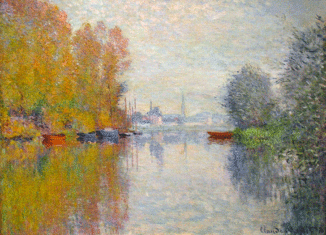
clark1
Claude Monet
“Autumn on the Seine, Argenteuil”
1873
Oil on canvas
21 3/8” x 28 7/8”
High Museum of Art
Atlanta, Georgia


Autumn on the Seine, Argenteuil

“Two banks, one golden, one green,
and in the center, the town
ahead, with a spire needling up,
a puncture into clouds,
and vague suggestions
of industry—buildings, smoke, and noise.

What I love along the bank are the skiffs
drawn up, five or more
at the golden side, the first boat
a bright russet like a horizontal flame
on water,
the next two mauve, one a sailboat,
one not.

The ochre-gold spills down from the cottonwoods,
pouring under the hulls,
entering the river with the same
intensity of burning
we see in life at its peak,
or life with the flame
threatening to go out.

In a month the trees will be masts
bare as the boats,
the man we know, ill with a fatal brain tumor,
will be gone—the Grand River
burnished with ochre and red
as the Seine is,
cooling air hinting at winter’s knives.

One bank green in the painting,
green going away,
and the river placid, calm—
in the center of it—
the flowing never ceasing, rhythm of moon,
sun, the turning earth, pulling it outward,
eternal, restless, to the maw of the sea.”[i]

One important element in Patricia Clark’s work is that she starts with a description or a reflection on the painting, but then goes beyond into our current time and place, commenting upon her own life events and keeping the imagery relevant and alive.

In many poems Clark has used certain relationships as an extension of the original idea.  A color or texture will often spark an image of a loved one:  the death of her mother, a remembering of her sister and the friends who travel along the Grand River in the state of Michigan.

In a recent conversation, I asked her specifically about the Monet painting and a second one by Wolf Kahn, and the general process that she uses.  This was her response:

“What I usually do is surround myself in my little studio hut with some images I feel drawn to. I’m not really looking for something — it’s a combination for me of color, image, atmosphere, who knows? I also don’t put too much pressure on, like ‘you must write about this painting!’ I wait & see if it speaks to me. Often that has happened. The Monet one, ‘Autumn on the Seine’ just grabbed me one day & I started . . . by just describing what I see — but then quickly one’s own concerns get woven in there somehow, inevitably. . . .”

“For awhile . . . after my mother’s passing, I wrote about her and just would let that happen, too, rather than forbidding any more ‘mother’ poems.”[ii]

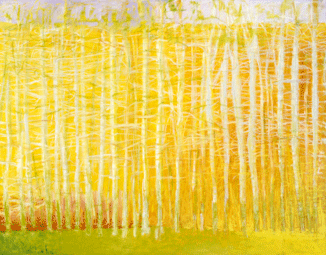
clark2
Wolf Kahn
“Frontal View of Trees”
2016
Oil on canvas
52” x 60”
Courtesy: Ameringer McEnery Yohe
New York, New York

Frontal View of Trees
                  (after Wolf Kahn)

“I like it when the trunks
of the birches
take up earth’s
mantis green,
that’s what she would do—
appropriate the ground,
by sinking in.

She troubles me, my mother
who didn’t die
comforted, at home.
Our bodies point to fates
we live but cannot decipher.
The sun offers
its warming touch.

Souls of the dead, thin
presences and pale—
yet their spirits
have turned to light—
glow of cumin, cinnamon ruddy
in the corner
of the canvas.

To misread means to author
your own text—
in truth, the trunks
wear flood marks, mud
floating high in water left
the smear.
She fell down.

Smack of the ground’s kiss,
that broke
her nose.  The doctor said,
dead before she hit the ground.
Linked once, she and I severed now
and who will be
at my side when I go?

The birches make a grove
collecting light—
she wore a verve
for  living, cloak
of many colors.”[iii]


[i] Clark, Patricia; Sunday rising; Michigan State University Press; East Lansing, Michigan; 2013; pp. 5-6.

[ii] Clark, Patricia; An explanatory statement on process as contained in an e-mail communication with this writer, 24 January 2018.

[iii] Clark, Patricia; The Canopy; Terrapin Books; West Caldwell, New Jersey; 2017; pp. 8-9.

A NUDE DESCENDING THE STAIRS

“Why?  Only because she had walked naked into my life?  In a painting?”[i]

“You came here so you could finally understand modern art?”[ii]  Who knows how many times this question has been asked, and inadequately answered?  Beginning with the Impressionists and Post-Impressionists and continuing into our current time, now including the Modernists and Post-Modernists.  These questions involving the definition of modern art come up several times in this story that revolves around a young nude woman who is portrayed as she comes down a staircase in a modern painting.

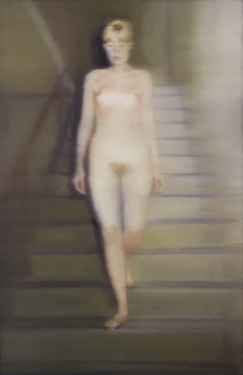
In his recent novel The Woman on the Stairs the writer Bernhard Schlink draws inspiration from a Gerhardt Richter painting for a story involving the interrelationships amongst an art patron and his wife, an artist and his mistress, and a young lawyer who is caught in the middle of all of this.  Threats of lawsuits are flying back and forth.  Discussions and negotiations are being held regarding the conservation of this modern masterpiece.  And, the lawyer has fallen in love with a nude woman descending a staircase.  I am not sure if there is a post-modern dilemma effecting the legal profession nowadays, but this situation certainly highlights that dilemma in the contemporary art world.

The industrial revolution brought with it the production of a new range of synthetic pigments for artists.  Scientific discoveries and theories brought to our attention how reality is made up of smaller and smaller elements and particles.  And photography brought a new interest in capturing the realistic moment.  Although many writers have proposed that photography also destroyed the need for painting, the final result was to free it, allowing painting to explore new paths of expression, no longer confined by realism and the mimetic.

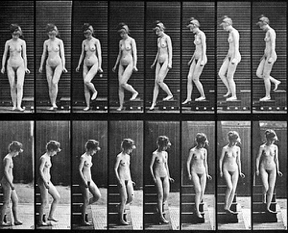
One important historic example was the work of the photographer Eadweard Muybridge and his experiments in capturing a variety of figures and animals in motion.  For example, his photographs of horses in motion proved once and for all that artists of the past had never correctly depicted the action of galloping horses.

nude
Eadward Muybridge
“Woman descending a staircase, sequence”
1887
Collotype on paper
7 3/4” x 14 13/16”
University of Pennsylvania Archives
Philadelphia, Pennsylvania

Muybridge’s studies of human figures walking, running, climbing and descending stairs also brought new light on these particular movements.  When Duchamp’s “Nude Descending the Staircase” was shown at the Armory Show in 1913 in the United States it of course created a stir as well as achieving unbelievable success.  In interviews afterwards, Duchamp stated how he had been directly influenced by Muybridge’s earlier work.[iii]

nude2
Marcel Duchamp
“Nude Descending a Staircase, No. 2”
1912
Oil on canvas
57 7/8” x 35 1/8”
The Louise and Walter Arensberg Collection
Philadelphia Museum of Art

For the author Bernhard Schlink, various discussions and descriptions of this painting advance the story line of his novel.  They become a series of ekphrastic exercises, deftly woven into the development of the story.

In talking about the German painter Karl Schwind’s painting of the “Woman on Staircase” the model Irene Gundlach mentioned that:  “It was an answer to Marcel Duchamp.  Do you know Nude Descending a Staircase?  A cubist figure, breaking up in the moments of descent, a vortex of legs, ass, arms and heads?  Duchamp’s work was talked about as the end of painting, and Schwind wanted to show that a naked woman descending a staircase could still be painted.”[iv]

Further on she explained that:  “He wanted to keep the pictures he felt defined him as an artist.  That spoke to issues in contemporary painting:  what representation and abstraction can offer, their relationship to photography, how beauty and truth interact.”[v]

At one point, the lawyer remembered:  “I went into a bookshop, and asked for everything they had on Karl Schwind.  A few years before, the Frankfort Art Association had organized an exhibition and published a slim catalogue – that was all they had.  I know nothing about art and couldn’t judge if the paintings were good or bad.  There were pictures of waves, of skies and

nude3
Gerhardt Richter
“Ema (Nude on a Staircase)”
1966
Oil on canvas
200 cm x 130 cm
Museum Ludwig, Cologne, Germany

clouds, of trees; the colours were beautiful, and everything was blurry, the way I see the world when I’m not wearing my glasses.  Familiar, yet distanced.  The catalogue listed the galleries that had exhibited Schwind and the awards he had won.  He didn’t appear to be a failure as an artist, bet he wasn’t established either – up-and-coming, perhaps.”[vi]

And finally, as the patron Peter Gundlach was speaking, he “ . . . told us about the article in the New York Times and the reports that followed in the German media.  The painting, Woman on Staircase, a fixture in Schwind catalogues, but never exhibited, about which Schwind had always been evasive, had a mysterious aura, and its sudden appearance in, of all places, the Art Gallery of New South Wales was a sensation.”[vii]

“Then he laughed.  ‘In any case, you had a good eye, better than mine.  If I had suspected that the painting would one day be worth more than twenty million . . . .’”[viii]


[i] Schlink, Bernhard; The Woman on the Stairs; Pantheon Books; New York, New York; 2016; p. 98.

[ii] Schlink, Bernhard; The Woman on the Stairs; p.85.

[iii] Ramirez, Juan Antonio; Duchamp:  love and death, even; Reaktion Books; London, United Kingdom; 1998; pp. 257-258.

[iv] Schlink, Bernhard; The Woman on the Stairs; p. 85.

[v] Schlink, Bernhard; The Woman on the Stairs; p. 85.

[vi] Schlink, Bernhard; The Woman on the Stairs; p. 14.

[vii] Schlink, Bernhard; The Woman on the Stairs; p. 116.

[viii] Schlink, Bernhard; The Woman on the Stairs; p. 113.