VERMEER AND THE HALF-FINISHED HEAVEN

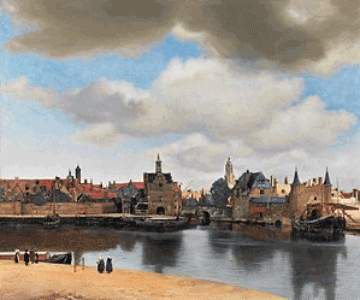
So many wars, the Eighty Years War and the Franco-Dutch War among them. During a peaceful interlude a pet goldfinch was waiting patiently to be painted. Later, the explosion of the powder magazine in Delft and the death of Carel Fabritius. And that beautiful spot of yellow on the rooftops of the city of Delft, as well as the nearby shadows on the Oude Kerk and the light on the Nieuwe Kerk in the “View of Delft.” The Nieuwe Kerk where Johannes Vermeer was baptized and the resting place for William of Orange.
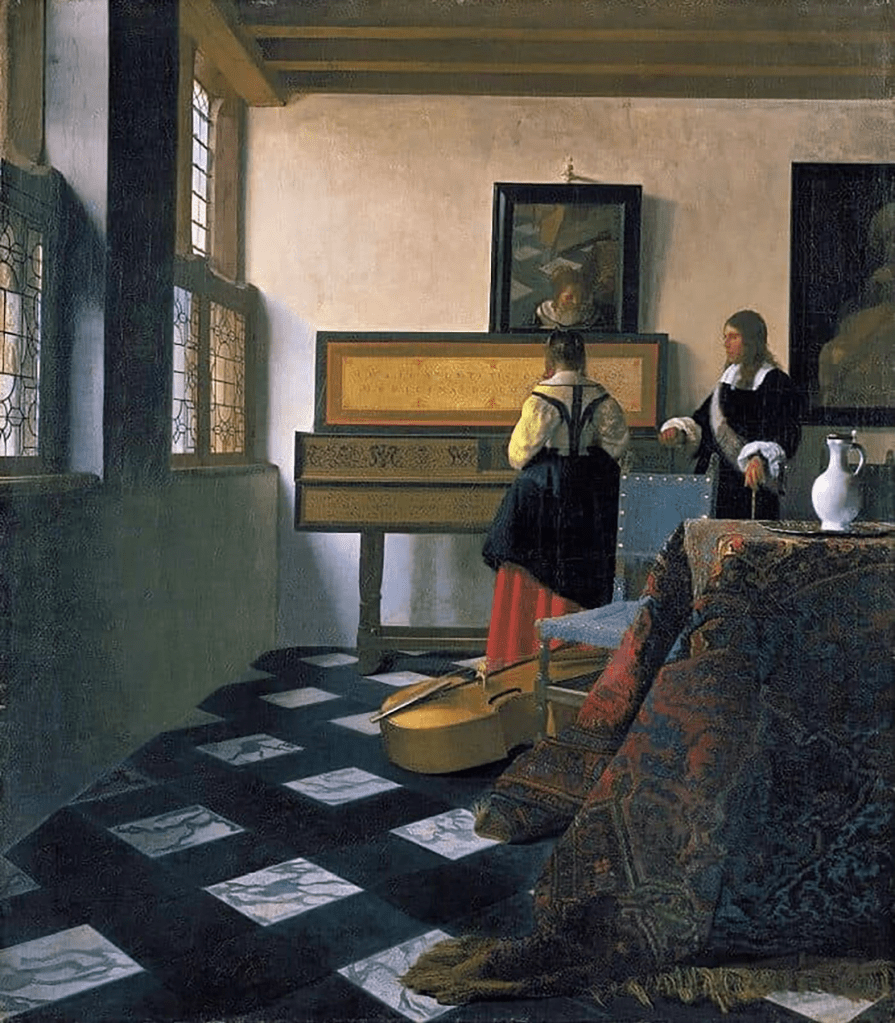
Johannes Vermeer
“The Music Lesson”
1662-1664
Oil on canvas
73.3cm x 64.5cm
The Royal Collection
London, United Kingdom

Such an important poet in his own right, Robert Bly was also a significant translator of the work of other poets. He published for the first time, many European and South American poets, and his translations range from Goethe, Hölderlin, Kabir, Rilke, Rumi, Ghalib and now to Tomas Tranströmer.

In his introduction to this translation of Tranströmer’s work, Bly mentions, a couple of times “. . . something approaching over a border. . . .”1 or “. . . the noise begins over there, on the other side of the wall. . . .”2 A kind of literary searching, I think, as both a poet and translator. Something beyond, but something that we cannot exactly put our finger on, in order to break through, either a border or a wall.

Vermeer

“It’s not a sheltered world. The noise begins over there, on the
other side of the wall
where the alehouse is
with its laughter and quarrels, its rows of teeth, its tears, its
chiming of clocks,
and the psychotic brother-in-law, the murderer, in whose
presence everyone feels fear.

The huge explosion and the emergency crew arriving late,
boats showing off on the canals, money slipping down into
pockets—the wrong man’s—
ultimatum piled on ultimatum,
wide-mouthed red flowers whose sweat reminds us of
approaching war.

And then straight through the wall—from there—straight into
the airy studio
and the seconds that have got permission to live for centuries.
Paintings that chose the name: The Music Lesson
or A Woman in Blue Reading a Letter.
She is eight months pregnant, two hearts beating inside her.
The wall behind her holds a crinkly map of Terra Incognito.

Just create. An unidentifiable blue fabric has been tacked to
the chairs.
Gold-headed tacks flew in with astronomical speed
and stopped smack there
as if they had always been stillness and nothing else.

The ears experience a buzz, perhaps it’s depth or perhaps
height.
It’s the pressure from the other side of the wall,
the pressure that makes each fact float
and makes the brushstroke firm.

Passing through walls hurts human beings, they get sick from
it,
but we have no choice.
It’s all one world. Now to the walls.
The walls are a part of you.
One either knows that, or one doesn’t; but it’s the same for
everyone
except for small children. There aren’t any walls for them.

The airy sky has taken its place leaning against the wall.
It is like a prayer to what is empty.
And what is empty turns its face to us
and whispers:
‘I am not empty, I am open.’”3

Johannes Vermeer
“Woman in Blue Reading a Letter”
1662-1664
Oil on canvas
46.5cm x 39cm
Rijksmuseum,
Amsterdam, The Netherlands

Later in life Tomas Tranströmer suffered a stroke that left his right side paralyzed, leading to difficulties in both writing and his piano playing. Several of his friends and colleagues, musicians and composers, set about composing piano pieces to be played only by the left hand, and sent them directly to him.4

Tranströmer’s imagery is so clear that we believe in its reality and in his imagination. As when he drew out a piano key-board on the kitchen tabletop in order to silently practice his music: “I played on them, without a sound. Neighbors came by to listen!”5


1 Tranströmer, Tomas; Translated by Robert Bly; The Half-Finished Heaven; Graywolf Press; Saint Paul, Minnesota; 2001; p. xviii.

2 Tranströmer, Tomas; Translated by Robert Bly; The Half-Finished Heaven; Graywolf Press; Saint Paul, Minnesota; 2001; p. xviii.

3 Tranströmer, Tomas; Translated by Robert Bly; The Half-Finished Heaven; Graywolf Press; Saint Paul, Minnesota; 2001; pp. 87-88.

4 Tranströmer, Tomas; Translated by Robert Bly; The Half-Finished Heaven; Graywolf Press; Saint Paul, Minnesota; 2001; p. xxi.

5 Tranströmer, Tomas; Translated by Robert Bly; The Half-Finished Heaven; Graywolf Press; Saint Paul, Minnesota; 2001; p. xx.

WISLAWA SZYMBORSKA: THREE POEMS

In the conclusion of his book, Vermeer in Bosnia, Lawrence Weschler writes about two of Wislawa Szymborska’s poems: “In Praise of Dreams” from 1986, and “Maybe All This” from 1993. From the first poem he notes that Szymborska wrote: “In my dream . . . I paint like Vermeer of Delft.” And in the second one, he speculates: “. . . the picture Szymborska’s words have in mind must be something very like Vermeer’s Lacemaker. How marvelously, at any rate, the poem helps elucidate the painting, and vice versa.”1 To my mind, this is one of the most important functions of the ekphrastic tradition.

In her collected work, Wislawa Szymborska provides us with several examples of this tradition. One especially is a diminutive poem, of only six lines describing a diminutive painting of a milkmaid by Vermeer. When this was written, the author was surely reflecting upon earlier wars and invasions in Europe, especially in her homeland of Poland. Today however, it has taken on a new and timely meaning related to the Ukraine.2

In earlier work, Szymborska takes a more generalized view through a museum, taking note of certain historic objects: an antique plate, a necklace, gloves and shoes, swords, and even a lute. She alludes to the scene without illustrating it.

In another poem she doesn’t literally show the ‘Tower of Babel’ as it was painted by Pieter Brueghel, but she does set up a dialogue between two of its inhabitants. There are two different type faces printed throughout this conversation: Italic for the first one, and ROMAN for the second. Although they are both placed together on the ensuing lines, they clearly do not communicate in any logical way. The speaking in different languages and at cross purposes has begun.3

In several other poems however, Szymborska takes a cue directly from the works of art. These include an ancient Greek sculptural fragment, and paintings by both Pieter Brueghel and Johannes Vermeer.

BRUEGHEL’S TWO MONKEYS

“This is what I see in my dreams about final exams:
two monkeys, chained to the floor, sit on the windowsill,
the sky behind them flutters,
the sea is taking its bath.

The exam is History of Mankind.
I stammer and hedge.

One monkey stares and listens with mocking disdain,
the other seems to be dreaming away—
but when it’s clear I don’t know what to say
he prompts me with a gentle

clinching of his chain.”4

Pieter Brueghel
“Two Monkeys”
1562
Oil on wooden panel
20cm x 23cm
Gemaldegalerie, Berlin, Germany

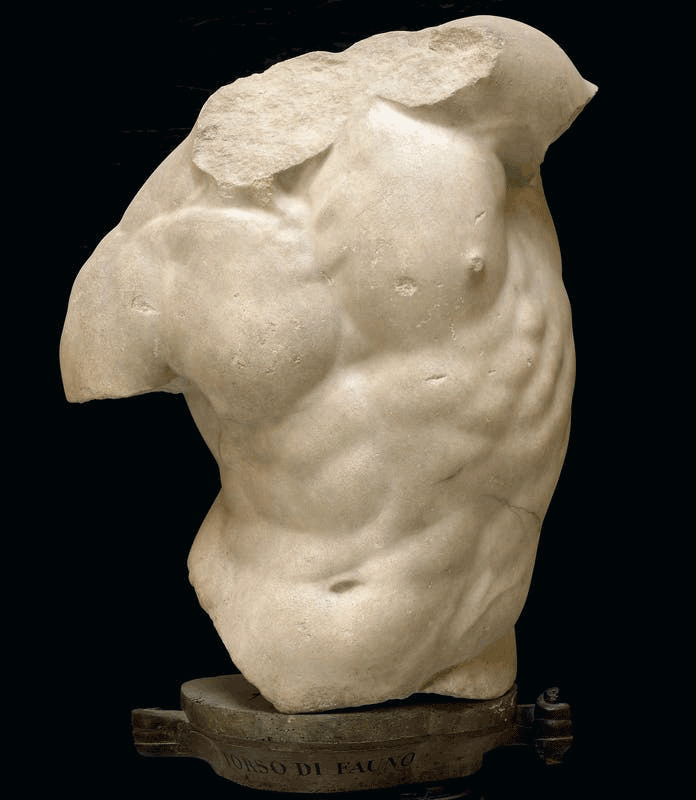
GREEK STATUE

“With the help of people and the other elements
time hasn’t done a bad job on it.
It first removed the nose, then the genitalia,
next, one by one, the toes and fingers,
over the years the arms, one after the other,
the left thigh, the right,
the shoulders, hips, head, and buttocks,
and whatever dropped off has since fallen to pieces,
to rubble, to gravel, to sand.

When someone living dies that way
blood flows at every blow.

But marble statues die white
and not always completely.

From the one under discussion only the torso lingers
and it’s like a breath held with great effort,
since now it must
draw
to itself
all the grace and gravity of what was lost.

And it does,
for now it does,
it does and it dazzles,
it dazzles and endures—

Time likewise merits some applause here,
since it stopped work early,
and left some for later.”5

“The Gaddi Torso”
1st Century BC.
Marble
84cm high
The Uffizi Galleries, Florence, Italy

Perhaps works of art actually do survive, in one way or another, in one form or another, in order to remind us of what is important. They need not follow the dictates of ‘socialist realism’ nor the fashions of ‘post-modernism’ and so many other contemporary isms. What we end up experiencing is the persistence of each artist, their story and how they want to tell it, even if it ends up being only a fragment, or a whisper. The artist’s voice, carried through even in a fragment, is an antidote to the craziness of our world during these times.

Johannes Vermeer
“The Milkmaid”
1658-1660
Oil on canvas
17 7/8” x 16”
Rijksmuseum, Amsterdam,
The Netherlands.

VERMEER

“As long as that woman from the Rijksmuseum
in painted silence and concentration
keeps pouring milk day after day
from the jug to the bowl
the World hasn’t earned
the world’s end.”6


1 Weschler, Lawrence; Vermeer in Bosnia; Vintage Books, A Division of Random House, Inc.; New York, New York; 2004; p. 403.

2 Szymborska, Wiesława; Poems New and Collected 1957-1997; (Translated by Clare Cavanagh and Stanisław Baranczak); Harcourt Brace & Company; New York, San Diego, London; 1998; p. 30.

3 Szymborska, Wiesława; Poems New and Collected 1957-1997; (Translated by Clare Cavanagh and Stanisław Baranczak); Harcourt Brace & Company; New York, San Diego, London; 1998; p. 57.

4 Szymborska, Wiesława; Poems New and Collected 1957-1997; (Translated by Clare Cavanagh and Stanisław Baranczak); Harcourt Brace & Company; New York, San Diego, London; 1998; p. 15.

5 Szymborska, Wisława; Here; (Translated by Clare Cavanagh and Stanisław Baranczak); Houghton Mifflin Harcourt; Boston, New York; 2010; p. 77.

6 Szymborska, Wisława; Here; (Translated by Clare Cavanagh and Stanisław Baranczak); Houghton Mifflin Harcourt; Boston, New York; 2010; p. 55.

A VIEW OF DELFT

Much of the mystery surrounding the life of Johannes Vermeer begins with the Arnold Bon poem written in eulogy after the death of Carel Fabritius, who was killed as a result of the explosion of the gunpowder magazine in Delft on 12 October 1654. 

Carel Fabritius
“A View of Delft, With a Guitar Sellers Stall” 
1652
Oil on canvas
15.5 cm x 31.7 cm
National Gallery, London

All of the stanzas of Arnold Bon’s poem recall the life and accomplishments of Fabritius, who at the time was the most eminent painter in Delft.  However, the last stanza mentions a younger artist, a Vermeer, who rises like a phoenix following this tragedy. 

Bon, Arnold; Last Stanza of the Eulogy Poem for Carel Fabritius; Published by Dirck van Bleyswijck; Delft, The Netherlands; 1667; p. 854.

“Thus did this Phoenix, to our loss, expire,
In the midstand at the height of his powers,
But happily there arose out of the fire
VERMEER, who masterfully trod in his path.”[i]

Aside from this single mention, very little had been written about Vermeer for many of the decades that followed.  Almost two hundred years later the art historian, critic, and connoisseur Théophile Thoré-Bürger was carrying out a survey of European museums and private collections.  In several cases, he recognized a different hand and eye amongst these paintings.  None of them, he felt, could still be attributed to artists such as Carel Fabritius or Pieter de Hooch.  Nor could they have come from the school of Rembrandt.  In an essay from 1866, not knowing at that time who this artist might be, Thoré-Bürger referred to Vermeer as the Sphinx of Delft.  As Thoré-Bürger continued his research this artist’s identity became clearer, and many artists and authors started taking notice. 

“…like the patch of yellow wall painted with so much skill and refinement by an artist destined to be for ever unknown and barely identified under the name Vermeer.”[ii]

Vermeer’s paintings have often played an important role in historic pieces of literature, recent fiction and popular novels.  During the summer of 1921 the Galerie Nationale du Jeu de Paume in Paris collected and arranged several examples of Dutch painting for a loan exhibition from The Hague that included two Vermeer paintings:  “The Girl with the Pearl Earring” and “A View of Delft. 

It was in a setting at this exhibition that Proust situated his character, the novelist Bergotte, directly in front of the View of Delft:  “He repeated to himself:  ‘Little patch of yellow wall, with a sloping roof, little patch of yellow wall.’  Meanwhile he sank down on to a circular settee; whereupon he suddenly ceased to think that his life was in jeopardy and, reverting to his natural optimism, told himself:  ‘It’s nothing, merely a touch of indigestion….’ A fresh attack struck him down; he rolled from the settee to the floor, as visitors and attendants come hurrying to his assistance.  He was dead.”[iii]

In more recent times, the author Jane Jelley traces many ideas covering Vermeer paintings, producing a series of art historical essays written as if they were prose poems. They bring a refreshing vision and description to these works.

“No reproduction of the View of Delft does justice to this masterpiece.  If you are lucky enough ever to stand in front of this painting in the Mauritshuits in The Hague, you are likely to find its effects as compelling as do many other visitors.  They have also turned their backs on one of the most famous pictures in the world, to follow the gaze of the Girl with a Pearl Earring.  She is actually not looking at us after all, but at the town in which she was born, the town in which she was painted.  Together we see straight into a tranquil, newly-washed, early summer morning in Delft 1663; as if through a window in the wall.”[iv]

Johannes Vermeer
“A View of Delft”
1660-1661
Oil on canvas
96.5 cm x 115.7 cm
Mauritshuis, The Hague
The Netherlands

Jane Jelley’s writing also recognizes the pure plastic qualities of painting; those elements that are especially important when viewing a painting close up, with very little distance between the eye of the viewer and the surface of the painting.  These are qualities that apply equally to Vermeer as well as to de Kooning.

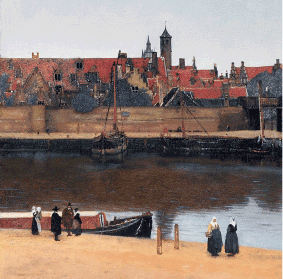
“Like flies in amber, stray brush-hairs have been caught in the paint in some of Vermeer’s paintings.  There are some on the surface of the View of Delft ‘used to finish the painted reflections of the buildings in the water’. . . . and conservators wondered whether Vermeer had used old or poor quality brushes; or whether these had shed hair because of the way they were made.”[v]  

Johannes Vermeer
“A View of Delft (detail)”

“Whatever its thickness, a good brush should balance in the hand like a violin bow.  An experienced painter will feel the weight of the handle; and judge where he should hold it, and how he should move his arm.  He can use the force from a turn of a wrist, or the pressure of a finger, to change the direction, depth, and speed of the stroke, as he feels the response of the thicknesses and texture of the paint against the canvas.  The brush movement is as much a part of the painting as the colour, tone, or composition; and in some canvases, especially from the twentieth century onwards, becomes the subject of the picture itself.”[vi] 

The ultimate example with regards to this writing is in volume five of A la recherche du temps perdu, by Marcel Proust.  The novelist Bergotte dies in a gallery, at an exhibition of Dutch paintings, in front of the “View of Delft.” He fixes his last living look on that picture, homing in on several details that had been pointed out by a critic in the newspaper:

“At last he came to the Vermeer, which he remembered as more striking, more different from anything else he knew, but in which, thanks to the critic’s article, he noticed for the first time some small figures in blue, that the sand was pink, and, finally, the precious substance of the tiny patch of yellow wall….”

Johannes Vermeer
“A View of Delft (detail)”

“…His dizziness increased; he fixed his gaze, like a child upon a yellow butterfly that it wants to catch, on the precious little patch of wall. ‘That’s how I ought to have written,’ he said. ‘My last books are too dry, I ought to have gone over them with a few layers of colour, made my language precious in itself, like this little patch of yellow wall….’ He repeated to himself:  ‘Little patch of yellow wall, with a sloping roof, little patch of yellow wall.’”[vii]

Johannes Vermeer
“A View of Delft (detail)”

It was not, however, the character Bergotte, but Proust himself who managed the final word on the View of Delft.  Vermeer was a special favorite of Proust, and in an interview late in his life, Marcel Proust made this observation:  “Ever since I saw the View of Delft in the museum in The Hague, I have known that I had seen the most beautiful painting in the world.”[viii]


[i] Bon, Arnold; Last Stanza of the Eulogy Poem for Carel Fabritius; Published by Dirck van Bleyswijck; Delft, The Netherlands; 1667; p. 854.

[ii] Proust, Marcel; In Search of Lost Time; Everyman’s Library; Everyman Publishers and Random House; London, United Kingdom; 2001; Volume3, p. 665.

[iii] Proust, Marcel; In Search of Lost Time; Everyman’s Library; Everyman Publishers and Random House; London, United Kingdom; 2001; Volume3, p. 665.

[iv][iv] Jelley, Jane; Traces of Vermeer; Oxford University Press; Oxford, United Kingdom; 2017; pp. 142-143.

[v] Jelley, Jane; Traces of Vermeer; Oxford University Press; Oxford, United Kingdom; 2017; pp. 87-88.

[vi] Jelley, Jane; Traces of Vermeer; Oxford University Press; Oxford, United Kingdom; 2017; p. 87.

[vii] Proust, Marcel; In Search of Lost Time; Everyman’s Library; Everyman Publishers and Random House; London, United Kingdom; 2001; Volume3, pp. 664-665.

[viii] West, Adam, ed.; Proust in Context; Cambridge University Press; Cambridge, United Kingdom; 2013; p. 84.