From Grand Rapids, Michigan to Baltimore, Maryland, the poet Patricia Clark is always searching for artists to study, and to be inspired by. In the last couple of years she has visited the work of two such artists. A newly installed sculpture by Deborah Butterfield on a rooftop balcony at Grand Valley State University at its Downtown Campus. And a few months later, on a trip to Baltimore, a pilgrimage of sorts to the Joan Mitchell Retrospective Exhibition at the Baltimore Museum of Art.
Just last year, 7 September 2023 to be exact, I attended a reading by Patricia Clark at the Poetry on Brick Street Series in Zionsville, Indiana. It was there, reading from a selection of her latest work, that I heard her read two new works, these ones on Deborah Butterfield and Joan Mitchell.
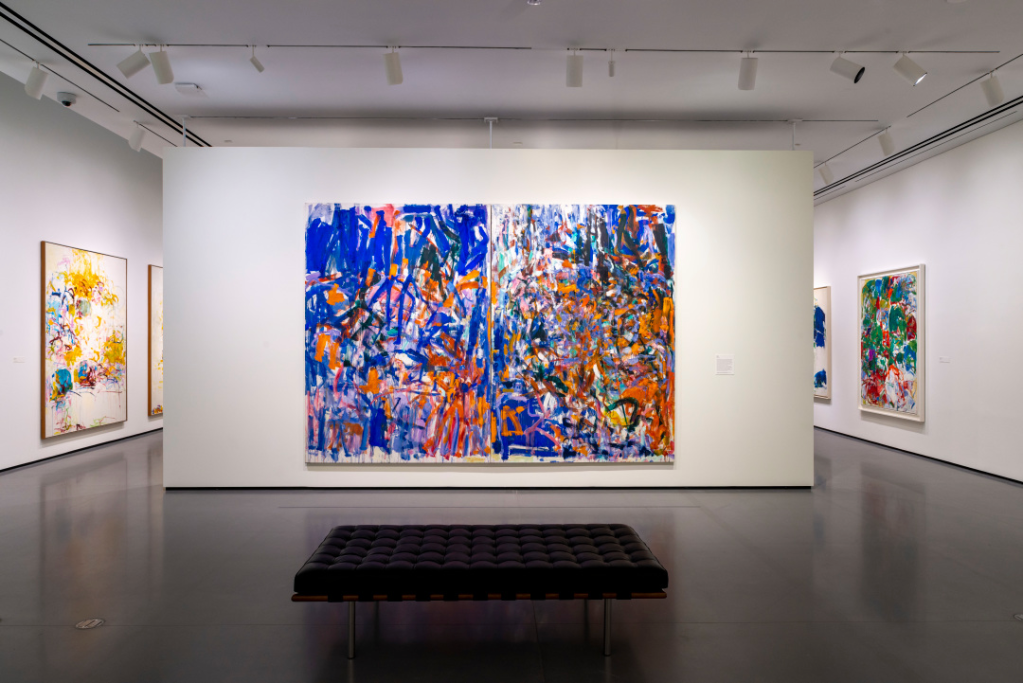
“Weeds”
Installation view:
Joan Mitchell Retrospective Exhibition,
Baltimore Museum of Art,
2022
Situated in a prairie like setting at the Meijer Gardens and Sculpture Park in Grand Rapids is an isolated crazing horse by Deborah Butterfield1. It has a natural like stance and bend to its neck, standing in this open space. Further downtown, in fact near the very center of the city and elevated to the top of a Grand Valley State University classroom building, is another one of these pieces.
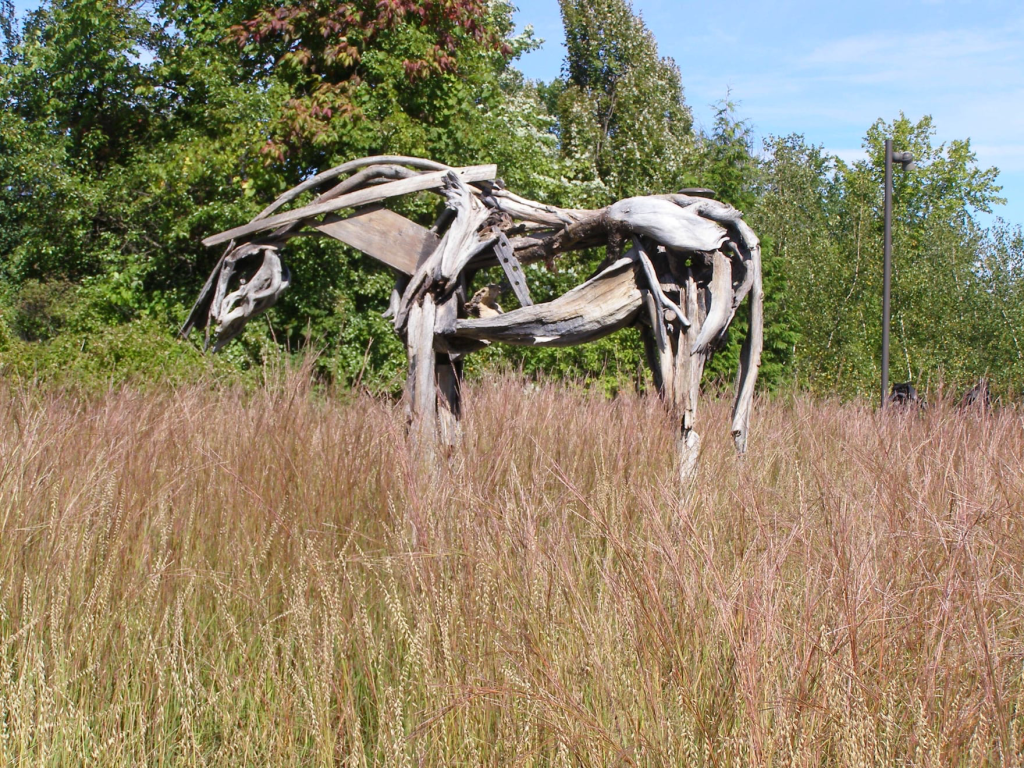
“Cabin Creek”
1999
Bronze
88” x 122.5: x 30.5”
Meijer Sculpture Garden and Park
Grand Rapids, Michigan
Char: Above the City
–for Nathan, Joel, and Alison
“On a rooftop downtown at the edge
of the building where they’ve planted succulents
stands a horse blackened by fire
called Char by its maker Deborah Butterfield.
The artist scoured a smoky ravaged forest
in California, picking up branches, limbs,
burnt saplings, then brought these to her studio
where she fashioned them into the shape of a horse.
During the process, taking weeks, Butterfield often dreams
of horses. This one grazing in a meadow
where red-tipped grass waved against its belly, seeds
catching in its long tail. Horse has become the artist’s
mirror self, a dream figure made manifest.
After the studio, a foundry, a way to cast
wood into metal, finally pouring
bronze for the final sculpture. The workers made marks
in metal to resemble wood, adding a patina black
as night sky. Char looks east into clouds
above our city, ignoring for past weeks
the haze from Canada wildfires, not pricking
its ears in terror or flipping its tail.
Char is more skeleton than mass, negative space
allowing us to glimpse what’s been ruined and where
we stand, on the edge, barely able to breathe.”2

“Char”
2021
Bronze
82.5″ x 102.5″ x 33″
Center for Interprofessional Health,
Grand Valley State University,
Grand Rapids, Michigan
In the Spring of 2019 I visited the Baltimore Art Museum in order to see the Joan Mitchell Retrospective3. It was the first time I had returned to Baltimore in so many years and certain sites were hard to remember. We arrived early, way before our scheduled entry time, not crowded at all so the guards waved us right on in. When I mentioned this to Patricia Clark later, back in the Mid-West, she stated that she and her husband Stanley Krohmer, who had also studied in Baltimore, were planning a very similar trip, and specifically to see the Joan Mitchell Retrospective.
One really important element to all of Mitchell’s work is her affinity with other artists and poets of her generation. Several of her paintings have inspired writers and writers have inspired her in both her paintings and her poem pastels.
These include James Schyler, Eileen Myles, Frank O’Hara and John Ashbery. Below is Patricia Clark’s poem in response to this exhibition.
Painter Joan Mitchell Pulls Me Up
“What was in the air was leaf-fall, the rot
of the year’s perennials and annuals, stems
and blossom ends done for, going back to earth.
I couldn’t move for being caught by the suck
of quicksand, a clump of blue feathers smacked
on a window from a hit. Here I am on a cold Friday
and to my amazement the painter Joan
Mitchell reaches for me, from her oil
on canvas, a diptych called Weeds,
grabbing a hold of me, saying ‘Here,
take my hand!’ There’s something about
her seeming riot of marks that’s giving
a calming and cooling effect. It’s cobalt blue,
orange, tawny, and flecked with white,
even a spot or two of sage, and I see
the trail-side at Huff Park with tall
teasel, Queen Anne’s lace, and a waving
frond of goldenrod or a flat-topped
white aster. Each year I’m caught watching
this awakening starting up in early spring,
a mere sprout or two at first, then
climbing, growing, a stem hoisting itself up
all season till it’s five feet high,
shedding petals, pollen and seeds. Not
a riot at all, a cyclic process of
great determination, genetics, chance . . .”

“Weeds”
1976
Oil on canvas,
110 1/2” x 157 1/2”
Hirshhorn Museum and Sculpture Garden
Washington, DC.
“. . . weather, sunlight, rain. Right now,
I’m bowing to the botanical display and to two
canvasses of supreme order, remembering
our visit to the Baltimore Art Museum, August,
standing in front of the actual paintings,
work as sturdy and wrought
as any palace. Then we went walking off
in a pack for lunch, having salad and Chesapeake oysters
on the half-shell along with a crisp
citrus tasting wine. Good friends, fellow
artists, a couple more hands to pull me
out of quicksand. Where do we turn, lost
on that trail, or sinking? The Baltimore light
was pure lemon as we strolled through
the galleries pointing, talking, saying
look at that magenta, violet, sage, her vision,
her ability to make these marks. The gleam of it
lasting as long as the light, what we call a day.”4
1 Kuspit, Donald, and Marcia Tucker; Horses: The Art of Deborah Butterfield; Lowe Art Museum, University of Miami, Coral Gables, Florida, and Chronicle Books, San Francisco, California; 1992.
2 Clark, Patricia; “Char;” The Superstition Review; Arizona State University; Issue 32; Fall 2023.
3 Roberts, Sarah, and Katy Siegel, eds.; Joan Mitchell; Baltimore Museum of Art and the San Francisco Museum of Modern Art; Yale University Press, New Haven and London; 2020.
4 Clark, Patricia; “Painter Joan Mitchell Pulls Me Up;” Nelle; University of Alabama at Birmingham; Issue 7; 2024.


 BRIDGING THE GAP