DEAD BIRDS

“His Bathrobe Pockets Stuffed with Notes”

“The early sixteenth-century Belgian painter called, for want of his real name, The Master of the Embroidered Leaf.

Those dead birds on the porch when I opened up the house after being away for three months.

Remember Haydn’s 104 symphonies. Not all of them were great. But there were 104 of them.”[i]
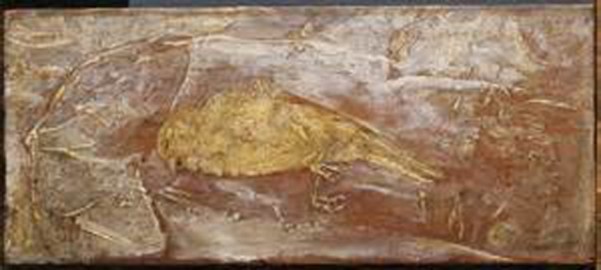
deadbird1
Albert Pinkham Ryder
“Dead Bird”
1890’s
Oil on wood panel
4 3/8” x 10”
The Phillips Collection, Washington, DC.

This terrible but beautiful image of a dead bird has always been one of the most haunting paintings in the Phillips Collection in Washington, DC. Just over four inches high it is an important example of works of art that are intimate in size and grand in spirit. Their effect remains with the viewer long after stepping outside of the museum.

Raymond Carver used this technique on several occasions in his work, especially in his collection A New Path to the Waterfall. Small statements, snippets really, are concise and to the point. 16th Century illuminations, dead birds on the front porch, or an incident involving Billy Strayhorn and Duke Ellington all incorporate the painterly criteria of ‘economy of means.’ Compression.

Georgia O’Keeffe’s “Red and Pink Rocks with Teeth” at the Art Institute of Chicago, Jan Vermeer’s “Girl in the Red Hat” at the National Gallery in Washington and Ryder’s “Dead Bird” mentioned above are all small in size but powerful in scale. Why should this be? Perhaps it was the desire of certain figurative painters and Imagist poets for the significant detail: to rivet the universal with the particular. Or, the suggestion made several times by William Carlos Williams throughout his epic poem Patterson to “Say it! No ideas, but in things.”[ii]

Whether it was the search for an American idiom or a single image out of the mass of chaos, Williams would ask of us: “What common language to unravel?”[iii] For both the poet and the painter it would be the process of finding one’s own vision or voice coming out of “…a mass of detail to interrelate on a new ground…pulling the disparate together to clarify and compress.”[iv]

“Because the sun was behind them
their shadows came first and then
the birds themselves.”[v]
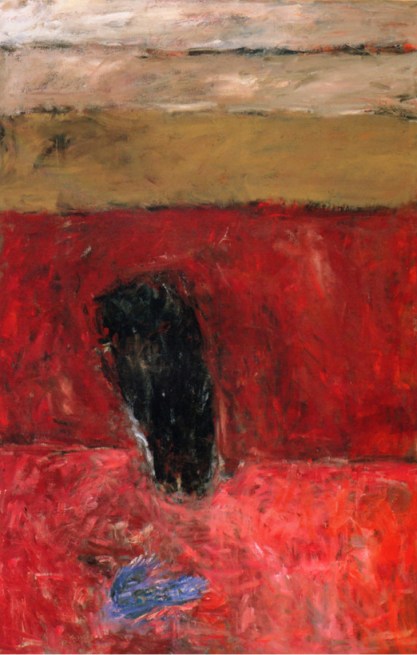
deadbird2
Susan Rothenberg
“Blue Bird Wings”
1989
Oil on canvas
65″x43″
Private collection

To make an image or an object one’s own is to have a signature that comes out of the process of creating that image. Idiosyncratic imagery, like that in Ryder’s painting, has been the trademark of a certain few artists: as in the work of Musa McKim or Leonard Baskin or Susan Rothenberg; Raymond Carver or Kim Fuelling or Michael Ondaatje. These images will speak for themselves, as any real painting or drawing or poem will.

deadbird3
Leonard Baskin
“Dead Bird”
c. 1950’s
Woodcut
1” x 2”
Michelson Galleries, Northampton, Massachusetts

“Through the Boughs”

“Down below the window, on the deck, some ragged-looking birds gather at the feeder. The same birds, I think, that come every day to eat and quarrel. Time was, time was, they cry and strike at each other. It’s nearly time, yes. The sky stays dark all day, the wind is from the west and won’t stop blowing. . . . Give me your hand for a time. Hold on to mine. That’s right, yes. Squeeze hard. Time was we thought we had time on our side. Time was, time was, those ragged birds cry.”[vi]

deadbird4
Kim Fuelling
“Fallen Bird”
c. 1998
Graphite on paper
8” x 10”
Courtesy of the artist, Zionville, North Carolina

“Application for a Driving License”

“Two birds loved
in a flurry of red feathers
like a burst cottonball,
continuing while I drove over them.

I am a good driver, nothing shocks me.”[vii]


[i] Carver, Raymond; “His Bathrobe Pockets Stuffed with Notes;” A New Path to the Waterfall; The Atlantic Monthly Press; New York, New York; 1989; pp. 64-66.

[ii] Williams, William Carlos; Patterson; New Directions Publishing Corporation; New York, New York; 1992; p. 7.

[iii] Williams, William Carlos; Patterson; p. 9.

[iv] Williams, William Carlos; Patterson; p. 19.

[v] McKim, Musa; Alone With the Moon, Selected Writings; The Figures; Great Barrington, Massachusetts; 1994; p. 137.

[vi] Carver, Raymond; “Through the Boughs;” A New Path to the Waterfall; p. 120.

[vii] Ondaatje, Michael; “Application for a Driving License;” The Cinnamon Peeler; Vintage International; New York, New York; 1997; p. 14.
I SAW THE FIGURE FIVE IN GOLD

There is a story regarding the poet William Carlos Williams and the painter Marsden Hartley that recounts an early shared experience. Dr. Williams was working at the time at the Post Graduate Clinic in New York and after his shift had made arrangements to visit Hartley’s studio. Hartley however, was either late or had totally forgotten the appointment and Williams sat for a few minutes on the stoop in front of the building. It was getting dark, streetlights were coming on and firetrucks were racing past. Williams got out a piece of paper and wrote down, or sketched out, the entire scene. It became his poem “The Great Figure” and was published as part of his collection Sour Grapes in 1921.

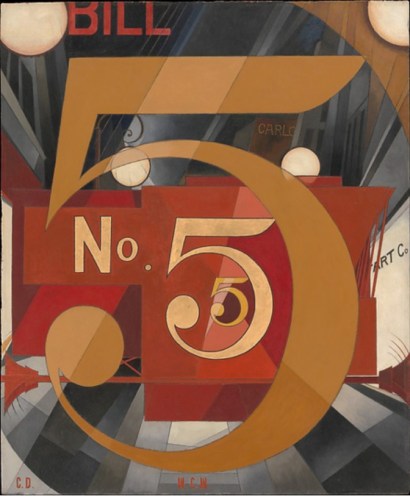
A few years later Charles Demuth began a series of eight abstract “poster portraits” as tributes to other modern American artists, amongst them were Georgia O’Keeffe, John Marin and Arthur Dove. Although these were not literal likenesses, Demuth created these portraits using imagery that related to each sitter. In William Carlos Williams’ case urban sights and sounds, cubist directional lines and a number on the side of a passing firetruck are all incorporated into this one particular painting.

demuth
Charles Demuth
“I Saw the Figure 5 in Gold”
1928
Oil, graphite, ink, and gold leaf on paperboard
35 1/2″ x 30″
Metropolitan Museum of Art, Alfred Stieglitz Collection

“The Great Figure”

“Among the rain
and lights
I saw the figure 5
in gold
on a red
firetruck
moving
tense
unheeded
to gong clangs
siren howls
and wheels rumbling
through the dark city”[i]

Williams’ poem became a classic example of the new writing in America known as Imagism. Charles Demuth’s painting was purchased by Alfred Stieglitz and later donated to the Metropolitan Museum of Art in New York. And later still, during the Pop Art period, Robert Indiana appropriated this image for a series of his own paintings and silkscreen prints titled the “American Dream.” Examples of these works are now in the collection of the Indianapolis Museum of Art.

indiana
Robert Indiana
“The American Dream”
1971
Screen print
39″ x 32″
Indianapolis Museum of Art


[i] Williams, William Carlos; The Collected Poems: Volume I; New Directions Publishing Corporation; New York, New York; 1986; p. 174.

THE MATISSE STORIES

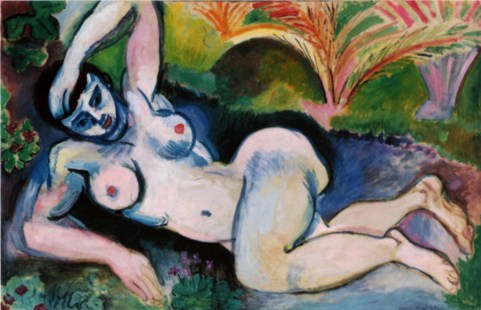
At the Salon of 1907 in Paris, the critic Louis Vauxcelles described the “Blue Nude” as: “A nude woman, ugly, spread out on opaque blue grass under some palm trees.”[i]

In 1913 in New York and Chicago the Armory Show was a catalyst for derision of both European and modern art by the general American population. It was of course the first exposure of works by Cezanne, Picasso, Matisse, and even Ingres to the American public. This exhibition also included selected contemporary American artists, including several who were associated with Alfred Stieglitz and his gallery.

Henri Matisse’s early painting, “Blue Nude, a Souvenir of Biskra” from 1907 was one of the pieces to cause a public stir. At the close of the exhibition at the Art Institute of Chicago in 1913, the students rioted and burned both the painting and Matisse in effigy on the steps of the museum.

matisse-1
Henri Matisse
“Blue Nude, Souvenir of Biskra”
1907
36 1/4″ x 55 1/4″
Oil on canvas Baltimore Museum of Art, The Cone Collection, formed by Dr. Claribel Cone and Miss Etta Cone of Baltimore, Maryland

The painting had been purchased by Leo Stein in Paris at the 1907 Salon. Later it was purchased by the American collector John Quinn, whose estate in turn sold it to Etta and Claribel Cone of Baltimore, where it remains in the collection of the Baltimore Museum of Art.

The Blue Nude was also featured in an exhibition at Stieglitz’s gallery in 1921, where it was seen by the American poet William Carlos Williams. His prose poem, inspired by this painting, may be one of the first positive pieces of writing regarding the “Blue Nude.”

“A Matisse in New York”

“On the french grass, in that room on Fifth Ave., lay that woman who had never seen my own poor land.”

“So he painted her. The sun had entered his head in the color of sprays of flaming palm leaves. They had been walking for an hour or so after leaving the train. They were hot. She had chosen the place to rest and he had painted her resting, with interest in the place she had chosen.”

“It was the first of summer. Bare as was his mind of interest in anything save the fullness of his knowledge, into which her simple body entered as into the eye of the sun himself, so he painted her.”

“No man in my country has seen a woman naked and painted her as if he knew anything except that she was naked. No woman in my country is naked except at night.”

“In the french sun, on the french grass in a room on Fifth Ave., a french girl lies and smiles at the sun without seeing us.”[ii]

More recently, in 1993 the English writer A. S. Byatt has taken a similar approach to this subject in The Matisse Stories, a series of short stories each inspired by one of Matisse’s paintings. This time, it is the “Large Reclining Nude” also known as the “Pink Nude” purchased in 1936 directly from the artist by Etta Cone and donated to the Baltimore Museum of Art through the Cone Sisters’ bequest in 1950.

Dr. Claribel Cone’s will stated that the Baltimore Museum of Art should receive the bequest of their collection provided that “…the spirit of appreciation for modern art in Baltimore became improved.”[iii]

matisse-2
Henri Matisse
“Large Reclining Nude”
1935
26 1/8″ x 36 3/4″
Oil on canvas
Baltimore Museum of Art, The Cone Collection, formed by Dr. Claribel Cone and Miss Etta Cone of Baltimore, Maryland

“She had walked in one day because she had seen the Rosy Nude through the plate glass. That was odd, she thought, to have that lavish and complex creature stretched voluptuously above the coat rack, where one might have expected the stare, silver and supercilious or jetty and frenzied, of the model girl. They were all girls now, not women. The rosy nude was pure flat colour, but suggested mass. She had huge haunches and a monumental knee, lazily propped high. She had round breasts, contemplations of the circle, reflections on flesh and its fall. . . . She had asked cautiously for a cut and blow-dry.”[iv]

In conversations with his friends and fellow artists over the years, especially with the poet Louis Aragon, Matisse often stated that: “The importance of an artist is to be measured by the number of new signs he has introduced into the plastic language…”[v]


[i] Flam, Jack; Matisse in the Cone Collection: The Poetics of Vision; The Baltimore Museum of Art; Baltimore, Maryland; 2001; pp. 41-42.

[ii] Tashjian, Dickran; William Carlos Williams and the American Scene 1920-1940; Whitney Museum of American; New York, New York; 1978; 29-31.

[iii] Flam; Matisse in the Cone Collection; p. 7.

[iv] Byatt, A. S.; The Matisse Stories; Vintage International; New York, New York; 1996; p. 3.

[v] Flam, Jack; Matisse on Art; University of California Press; Berkeley, Los Angeles, London; 1995; p. 150.