My friend and colleague, Brett Waller, Director Emeritus of the Indianapolis Museum of Art, used to always mention to students and visitors that art museums were the birth-right of artists: explaining that historically, when many royal and private collections were first opened to the public as museums, they were linked to the local art academies and schools.
Artists such as Paul Cézanne and Alberto Giacometti both were sensitive to the importance of museums and their collections. It was Cézanne who stated many times that “. . . it was his ambition ‘to do Poussin again after nature’ and that he wanted to make of Impressionism ‘. . . something solid and enduring like the art of the museums.’”1
In his Sketchbook of Interpretive Drawings Alberto Giacometti shows us both the range and depth of how he looked at the great art of museums: “I began to copy long before even asking myself why I did it, probably in order to give reality to my predilections, much rather this painting here than that one there, but for many years I have known that copying is the best means for making me aware of what I see, the way it happens with my own work; I can know a little about the world there, a head, a cup, or a landscape, only by copying it.”2
Alberto Giacometti “Study after Pieter Breughel’s Hunters in the Snow” c. 1952 Ballpoint pen on paper 8 1/4” x 11 1/2” Annette and Alberto Giacometti Foundation, Paris and Zurich
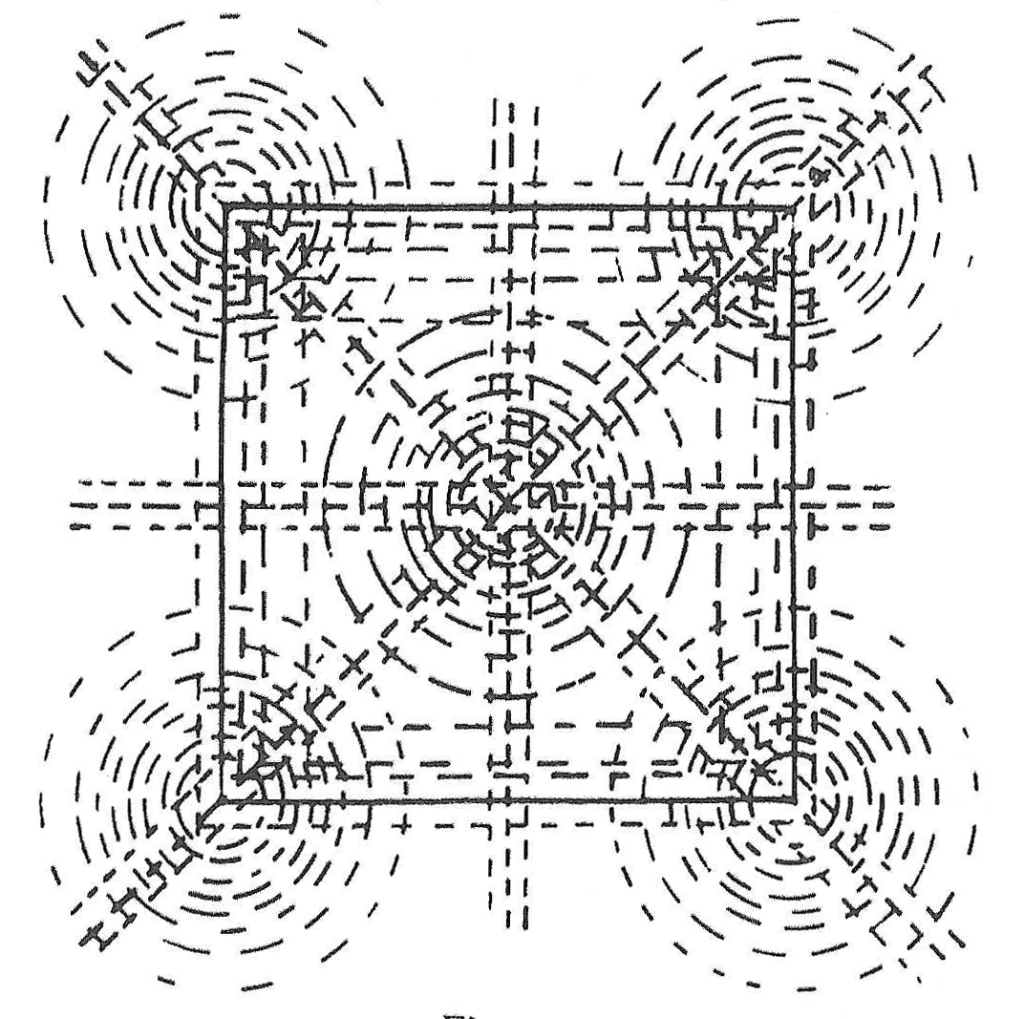
Through the writings of Rudolph Arnheim we have known of the ascending and descending angles and movements through out a painting.3 Also, we understand kinetic and haptic space as it runs through a work of art, leading our eye and mind through this very space.
Rudolph Arnheim “Structural Map” (Figure 3, p. 4) Art and Visual Perception 1971
Whether it is a snow covered hill leading us downward from the center left to the bottom right of the painting, or the path that the hunters are taking from the lower left upward into the center, or even the complimentary angles of the magpie gliding above the distant landscape and holding the upper part of the composition, we can feel the structural movement throughout.
It is this seeing, and experiencing of the thing that is most important, and this of course is exactly what William Carlos Williams achieved with this great painting “The Hunters in the Snow.”
Pieter Breughel the Elder “The Hunters in the Snow” 1565 Oil on wood panel 46” x 63 3/4” Kunsthistorisches Museum, Vienna
The Hunters in the Snow
“The over-all picture is winter icy mountains in the background the return
from the hunt it is toward evening from the left sturdy hunters lead in
their pack the inn-sign hanging from a broken hinge is a stag a crucifix
between his antlers the cold inn yard is deserted but for a huge bonfire
that flares wind-driven tended by women who cluster about it to the right beyond
the hill is a pattern of skaters Breughel the painter concerned with it all has chosen
a winter-struck bush for his foreground to complete the picture . . ”4
1 Chilvers, Ian, & John Glaves-Smith; A Dictionary of Modern and Contemporary Art; Oxford University Press; Oxford, United Kingdom; 2009; p. 132.
2 Carluccio, Luigi; Giacometti: A Sketchbook of Interpretive Drawings; Harry N. Abrams, Inc.; New York, New York; 1967; p. xi.
3 Arnheim, Rudolf; Art and Visual Perception: A Psychology of the Creative Eye; University of California Press; Berkeley and Los Angeles; 1971; p. 4.
4 Williams, William Carlos; Pictures from Brueghel and other poems; New Directions Publishing Corporation; New York, New York; 1967; p. 5.
“I know a good print when I see it. I know when it is good and why it is good. It is the neck of a man, the nose of a woman . . . . It is a photograph by Sheeler. It is. It is the thing where it is. So. That’s the mine out of which riches have always been drawn.”[i]
Charles Sheeler “Shaker Window” c. 1935 B&W photograph The William H. Lane Collection, Museum of Fine Arts, Boston, Massachusetts
This is one of many observations made by William Carlos Williams regarding his long time friend Charles Sheeler. Williams was constantly calling for an “intense vision of the facts”[ii] and considered a painting or a photograph or a poem as a thing to be shaped or carved out in the process.
Williams noted this many times throughout his career: from his early work, in several of his essays, and in his epic poem Patterson. It even came up in his “Introduction” for Sheeler’s Retrospective Exhibition at the Museum of Modern Art in New York in 1939 where he observed: “It is in things that for the artist the power lies. . . .”[iii]
Sheeler had a wide range of interests, not only through his professional work but also as an inquisitive and thoughtful human being. He supported himself for many years as a documentary photographer both with Vogue and Fortune Magazines, as well as work for the Metropolitan Museum of Art.
These projects often paralleled his aesthetic interests, complimenting his studio work. Modern industrial subjects such as the factories in Ballardvale, Massachusetts and the Ford Motors plant in Detroit, Michigan became important sources of inspiration for this work. Simultaneously, he was interested in, and paid visits to historic farmhouses in Pennsylvania and New England, as well as communitarian sites such as the Ephrata Community in Lancaster County, and the Shaker Villages in both Mount Lebanon, New York and Hancock, Massachusetts. He even began collecting certain pieces of antique furniture with which he furnished his own home: folk art, ceramics, curved wooden boxes, and of course many Shaker chairs, cabinets, and tables.
Charles Sheeler “Buildings at Lebanon” 1949 Tempera and graphite on pressed board faced with sized paper 14 5/16” x 20 1/4” Walker Art Center, Minneapolis, Minnesota
William Carlos Williams even noted how his friend Charles Sheeler had taken certain objects and constructed an environment in which to live. Williams writing in his autobiography stated:
“The poem is our objective, the secret at the heart of the matter—as Sheeler’s small house, reorganized….”
“Charles Sheeler, artist, has taken the one rare object remaining more or less intact…and proceeded to live in it…and make a poem (a painting) of it….”[iv]
“How shall we in this region of the mind which is all we can tactically, sensually know, organize our history other than as Shaker furniture is organized? It is a past, totally uninfluenced by anything but the necessity, the total worth of the thing itself, the relationship of the parts to the whole. The Shakers made furniture for their own simple ritualistic use, of white pine, applewood, birch—what they had. Sheeler has a remarkable collection of this furniture.”[v]
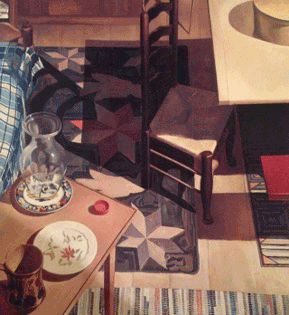
Charles Sheeler “American Interior” 1934 Oil on canvas 32 1/2” x 30” Gift of Mrs. Paul Moore, Yale University Art Gallery, New Haven, Connecticut
For several years Sheeler had been working on an autobiography, which he turned over to the writer Constance Rourke, who edited and organized it. Rourke drew heavily upon Sheeler’s words, which became an important element in her monograph on this artist in 1939. Later, the historians Faith and Edward Demming Andrews referred to this book in their article on Sheeler in “Art in America” that focused on his interest in the Shakers:
“But as time went on he must have become more and more convinced that he wanted to do, through his medium, what the Shakers . . . had done in theirs: to strip away all that was superficial, to find the essential, the absolute, the inner undisguised meaning, the final irreducible character in form.”[vi]
Charles Sheeler “Americana 31” 1931 Oil on canvas 36” x 48” Collection of Mr. and Mrs. Milton Lowenthal, Museum of Modern Art, New York
Sheeler himself had many things to say regarding his interests and this collection. They were historic artifacts by that time, but they were also very contemporary in feeling and form. He stated that: “I don’t like these things because they are old but in spite of it. I’d like them still better if they were made yesterday because then they would afford proof that the same kind of creative power is continuing.”[vii]
Charles Sheeler “Shaker Detail” 1941 Oil and tempera on Masonite 8.75” x 9.75” Wallace M. Scudder Bequest Newark Museum of Art, Newark, New Jersey
“No embellishment meets the eye. Beauty of line and proportion through excellence of craftsmanship make the absence of ornament in no way an omission. The sense of light and spaciousness received upon entering the hall is indicative of similar spiritual qualities of the Shakers. Instinctively one takes a deep breath, as in the midst of some moving and exalted association of nature. There were no dark corners in those lives.”[viii]
Charles Sheeler “On a Shaker Theme” 1956 Oil on canvas 30” x 36” Stephen and Sybil Stone Foundation, Wareham, Massachusetts
“—Say it, no ideas but in things— nothing but the blank faces of the houses and cylindrical trees bent, forked by preconception and accident— split, furrowed, creased, mottled, stained— secret—into the body of the light!”[ix]
[i] Williams, William Carlos; “The Descent of Winter” included in Imaginations; New Directions Publishing Corporations; New York, New York; 1971; p. 253.
[ii] Williams, William Carlos; “The Descent of Winter” included in Imaginations; New Directions Publishing Corporation; New York, New York; 1971; p. 231.
[iii] Williams, William Carlos; Selected Essays; New Directions Publishing Corporations; New York, New York; 1992; p. 234.
[iv] Williams, William Carlos; The Autobiography of William Carlos Williams; New Directions Publishing Corporation; New York, New York; 1967; pp. 332-333.
[v] Williams, William Carlos; The Autobiography of William Carlos Williams; New Directions Publishing Corporation; New York, New York; 1967; pp. 333-334.
[vi] Andrews, Faith and Edward D.; “Sheeler and the Shakers;” Art in America; New York, New York; Number One; 1965; p. 95.
[vii] Rourke, Constance; Charles Sheeler: Artist in the American Tradition; Kennedy Galleries, Inc., and Da Capo Press; New York, New York; 1938 and 1969; p. 136.
[viii] Rourke, Constance; Charles Sheeler: Artist in the American Tradition; Kennedy Galleries, Inc., and Da Capo Press; New York, New York; 1938 and 1969; p. 136.
[ix] Williams, William Carlos; Patterson; New Directions Publishing Corporations; New York, New York; 1992; pp. 6-7.
“We looked upon the French with a certain amount of awe because we thought they had secrets about art and literature which we might gain. We were anxious to learn, and yet we were repelled too. There was a little resentment in us against all the success of the French. The time had come for us to talk on our own terms. We felt this.”[i]
Charles Sheeler “Buttresses, Chartres Cathedral” 1929 Gelatin silver print 9 5/8” x 7 9/16” Gift of the artist Museum of Modern Art, New York
“Even though I have so profound an admiration for the beauty of Chartres, I realize strongly that it belongs to a culture, a tradition, a people of which I am not a part….It seems to be a persistent necessity for me to feel a sense of derivation from the country in which I live and work.”[ii]
Here are two important statements by 20th Century Americans: the first from William Carlos Williams and the second from Charles Sheeler. They became friends almost immediately after meeting for the first time and remained so for years to follow. Sheeler was concerned as a painter and photographer with discovering an American vision and a local, immediate subject matter. Williams, in his search for a poetic voice and an American idiom in his writing, incorporated everyday subjects and images, always insisting to ‘say it, no ideas but in things!’[iii]
In her early book on Charles Sheeler, Constance Rourke noticed the mutual interest in painting and poetry and the personal affection that had been established between the painter Charles Sheeler and the poet William Carlos Williams. They travelled in some of the same social and aesthetic circles: in Philadelphia within the Louise and Walter Arensberg family of influence, and New York, both were included in the circle built around the Steiglitz Group, which also included the artists Marsden Hartley and Charles Demuth.
Elizabeth Black Carmer “William Carlos Williams, Charles Sheeler and Carl Carmer at the Carmer’s Octagon House” 1961 B&W photograph 26” x 21” Archives of American Art, Smithsonian Institution, Washington, DC.
“A new intercommunication between artists and writers had begun of which this lasting friendship was a symbol. Williams, Wallace Stevens, and a few other ‘new’ poets had read some of their work at one of the Independents exhibitions. Some of Sheeler’s drawings and photographs were reproduced in Broom. . . . Each group was tending more often to look at the work of the other, to consider it, stay with it, give it the warmth of immediate discussion. Exchanges of ideas were taking place that might not be reflected directly in either painting or writing but could provide something in the way of a generative force for both.”[iv]
And here is one of Williams’ early observations regarding Sheeler’s work: “Romance, decoration, fullness—are lost in touch, sight, a word, to bite an apple. Henry Ford has asked Chas. Sheeler to go to Detroit and photograph everything. Carte blanche. Sheeler! That’s rich. . . .”[v]
Charles Sheeler “River Rouge Plant” 1932 Oil on canvas 20” x 24 1/8” Whitney Museum of American Art, New York
Sheeler, in his capacity as a professional photographer, worked for several publications in the Conde Nast Group, as well as documenting the collection of the Metropolitan Museum of Art and the Arensburg family private collection. Williams also knew of the Arensburg circle of artists, realists and surrealists amongst them, and of the importance of the local avant-garde. These are interesting parallels in their lives and activities. Today however, writers and artists often see this as the glorification of the industrial object, or as nostalgia, or realism so real, that it becomes surreal.
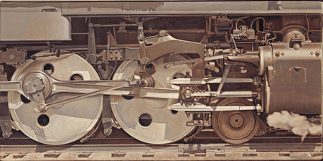
Charles Sheeler “Rolling Power” 1939 Oil on canvas 15 “ x 30” Smith College Museum of Art Northampton, Massachusetts
The Descent of Winter 10/30
“To freight cars in the air all the slow clank, clank clank, clank moving above the treetops
the wha, wha of the horse whistle
pah, pah, pah pah, pah, pah, pah, pah
piece and piece piece and piece moving still trippingly through the morningmist
long after the engine has fought by and disappeared in silence to the left”[vi]
Sheeler took great advantage of his many photographic essay commissions not just to document industrial sites in the East and the Mid-West, but to also collect valuable images for his own studio work in both drawing and painting. Variations on many of these themes appeared in his work throughout his lifetime and they have continued to provide inspiration for several artists in younger generations.
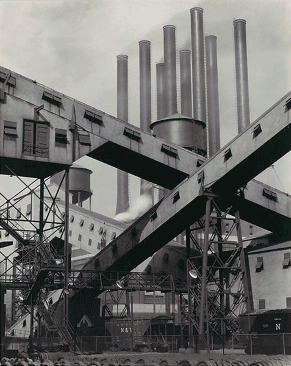
Charles Sheeler “Criss-Crossed Conveyors—Ford Plant ” 1927 B&W Photograph The William H. Lane Collection, Museum of Fine Arts, Boston, Massachusetts
Contemporary painters such as Donald Sultan and Robert Moskowitz have benefitted from this insight that is contained in Sheeler’s work: an intense perception of the man-made environment and landscape. Recent curators and art historians have also noticed this, especially those writing about the Industrial Sublime[vii] and Charles Sheeler and the Cult of the Machine.[viii] It is an ongoing aesthetic.
Donald Sultan “Veracruz, November 18, 1986” 1986 Latex and tar on tile over Masonite Matthew and Iris Strauss Collection, Rancho Santa Fe, California
“A poem is a small (or large) machine made of words. When I say there’s nothing sentimental about a poem I mean that there can be no part, as in any other machine, that is redundant. . . . Its movement is intrinsic, undulant, a physical more than a literary character. Therefore, each speech having its own character, the poetry it engenders will be peculiar to that speech also in its own intrinsic form. The effect is beauty, what in a single object resolves our complex feelings of propriety. . . .”
Charles Sheeler “Stacks in Celebration” 1954 Oil on canvas 22” x 28” Dayton Art Institute, Dayton, Ohio
“When a man makes a poem, makes it, mind you, he takes words as he finds them interrelated about him and composes them—without distortion which would mar their exact significances—into an intense expression of his perceptions and ardors that they may constitute a revelation in the speech that he uses. It isn’t what he says that counts as a work of art, it’s what he makes, with such intensity of perception that it lives with an intrinsic movement of its own to verify its authenticity.”[ix]
Robert Moskowitz “Stack” 2000 Pastel on paper 50 5/8” x 22 1/2” Lawrence Markey Inc., San Antonio, Texas
[i] Rourke, Constance; Charles Sheeler: Artist in the American Tradition; Kennedy Galleries, Inc., and Da Capo Press; New York, New York; 1938 and 1969; p. 49.
[ii] Tsujimoto, Karen; Images of America: Precisionist Painting and Modern Photography; San Francisco Museum of Modern Art and the University of Washington Press; Seattle & London; 1982; p. 85. (Statement made by Sheeler on his series of photographs of Chartres Cathedral, originally published in Constance Rourke; Charles Sheeler: Artist in the American Tradition; New York, New York; Harcourt, Brace; 1938; p. 130).
[iii] Williams, William Carlos; Patterson; New Directions Publishing Corporation; New York, New York; 1946 & 1992; p. 6.
[iv] Rourke, Constance; Charles Sheeler: Artist in the American Tradition; Kennedy Galleries, Inc., and Da Capo Press; New York, New York; 1938 and 1969; p. 50.
[v] Williams, William Carlos; Imaginations; New Directions Publishing Corporation; New York, New York; 1971; p. 253.
[vi] Williams, William Carlos; Imaginations; New Directions Publishing Corporation; New York, New York; 1971; p. 246.
[vii] Botwinick, Michael, et al; Industrial sublime; Empire State Editions, Fordham University Press; Yonkers, New York; 2014.
[viii] Lucic, Karen; Charles Sheeler and the Cult of the Machine; Harvard University Press; Cambridge, Massachusetts; 1991.
[ix] Williams, William Carlos; I Wanted to Write a Poem: The Autobiography of the Works of a Poet; (Edited by Edith Heal); New Directions Publishing Corporation; New York, New York; 1978; pp. 78-79.
As an extended reflection on the artist’s life and family history, his marriage, and with several references to other artists, William Carlos Williams chose to include this great poem at the very end of his last collection, Pictures from Brueghel and other poems, published in 1962. It is sometimes referred to as the world’s darkest love poem.
In the past, whenever I read “Asphodel” I had always thought of it as a written piece of surrealism: an author speaking to his contemporaries while walking through a strange landscape. He often mentions his wife Flossie and their friend Charlie Demuth, as well as other artists such as Goya and Cezanne. Today, when I re-read these lines, I associate them with more contemporary artists, especially Alfred Leslie and Laurie Gatlin.
I used to see certain paintings by Leslie at Allen Frumkin’s galleries in both Chicago and New York. I would often make a connection to certain other events or stories. With this one in particular, “7:00 AM News” I would always go right back to Williams and his observations regarding dreaded poetry and the news.
Alfred Leslie “7:00 AM News” 1976 Oil on canvas 84” x 60” Allan Frumkin Gallery, New York
Then there is that strange visual juxtaposition of flowers actually blooming in hell. Totally surreal and I cannot help but think of the artist’s post card series created by Laurie Gatlin during the mid 1990’s.
I have recently re-discovered several of Dr. Gatlin’s post cards from this series, especially the ones quoting Dr. Williams and the Asphodel. When I asked her about them, this is what she had to say:
“I love that poem. I like the way it meanders through memory, and balances both loss and sorrow and love. I started that postcard project when I was living alone for the first time – I got married young and never lived on my own – I went from my parents house to my husband’s house, and then we had a house with children, a noisy house, and when I separated from him and moved into my own apartment, I was both happy with the ability to be alone and also terribly lonely. It’s hard to make that adjustment, and the way I coped was to reach out with my postcards. . . . So there were a lot of things in that poem that resonated with me, and re-reading it again today, I am more struck by the sense of looking back over a life lived. . . .”
Laurie Gatlin “Flowers in Hell” 1995 5 1/2” x 3 1/2” Collage and acrylic medium on post card Private collection, Indianapolis
“One of the things that strikes me about William Carlos Williams is the sense of rhythm in his works – not structured with regular meter, but it reads to me very much like a metered poem. There’s also the sense of distance in most of his poems – a sense of standing apart, and I think that appeals to me. Of Asphodel is actually pretty personal as it speaks about his relationship with his wife, but so much of it is also observational and distant. I think I appreciated both of those aspects at the time as well – the meter and the sense of distance/personal relationship.”[ii]
I have always agreed with these observations from Laurie Gatlin and I share her understanding of Williams’ poem and its meanings. However, during all of this time I missed a crucial detail of what Williams was trying to say. Only recently have I discovered classical references to this greeny flower. In fact, Homer mentions this in several passages of The Odyssey. While exploring Hades at the direction of Circe in order to consult the prophet Tiresias, Odysseus had met and talked with Achilles’ ghost and Minos, as well as Agamemnon, his own dead mother Autolycus, and of course Tiresias hinself. He had been sent by Circe in order to question his former crew regarding the events wherein he was lost at sea and these mates had been killed. All the while, during this visit, he noticed that there were fields and meadows of asphodels growing there.
“Of asphodel, that greeny flower, like a buttercup upon its branching stem— save that it’s green and wooden— I come, my sweet, to sing to you. We lived long together a life filled, if you will, with flowers. So that I was cheered when I came first to know that there were flowers also in hell.”[iii]
It turned out that Circe had instructed Odysseus two different times to travel to Hades for advice and guidance from his brothers in arms and from Tiresias. When he told Achilles that his son was actually still alive and had brought honor to his family, the ghost was overjoyed:
“…after I told him this, Achilles’ ghost took great swift-footed strides across the fields of asphodel, delighted to have heard about the glorious prowess of his son.”[iv]
During these explorations Odysseus met and talked with many of the inhabitants of the underworld. Whilst he was seeking to learn the routes out in order to return to Ithaca, his comrades in the underworld were seeking news of the outside world and they rushed to find any news that they could.
“On open roads they crossed the Ocean stream, went past the rock of Leucas and the gates of Helius the Sun, and skittered through the provinces of dreams, and soon arrived in fields of asphodel, the home of shadows who have been worn to weariness by life.”[v]
Asphodel, That Greeny Flower “Of asphodel, that greeny flower, I come, my sweet, to sing to you! My heart rouses thinking to bring you news of something that concerns you and concerns many men. Look at what passes for the new. You will not find it there but in despised poems. It is difficult to get the news from poems yet men die miserably every day for lack of what is found there.”[vi]
Laurie Gatlin “It is difficult to get the news” 1995 5 1/2” x 3 1/2” Collage and acrylic medium on post card Private collection, Indianapolis
“What power has love but forgiveness? In other words by its intervention what has been done can be undone. What good is it otherwise? Because of this I have invoked the flower in that frail as it is after winter’s harshness it comes again to delect us. Asphodel, the ancients believed, in hell’s despite was such a flower.”[vii]
[i] Williams, William Carlos; Pictures from Brueghel and other poems; New Directions Publishing Corporation; New York, New York; 1962; p. 161.
[ii] Gatlin, Laurie; in an artist’s statement and e-mail communication with this writer; 29 June 2020, 6:58 AM.
[iii] Williams, William Carlos; Pictures from Brueghel and other poems; New Directions Publishing Corporation; New York, New York; 1962; p. 153.
[iv] Homer; The Odyssey; (translated by Robert Fitzgerald and with an introduction by Seamus Heaney); Everyman’s Library and Alfred A. Knopf; New York, London, Toronto; 1910 & 1992; pp. 296-197, lines 538-541.
[v] Homer; The Odyssey; (translated by Robert Fitzgerald and with an introduction by Seamus Heaney); Everyman’s Library and Alfred A. Knopf; New York, London, Toronto; 1910 & 1992; p. 507, lines 11-16.
[vi] Williams, William Carlos; Pictures from Brueghel and other poems; New Directions Publishing Corporation; New York, New York; 1962; pp. 161-162.
[vii] Williams, William Carlos; Pictures from Brueghel and other poems; New Directions Publishing Corporation; New York, New York; 1962; pp. 169-170.
Bob Dylan shows up at The Factory for a screen test. These are traditionally short, on the spot, spontaneous interviews, filmed and conducted by Andy Warhol himself. Warhol is a bit dazzled that Dylan actually showed up. Dylan a bit nonplussed, as he doesn’t really like Warhol’s paintings.
Nat Finkelstein “Andy Warhol and Bob Dylan at The Factory” (Copyright Nat Finkelstein) 1966 B&W photograph Courtesy of Idea Generation Gallery
Edie Sedgwick, supposedly introduced Dylan to Warhol sometime around 1965-1966, but it was Barbara Rubin, a filmmaker and a mutual acquaintance of both, who brought Dylan to the studio. Having finished the screen test, Dylan received a personal tour of The Factory. One account of the story has Warhol giving a painting of Elvis Presley to Dylan. The other account has Dylan picking up the Presley painting, putting it under his arm, and walking out with it as payment for the screen test. Warhol’s studio assistants were aghast, but did not quite know what to do at this point. The kind of story from which myths are made. Fortunately, the photographer Nat Finkelstein was there at The Factory, documenting the entire encounter.
The painting was the large “Double Elvis” from the “Silver Elvis Series” produced by Warhol in silver spray paint and silk-screen, printed on rolls of canvas and cut to size by his assistants: one, two, or three images to a panel. In any case, the “Double Elvis” was strapped to the roof of Dylan’s station wagon and taken away!
Nat Finkelstein “Bob Dylan with ‘Double Elvis’ strapped to the roof of his car in front of The Factory” (Copyright Nat Finkelstein) 1966 B&W photograph Courtesy of Idea Generation Gallery
Musical history, myth, and mystery all wrapped up in the long stem of connection, and Elvis Presley remains at the center of our attention. Presley’s early renditions of classic blues songs such as “Milk Cow Blues” were really important influences on the young Bob Dylan.[i] Presley’s appearances on the Ed Sullivan Show were crucial influences on an entire generation of young Americans, including the poet David Wojahn, who was born in 1953 in St. Paul, Minnesota and studied at both the University of Minnesota and the University of Arizona.
Writing in his collection Mystery Train, Wojahn collected several rock & roll myths, all supposedly based on true incidents. They were visions of musical stars and hangers on, often containing tragic outcomes: Brian Wilson having a ton of sand delivered to his living room where he set his piano in order to compose several of his masterpieces; Bo Diddley being mistaken for Chuck Berry one night on Long Beach Island in New Jersey; and William Carlos Williams taking a break in his hospital day room just in time to see Elvis Presley on the Ed Sullivan Show one Sunday night.
The poet Denise Levertov was born in 1923 in Ilford in Essex, England, where she was raised and home schooled by her Welsh mother. In 1948 she emigrated to the United States with her husband, the writer and activist Mitchell Goodman, in order to work and teach. Levertov shared many literary and aesthetic concerns with her American counterparts from Black Mountain College to New York City. Many of these younger poets especially, were drawn to the work of William Carlos Williams. Of utmost importance were visions of the local and attention to detail, a new method on how to create a presence, and the physical measure of an object or a sound.
There are two modern poems that touch on these interrelationships, one each by Levertov and Wojahn. Although they are of differing generations, they share an interest in the attention to certain details, and looking directly at the world around themselves. Wojahn even uses a line “…missed connections, missed connections….” which seems to be a play on Levertov’s powerful portrait of Williams. Here are the two pieces, from very different points of view, but featuring work that places them each within the aesthetic realm that was established by William Carlos Williams.
Geoffrey Clements “Dr. Williams on the roof of the Passaic General Hospital” 1936 B&W photograph Courtesy of the Rutherford Public Library, Rutherford, New Jersey
Williams: An Essay
“His theme over and over:
the twang of plucked catgut from which struggles music,
the tufted swampgrass quicksilvering dank meadows,
a baby’s resolute—metaphysic of appetite and tension.
Not the bald image, but always— undulant, elusive, beyond reach of any dull staring eye—lodged
among the words, beneath the skin of image: nerves, muscles, rivers of urgent blood, a mind
secret, disciplined, generous and unfathomable. Over
and over, his theme hid itself and smilingly, reappeared.
He loved persistence—but it must be linked to invention: landing backwards, ‘facing into the wind’s teeth,’ to please him.
He loved the lotus cup, fragrant upon the swaying water, loved
the wily mud pressing swart riches into its roots,
Andy Warhol “Double Elvis” 1963 6’ 11” x 53” Silkscreen ink and acrylic on canvas Museum of Modern Art, New York
W. C. W. Watching Presley’s Second Appearance on “The Ed Sullivan Show”: Mercy Hospital, Newark, 1956
“The tube, like the sonnet, is a fascist form. I read they refused to show this kid’s wriggling bum. ‘The pure products of America. . . .’ etc. From Mississippi! Tupelo, a name like a flower you wouldn’t want beside you in a room like this, where the smells hold you a goddamn hostage to yourself, where talk’s no longer cheap. Missed connections, missed connections— a junk heap blazing there in Ironbound, a couple kids beside it, juiced on the cheapest wine. Mid- thought. Mid winter, and stalled between TV screen and window. . . . This pomped-up kid, who preens and tells us ‘Don’t Be Cruel.’ Kid, forget it. You don’t know a fucking thing about cruelty yet.”[iii]
[i] Barker, Derek, ed.; “Bob Dylan’s Jukebox: Songs that Influenced the Bard;” CD Recording; ISIS and Chrome Dreams Productions; Surrey and Warwickshire, United Kingdom; 2006.
[ii] Levertov, Denise; Candles in Babylon; New Directions Publishing Corporation; New York, New York; 1982; pp. 59-60.
[iii] Wojahn, David; Mystery Train; University of Pittsburgh Press; Pittsburgh, Pennsylvania; 1990; p. 27.
“I’m thinking of decorating my studio with half a dozen pictures of ‘Sunflowers,’ a decoration in which the raw or broken chrome yellows will blaze forth from backgrounds—blue, from the palest malachite green to royal blue, framed in thin strips painted orange lead.”
“Effects like those of stained-glass windows in a Gothic church.”[i]
Vincent van Gogh “Sunflowers” (Two pages from the Paris and Auvers-sur-Oise Sketchbook) 1890 Pencil on paper 13.4 cm x 8.5 cm each page Vincent van Gogh Foundation, Van Gogh Museum, Amsterdam
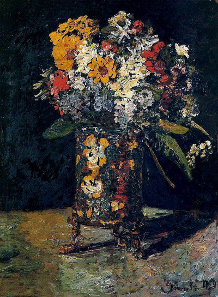
There are certain threads running throughout history, both plastic and poetic, which show us how ideas grow and develop. One artist will create an image or composition that will be picked up by another artist working at a later date, as if in answer to the first. These ideas and images will add to and expand upon the original. One important example of this can be found in Vincent van Gogh’s paintings and letters, where several times he mentions the debt that he owes to the paintings of Adolphe Monticelli. In fact a total of 57 of Vincent’s letters mention Monticelli, and his series of sunflower paintings illustrate this point.
Adolphe Monticelli “Vase with Flowers” 1875Oil on panel 51 cm x 39 cm Vincent van Gogh Foundation, Van Gogh Museum, Amsterdam
I remember that the contemporary painter Knox Martin, an important faculty member at both the Art Students League and Yale University School of Art, would always mention this, every chance he had.[ii] Van Gogh saw himself as the ‘spiritual heir’ to Monticelli, as later Antonin Artaud[iii] saw himself as the heir to van Gogh. Others following in this line have included the philosopher Gaston Bachelard[iv] and the rock and roll idol Jim Morrison!
It is clear that van Gogh was using history, and references to certain artists such as Gauguin, Delacroix, and Millet, as his guideposts. And especially Monticelli:
“But I myself—I tell you frankly—am returning more to what I was looking for before I came to Paris. I do not know if anyone before me has talked about suggestive color, but Delacroix and Monticelli, without talking about it, did it.”[v]
“Now listen, for myself I am sure that I am continuing his work here, as if I were his son or brother.”[vi]
It often seems to me that van Gogh’s emphasis on observing those everyday objects surrounding him was a kind of searching, not just for a subject, but also for a larger meaning: the soul of a flower, perhaps, which would establish him within an aesthetic family that includes Adolphe Monticelli and William Blake, as well as more modern heirs such as Allen Ginsberg, Jim Dine and even Edwin Dickinson.
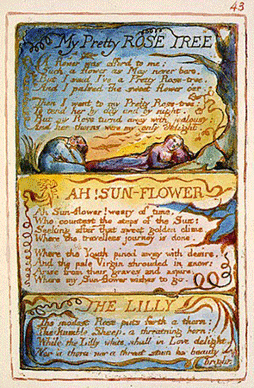
A parallel occurrence happens within the literary tradition, especially when we consider the effect that Blake has had on both painters and poets. This includes of course, Allen Ginsberg. In his biography on Ginsberg, the author Barry Miles describes one defining moment for that writer:
“The summer heat was on. Allen lay on his bed by the open window, reading William Blake. The book was open to the poem ‘Ah! Sunflower,’ from Songs of Innocence and Songs of Experience. . . . when he heard a deep, ancient voice, reading the poem aloud. He immediately knew, without thinking, that it was the voice of Blake himself, coming to him across the vault of time. The voice was prophetic, tender. It didn’t seem to be coming from his head; in fact, it seemed to be in the room, but no one was there. He described it: ‘The peculiar quality of the voice was something unforgettable because it was like God had a human voice, with all the infinite tenderness and mortal gravity of a living Creator speaking to his son.’”[vii]
William Blake. “Ah, Sunflower, Copy AA” (From the Songs of Innocence and Experience) 1794 Relief etching, with pen & watercolour touched with gold 14 cm x 9.4 cm The Fitzwilliam Museum, Cambridge, United Kingdom
“Ah, Sunflower, weary of time,
Who countest the steps of the sun,
Seeking after that sweet golden clime
Where the traveller’s journey is done;
Where the youth pined away with desire,
And the pale virgin shrouded in snow,
Arise from their graves and aspire
Where my Sunflower wishes to go!”[viii]
Vincent van Gogh “Sunflowers” 1888 Oil on canvas 92.1 cm x 73 cm The Courtauld Fund National Gallery, London
After that experience, it didn’t take long for Allen Ginsberg to discover his true voice as a poet, calling forth the legacy of a previous generation and adding new imagery to it. He collected these new poems in the book Howl, which included an introduction by another New Jersey poet, William Carlos Williams. It was Williams who observed: “Say what you will, he proves to us, in spite of the most debasing experiences that life can offer a man, the spirit of love survives to ennoble our lives if we have the wit and the courage and the faith—and the art! to persist. . . . Poets are damned but they are not blind, they see with the eyes of the angels. This poet sees through and all around the horrors he partakes of in the intimate details of his poem. He avoids nothing but experiences it to the hilt. He contains it. Claims it as his own. . . .”[ix]
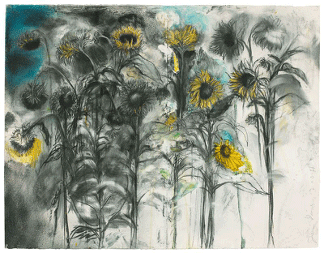
Jim Dine “Sun on the Palouse” 2004 Charcoal, watercolor, pastel and spray-paint on paper 47 1/2” x 61 1/2” The Wildenstein Collection, New York, New York
SUNFLOWER SUTRA
“I walked on the banks of the tincan banana dock and sat down under the huge shade of a Southern Pacific locomotive to look at the sunset over the box house hills and cry.
Jack Kerouac sat beside me on a busted rusty iron pole, companion, we thought the same thoughts of the soul, bleak and blue and sad-eyed, surrounded by the gnarled steel roots of trees of machinery.
The oily water on the river mirrored the red sky, sun sank on top of final Frisco peaks, no fish in that stream, no hermit in those mounts, just ourselves rheumy-eyed and hung-over like old bums on the riverbank, tired and wily.
Look at the Sunflower, he said, there was a dead gray shadow against the sky, big as a man, sitting dry on top of a pile of ancient sawdust—
—I rushed up enchanted—it was my first sunflower, memories of Blake—my visions—Harlem
and Hells of the Eastern rivers, bridges clanking Joes Greasy Sandwiches, dead baby carriages, black treadless tires forgotten and unretreaded, the poem of the riverbank, condoms & pots, steel knives, nothing stainless, only the dank muck and the razor-sharp artifacts passing into the past—
and the gray Sunflower poised against the sunset, crackly bleak and dusty with the smut and smog and smoke of olden locomotives in its eye—
corolla of bleary spikes pushed down and broken like a battered crown, seeds fallen out of its face, soon-to-be-toothless mouth of sunny air, sunrays obliterated on its hairy head like a dried wire spiderweb,
leaves stuck out like arms out of the stem, gestures from the sawdust root, broke pieces of plaster fallen out of the black twigs, a dead fly in its ear,
Unholy battered old thing you were, my sunflower O my soul, I loved you then!”
Edwin Dickinson, “Sunflower” 1941 Oil on canvas 14” x 20” Collection of Dr. and Mrs. Arthur E. Kahn, New York
“The grime was no man’s grime but death and human locomotives,
all that dress of dust, that veil of darkened railroad skin, that smog of cheek, that eyelid of black mis’ry, that sooty hand or phallus or protuberance of artificial worse-than-dirt—industrial—modern—all that civilization spotting your crazy golden crown—
and those blear thoughts of death and dusty loveless eyes and ends and withered roots below, in the home-pile of sand and sawdust, rubber dollar bills, skin of machinery, the guts and innards of the weeping coughing car, the empty lonely tincans with their rusty tongues alack, what more could I name, the smoked ashes of some cock cigar, the cunts of wheelbarrows and the milky breasts of cars, wornout asses out of chairs & sphincters of dynamos—all these
entangled in your mummied roots—and you there standing before me in the sunset, all your glory in your form!
A perfect beauty of a sunflower! a perfect excellent lovely sunflower existence! a sweet natural eye to the new hip moon, woke up alive and excited grasping in the sunset shadow sunrise golden monthly breeze!
How many flies buzzed round you innocent of your grime, while you cursed the heavens of the railroad and your flower soul?”
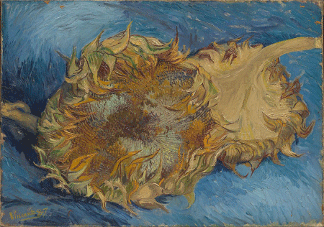
Vincent van Gogh “Sunflowers” 1887 Oil on canvas 43.2 cm x 61 cm The Rogers Fund Metropolitan Museum of Art, New York
“Poor dead flower? when did you forget you were a flower? when did you look at your skin and decide you were an impotent dirty old locomotive? the ghost of a locomotive? the specter and shade of a once powerful mad American locomotive?
You were never no locomotive, Sunflower, you were a sunflower!
And you Locomotive, you are a locomotive, forget me not!
So I grabbed up the skeleton thick sunflower and stuck it at my side like a scepter,
and deliver my sermon to my soul, and Jack’s soul too, and anyone who’ll listen,
—We’re not our skin of grime, we’re not dread bleak dusty imageless locomotives, we’re golden sunflowers inside, blessed by our own seed & hairy naked accomplishment-bodies growing into mad black formal sunflowers in the sunset, spied on by our own eyes under the shadow of the mad locomotive riverbank sunset Frisco hilly tincan evening sitdown vision.”[x]
[i] Van Gogh, Vincent; “Letter 19 to Emile Bernard, August 1888” The Complete Letters of Vincent Van Gogh; New York Graphic Society; Greenwich, Connecticut; 1959; vol. 3, p. 511.
[ii] Knox Martin served as one of the faculty members at the Yale University Summer School of Music and Art in Norfolk, Connecticut during the summer of 1967. His lectures, field trips and critiques were filled with references to these artists and more during that time.
[iii] de la Faille, J. B.; The Works of Vincent van Gogh: His Paintings and Drawings; Reynal & Company in association with William Morrow & Company; Amsterdam and New York; 1970; pp. 29-30.
[iv] de la Faille, J. B.; The Works of Vincent van Gogh: His Paintings and Drawings; Reynal & Company in association with William Morrow & Company; Amsterdam and New York; 1970; pp. 34-35.
[v] Van Gogh, Vincent; The Complete Letters of Vincent Van Gogh; New York Graphic Society; Greenwich, Connecticut; 1959; vol. 3, p. 44.
[vi] Van Gogh, Vincent; The Complete Letters of Vincent Van Gogh; New York Graphic Society; Greenwich, Connecticut; 1959; vol. 3 p. 445.
[vii] Miles, Barry; Ginsberg: A Biography; Simon and Schuster; New York, London and Toronto; 1989; p. 99.
[viii] Blake, William; Songs of Innocence and Songs of Experience; Walton Street Press; Great Britain; 1794 & 2016; p. 38.
[ix] Ginsberg, Allen; Howl; (With an introduction by William Carlos Williams); City Lights Books; San Francisco. California; 1956; pp. 7-8.
[x] Ginsberg, Allen; Howl; (With an introduction by William Carlos Williams); City Lights Books; San Francisco. California; 1956; pp. 28-30.
Henri Matisse “The Fall of Icarus” 1943 Gouache on paper cut out, collaged on canvas 35 x 26.5 cm Private Collection
“‘I warn you,’ Daedalus had said, ‘not to fly so low that the mist or fog weighs down your wings, nor so high that the sun scorches you: fly between the two! Avoid too much heat and too much damp, too much dryness and too much cold. Keep to the center of their wheel. Don’t look at Bootes or Helice, or at Orion’s drawn sword. Take me as your guide and follow!”
“But Icarus grows excited. He forgets the advice. Soon he masters the beating of his wings and swoops in wide, playful circles above the sea. Does Minos see him laughing and dancing on the invisible crest of the world? Like a swimmer, turning his back on the cries from shore, he is already far at sea. He has tired of following his father’s shoulders, his snowy wings and shock of hair. He enters into glory as into a garden, a garden of flames that surrounds him; and he breathes in. ‘O Sun! Father!’ he cries to the encircling fire. Once more he kicks on the wind! Again he beats his wings on the torrid wave of the wind! Once more he thrusts up into the light!”[i]
We know of course, how this is going to end: wings and wax melting, bursting into flames, and finally falling into the sea below. Deadalus, the great engineer and inventor, who had constructed these devices for himself and his son, Icarus, had been imprisoned by King Minos in the very dungeon he had constructed for the Minitaur on orders from this king.
The excitement and enthusiasm of this young man overshadowed the warnings of his father, to stay the course. It is an ancient moral tale from Ovid that has fascinated many generations of painters and poets: from Pieter Breughel (both the Elder and the Younger) to Henri Matisse and from William Carlos Williams to Claude-Henri Rocquet.
Many years ago, in literature and composition classes in Baltimore we were exposed to both classic and contemporary writers, especially Allen Ginsberg and Denise Levertov, Ed Sanders and Susan Sontag. Ezra Pound, T. S. Elliot, Dylan Thomas and Marianne Moore were always mentioned as well, but William Carlos Williams was often sited only as a footnote. Sometimes at night I would hit the library and find the new (at the time) two volume edition of Williams’ Collected Poems on the reserve shelf. I read through the entire collection several times that semester.
I have read that Williams himself was aware of and frustrated by the lack of greater recognition his work was afforded at that time. He continued to write nonetheless, and his last collection, “Pictures from Breughel” proved beyond a doubt his importance. Three months after his death, Williams was awarded the Pulitzer Prize for Poetry for this collection. His deep seeing, attention to detail and sensitivity towards Breughel’s work have continued to influence many younger painters and poets.
II LANDSCAPE WITH THE FALL OF ICARUS
“According to Brueghel
when Icarus fell
it was spring
a farmer was ploughing
his field
the whole pageantry
of the year was
awake tingling
near
the edge of the sea
concerned
with itself
sweating in the sun
that melted
the wings’ wax
unsignificantly
off the coast
there was
a splash quite unnoticed
this was
Icarus drowning”[ii]
Pieter Bruegel “La chute d’Icare” Oil on panel 1562-1563 73.5 x 112 cm Musee Royaux des Beaux-Arts de Belgique, Brussels
[i] Rocquet, Claude-Henri; Bruegel or the Workshop of Dreams; The University of Chicago Press; Chicago and London; 1991. (p. 122).
[ii] Williams, William Carlos; “Landscape With the Fall of Icarus,” Pictures from Breughel; New Directions Publishing Corporation; New York, New York; 1962; p. 4.
“Nothing is hollow or waste to the imagination of Marianne Moore….For I don’t think there is a better poet writing in America today or one who touches so deftly so great a range of our thought….So that in looking at some apparently small object one feels the swirl of great events.”[i]
This is what William Carlos Williams wrote about his friend and colleague Marianne Moore in an article regarding her work for the Quarterly Review of Literature in 1948. This particular issue of the Quarterly Review was published in honor of Miss Moore.
Marianne Moore was born in Brooklyn, New York in 1887 and lived most of her life there. Miss Moore studied at the University of Pennsylvania and worked as a professional librarian, with the other half of her career as a poet. Along the way, she met and shared aesthetic interests with other fellow poets including Ezra Pound and William Carlos Williams. On a rare trip overseas to London and the British Museum with her mother in 1911 she discovered a small Egyptian blown glass sculpture in the form of a fish, which later became an important example of the ekphrastic tradition. She has also written sensitively about Leonardo da Vinci’s “Saint Jerome and His Lion” and “Rodin’s Penseur.”
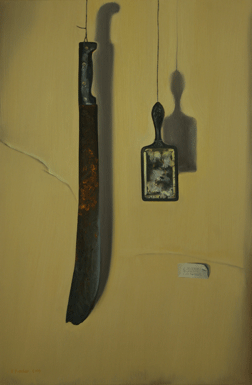
Ellen Fischer “Kodak and Mirror” 2016 Oil on panel 12” x 9” (Courtesy of the artist
Ellen Fischer was born in Oak Park, Illinois in 1956. She studied at the Herron School of Art in Indianapolis, the Skowhegan School of Painting and Sculpture in Maine, and at the School of the Art Institute of Chicago. She has served as a curator at both the Greater Lafayette Museum of Art in Indiana and the Vero Beach Museum of Art in Florida. The other half of her career over these years was of course as a studio artist.
These two could have been sisters, or distant cousins, perhaps not from the exact same family, but from across the spread of time. They share several aesthetic, intellectual and spiritual traditions even though one was an Imagist poet and the other is a contemporary painter. Both women have worked with great independence and determination.
On several occasions I have accompanied Ms. Fischer to art museums, galleries, antique stores and markets in Central Florida. The same eyes that look so intensely at works of art are also used to search out a find or two at the local flea market or Goodwill Store. Her juxtapositions are always surprising and provocative, bringing out the best in every object.
Quietly creating these still lives, flooding them with light and satire and curiosity, Ms. Fischer has assembled a body of work that speaks of human hands and activities. It is exactly what Miss Moore advocated when she mentioned how one object shouldn’t diminish or reduce another: one thing being great because another is small.
Ellen Fischer “Hanging Machete” 2016 Oil on panel 12” x 9” (Courtesy of the artist
Although many of these objects are old and discarded, they are not, to my mind, nostalgic. They are unusual in form and antique in the sense that they carry with them a certain history, or an untold story that may have already been lost, only now to be participants in a totally new story.
When I recently asked Ms. Fischer about her work and her selection of subjects, this was her response:
“YES, I see things at Goodwill and thrift stores and flea markets, and buy them. I know right away that I have to have them, and that I will paint them. The meat cleaver was purchased at the St. Vincent DePaul shop here in Vero. Two friends were with me and I had nothing to buy. When they were checking out, I saw it in a case on the other side of the cash register and asked to see it.”
“Well, once something like that is in your hands you can’t let it go. I paid way more for that cleaver than I usually spend on anything in the thrift store– $10.00!”
“I had done a few paintings with sharp objects in them, and wanted to do more. The cleaver interested me as an object to paint. It did lie around the studio for a few months before I used it, but I never stopped thinking about it, in a general way.”
“It seemed natural to use the little Parian ware ‘Ma Kettle’ figure with it– she is holding an ax, you may have noticed, and has a pig at her side….And she was just the right size to hide behind the blade.”
Ellen Fischer “A Close Call” 2016 Oil on panel 12” x 9” (Private collection Indianapolis)
“Always best when a still life comes together spontaneously. I don’t think you can force objects to go together that don’t belong together, no matter how you juggle them.”
“Sometimes I have played around with objects, positioning them this way and that to see how they might work, but if it doesn’t happen within a reasonable amount of time, I keep the object I am most interested in painting on the table and try different objects with it.”
“I have to feel strongly about the objects in the first place to want to paint them.”[ii]
Because of her interest in various works of art, Marianne Moore was often questioned about her writing and collecting. She struggled to defend the directness of her own work and to explain what she saw in the work of others, both poets and painters. Finally having had enough, she made her own statement regarding what she indeed looked for.
Here is Miss Moore’s response regarding her collection of art and objects:
“When I Buy Pictures
or what is closer to the truth,
when I look at that of which I may regard myself as the imaginary possessor,
I fix upon what would give me pleasure in my average moments:
the satire upon curiosity in which no more is discernible
than the intensity of the mood;
or quite the opposite–the old thing, the medieval decorated hat-box,
in which there are hounds with waists diminishing like the waist of the hour-glass,
and deer and birds and seated people;
it may be no more than a square of parquetry; the literal biography perhaps,
in letters standing well apart upon a parchment-like expanse;
an artichoke in six varieties of blue; the snipe-legged hieroglyphic in three parts;
the silver fence protecting Adam’s grave, or Michael taking Adam by the wrist.
Ellen Fischer “Bust with Palette Knife” 2016 Oil on panel 12” x 9” (Courtesy of the artist)
Too stern an intellectual emphasis upon this quality or that detracts from one’s enjoyment.
It must not wish to disarm anything; nor may the approved triumph easily be honored–
that which is great because something else is small.
It comes to this: of whatever sort it is,
it must be ‘lit with piercing glances into the life of things’;
it must acknowledge the spiritual forces which have made it.”[iii]
[i] Williams, William Carlos; “Marianne Moore” Selected Essays; New Directions Publishing Corporation; New York, New York; 1969; pp. 292-294.
[ii] Fischer, Ellen; An artist’s statement regarding “Close Call” and other still life elements as contained in an e-mail correspondence with this writer, 21 June 2017.
[iii] Schulman, Grace, ed.; The Poems of Marianne Moore; Viking; New York, New York; 2003; p. 144.
“And he came to a certain place, and stayed there that night, because the sun had set. Taking one of the stones of the place, he put it under his head and lay down in that place to sleep. And he dreamed that there was a ladder set up on the earth, and the top of it reached to heaven; and behold, the angels of God were ascending and descending on it! And behold, the Lord stood
above it and said, ‘I am the Lord, the God of Abraham your father and the God if Isaac; the land on which you lie I will give to you and to your descendants; and your descendants shall be like the dust of the earth, and you shall spread abroad to the west and to the east and to the north and to the
Attavante “Le songe de Saint Romuald et l’Echelle des moines”[i] 1502 Miniature on parchment 44 cm. x 34 cm. Wildenstein Collection of Illuminations Musee Marmottan, Parissouth; and by you and your descendants shall all the families bless themselves. Behold, I am with you and will keep you wherever you go, and will bring you back to this land; for I will not leave you until I have done that of which I have spoken to you.’ Then Jacob awoke from his sleep and said, ‘Surely the Lord is in this place….This is none other than the house of God, and this is the gate of heaven.’”[ii]
The Jacob’s Ladder
“The stairway is not
a thing of gleaming strands
a radiant evanescence for angels’ feet that
only glance in their
tread, and
need not touch the stone.
It is of stone.
A rosy stone that takes
a glowing tone of softness
only because behind it the sky is a
doubtful,
a doubting night gray.
A stairway of sharp
angles, solidly built.
One sees that the angels must spring
down from one step to the next giving a
little
lift of wings:
and a man climbing
must scrape his knees and bring
the grip of his hands into play. The cut
stone
consoles his groping feet. Wings brush past
him.
The poem ascends.”[iii]
There are many literary references and historical illustrations to the passage of people and angels traveling between Heaven and Earth. There are also contemporary examples such as the one above by Denise Levertov and one at the end of this essay by Bob Dylan. In literature these draw upon the Old Testament story of the Dream of Jacob. In music there is a major source for this in the great American Southern Baptist spiritual: “Jacob’s Ladder.”
“We are climbing Jacob’s ladder.
We are climbing Jacob’s ladder.
We are climbing Jacob’s ladder,
Soldiers of the cross.
Every rung goes higher and higher.
Every rung goes higher and higher.
Every rung goes higher and higher.
We are brothers, and sisters, all.”[iv]
It was one of the first African American spirituals to become popular with both black and white citizens of the south. There is no record of when it was written or who wrote it, but it came into being sometime between 1750 and 1825, and was known as a call and response song amongst slaves. The ladder quickly became one of many symbols for the means of escaping slavery.
As is typical with folk traditions, this song was handed down through generations and verses were added and changed to reflect more recent times. Significant versions from the 20th Century include recordings by Paul Robeson, Pete Seeger and most recently by Bruce Springsteen during his “Seeger Sessions.”
Georgia O’Keeffe “Ladder to the Moon” 1958 Oil on canvas 40 3/16” x 30 1/4” The Whitney Museum of American Art, New York
In the visual arts as well, this imagery has wide ranging uses, from medieval manuscript illuminations to pieces of surrealism and even to contemporary sculpture. The “Dream of Romuald with the stairs of the Monks” from an Italian book illumination at the Marmottan-Monet Museum in Paris is a reference to the story of Jacob’s Ladder. Many early 20th Century artists incorporated this imagery into their work, from realists to surrealists, from Georgia O’Keeffe to Joan Miro and most recently, Martin Puryear, who has used the ladder form in his sculpture dedicated to Booker T. Washington.
Martin Puryear “Ladder for Booker T. Washington” 1996 Wood (ash and maple) 432” x 22 3/4” x 3” The Modern Art Museum of Fort Worth, Texas
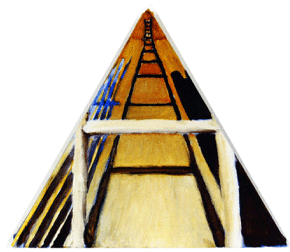
Finally, a young artist here in Indiana has for several years been employing severe and unusual views of many ordinary and everyday objects. Having studied at the Herron School of Art in Indianapolis, the Pont-Aven School of Contemporary Art in Pont-Aven, France and the Arizona State University in Tempe, Sarah Jones has always had an eye for the unique angle of things.
Sarah K. Jones “Ladder #2” 1993 Oil on canvas 12” x 12” Courtesy of the artist
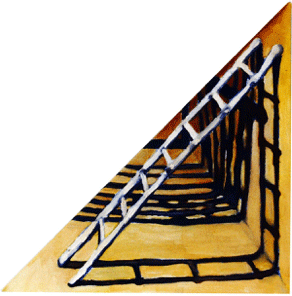
The dramatic placement and situation of certain objects is combined with her own personal point of view towards these things. Her paintings above and below best illustrate this, as does her own statement regarding how they came about.
Sarah K. Jones “Ladder #3” 1993 Oil on canvas 12” x 12” Courtesy of the artist
“The paintings came about after a summer spent in the four corners region. I was working on a ranch in Durango, CO and took weekend trips to places like Mesa Verde, Taos, and Albuquerque. It was my first trip west of the Mississippi and I was fascinated by the differences in landscape and even quality of light compared to Indiana. The images which inspired the paintings were taken at Taos Pueblo. The sky was SO blue. The light was SO bright. The shadows were SO strong. I loved the clean lines of the buildings and the shadow patterns made by ladders leaning against the adobe buildings. They formed lovely right angle triangles: building= side 1, ladder = side 2 and shadow of ladder falling across the ground = side 3.”[v]
Sarah Kathryn Jones “Ladder #1” 1993 Oil on canvas 12” x 12” Courtesy of the artist
Finally, I am reminded of a certain theme that runs through much of the writing of William Carlos Williams: primarily in his epic poem “Patterson” and secondly in an essay on the work of the artist Charles Sheeler. He mentions several times that we should “Say it! No ideas but in things!”[vi] And further, he observes that “It is in things that for the artist power lies….”[vii] So, it is in both poetry and painting that a single object might become a powerful image.
“May God bless and keep you always
May your wishes all come true
May you always do for others
And let others do for you
May you build a ladder to the stars
And climb on every rung
And may you stay forever young”[viii]
[i] Translated as “The Dream of St. Romuald and the Ladder of the Monks” this is a piece from the Wildenstein Collection of historic manuscript illuminations at the Marmottan-Monet Museum in Paris. One historian, Peter Damian, has noted that St. Romuald’s Dream is also a conflation of the legend of Jacob’s Dream.
[ii] “Genesis 28:11-17” The Holy Bible: Revised Standard Version; Thomas Nelson & Sons; New York, Toronto, Edinburgh; 1952; p. 21.
[iii] Levertov, Denise; Selected Poems; New Directions Publishing Corporation; New York, New York; 2002; p. 25.
[iv] Springsteen, Bruce; “Jacob’s Ladder” The Seeger Sessions; Audio Recording, Columbia Records and Sony Entertainment; New York, New York; 1998 & 2006.
[v] Jones, Sarah; An artist’s statement regarding her “Ladder Paintings” as contained in an e-mail correspondence with this writer, 16 May 2017.
[vi] Williams, William Carlos; Patterson; New Directions Publishing Corporation; New York, New York; 1992; pp. 6 & 9.
[vii] Williams, William Carlos; Selected Essays; New Directions Publishing Corporation; New York, New York; 1969; p. 234.
[viii] Dylan, Bob; “Forever Young” Planet Waves; Audio Recording, Columbia Records and Sony Entertainment; New York, New York; 1974 & 2004.
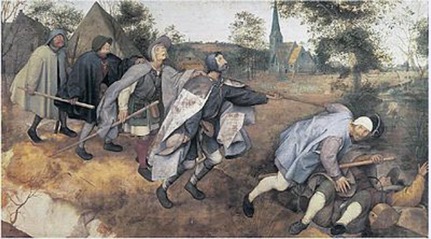
In the New Testament both Matthew and Luke relate the story of Jesus being confronted and questioned by the Pharisees, who were pretending to be ‘teachers’ and trying to catch this young man in his own teachings. When questioned by his disciples later, Jesus described the Pharisees like this:
“. . . they are blind guides. And if a blind man leads a blind man, both will fall into a pit.”[i]
Pieter Breughel the Elder “The Parable of the Blind” 1568 Distemper on linen canvas 86 cm x 154 cm Museo di Capadimonte, Naples, Italy
It was a powerful image that caught the imagination of many Northern Renaisance artists, especially Pieter Breughel the Elder. Later still, it continued to influence writers such as Charles Baudelaire and William Carlos Williams, who included this subject in his final collection, Pictures from Brueghel, which won the Pulitzer Prize for Poetry in 1963, just two months after that author’s death.
“This horrible but superb painting
the parable of the blind
without a red
in the composition shows a group
of beggars leading
each other diagonally downward
across the canvas
from one side
to stumble finally into a bog
where the picture
and the composition ends back
of which no seeing man
is represented the unshaven
features of the des-
titute with their few
pitiful possessions a basin
to wash in a peasant
cottage is seen and a church spire
the faces are raised
as toward the light
there is no detail extraneous
to the composition one
follows the others stick in
hand triumphant to disaster” [ii]
Paintings by Pieter Breughel and poems by William Carlos Williams have continued to inspire and influence artists and writers today. “Referring to a group of figural drawings he had begun around 1963, Willem de Kooning would say in 1975, ‘I draw while painting, and I don’t know the difference between painting and drawing. The drawings that interest me most are made with eyes closed.’”[iii]
They all looked like scratches, these drawings that de Kooning called ‘blind’ drawings. We first saw them in an exhibition at the Contemporary Arts Center[iv] in Cincinnati, Ohio in 1979. At the time, this exhibition was known as “Recent de Kooning” and featured paintings, drawings, and sculptures completed since 1969.
Willem de Kooning “Blind Drawing” 1969 Ink on paper 26” x 18 7/8” Estate of the artist
What we didn’t know at the time, was that de Kooning completed these drawings in a vertical format and later rotated them 90 or 180 degrees in order to further dissorient the viewer. When re-oriented to their original format certain details emerge: these details include several clear references to Breughel’s great painting, “The Parable of the Blind.”
Pieter Breughel the Elder “The Parable of the Blind” DETAIL
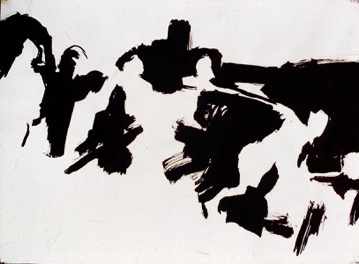
You wouldn’t believe the number of art students who in studying this painting will draw all of the figures straight across the page from left to right, all in a line, and all horizontally. Totally ignoring the descending diagonal from the upper left to the lower right. This of course flattens both the movement and the composition.
Casey Roberts “Study #1 from The Parable of the Blind” 1993-1994 Brush and ink on paper 18” x 24” Courtesy of the artist, Indianapolis, Indiana
One younger artist who noticed this right away was Casey Roberts. Examples of his brush and ink drawings above and below, clearly show that he saw this diagonal movement and took it to a contemporary conclusion. As long time faculty members in various art schools around the country we could all probably be described as the blind leading the blind. An all encompassing metaphor.
Casey Roberts “Study #2 from The Parable of the Blind” 1993-1994 Brush and ink on paper 18” x 24” Courtesy of the artist, Indianapolis, Indiana
[i] “Matthew 15:13-14” The Holy Bible: Revised Standard Version; Thomas Nelson & Sons; New York, Toronto, Edinbugh; 1952; p. 770.
[ii] Williams, William Carlos; Pictures from Brueghel and other poems; New Directions Publishing Corporation; New York, New York; 1967; p. 11.
[iii] Elderfield, John, et al; de Kooning a Retrospective; The Museum of Modern Art; New York, New York; 2011; p. 369.
[iv] Cowart, Jack, and Sanford Sivits Shaman; de Kooning 1969-1978; University of Northern Iowa; Cedar Falls, Iowa; 1978.




















 BRIDGING THE GAP