In a short prose poem, six pages at best, Jack Kerouac sets the stage for a much longer visual poem by the photographer Robert Frank:
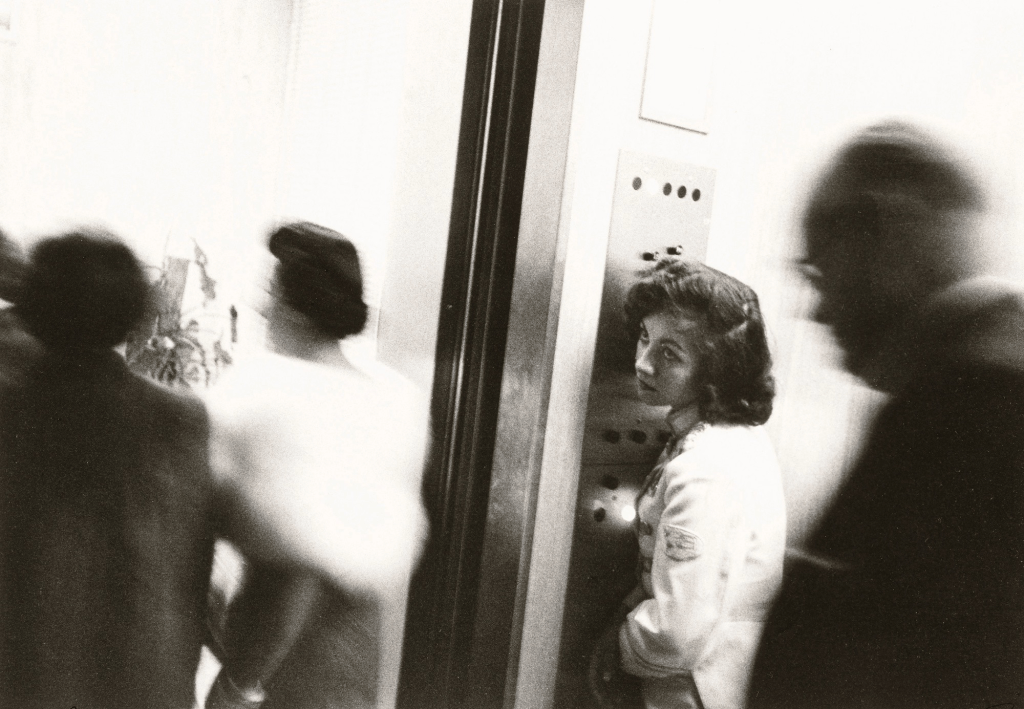
“Robert Frank, Swiss, unobtrusive, nice, with that little camera that he raises and snaps with one hand he sucked a sad poem right out of America onto film, taking rank among the tragic poets of the world. . . . And I say: ‘That little ole lonely elevator girl looking up sighing in an elevator full of blurred demons, what’s her name & address?’”1
Robert Frank “Elevator, Miami Beach” 1955 Gelatin silver print 9 1/8” x 13 1/4” Metropolitan Museum of Art, New York
For many years my Dad worked as a photographer, first for the commercial company Cooper-Trent in Washington, DC, and later for the federal government. He was the one who first taught me how to shoot and process film, although I struggled with this. Later in college, 1967 summer school in Norfolk, Connecticut, it was Walter Rosenblum and his assistant, Sedat Pakay, who took us under their wings. Two other personal influences also should be mentioned here: the sensitive portraits of one of my classmates at Norfolk, Carol Ginandes; and a second classmate in Baltimore, Dudley Gray, whose visions of New York City are continually inspiring. All of these examples are ways to help us to see and to work directly.
In writing, it is no surprise that many contemporary poets used the dictum: first thought, best thought. Not unlike the photographer who composes, shoots, and fills the full frame, instantaneously. By writing directly, it eliminated the process of editing and re-writing, which can often make a work stiff, too structured, and not as spontaneous. So it is no surprise that the photographer Robert Frank hooked up with the writer Jack Kerouac for the publication of his photographic series “The Americans.”
Kerouac’s lines resonate with the imagery in equally spontaneous ways.
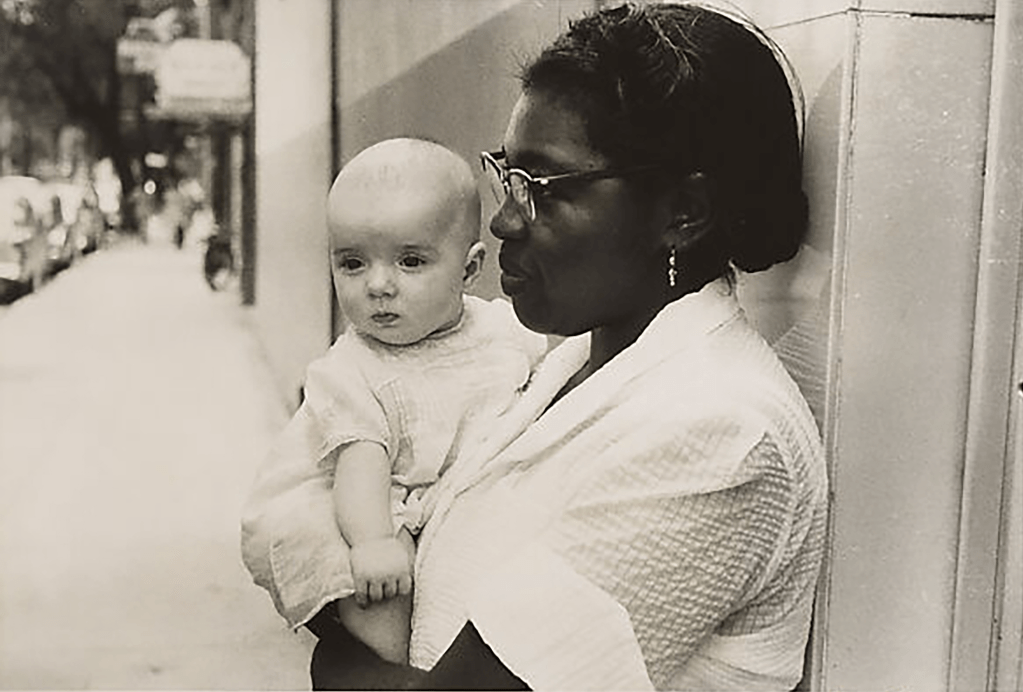
“——-The gasoline monsters stand in the New Mexico flats under big sign says Save——-the sweet little white baby in the black nurse’s arms both of them bemused in heaven, a picture that should have been blown up and hung in the street of Little Rock showing love under the sky and in the womb of our universe. . . .”2
Robert Frank “Charlestown, South Carolina” 1955 Gelatin silver print 8 1/4” x 12 1/4” Metropolitan Museum of Art, New York
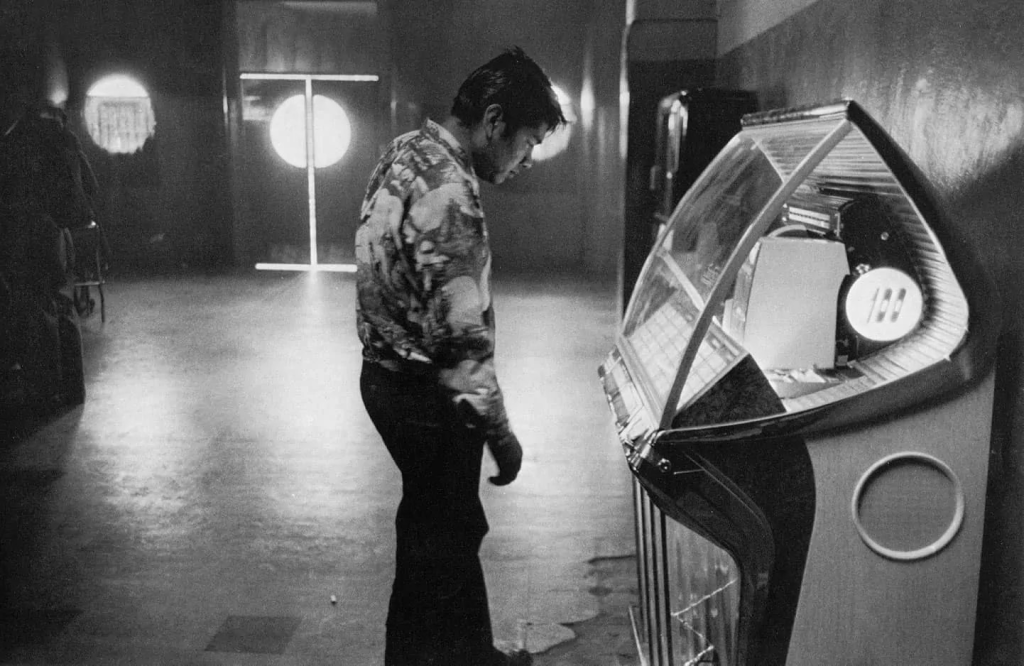
“THAT CRAZY FEELING IN AMERICA when the sun is hot on the streets and music comes out of the jukebox or from a nearby funeral, that’s what Robert Frank has captured. . . with the agility, mystery, genius, sadness and strange secrecy of a shadow photographed scenes that have never been seen before on film. . . . After seeing these pictures you end up finally not knowing any more whether a jukebox is sadder than a coffin. That’s because he’s always taking pictures of jukeboxes and coffins. . . !”3
Robert Frank “Bar, Las Vegas, Nevada” 1955/56 Gelatin silver print 8 15/16” x 13 7/16” The Art Institute of Chicago, Chicago, Illinois
“What a poem this is, what poems can be written about this book of pictures some day by some young new writer high by candlelight bending over them describing every gray mysterious detail, the gray film that caught the actual pink juice of human kind. Whether ’t is the milk of humankind-ness, of human-kindness, Shakespeare meant, makes no difference when you look at these pictures. Better than a Show.”4
Louis Faurer “Robert Frank” 1947 Gelatin silver print 8 1/16″ x 5 3/8″ National Portrait Gallery, Smithsonian Institution, Washington, DC.
And Kerouac’s last word to all of this:
“Anybody doesnt like these these pitchers dont like potry, see? Anybody dont like potry go home see Television shots of big hatted cowboys being tolerated by kind horses.”
“To Robert Frank I now give this message: You got eyes.”5
1 Frank, Robert; The Americans; (With and Introduction by Jack Kerouac); An Aperture Book, Grossman Publishers; New York, New York; 1969; p. vi.
2 Frank, Robert; The Americans; (With and Introduction by Jack Kerouac); An Aperture Book, Grossman Publishers; New York, New York; 1969; p. vi.
3 Frank, Robert; The Americans; (With and Introduction by Jack Kerouac); An Aperture Book, Grossman Publishers; New York, New York; 1969; p. i.
4 Frank, Robert; The Americans; (With and Introduction by Jack Kerouac); An Aperture Book, Grossman Publishers; New York, New York; 1969; p. iii.
5 Frank, Robert; The Americans; (With and Introduction by Jack Kerouac); An Aperture Book, Grossman Publishers; New York, New York; 1969; p. vi.
“The humanity, the simple direct humanity of his figures—you feel like they’re real people that you can empathize with. He treats them with a certain dignity, it’s not like he’s trying to belittle them by making them seem so down-to-earth. He has respect for the ordinary person.”1
This is one of the many observations that my friend and colleague Stephanie Dickey has made regarding the work of Rembrandt van Rijn. She is one of the leading authorities on this artist, and was interviewed by Smithsonian Magazine on the anniversary of his 400th birth. She is unique amongst art historians, in my opinion, as she is so aware of, and sensitive to, the thought and painting processes of artists, not unlike the writing of the poet Robert Bly, who has himself had a life long interest and sensitivity to the work of painters and sculptors.
The Old St. Peter by Rembrandt
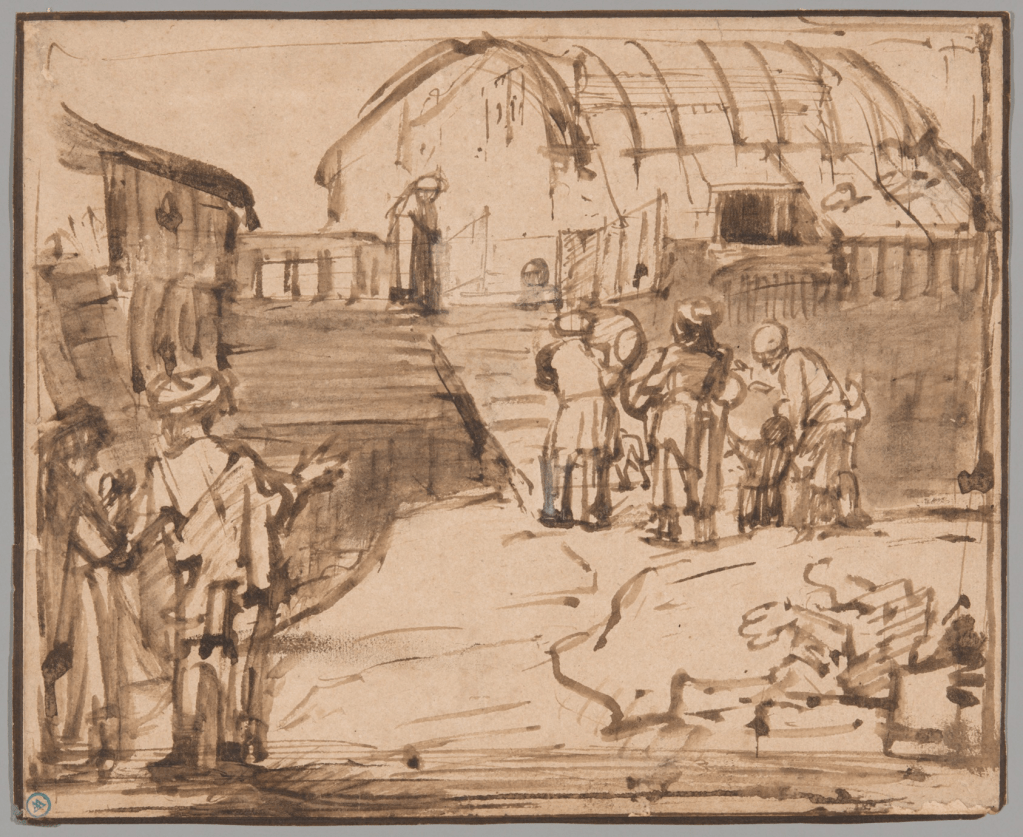
“Noah’s ship does not sail with its elephants forever. The crying of the monkeys breaks off and starts again. Even shame does not last a whole lifetime.”
Rembrandt van Rijn “Noah’s Ark” 1660 Pen & ink with brown washes 203mm x 248mm The Art Institute of Chicago, Chicago, Illinois.
“‘It was dark,’ Peter said. ‘We were alone. We had A single candle which shone on the steel breastplate Of the Roman soldier. The whole town was asleep.’
We are bubbles on the lips of our friends. Each time they turn their heads, we drift toward the Pole; We pass into the Many and return.
Who can say, ‘With God, the rest is nothing?’ Who can say, ‘I am a grandchild of the unfaithful?’ Who is able to wait one month to drink water?
We fell into weeping yesterday at five o’clock. We wept because slavery has returned; we wept Because the whole century has been a defeat.
Oh Peter! Peter! The night behind you is black. A beam of light falls on your outworn face. What can you do but lift up your hand for forgiveness?”2
Rembrandt van Rijn “The Apostle Peter” 1632 Oil on canvas 32.2” x 24.4” Nationalmuseum, Sweden
Rembrandt’s Brown Ink
“The sorrow of an old horse standing in the rain Goes on and on. The plane that crashes in the desert Holds shadows under its wings for thirty years.
Each time Rembrandt touches his pen to the page, So many barns and fences fly up. Perhaps that happens Because earth has pulled so many nights down.
When we hear a Drupad singer with his low voice Patiently waiting for the next breath, we know The universe can easily get along without us.
So much suffering has been stored in the amygdala That we know it won’t be long before we put Our heads down on the chopping block again.
Our thighs still remember all those smoky nights When we crouched for hours on the dusty plains Holding small-boned mammals into the fire.
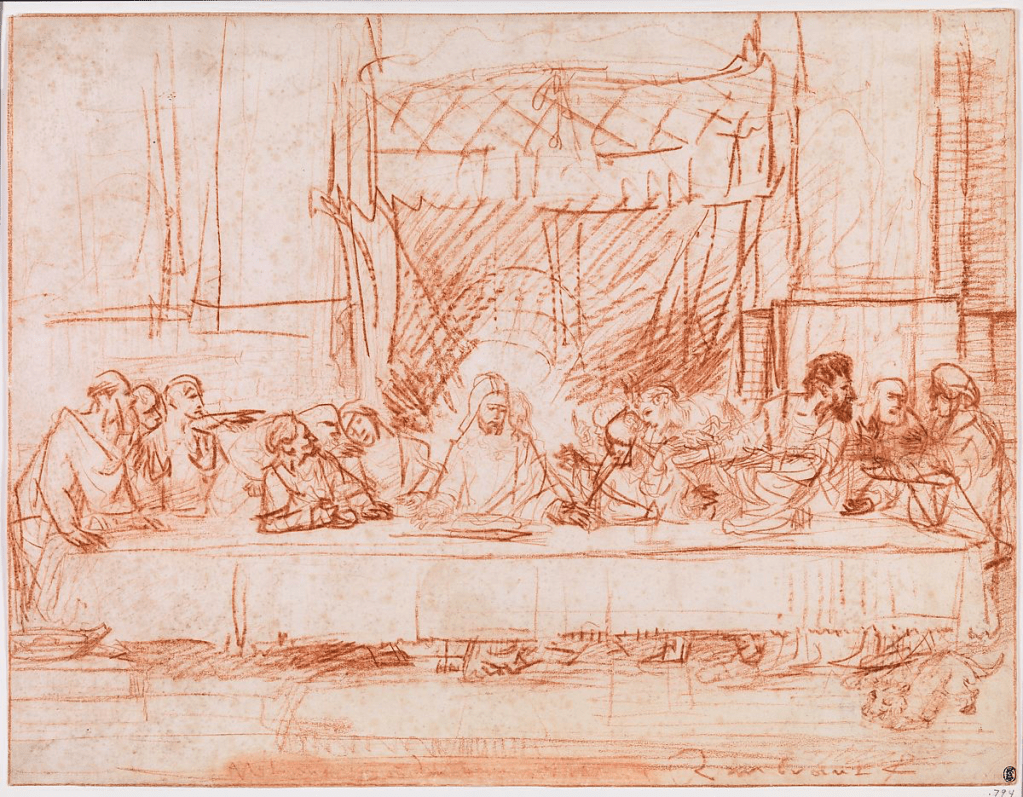
How is it possible that so many nights of suffering Could be summed up by a sketch in brown ink Of Christ sitting at the table with Judas near?”3
Rembrandt van Reign “The Last Supper, after Leonardo da Vinci” 1634-1635 Red chalk 14 1/4” x 18 11/16” Robert Lehman Collection, The Metropolitan Museum of Art, New York, New York.
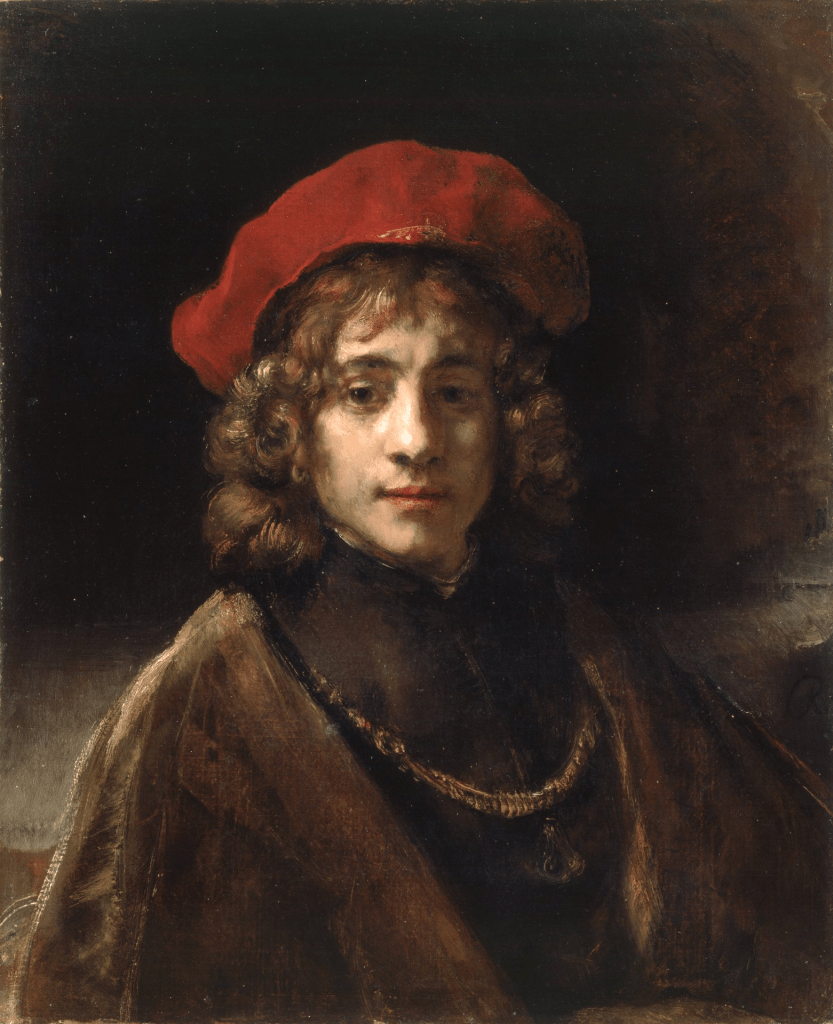
Rembrandt’s Portrait of Titus with a Red Hat
“It’s enough for light to fall on one half of a face. Let the other half belong to the restful shadow, The shadow the bowl of bread throws on the altar.
Some are like a horse’s eating place At the back of the barn where a single beam Of light comes down from a crack in the ceiling.
Painting bright colors may lie about the world. Too many windows cause the artist to hide. Too many well-lit necks call for the axe.
Beneath his red hat, Titus’s eyes hint to us How puzzled he is by the sweetness of the world— The way the dragonfly hurries to its death.
So many forces want to kill the young Male who has been blessed. The Holy Family Has to hide many times on the way to Egypt.
Titus receives a scattering of darkness. He’s baptized by water soaked in onions; The father protects his son by washing him in the night.”4
Rembrandt van Rijn “Portrait of Titus with Red Hat” 1657 Oil on canvas 68.5cm x57.3cm The Wallace Collection, London, The United Kingdom.
Everything he paints, he paints with a sense of light (a touch of light) and a tacit understanding of the sitter just across from him. The form is felt with each brushstroke, and handled with sensitivity as the light falls across the space/face. One may identify one of these paintings from across the gallery, even without seeing the didactic information posted on the nearby wall. Always recognizable. And this work has grown so much, almost mythologically, that it exists on a whole ‘nother level of culture. So the last word on this surely belongs to my colleague and friend Stephanie Dickey from her observations on 400 Years of Rembrandt. Rembrandt’s reputation has taken on a life of its own:
“One thing that really surprises me is the extent to which Rembrandt exists as a phenomenon in pop culture. You have this musical group called The Rembrandts, who wrote the theme song to Friends—‘I’ll Be There For You.’ There are Rembrandt restaurants, Rembrandt hotels, art supplies and other things that are more obvious. But then there’s Rembrandt toothpaste. Why on Earth would somebody name a toothpaste after this artist who’s known for his really dark tonalities? It doesn’t make a lot of sense. But I think it’s because his name has become synonymous with quality. It’s even a verb—there’s a term in underworld slang, ‘to be Rembrandted,’ which means to be framed for a crime. And people in the cinema world use it to mean pictorial effects that are overdone. He’s just everywhere, and people who don’t know anything, who wouldn’t recognize a Rembrandt painting if they tripped over it, you say the name Rembrandt and they already know that this is a great artist. He’s become a synonym for greatness.”5
Dr. Stephanie Dickey, Bader Chair in Northern Baroque Art, Queen’s University, Kingston, Ontario, Canada.
1 Amy, Crawford; An Interview with Stephanie Dickey, author of ‘Rembrandt at 400’; “Arts & Culture,” Smithsonian Magazine; 1 December 2006; Washington, DC; Archived 21 September 2018.
2 Bly, Robert; The Night Abraham Called to the Stars; Perennial/Harper Collins; New York; 2001; p. 75.
3 Bly Robert; My Sentence was a Thousand Years of Joy; Harper Perennial; New York, London, Toronto and Sydney; 2005; p. 35.
4 Bly, Robert; The Night Abraham Called to the Stars; Perennial/Harper Collins; New York; 2001; p. 39.
5 Amy, Crawford; An Interview with Stephanie Dickey, author of ‘Rembrandt at 400’; “Arts & Culture,” Smithsonian Magazine; 1 December 2006; Washington, DC; Archived 21 September 2018.
It is not really a debate, more like an on-going discussion on the Post-Modern Condition from the point of view of a rabbit and a kitty cat. They are constantly asking each other questions, and pointing out the contradictions in both the real and imagined worlds surrounding them, leading to a long list of interesting philosophical problems which often begin in The Artist’s studio.
“Maybe it comes from her imagination, so it’s not real at all.”1
“‘You don’t always want to imagine something,’ Kitty Boy answered. ‘Sometimes you just do it: it comes to you whether you want it or not.’”2
“I think I get it now, Rabbit thought. I’ve been taking this situation seriously. But the whole thing is a joke, the dancing rabbits and the pink flower and the torn-up field. It isn’t really happening. I thought it was a dream, or eating the flowers, or my imagination, or The Artist’s new painting. It’s just a joke someone is playing on me.”3
Kristy Deetz “New Year’s Eve Pawsing” Acrylic paint, embroidery, on digital pattern printed on silk 36” x 36” x 1.5” 2020 Courtesy of the artist.
In the new publication “Holidays Unfolding: The Continuing Adventures of Rabbit and Kitty Boy” the main characters are of course Rabbit and Kitty Boy, along with one or two supporting characters such as Bo-Doggie. Then there are two other main characters, “The Artist” and “The Writer” who are often referred to and always seem as gods to the animal characters. Kristy Deetz and Edward S. Louis are the creators of this fictional story: the series of paintings depicting the animals and their adventures and the text that so aptly describes the world in which they exist.
The paintings are seen at first as patterns repeated across a background fabric. The animals are flattened and fitted together in order to hold that plane. However, placed just in front of this screen, are a series of small ceramic animal sculptures, coming forward in space. And finally, in front of this backdrop, the characters of Rabbit and Kitty Boy come to life. This after having discovered that they have jumped off of the picture plane and can now see themselves as separated from the patterned background. This is a startling existential recognition. This is also where the confusing discussion regarding the difference between the modern and the post-modern and the function of the imagination begins. We are seeing and experiencing three levels of plastic space, as well as three levels of literary irony and parody. The two fit perfectly together like a fine glove.
There are many questions in any discussion of the ekphrastic tradition and two of the most important ones ask: are these paintings illustrations of the stories, or are the stories true literary reactions/responses to already existing works of visual art? These same questions, regarding several other historical artists immediately come to mind: both the poems and prints of William Blake, the classic French story and the accompanying drawings for “Le Petite Prince” by Antoine St. Exupery, and the many versions and editions of “The Fables of La Fontaine.” These works of visual art and the writing are seemingly inseparable. We must add to this list the new work created by the artist Kristy Deetz and the writer Edward S. Louis.
Their work also raises new questions not just regarding the ekphrastic tradition, but also related to the post Post-Modern era. In recent years we have become lost in a jumble of images, meanings, and interpretations of every little thing, very often losing track of any original ideas. In literature, art and even architecture, certain forms and images were re-introduced into the overall content of this era that came after the Modern one. Although this was all supposed to become more enlightening, it most often led to confusion. Beginning with a sense of historical playfulness, this point of view was soon replaced with parody, irony, and even out right joking!
Kristy Deetz “Friends Day Hiding” 2020 Acrylic paint, embroidery, image transfer, on digital pattern printed on silk 36″ x 36″ x 1.5” Collection of the artist.
Over the years, Deetz has been producing a series of “Veil Paintings” investigating the idea of “Nature Morte” and giving life back to certain objects and imagery. Adding to this, a new series titled “Holidays Unfolding” explores certain contradictions in the phenomenon of seeing. In painting, the process of applying the paint itself becomes a metaphor for the subjects of a still life: laying on the under-painting and the background; developing and arranging the drapery; and finally the arrangement of objects in an overall composition. Although the resulting life is still, a closer seeing of the paintings will reveal a lot of shifting movement.
Through correspondence with both Kristy Deetz and Edward S. Louis I have discovered several unique interrelationships regarding their work. Describing this process, Deetz writes: “The painted fabric, ellipses, and patterned fabric in the paintings act as limina or thresholds that, along with the accompanying images and forms, place the viewer into multiple, often conflicting, layers of space and meaning. . . . The paintings good-humoredly deconstruct imagery from my own painting history, as well as from pop and high culture to create new ‘spaces’ of meaning. The paintings also contain dark humor, visual puns, symbols and metaphors, moments of silence, art historical allusions, and spiritual conundrums.”
“Yes, our process is ekphrastic. I make the painting series and when completed Ed creates a story about the series. Rabbit and Kitty Boy evolved out of my Through the Veil series but appeared in other forms in past work. Our process is also somewhat collaborative. We are very self-directed but give each other feedback in the middle of things, on titles, visual puns, and finished products.” 4
The author Edward S. Louis, who has often taught on the subject of ekphrastics, has offered this definition to me: “Ekphrasis in Greek literally means to ‘tell out’ or ‘recount.’ By its nature it relies on collaboration, since it incorporates or encapsulates the original to which it responds. I’ve been thinking about it for a long time, too, for me in the context of what ‘literary criticism’ means. I’ve argued in critical as well as creative outlets that our tradition has often drawn too firm a line between ‘scholarly’ work and ‘creative’ work. The creative is much better if it has a scholarly base, and scholarly work is more fun to read if it has a creative edge. Ekphrasis is an excellent means/mode to do critical and creative work at once.”
“The stories ‘illustrate’ the visuals (that, I think, is our major innovation, since it’s backwards of standard expectations). There would be no stories without the visuals. In some cases the stories explicate, whereas in others they derive from or expand on the paintings. So they both ‘tell out’ and ‘recount’ what the paintings do, as well as taking some latitude to introduce narrative possibilities that the paintings imply or inspire, sometimes one at a time or sometimes through the course of several at a time.”5
Kristy Deetz “Halloween Floating” Acrylic paint, embroidery, image transfer, on digital pattern printed on silk 36” x 36” x 1.5” 2017 Courtesy of the artist.
At the beginning of this adventure, these characters are speculating on many possibilities. Reflecting on all of this near the end, it is Kitty Boy who observes:
“Kitty Boy wondered. They all seem to be floating into that hole. Where does it go, and what will happen to them? That one looks a little like Rabbit, and that one: is it Bo-Doggie? And, hey! Is that one supposed to be me?” “He was standing on the windowsill in the studio looking at The Artist’s new painting.” “It showed many rabbits, all wearing masks—one that Kitty Boy thought looked like him—and they were all drifting up toward a large, black hole.” “Back out of the hole came nothing but ghost rabbits, thin shadows of their former selves. But the live rabbits seemed not to care; they seemed not even to be aware of what they were doing. Ghost bats flew around the rabbits, but neither seemed to notice the other. A tablecloth that someone had been starting to sew was also drifting toward a hole, about to get tugged in. On top of the table another cloth unfolded—Kitty Boy wasn’t sure if it was a banderole or a toilet roll.”6
“Maybe imagining isn’t such a bad thing.”7
1 Deetz, Kristy, and Edward S. Louis; Holidays Unfolding: The Continuing Adventures of Rabbit and Kitty Boy; Elm Grove Publishing; San Antonio, Texas; 2021 & 2022; p. 15.
2 Deetz, Kristy, and Edward S. Louis; Holidays Unfolding: The Continuing Adventures of Rabbit and Kitty Boy; Elm Grove Publishing; San Antonio, Texas; 2021 & 2022; p. 16.
3 Deetz, Kristy, and Edward S. Louis; Holidays Unfolding: The Continuing Adventures of Rabbit and Kitty Boy; Elm Grove Publishing; San Antonio, Texas; 2021 & 2022; p. 33.
4 Deetz, Kristy; E-mail communication with this author; 10 October 2021, 5:43 PM.
5 Risden, Edward (aka Edward S. Louis); E-Mail communication with this author; 12 January 2022, 10:30 PM.
6 Deetz, Kristy, and Edward S. Louis; Holidays Unfolding: The Continuing Adventures of Rabbit and Kitty Boy; Elm Grove Publishing; San Antonio, Texas; 2021 & 2022; p. 77.
7 Deetz, Kristy, and Edward S. Louis; Holidays Unfolding: The Continuing Adventures of Rabbit and Kitty Boy; Elm Grove Publishing; San Antonio, Texas; 2021 & 2022; p. 95.




 BRIDGING THE GAP