SELF-PORTRAIT IN A CONVEX MIRROR

Beginning with the Renaissance and running through our contemporary era it has been a recurring metaphor that painting has provided a window onto, or a mirror of, the world. So much so, that we may often forget the power of reflection and the conventions of reflecting the things surrounding us. Two examples include the foreground still life in the Northern Renaissance painting of “The Money Changer and his Wife” from 1514 by Quinten Massys and an M. C. Escher lithograph of the “Hand with a Reflecting Sphere” from 1935. Sandwiched in between is that great “Self-Portrait in a Convex Mirror” by Girolamo Francesco Maria Mazzola, otherwise known as Parmigianano.

Quinten Massys
“The Money Changer and his Wife”
1514
Oil on canvas
70.5cm x 67cm
Musée Louvre, Paris

There are two important literary examples associated with this single painting by Parmigianino: the first one historic, written by Vasari regarding the creation of this painting, and the second one modern, John Ashberry’s extensive and thoughtful meditation on this subject.

The artist is seen in a circular form: a sphere that has been cut in half, one part to be polished and glazed into a mirror and the second part to be prepared and used as the support for this very painting.

Although it is small in diameter, it is forceful in its imagery, and a perfect presentation piece intended to be seen by future patrons in Rome. We are confronted by his intense stare, slightly above center of the composition, and then the sweep of his shoulder and arm around into the extreme foreground, concluding with that hand. A circular movement shown by the model himself that echoes the circular form of the entire painting.
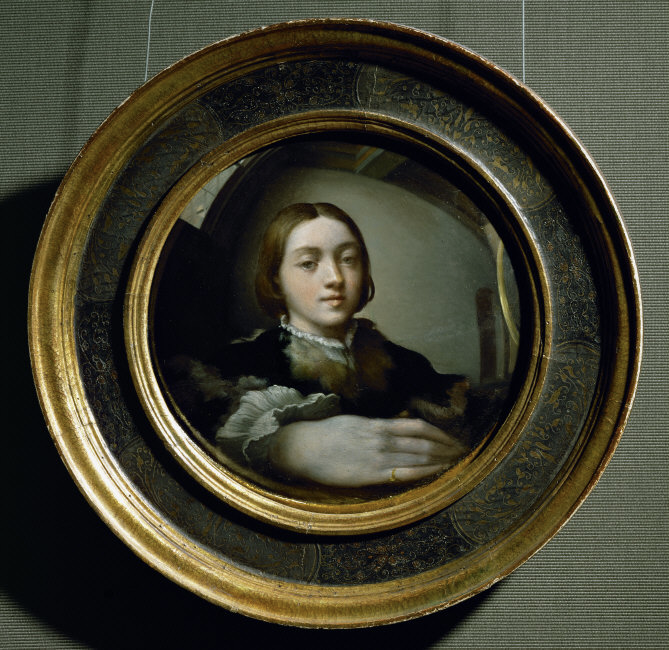
Francesco Mazzola, called Parmigianino
c. 1524
Oil on a convex panel
9.6” in diameter
Kunsthistorisches Museum, Vienna

“Then came upon him the desire to see Rome, hearing men greatly praise the works of the masters there, especially of Raffaello and Michael Angelo, and he told his desire to his old uncles. They, seeing nothing in the desire that was not praiseworthy, agreed, but said that it would be well to take something with him which would gain him an introduction to artists. And the counsel seeming good to Francesco, he painted three pictures, two small and one very large. Besides these, inquiring one day into the subtleties of art, he began to draw himself as he appeared in a barber’s convex glass. He had a ball of wood made at a turner’s and divided in half, and on this he set himself to paint all that he saw in the glass, and because the mirror enlarged everything that was near and diminished what was distant, he painted the hand a little large. Francesco himself, being of very beautiful countenance and more like an angel than a man, his portrait on the ball seemed a thing divine, and the work altogether was a happy success, having all the lustre of the glass, with every reflection and the light and shade so true, that nothing more could be hoped for from the human intellect.”1

“The picture being finished and packed, together with the portrait, he set out, accompanied by one of his uncles, for Rome; and as soon as the Chancellor of the Pope had seen the pictures, he introduced the youth and his uncle to Pope Clement, who seeing the works produced and Francesco so young, was astonished, and all his court with him. And his Holiness gave him the charge of painting the Pope’s hall.”2

Sebastiano del Piombo
“Portrait of Pope Clement VII”
c. 1531
41 1/2” x 34 1/2”
Oil on slate
J. Paul Getty Museum, Los Angeles, California.

“The glass chose to reflect only what he saw

Which was enough for his purpose: his image

Glazed, embalmed, projected at a 180-degree angle.

The time of day or the density of the light

Adhering to the face keeps it

Lively and intact in a recurring wave

Of arrival. The soul establishes itself.

But how far can it swim out through the eyes 

And still return safely to its nest? The surface

Of the mirror being convex, the distance increases

Significantly; that is, enough to make the point

That the soul is a captive, treated humanely, kept

In suspension, unable to advance much farther

Than your look as it intercepts the picture.

Pope Clement and his court were ‘stupefied’

By it, according to Vasari, and promised a commission

That never materialized. . . .”3
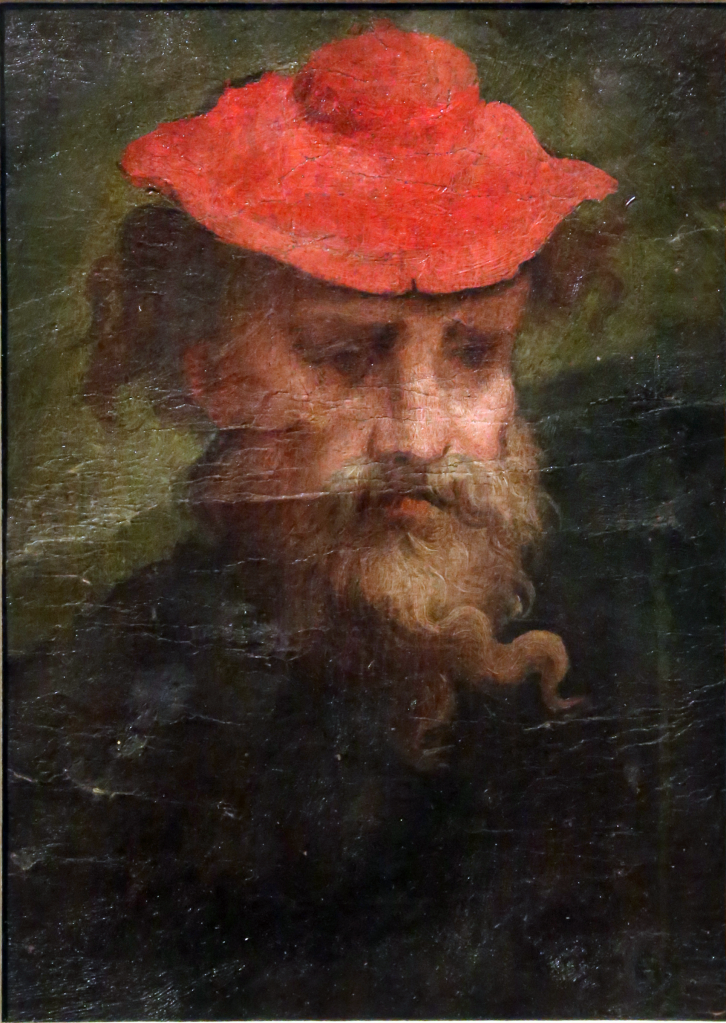
Atributed to: Francesco Mazzola, called Parmigianino
“Self Portrait in Old Age, or Portrait of a Man in a Red Beret”
1540
Oil on paper
21cm x 15.5cm
National Gallery of Parma, Italy

Years later Parmigianino again took the self-portrait as his subject matter. This time without the youthful visage and silvery reflections, but with a melancholy softness. Vasari’s discussion of tis artist would become an important part of his larger written masterpiece The Lives of the Artists, published in 1550 & 1568, and remains one of the most important documents in the history of art.

John Ashberry’s “Self Portrait in a Convex Mirror” was first published by Viking Press in 1975. The following year John Ashberry won the Pulitzer Prize, the National Book Award, and the National Book Critics Circle Award. Twenty years later I attended his reading at the Visiting Writers Lecture Series at Butler University in Indianapolis, Indiana, 9 April 1996. Ashberry was such an important figure in the New York School as it related to both poets and painters. His friends and colleagues over the years have included Fairfield Porter, Jane Freilicher and Frank O’Hara and he always acknowledges these inter-relationships. Below are three excerpts from his extended poem, along with a visual footnote: M. C. Escher’s well known “Self-Portrait in Spherical Mirror.”

Francesco Mazzola, called Parmigianino
c. 1524
Oil on a convex panel
9.6” in diameter
Kunsthistorisches Museum, Vienna

“As Parmigianino did it, the right hand

Bigger than the head, thrust at the viewer

And swerving easily away, as though to protect

What it advertises. A few leaded panes, old beams,

Fur, pleated muslin, a coral ring run together

In a movement supporting the face, which swims

Toward and away like the hand

Except that it is in repose. It is what is

Sequestered. Vasari says, “Francesco one day set himself

To take his own portrait, looking at himself from that purpose

In a convex mirror, such as is used by barbers . . .

He accordingly caused a ball of wood to be made

By a turner, and having divided it in half and

Brought it to the size of the mirror, he set himself

With great art to copy all that he saw in the glass. . . .”4

“This past

Is now here: the painter’s

Reflected face, in which we linger, receiving

Dreams and inspirations on an unassigned

Frequency, but the hues have turned metallic,

The curves and edges are not so rich. Each person

Has one big theory to explain the universe

But it doesn’t tell the whole story

And in the end it is what is outside him

That matters, to him and especially to us

Who have been given no help whatever

In decoding our own man-size quotient and must rely

On second-hand knowledge.”5

“Aping naturalness may be the first step

Toward achieving an inner calm

But it is the first step only, and often 

Remains a frozen gesture of welcome etched

On the air materializing behind it,

A convention.”6

Maurits Cornelis Escher
“Hand with Reflecting Sphere
(Self-Portrait in Spherical Mirror)”
1935
Lithograph
31.8cm x 21.3cm
Kunstmuseum Den Haag, The Netherlands.

1 Vasari, Giorgio, translated by Gaston du C. de Vere; Lives of the Painters, Sculptors and Architects; Everyman’s Library, Alfred A. Knopf; New York and Toronto; 1996; Volume 1, pp. 934-935.

2 Vasari, Giorgio, translated by Gaston du C. de Vere; Lives of the Painters, Sculptors and Architects; Everyman’s Library, Alfred A. Knopf; New York and Toronto; 1996; Volume 1, pp. 934-935.

3 Ashberry, John; Self Portrait in a Convex Mirror; Penguin Books; New York, New York; 1990; pp. 68-69.

4 Ashberry, John; Self Portrait in a Convex Mirror; Penguin Books; New York, New York; 1990; p. 68.

5 Ashberry, John; Self Portrait in a Convex Mirror; Penguin Books; New York, New York; 1990; pp. 81-82
.
6 Ashberry, John; Self Portrait in a Convex Mirror; Penguin Books; New York, New York; 1990; p. 82
.

HOKUSAI’S WAVES

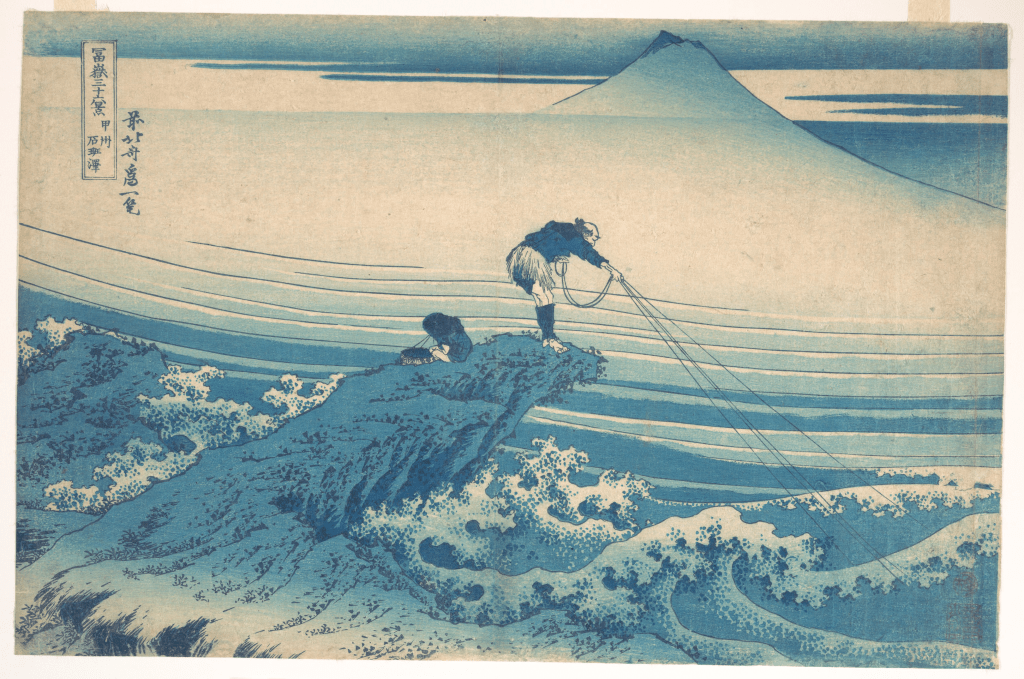
There are certain images, or should I say icons, that exert a visual power over all others. Two in particular come to mind: Turner’s great paintings of various “Storms at Sea” and Hokusai’s series of “Thirty-six Views of Mt. Fuji” which includes important images of nearby waves and distant views of Mt. Fuji. Whereas Hokusai often happily described himself as an old crazy man to paint, Turner was often derogatorily described by many of his contemporaries, often depicted as a crazy man wielding mops in order to complete his paintings!

“Turner painting one of his pictures”
Satirical cartoon, Almanack of the Month
1846
J. Paul Getty Trust, Los Angeles, California

We have often seen entire sets of Hokusai’s woodcuts exhibited at both the Art Institute of Chicago and the Metropolitan Museum of Art in New York. As for Turner, nothing surpasses the work from the Turner Bequest at the Tate Museum in London, or the Clowes Collection at the Indianapolis Museum of Art.

Contemporary writers have also been drawn to these two artists, including Yusef Komunyakaa and Patricia Clark. We have previously written regarding Komunyakaa’s “Turner’s Tussle with Water” and take a look now at Hokusai’s waves as written by Patricia Clark. Clark and her husband, the contemporary painter Stanley Krohmer, are often traveling and visiting museums. They collect exhibition catalogues, calendars and post cards from these locations. These are all important visual mnemonic devices, reminders of people and places seen, as well as sources for future investigations into both painting and poetry.1

Stanley Krohmer,
“Nocturne, Lake Michigan”
2021
Oil on wood panel
30” x 24”
Collection of the artist.

As a result of one of these trips, an image from Hokusai re-appeared in Clark’s memory. When I asked her about it, this was her response: “I never PLAN to write about some image ahead of time; I like to wait & see if it speaks to me somehow, over time. And somehow this one did. I think I was attracted to the tension in the fishing lines, the odd outfit the fellow is wearing, and the two figures. Plus the evident danger they might be in. I was surprised when it called up an old memory of mine — fishing during a camping trip, and also wandering along the shore, looking into tidepools and under rocks.”2

As is her practice, Patricia Clark uses her direct written responses to this visual work of art in order to combine them with certain memories of family members and their interactions with a landscape remembered from a distance.

Katsushika Hokusai
“Thirty-six Views of Mount Fuji: Fishermen standing on a rocky promontory at Kajikazawa”
1830-1832
Woodblock print on paper
10” x 15 1/8”
Metropolitan Museum of Art, New York

Barnacle

“The fisherman’s bent in half
on the tip
of a promontory,

a jacket, short pants, a grass skirt
over the pants,
no hat, tall socks

with shoes—though I’m fearful he’ll slip
where below
waves growl and snap.

He’s pulling in at least four lines, heavy
with fish,
one has to hope—

and he’s not alone. Nearby crouches a person
down on his haunches
also holding lines.

If the land’s rocky, okay, but it looks
fragile enough
to break off,

soft ground with wet sod crumbling
to pitch him in,
if not both of them. Once,

we wandered far down Agate & Crescent Beach,
stooping at
tidepools, turning over rocks

to find small gray crabs and touch
anemones, fascinated
by their pulse, heedless of tides.

By the time we looked up, our path back
was erased,
water crashing in, spraying foam,

and only through luck did we find
a cut
in the bluff where a path

snaked down—we clambered up with sea-
salt biting
at our heels. That was the day

later on, we hauled in a creature of the deep
we didn’t know,
a purple spiny thing large

as a cabbage we brought to the park ranger
in a bucket—
sea urchin, he said mildly.

It was a fearsome beautiful thing—
those spines dripping
with the sea, waving–I hope we let it go.

My father and his father, me and who else?
–my brother Dan?—
last seen on that shore

now washed away by waves of time
though memory has
planted a barnacle there.”3

Stanley Krohmer
“Steller’s Jay”
2015
Oil on canvas
36” x 36”
Collection of the Artist.

1 And as a footnote to this essay, I have included at the end an image of one of Stanley Krohmer’s paintings, “Steller’s Jay” which was actually used as the cover art for one of Patricia Clark’s books, “The Canopy” published by Terrapin Books in 2017.

2 Clark, Patricia; “Barnacle;” Manuscript page and notes in an E-Mail correspondence to this author, 2 December 2021, 4:58 PM.

3 Clark, Patricia; “Barnacle;” Included in the journal SALT; Santa Barbara, California; Issue 4, #1; 2023.

MARIANNE MOORE AND THE FABLES OF LA FONTAINE

Since ancient times, certain stories have been handed down from one generation to another through the spoken word. They were collected by such writers as Ovid, Homer, Aesop; other later fabulist writers; and even Rumi. It was later that they were finally published. There are also times when pieces of writing, or works of art are not merely illustrations of each other, but are truly complementary, that they support one another. “The Fables of La Fontaine” are a great example of this.

Pierre Julien
“La Fontaine with the Manuscript of the Fox and the Grapes”
1785
Marble
5′ 8″ x 3′ 7 1/4″ x 4′ 2 3/4″
The Louvre, Paris, France

“The Fables of La Fontaine” were published from 1668 to 1694. Over these years several editions were illustrated by François Chauveau, Jean-Baptiste Oudry, and Gustave Doré: these becoming major works of art in their own right. They were translated into English by Walter Thornbury in 1868 and much later by the Imagist poet Marianne Moore in her “Late Poems from 1965 to 1972.”

As this ancient tradition of story telling spread throughout the world, several of Aesop’s Fables found their way from the West to the East. As Jelaluddin Rumi had himself been collecting similar stories, several of them were included in his late work the Masnavi. In more recent times, new translations of these have been undertaken by Coleman Barks, especially in his books on The Soul of Rumi and One-Handed Basket Weaving.

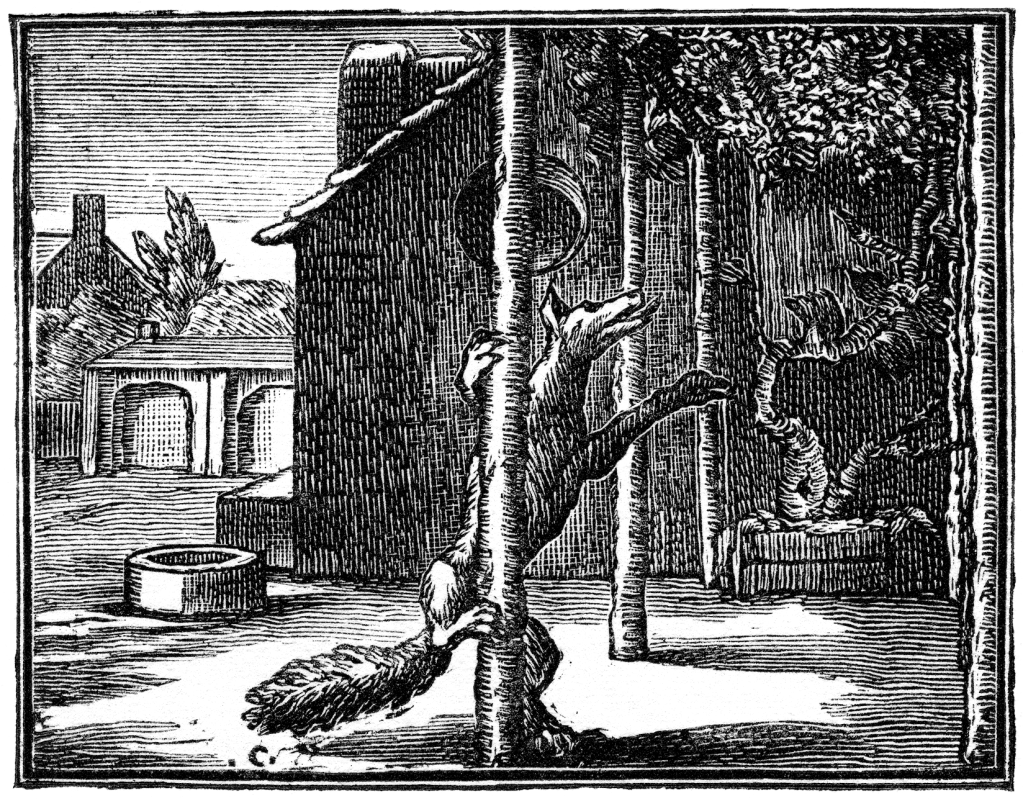
So the following is a selection of three poems. Two versions of the story of the friendship between a bear and a gardener: the first is Marianne Moore’s translation of La Fontaine’s “The Bear and the Garden-Lover” and the second one is Coleman Barks’ translation of “The Man with a Bear” by Rumi. The final selection is a short piece from Marianne Moore’s translations titled “The Fox and the Grapes.” The works of art by Gustave Doré, an Anonymous Persian Miniaturist, and François Chauveau.

The Bear and the Garden-Lover

“A bear with fur that appeared to have been licked backward
Wandered a forest once where he alone had a lair.
This new Bellerophon, hid by thorns which pointed outward,
Had become deranged. Minds suffer disrepair
When every thought for years has been turned inward.
We prize witty byplay and reserve is still better,
But too much of either and health has soon suffered.
No animal sought out the bear
In coverts at all times sequestered,
Until he had grown embittered
And, wearying of mere fatuity,
By now was submerged in gloom continually.
He had a neighbor rather near,
Whose own existence had seemed drear;
Who loved a parterre of which flowers were the core,
And the care of fruit even more.
But horticulturalists need, besides work that is pleasant,
Some shrewd choice spirit present.
When flowers speak, it is as poetry gives leave
Here in this book; and bound to grieve,
Since hedged by silent greenery to tend,
The gardener thought one sunny day he’d seek a friend.
Nursing some thought of the kind,
The bear sought a similar end
And the past just missed collision
Where their paths came in conjunction.
Numb with fear, how ever get away or stay here?
Better be a Gascon and disguise despair
In such a plight, so the man did not hang back or cower.
Lures are beyond a mere bear’s power
And this one said, ‘Visit my lair.’ The man said, ‘Yonder bower,
Most noble one, is mine; what could be friendlier
Than to sit on tender grass and share such plain refreshment
As native products laced with milk? Since it’s an embarrassment
To lack what lordly bears would have as daily fare,
Accept what if here.’ The bear appeared flattered.
Each found, as he went, a friend was what most mattered;
Before they’d neared the door, they were inseparable.
As confidant, a beast seems dull.
Best live alone if wit can’t flow,
And the gardener found the bear’s reserve a blow,
But conducive to work, without sounds to distract.
Having game to be dressed, the bear, as it puttered,
Diligently chased or slaughtered
Pests that filled the air, and swarmed, to be exact,
Round his all too weary friend who lay down sleepy—
Pests—well, flies, speaking unscientifically.
One time as the gardener had forgot himself in dream
And a single fly had his nose at its mercy,
The poor indignant bear who had fought it vainly,
Growled, ‘I’ll crush that trespasser; I have evolved a scheme.’
Killing flies was his chore, so as good as his word,
The bear hurled a cobble and made sure it was hurled hard,
Crushing a friend’s head to rid him of a pest.
With bad logic, fair aim disgraces us the more;
He’d murdered someone dear, to guarantee his friend rest.

Intimates should be feared who lack perspicacity;
Choose wisdom, even in an enemy.”1

Gustave Doré
Jean de La Fontaine’s “L’Ours et l’amateur des jardins”
1868
Wood engraving
Public Domain

“The Man with a Bear”

“For the man who saved the bear
from the dragon’s mouth, the bear
became a sort of pet.

When he would lie down to rest,
the bear would stand guard.

A certain friend passed by,
‘Brother how did this bear
get connected to you?’

He told the adventure with the dragon,
and the friend responded,
‘Don’t forget
what your companion is. This friend
is not human! It would be better
to choose one of your own kind.’

‘You’re just jealous of my unusual helper.
Look at his sweet devotion. Ignore
the bearishness!’

But the friend was not convinced,
‘Don’t go into the forest
with a comrade like this!
Let me go with you.’
‘I’m tired.
Leave me alone.’
The man began imagining
motives other than kindness for his friend’s concern.
‘He has made a bet with someone
that he can separate me from my bear.’ Or,
‘He will attack me when my bear is gone.’

He had begun to think like a bear!

So the human friends went different ways,
the one with his bear into a forest,
where he fell asleep again.

The bear stood over him
waving the flies away.

But the flies kept coming back,
which irritated the bear.

He dislodged a stone from the mountainside
and raised it over the sleeping man.

When he saw that the flies had returned
and settled comfortably on the man’s face,
He slammed the stone down, crushing
to powder the man’s face and skull.

Which proves the old saying:

IF YOU’RE FRIENDS
WITH A BEAR,
THE FRIENDSHIP
WILL DESTROY YOU.

WITH THAT ONE,
IT’S BETTER TO BE
ENEMIES.”2

Illustration contained in the Manuscript W.626.79B
“Masnavi-i ma’navi” by Jalal al-Din Rumi
1663
Ink and pigments on thin laid paper
10 7/16” x 5 7/8”
The Walters Art Museum,
Baltimore, Maryland.

The Fox and the Grapes

“A fox of Gascon, through some say of Norman descent,
When stared till faint gazed up at a trellis to which grapes were tied—
Matured till they glowed with a purplish tint
As though there were gems inside.
Now grapes were what our adventurer on strained haunches chanced to crave
But because he could not reach the vine
He said, ‘These grapes are sour; I’ll leave them for some knave.’

Better, I think, than an embittered whine.”3

Francois Chauveau
“Illustration for the Fables de La Fontaine, Volume 1”
1668
Burin engraving
Claude Barbin & Denys Thierry,
Paris, France

1 Moore, Marianne; Grace Schulman, ed.; The Poems of Marianne Moore, Viking Penguin; New York, New York; 2003; pp. 370-371.

2 Barks, Coleman; RUMI One-Handed Basket Weaving Poems on the Theme of Work; MAYPOP; Athens, Georgia; pp. 23-24.

3 Moore, Marianne; Grace Schulman, ed.; The Poems of Marianne Moore, Viking Penguin; New York, New York; 2003; p. 365.

STILL LIFE WITH A BRIDLE

“The Orpheus of the still life.  He was surrounded by an aura of mystery, and legends circulated about what took place in his atelier, tales about supernatural forces he brought into his work.  Probably Torrentius thought a certain dose of charlatanism did not harm art (differing here from his modest guild brothers of the Fraternity of Saint Luke), but on the contrary helped it.  For example, he used to say he did not in fact paint but only placed paints on the floor next to his canvases; under the influence of musical sounds they arranged themselves in colourful harmonies.  But is not art, every art, a kind of alchemical transmutation?  From pigments dissolved in oil arise flowers, towns, bays of the ocean and views of paradise truer than the real ones.”[i]


bridle
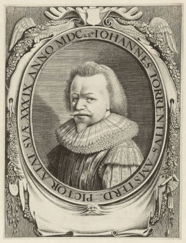
Jan van de Velde
“Johannes van der Beeck, aka Torrentius”
1628
Engraving
21.6 cm x 16.6 cm
Rijksmuseum
Amsterdam, The Netherlands

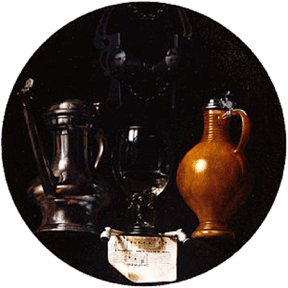
It is an entire book written as an ekphrastic exercise.  The author, Zbigniew Herbert, takes various elements from the Golden Age of Dutch painting and life and weaves a series of stories and essays around these themes.  In this particular example, an art historian is doing research on a surprising painting that he has just encountered in a museum, by an artist he has never heard of.  The “Still Life with a Bridle” by Johannes van der Beeck, also know as Torrentius, is equally as enigmatic as its maker.  It clearly shows the artist’s hand at rendering a variety of materials and subjects:  reading from right to left across the center of the painting we have a ceramic jug, a glass cruet, and a pewter pitcher, clearly illustrating the artist’s ability to handle a variety of surfaces in both light and shadow.


bridle-2
Johannes van der Beeck, aka Torrentius
“Emblematic still life with flagon, glass, jug and bridle”
(DETAIL)

Herbert, even in the description of this still life, finds an underlying structure forming both horizontals and verticals, as well as hidden imagery, a mysterious note placed at the bottom of the composition and then the dark, almost hidden bridle directly above at the top.  And, as an historian, he warns himself of the dangers of speculation and reading into the meaning of this mysterious painting.  In the process of deciphering the verse written on the note anchoring the composition, Herbert observes:  “Gnomic poems, particularly those that are esoteric texts, should be explained rather than translated word by word.  One should approach them by degrees of meaning, carefully and on tiptoes, because literalness renders their meaning shallow and frightens away mystery.”[ii]


bridle-3
Johannes van der Beeck, aka Torrentius
“Emblematic still life with flagon, glass, jug and bridle”
1614
1’ 8” x 1’ 8”
Oil on wooden panel
Rijksmuseum
Amsterdam, The Netherlands

Bret Waller, the Director Emeritus of the Indianapolis Museum of Art used to always start his talks to my classes with the explanation that:  “All works of art contain within themselves the definition of what they are about and how they were made.”[iii]  And then of course, he would go through the elements of the piece that we were standing in front of and explicate exactly that.  I have always tried to keep this lesson in mind, as both an artist and educator.

My reading over the last year, in both Gotthold Ephraim Lessing and Sbigniew Herbert, has led to several new definitions and functions regarding the ekphrastic tradition.  Contained within the descriptions of certain works of visual art are not merely observations but also insights; not just formal analyses but also lyrical and metaphorical underpinnings.

Lessing does this by first arguing one side of the history and in the next chapter, arguing the exact opposite side in both dating and aesthetic problems.  Until more scientific dating can occur, we will be left with only a range of styles:  early or late, Greek or Roman, etc.  Herbert is aware of this dilemma as well, and even quotes the great French poet:  “Paul Valery warned:  ‘We should apologize that we dare to speak about painting.’  I was always aware of committing a tactless act.”[iv]

“I know well, too well, all the agonies and vain effort of what is called description, and also the audacity of translating the wonderful language of painting into the language—as voluminous, as receptive as hell—in which court verdicts and love novels are written.  I don’t even know very well what inclines me to undertake these efforts.  I would like to believe that it is my impervious ideal that requires me to pay it clumsy homages.”[v]

bridle-4
Johannes van der Beeck, aka Torrentius
“Emblematic still life with flagon, glass, jug and bridle”
(DETAIL)

“Freedom – so many treatises were written about it that it became a pale, abstract concept.  But for the Dutch it was something as simple as breathing, looking and touching objects.  It did not need to be defined or beautified.  This is why there is no division in their art between what is great and small, what is important and unimportant, elevated and ordinary.  They painted apples and the portraits of fabric shopkeepers, pewter plates and tulips, with such patience and such love that the images of other worlds and noisy tales about earthly triumphs fade in comparison.”[vi]


[i] Herbert, Zbigniew; Still Life With A Bridle; Notting Hill Editions; London, United Kingdom; 2012; p. 100.

[ii] Herbert, Zbigniew; Still Life With A Bridle; p. 127.

[iii] This observation is taken from my own notebooks and recollections of several public and private discussions with Mr. Bret Waller, Director of the Indianapolis Museum of Art from 1990-2001.

[iv] Herbert, Zbigniew; Still Life With A Bridle; p. 123.

[v] Herbert, Zbigniew; Still Life With A Bridle; p. 122.

[vi] Herbert, Zbigniew; Still Life With A Bridle; p. 150.

THE DISASTERS OF WAR

war1
Francisco Goya
“Not in this case, Plate #36, The Disasters of War”
c. 1812/1815, published 1863
Etching, aquatint and drypoint
140 x 190 mm
The Art Institute of Chicago

“One cannot look at this.
This is bad.
This is how it happened.
This always happens.
There is no one to help them.
With or without reason.
He defends himself well.
He deserved it.
Bury them and keep quiet.
There was nothing to be done and he died.
What madness!
This is too much!
Why?
Nobody knows why.
Not in this case either.
This is worse.
Barbarians!
This is the absolute worst!
It will be the same.
All this and more.
The same thing elsewhere.
Perhaps they are of another breed.
I saw it.
And this too.
Truth has died.
This is the truth.”[i]

In one of her late series of essays, Susan Sontag created a literary collage of sorts. The title of this piece is “Looking at the Unbearable” and is inspired by Goya’s series of “The Disasters of War.” In fact, it is a very straightforward listing of several titles of Goya’s prints as they were later annotated in pencil beneath each print!

Goya was inspired to work in this direction by the earlier artist Jacques Callot whose “Miseries and Misfortunes of War” was published in 1633 as a response to the French invasion of Lorraine during the Thirty Years War. From 1808 to 1814 it was the Napoleonic invasion of Spain, witnessed by Goya, that lead to “The Disasters of War.” Although separated by over 200 years, these two bodies of work, taken together, comprise some of the most powerful statements ever made against war. What does that mean for us now?

war2
Jacques Callot
“The Hanging: Number 11, The Miseries of War”
1631, published in 1633
Etching
8.1 x 18.6 cm.
Collection: The Art Gallery of New South Wales

Instant justice on the battlefield, or revenge and vigilante justice in small town America seemed to take no heed of past history and warnings. In Marion, Indiana for example, on 7 August 1930 the photographer Lawrence Beitler came upon a scene that just had to be documented. A mob of citizens had broken into the local jail and took two African American prisoners, Thomas Shipp and Abram Smith, out into the night, where they were lynched. This particular photograph became a symbol of the ongoing racial war and tensions within our country. Thousands of copies of it, both as post cards and posters were printed over the following few days and weeks.

war3
Lawrence Henry Beitler
“Marion Lynching”
1930
B&W Photograph
Indiana Historical Society, Indianapolis, Indiana

In 1937, Abel Meeropol saw a copy of this photograph and was inspired to write the poem “Bitter Fruit” along with the music that later became a labor/civil rights anthem titled “Strange Fruit.” Since then it has been recorded many times up to the present day, but the 1939 version by Billie Holiday became a classic.

One contemporary artist and musician in the greater Boston area, James Reitzas, found a way to voice this through sculpture. Using very simple materials, rope and sand and burlap, he fashioned units of human size and proportion and literally hung them from local trees. Mimicking and referring back to Billie Holiday’s signature song “Strange Fruit” and Callot’s and Goya’s prints, these pieces show the metaphorical power of materials. They also echo many of the songs written at the time in order to give voice to both the civil rights and anti-war movements: the early Bob Dylan masterpiece “Desolation Row” contains an opening line that was directly inspired from Beitler’s photograph.

“They’re selling postcards of the hanging
They’re painting the passports brown
The beauty parlor is filled with sailors
The circus is in town
Here comes the blind commissioner
They’ve got him in a trance
One hand is tied to the tight-rope walker
The other is in his pants
And the riot squad they’re restless
They need somewhere to go
As Lady and I look out tonight
From Desolation Row.”[ii]

war4
James Reitzas
“Strange Fruit”
2000
Rope, sand and body bags
(Installation dimensions variable)
Boston, Massachusetts

“Southern trees bear a strange fruit,
Blood on the leaves and blood at the root,
Black bodies swinging in the southern breeze,
Strange fruit hanging from the poplar trees.”[iii]


[i] Sontag, Susan; Regarding the Pain of Others; Farrar, Straus and Giroux; New York, New York; 2003; pp. 44-47.

[ii] Dylan, Bob; “Desolation Row,” Writings and Drawings; Alfred A. Knopf, Borzoi Books; New York, New York; 1973; pp. 193-195.

[iii] Holiday, Billie; “Strange Fruit” The Centennial Collection; audio recording B00S7E1V7W; Sony Legacy; New York, New York; 2015.