VERMEER AND THE HALF-FINISHED HEAVEN

So many wars, the Eighty Years War and the Franco-Dutch War among them. During a peaceful interlude a pet goldfinch was waiting patiently to be painted. Later, the explosion of the powder magazine in Delft and the death of Carel Fabritius. And that beautiful spot of yellow on the rooftops of the city of Delft, as well as the nearby shadows on the Oude Kerk and the light on the Nieuwe Kerk in the “View of Delft.” The Nieuwe Kerk where Johannes Vermeer was baptized and the resting place for William of Orange.

Johannes Vermeer
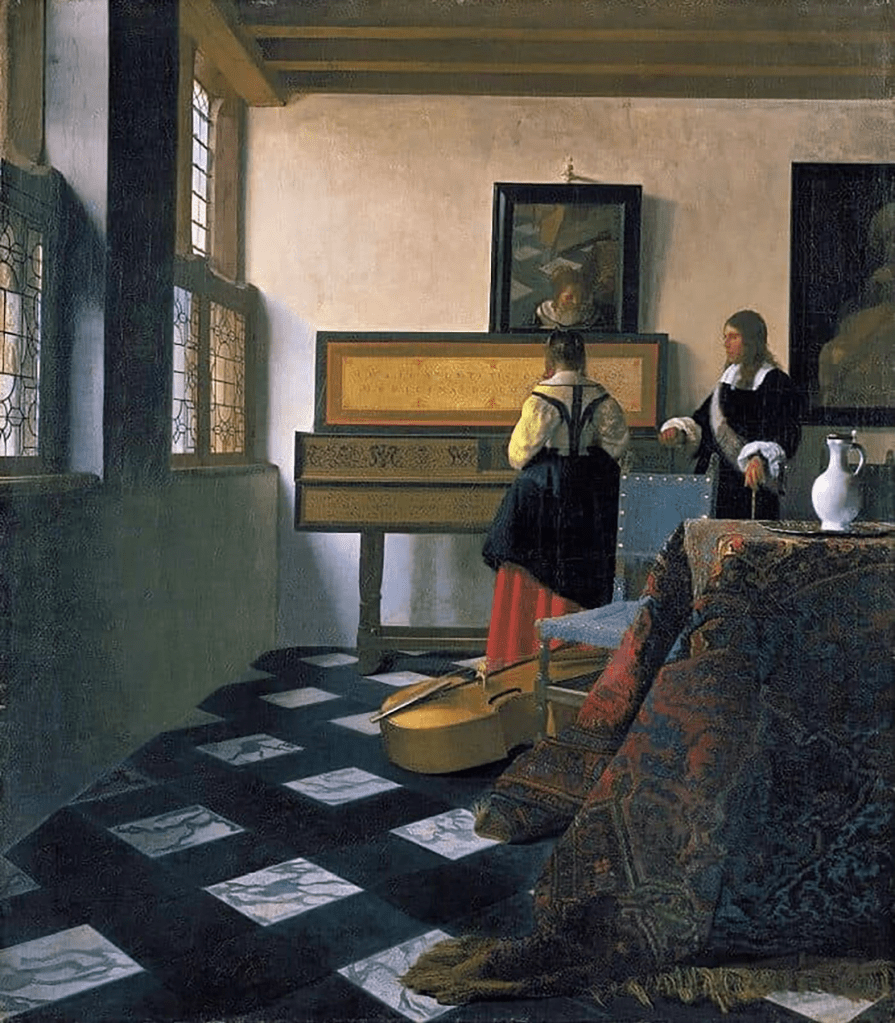
“The Music Lesson”
1662-1664
Oil on canvas
73.3cm x 64.5cm
The Royal Collection
London, United Kingdom

Such an important poet in his own right, Robert Bly was also a significant translator of the work of other poets. He published for the first time, many European and South American poets, and his translations range from Goethe, Hölderlin, Kabir, Rilke, Rumi, Ghalib and now to Tomas Tranströmer.

In his introduction to this translation of Tranströmer’s work, Bly mentions, a couple of times “. . . something approaching over a border. . . .”1 or “. . . the noise begins over there, on the other side of the wall. . . .”2 A kind of literary searching, I think, as both a poet and translator. Something beyond, but something that we cannot exactly put our finger on, in order to break through, either a border or a wall.

Vermeer

“It’s not a sheltered world. The noise begins over there, on the
other side of the wall
where the alehouse is
with its laughter and quarrels, its rows of teeth, its tears, its
chiming of clocks,
and the psychotic brother-in-law, the murderer, in whose
presence everyone feels fear.

The huge explosion and the emergency crew arriving late,
boats showing off on the canals, money slipping down into
pockets—the wrong man’s—
ultimatum piled on ultimatum,
wide-mouthed red flowers whose sweat reminds us of
approaching war.

And then straight through the wall—from there—straight into
the airy studio
and the seconds that have got permission to live for centuries.
Paintings that chose the name: The Music Lesson
or A Woman in Blue Reading a Letter.
She is eight months pregnant, two hearts beating inside her.
The wall behind her holds a crinkly map of Terra Incognito.

Just create. An unidentifiable blue fabric has been tacked to
the chairs.
Gold-headed tacks flew in with astronomical speed
and stopped smack there
as if they had always been stillness and nothing else.

The ears experience a buzz, perhaps it’s depth or perhaps
height.
It’s the pressure from the other side of the wall,
the pressure that makes each fact float
and makes the brushstroke firm.

Passing through walls hurts human beings, they get sick from
it,
but we have no choice.
It’s all one world. Now to the walls.
The walls are a part of you.
One either knows that, or one doesn’t; but it’s the same for
everyone
except for small children. There aren’t any walls for them.

The airy sky has taken its place leaning against the wall.
It is like a prayer to what is empty.
And what is empty turns its face to us
and whispers:
‘I am not empty, I am open.’”3

Johannes Vermeer
“Woman in Blue Reading a Letter”
1662-1664
Oil on canvas
46.5cm x 39cm
Rijksmuseum,
Amsterdam, The Netherlands

Later in life Tomas Tranströmer suffered a stroke that left his right side paralyzed, leading to difficulties in both writing and his piano playing. Several of his friends and colleagues, musicians and composers, set about composing piano pieces to be played only by the left hand, and sent them directly to him.4

Tranströmer’s imagery is so clear that we believe in its reality and in his imagination. As when he drew out a piano key-board on the kitchen tabletop in order to silently practice his music: “I played on them, without a sound. Neighbors came by to listen!”5


1 Tranströmer, Tomas; Translated by Robert Bly; The Half-Finished Heaven; Graywolf Press; Saint Paul, Minnesota; 2001; p. xviii.

2 Tranströmer, Tomas; Translated by Robert Bly; The Half-Finished Heaven; Graywolf Press; Saint Paul, Minnesota; 2001; p. xviii.

3 Tranströmer, Tomas; Translated by Robert Bly; The Half-Finished Heaven; Graywolf Press; Saint Paul, Minnesota; 2001; pp. 87-88.

4 Tranströmer, Tomas; Translated by Robert Bly; The Half-Finished Heaven; Graywolf Press; Saint Paul, Minnesota; 2001; p. xxi.

5 Tranströmer, Tomas; Translated by Robert Bly; The Half-Finished Heaven; Graywolf Press; Saint Paul, Minnesota; 2001; p. xx.

THE MAN WITH THE BLUE GUITAR

“The colour blue offers a multiplicity of remarkable characteristics to the observing eye and to the reflective mind alike. It is the only colour which can be seen as a close neighbor to and essentially akin to both dark and light, almost black in the night and almost white at the horizon by day; and it is also the colour of shadows on snow. It can darken, it can obscure, it may float to and fro like a mist, dimming reality with sadness and concealing truth…. By contrast light blue is the colour of loyalty and ecstasy—‘true blue’ for example….”1

This description is from a remarkable study on Paul Cézanne by the German art historian Kurt Badt. Cézanne of course pushed the use of color and structure to new limits in all of his work and so many of the younger artists migrating to Paris at the beginning of the 20th Century soon became aware of this, including Pablo Picasso.

Pablo Picasso
“Self Portrait”
1901
Oil on canvas
81 cm x 60 cm
Picasso Museum, Paris

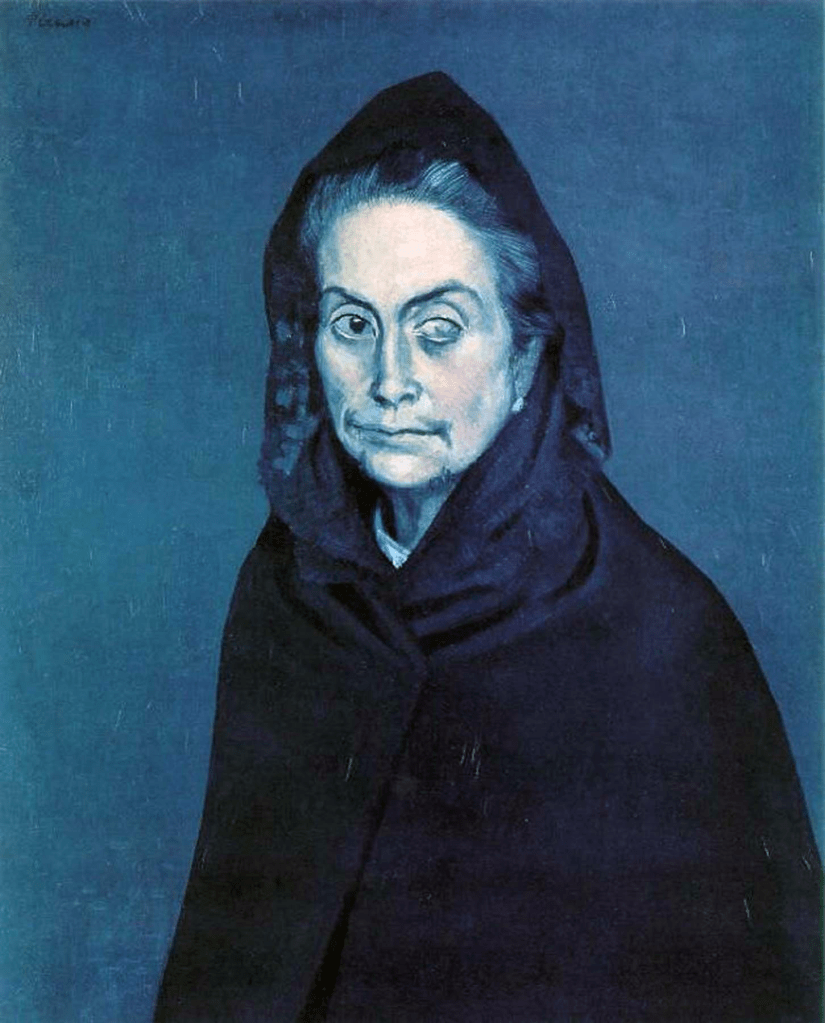
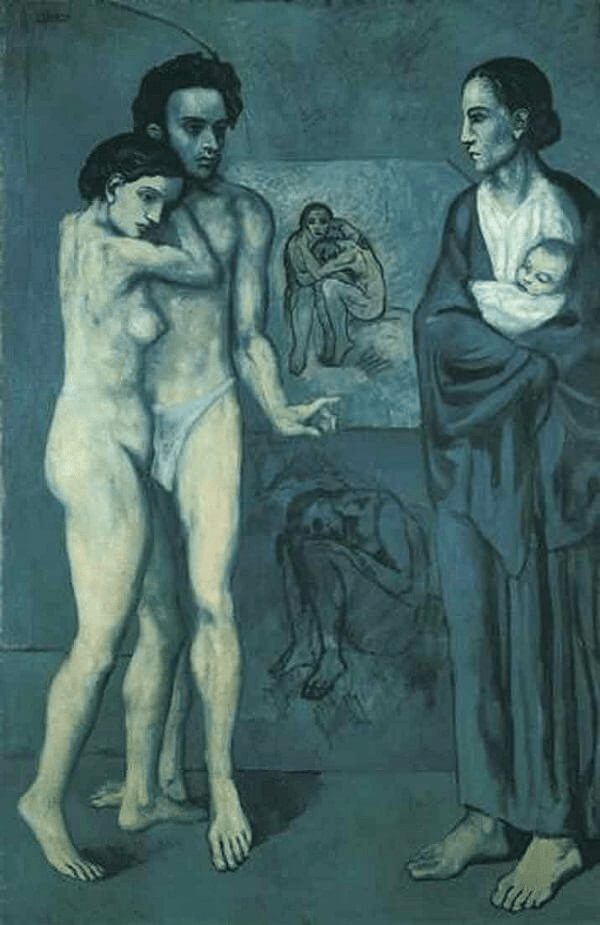
For Picasso, this became one of the most important attributes to his early paintings. Alone and isolated as many artists found themselves in Paris at that time, it was inevitable that a certain melancholy would set in. This was intensified by the sudden death of one of his dear friends, Casagemas. The psychological range of the color blue became an important element in his search for a way out of his situation. Using local residents, not traditional artist’s models, he began to paint this series from 1901 through 1904. His portrait of Casagemas was painted as a tribute in 1901, and was included again as the male figure in “La Vie” from the Cleveland Museum of Art in 1903.

Along with his description of the color blue, Kurt Badt also has mentioned the psychology of this color, even referring to it emotionally as ‘the blues’ as we might assume. For Picasso, this was a turning point.

Pablo Picasso
“La Celestina”
1904
Oil on canvas
70 cm x 56 cm
Musee Picasso, Paris

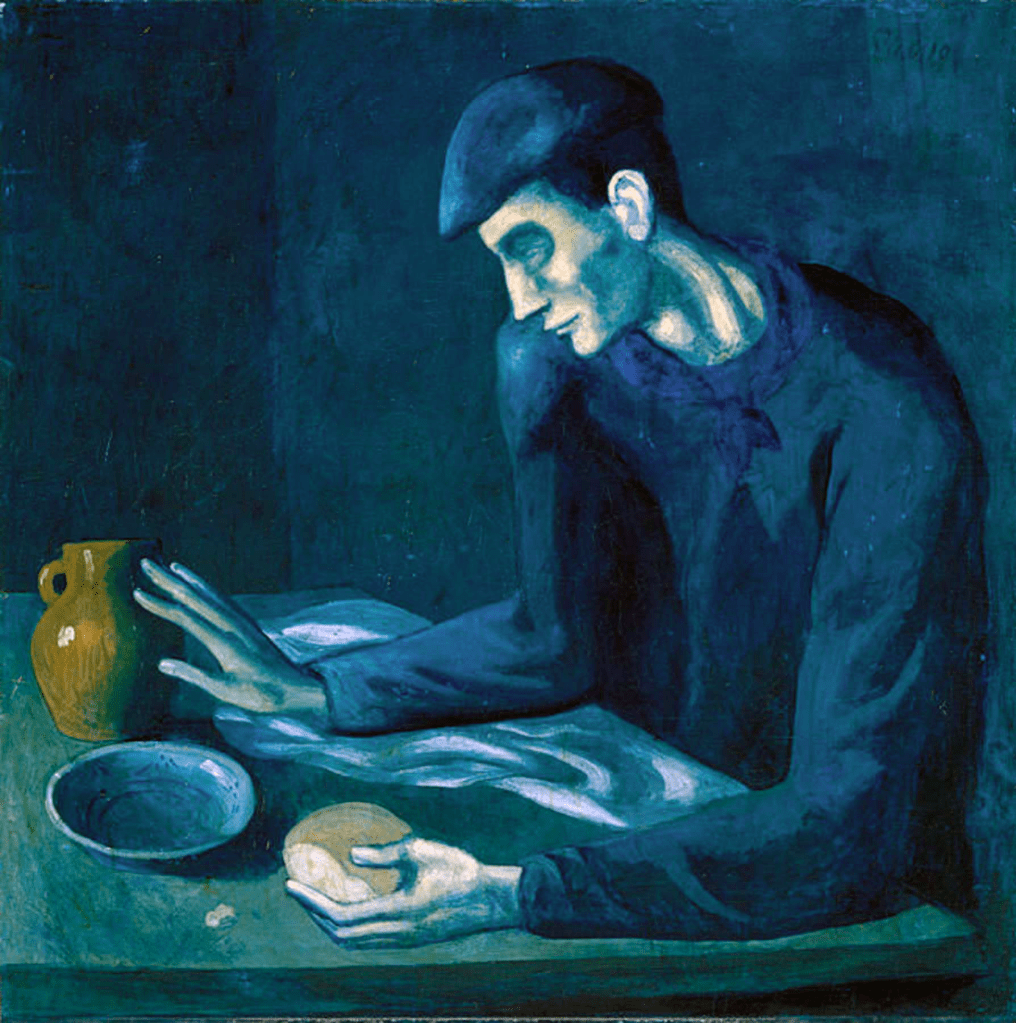
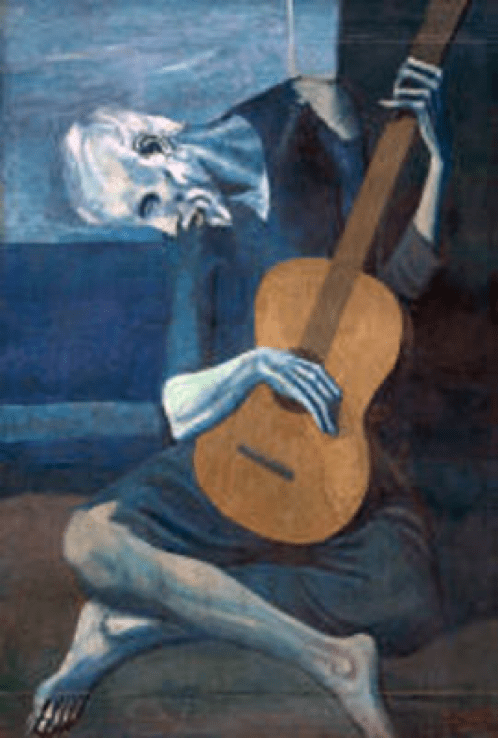
Whether it was a half blind woman in the street, a procuress named Celestina from a Spanish tragicomedy of 1499, or a totally blind man having his evening dinner, the people, their poses, and their color are simultaneously expressing a set of emotions and questions for the viewer. Add to these images, the portrait of “The Old Guitarist” from the collection of the Art Institute of Chicago, and we have more questions regarding life during this time period.

Pablo Picasso
“The Blind Man’s Meal”
1903
Oil on canvas
37 1/2” x 37 1/2”
The Metropolitan Museum of Art, New York

The musician, with his head bent over his instrument, with the weight of blue pressing down on his shoulder, we follow the line of his arm downward to the elbow and across to his hand strumming the guitar. And then up the neck of this guitar, to his fingers holding steady on the chords, and then across to his other shoulder, through his own neck and back to his dazed expression: a full compositional circle. This resulted of course, in one of the most important modern examples of the ekphrastic tradition, Wallace Stevens’ “The Man with the Blue Guitar.”

“The man bent over his guitar,

A shearsman of sorts. The day was green.

They said, ‘You have a blue guitar, 
You do not play things as they are.’

The man replied, ‘Things as they are

Are changed upon the blue guitar.’

And they said to him, ‘But play, you must,

A tune beyond us, yet ourselves,

A tune upon the blue guitar,

Of things exactly as they are.’”2

“I cannot bring a world quite round,

Although I patch it as I can.

I sing a hero’s head, large eye

And bearded bronze, but not a man,

Although I patch him as I can

And reach through him almost to man.

If a serenade almost to man

Is to miss, by that, things as they are,

Say that it is the serenade

Of a man that plays a blue guitar.”


Pablo Picasso
“The Old Guitarist”
1903–1904
Oil on panel
48 3/8” x 32 1/2”
The Art Institute of Chicago


So, we have a set up between the artist and the audience: the artist saying that things are changed upon the blue guitar, while the audience insists upon a tune of things exactly as they are!

Stevens starts with this guitarist from the Blue Period but soon goes on to other thoughts, not descriptive but reflective: “A tune beyond us as we are….”3 and ventures into the modern world of painting and poetry. He has to touch upon descriptions of general life and the accompanying dilemmas of 20th century artists. This then continues through several of the later sections of this poem. As Glen MacLeod mentioned in Wallace Stevens and Modern Art, he fuses references to Picasso with more general observations to modern life and a sense of contemporary surrealism, a kind of “…permissible imagination.”4


“A tune beyond us as we are, 

Yet nothing changed by the blue guitar;

Ourselves in tune as if in space,

Yet nothing changed, except the place

Of things as they are and only the place

As you play them on the blue guitar,

Placed, so, beyond the compass of change, 

Perceived in a final atmosphere;

For a moment final, in the way

The thinking of art seems final when

The thinking of god is smoky dew.

The tune is space. The blue guitar

Becomes the place of things as they are,

A composing of senses of the guitar.”5

Pablo Picasso
“La Vie”
1903
Oil on canvas
197 cm x 129 cm
The Cleveland Museum of Art,
Cleveland, Ohio


“The world washed in his imagination,
The world was a shore, whether sound or form

Or light, the relic of farewells,
Rock, of valedictory echoing,

To which his imagination returned,
From which it sped, a bar in space,

Sand heaped in the clouds, giant that fought
Against the murderous alphabet:

The swarm of thoughts, the swarm of dreams
Of inaccessible Utopia.

A mountainous music always seemed
To be falling and to be passing away.”6

“Is this picture of Picasso’s, this ‘hoard
Of destructions’, a picture of ourselves,

Now, an image of our society?”7


1 Badt, Kurt; The Art of Cezanne; University of California Press; Berkeley and Los Angeles; 1965; pp. 58-59.
2 Stevens, Wallace; “The Man With The Blue Guitar” Collected Poetry and Prose; The Library of America; New York, New York; 1997; Section I, p. 135.

3 Stevens, Wallace; “The Man With The Blue Guitar” Collected Poetry and Prose; The Library of America; New York, New York; 1997; Section VI, p. 137.

4 MacLeod, Glen; Wallace Stevens and Modern Art: From the Armory show to Abstract Expressionism; Yale University Press; New Haven and London; 1993; p. 197.

5 Stevens, Wallace; “The Man With The Blue Guitar” Collected Poetry and Prose; The Library of America; New York, New York; 1997; Section VI, p. 137.

6 Stevens, Wallace; “The Man With The Blue Guitar” Collected Poetry and Prose; The Library of America; New York, New York; 1997; Section XXVI, pp. 146-147.

7 Stevens, Wallace; “The Man With The Blue Guitar” Collected Poetry and Prose; The Library of America; New York, New York; 1997; Section XV, p. 141.

HUNTERS IN THE SNOW

My friend and colleague, Brett Waller, Director Emeritus of the Indianapolis Museum of Art, used to always mention to students and visitors that art museums were the birth-right of artists: explaining that historically, when many royal and private collections were first opened to the public as museums, they were linked to the local art academies and schools.

Artists such as Paul Cézanne and Alberto Giacometti both were sensitive to the importance of museums and their collections. It was Cézanne who stated many times that “. . . it was his ambition ‘to do Poussin again after nature’ and that he wanted to make of Impressionism ‘. . . something solid and enduring like the art of the museums.’”1

In his Sketchbook of Interpretive Drawings Alberto Giacometti shows us both the range and depth of how he looked at the great art of museums: “I began to copy long before even asking myself why I did it, probably in order to give reality to my predilections, much rather this painting here than that one there, but for many years I have known that copying is the best means for making me aware of what I see, the way it happens with my own work; I can know a little about the world there, a head, a cup, or a landscape, only by copying it.”2

Alberto Giacometti
“Study after Pieter Breughel’s Hunters in the Snow”
c. 1952
Ballpoint pen on paper
8 1/4” x 11 1/2”
Annette and Alberto Giacometti Foundation,
Paris and Zurich

Through the writings of Rudolph Arnheim we have known of the ascending and descending angles and movements through out a painting.3 Also, we understand kinetic and haptic space as it runs through a work of art, leading our eye and mind through this very space.

Rudolph Arnheim
“Structural Map” (Figure 3, p. 4)
Art and Visual Perception
1971

Whether it is a snow covered hill leading us downward from the center left to the bottom right of the painting, or the path that the hunters are taking from the lower left upward into the center, or even the complimentary angles of the magpie gliding above the distant landscape and holding the upper part of the composition, we can feel the structural movement throughout.

It is this seeing, and experiencing of the thing that is most important, and this of course is exactly what William Carlos Williams achieved with this great painting “The Hunters in the Snow.”

Pieter Breughel the Elder
“The Hunters in the Snow”
1565
Oil on wood panel
46” x 63 3/4”
Kunsthistorisches Museum, Vienna

The Hunters in the Snow

“The over-all picture is winter
icy mountains
in the background the return

from the hunt it is toward evening
from the left
sturdy hunters lead in

their pack the inn-sign
hanging from a
broken hinge is a stag a crucifix

between his antlers the cold
inn yard is
deserted but for a huge bonfire

that flares wind-driven tended by
women who cluster
about it to the right beyond

the hill is a pattern of skaters
Breughel the painter
concerned with it all has chosen

a winter-struck bush for his
foreground to
complete the picture . . ”4


1 Chilvers, Ian, & John Glaves-Smith; A Dictionary of Modern and Contemporary Art; Oxford University Press; Oxford, United Kingdom; 2009; p. 132.

2 Carluccio, Luigi; Giacometti: A Sketchbook of Interpretive Drawings; Harry N. Abrams, Inc.; New York, New York; 1967; p. xi.

3 Arnheim, Rudolf; Art and Visual Perception: A Psychology of the Creative Eye; University of California Press; Berkeley and Los Angeles; 1971; p. 4.

4 Williams, William Carlos; Pictures from Brueghel and other poems; New Directions Publishing Corporation; New York, New York; 1967; p. 5.

THE MIGHTY QUINN!

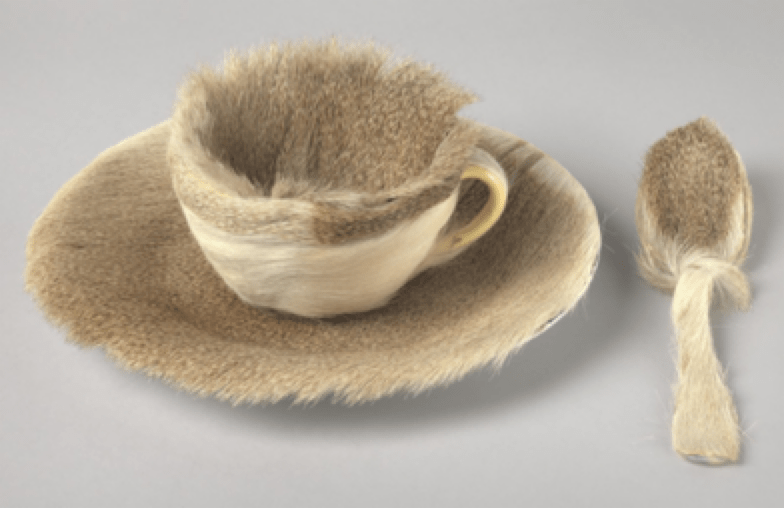
Surrealism and absurdity, fantasy and fiction, images come together in a variety of combinations. The range can be unbelievable: from Giotto’s painting of St. Francis Preaching to the Birds to a contemporary sculptural assemblage of a spoon and teacup lined with fur!1

“I like to do just like the rest, I like my sugar sweet
But guarding fumes and making haste
It ain’t my cup of meat. . . .”

Meret Oppenheim
“Object”
1936
Mixed media
32.7 cm x 7.3 cm
Museum of Modern Art, New York

“. . . Ev’rybody’s ’neath the trees
Feeding pigeons on a limb
But when Quinn the Eskimo gets here
All the pigeons gonna run to him.”2

Giotto di Bondone
“St. Francis Preaching to the Birds”
1296-1300
Fresco
Upper Church of St. Francis
Assisi, Italy

In one of his most important collections of poetry, the author and editor Robert Bly takes a look at this literature from so many angles. The Rag and Bone Shop of the Heart3 takes its title from the absurd poem “The Circus Animals’ Desertion” by William Butler Yeats:

“Now that my ladder’s gone,
I must lie down where all the ladders start,
in that foul rag and bone shop of the heart.”4

Included in the “Zaniness” section of this collection, Bly describes a song by Bob Dylan titled “The Mighty Quinn!” Packed full of silliness and surrealism, this mighty Eskimo is here to save us all.

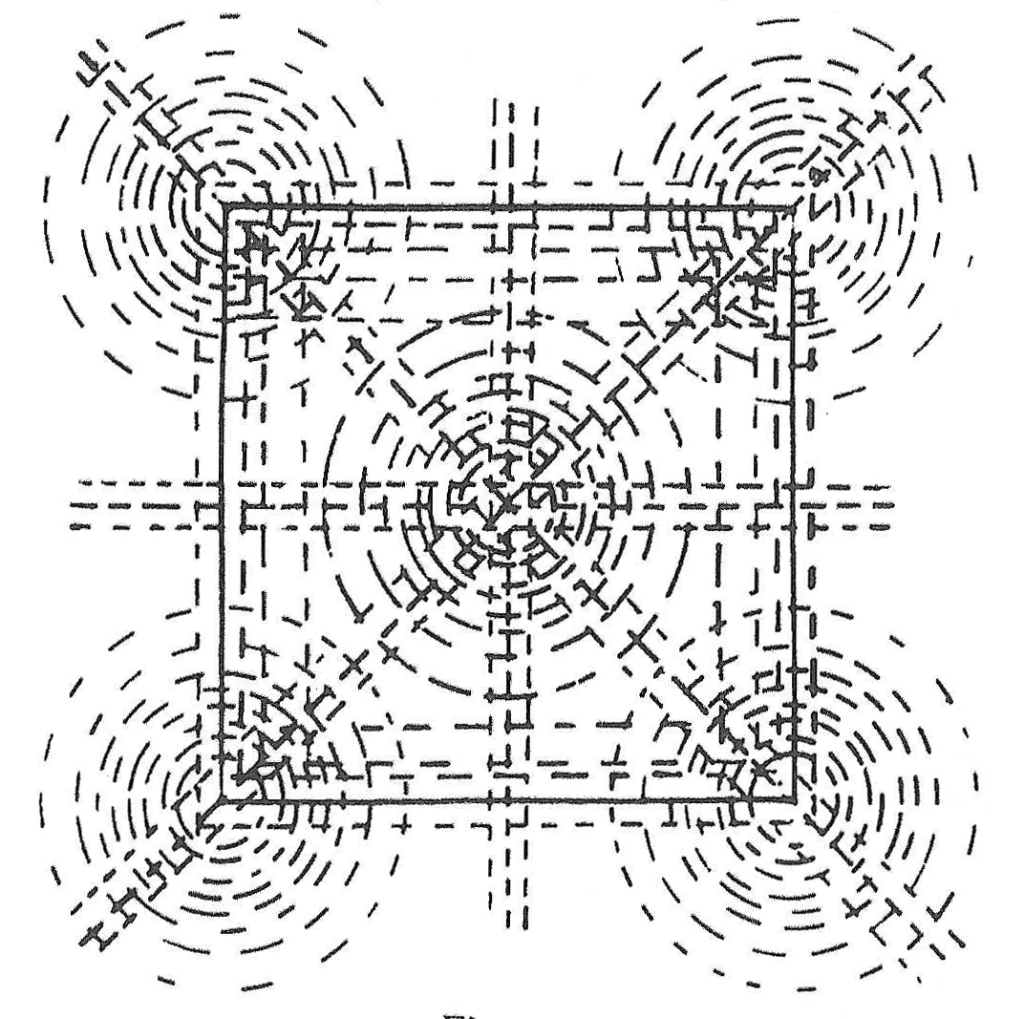
“Nanook of the North”
1922
Lithographic Poster
Royal Pictures, Inc.

There is a subtle source for this story: an early short documentary film of 1922 from the Museum of Modern Art Film Library titled “Nanook of the North.” This film circulated around New York and beyond in the 1960’s, even making it to the Maryland Institute College of Art in Baltimore for a film series.

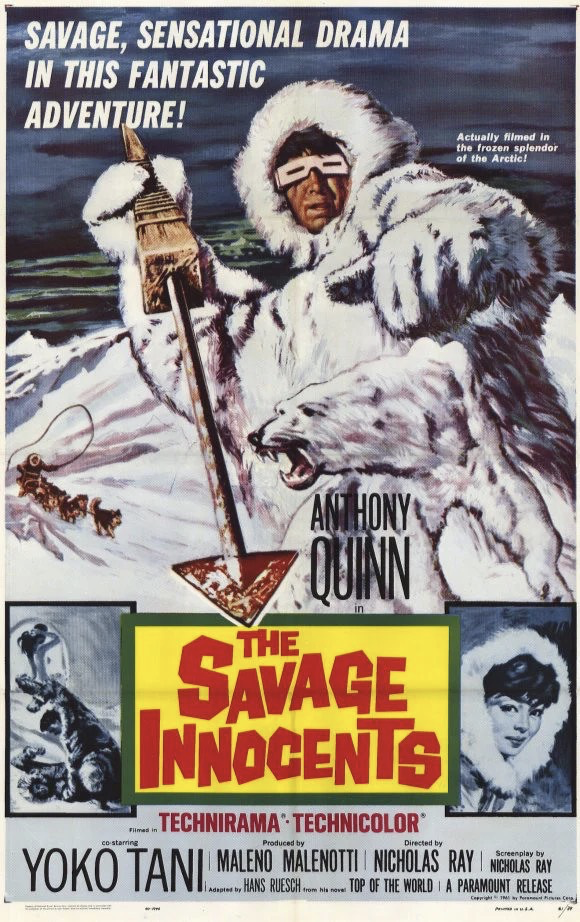
Several sources also point to the movie “The Savage Innocents” starring Anthony Quinn, playing the part of an Eskimo, as the inspiration for this song.

“The Savage Innocents”
Movie Poster
1960
40” x 27”

“Ev’rybody’s building the big ships and the boats
Some are building monuments
Others, jotting down notes
Ev’rybody’s in despair
Ev’ry girl and boy
But when Quinn the Eskimo gets here
Ev’rybody’s gonna jump for joy
Come all without, come all within
You’ll not see nothing like the mighty Quinn”5

“I like to do just like the rest, I like my sugar sweet
But guarding fumes and making haste
It ain’t my cup of meat
Ev’rybody’s ’neath the trees
Feeding pigeons on a limb
But when Quinn the Eskimo gets here
All the pigeons gonna run to him
Come all without, come all within
You’ll not see nothing like the mighty Quinn”6

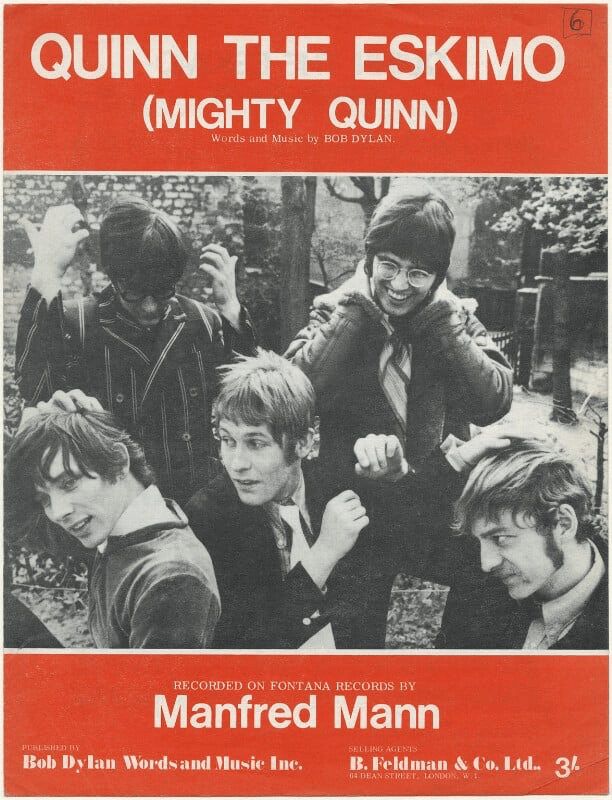
“Quinn the Eskimo” Sheet Music Cover
Words and Music, Bob Dylan,
Performed by Manfred Mann
1968
(Photographer Unknown)
11” x 8 1/2”
National Portrait Gallery
London, United Kingdom

Bob Dylan wrote this song in 1967 during the Basement Tapes Sessions however it was one of two outtakes at that time. Shortly afterwards, in 1968, it was picked up and famously recorded by the English group Manfred Mann. They used it often in live concerts and recorded several later versions, including an extended play one that lasted over ten minutes. Dylan’s original recording of the “Mighty Quinn” was finally included in the Biograph CD released in 1985.

“A cat’s meow and a cow’s moo, I can recite ’em all
Just tell me where it hurts yuh, honey
And I’ll tell you who to call
Nobody can get no sleep
There’s someone on ev’ryone’s toes
But when Quinn the Eskimo gets here
Ev’rybody’s gonna wanna doze
Come all without, come all within
You’ll not see nothing like the mighty Quinn”7

Although it may seem like double talk, writing in the absurd mode often gets more directly to the truth. As it happens in Bob Dylan, it also occurs in William Butler Yeats, who provides one last word:

“Players and painted stage took all my love,
And not those things that they were emblems of.”8

Anthony Quinn as the Eskimo Inuk
“The Savage Innocents”
Paramount Pictures,
Technicolor Film Still,
Nicholas Ray, Director
1960.

1 Dylan, Bob; “The Mighty Quinn” Words and Music; © 1968 by Dwarf Music; renewed in 1996 by Dwarf Music.

2 Dylan, Bob; “The Mighty Quinn” Words and Music; © 1968 by Dwarf Music; renewed in 1996 by Dwarf Music.

3 Bly, Robert; James Hillman and Michael Meade; The Rag and Bone Shop of the Heart: Poems for Men; Harper Perennial, Harper Collins Publishers; New Yrok, New York; 1992.

4 Rosenthal, M. L., ed.; Selected Poems and Two Plays of William Butler Yeats; The MacMillan Company; New York, New York; 1962; pp. 184-185.

5 Dylan, Bob; “The Mighty Quinn” Words and Music; © 1968 by Dwarf Music; renewed in 1996 by Dwarf Music.

6 Dylan, Bob; “The Mighty Quinn” Words and Music; © 1968 by Dwarf Music; renewed in 1996 by Dwarf Music.

7 Dylan, Bob; “The Mighty Quinn” Words and Music; © 1968 by Dwarf Music; renewed in 1996 by Dwarf Music.

8 Rosenthal, M. L., ed.; Selected Poems and Two Plays of William Butler Yeats; The MacMillan Company; New York, New York; 1962; p. 185.


SELF-PORTRAIT IN A CONVEX MIRROR

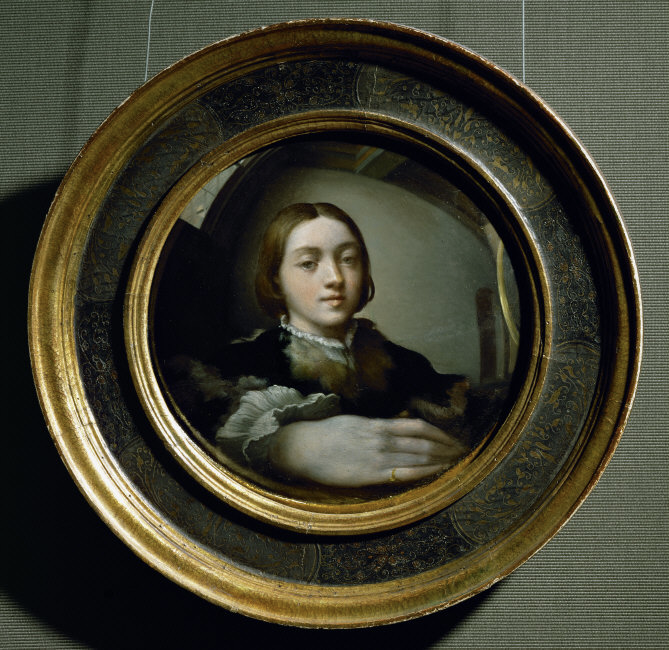
Beginning with the Renaissance and running through our contemporary era it has been a recurring metaphor that painting has provided a window onto, or a mirror of, the world. So much so, that we may often forget the power of reflection and the conventions of reflecting the things surrounding us. Two examples include the foreground still life in the Northern Renaissance painting of “The Money Changer and his Wife” from 1514 by Quinten Massys and an M. C. Escher lithograph of the “Hand with a Reflecting Sphere” from 1935. Sandwiched in between is that great “Self-Portrait in a Convex Mirror” by Girolamo Francesco Maria Mazzola, otherwise known as Parmigianano.

Quinten Massys
“The Money Changer and his Wife”
1514
Oil on canvas
70.5cm x 67cm
Musée Louvre, Paris

There are two important literary examples associated with this single painting by Parmigianino: the first one historic, written by Vasari regarding the creation of this painting, and the second one modern, John Ashberry’s extensive and thoughtful meditation on this subject.

The artist is seen in a circular form: a sphere that has been cut in half, one part to be polished and glazed into a mirror and the second part to be prepared and used as the support for this very painting.

Although it is small in diameter, it is forceful in its imagery, and a perfect presentation piece intended to be seen by future patrons in Rome. We are confronted by his intense stare, slightly above center of the composition, and then the sweep of his shoulder and arm around into the extreme foreground, concluding with that hand. A circular movement shown by the model himself that echoes the circular form of the entire painting.

Francesco Mazzola, called Parmigianino
c. 1524
Oil on a convex panel
9.6” in diameter
Kunsthistorisches Museum, Vienna

“Then came upon him the desire to see Rome, hearing men greatly praise the works of the masters there, especially of Raffaello and Michael Angelo, and he told his desire to his old uncles. They, seeing nothing in the desire that was not praiseworthy, agreed, but said that it would be well to take something with him which would gain him an introduction to artists. And the counsel seeming good to Francesco, he painted three pictures, two small and one very large. Besides these, inquiring one day into the subtleties of art, he began to draw himself as he appeared in a barber’s convex glass. He had a ball of wood made at a turner’s and divided in half, and on this he set himself to paint all that he saw in the glass, and because the mirror enlarged everything that was near and diminished what was distant, he painted the hand a little large. Francesco himself, being of very beautiful countenance and more like an angel than a man, his portrait on the ball seemed a thing divine, and the work altogether was a happy success, having all the lustre of the glass, with every reflection and the light and shade so true, that nothing more could be hoped for from the human intellect.”1

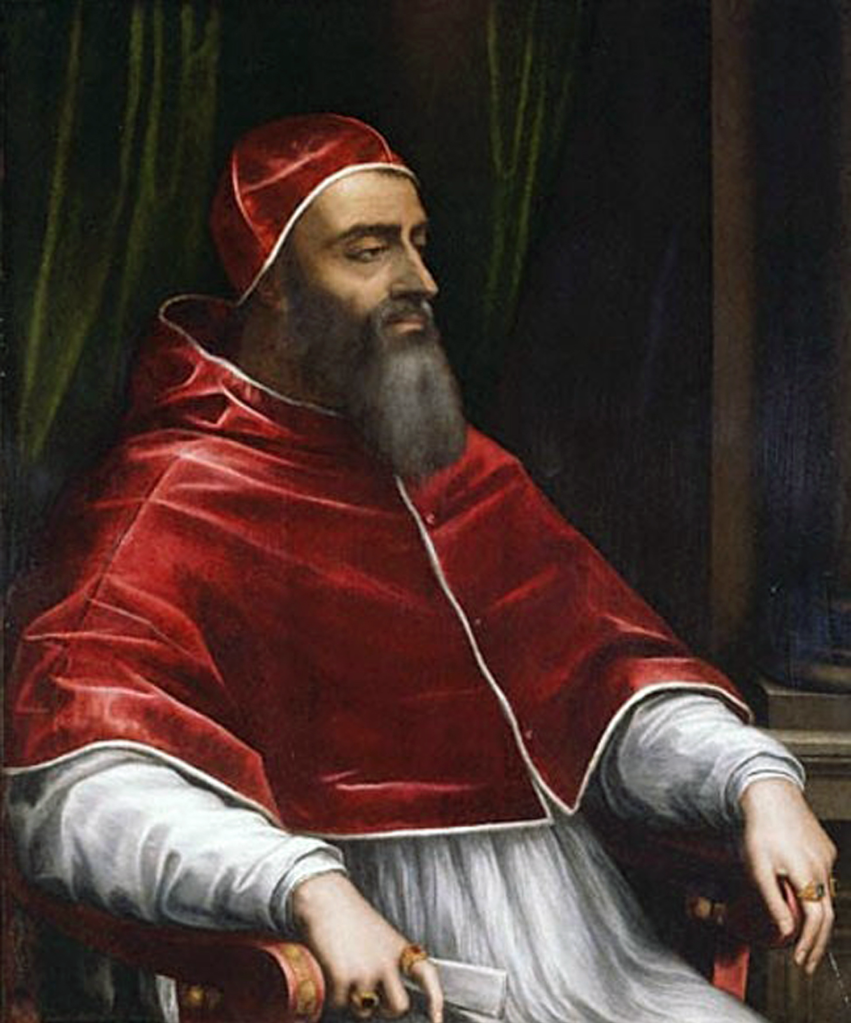
“The picture being finished and packed, together with the portrait, he set out, accompanied by one of his uncles, for Rome; and as soon as the Chancellor of the Pope had seen the pictures, he introduced the youth and his uncle to Pope Clement, who seeing the works produced and Francesco so young, was astonished, and all his court with him. And his Holiness gave him the charge of painting the Pope’s hall.”2

Sebastiano del Piombo
“Portrait of Pope Clement VII”
c. 1531
41 1/2” x 34 1/2”
Oil on slate
J. Paul Getty Museum, Los Angeles, California.

“The glass chose to reflect only what he saw

Which was enough for his purpose: his image

Glazed, embalmed, projected at a 180-degree angle.

The time of day or the density of the light

Adhering to the face keeps it

Lively and intact in a recurring wave

Of arrival. The soul establishes itself.

But how far can it swim out through the eyes 

And still return safely to its nest? The surface

Of the mirror being convex, the distance increases

Significantly; that is, enough to make the point

That the soul is a captive, treated humanely, kept

In suspension, unable to advance much farther

Than your look as it intercepts the picture.

Pope Clement and his court were ‘stupefied’

By it, according to Vasari, and promised a commission

That never materialized. . . .”3

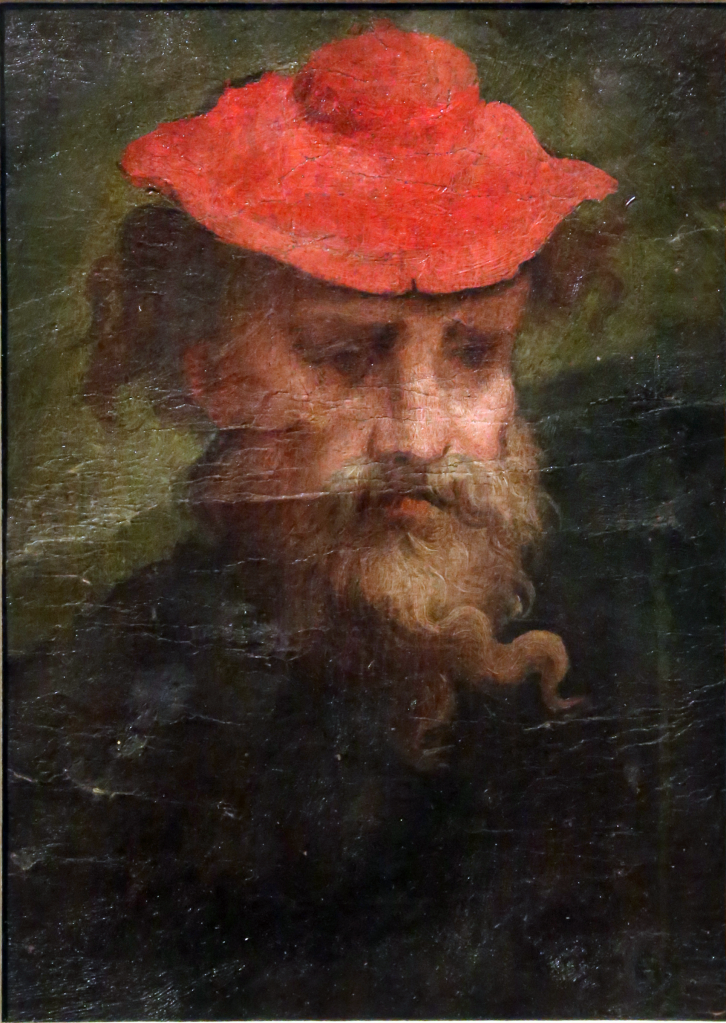
Atributed to: Francesco Mazzola, called Parmigianino
“Self Portrait in Old Age, or Portrait of a Man in a Red Beret”
1540
Oil on paper
21cm x 15.5cm
National Gallery of Parma, Italy

Years later Parmigianino again took the self-portrait as his subject matter. This time without the youthful visage and silvery reflections, but with a melancholy softness. Vasari’s discussion of tis artist would become an important part of his larger written masterpiece The Lives of the Artists, published in 1550 & 1568, and remains one of the most important documents in the history of art.

John Ashberry’s “Self Portrait in a Convex Mirror” was first published by Viking Press in 1975. The following year John Ashberry won the Pulitzer Prize, the National Book Award, and the National Book Critics Circle Award. Twenty years later I attended his reading at the Visiting Writers Lecture Series at Butler University in Indianapolis, Indiana, 9 April 1996. Ashberry was such an important figure in the New York School as it related to both poets and painters. His friends and colleagues over the years have included Fairfield Porter, Jane Freilicher and Frank O’Hara and he always acknowledges these inter-relationships. Below are three excerpts from his extended poem, along with a visual footnote: M. C. Escher’s well known “Self-Portrait in Spherical Mirror.”

Francesco Mazzola, called Parmigianino
c. 1524
Oil on a convex panel
9.6” in diameter
Kunsthistorisches Museum, Vienna

“As Parmigianino did it, the right hand

Bigger than the head, thrust at the viewer

And swerving easily away, as though to protect

What it advertises. A few leaded panes, old beams,

Fur, pleated muslin, a coral ring run together

In a movement supporting the face, which swims

Toward and away like the hand

Except that it is in repose. It is what is

Sequestered. Vasari says, “Francesco one day set himself

To take his own portrait, looking at himself from that purpose

In a convex mirror, such as is used by barbers . . .

He accordingly caused a ball of wood to be made

By a turner, and having divided it in half and

Brought it to the size of the mirror, he set himself

With great art to copy all that he saw in the glass. . . .”4

“This past

Is now here: the painter’s

Reflected face, in which we linger, receiving

Dreams and inspirations on an unassigned

Frequency, but the hues have turned metallic,

The curves and edges are not so rich. Each person

Has one big theory to explain the universe

But it doesn’t tell the whole story

And in the end it is what is outside him

That matters, to him and especially to us

Who have been given no help whatever

In decoding our own man-size quotient and must rely

On second-hand knowledge.”5

“Aping naturalness may be the first step

Toward achieving an inner calm

But it is the first step only, and often 

Remains a frozen gesture of welcome etched

On the air materializing behind it,

A convention.”6

Maurits Cornelis Escher
“Hand with Reflecting Sphere
(Self-Portrait in Spherical Mirror)”
1935
Lithograph
31.8cm x 21.3cm
Kunstmuseum Den Haag, The Netherlands.

1 Vasari, Giorgio, translated by Gaston du C. de Vere; Lives of the Painters, Sculptors and Architects; Everyman’s Library, Alfred A. Knopf; New York and Toronto; 1996; Volume 1, pp. 934-935.

2 Vasari, Giorgio, translated by Gaston du C. de Vere; Lives of the Painters, Sculptors and Architects; Everyman’s Library, Alfred A. Knopf; New York and Toronto; 1996; Volume 1, pp. 934-935.

3 Ashberry, John; Self Portrait in a Convex Mirror; Penguin Books; New York, New York; 1990; pp. 68-69.

4 Ashberry, John; Self Portrait in a Convex Mirror; Penguin Books; New York, New York; 1990; p. 68.

5 Ashberry, John; Self Portrait in a Convex Mirror; Penguin Books; New York, New York; 1990; pp. 81-82
.
6 Ashberry, John; Self Portrait in a Convex Mirror; Penguin Books; New York, New York; 1990; p. 82
.

THE AMERICANS

In a short prose poem, six pages at best, Jack Kerouac sets the stage for a much longer visual poem by the photographer Robert Frank:

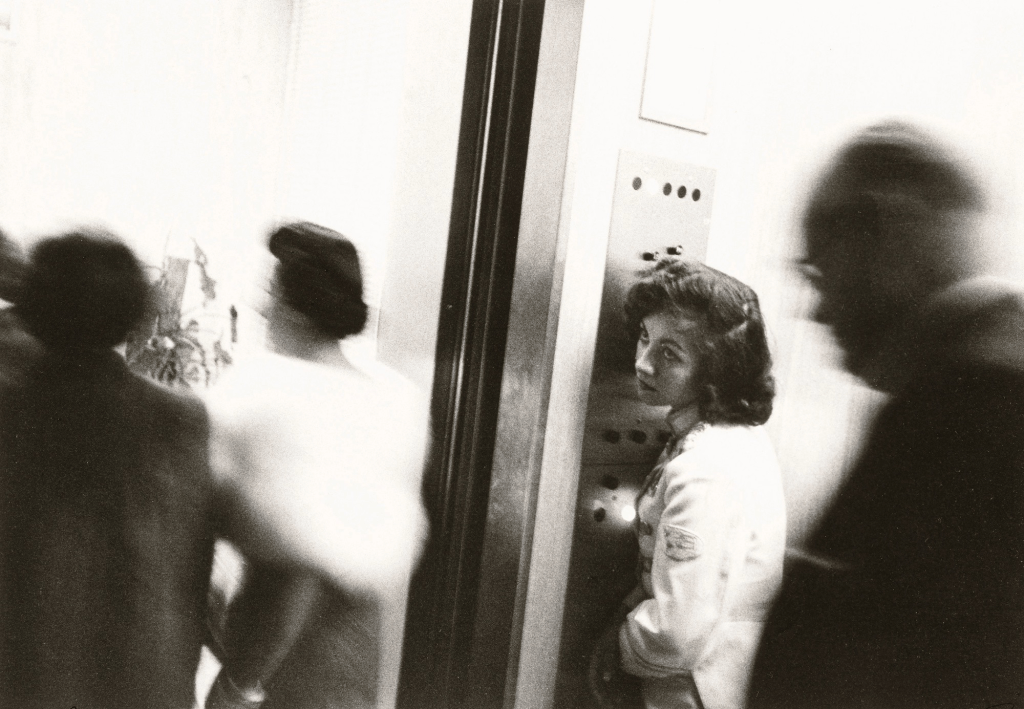
“Robert Frank, Swiss, unobtrusive, nice, with that little camera that he raises and snaps with one hand he sucked a sad poem right out of America onto film, taking rank among the tragic poets of the world. . . . And I say: ‘That little ole lonely elevator girl looking up sighing in an elevator full of blurred demons, what’s her name & address?’”1

Robert Frank
“Elevator, Miami Beach”
1955
Gelatin silver print
9 1/8” x 13 1/4”
Metropolitan Museum of Art, New York


For many years my Dad worked as a photographer, first for the commercial company Cooper-Trent in Washington, DC, and later for the federal government. He was the one who first taught me how to shoot and process film, although I struggled with this. Later in college, 1967 summer school in Norfolk, Connecticut, it was Walter Rosenblum and his assistant, Sedat Pakay, who took us under their wings. Two other personal influences also should be mentioned here: the sensitive portraits of one of my classmates at Norfolk, Carol Ginandes; and a second classmate in Baltimore, Dudley Gray, whose visions of New York City are continually inspiring. All of these examples are ways to help us to see and to work directly.

In writing, it is no surprise that many contemporary poets used the dictum: first thought, best thought. Not unlike the photographer who composes, shoots, and fills the full frame, instantaneously. By writing directly, it eliminated the process of editing and re-writing, which can often make a work stiff, too structured, and not as spontaneous. So it is no surprise that the photographer Robert Frank hooked up with the writer Jack Kerouac for the publication of his photographic series “The Americans.”

Kerouac’s lines resonate with the imagery in equally spontaneous ways.

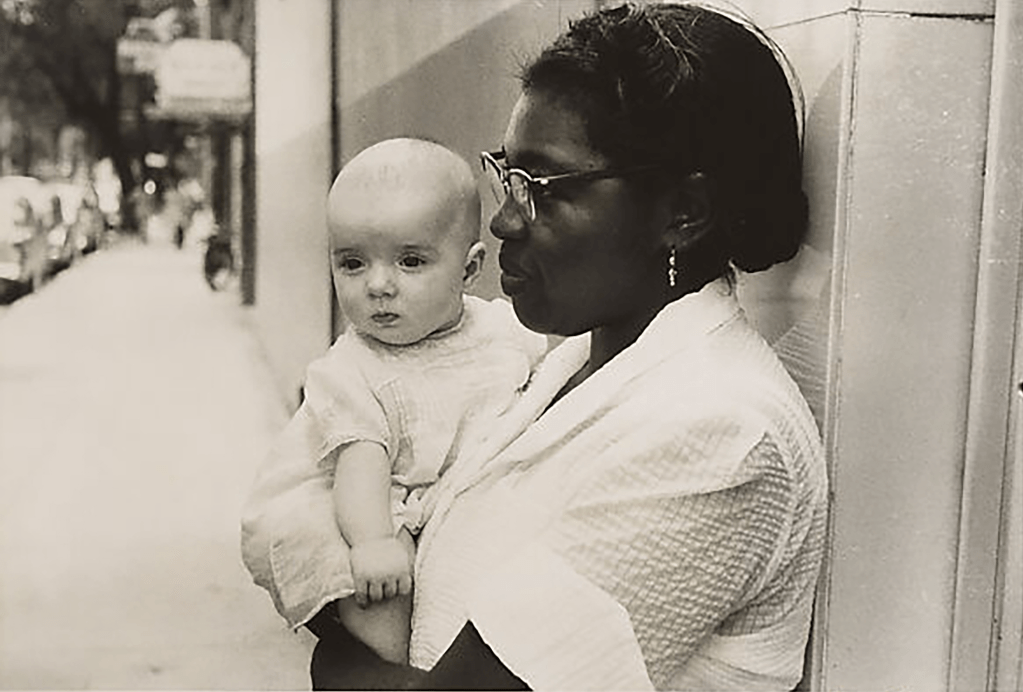
“——-The gasoline monsters stand in the New Mexico flats under big sign says Save——-the sweet little white baby in the black nurse’s arms both of them bemused in heaven, a picture that should have been blown up and hung in the street of Little Rock showing love under the sky and in the womb of our universe. . . .”2

Robert Frank
“Charlestown, South Carolina”
1955
Gelatin silver print
8 1/4” x 12 1/4”
Metropolitan Museum of Art, New York

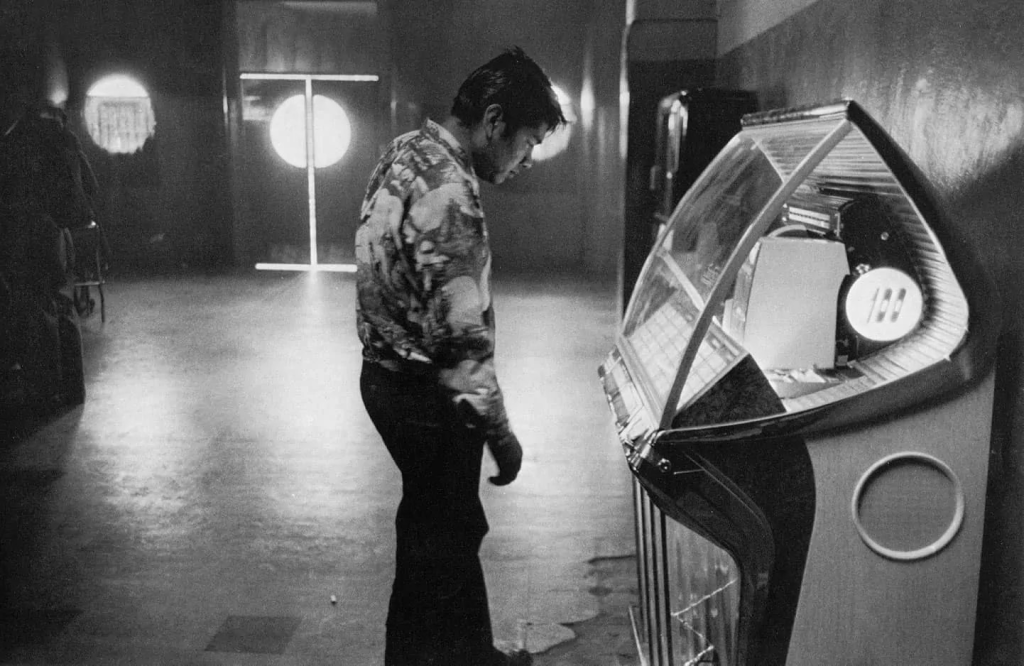
“THAT CRAZY FEELING IN AMERICA when the sun is hot on the streets and music comes out of the jukebox or from a nearby funeral, that’s what Robert Frank has captured. . . with the agility, mystery, genius, sadness and strange secrecy of a shadow photographed scenes that have never been seen before on film. . . . After seeing these pictures you end up finally not knowing any more whether a jukebox is sadder than a coffin. That’s because he’s always taking pictures of jukeboxes and coffins. . . !”3

Robert Frank
“Bar, Las Vegas, Nevada”
1955/56
Gelatin silver print
8 15/16” x 13 7/16”
The Art Institute of Chicago, Chicago, Illinois

“What a poem this is, what poems can be written about this book of pictures some day by some young new writer high by candlelight bending over them describing every gray mysterious detail, the gray film that caught the actual pink juice of human kind. Whether ’t is the milk of humankind-ness, of human-kindness, Shakespeare meant, makes no difference when you look at these pictures. Better than a Show.”4

Louis Faurer
“Robert Frank”
1947
Gelatin silver print
8 1/16″ x 5 3/8″
National Portrait Gallery, Smithsonian Institution,
Washington, DC.

And Kerouac’s last word to all of this:

“Anybody doesnt like these these pitchers dont like potry, see? Anybody dont like potry go home see Television shots of big hatted cowboys being tolerated by kind horses.”

“To Robert Frank I now give this message: You got eyes.”5


1 Frank, Robert; The Americans; (With and Introduction by Jack Kerouac); An Aperture Book, Grossman Publishers; New York, New York; 1969; p. vi.

2 Frank, Robert; The Americans; (With and Introduction by Jack Kerouac); An Aperture Book, Grossman Publishers; New York, New York; 1969; p. vi.

3 Frank, Robert; The Americans; (With and Introduction by Jack Kerouac); An Aperture Book, Grossman Publishers; New York, New York; 1969; p. i.

4 Frank, Robert; The Americans; (With and Introduction by Jack Kerouac); An Aperture Book, Grossman Publishers; New York, New York; 1969; p. iii.

5 Frank, Robert; The Americans; (With and Introduction by Jack Kerouac); An Aperture Book, Grossman Publishers; New York, New York; 1969; p. vi.

HOKUSAI’S WAVES

There are certain images, or should I say icons, that exert a visual power over all others. Two in particular come to mind: Turner’s great paintings of various “Storms at Sea” and Hokusai’s series of “Thirty-six Views of Mt. Fuji” which includes important images of nearby waves and distant views of Mt. Fuji. Whereas Hokusai often happily described himself as an old crazy man to paint, Turner was often derogatorily described by many of his contemporaries, often depicted as a crazy man wielding mops in order to complete his paintings!

“Turner painting one of his pictures”
Satirical cartoon, Almanack of the Month
1846
J. Paul Getty Trust, Los Angeles, California

We have often seen entire sets of Hokusai’s woodcuts exhibited at both the Art Institute of Chicago and the Metropolitan Museum of Art in New York. As for Turner, nothing surpasses the work from the Turner Bequest at the Tate Museum in London, or the Clowes Collection at the Indianapolis Museum of Art.

Contemporary writers have also been drawn to these two artists, including Yusef Komunyakaa and Patricia Clark. We have previously written regarding Komunyakaa’s “Turner’s Tussle with Water” and take a look now at Hokusai’s waves as written by Patricia Clark. Clark and her husband, the contemporary painter Stanley Krohmer, are often traveling and visiting museums. They collect exhibition catalogues, calendars and post cards from these locations. These are all important visual mnemonic devices, reminders of people and places seen, as well as sources for future investigations into both painting and poetry.1

Stanley Krohmer,
“Nocturne, Lake Michigan”
2021
Oil on wood panel
30” x 24”
Collection of the artist.

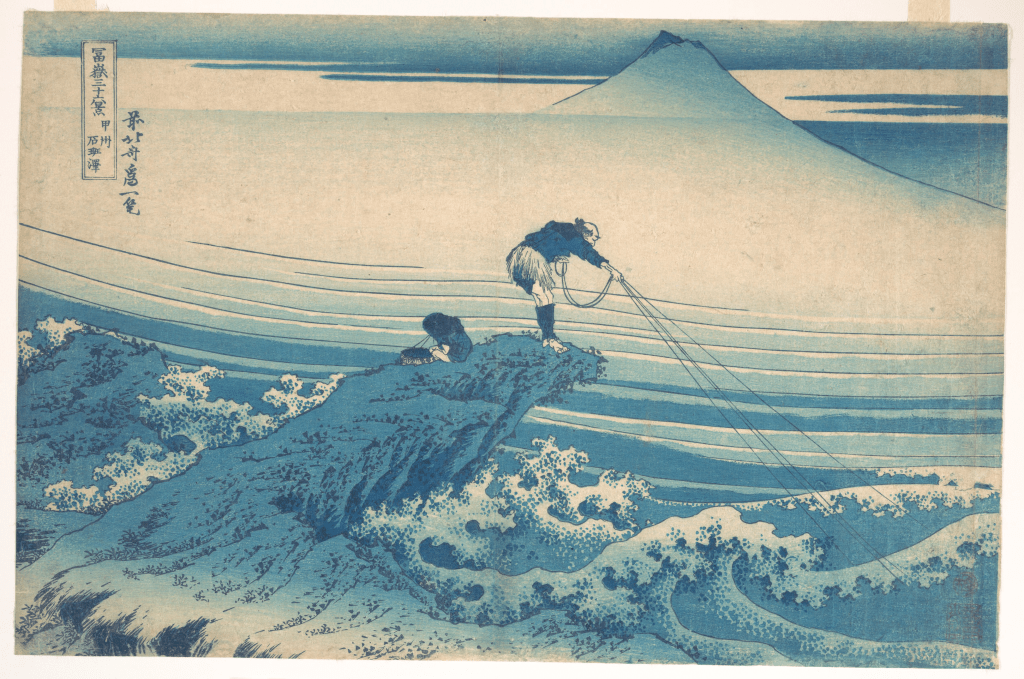
As a result of one of these trips, an image from Hokusai re-appeared in Clark’s memory. When I asked her about it, this was her response: “I never PLAN to write about some image ahead of time; I like to wait & see if it speaks to me somehow, over time. And somehow this one did. I think I was attracted to the tension in the fishing lines, the odd outfit the fellow is wearing, and the two figures. Plus the evident danger they might be in. I was surprised when it called up an old memory of mine — fishing during a camping trip, and also wandering along the shore, looking into tidepools and under rocks.”2

As is her practice, Patricia Clark uses her direct written responses to this visual work of art in order to combine them with certain memories of family members and their interactions with a landscape remembered from a distance.

Katsushika Hokusai
“Thirty-six Views of Mount Fuji: Fishermen standing on a rocky promontory at Kajikazawa”
1830-1832
Woodblock print on paper
10” x 15 1/8”
Metropolitan Museum of Art, New York

Barnacle

“The fisherman’s bent in half
on the tip
of a promontory,

a jacket, short pants, a grass skirt
over the pants,
no hat, tall socks

with shoes—though I’m fearful he’ll slip
where below
waves growl and snap.

He’s pulling in at least four lines, heavy
with fish,
one has to hope—

and he’s not alone. Nearby crouches a person
down on his haunches
also holding lines.

If the land’s rocky, okay, but it looks
fragile enough
to break off,

soft ground with wet sod crumbling
to pitch him in,
if not both of them. Once,

we wandered far down Agate & Crescent Beach,
stooping at
tidepools, turning over rocks

to find small gray crabs and touch
anemones, fascinated
by their pulse, heedless of tides.

By the time we looked up, our path back
was erased,
water crashing in, spraying foam,

and only through luck did we find
a cut
in the bluff where a path

snaked down—we clambered up with sea-
salt biting
at our heels. That was the day

later on, we hauled in a creature of the deep
we didn’t know,
a purple spiny thing large

as a cabbage we brought to the park ranger
in a bucket—
sea urchin, he said mildly.

It was a fearsome beautiful thing—
those spines dripping
with the sea, waving–I hope we let it go.

My father and his father, me and who else?
–my brother Dan?—
last seen on that shore

now washed away by waves of time
though memory has
planted a barnacle there.”3

Stanley Krohmer
“Steller’s Jay”
2015
Oil on canvas
36” x 36”
Collection of the Artist.

1 And as a footnote to this essay, I have included at the end an image of one of Stanley Krohmer’s paintings, “Steller’s Jay” which was actually used as the cover art for one of Patricia Clark’s books, “The Canopy” published by Terrapin Books in 2017.

2 Clark, Patricia; “Barnacle;” Manuscript page and notes in an E-Mail correspondence to this author, 2 December 2021, 4:58 PM.

3 Clark, Patricia; “Barnacle;” Included in the journal SALT; Santa Barbara, California; Issue 4, #1; 2023.

ROBERT BLY LOOKS AT REMBRANDT

“The humanity, the simple direct humanity of his figures—you feel like they’re real people that you can empathize with. He treats them with a certain dignity, it’s not like he’s trying to belittle them by making them seem so down-to-earth. He has respect for the ordinary person.”1

This is one of the many observations that my friend and colleague Stephanie Dickey has made regarding the work of Rembrandt van Rijn. She is one of the leading authorities on this artist, and was interviewed by Smithsonian Magazine on the anniversary of his 400th birth. She is unique amongst art historians, in my opinion, as she is so aware of, and sensitive to, the thought and painting processes of artists, not unlike the writing of the poet Robert Bly, who has himself had a life long interest and sensitivity to the work of painters and sculptors.

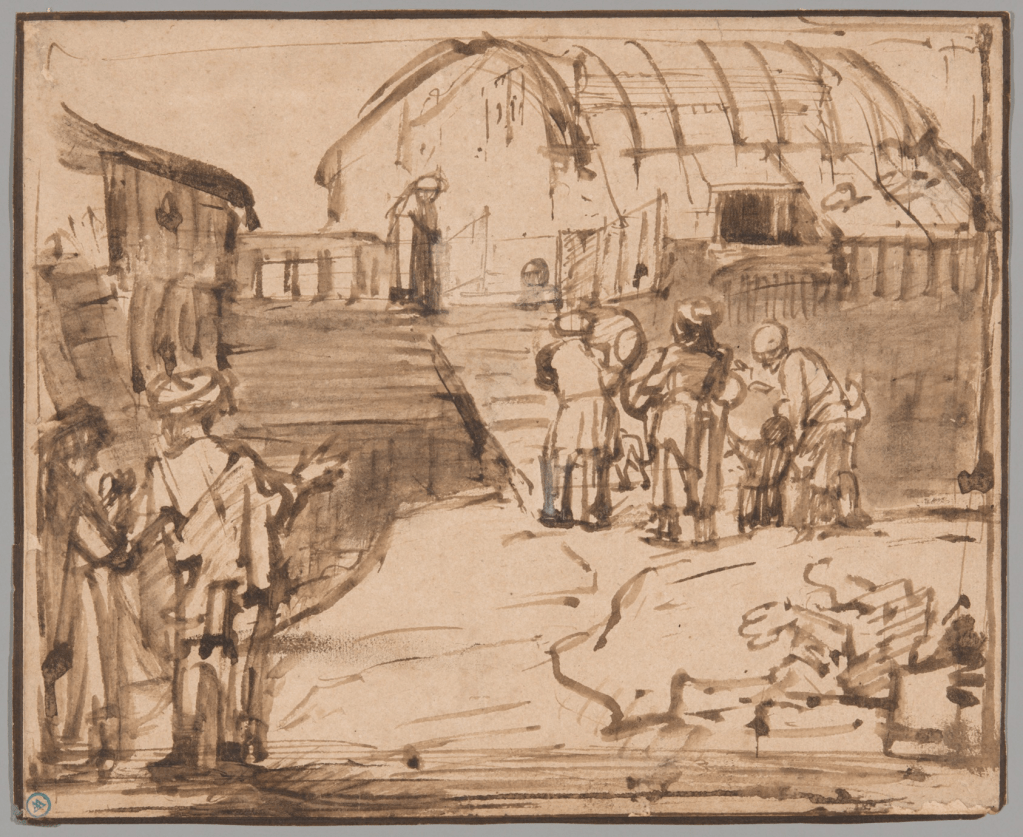
The Old St. Peter by Rembrandt

“Noah’s ship does not sail with its elephants forever.
The crying of the monkeys breaks off and starts again.
Even shame does not last a whole lifetime.”

Rembrandt van Rijn
“Noah’s Ark”
1660
Pen & ink with brown washes
203mm x 248mm
The Art Institute of Chicago, Chicago, Illinois.

“‘It was dark,’ Peter said. ‘We were alone. We had
A single candle which shone on the steel breastplate
Of the Roman soldier. The whole town was asleep.’

We are bubbles on the lips of our friends.
Each time they turn their heads, we drift toward the Pole;
We pass into the Many and return.

Who can say, ‘With God, the rest is nothing?’
Who can say, ‘I am a grandchild of the unfaithful?’
Who is able to wait one month to drink water?

We fell into weeping yesterday at five o’clock.
We wept because slavery has returned; we wept
Because the whole century has been a defeat.

Oh Peter! Peter! The night behind you is black.
A beam of light falls on your outworn face.
What can you do but lift up your hand for forgiveness?”2

Rembrandt van Rijn
“The Apostle Peter”
1632
Oil on canvas
32.2” x 24.4”
Nationalmuseum, Sweden

Rembrandt’s Brown Ink

“The sorrow of an old horse standing in the rain
Goes on and on. The plane that crashes in the desert
Holds shadows under its wings for thirty years.

Each time Rembrandt touches his pen to the page,
So many barns and fences fly up. Perhaps that happens
Because earth has pulled so many nights down.

When we hear a Drupad singer with his low voice
Patiently waiting for the next breath, we know
The universe can easily get along without us.

So much suffering has been stored in the amygdala
That we know it won’t be long before we put
Our heads down on the chopping block again.

Our thighs still remember all those smoky nights
When we crouched for hours on the dusty plains
Holding small-boned mammals into the fire.

How is it possible that so many nights of suffering
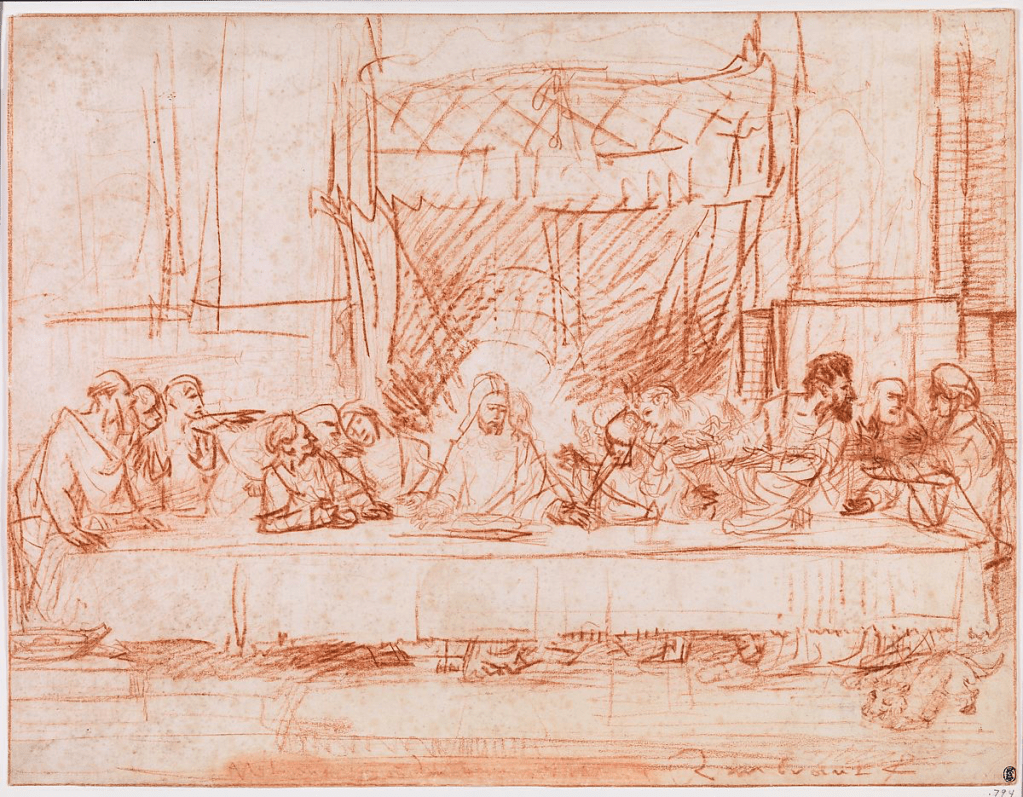
Could be summed up by a sketch in brown ink
Of Christ sitting at the table with Judas near?”3

Rembrandt van Reign
“The Last Supper, after Leonardo da Vinci”
1634-1635
Red chalk
14 1/4” x 18 11/16”
Robert Lehman Collection,
The Metropolitan Museum of Art,
New York, New York.

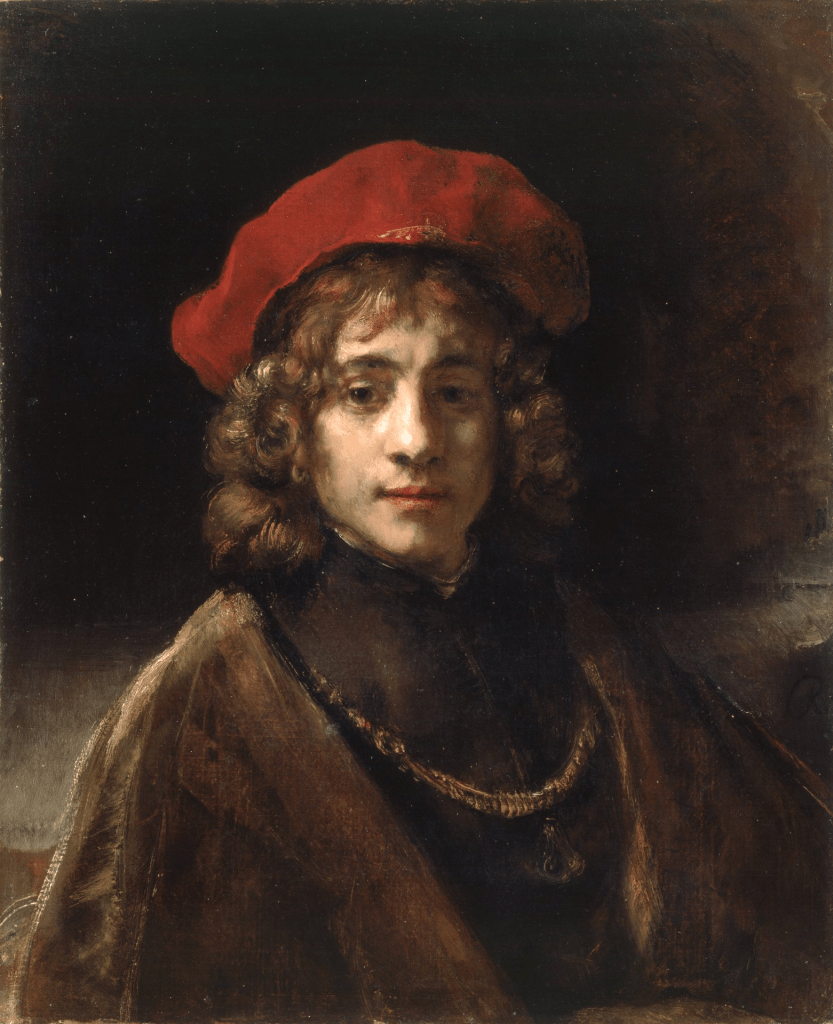
Rembrandt’s Portrait of Titus with a Red Hat

“It’s enough for light to fall on one half of a face.
Let the other half belong to the restful shadow,
The shadow the bowl of bread throws on the altar.

Some are like a horse’s eating place
At the back of the barn where a single beam
Of light comes down from a crack in the ceiling.

Painting bright colors may lie about the world.
Too many windows cause the artist to hide.
Too many well-lit necks call for the axe.

Beneath his red hat, Titus’s eyes hint to us
How puzzled he is by the sweetness of the world—
The way the dragonfly hurries to its death.

So many forces want to kill the young
Male who has been blessed. The Holy Family
Has to hide many times on the way to Egypt.

Titus receives a scattering of darkness.
He’s baptized by water soaked in onions;
The father protects his son by washing him in the night.”4

Rembrandt van Rijn
“Portrait of Titus with Red Hat”
1657
Oil on canvas
68.5cm x57.3cm
The Wallace Collection,
London, The United Kingdom.

Everything he paints, he paints with a sense of light (a touch of light) and a tacit understanding of the sitter just across from him. The form is felt with each brushstroke, and handled with sensitivity as the light falls across the space/face. One may identify one of these paintings from across the gallery, even without seeing the didactic information posted on the nearby wall. Always recognizable. And this work has grown so much, almost mythologically, that it exists on a whole ‘nother level of culture. So the last word on this surely belongs to my colleague and friend Stephanie Dickey from her observations on 400 Years of Rembrandt. Rembrandt’s reputation has taken on a life of its own:

“One thing that really surprises me is the extent to which Rembrandt exists as a phenomenon in pop culture. You have this musical group called The Rembrandts, who wrote the theme song to Friends—‘I’ll Be There For You.’ There are Rembrandt restaurants, Rembrandt hotels, art supplies and other things that are more obvious. But then there’s Rembrandt toothpaste. Why on Earth would somebody name a toothpaste after this artist who’s known for his really dark tonalities? It doesn’t make a lot of sense. But I think it’s because his name has become synonymous with quality. It’s even a verb—there’s a term in underworld slang, ‘to be Rembrandted,’ which means to be framed for a crime. And people in the cinema world use it to mean pictorial effects that are overdone. He’s just everywhere, and people who don’t know anything, who wouldn’t recognize a Rembrandt painting if they tripped over it, you say the name Rembrandt and they already know that this is a great artist. He’s become a synonym for greatness.”5

Dr. Stephanie Dickey,
Bader Chair in Northern Baroque Art,
Queen’s University,
Kingston, Ontario, Canada.


1 Amy, Crawford; An Interview with Stephanie Dickey, author of ‘Rembrandt at 400’; “Arts & Culture,” Smithsonian Magazine; 1 December 2006; Washington, DC; Archived 21 September 2018.

2 Bly, Robert; The Night Abraham Called to the Stars; Perennial/Harper Collins; New York; 2001; p. 75.

3 Bly Robert; My Sentence was a Thousand Years of Joy; Harper Perennial; New York, London, Toronto and Sydney; 2005; p. 35.

4 Bly, Robert; The Night Abraham Called to the Stars; Perennial/Harper Collins; New York; 2001; p. 39.

5 Amy, Crawford; An Interview with Stephanie Dickey, author of ‘Rembrandt at 400’; “Arts & Culture,” Smithsonian Magazine; 1 December 2006; Washington, DC; Archived 21 September 2018.

PAINT IT BLACK

“She’s got everything she needs,
She’s an artist, she don’t look back.
She’s got everything she needs,
She’s an artist, she don’t look back.
She can take the dark out of the nighttime
And paint the daytime black.”1

Louise Nevelson
“Black Wall”
1959
Painted wood
2642mm x 2165mm x 648mm
The Tate Gallery, London, United Kingdom.

We might be reminded of a couple songs on this subject: the first one written by Bob Dylan and the other by Mick Jagger and Keith Richards. Or, we might think of Goya’s late Pinturas Negras from 1819 to 1823; or two individual bodies of monochromatic abstractions produced by Ad Reinhardt and Louise Nevelson during the 1960’s. All incorporating the color black. Additionally, poets such as Robert Bly, Lawrence Ferlinghetti and Edward Hirsch have described various uses of this same color. Hirsch especially has commented on this in one of the essays in his larger collection titled The Demon and the Angel. He quotes a statement from the painter Robert Motherwell, and takes note that there are both physical and technical as well as psychological reasons for using this specific color.

Aaron Siskind
“Installation view of the ‘Black or White’ Exhibition”2
1950
b&w photograph
14cm x 25cm
Archives of American Art,
Smithsonian Institution, Washington, DC.

“The New York painters discovered that they could use black pigments to create a feeling that was sometimes infernal, sometimes transcendent. They entered a zone of black hues that was both boldly contemporary and richly archaic. Black fit the spirit of urban painters who also embraced a Modernist Primitivism: ‘The chemistry of the pigments is interesting: ivory black, like bone black, is made from charred bones or horns, carbon black is burnt gas,’ Robert Motherwell explained in a catalog note to the 1950 show Black or White. ‘Sometimes I wonder, laying in a great black stripe on a canvas, what animal’s bones (or horns) are making the furrows of my picture.”3

In another collection, My Sentence was a Thousand Years of Joy, Robert Bly includes several examples of the ekphrastic tradition related to this subject. He speaks of Cézanne and Monet, as well as Giotto, Fra Lippi, Rembrandt, and especially Robert Motherwell.

For Robert Motherwell

“Hunter, give me your horse. I am going into sorrow again.
I’m looking for the dead people hidden in the grass.
Help me up. I am crazy about suffering again.

I see that I am walking in a dead man’s shoes.
I have been born so many times as an orphan. The thin fiddle
Strings stretched tight have saved me from suicide.

When Robert Motherwell lifts up his two black clouds
So that they float a few feet from each other,
I know grief is the one who tells me what to do.

The soul can never get enough of the taste of its sorrow.
I am a horse throwing his head sideways, galloping
Away from the place where the happy people live.

I don’t care anymore whether I am educated or not.
We have learned so much pain by not going to school.
Our lines suggest the luck lost between heartbeats.

We who love Motherwell’s black clouds may be insane,
But at least we know where to feed. We are close
Relatives of the birds that followed Jesus to Egypt.”4

Robert Motherwell
“Elegy to the Spanish Republic”
1962
Acrylic on canvas
71″ x 132 1/4”
Yale University Art Gallery,
New Haven, Connecticut

As poets over the years, Robert Bly, Edward Hirsch, and Lawrence Ferlinghetti have all been interested in their contemporaries who were painters, as the above examples by Hirsch and Bly illustrate. In the example below, one of his late prose poems, Ferlinghetti writes about the many transformative processes that painters often go through, inspired by a certain painting by Motherwell.

The Painter’s Dilemma

“There they all were still, the unfinished canvasses, all chimeras, chiaroscuro illusions, dead stick figures still to be brought to real life, with their numbered pigments upon the canvas ground where formed the limbs the figures the faces of longing, yearning dogs and hungry horses’ heads among them, the skulls with ears, liquid porches, spilling light, onto the canvas, pools of it forming into shape of eyes, but as soon as they were formed they ran down with too much turpentine and ran onto the dark dogs and horses, and they turned into echoes of laughter with every mocking sound a different color echoing about the canvas and transfiguring all its painted parts, horses’ penises turned to yellow flutes that fitted to manifolds that fitted into female plumbing that in turn dissolved and floated down streets as yellow sunlight, while numbered shadows melted and percolated up into the gutters of tilted houses. Hunger and passion were what was needed but this got lost in the whirl of paint, in the depths of the cave that every canvas became, and the brush could not reach the boundaries of being inside Plato’s Cave.”5

Robert Motherwell
“In Plato’s Cave”
1991
Acrylic on canvas
72″ x 96”
National Gallery of Art,
Washington, DC.

These have been several observations pertaining to this one subject, which are shared by Robert Bly and Robert Motherwell, Edward Hirsch and Lawrence Ferlinghetti. It is a specific theme and color range that occurs in various periods of art history. And in Rock ’n Roll. So it seems like some one should have the final word here. But it will come to this, shared by three writers and one painter: Mick Jagger and Keith Richards, Franz Kline for one of his great ‘black’ paintings, and last but not least: Robert Bly.

“I see a red door
And I want it painted black
No colors anymore
I want them to turn black. . . .”

“Maybe then, I’ll fade away
And not have to face the facts
It’s not easy facing up
When your whole world is black. . . .”

“I wanna see the sun
Blotted out from the sky
I wanna see it painted, painted, painted
Painted black. . . .”6

Franz Kline
“Untitled”
1952
Enamel on canvas
53 3/8” x 68”
Metropolitan Museum of Art
New York, New York.

“Some people say
A painting is a pitcher full of the invisible.”7

“I don’t know why these poems keep veering off
Toward darkness.”8


1 Dylan, Bob; “She Belongs to Me” from Writings and Drawings; Alfred A. Knopf, Inc.; New York, New York; 1973; p.159.

2 In this installation photograph of the exhibition “Black or White” by Aaron Siskind, the works shown are from left to right: “Dark Pond” by Willem de Kooning, 1948; “Granada” by Robert Motherwell, 1948-1949; and “Germania II” by Hans Hofmann, 1950. Kootz Gallery, New York, New York, 1950.

3 Hirsch, Edward; The Demon and the Angel: Searching for the Source of Artistic Inspiration; Harcourt, Inc.; New York, San Diego and London; 2002; p. 183.

4 Bly Robert; My Sentence was a Thousand Years of Joy; Harper Perennial; New York, London, Toronto and Sydney; 2005; p. 59.

5 Ferlinghetti, Lawrence; When I Look at Pictures, Peregrine Smith Books; Salt Lake City, Utah; 1990; p. 46.

6 Jagger, Mick, & Keith Richards; Aftermath: Paint It Black; Audio Recording; Decca Records & RCA Studios; Los Angeles, California; 1966.

7 Bly Robert; My Sentence was a Thousand Years of Joy; Harper Perennial; New York, London, Toronto and Sydney; 2005; p. 13.

8 Bly Robert; My Sentence was a Thousand Years of Joy; Harper Perennial; New York, London, Toronto and Sydney; 2005; p. 85.

THE LAST PAINTINGS AT RUSSELL’S CORNERS

Writing about the George Ault Retrospective Exhibition at the Whitney Museum of American Art in New York in 1988, the critic Roberta Smith observed: “. . . Ault’s firm, unflamboyant way with a brush, his feeling for a building’s austere, carefully dovetailed planes and, above all, his love of light as painting’s form-giving, mood-setting force, sustained him at nearly every turn, in any direction he chose to move. His forte was the nocturne, which he painted from the beginning to the end of his career.”1

George Copeland Ault was born in Cleveland, Ohio in 1891. Between 1899 and 1911 the Ault family lived in London where his father represented his family’s business. During this time George was encouraged by his father to study at the Slade School of Art. Four years after the family’s return to the States in 1915, George’s younger brother committed suicide. Five years later, his Mother died of pernicious anemia in a New Jersey mental hospital. In 1929 his Father died and the family fortune was lost in the stock market crash. Within the next two years both of his older brothers committed suicide. George and his sister Esther were the only remaining family members at that time. Ault continued working on his paintings of city views during the early nineteen-thirties. However, he left his affiliation with the Downtown Gallery in New York City in 1937 and sought isolation outside of the city.2

In this late series of paintings one might see and understand how George Ault came to embrace the darkness and solitude of an isolated country crossroads. For several years he was often grouped with other early 20th Century artists. His Precisionist tendencies, combined with an understated surrealist sensibility placed him in good company with the likes of Ralston Crawford, Charles Sheeler, and Edward Hopper, and even the early city-scapes of Arthur Dove and Georgia O’Keeffe.

George Ault
“Hudson Street”
1932
Oil on linen
24 3/16” x 20”
Whitney Museum of American Art, New York.

Moving north, George Ault found his isolation in small town America, and an even smaller crossroads just a short walk outside of Woodstock, New York. It was there that he found a particular quietude, and his vision as an artist. From 1943 through 1948 Ault painted five views of Russell’s Corners, one in daylight and four at night. George Ault’s life and work has sparked new interest recently: from Roberta Smith to Alexander Nemerov, and especially for the art historian and poet, Joseph Stanton.

George Ault
“Black Night at Russell’s Corners”
1943
Oil on canvas
18” x 24 1/16”
Pennsylvania Academy of Fine Arts,
Philadelphia, Pennsylvania

Stanton’s writing has often had as a source, specific works of visual art, in the true ekphrastic tradition. These have included many works by Edward Hopper and Winslow Homer, and even one painting by Marjorie Phillips of Joe DiMaggio coming up to the plate for the last time at the old Griffith Stadium against the Washington Senators.

Joseph Stanton has captured that sense of isolation that is particularly American in certain paintings: the lone batsman, standing at home plate; or the architectural abstractions of both Edward Hopper and Charles Sheeler. Not nearly as well known as Hopper, or other of his contemporaries, George Ault nonetheless created a powerful and haunting body of work.

“Bright Light at Russell’s Corners”
1946
Oil on canvas
19 5/8” x 25”
Smithsonian American Art Museum,
Washington, DC.

George Ault’s Last Painting of Russell’s Corners

“He loved the lamp that made the corner bright,
adored it as a stay against the dark,
but dark returned when he moved past the light.

The chaos of this era out of sight,
his deft Precision kept his vision stark,
shaped by the lamp that made the corner bright.

Against the tumult of the world he posed this site;
he dreamt geometry as if a truth were clear,
but dark returned when he moved past the light.

This Catskill village was his whole delight,
his universe had Woodstock at its heart,
a tiny town had made his corner bright.

He painted roofs to shoulder up the night,
and walked this road, avoiding shadowed forks,
but dark returned when he moved past the light.

Beyond himself in art, he could not quite
decide to live and plunged into dark.
He loved the lamp that made the corner bright,
but dark returned when he moved past the light.”3

On the night of 30 December 1948, George Ault was walking alone in a storm along the Sawkill Brook, in Woodstock, New York, where he drowned. What we are left with is this sense of loneliness, and that feeling of the solitary figure or place. Isolation, and a uniquely American sense of place and light.

Roberta Smith again describes this work: “The setting is the same in each case—a solitary streetlight, the same bend in the road, the same collection of barns and sheds—but seen from different vantage points. In them, Ault has summoned up the poetry of darkness in an unforgettable way—the implacable solitude and strangeness that night bestows upon once-familiar forms and places.”4

George Ault
“August Night at Russell’s Corners
1948
Oil on canvas
18” x 24”
Joslyn Art Museum, Omaha, Nebraska

1 Smith, Roberta; “George Ault’s Sad, Everyday Beauty in Stillness;” The New York Times; 29 April 1988; Section C, p. 17.

2 Nemerov, Alexander; To Make a World: George Ault and 1940’s America; Smithsonian American Art Museum and Yale University Press; New Haven, London, and Washington, DC.; 2011. This information summarized from the more extensive chronological information, pp. 131-133.

3 Stanton, Joseph; Prevailing Winds; Shanti Arts Publishing; Brunswick, Maine; 2022; p. 37.

4 Smith, Roberta; “George Ault’s Sad, Everyday Beauty in Stillness;” The New York Times; 29 April 1988; Section C, p. 17.