THE MAN WITH THE BLUE GUITAR

“The colour blue offers a multiplicity of remarkable characteristics to the observing eye and to the reflective mind alike. It is the only colour which can be seen as a close neighbor to and essentially akin to both dark and light, almost black in the night and almost white at the horizon by day; and it is also the colour of shadows on snow. It can darken, it can obscure, it may float to and fro like a mist, dimming reality with sadness and concealing truth…. By contrast light blue is the colour of loyalty and ecstasy—‘true blue’ for example….”1

This description is from a remarkable study on Paul Cézanne by the German art historian Kurt Badt. Cézanne of course pushed the use of color and structure to new limits in all of his work and so many of the younger artists migrating to Paris at the beginning of the 20th Century soon became aware of this, including Pablo Picasso.

Pablo Picasso
“Self Portrait”
1901
Oil on canvas
81 cm x 60 cm
Picasso Museum, Paris

For Picasso, this became one of the most important attributes to his early paintings. Alone and isolated as many artists found themselves in Paris at that time, it was inevitable that a certain melancholy would set in. This was intensified by the sudden death of one of his dear friends, Casagemas. The psychological range of the color blue became an important element in his search for a way out of his situation. Using local residents, not traditional artist’s models, he began to paint this series from 1901 through 1904. His portrait of Casagemas was painted as a tribute in 1901, and was included again as the male figure in “La Vie” from the Cleveland Museum of Art in 1903.

Along with his description of the color blue, Kurt Badt also has mentioned the psychology of this color, even referring to it emotionally as ‘the blues’ as we might assume. For Picasso, this was a turning point.
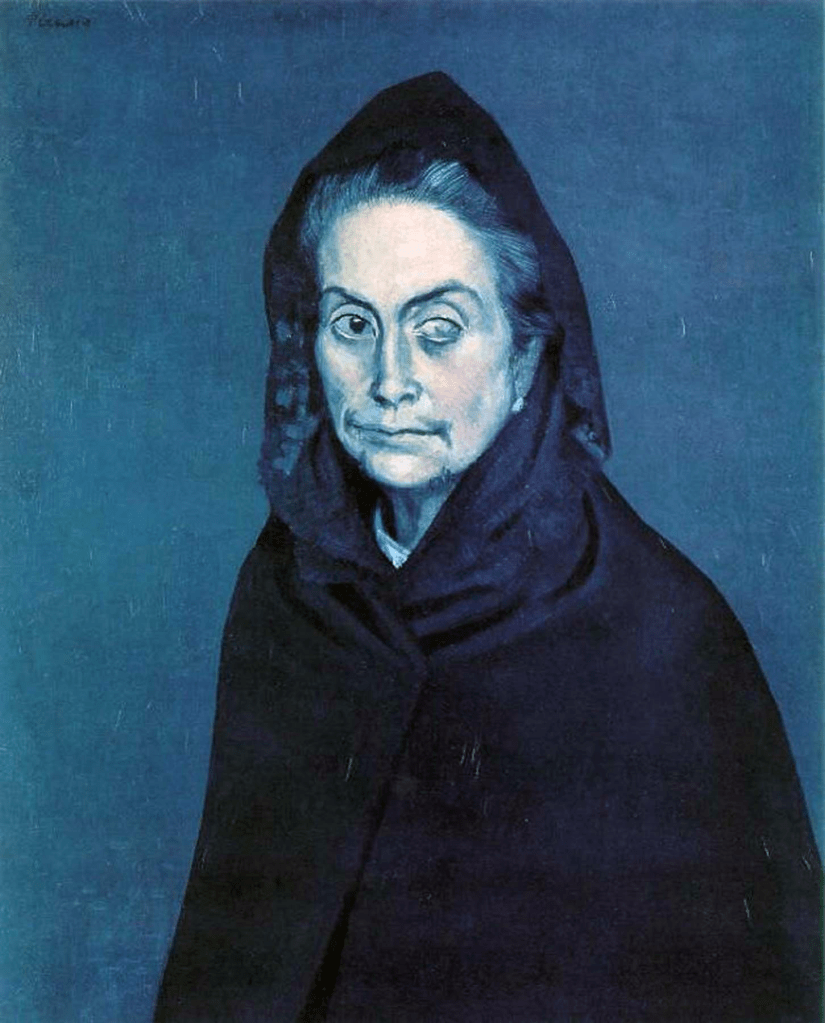
Pablo Picasso
“La Celestina”
1904
Oil on canvas
70 cm x 56 cm
Musee Picasso, Paris

Whether it was a half blind woman in the street, a procuress named Celestina from a Spanish tragicomedy of 1499, or a totally blind man having his evening dinner, the people, their poses, and their color are simultaneously expressing a set of emotions and questions for the viewer. Add to these images, the portrait of “The Old Guitarist” from the collection of the Art Institute of Chicago, and we have more questions regarding life during this time period.
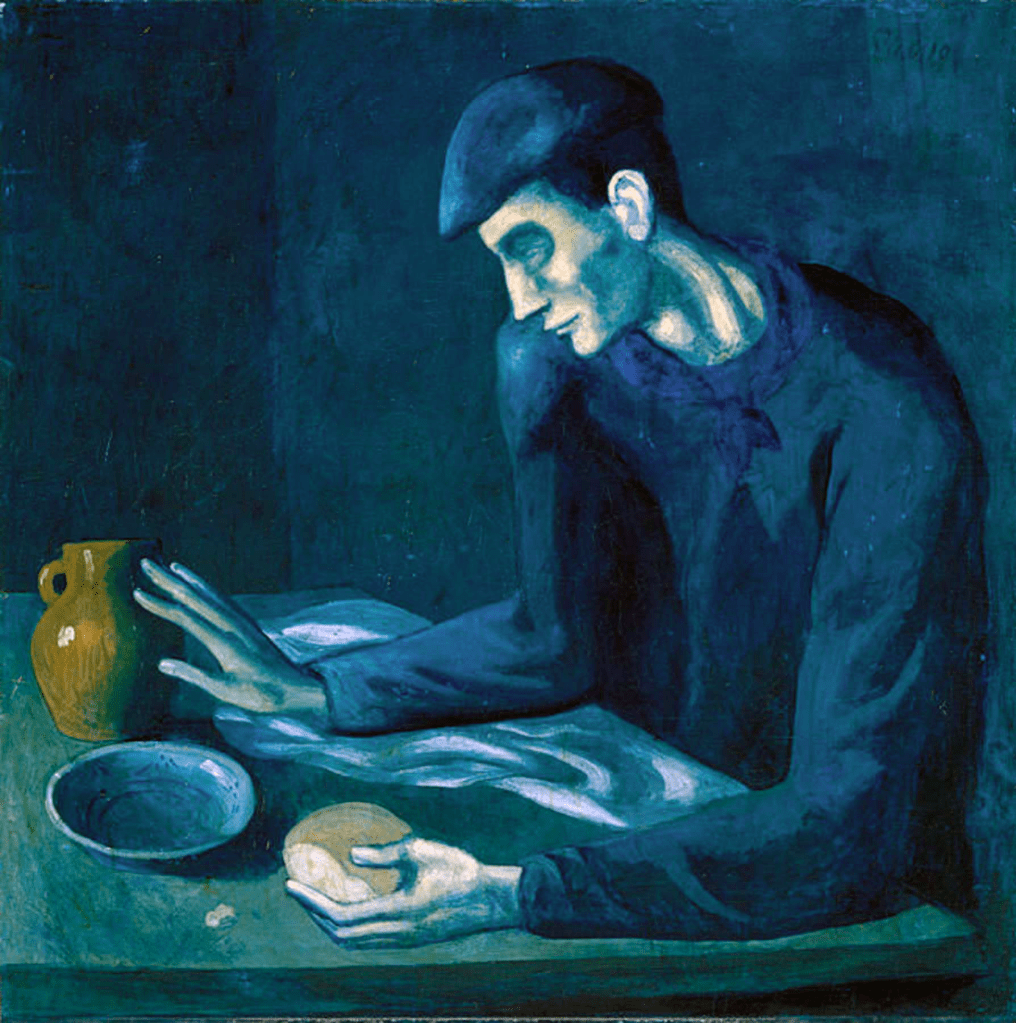
Pablo Picasso
“The Blind Man’s Meal”
1903
Oil on canvas
37 1/2” x 37 1/2”
The Metropolitan Museum of Art, New York

The musician, with his head bent over his instrument, with the weight of blue pressing down on his shoulder, we follow the line of his arm downward to the elbow and across to his hand strumming the guitar. And then up the neck of this guitar, to his fingers holding steady on the chords, and then across to his other shoulder, through his own neck and back to his dazed expression: a full compositional circle. This resulted of course, in one of the most important modern examples of the ekphrastic tradition, Wallace Stevens’ “The Man with the Blue Guitar.”

“The man bent over his guitar,

A shearsman of sorts. The day was green.

They said, ‘You have a blue guitar, 
You do not play things as they are.’

The man replied, ‘Things as they are

Are changed upon the blue guitar.’

And they said to him, ‘But play, you must,

A tune beyond us, yet ourselves,

A tune upon the blue guitar,

Of things exactly as they are.’”2

“I cannot bring a world quite round,

Although I patch it as I can.

I sing a hero’s head, large eye

And bearded bronze, but not a man,

Although I patch him as I can

And reach through him almost to man.

If a serenade almost to man

Is to miss, by that, things as they are,

Say that it is the serenade

Of a man that plays a blue guitar.”
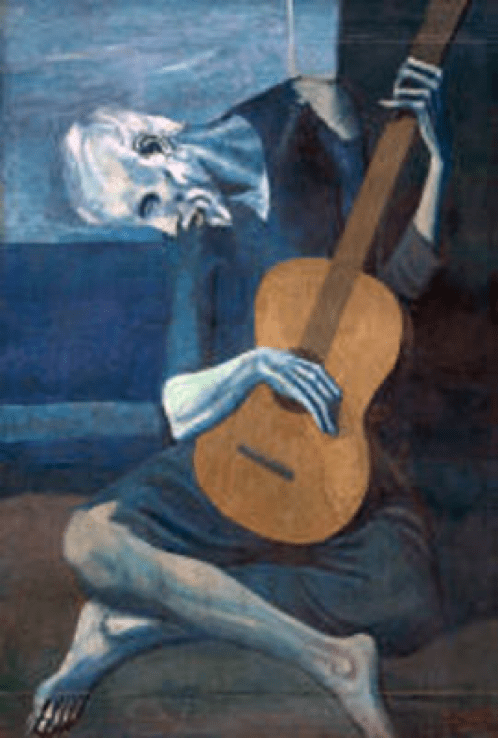

Pablo Picasso
“The Old Guitarist”
1903–1904
Oil on panel
48 3/8” x 32 1/2”
The Art Institute of Chicago


So, we have a set up between the artist and the audience: the artist saying that things are changed upon the blue guitar, while the audience insists upon a tune of things exactly as they are!

Stevens starts with this guitarist from the Blue Period but soon goes on to other thoughts, not descriptive but reflective: “A tune beyond us as we are….”3 and ventures into the modern world of painting and poetry. He has to touch upon descriptions of general life and the accompanying dilemmas of 20th century artists. This then continues through several of the later sections of this poem. As Glen MacLeod mentioned in Wallace Stevens and Modern Art, he fuses references to Picasso with more general observations to modern life and a sense of contemporary surrealism, a kind of “…permissible imagination.”4


“A tune beyond us as we are, 

Yet nothing changed by the blue guitar;

Ourselves in tune as if in space,

Yet nothing changed, except the place

Of things as they are and only the place

As you play them on the blue guitar,

Placed, so, beyond the compass of change, 

Perceived in a final atmosphere;

For a moment final, in the way

The thinking of art seems final when

The thinking of god is smoky dew.

The tune is space. The blue guitar

Becomes the place of things as they are,

A composing of senses of the guitar.”5
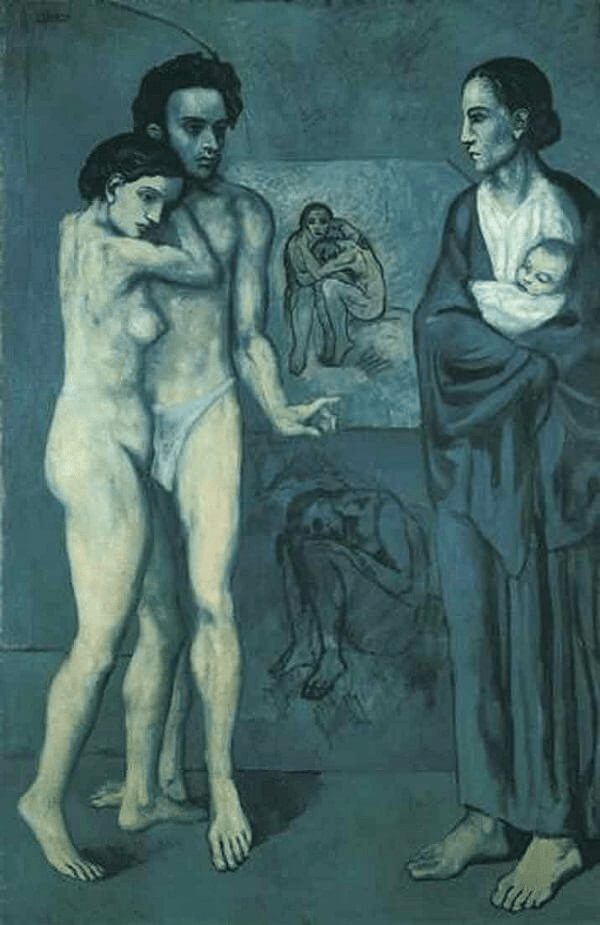
Pablo Picasso
“La Vie”
1903
Oil on canvas
197 cm x 129 cm
The Cleveland Museum of Art,
Cleveland, Ohio


“The world washed in his imagination,
The world was a shore, whether sound or form

Or light, the relic of farewells,
Rock, of valedictory echoing,

To which his imagination returned,
From which it sped, a bar in space,

Sand heaped in the clouds, giant that fought
Against the murderous alphabet:

The swarm of thoughts, the swarm of dreams
Of inaccessible Utopia.

A mountainous music always seemed
To be falling and to be passing away.”6

“Is this picture of Picasso’s, this ‘hoard
Of destructions’, a picture of ourselves,

Now, an image of our society?”7


1 Badt, Kurt; The Art of Cezanne; University of California Press; Berkeley and Los Angeles; 1965; pp. 58-59.

2 Stevens, Wallace; “The Man With The Blue Guitar” Collected Poetry and Prose; The Library of America; New York, New York; 1997; Section I, p. 135.

3 Stevens, Wallace; “The Man With The Blue Guitar” Collected Poetry and Prose; The Library of America; New York, New York; 1997; Section VI, p. 137.

4 MacLeod, Glen; Wallace Stevens and Modern Art: From the Armory show to Abstract Expressionism; Yale University Press; New Haven and London; 1993; p. 197.

5 Stevens, Wallace; “The Man With The Blue Guitar” Collected Poetry and Prose; The Library of America; New York, New York; 1997; Section VI, p. 137.

6 Stevens, Wallace; “The Man With The Blue Guitar” Collected Poetry and Prose; The Library of America; New York, New York; 1997; Section XXVI, pp. 146-147.

7 Stevens, Wallace; “The Man With The Blue Guitar” Collected Poetry and Prose; The Library of America; New York, New York; 1997; Section XV, p. 141.

THE GOOD SHEPHERD

shepherd
“The Calf Bearer”
c. 570 BC
Marble
65″ high
Acropolis Museum, Athens

It could have been a reference to an ancient or biblical theme, the good shepherd or the calf bearer. An image of a man carrying a calf or a sheep on his shoulders, having just rescued it, and returning it to the flock. Pablo Picasso used many such themes and ideas in his work, however, he usually denied it in reference to this particular piece. “The man could just as well be carrying a pig as a sheep! There is no symbolism in it. It is just something beautiful.”[i]

shepherd-2
Pablo Picasso
“The Man with the Sheep”
1943
Bronze
222.5 x 78 x 78 cm
Musee Picasso, Paris

Shifting back and forth from serious to playful, perhaps he is being sly or evasive? Or surrealistic and poetic like his friend of more than forty years, Max Jacob? Picasso and Jacob met in 1901 and became fast friends. Jacob was the first Parisian to teach Picasso French. And, as an early art critic, he wrote enthusiastically about Picasso’s work. Jacob was also a painter, cubist/surrealist poet, bon vivant, homosexual and a Jew. As described by Roger Shattuck, the beginning of the 20th Century was an exhilerating time: “In its early demonstrations the avant-garde remained a true community, loyal to itself and to its time…. Painters, writers, and musicians lived and worked together and tried their hands at each other’s arts in an atmosphere of perpetual collaboration.”[ii]

“When you paint a picture, it completely changes with each brushtroke, turning like a cylinder, almost interminably. When it stops turning, it’s finished. My latest was a Tower of Babel made of lighted candles.”[iii]

Max Jacob was originally from Quimper in Brittany, France. A street, a bridge, a high school and even the courtyard of the house at 8, rue de Parc, in Quimper bear his name. The Musee des Beaux-Arts in Quimper even has a room dedicated to Jacob featuring his drawings, paintings, and manuscripts. It was there, during the summer of 1997 that I first learned about several details of his life. In Quimper and in Paris during the summer of 1994—the 50th anniversary of Jacob’s death, there was an exhibition documenting this almost lifelong friendship between Max Jacob and Pablo Picasso.

“All it takes is a five-year-old in pale overalls drawing in a coloring book for a door to open into the light, for the house to be built again and the ochre hillside covered with flowers.”[iv]

shepherd-3
Pablo Picasso
“Study for The Man with the Sheep”
1943
Pen and ink with washes on paper
51 1/8″ x 20″
Musee Picasso, Paris

Picasso claims to have completed “The Man with the Sheep” in a burst of spontaneous energy in just one day. It was first in plaster, with the legs a bit too thin to support the upper half, so he and an assistant hoisted it up with ropes, he finished what needed to be done, and then had it cast in bronze right away. However, there are several drawings made as studies for this piece from the previous year. Not only was the position of the sheep not to his liking, but the head of the figure went through several stages: a younger man, then an older one; a clean shaven figure, then a bearded one, and so on.

shepherd-4
Pablo Picasso
“Studies for The Man with the Sheep”
1942
Pen and ink on paper
Musee Picasso, Paris

shepherd-5
Robert Capa
“Picasso in the Grands-Augustins studio, with ‘Man With a sheep’ plaster version”
1944
B&W photograph
Musee Picasso, Paris

At the end he, Picasso, modelled the face of his friend Max Jacob onto this figure. When the piece had been cast, Picasso placed it at the top of the stairs to his studio on the rue des Grands-Augustins. Often SS Officers would climb just to the top of the stairs in surprise inspections and be met by the “Man Holding a Sheep.” They looked quickly around and returned down to the street, not realizing that Jacob had been looking down on them. Max Jacob had been arrested by the SS earlier, and was in the process of being shipped to Auschwitz, however, he died from bronchial pneumonia while in one of the deportation camps at Drancy, France.

“The Yellow Star Again”

“Are those beets your dog’s eating?”
“No, it’s a Jew who fell in the snow.”
“They could find some other place to faint instead of my sidewalk.”[v]


[i] Bernadac, Marie-Laure; Picasso Museum, Paris: The Masterpieces; Reunion des Musees Nationaux and Prestel; Paris and munich; 1991; p. 162.

[ii] Shattuck, Roger; The Banquet Years: The Origins of the Avant-Garde in France 1885 to World War I; Vintage Books, Random House; New York, New York; 1968; p. 28.

[iii] Kulik, William, editor and translater; The Selected Poems of Max Jacob; Oberlin College Press; Oberlin, Ohio; 1999; p. 57.

[iv] Kulik, William, editor and translater; The Selected Poems of Max Jacob; p. 129.

[v] Kulik, William, editor and translater; The Selected Poems of Max Jacob; p. 122.

BUT WHO ARE THEY?

Between 1902 and 1914 the poet Rainer Maria Rilke lived in Paris to work on a monograph and to act for a short time as the secretary for the sculptor August Rodin. It was Rodin who introduced him to other Parisian artists of the time, including Paul Cezanne. Influenced by the physicality of many of the paintings and sculptures he saw, Rilke developed a new style, which he called the “object poem.” This form of writing sought to capture the plastic presence of a physical object and resulted in imaginative interpretations of certain works of art.

Rilke began writing the “Duino Elegies” in 1912 while a guest of Princess Marie von Thurn und Taxis at the Duino Castle near Trieste. For the next ten years however, the “Elegies” remained incomplete whilst Rilke fell frequently in and out of a depression partially caused by the events of World War I.

In 1915, while he was living in Munich and finding it difficult to secure suitable housing, Rilke asked Hertha Koenig if he might live for a while in her house while she and her family were in the country. His request was granted, and he lived there from June until October 1915. Sometime in 1914 Frau Koenig had purchased Picasso’s painting “The Family of Saltimbanques” and this is where Rilke was privileged to have lived with this painting for five months.

Later, in the summer of 1921 Rilke took up residence at the Château de Muzot, as the guest of another patron. Within the space of a few days in February 1922, he completed the Duino cycle, begun years earlier. The final section to be completed was the Fifth Elegy, which was dedicated to Frau Hertha von Koenig and based on this rose period masterpiece: “The Family of Saltimbanques.”

picasso-1
Pablo Picasso
“Family of Saltimbanques”
1905
Oil on canvas 
83 3/4″ x 90 3/8″
The Chester Dale Collection, National Gallery of Art, Washington, DC

“But tell me, who are they, these acrobats, even a little
more fleeting than we ourselves,–so urgently, ever since childhood
wrung by an (oh, for the sake of whom?)
never-contented will? That keeps on wringing them,
bending them, slinging them, swinging them,
throwing them and catching them back; as though from an oily
smoother air, they come down on the threadbare
carpet, thinned by their everlasting
upspringing, this carpet forlornly
lost in the cosmos.
Laid on there like a plaster, as though the suburban
sky had injured the earth.”[i]

“There, the withered wrinkled lifter,
old now and only drumming,
shriveled up in his mighty skin as though it had once contained
two men, and one were already
lying in the churchyard, and he had outlasted the other,
deaf and sometimes a little strange.”[ii]

Who are they? They have become one and the same color as the sand and sawdust beneath their feet. Almost ghosts. It is a huge painting at the National Gallery with figures almost life size who know how to keep secrets. Even the painting itself has a secret: look for the water jug just behind the woman in the lower right, and the pointed stance of the young acrobat to her left, below that and just beneath the surface is a ghost of a leg, a pentimento of another earlier figure, now painted out of the picture. This lost figure, as well as the surviving ones are all ghosts now, inhabiting the rose desert of Rilke’s poem, but not always adding up to zero.

picasso-2
Pablo Picasso
“Family of Saltimbanques” (DETAIL)
1905
Oil on canvas
83 3/4″ x 90 3/8″
The Chester Dale Collection, National Gallery of Art, Washington, DC

“And the yonger, the man, like the son of a neck
and a nun: so taughtly and smartly filled
with muscle and simpleness.”[iii]

“And then, in this wearisome nowhere, all of a sudden,
the ineffable spot where the pure too-little
incomprehensibly changes,–springs round
into that empty too-much?
Where the many-digited sum
solves into zero?”[iv]


[i] Rilke, Rainer Maria; The Duino Elegies, translated by J. B. Leishman and Stephen Spender; W. W. Norton & Company; New York, New York; 1963; p. 47.

[ii] Rilke, Rainer Maria; The Duino Elegies; p. 49.

[iii] Rilke, Rainer Maria; The Duino Elegies; p. 49.

[iv] Rilke, Rainer Maria; The Duino Elegies; p. 53.