THE DISASTERS OF WAR

war1
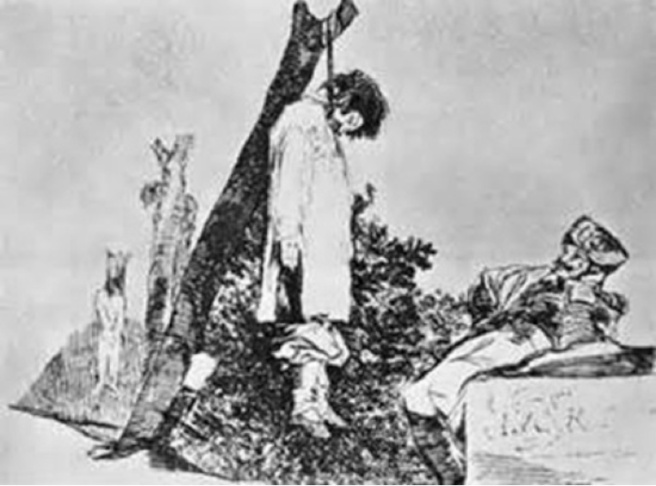
Francisco Goya
“Not in this case, Plate #36, The Disasters of War”
c. 1812/1815, published 1863
Etching, aquatint and drypoint
140 x 190 mm
The Art Institute of Chicago

“One cannot look at this.
This is bad.
This is how it happened.
This always happens.
There is no one to help them.
With or without reason.
He defends himself well.
He deserved it.
Bury them and keep quiet.
There was nothing to be done and he died.
What madness!
This is too much!
Why?
Nobody knows why.
Not in this case either.
This is worse.
Barbarians!
This is the absolute worst!
It will be the same.
All this and more.
The same thing elsewhere.
Perhaps they are of another breed.
I saw it.
And this too.
Truth has died.
This is the truth.”[i]

In one of her late series of essays, Susan Sontag created a literary collage of sorts. The title of this piece is “Looking at the Unbearable” and is inspired by Goya’s series of “The Disasters of War.” In fact, it is a very straightforward listing of several titles of Goya’s prints as they were later annotated in pencil beneath each print!

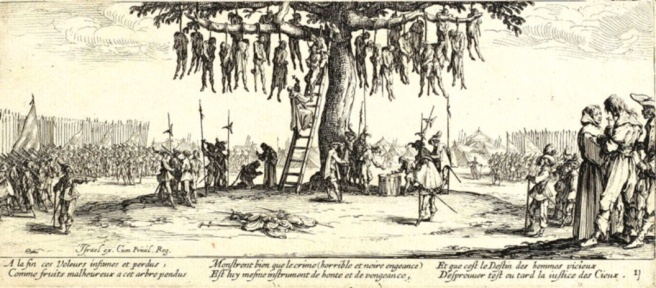
Goya was inspired to work in this direction by the earlier artist Jacques Callot whose “Miseries and Misfortunes of War” was published in 1633 as a response to the French invasion of Lorraine during the Thirty Years War. From 1808 to 1814 it was the Napoleonic invasion of Spain, witnessed by Goya, that lead to “The Disasters of War.” Although separated by over 200 years, these two bodies of work, taken together, comprise some of the most powerful statements ever made against war. What does that mean for us now?

war2
Jacques Callot
“The Hanging: Number 11, The Miseries of War”
1631, published in 1633
Etching
8.1 x 18.6 cm.
Collection: The Art Gallery of New South Wales

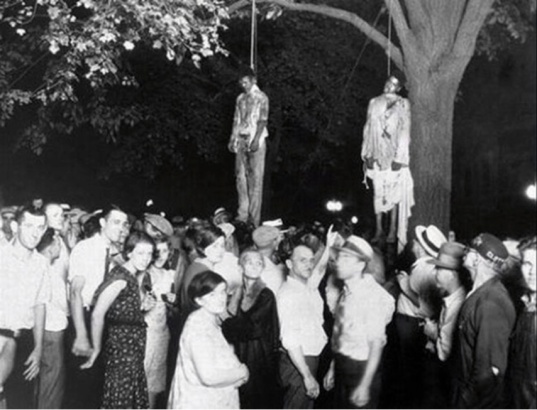
Instant justice on the battlefield, or revenge and vigilante justice in small town America seemed to take no heed of past history and warnings. In Marion, Indiana for example, on 7 August 1930 the photographer Lawrence Beitler came upon a scene that just had to be documented. A mob of citizens had broken into the local jail and took two African American prisoners, Thomas Shipp and Abram Smith, out into the night, where they were lynched. This particular photograph became a symbol of the ongoing racial war and tensions within our country. Thousands of copies of it, both as post cards and posters were printed over the following few days and weeks.

war3
Lawrence Henry Beitler
“Marion Lynching”
1930
B&W Photograph
Indiana Historical Society, Indianapolis, Indiana

In 1937, Abel Meeropol saw a copy of this photograph and was inspired to write the poem “Bitter Fruit” along with the music that later became a labor/civil rights anthem titled “Strange Fruit.” Since then it has been recorded many times up to the present day, but the 1939 version by Billie Holiday became a classic.

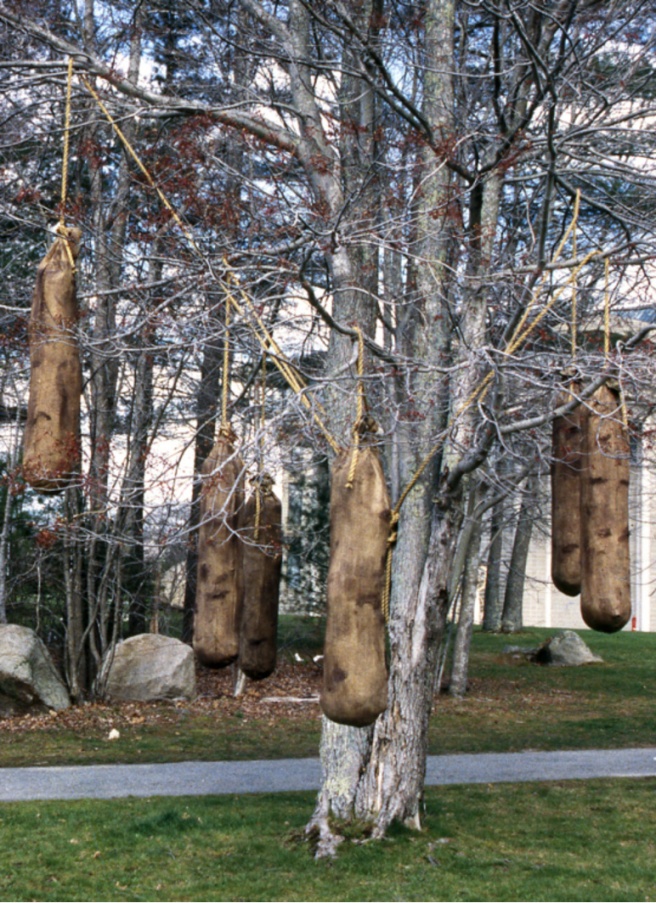
One contemporary artist and musician in the greater Boston area, James Reitzas, found a way to voice this through sculpture. Using very simple materials, rope and sand and burlap, he fashioned units of human size and proportion and literally hung them from local trees. Mimicking and referring back to Billie Holiday’s signature song “Strange Fruit” and Callot’s and Goya’s prints, these pieces show the metaphorical power of materials. They also echo many of the songs written at the time in order to give voice to both the civil rights and anti-war movements: the early Bob Dylan masterpiece “Desolation Row” contains an opening line that was directly inspired from Beitler’s photograph.

“They’re selling postcards of the hanging
They’re painting the passports brown
The beauty parlor is filled with sailors
The circus is in town
Here comes the blind commissioner
They’ve got him in a trance
One hand is tied to the tight-rope walker
The other is in his pants
And the riot squad they’re restless
They need somewhere to go
As Lady and I look out tonight
From Desolation Row.”[ii]

war4
James Reitzas
“Strange Fruit”
2000
Rope, sand and body bags
(Installation dimensions variable)
Boston, Massachusetts

“Southern trees bear a strange fruit,
Blood on the leaves and blood at the root,
Black bodies swinging in the southern breeze,
Strange fruit hanging from the poplar trees.”[iii]


[i] Sontag, Susan; Regarding the Pain of Others; Farrar, Straus and Giroux; New York, New York; 2003; pp. 44-47.

[ii] Dylan, Bob; “Desolation Row,” Writings and Drawings; Alfred A. Knopf, Borzoi Books; New York, New York; 1973; pp. 193-195.

[iii] Holiday, Billie; “Strange Fruit” The Centennial Collection; audio recording B00S7E1V7W; Sony Legacy; New York, New York; 2015.

HAND TOOLS

dine-1
Jim Dine
“Untitled (Pliers)”
1973
Graphite, charcoal and crayon on paper
25 5/8″ x 19 3/4″
Museum of Modern Art, New York

“I love the tools made for mechanics. I stop at the windows of hardware stores. If I could only find an excuse to buy many more of them than I have already bought on the pretense that I might have use for them! They are so beautiful, so simple and plain and straight to their meaning. There is no ‘Art’ about them, they have not been made beautiful, they are beautiful.”

“Someone has defined a work of art as a ‘thing beautifully done.’ I like it better if we cut away the adverb and preserve the word ‘done,’ and let it stand alone in its fullest meaning. Things are not done beautifully. The beauty is an integral part of their being done.”[i]

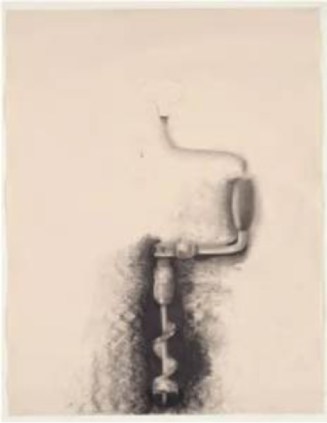
dine-2
Jim Dine
“Untitled (Brace and Bit)”
1973
Graphite, charcoal and crayon on paper
25 5/8″ x 19 3/4″
Museum of Modern Art, New York

A wrench, a brace or a pair of pliers, along with pencils and brushes, are all literal extensions of the human hand. Metaphorically, as artists we also speak of finding our own hand, or discovering one’s touch. Poets speak of finding their own voice. This is often a difficult process, which takes a lot of work. To accomplish this work, we use the tools that are near at hand.

This idea has echoes both across and beyond our borders. Whether it might be the great simplicity in a Shaker building or chair, or the profound Japanese insight into beauty, the tools that allow us to produce the hand-made object are of utmost importance.

In his great treatise on craftsmanship and the making of certain objects, Soetsu Yanagi wrote that: “They are made without obsessive consciousness of beauty; thus we catch a glimpse of what is meant by ‘no-mindedness,’ whereby all things become simplified, natural, and without contrivance.”[ii]

Similarly, Faith and Edward Demming Andrews have observed the work and the laws of the Shakers:   “All beauty that has not a foundation in use, soon grows distasteful, and needs continual replacement with something new. That which has in itself the highest use possesses the greatest beauty.”[iii]

shaker-1
Richard Emery Nickolson
“Dwelling House Interior, Hancock Shaker Village”
Color photograph
1978
Hancock, Massachusetts

“The craftsmanship of the Shakers was an integral part of the life and thought of a humble but consecrated folk. They did not think of the work of their hands—in building, in joinery, in industrial pursuit of every kind—as an art, something special or exclusive, but rather as the right way of sustaining their church order, the ideal of a better society. For them the machine or tool was a ‘servant force.’ It was the purpose of work which was important. This led to a manner of work, which in turn gave a common character—an integrity, a harmony, a subtle but identifiable quality to all the labor of their hands.”[iv]

shaker-2
Richard Emery Nickolson
“Dwelling House Interior, Hancock Shaker Village”
Color photograph
1978
Hancock, Massachusetts

And in the end, it is a reminder to all artists that “The thing shines, not the maker.…and therefore whatever is made is lovely.”[v]


[i] Henri, Robert; The Art Spirit, Basic Books, New York, New York; 2007; p. 53.

[ii] Yanagi, Soetsu; The Unknown Craftsman; Kodansha International; Tokyo, New York and London; 1972 & 1989; p. 203.

[iii] Andrews, Edward Deming, and Faith Andrews; Religion in Wood: A Book of Shaker Furniture; Indiana University Press; Bloomington and London; 1966; p. 15.

[iv] Andrews, Edward Deming, and Faith Andrews; Religion in Wood: A Book of Shaker Furniture; p. 14.

[v] Yanagi, Soetsu; The Unknown Craftsman; p. 200.

TIME OUT OF MIND

“Here is the test of wisdom,
Wisdom is not finally tested in schools,
Wisdom cannot be pass’d from one having it to another not having it,
Wisdom is of the soul, is not susceptible of proof, is its own proof,
Applies to all stages and objects and qualities and is content,
Is the certainty of the reality and immortality of things, and the excellence of things;
Something there is in the float of the sight of things that provokes it out of the soul.”[i]

dolmen
Richard Emery Nickolson
“Le geant du Manio, c.6,000-4,000BC, Carnac, France”
Color photograph
1997

Our students at the Pont-Aven School of Contemporary Art in 1995 and 1997 often asked us, having seen pre-historic sites for the first time: how did these people know that they could build something that would last over a thousand years? The site of the Alignements at Carnac in Brittany, France is possibly one or two thousand years older than Stonehenge and constructed by what we now know to be a pre-Druidic culture. Stone constructions known as dolmens are found throughout Brittany and in Carnac proper there are alignements of stones, as many as two or three thousand, always arranged on an east to west axis, which allows for each stone to annually throw its shadow on its neighbor at both sunrise and sunset during the summer solstice.

“That grosbois is oak, ash, elm,

beech, horsbeche & hornbeam
but of acorns tithe shall be paid
For every lamb a penny

time out of mind

one lira per sheep nel Tirolo
sale must be in place overt

not in a backe-room
& between sun-up & sun-down

dies solaris
ut pena ad paucos

metus ad omnes perveniat
of 2 rights the more ancient preferred
caveat emptor.”[ii]

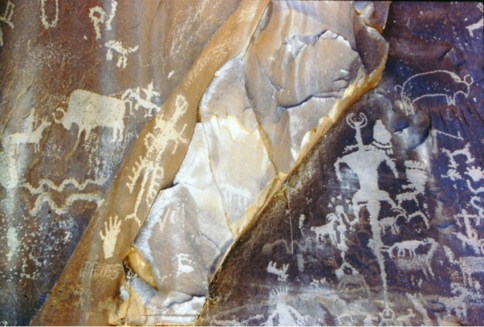
petroglyph-1
Richard Emery Nickolson
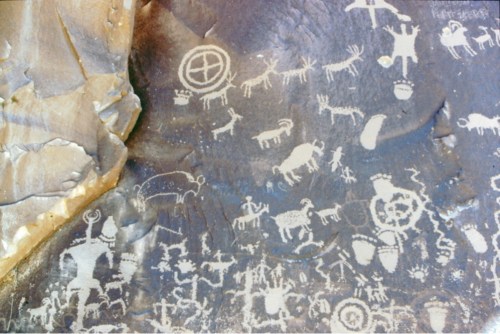
“Newspaper Rock, c. 100BC-1500AD, Moab, Utah”
Color photograph
1999

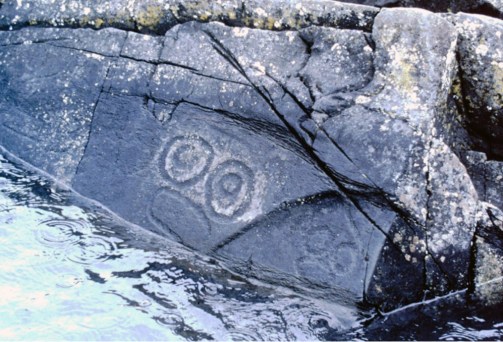
Following my teaching assignments in France in 1995 and 1997 we went on several family trips to Alaska and Canada and to the Four Corners area of the lower forty-eight. Near Moab, Utah there is the site known as Newspaper Rock, which contains dozens of images inscribed into the surface of the rock face over hundreds of years. There are examples of at least three successive Native American cultures, including Anasazi, Navajo and Ute. They are pictographs and petroglyhps: images full of meaning. Similar images seem to appear in several other cultures around the world. In Wrangell Bay, Alaska, there are stones containing petroglyphs which can be seen only at low tide. They are approximately 8,000 years old and carved by the ancesters of today’s Tlingit people.

petroglyph-2
Richard Emery Nickolson
“Petroglyph, c. 6,000BC, Wrangell Bay, Alaska”
Color photograph
1996

“What do you think endures? . . . .”

“A great city is that which has the greatest men and women,
If it be a few ragged huts it is still the greatest city in the whole world.”

“Than this nothing has better served, it has served all,
Served the fluent-tongued and subtle-sensed Greek, and long ere the Greek,
Served in building the buildings that last longer than any, . . . .
Served the mound-raiser on the Mississippi. . . .
Served the Albic temples in woods or on plains, with unhewn pillars and the druids. . . .
Served those who time out of mind made on the granite walls rough sketches of the sun, moon, stars, ships, ocean waves,

petroglyph-3
Richard Emery Nickolson
“Newspaper Rock, c. 100BC-1500AD, Moab, Utah”
Color photograph
1999

Served the paths of the irruptions of the Goths. . . .
Served the long distant Kelt. . . .
Served the making of helms for the galleys of pleasure and the making of those for war,
Served all great works on land and all great works on the sea,
For the medieval ages and before the medieval ages,
Served not the living only then as now, but served the dead.”[iii]

Time out of mind.


[i] Whitman, Walt; Selected Poems; Gramercy Books; New York, New York and Avenel, New Jersey; 1992; p. 153.

[ii] Pound, Ezra; The Cantos of Ezra Pound; New Directions Publishing Corporation; New York, New York; 1979; p. 769.

[iii] Whitman; Selected Poems; pp. 131-134.

GREAT LADY PAINTER, SHE KILLED SNAKES WITH A STICK!

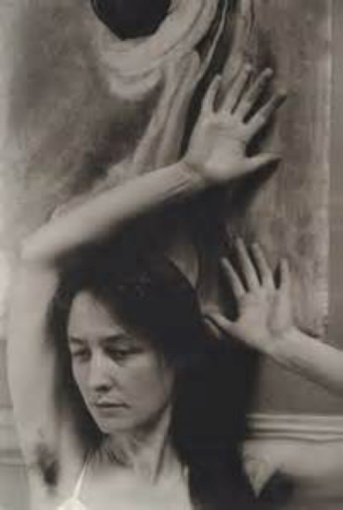
There is this photograph, all stark, black & white. It is haunting, shocking and a bit punked out, but it was not taken by Robert Mapplethorpe. A young woman all shaggy, crazy, in a camisole with arms raised: a beautiful black & white study, but again, not by Robert Mapplethorpe and the subject is not Patti Smith. It is Georgia O’Keeffe as photographed by Alfred Stieglitz.

okeefe
Alfred Stieglitz. “Portrait of Georgia O’Keeffe”
1918
Gelatin silver print
23.5 cm x 15.4 cm
The Metropolitan Museum of Art, Gift of Georgia O’Keeffe [i]
In many ways they set New York City and the art world on fire in the 1920’s. And would it be any different today? In 2010 Patti Smith published her autobiographical book Just Kids, wherein the feel of New York City and the ambience of the Chelsea Hotel are the background for many honest and lyrical memories of an otherwise decrepit downtown environment.

Smith has also written of other influences, amongst them: James Joyce, Arthur Rimbaud, Bob Dylan and Georgia O’Keeffe. In the art world, it seems like there is a parallel to the music world when it comes to the matter of a ‘folk tradition.’ Where one younger artist might hear of an old time tune or lyric and learn that song and then up-date it, adding a verse or two that applies to the current times. A thread that runs through the fabric of history. So Patti Smith has done exactly that in her poem/portrait of Georgia O’Keeffe.

georgia o’keeffe

“great lady painter
what she do now
she goes out with a stick
and kills snakes

georgia o’keeffe
all life still
cow skull
bull skull
no bull shit
pyrite pyrite
she’s no fool
started out pretty
pretty pretty girl

georgia o’keeffe
until she had her fill
painted desert
flower cactus
hawk and head mule
choral water color
red coral reef
been around forever

georgia o’keeffe
great lady painter
what she do now
go and beat the desert
stir dust bowl
go and beat the desert
snake skin skull
go and beat the desert
all life still”[ii]

Not to be outdone by the ‘punk’ music scene, Robbie Robertson’s solo studio albums following the breakup of The Band explored melancholy and meditative views of a variety of American cultural issues. He reflects upon the American West, the city of New Orleans and a variety of dream images including a long ago Georgia O’Keeffe. In a ‘talkin blues’ style these are modern musings, or even warnings, somewhat seductive and even dangerous.

“I remember the smell of burning leaves
And we were making love
She was like a young Georgia O’Keeffe
From another time
In an old abandoned railroad shack
One should never go
Where anything can happen….”[iii]


[i] Stieglitz, Alfred; Georgia O’Keeffe: A Portrait; The Metropolitan Museum of Art; New York, New York; 1978 & 1997; plate 9.

[ii] Smith, Patti; Early Work: 1970-1979; W. W. Norton & Company; New York & London; 1994; pp. 48-49.

[iii] Robertson, Robbie; “Day of Reckoning,” Storyville; audio recording GEFSD 24303; David Geffen Company; Ontario, Canada; 1991.

WHAT GOD SAID TO ABRAHAM

abraham1
Lorenzo Ghiberti
“The Sacrifice of Isaac”
1401-1402
Gilt bronze
21″ x 17″
National Museum, Florence

“. . . God said to Abraham, ‘Kill me a son’
Abe says, ‘Man, you must be puttin’ me on’
God say, ‘No’ Abe say, ‘What?’
God say, ‘You can do what you want, Abe, but
The next time you see me comin’, you better run’
Well, Abe says, ‘Where d’you want this killin’ done?’
God says, ‘Out on Highway 61’”[i]

It is one of the great Old Testament stories regarding Abraham’s sacrifice of his son Isaac in order to somehow and ultimately prove his faith. He struggled with this dearly. A very important depiction of this is the one above that Lorenzo Ghiberti used as the presentation piece for the commission of the bronze doors in the Basilica at Florence in 1401.

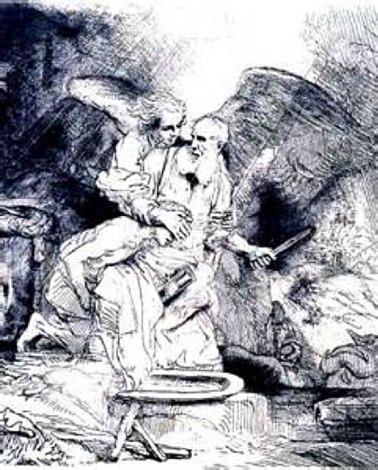
Another powerful image is an etching by Rembrandt in the collection of the Art Institute of Chicago. The processes of etching and drypoint not only illustrate the story but parallel the psychological struggle through physical struggle and manipulation of the medium. Rembrandt, always being a master of both the formal and the personal, combines these elements into a universal statement.

abraham2
Rembrandt van Rijn
“The Sacrifice of Abraham”
Etching and drypoint
1655
154 x 131 mm
The Art Institute of Chicago

We need only to come to the late 1960’s in America for several other critical examples. These years proved to be a shocking turning point in the lives of many people. Earlier civil rigths demonstrations had evolved into anti-war demonstrations. Meanwhile, a music and arts festival was held in a sleepy town in upstate New York in August 1969. But, by May of the next year, the Kent State Massacre had occurred.

abraham3
John Filo
“Mary Vecchio cries over the body of one of the Kent State University students who had just been shot by Ohio National Guard soldiers on May 4, 1970”
B&W photograph
Courtesy of the Pulitzer Prize Foundation

Upon hearing of the massacre at Kent State and seeing this photograph for the first time, the singer songwriter Neil Young penned what would become an anthem performed by Crosby, Stills, Nash and Young: “Ohio.”

“Gotta get down to it
Soldiers are cutting us down
Should have been done long ago.
What if you knew her
And found her dead on the ground
How can you run when you know?

Tin soldiers and Nixon coming,
We’re finally on our own.
This summer I hear the drumming,
Four dead in Ohio.”[ii]

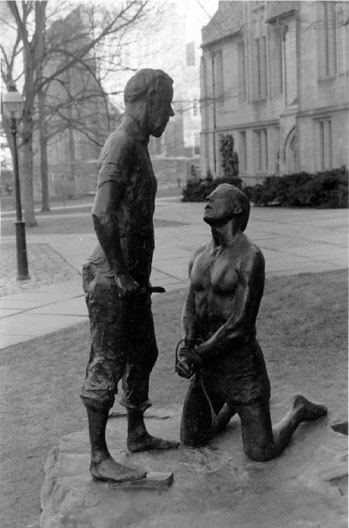
In 1978 Kent State University commissioned the sculptor George Segal to create a memorial to the people killed in the massacre. Segal chose as his theme the Old Testament story of Abraham and Isaac. Safe enough at the time. The piece was actually completed and about to be installed when the university had second thoughts. The sculpture was never installed and offered instead to the Princeton University Art Museum, where it now sits in the courtyard near the University Chapel.

The situation was offensive all the way around, but, it was most offensive because the Kent State officials did not want to be associated with the idea that one generation was willing to sacrifice another for the sake of a totally misguided involvement in a distant war.

abraham4
George Segal
“Abraham and Isaac: In Memory of May 4, 1970, Kent State University”
Bronze
1978-1979
The John B. Putnam Jr. Memorial Collection, Princeton University
Princeton, New Jersey

Although a very safe and more abstract memorial now occupies the spot of the Kent State Massacre, the question still remains, when and how will we ever learn to work to end war, rather than to invest in and profit from, the engagement in war?

“Now the roving gambler he was very bored
He was tryin’ to create a next world war
He found a promoter who nearly fell off the floor
He said I never engaged in this kind of thing before
But yes I think it can be very easily done
We’ll just put some bleachers out in the sun
And have it on Highway 61”[iii]


[i] Dylan, Bob; “Highway 61 Revisited,” Writings and Drawings; Alfred A. Knopf, Borzoi Books; New York, New York; 1973; pp. 196.

[ii] Young, Neil; “Ohio,” Live at Massey Hall, 1971; audio recording, BOOOMTPANG; Reprise Records; New York, New York; 2007.

[iii] Dylan, Bob; “Highway 61 Revisited,” Writings and Drawings; pp. 196.