PATRICIA CLARK, DEBORAH BUTTERFIELD AND JOAN MITCHELL

From Grand Rapids, Michigan to Baltimore, Maryland, the poet Patricia Clark is always searching for artists to study, and to be inspired by. In the last couple of years she has visited the work of two such artists. A newly installed sculpture by Deborah Butterfield on a rooftop balcony at Grand Valley State University at its Downtown Campus. And a few months later, on a trip to Baltimore, a pilgrimage of sorts to the Joan Mitchell Retrospective Exhibition at the Baltimore Museum of Art.

Just last year, 7 September 2023 to be exact, I attended a reading by Patricia Clark at the Poetry on Brick Street Series in Zionsville, Indiana. It was there, reading from a selection of her latest work, that I heard her read two new works, these ones on Deborah Butterfield and Joan Mitchell.
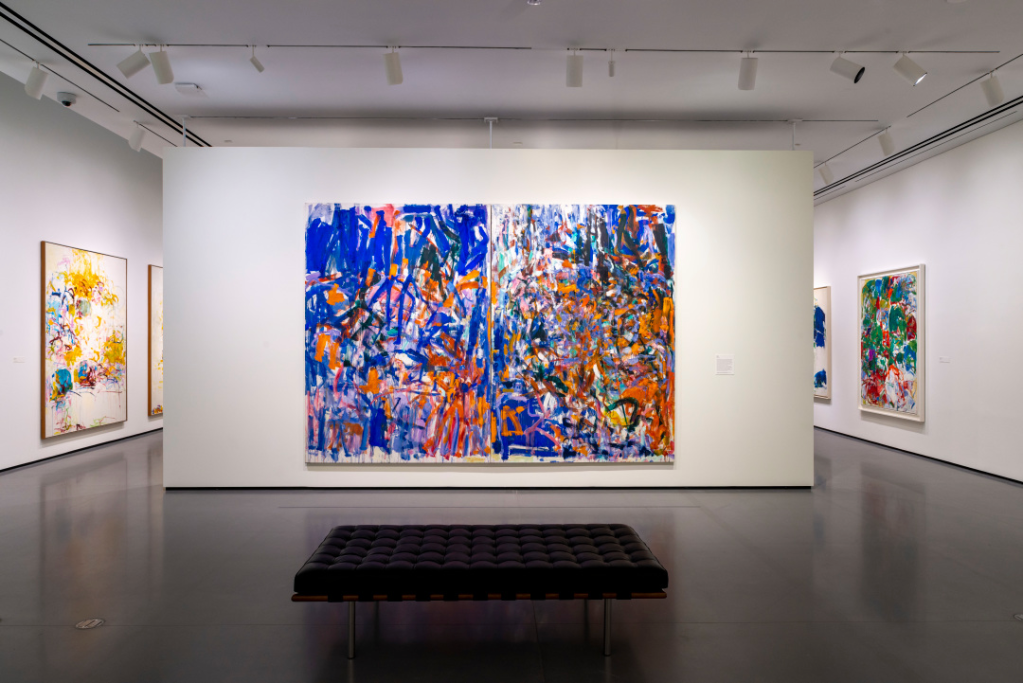
Joan Mitchell
“Weeds”
Installation view:
Joan Mitchell Retrospective Exhibition,
Baltimore Museum of Art,
2022

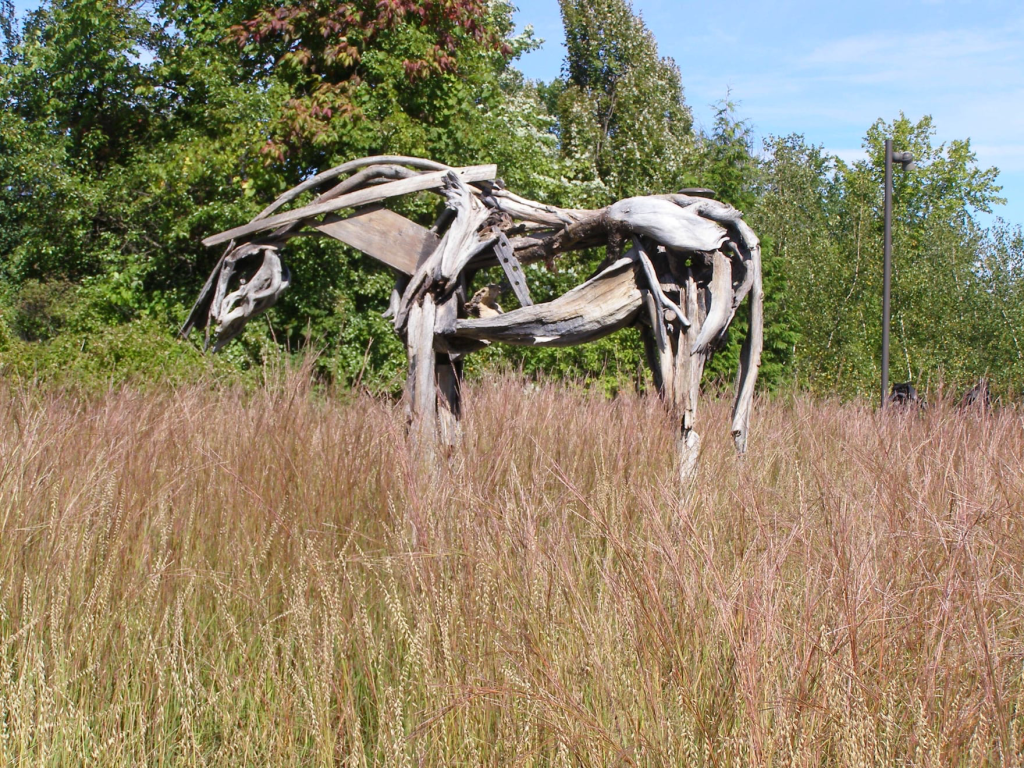
Situated in a prairie like setting at the Meijer Gardens and Sculpture Park in Grand Rapids is an isolated crazing horse by Deborah Butterfield1. It has a natural like stance and bend to its neck, standing in this open space. Further downtown, in fact near the very center of the city and elevated to the top of a Grand Valley State University classroom building, is another one of these pieces.
Deborah Butterfield
“Cabin Creek”
1999
Bronze
88” x 122.5: x 30.5”
Meijer Sculpture Garden and Park
Grand Rapids, Michigan

Char: Above the City
–for Nathan, Joel, and Alison

“On a rooftop downtown at the edge
of the building where they’ve planted succulents
stands a horse blackened by fire
called Char by its maker Deborah Butterfield.
The artist scoured a smoky ravaged forest
in California, picking up branches, limbs,
burnt saplings, then brought these to her studio
where she fashioned them into the shape of a horse.
During the process, taking weeks, Butterfield often dreams
of horses. This one grazing in a meadow
where red-tipped grass waved against its belly, seeds
catching in its long tail. Horse has become the artist’s
mirror self, a dream figure made manifest.
After the studio, a foundry, a way to cast
wood into metal, finally pouring
bronze for the final sculpture. The workers made marks
in metal to resemble wood, adding a patina black
as night sky. Char looks east into clouds
above our city, ignoring for past weeks
the haze from Canada wildfires, not pricking
its ears in terror or flipping its tail.
Char is more skeleton than mass, negative space
allowing us to glimpse what’s been ruined and where
we stand, on the edge, barely able to breathe.”2

Deborah Butterfield
“Char”
2021
Bronze
82.5″ x 102.5″ x 33″
Center for Interprofessional Health,
Grand Valley State University,
Grand Rapids, Michigan

In the Spring of 2019 I visited the Baltimore Art Museum in order to see the Joan Mitchell Retrospective3. It was the first time I had returned to Baltimore in so many years and certain sites were hard to remember. We arrived early, way before our scheduled entry time, not crowded at all so the guards waved us right on in. When I mentioned this to Patricia Clark later, back in the Mid-West, she stated that she and her husband Stanley Krohmer, who had also studied in Baltimore, were planning a very similar trip, and specifically to see the Joan Mitchell Retrospective.

One really important element to all of Mitchell’s work is her affinity with other artists and poets of her generation. Several of her paintings have inspired writers and writers have inspired her in both her paintings and her poem pastels.

These include James Schyler, Eileen Myles, Frank O’Hara and John Ashbery. Below is Patricia Clark’s poem in response to this exhibition.

Painter Joan Mitchell Pulls Me Up

“What was in the air was leaf-fall, the rot
of the year’s perennials and annuals, stems

and blossom ends done for, going back to earth.
I couldn’t move for being caught by the suck

of quicksand, a clump of blue feathers smacked
on a window from a hit. Here I am on a cold Friday

and to my amazement the painter Joan
Mitchell reaches for me, from her oil

on canvas, a diptych called Weeds,
grabbing a hold of me, saying ‘Here,

take my hand!’ There’s something about
her seeming riot of marks that’s giving

a calming and cooling effect. It’s cobalt blue,
orange, tawny, and flecked with white,

even a spot or two of sage, and I see
the trail-side at Huff Park with tall

teasel, Queen Anne’s lace, and a waving
frond of goldenrod or a flat-topped

white aster. Each year I’m caught watching
this awakening starting up in early spring,

a mere sprout or two at first, then
climbing, growing, a stem hoisting itself up

all season till it’s five feet high,
shedding petals, pollen and seeds. Not

a riot at all, a cyclic process of
great determination, genetics, chance . . .”

Joan Mitchell
“Weeds”
1976
Oil on canvas,
110 1/2” x 157 1/2”
Hirshhorn Museum and Sculpture Garden
Washington, DC.

“. . . weather, sunlight, rain. Right now,
I’m bowing to the botanical display and to two

canvasses of supreme order, remembering
our visit to the Baltimore Art Museum, August,

standing in front of the actual paintings,
work as sturdy and wrought

as any palace. Then we went walking off
in a pack for lunch, having salad and Chesapeake oysters

on the half-shell along with a crisp
citrus tasting wine. Good friends, fellow

artists, a couple more hands to pull me
out of quicksand. Where do we turn, lost

on that trail, or sinking? The Baltimore light
was pure lemon as we strolled through

the galleries pointing, talking, saying
look at that magenta, violet, sage, her vision,

her ability to make these marks. The gleam of it
lasting as long as the light, what we call a day.”4


1 Kuspit, Donald, and Marcia Tucker; Horses: The Art of Deborah Butterfield; Lowe Art Museum, University of Miami, Coral Gables, Florida, and Chronicle Books, San Francisco, California; 1992.

2 Clark, Patricia; “Char;” The Superstition Review; Arizona State University; Issue 32; Fall 2023.

3 Roberts, Sarah, and Katy Siegel, eds.; Joan Mitchell; Baltimore Museum of Art and the San Francisco Museum of Modern Art; Yale University Press, New Haven and London; 2020.

4 Clark, Patricia; “Painter Joan Mitchell Pulls Me Up;” Nelle; University of Alabama at Birmingham; Issue 7; 2024.

HOKUSAI’S WAVES

There are certain images, or should I say icons, that exert a visual power over all others. Two in particular come to mind: Turner’s great paintings of various “Storms at Sea” and Hokusai’s series of “Thirty-six Views of Mt. Fuji” which includes important images of nearby waves and distant views of Mt. Fuji. Whereas Hokusai often happily described himself as an old crazy man to paint, Turner was often derogatorily described by many of his contemporaries, often depicted as a crazy man wielding mops in order to complete his paintings!

“Turner painting one of his pictures”
Satirical cartoon, Almanack of the Month
1846
J. Paul Getty Trust, Los Angeles, California

We have often seen entire sets of Hokusai’s woodcuts exhibited at both the Art Institute of Chicago and the Metropolitan Museum of Art in New York. As for Turner, nothing surpasses the work from the Turner Bequest at the Tate Museum in London, or the Clowes Collection at the Indianapolis Museum of Art.

Contemporary writers have also been drawn to these two artists, including Yusef Komunyakaa and Patricia Clark. We have previously written regarding Komunyakaa’s “Turner’s Tussle with Water” and take a look now at Hokusai’s waves as written by Patricia Clark. Clark and her husband, the contemporary painter Stanley Krohmer, are often traveling and visiting museums. They collect exhibition catalogues, calendars and post cards from these locations. These are all important visual mnemonic devices, reminders of people and places seen, as well as sources for future investigations into both painting and poetry.1

Stanley Krohmer,
“Nocturne, Lake Michigan”
2021
Oil on wood panel
30” x 24”
Collection of the artist.

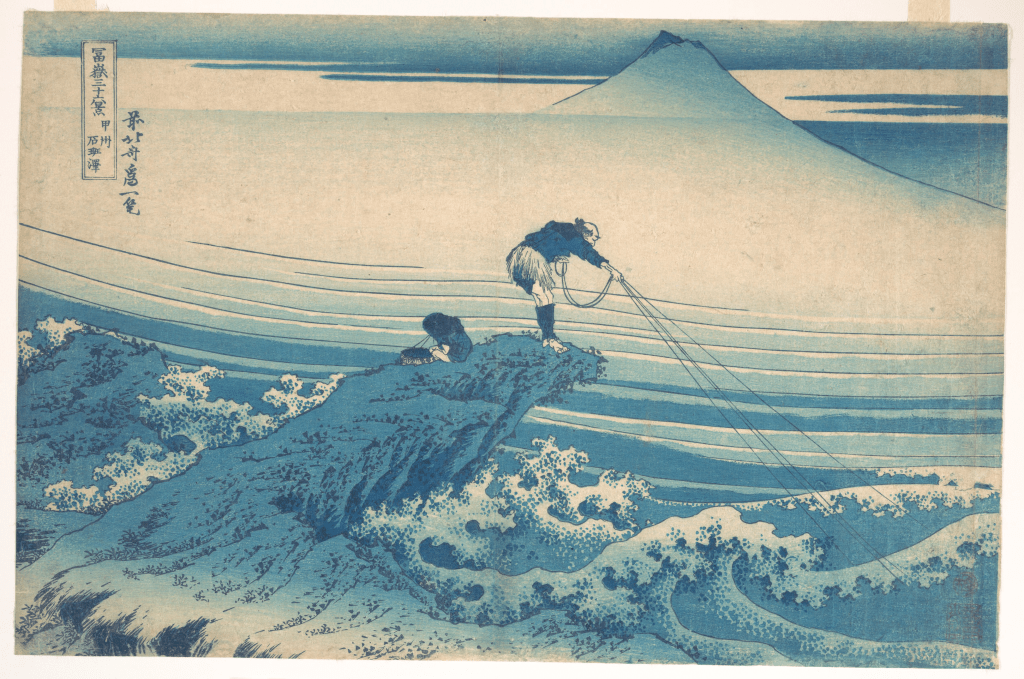
As a result of one of these trips, an image from Hokusai re-appeared in Clark’s memory. When I asked her about it, this was her response: “I never PLAN to write about some image ahead of time; I like to wait & see if it speaks to me somehow, over time. And somehow this one did. I think I was attracted to the tension in the fishing lines, the odd outfit the fellow is wearing, and the two figures. Plus the evident danger they might be in. I was surprised when it called up an old memory of mine — fishing during a camping trip, and also wandering along the shore, looking into tidepools and under rocks.”2

As is her practice, Patricia Clark uses her direct written responses to this visual work of art in order to combine them with certain memories of family members and their interactions with a landscape remembered from a distance.

Katsushika Hokusai
“Thirty-six Views of Mount Fuji: Fishermen standing on a rocky promontory at Kajikazawa”
1830-1832
Woodblock print on paper
10” x 15 1/8”
Metropolitan Museum of Art, New York

Barnacle

“The fisherman’s bent in half
on the tip
of a promontory,

a jacket, short pants, a grass skirt
over the pants,
no hat, tall socks

with shoes—though I’m fearful he’ll slip
where below
waves growl and snap.

He’s pulling in at least four lines, heavy
with fish,
one has to hope—

and he’s not alone. Nearby crouches a person
down on his haunches
also holding lines.

If the land’s rocky, okay, but it looks
fragile enough
to break off,

soft ground with wet sod crumbling
to pitch him in,
if not both of them. Once,

we wandered far down Agate & Crescent Beach,
stooping at
tidepools, turning over rocks

to find small gray crabs and touch
anemones, fascinated
by their pulse, heedless of tides.

By the time we looked up, our path back
was erased,
water crashing in, spraying foam,

and only through luck did we find
a cut
in the bluff where a path

snaked down—we clambered up with sea-
salt biting
at our heels. That was the day

later on, we hauled in a creature of the deep
we didn’t know,
a purple spiny thing large

as a cabbage we brought to the park ranger
in a bucket—
sea urchin, he said mildly.

It was a fearsome beautiful thing—
those spines dripping
with the sea, waving–I hope we let it go.

My father and his father, me and who else?
–my brother Dan?—
last seen on that shore

now washed away by waves of time
though memory has
planted a barnacle there.”3

Stanley Krohmer
“Steller’s Jay”
2015
Oil on canvas
36” x 36”
Collection of the Artist.

1 And as a footnote to this essay, I have included at the end an image of one of Stanley Krohmer’s paintings, “Steller’s Jay” which was actually used as the cover art for one of Patricia Clark’s books, “The Canopy” published by Terrapin Books in 2017.

2 Clark, Patricia; “Barnacle;” Manuscript page and notes in an E-Mail correspondence to this author, 2 December 2021, 4:58 PM.

3 Clark, Patricia; “Barnacle;” Included in the journal SALT; Santa Barbara, California; Issue 4, #1; 2023.

PATRICIA CLARK AND THE PAINTERS:  Chapter 2 

In French, the sign along the roadside simply read:  DANGER MORTAL!  These were posted all along the winding coastal roads going out from the port at Le Palais.  They covered most of the island.  They were a very real warning as many of the island roads curved right along the coast, with precipitous and precarious views down from the cliffs, and across the inlets and bays.  There were no guardrails.   

We visited there in the summer of 1995 with our friend, the painter Holly Hughes and her mother Wanda, who at that time was the studio/office manager for the contemporary American painter Ellsworth Kelly.  Wanda was armed with a map that had been given to her by Ellsworth so that we might find the ‘village’ where he had lived after WWII.  Little did we know what a sight we were approaching?     

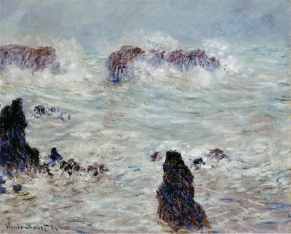
Claude Monet
“Tempête, côtes de Belle-Ile”
1886
Oil on canvas
65.4 cm. x 81.5 cm.
Musée d’Orsay, Paris, France

Over the years on Belle-Isle, the largest of the Breton Islands, many artists found in the isolation, the savage waves and tides, the inspiration that they were searching for.  Claude Monet, Henri Matisse, the actress Sarah Bernhardt and her companion the painter Georges Clairin, the Irish painter John Peter Russell, were all attracted to this special place, and later of course, so was Ellsworth Kelly.

During the fall of 1886, from 12 September to 25 November to be exact, Claude Monet lived and worked on Belle-Isle.  During this time he produced a series of 39 paintings, exploring the weather and the wildness of this place. 

Not to be outdone by the painters, the contemporary poet Patricia Clark from Grand Rapids, Michigan, recently visited Paris and many of the great museums there.  She noticed in particular the paintings by Monet at the Musée D’Orsay, and the potential for an ekphrastic experience.  When I asked Clark about this, this is what she said: 

“As for the poem about Monet’s Rochers — we did not go out to the place, alas! Would love to see it. I believe (memory is slippery!) we saw the painting at the Musee D’Orsay. My method — such as it is! — is to buy postcards of paintings that really move me. . . . Then there’s a catalog. But I know I have a postcard of this painting.”

“I think what drew me to it is that it’s not an image I’d seen that much. It seems rougher and less ‘pretty’ than many Monets. I kept it in front of me and then one day, I started to write about it. That’s about as much as I recall — of course, a writer can’t help but layer their own issues over what they look at — so that’s what happens, doesn’t it? I hope that comes through.”[i] 

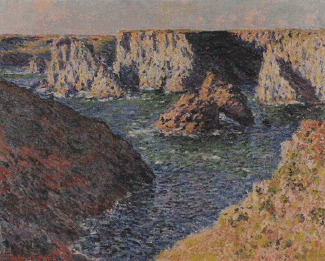
Claude Monet
“Les rochers de Belle-Île”
1886
Oil on canvas
25 7/8″ x 32 1/8″
Musee des Beaux-Arts, Reims

“Les Rochers de Belle-Ille”

                  (after the painting by Claude Monet)

“No beach here—just the sea
swirling in blue

deep blue and green

Both the sea and the rocks
show age

It’s a tired scene of their
coming together

each hour and day

The water’s force, erosion
of all the softest parts

leaving only solid rock

This you could be
crushed upon—the hardest

knowledge of all—

What is impervious to you, quite
solidly indifferent

No escaping the sea

throws you repeatedly on the rocks
of all you’re stupid about—

self-ignorance, deception, lies—

Instead someone calls this a scene,
a landscape, seascape—

yes, but first:  crags of the mind, and soul.”[ii]

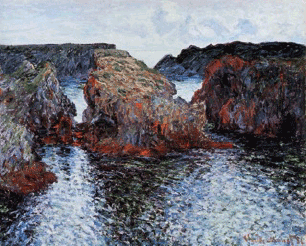
Claude Monet
“Rochers a Belle-Île at Port Goulphor”
1886
Oil on canvas
26” x 32 3/16”
Art Institute of Chicago, Chicago, Illinois

Following the end of WWII, from 1948 to 1954, the American artist and veteran Ellsworth Kelly visited and lived in several areas of France.   In July 1949 he even rented a house on Belle-Ile-en-Mer for the summer and part of the fall.  He had fallen in love with France and with its artists, especially Claude Monet and Henri Matisse. 

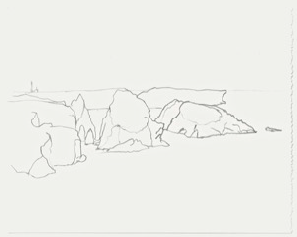
In 1965 Kelly returned to Belle-Isle with a specific purpose, to re-visit certain sites that Monet had painted and witness them directly, not just metaphorically.  Later in his life, 2005, he returned to Belle-Isle for a last series of drawings, not abstracted from the rocks, but directly created from the sources.[iii]

Ellsworth Kelly
“Port-Goulphar, Belle- Île”
2005
Pencil on paper
49.5 cm x 62.2 cm
Estate of the artist.

It is a landscape that would challenge one’s imagination.  From the earliest visitors to contemporary painters and poets, one can only wonder how they felt when approaching these vistas for the first time.  Looking out on this frighteningly beautiful land, with its bays, inlets, needles, rocks, and steep cliffs, it is no wonder that this entire region of France would come to be described as Finistère:  the end of the earth.


[i] Clark, Patricia; in an e-mail response to this writer; 9 January 2021; 9:52 AM. 

[ii] Clark, Patricia; Self-Portrait with a Million Dollars; Terrapin Books; West Caldwell, New Jersey; 2020; pp. 36-37.  

[iii] Bois, Yve-Alain, and Sarah Lees; Monet/Kelly; Sterling and Francine Clark Art Institute; Williamston, Massachusetts; and Yale University Press; New Haven and London; 2014.

PATRICIA CLARK AND THE PAINTERS

In the ekphrastic tradition, painting and poetry are considered as parallel disciplines:  incorporating imagery and metaphor while combining imagination and transformation.  Differing in the use of line and color in one and words and rhythms in the other.  Each begins with the mimetic element and usually moves into the semiotic.  Literal descriptions of the world around us are then used to create a new meaning or vision.

When I first heard Patricia Clark’s poem, inspired by a Claude Monet painting, it was while attending her reading sponsored by the Kellogg Writers Series at the University of Indianapolis in September 2013.  She also mentioned to the students there, that there were artists in the audience and that she wanted to put in a word or two regarding the ekphrastic tradition.  Although an ancient tradition, it is also an obscure one to the average reader.  Students in the audience may have been hearing about this for the first time.

clark1
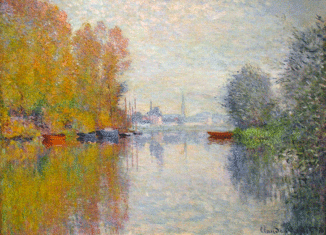
Claude Monet
“Autumn on the Seine, Argenteuil”
1873
Oil on canvas
21 3/8” x 28 7/8”
High Museum of Art
Atlanta, Georgia


Autumn on the Seine, Argenteuil

“Two banks, one golden, one green,
and in the center, the town
ahead, with a spire needling up,
a puncture into clouds,
and vague suggestions
of industry—buildings, smoke, and noise.

What I love along the bank are the skiffs
drawn up, five or more
at the golden side, the first boat
a bright russet like a horizontal flame
on water,
the next two mauve, one a sailboat,
one not.

The ochre-gold spills down from the cottonwoods,
pouring under the hulls,
entering the river with the same
intensity of burning
we see in life at its peak,
or life with the flame
threatening to go out.

In a month the trees will be masts
bare as the boats,
the man we know, ill with a fatal brain tumor,
will be gone—the Grand River
burnished with ochre and red
as the Seine is,
cooling air hinting at winter’s knives.

One bank green in the painting,
green going away,
and the river placid, calm—
in the center of it—
the flowing never ceasing, rhythm of moon,
sun, the turning earth, pulling it outward,
eternal, restless, to the maw of the sea.”[i]

One important element in Patricia Clark’s work is that she starts with a description or a reflection on the painting, but then goes beyond into our current time and place, commenting upon her own life events and keeping the imagery relevant and alive.

In many poems Clark has used certain relationships as an extension of the original idea.  A color or texture will often spark an image of a loved one:  the death of her mother, a remembering of her sister and the friends who travel along the Grand River in the state of Michigan.

In a recent conversation, I asked her specifically about the Monet painting and a second one by Wolf Kahn, and the general process that she uses.  This was her response:

“What I usually do is surround myself in my little studio hut with some images I feel drawn to. I’m not really looking for something — it’s a combination for me of color, image, atmosphere, who knows? I also don’t put too much pressure on, like ‘you must write about this painting!’ I wait & see if it speaks to me. Often that has happened. The Monet one, ‘Autumn on the Seine’ just grabbed me one day & I started . . . by just describing what I see — but then quickly one’s own concerns get woven in there somehow, inevitably. . . .”

“For awhile . . . after my mother’s passing, I wrote about her and just would let that happen, too, rather than forbidding any more ‘mother’ poems.”[ii]

clark2
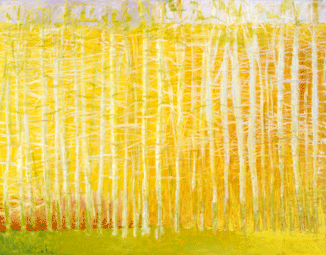
Wolf Kahn
“Frontal View of Trees”
2016
Oil on canvas
52” x 60”
Courtesy: Ameringer McEnery Yohe
New York, New York

Frontal View of Trees
                  (after Wolf Kahn)

“I like it when the trunks
of the birches
take up earth’s
mantis green,
that’s what she would do—
appropriate the ground,
by sinking in.

She troubles me, my mother
who didn’t die
comforted, at home.
Our bodies point to fates
we live but cannot decipher.
The sun offers
its warming touch.

Souls of the dead, thin
presences and pale—
yet their spirits
have turned to light—
glow of cumin, cinnamon ruddy
in the corner
of the canvas.

To misread means to author
your own text—
in truth, the trunks
wear flood marks, mud
floating high in water left
the smear.
She fell down.

Smack of the ground’s kiss,
that broke
her nose.  The doctor said,
dead before she hit the ground.
Linked once, she and I severed now
and who will be
at my side when I go?

The birches make a grove
collecting light—
she wore a verve
for  living, cloak
of many colors.”[iii]


[i] Clark, Patricia; Sunday rising; Michigan State University Press; East Lansing, Michigan; 2013; pp. 5-6.

[ii] Clark, Patricia; An explanatory statement on process as contained in an e-mail communication with this writer, 24 January 2018.

[iii] Clark, Patricia; The Canopy; Terrapin Books; West Caldwell, New Jersey; 2017; pp. 8-9.