Henri Matisse “The Fall of Icarus” 1943 Gouache on paper cut out, collaged on canvas 35 x 26.5 cm Private Collection
“‘I warn you,’ Daedalus had said, ‘not to fly so low that the mist or fog weighs down your wings, nor so high that the sun scorches you: fly between the two! Avoid too much heat and too much damp, too much dryness and too much cold. Keep to the center of their wheel. Don’t look at Bootes or Helice, or at Orion’s drawn sword. Take me as your guide and follow!”
“But Icarus grows excited. He forgets the advice. Soon he masters the beating of his wings and swoops in wide, playful circles above the sea. Does Minos see him laughing and dancing on the invisible crest of the world? Like a swimmer, turning his back on the cries from shore, he is already far at sea. He has tired of following his father’s shoulders, his snowy wings and shock of hair. He enters into glory as into a garden, a garden of flames that surrounds him; and he breathes in. ‘O Sun! Father!’ he cries to the encircling fire. Once more he kicks on the wind! Again he beats his wings on the torrid wave of the wind! Once more he thrusts up into the light!”[i]
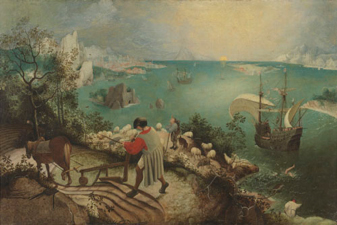
We know of course, how this is going to end: wings and wax melting, bursting into flames, and finally falling into the sea below. Deadalus, the great engineer and inventor, who had constructed these devices for himself and his son, Icarus, had been imprisoned by King Minos in the very dungeon he had constructed for the Minitaur on orders from this king.
The excitement and enthusiasm of this young man overshadowed the warnings of his father, to stay the course. It is an ancient moral tale from Ovid that has fascinated many generations of painters and poets: from Pieter Breughel (both the Elder and the Younger) to Henri Matisse and from William Carlos Williams to Claude-Henri Rocquet.
Many years ago, in literature and composition classes in Baltimore we were exposed to both classic and contemporary writers, especially Allen Ginsberg and Denise Levertov, Ed Sanders and Susan Sontag. Ezra Pound, T. S. Elliot, Dylan Thomas and Marianne Moore were always mentioned as well, but William Carlos Williams was often sited only as a footnote. Sometimes at night I would hit the library and find the new (at the time) two volume edition of Williams’ Collected Poems on the reserve shelf. I read through the entire collection several times that semester.
I have read that Williams himself was aware of and frustrated by the lack of greater recognition his work was afforded at that time. He continued to write nonetheless, and his last collection, “Pictures from Breughel” proved beyond a doubt his importance. Three months after his death, Williams was awarded the Pulitzer Prize for Poetry for this collection. His deep seeing, attention to detail and sensitivity towards Breughel’s work have continued to influence many younger painters and poets.
II LANDSCAPE WITH THE FALL OF ICARUS
“According to Brueghel
when Icarus fell
it was spring
a farmer was ploughing
his field
the whole pageantry
of the year was
awake tingling
near
the edge of the sea
concerned
with itself
sweating in the sun
that melted
the wings’ wax
unsignificantly
off the coast
there was
a splash quite unnoticed
this was
Icarus drowning”[ii]
Pieter Bruegel “La chute d’Icare” Oil on panel 1562-1563 73.5 x 112 cm Musee Royaux des Beaux-Arts de Belgique, Brussels
[i] Rocquet, Claude-Henri; Bruegel or the Workshop of Dreams; The University of Chicago Press; Chicago and London; 1991. (p. 122).
[ii] Williams, William Carlos; “Landscape With the Fall of Icarus,” Pictures from Breughel; New Directions Publishing Corporation; New York, New York; 1962; p. 4.
“Nothing is hollow or waste to the imagination of Marianne Moore….For I don’t think there is a better poet writing in America today or one who touches so deftly so great a range of our thought….So that in looking at some apparently small object one feels the swirl of great events.”[i]
This is what William Carlos Williams wrote about his friend and colleague Marianne Moore in an article regarding her work for the Quarterly Review of Literature in 1948. This particular issue of the Quarterly Review was published in honor of Miss Moore.
Marianne Moore was born in Brooklyn, New York in 1887 and lived most of her life there. Miss Moore studied at the University of Pennsylvania and worked as a professional librarian, with the other half of her career as a poet. Along the way, she met and shared aesthetic interests with other fellow poets including Ezra Pound and William Carlos Williams. On a rare trip overseas to London and the British Museum with her mother in 1911 she discovered a small Egyptian blown glass sculpture in the form of a fish, which later became an important example of the ekphrastic tradition. She has also written sensitively about Leonardo da Vinci’s “Saint Jerome and His Lion” and “Rodin’s Penseur.”
Ellen Fischer “Kodak and Mirror” 2016 Oil on panel 12” x 9” (Courtesy of the artist
Ellen Fischer was born in Oak Park, Illinois in 1956. She studied at the Herron School of Art in Indianapolis, the Skowhegan School of Painting and Sculpture in Maine, and at the School of the Art Institute of Chicago. She has served as a curator at both the Greater Lafayette Museum of Art in Indiana and the Vero Beach Museum of Art in Florida. The other half of her career over these years was of course as a studio artist.
These two could have been sisters, or distant cousins, perhaps not from the exact same family, but from across the spread of time. They share several aesthetic, intellectual and spiritual traditions even though one was an Imagist poet and the other is a contemporary painter. Both women have worked with great independence and determination.
On several occasions I have accompanied Ms. Fischer to art museums, galleries, antique stores and markets in Central Florida. The same eyes that look so intensely at works of art are also used to search out a find or two at the local flea market or Goodwill Store. Her juxtapositions are always surprising and provocative, bringing out the best in every object.
Quietly creating these still lives, flooding them with light and satire and curiosity, Ms. Fischer has assembled a body of work that speaks of human hands and activities. It is exactly what Miss Moore advocated when she mentioned how one object shouldn’t diminish or reduce another: one thing being great because another is small.
Ellen Fischer “Hanging Machete” 2016 Oil on panel 12” x 9” (Courtesy of the artist
Although many of these objects are old and discarded, they are not, to my mind, nostalgic. They are unusual in form and antique in the sense that they carry with them a certain history, or an untold story that may have already been lost, only now to be participants in a totally new story.
When I recently asked Ms. Fischer about her work and her selection of subjects, this was her response:
“YES, I see things at Goodwill and thrift stores and flea markets, and buy them. I know right away that I have to have them, and that I will paint them. The meat cleaver was purchased at the St. Vincent DePaul shop here in Vero. Two friends were with me and I had nothing to buy. When they were checking out, I saw it in a case on the other side of the cash register and asked to see it.”
“Well, once something like that is in your hands you can’t let it go. I paid way more for that cleaver than I usually spend on anything in the thrift store– $10.00!”
“I had done a few paintings with sharp objects in them, and wanted to do more. The cleaver interested me as an object to paint. It did lie around the studio for a few months before I used it, but I never stopped thinking about it, in a general way.”
“It seemed natural to use the little Parian ware ‘Ma Kettle’ figure with it– she is holding an ax, you may have noticed, and has a pig at her side….And she was just the right size to hide behind the blade.”
Ellen Fischer “A Close Call” 2016 Oil on panel 12” x 9” (Private collection Indianapolis)
“Always best when a still life comes together spontaneously. I don’t think you can force objects to go together that don’t belong together, no matter how you juggle them.”
“Sometimes I have played around with objects, positioning them this way and that to see how they might work, but if it doesn’t happen within a reasonable amount of time, I keep the object I am most interested in painting on the table and try different objects with it.”
“I have to feel strongly about the objects in the first place to want to paint them.”[ii]
Because of her interest in various works of art, Marianne Moore was often questioned about her writing and collecting. She struggled to defend the directness of her own work and to explain what she saw in the work of others, both poets and painters. Finally having had enough, she made her own statement regarding what she indeed looked for.
Here is Miss Moore’s response regarding her collection of art and objects:
“When I Buy Pictures
or what is closer to the truth,
when I look at that of which I may regard myself as the imaginary possessor,
I fix upon what would give me pleasure in my average moments:
the satire upon curiosity in which no more is discernible
than the intensity of the mood;
or quite the opposite–the old thing, the medieval decorated hat-box,
in which there are hounds with waists diminishing like the waist of the hour-glass,
and deer and birds and seated people;
it may be no more than a square of parquetry; the literal biography perhaps,
in letters standing well apart upon a parchment-like expanse;
an artichoke in six varieties of blue; the snipe-legged hieroglyphic in three parts;
the silver fence protecting Adam’s grave, or Michael taking Adam by the wrist.
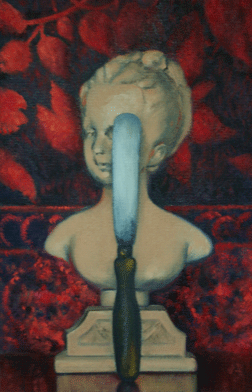
Ellen Fischer “Bust with Palette Knife” 2016 Oil on panel 12” x 9” (Courtesy of the artist)
Too stern an intellectual emphasis upon this quality or that detracts from one’s enjoyment.
It must not wish to disarm anything; nor may the approved triumph easily be honored–
that which is great because something else is small.
It comes to this: of whatever sort it is,
it must be ‘lit with piercing glances into the life of things’;
it must acknowledge the spiritual forces which have made it.”[iii]
[i] Williams, William Carlos; “Marianne Moore” Selected Essays; New Directions Publishing Corporation; New York, New York; 1969; pp. 292-294.
[ii] Fischer, Ellen; An artist’s statement regarding “Close Call” and other still life elements as contained in an e-mail correspondence with this writer, 21 June 2017.
[iii] Schulman, Grace, ed.; The Poems of Marianne Moore; Viking; New York, New York; 2003; p. 144.
“And he came to a certain place, and stayed there that night, because the sun had set. Taking one of the stones of the place, he put it under his head and lay down in that place to sleep. And he dreamed that there was a ladder set up on the earth, and the top of it reached to heaven; and behold, the angels of God were ascending and descending on it! And behold, the Lord stood
above it and said, ‘I am the Lord, the God of Abraham your father and the God if Isaac; the land on which you lie I will give to you and to your descendants; and your descendants shall be like the dust of the earth, and you shall spread abroad to the west and to the east and to the north and to the
Attavante “Le songe de Saint Romuald et l’Echelle des moines”[i] 1502 Miniature on parchment 44 cm. x 34 cm. Wildenstein Collection of Illuminations Musee Marmottan, Parissouth; and by you and your descendants shall all the families bless themselves. Behold, I am with you and will keep you wherever you go, and will bring you back to this land; for I will not leave you until I have done that of which I have spoken to you.’ Then Jacob awoke from his sleep and said, ‘Surely the Lord is in this place….This is none other than the house of God, and this is the gate of heaven.’”[ii]
The Jacob’s Ladder
“The stairway is not
a thing of gleaming strands
a radiant evanescence for angels’ feet that
only glance in their
tread, and
need not touch the stone.
It is of stone.
A rosy stone that takes
a glowing tone of softness
only because behind it the sky is a
doubtful,
a doubting night gray.
A stairway of sharp
angles, solidly built.
One sees that the angels must spring
down from one step to the next giving a
little
lift of wings:
and a man climbing
must scrape his knees and bring
the grip of his hands into play. The cut
stone
consoles his groping feet. Wings brush past
him.
The poem ascends.”[iii]
There are many literary references and historical illustrations to the passage of people and angels traveling between Heaven and Earth. There are also contemporary examples such as the one above by Denise Levertov and one at the end of this essay by Bob Dylan. In literature these draw upon the Old Testament story of the Dream of Jacob. In music there is a major source for this in the great American Southern Baptist spiritual: “Jacob’s Ladder.”
“We are climbing Jacob’s ladder.
We are climbing Jacob’s ladder.
We are climbing Jacob’s ladder,
Soldiers of the cross.
Every rung goes higher and higher.
Every rung goes higher and higher.
Every rung goes higher and higher.
We are brothers, and sisters, all.”[iv]
It was one of the first African American spirituals to become popular with both black and white citizens of the south. There is no record of when it was written or who wrote it, but it came into being sometime between 1750 and 1825, and was known as a call and response song amongst slaves. The ladder quickly became one of many symbols for the means of escaping slavery.
As is typical with folk traditions, this song was handed down through generations and verses were added and changed to reflect more recent times. Significant versions from the 20th Century include recordings by Paul Robeson, Pete Seeger and most recently by Bruce Springsteen during his “Seeger Sessions.”
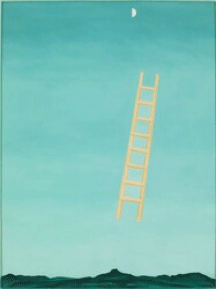
Georgia O’Keeffe “Ladder to the Moon” 1958 Oil on canvas 40 3/16” x 30 1/4” The Whitney Museum of American Art, New York
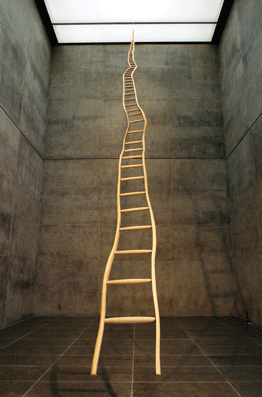
In the visual arts as well, this imagery has wide ranging uses, from medieval manuscript illuminations to pieces of surrealism and even to contemporary sculpture. The “Dream of Romuald with the stairs of the Monks” from an Italian book illumination at the Marmottan-Monet Museum in Paris is a reference to the story of Jacob’s Ladder. Many early 20th Century artists incorporated this imagery into their work, from realists to surrealists, from Georgia O’Keeffe to Joan Miro and most recently, Martin Puryear, who has used the ladder form in his sculpture dedicated to Booker T. Washington.
Martin Puryear “Ladder for Booker T. Washington” 1996 Wood (ash and maple) 432” x 22 3/4” x 3” The Modern Art Museum of Fort Worth, Texas
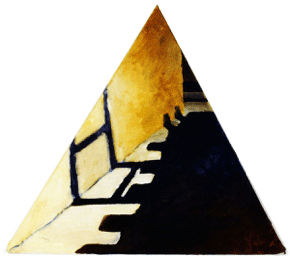
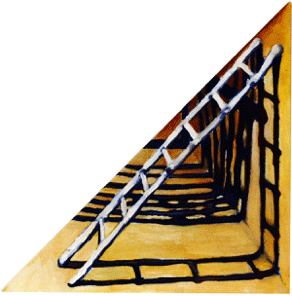
Finally, a young artist here in Indiana has for several years been employing severe and unusual views of many ordinary and everyday objects. Having studied at the Herron School of Art in Indianapolis, the Pont-Aven School of Contemporary Art in Pont-Aven, France and the Arizona State University in Tempe, Sarah Jones has always had an eye for the unique angle of things.
Sarah K. Jones “Ladder #2” 1993 Oil on canvas 12” x 12” Courtesy of the artist
The dramatic placement and situation of certain objects is combined with her own personal point of view towards these things. Her paintings above and below best illustrate this, as does her own statement regarding how they came about.
Sarah K. Jones “Ladder #3” 1993 Oil on canvas 12” x 12” Courtesy of the artist
“The paintings came about after a summer spent in the four corners region. I was working on a ranch in Durango, CO and took weekend trips to places like Mesa Verde, Taos, and Albuquerque. It was my first trip west of the Mississippi and I was fascinated by the differences in landscape and even quality of light compared to Indiana. The images which inspired the paintings were taken at Taos Pueblo. The sky was SO blue. The light was SO bright. The shadows were SO strong. I loved the clean lines of the buildings and the shadow patterns made by ladders leaning against the adobe buildings. They formed lovely right angle triangles: building= side 1, ladder = side 2 and shadow of ladder falling across the ground = side 3.”[v]
Sarah Kathryn Jones “Ladder #1” 1993 Oil on canvas 12” x 12” Courtesy of the artist
Finally, I am reminded of a certain theme that runs through much of the writing of William Carlos Williams: primarily in his epic poem “Patterson” and secondly in an essay on the work of the artist Charles Sheeler. He mentions several times that we should “Say it! No ideas but in things!”[vi] And further, he observes that “It is in things that for the artist power lies….”[vii] So, it is in both poetry and painting that a single object might become a powerful image.
“May God bless and keep you always
May your wishes all come true
May you always do for others
And let others do for you
May you build a ladder to the stars
And climb on every rung
And may you stay forever young”[viii]
[i] Translated as “The Dream of St. Romuald and the Ladder of the Monks” this is a piece from the Wildenstein Collection of historic manuscript illuminations at the Marmottan-Monet Museum in Paris. One historian, Peter Damian, has noted that St. Romuald’s Dream is also a conflation of the legend of Jacob’s Dream.
[ii] “Genesis 28:11-17” The Holy Bible: Revised Standard Version; Thomas Nelson & Sons; New York, Toronto, Edinburgh; 1952; p. 21.
[iii] Levertov, Denise; Selected Poems; New Directions Publishing Corporation; New York, New York; 2002; p. 25.
[iv] Springsteen, Bruce; “Jacob’s Ladder” The Seeger Sessions; Audio Recording, Columbia Records and Sony Entertainment; New York, New York; 1998 & 2006.
[v] Jones, Sarah; An artist’s statement regarding her “Ladder Paintings” as contained in an e-mail correspondence with this writer, 16 May 2017.
[vi] Williams, William Carlos; Patterson; New Directions Publishing Corporation; New York, New York; 1992; pp. 6 & 9.
[vii] Williams, William Carlos; Selected Essays; New Directions Publishing Corporation; New York, New York; 1969; p. 234.
[viii] Dylan, Bob; “Forever Young” Planet Waves; Audio Recording, Columbia Records and Sony Entertainment; New York, New York; 1974 & 2004.
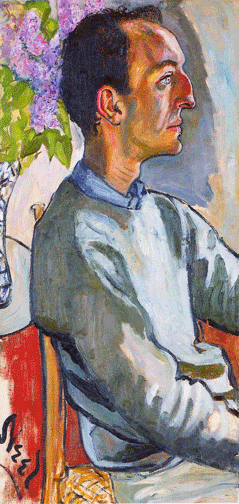
Alice Neel “Frank O’Hara” Oil on canvas 1960 34” x 16 1/8” National Portrait Gallery, Smithsonian Institution, Washington, DC.
He started out manning the front desk at the Museum of Modern Art in New York right after finishing up graduate school at the University of Michigan in 1951. He soon became an Assistant Curator and later an Associate Curator of Painting and Sculpture.
He would often take off for lunch and scribble notes in the park while he ate a sandwich, or he would walk around the block, stop in at the Ollivetti Shop pretending to test out the latest typewriter and type out 10 or 15 lines on a sheet of paper and then return to his office. “Lunch Poems” he would later call them.[i]
Although his degrees were in creative writing, Frank O’Hara had a keen eye and a contagious smile and soon met many of the other younger painters and poets in New York. Amongst his new circle of friends and associates were Grace Hartigan, Kenneth Koch, John Ashbery and Larry Rivers, James Schuyler, Jane Freilicher and Fairfield Porter, Michael Goldberg, Alfred Leslie and Joan Mitchell. He would often collaborate with several of these painters, especially Larry Rivers, Michael Goldberg, and Grace Hartigan. One important example of this was the series of Hartigan’s paintings and O’Hara’s poems titled “Oranges” exhibited and published through Tibor de Nagy in 1953.[ii]
Grace Hartigan “Oranges No. 1” 1952 Oil on paper 44 1/4” x 33 1/2” Poetry and Rare Books Collection State University of New York Buffalo, New York
“WHY I AM NOT A PAINTER”
“I am not a painter, I am a poet.
Why? I think I would rather be
a painter, but I am not. Well,
for instance, Mike Goldberg
is starting a painting. I drop in.
‘Sit down and have a drink’ he
says. I drink: we drink. I look
up. ‘You have SARDINES in it.’
‘Yes, it needed something there.’
‘Oh.’ I go and the days go by
and I drop in again. The painting
is going on, and I go, and the days
go by. I drop in. The painting is
finished. ‘Where’s the SARDINES?’
All that’s left is just
letters. ‘It was too much,’ Mike says.
But me? One day I am thinking of
a color: orange. I write a line
about orange. Pretty soon it is a
whole page of words, not lines.
Then another page. There shoud be
so much more, not of orange, of
words, of how terrible orange is
and life. Days go by. It is even in
prose, I am a real poet. My poem
is finished and I haven’t mentioned
orange yet. It’s twelve poems, I call
it ORANGES. And one day in a gallery
I see Mike’s painting, called SARDINES.”[iii]
Michael Goldberg “Sardines” 1955 Oil and adhesive tape on canvas 80 3/4” x 66” National Museum of American Art Smithsonian Institution, Washington, DC.
[i] O’Hara, Frank; Lunch Poems; City Lights Books; San Francisco, California; 2014.
[ii] Perloff, Marjorie; Frank O’Hara: Poet among Painters; The University of Chicago Press; Chicago and London; 1998, pp. 76-77.
[iii] Allen, Donald, ed.; The Collected Poems of Frank O’Hara; University of California Press; Berkeley, Los Angeles, and London; 1995; pp. 261-262.
“Today he is hardly likely to find himself unless he is a non-conformist and a rebel. To say this is neither dangerous nor new. It is what society really expects of its artists. For today the artist has, whether he likes it or not, inherited the combined functions of hermit, pilgrim, prophet, priest, shaman, sorcerer, soothsayer, alchemist, and bonze.”[i]
This is what Thomas Merton had to say about contemporary artists and writers. He had multiple points of view regarding this position: as a poet himself, as a Trappist monk at the Abbey of Gethsemani in Lexington, Kentucky, as a student of calligraphy and as a colleague and friend to others in the field, including Ad Reinhart, John Cage, D. T. Suzuki and Jacques Maritain.
Thomas Merton “Untitled” (Sorcerer, soothsayer, alchemist) c. 1963 Brush and India ink on paper 10 1/4” x 7 1/2” The Thomas Merton Center, Bellarmine University, Louisville, Kentucky
In the beginning years of the 20th century Henri Matisse began thinking and writing about the importance of signs. He saw this especially in the pen and ink drawings of Vincent van Gogh, which were an early influence on him, as well as in certain examples of calligraphy from Oriental art.
Henri Matisse “Standing Nude, Arms Covering her Face” 1901-1903 Ink on paper 10 3/8” x 8” Gift of Edward Steichen Museum of Modern Art, New York
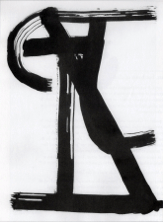
In these same years the poet Ezra Pound was sent a manuscript that had been written by the scholar Ernest Fenollosa who had been studying the origins of the Japanese and Chinese alphabets, whose characters had originally been drawings!
“Chinese poetry has the unique advantage of combining both elements. It speaks at once with the vividness of painting, and with the mobility of sounds.”[ii]
Ezra Pound called this the ‘ideogramic method’ and used what he had learned from Fenollosa to define and clarify the quality known as ‘economy of means’ that is so important to both painters and poets. This also led directly to the invention of ‘Imagist Poetry’ that is characterized by clarity and directness.
In letters and conversations with Louis Aragon throughout his lifetime Henri Matisse often explained that: “The sign is determined at the moment I use it and for the object of which it must form a part. For this reason I cannot determine in advance signs which never change and which would be like writing: that would paralyze the freedom of my invention.”[iv]
Henri Matisse “Acrobat” 1952 Brush and ink on paper 41 3/8” x 29 1/2” Private Collection
Aragon helped to ‘translate’ many of Matisse’s statements, paintings and drawings, into literature through his essay ‘Matisse en France’ from 1942-43 and the two volume ‘Matisse: A Novel’ from 1972.
Similar concerns can be seen in the works of Henri Michaux working in Paris and Thomas Merton working in Lexington, Kentucky. They were both interested in painting and poetry, through which they each investigated the use of signs.
“To abstract means to free oneself, to come disentangled.”
“The hand should be empty, should in no way hinder what’s flowing into it.”
“Only the ‘exact placement,’ the ‘just proportion’ matter.”[v]
Henri Michaux “Untitled (Mouvements)” c. 1950-51 India ink on paper 12 5/8” x 9 1/2” Private collection
More recently, in an interview with Janie C. Lee at the Whitney Museum of American Art on 21 May 1998, Brice Marden described some of his work in the “St. Bart’s 1985-86 Series” in this way: “The whole history of the life is right there on the surface. These drawings were all started as individual sheets in a book. Then I took the book apart and started putting them together in different sequences. Some I reworked, putting two sheets on
Brice Marden “St. Bart’s 1985-86 N.Y. 3” 1985-1986 Ink and gouache on paper 7 5/16” x 7 7/8” Whitney Museum of American Art, New York
each page . . . . Top to bottom and across to the left. I was following the Chinese calligraphic method. It was easier for me because I’m left handed, so if I work from right to left, I don’t run the chance of smudging the ink or some marking. These were very early calligraphy-based drawings.”[vi]
The effects of Matisse’s experiments along with Fenollosa’s observations have been wide ranging: from the paintings of Henri Michaux to the calligraphies of Thomas Merton, to Brice Marden’s recent drawings and even to a few of my own students over the years, especially the work of Rene Gonzalez.
Rene Gonzales “The Civil War Cannon” Pen & ink on paper 8 1/2” x 11” 1997 Courtesy of the artist
“Yes, I remember these drawings very well…they were an automatic drawing series. I had been studying a lot of Motherwell at that time and watched a documentary on his Reconciliation Elegy work. In it, he described a process where he would sit down with a stack of paper and ink and a brush and just knock out gestures with no edits or reworks. He could then look at 50 to 100 drawings on the floor and begin to select the ones he wanted to investigate further. The series of drawings I did went through a similar process and only a few were then selected as the actual compositions to my paintings. I believe they were either 8 1/2 x 11 or smaller but I do not remember.”[vii]
Rene Gonzales “An M-16” Pen & ink on paper 8 1/2” x 11” 1997 Courtesy of the artist
“The freedom of the artist is to be sought precisely in the choice of his work and not in the choice of the role as ‘artist’ which society asks him to play.”[viii]
[i] Lipsey, Robert; Angelic Mistakes: The Art of Thomas Merton; New Seeds Publishing; Boston & London; 2006; p. 100.
[ii] Fenollosa, Ernest and Ezra Pound, ed.; The Chinese Written Character as a Medium for Poetry; City Lights Books; San Francisco, California; 1936; p. 9.
[iii] This example has been published in both Fenollosa (p. 8) and Michaux (p. 43). It shows three characters, all containing legs. To the right the ideogram for ‘horse’ with four legs underneath. In the center is an ‘eye’ being carried by two legs. And on the left the image of a man. As both authors explain, these images taken together produce the line: “man sees horse.”
[iv] Schneider, Pierre; Matisse; Rizzoli International; New York, New York; 1984 and 2002; p. 576.
[v] Michaud, Henri; translated by Gustaf Sobin; Henri Michaux: Ideograms in China; New Directions Publishing Corporation; New York, New York; 1975; (unpaginated).
[vi] Lee, Janie C.; Brice Marden Drawings; The Whitney Museum of American Art and Harry N. Abrams, Inc.; New York, New York; 1998; p. 19.
[vii] From E-MAIL communications between the artist and this writer on 14 January and 27 January 2017.
[viii] Lipsey, Robert; Angelic Mistakes: The Art of Thomas Merton; p. 100.
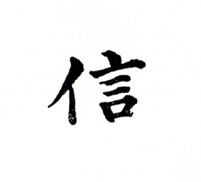
[ix] This last example is taken from Fenollosa (p. 40). It shows a ‘mouth’ on the lower right with words and tongue coming out of it. On the left is the figure of a ‘man.’ Taken together, they form the sign: “a man standing beside his word, truth.”
“In ‘Jungle Surrender’ the figures in the foreground are in a semiconscious state of concern about a relationship between their offsprings, the embracing couple in the mid ground. My scout dog and I become voyeurs hidden in the jungle. The figure with raised hands represents my surrender to the memories and hallucinations of war. The mournful howl of the lone wolf echoes throughout the burning glow of the agent orange landscape.”[i]
The artist Don Cooper was born in Texas in 1944 and received his BFA in 1966 and his MFA in 1968, both from the University of Georgia. He has held a variety of faculty positions at the University of Georgia, West Georgia College, and the Atlanta College of Art over the ensuing years. His work is represented in several public collections including the Albright-Knox Gallery in Buffalo, New York and the High Museum of Art in Atlanta, Georgia.
Cooper was drafted within days of receiving his MFA and served as a ‘scout dog handler’ in Vietnam in 1969-1970. After the war, he often painted dogs and other domestic animals but didn’t directly address images related to that war until the mid-1980’s. He felt that these paintings, including “Jungle Surrender,” were a sort of purge of the trauma of that war.
Yusef Komunyakaa was born in Bogalusa, Louisiana in 1947. He served as an Information Specialist in the United States Army and was also stationed in Viet Nam in 1969-1970. He received an MA in writing in 1978 from Colorado State University and an MFA in creative writing from the University of California, Irvine, in 1980.
Komunyakaa has published more than fourteen collections of poetry including Dien Cai Dau in 1988 and Neon Vernacular for which he won the Pulitzer Prize in 1994. He has held several teaching positions including the University of New Orleans, Indiana University, and Princeton University. Currently he serves as Distinguished Senior Poet in New York University’s graduate creative writing program.
Don Cooper “Jungle Surrender” 1984 Oil on canvas 56” x 84” (Courtesy of the artist)
“Jungle Surrender (after Don Cooper’s painting)”
“Ghosts share us with the past & future
but we struggle to hold on to each breath.
Moving toward what waits behind the trees,
the prisoner goes deeper into himself, away
from how a man’s heart divides him, deeper
into the jungle’s indigo mystery & beauty,
with both hands raised into the air, only
surrendering halfway: the small man inside
waits like a photo in a shirt pocket, refusing
to raise his hands, silent & uncompromising
as the black scout dog beside him. Love & hate
flesh out the real man, how he wrestles
himself through a hallucination of blues
& deep purples that set the day on fire.
He sleepwalks a labyrinth of violet,
measuring footsteps from one tree to the next,
knowing we’re all somehow connected.
What would I have said?
The real interrogator is a voice within.
I would have told them about my daughter
in Phoenix, how young she was,
about my first woman, anything
but how I helped ambush two Viet Cong
while plugged into the Grateful Dead.
For some, a soft windy voice makes them
snap. Blues & purples. Some place between
central Georgia & Tay Ninh Province—
the vision a knot of blood unravels
& parts of us we dared put into the picture
come together; the prisoner goes away
almost whole. But he will always touch
fraying edges of things, to feel hope break
like the worm that rejoins itself
under the soil . . . head to tail.”[ii]
[i] Cooper, Don; An artist’s statement regarding “Jungle Surrender” as contained in an e-mail correspondence with this writer, 12 July 2016.
[ii] Komunyakaa, Yusef; “Jungle Surrender (after Don Cooper’s painting)” Dien Cai Dau; Wesleyan University Press; Middletown, Connecticut; 1988; pp. 37-38.
“The relationships that bind forms together in nature cannot be pure chance, and what we call ‘natural life’ is in effect a relationship between forms, so inexorable that without it this natural life could not exist. So it is with art as well. The formal relationships within a work of art and among different works of art constitute an order for, and a metaphor of, the entire universe.”[i]
For many years while travelling I always carried a set of ink pens and a field sketchbook and close by a copy of a book of poems by Eugene Guillevec that had been translated by Denise Levertov. These poems were so vivid: extremely colorful, visual, imaginary. And solid. Perfect for a painter.
In her translations Levertov observed that Guillevic’s work was based on a “… simplicity of diction, the plain and hard meaning of things without descriptive qualification reverberates … with the ambiguity, the unfathomable mystery of natural objects.”[ii]
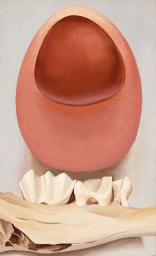
Georgia O’Keeffe “Red and Pink Rocks and Teeth” 1938 Oil on canvas 21” x 13” Alfred Stieglitz Collection, gift of Georgia O’Keeffe The Art Institute of Chicago, Chicago, Illinois
During one summer several years ago on a visit to the Denver Art Museum it was clear that the curators had arranged a new hanging of the permanent collection featuring the addition of works not usually exhibited. It was there that I came upon a small still life by Kay Sage that brought to mind instantly another small still life, this one by Georgia O’Keeffe, that I had seen earlier in the year at the Art Institute of Chicago.
It is strange, even surreal one might say, how certain images might carry over a great distance and an expanse of time. I have admired, for a long time, the paintings of Kay Sage and Georgia O’Keeffe, finding a shared sensibility between these two women, which alerted me to another shared set of sensibilities between Guillevic and Tanguy, physical and spiritual elements both!
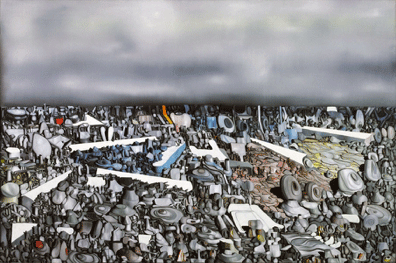
The paintings of Yves Tanguy and the poems of Eugene Guillevec show the influence of the Breton landscape in both abstract and physical ways. The formal and lyrical qualities depend greatly on the strange and surreal spirit of this place, the landscape of Brittany, while the litteral and figurative elements seem to depend on the clear observation and depiction of that landscape. Specific forms layed out in a specific space. Although I had always admired this element in Guillevic’s writing, it was also something that bothered me regarding Tanguy’s landscapes. Something overly stylized or self-consciously surreal.
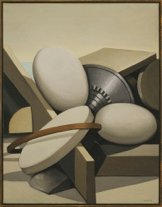
Yves Tanguy “Multiplication of the Arcs” 1954 Oil on canvas 40” x 60” Mrs. Simon Guggenheim Fund The Museum of Modern Art, New York
“The form of the work of art is first, in the artist, a sort of conscious urge to produce a certain piece of work; his confused awareness of the work to be is already his awareness of its form. The making of beauty consists in the progressive information of a piece of freely chosen matter by the form present in the artist’s mind.”[iii]
Late in the summer of 2007 we visted both the Musee de Prehistoire and the galleries at the Hall de la Mairie de Carnac in Brittany, France. One was an exhibition of photographs of those many pre-historic sites that inhabit the Breton landscape. The other was a selection of writings by Guillevec exhibited alongside several paintings by contemporary artists. These included works by Marie Alloy, Jean-Jacques Dournon, and Julius Baltazar. In both cases it highlighted the importance of this ancient landscape, even on contemporary painters and poets. I have also discovered many of the nearby beaches, not on the sandy leeward sides of the land, but the ones on the windward sides, the rocky ones! And it was there that I saw the importance of Tanguy’s paintings: the balance that he maintained between the real and the surreal. And what Guillevec felt about the rocks and the sea, winds blowing in and out in contrary routes.
Richard Emery Nickolson “The Beach near Le Pouldu, Brittany, France” 1997 Color photograph Collection of the artist
“De la mer aux menhirs,
Des menhirs a la mer,
La meme route avec deux vents contraires
Et celui de la mer
Plein du meutre de l’autre.”
[i] Focillon, Henri; The Life of Forms in Art; Zone Books; New York, New York; 1992; p. 33.
[ii] Guillevic, Eugene; Translated by Denise Levertov; Guillevic: Selected Poems; New Directions Publishig Corporation; New York, New York; 1969; pp. viii-ix.
[iii] Gilson, Etienne; The Arts of the Beautiful; Dalkey Archive Press; Champaign, Illinois; 2000; p. 97.
[iv] Notes taken by this writer regarding poems written by Eugene Guillevic and posted in conjunction with the exhibition “Guillevic et les peintres” at the Hall de la Mairie de Carnac, Carnac, Brittany, France, 25 July 2007.
Yves Tanguy and Eugene Guillevic have often been described as ‘Druids’ in the 20th century worlds of painting and poetry.
As a youth in Locronan, Yves Tanguy would often watch a local painter named Toche at work, whose aim it was to capture the atmospheric qualities of the Breton landscape in a kind of half light. Eugene Guillevic was also influenced early on, first by the German poet Rilke and later by the French poet Trakl.
Yves Tanguy was born in 1900 on the Place de la Concorde in Paris and many childhood vacations were spent in his family home at Locronan in Finistere, Brittany where thousands of menhirs and dolmens have been scattered across the landscape since prehistoric times.
Tanguy was drafted into the Army in 1918 and returned to Paris at the end of his service in 1922. It was during this time period that he met two fellow artists, Jacques Prevert and Giorgio de Chirico. It was through these contacts that Tanguy became associated with Andre Breton and the Surrealist Group, from 1924 to 1938. Prior to World War II, he met and married the American artist Kay Sage and moved to New York and later established a studio in Woodberry, Connecticut. Tanguy died in Connecticut in 1955.
Kay Sage “A Little Later” 1938 Oil on canvas 36” x 28” Denver Art Museum, Denver Colorado
Eugene Guillevic was born in Carnac, Morbihan, Brittany in 1907. He began writing poetry as a child, inspired primarily by the Fables of La Fontaine. Upon passing his baccalaureate in 1926 he was assigned a series of governmental positions including as Inspecteur d’Economie National from 1946 to 1963.
His work developed through the Surrealist period and into a more personal simplicity and maturity later in his life. He received Le Grand Prix de Poesie from the French Academy in 1976 and Le Grand Prix National de Poesie in 1984. Guillevic died in 1997.
In her book of translations of selected Guillevic poems, the poet Denise Levertov observed that: “The great ritual places of the Celts . . . the places where the great and small stones or menhirs, are gathered in powerful and enigmatic testimony to forgotten certainties, are landscapes of a profound austerity.”[i]
“The Rocks”
“The rocks won’t know
one speaks about them.
And always to sustain them, they’ll have
only grandeur. . . .”
“They don’t burn sulphur
in the darkness
for they have never known
the fear of death. . . .”
“And then the joy
of knowing the menace
and enduring.
Yves Tanguy “Multiplication of the Arcs” 1954 Oil on canvas 40” x 60” Mrs. Simon Guggenheim Fund The Museum of Modern Art, New York
While at their edges
bits of stone flake off
which wind and wave had scraped at
while they were dozing.”
“. . . They don’t have to go about
With faces you can read like books.”
“They did not want to be the temple
in which to delight. . . .”
“And joy
comes to them out of themselves alone. . . .”
“It happens that a block of stone
detaches itself and falls,
falls so that one misses a breath,
into the wet sea. . . .”
“. . . To be the memory of a rock, of being
promontory, out and towards the wave.”[ii]
[i] Guillevic, Eugene; Translated by Denise Levertov; Guillevic: Selected Poems; New Directions Publishig Corporation; New York, New York; 1969; p. vii.
[ii] Guillevic, Eugene; Translated by Denise Levertov; Guillevic: Selected Poems; pp. 76-83.
During the fall of 1872 and continuing through 1874, Paul Cezanne sought out the advice and guidance of the much older Impressionist painter Camille Pissarro. They often painted side by side, observing the very same motif at the same hour of the day, in and around the area of Pontoise and Auvers-sur-Oise. They would compare and criticize each other’s work. This began both a personal and professional relationship that had a profound affect on each of them. A recipe for success.
Rooftops of red and a variety of other colors became a kind of theme or metaphor. Robert and Sonia Delauney, Francis Picabia and other French artists took up this subject. Certain American artists as well, in the early 20th Century, also incorporated these architectural forms, such as Charles Sheeler’s barns at Lancaster and Georgia O’Keeffe’s barns at Lake George, along with other works by Ralston Crawford and Marsden Hartley. The roofs got to a point where they became very abstract and even surreal. More so later when painted by Rene Magritte or written about by Marianne Moore.
Rene Magritte “Empire of Light” 1953-1954 Oil on canvas 76 15/16” x 51 5/8” The Solomon R. Guggenheim Foundation, New York, New York
“The magician’s retreat”
“of moderate height,
(I have seen it)
cloudy but bright inside
like a moonstone,
while a yellow glow
from a shutter-crack shone,
and a blue glow from the lamppost
close to the front door.
It left nothing of which to complain,
nothing more to obtain,
consummately plain.
A black tree mass rose at the back
almost touching the eaves
with the definiteness of Magritte,
was above all discreet.”[iii]
[i] The penultimate line could be written in a couple of alternate ways, including “Let them be” and “Let them work” as in certain other culinary procedures.
[ii] Guillevic, Eugene; Seleceted Poems (translated by Denise Levertov); New Directions Publishing Corporation; New York, New York; 1969; pp. 66-67.
[iii] Schulman, Grace, ed.; The Poems of Marianne Moore; Viking; New York, New York; 2003; p. 136.
Edward Hopper “House by the Railroad” 1925 Oil on canvas 24” x 29” Museum of Modern Art, New York. New York
“‘All I wanted to do was paint sunlight on the side of a house,’ said Edward Hopper (or words to that effect), and there have been legions of poets and filmmakers obsessed with light. I would side with the irrational visionary romantic who says light came first, and darkness but a fleeting shadow to be swept away with more light. (“More light!” cried the great poet, dying.) Poets and painters are the natural bearers of it, and all I ever wanted to do was paint light on the walls of life.”[i]
Painters and poets are indeed the natural bearers of light. And, it would be difficult to overestimate the influence that Edward Hopper has had on later artists. Gail Levin has explained this very succinctly in her essay “Edward Hopper: His Legacy for Artists.” She writes: “Many contemporary painters work on Hopperesque themes in a realist style that he would have respected. Cape Cod scenes by both Philip Koch and John Dowd have been compared to Hopper’s work. . . . Walter Hatke’s Room of the Sun (1979) was one of many pictures in which he explored painting sunlight in interiors in a way suggestive of Hopper’s focus on light, particularly in the latter’s celebrated Sun in an Empty Room (1963). Hopper’s themes reappear in the gas stations, street corners, and trains of George Nick, who studied with Hopper’s friend and admirer Edwin Dickinson….”[ii]
Philip Koch “Equinox” 1991 Oil on canvas 40” x 60” Courtesy of the artist
Hopper has also had an influence on several contemporary writers such as John Hollander, Tess Gallagher, Galway Kinnell, Mark Strand and especially Lawrence Ferlinghetti. As a poet, Ferlinghetti has written about artists from every period. He often uses the analogy for being an artist as ‘walking on a tightrope’ and applies this to everyone from Charlie Chaplin to Goya, from Morris Graves to Picasso, and from Marc Chagall to Edward Hopper. In fact, he has paid great attention to Hopper in several poems and the two collections titled “Pictures of the Gone World” and “How to Paint Sunlight.” In particular Ferlinghetti was inspired by a photographic portrait of Edward Hopper taken by Arnold Newman in front of Hopper’s house in Truro, Massachusetts in 1960.
Arnold Newman “Edward Hopper: Truro, Massachusetts” 1960 B & W Photograph 22 5/16” x 17 13/16” National Portrait Gallery, Smithsonian Institution, Washington, DC.
[i] Ferlinghetti, Lawrence; How to Paint Sunlight; New Directions Publishing Corporation; New York, New York; 2001; p. ix.
[ii] Lyons, Deborah and Adam D. Weinberg; Edward Hopper and the American Imagination; (including the essay “Edward Hopper: His Legacy for Artists” by Gail Levin); W. W. Norton & Company; New York and London; 1995; pp. 115-116.
[iii] Ferlinghetti, Lawrence; “At the Hopper house” Pictures of the gone world; City Lights Publishing; San Francisco, California; 1995; #37.









 [ix]
[ix]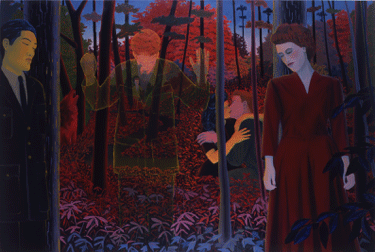



 BRIDGING THE GAP