WHAT GOD SAID TO ABRAHAM

abraham1
Lorenzo Ghiberti
“The Sacrifice of Isaac”
1401-1402
Gilt bronze
21″ x 17″
National Museum, Florence

“. . . God said to Abraham, ‘Kill me a son’
Abe says, ‘Man, you must be puttin’ me on’
God say, ‘No’ Abe say, ‘What?’
God say, ‘You can do what you want, Abe, but
The next time you see me comin’, you better run’
Well, Abe says, ‘Where d’you want this killin’ done?’
God says, ‘Out on Highway 61’”[i]

It is one of the great Old Testament stories regarding Abraham’s sacrifice of his son Isaac in order to somehow and ultimately prove his faith. He struggled with this dearly. A very important depiction of this is the one above that Lorenzo Ghiberti used as the presentation piece for the commission of the bronze doors in the Basilica at Florence in 1401.

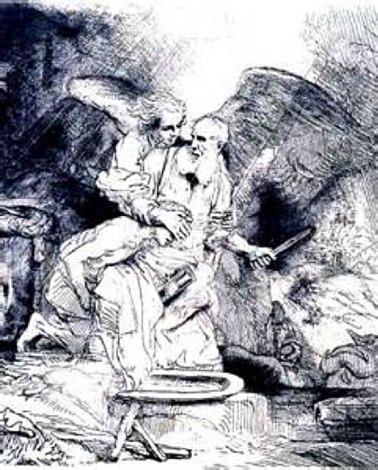
Another powerful image is an etching by Rembrandt in the collection of the Art Institute of Chicago. The processes of etching and drypoint not only illustrate the story but parallel the psychological struggle through physical struggle and manipulation of the medium. Rembrandt, always being a master of both the formal and the personal, combines these elements into a universal statement.

abraham2
Rembrandt van Rijn
“The Sacrifice of Abraham”
Etching and drypoint
1655
154 x 131 mm
The Art Institute of Chicago

We need only to come to the late 1960’s in America for several other critical examples. These years proved to be a shocking turning point in the lives of many people. Earlier civil rigths demonstrations had evolved into anti-war demonstrations. Meanwhile, a music and arts festival was held in a sleepy town in upstate New York in August 1969. But, by May of the next year, the Kent State Massacre had occurred.

abraham3
John Filo
“Mary Vecchio cries over the body of one of the Kent State University students who had just been shot by Ohio National Guard soldiers on May 4, 1970”
B&W photograph
Courtesy of the Pulitzer Prize Foundation

Upon hearing of the massacre at Kent State and seeing this photograph for the first time, the singer songwriter Neil Young penned what would become an anthem performed by Crosby, Stills, Nash and Young: “Ohio.”

“Gotta get down to it
Soldiers are cutting us down
Should have been done long ago.
What if you knew her
And found her dead on the ground
How can you run when you know?

Tin soldiers and Nixon coming,
We’re finally on our own.
This summer I hear the drumming,
Four dead in Ohio.”[ii]

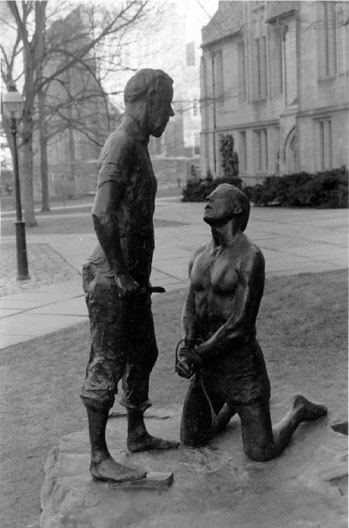
In 1978 Kent State University commissioned the sculptor George Segal to create a memorial to the people killed in the massacre. Segal chose as his theme the Old Testament story of Abraham and Isaac. Safe enough at the time. The piece was actually completed and about to be installed when the university had second thoughts. The sculpture was never installed and offered instead to the Princeton University Art Museum, where it now sits in the courtyard near the University Chapel.

The situation was offensive all the way around, but, it was most offensive because the Kent State officials did not want to be associated with the idea that one generation was willing to sacrifice another for the sake of a totally misguided involvement in a distant war.

abraham4
George Segal
“Abraham and Isaac: In Memory of May 4, 1970, Kent State University”
Bronze
1978-1979
The John B. Putnam Jr. Memorial Collection, Princeton University
Princeton, New Jersey

Although a very safe and more abstract memorial now occupies the spot of the Kent State Massacre, the question still remains, when and how will we ever learn to work to end war, rather than to invest in and profit from, the engagement in war?

“Now the roving gambler he was very bored
He was tryin’ to create a next world war
He found a promoter who nearly fell off the floor
He said I never engaged in this kind of thing before
But yes I think it can be very easily done
We’ll just put some bleachers out in the sun
And have it on Highway 61”[iii]


[i] Dylan, Bob; “Highway 61 Revisited,” Writings and Drawings; Alfred A. Knopf, Borzoi Books; New York, New York; 1973; pp. 196.

[ii] Young, Neil; “Ohio,” Live at Massey Hall, 1971; audio recording, BOOOMTPANG; Reprise Records; New York, New York; 2007.

[iii] Dylan, Bob; “Highway 61 Revisited,” Writings and Drawings; pp. 196.

EXPHRASTICS

“Someone, I tell you, in another time,
will remember us.”[i]

Ekphrasis or ecphrasis, from the Greek: a description of a work of art, either real or imaginary, produced as a rhetorical exercise; often used in the adjectival form, ekphrastic, a graphic, often dramatic, description of a visual work of art.

keats
John Keats
“Tracing of an engraving of the Sosibios vase”
1819
Ink on paper
The Louvre, Paris, France

From ancient times to the 20th century there has been an interdisciplinary dance played out between poets and painters. The idea of writing a poem or a play that was descriptive of, or inspired by a work of visual art was in fact invented by the Greeks. Homer’s description of the Shield of Achilles in the 18th Book of The Illiad being one of the first examples.

“Then first he form’d the immense and solid shield;
Rich various artifice emblazed the field;
Its utmost verge a threefold circle bound;
A silver chain suspends the massy round;
Five ample plates the broad expanse compose,
And godlike labours on the surface rose.
There shone the image of the master-mind:
There earth, there heaven, there ocean he design’d;
The unwearied sun, the moon completely round;
The starry lights that heaven’s high convex crown’d;
The Pleiads, Hyads, with the northern team;
And great Orion’s more refulgent beam;
To which, around the axle of the sky,
The Bear, revolving, points his golden eye,
Still shines exalted on the ethereal plain,
Nor bathes his blazing forehead in the main.”[ii]

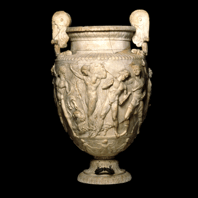
This was of course, a literary fiction based totally on a plastic fiction, made real through the art of storytelling. The Romantic poet John Keats harks back to classic examples with his “Ode on a Grecian Urn.” Published anonymously in the January 1820, Number 15 issue of the magazine “Annals of the Fine Arts” it is an elegaic description on this single object. Early speculation centered around the fact that Keats had based his poem on a specific vase, either “The Sosibios Vase” at the Louvre in Paris or later on “The Townley Urn” at the British Museum in London. Nowadays it is considered that his work is more of a synthesis of several objects.

townley
“The Townley Urn”
100-200AD
Marble
H:1.06 metres
The British Museum, London

“Thou still unravish’d bride of quietness,
Thou foster-child of silence and slow time,
Sylvan historian, who canst thus express
A flowery tale more sweetly than our rhyme:
What leaf-fring’d legend haunts about thy shape
Of deities or mortals, or of both,
In Tempe or the dales of Arcady?
What men or gods are these? What maidens loth?
What mad pursuit? What struggle to escape?
What pipes and timbrels? What wild ecstasy?”

“O Attic shape! Fair attitude! with brede
Of marble men and maidens overwrought,
With forest branches and the trodden weed;
Thou, silent form, dost tease us out of thought
As doth eternity: Cold Pastoral!
When old age shall this generation waste,
Thou shalt remain, in midst of other woe
Than ours, a friend to man, to whom thou say’st,
Beauty is truth, truth beauty,—that is all
Ye know on earth, and all ye need to know.”[iii]

Keats ends his poem with an observation that has become an everlasting philosophical debate: “Beauty is truth, truth beauty.” From artists’ arguments in cafes and bars to doctoral dissertation defenses, it has become an ongoing discussion. Whether writing directly from a work of art as the primary source, as Keats has done, or inventing an image and then writing about it, this form of inspiration flows directly from the visual artist to the writer. In some more recent cases the artist seizes upon an image written by a poet and then makes a drawing or painting.

Near the end of his life, the 20th century abstract painter Philip Guston chose an entire new direction for his work, seeming to reject everything he had created before. He got himself hated by many former friends, but not everyone. Younger poets and painters recognized this new figuration, not as a retreat back into a mimetic mode, but as a venture into a new plastic and literary arena. His late drawings and paintings are a rare example of real dialogue between one painter and several contemporary poets. These poets included: Clark Coolidge, Bill Bergson, Musa McKim, Anne Waldman, William Corbett, Frank O’Hara and Stanley Kunitz.

guston
Philip Guston
“Untitled (Book)”
1968
Goache on paper board
51 cm x 76 cm
Estate of the artist

A generation later, young painters who had studied exclusively with abstract artists in school struggled to find their own voices and visions. It seemed like a dead end to continue without a subject, or subject matter. At first they were accused of producing ‘bad’ painting. With a few more artists testing these waters they became known as ‘New Image’ painters and even ‘neo-expressionists.’ Amongst these artists were: Susan Rothenberg, Robert Moskowitz, Elizabeth Murray and Neil Jenney. All were working, in no small part, thanks to the doors that Philip Guston had opened.

“Henceforth a painting was a legible record of all the decisions, whether tentative or assured, that went into its conception and realization. The issue was not one of speed . . . but rather one of the immediacy and responsiveness of process, the simultaneity of thinking and making.”
Philip Guston [iv]


[i] Sappho; “No Oblivion,” The Complete Poems of Sappho (translated by Willis Barnstone); Shambala Publications; Boston & London; 2011; [147].

[ii] Translated by Alexander Pope. This poem is in the public domain.

[iii] Keats, John; John Keats: The Major Works; Oxford University Press; Oxford & New York; 1990 & 2001; pp. 288-289.

[iv] Storr, Robert; Philip Guston; Abbeville Press; New York, New York; 1986; p. 25.