CEPHALOPHORES: HEADLESS SAINTS AND MARTYRS IN FRANCE

This is going to be messy! In ancient times in Brittany, there were magicians and wise men and martyrs roaming the countryside, often secluding themselves in the nearby forests. In equal numbers of cases, there were heroic as well as villainous knights, many soon to become martyrs. So many of them were killed in battles or through torture, including beheadings over the years, that the early church had to invent a specific word for this: “cephalophores.”

Anonymous
“Saint Trémeur”
XVIIe Century
Bois polychrome
Chapelle Saint-Trémeur,
Bury, France

At the beginning of each Summer Session in 1995, 1997, 2000, and 2007, while teaching at the Pont-Aven School of Contemporary Art in Brittany, France, there would always be a school-wide orientation followed by field trips to the local churches and museums. All local institutions with regional collections filled with histories and legends.

During these trips, many of the local stories were passed down to us by word of mouth. One important story related how a certain figure had suffered a beheading in battle, whereupon he picked up his own head and carried it out into the Brocéliande Forest where Merlin the Magician supposedly lived. Merlin returned this young man’s head to its correct position so that revenge could be accomplished. It parallels so many other stories in the history of ‘cephalophores!’
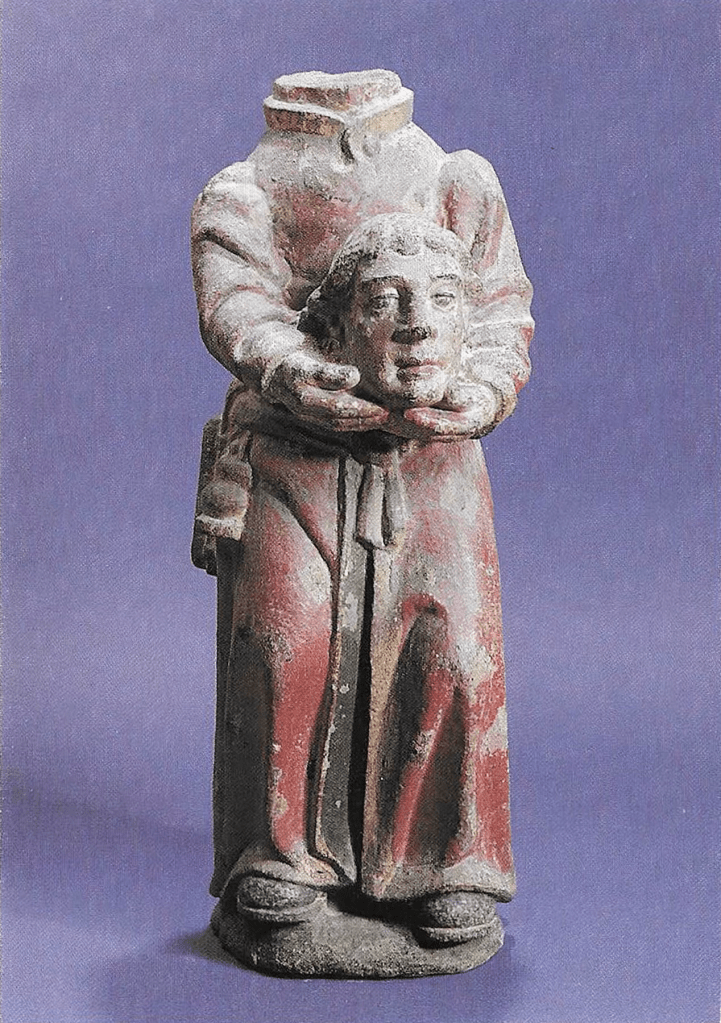
Anonymous
“Saint Trémeur”
XVIe Century
Pierre de kersanton
Le Musée Departmental Breton,
Quimper, France

In one of the local bookstores I discovered a small collection of stories titled Celtic Legends of Brittany containing many references to the local people and history. One especially was the story of Trémeur who was beheaded by his step-father Conmore. Conmore was totally against the Catholic Church and its proselytizing in the area. His wife Trephine had become interested in this new religion and so she was killed by her own husband.

“Years passed, when one day as Conmore was walking in the woods he came to the very spot where he had slain Trephine. There he found children playing, one of whom was called by his companions Tremeur. The name attracted his attention. He looked at the child and asked him his age.”

“‘I shall soon be nine’, he replied.”

“Conmore thought for a moment. He had the intuition, soon the certainty, that this child before him was the son of himself and Trephine. Quick as a flash he drew his sword and struck the child’s head off, as he had struck off the head of his mother, and then hastened away.”

“The little martyr, says the legend, when the tyrant was gone, took his head in his hands and carried it to the side of his mother’s tomb where she was sleeping. In the cemetery of St. Trephine is a chapel, of modern construction, covering the tomb of Tremeur, which is not far from that of his mother. Inside the church, five round stones emerge. The people declare they are the stones with which Tremeur was playing when he was struck down by his father.”1

The greatest story along these lines of course is that of St. Denis, the first bishop of Paris. There are several sculptural representations of St. Denis included in the collections of both the Musée Cluny and the Louvre as well on the walls of Notre Dame Cathedral in Paris.
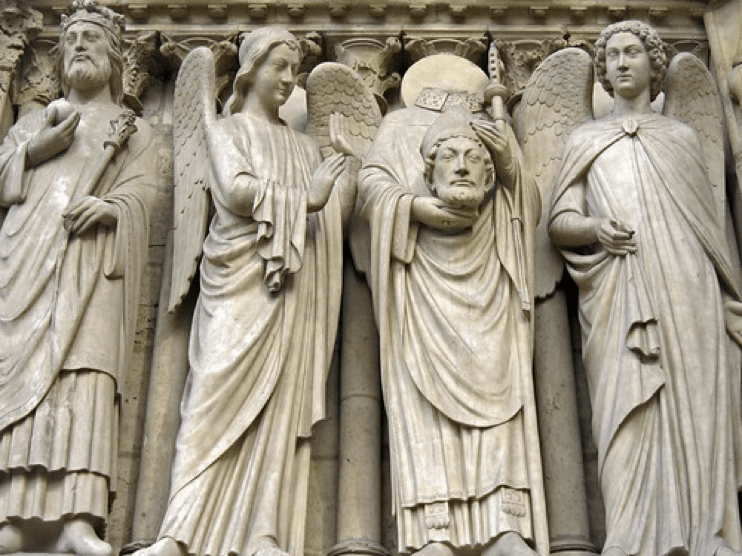
“Saint Denis”
From the outside walls of Notre Dame Cathedral
(after the major renovation of the 19th Century by Viollet-le-Duc)
Paris, France

During an anti-Christian period in Paris, St. Denis was evangelizing in the area when he was beheaded by the Romans on what is now Montmartre. It is said that he picked up his own head and continued his sermon as he walked across the city to the site he had chosen for his own grave. On this site he was buried in a small chapel.
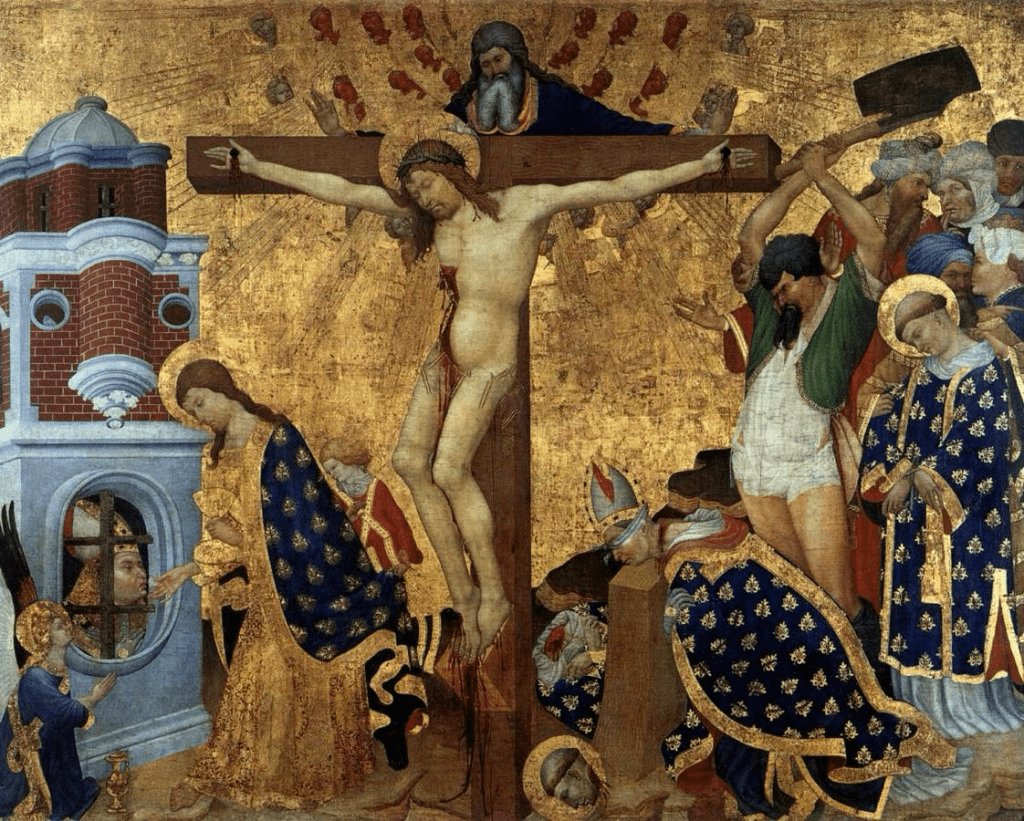
Henri Bellechose
“Calvary and the Martyrdom of St. Denis”
1415-1416
Tempera and gold leaf on canvas and panel
162cm x 211cm
Musée Louvre, Paris

Later this chapel was dedicated as an Abbey and the architect Suger was designated by the Pope to revitalize it. In the process it was dedicated as the Abbey of St. Denis in the town of the same name. As Abbot Suger designed the building and rebuilt the altar and the upper choir from 1135 to 1144, he clarified his theories on both light and structure, combining the old and the new in harmony, defining what would become Gothic Architecture. It became the resting place for many of the Kings of France and is now known as the Basilique Cathédrale de Saint-Denis.

Here, taken from the writings of Suger, is part of his vision for synthesizing the reconstruction of the chapel that St. Denis chose for his burial.

“The admirable power of one unique and supreme reason equalizes by proper composition the disparity between things human and Divine; and what seems mutually to conflict by inferiority of origin and contrariety of nature is conjoined by the single, delightful concordance of one superior, well-tempered harmony.”2

Abott Suger, Design and Architecture
Side Aisles, Transept’s, Upper Choir and Facade
1135-1144
St. Denis, France

In tribute to Saint Denis, here is what Abbot Suger had written into the Panel on the Altar Front in the Upper Choir at the Chapel of St. Denis:

“Great Denis, open the door of Paradise
And protect Suger through thy pious guardianship.”

“That which is signified pleases more than that which signifies.”3


1 Aubert, O.-L.; Celtics Legends of Brittany; COOP BREIZH; Spézet, Brittay, France; 1993; pp. 86-87.

2 Panofsky, Erwin (Translator and Editor); Abbot Suger: On the Abbey Church of St.-Denis and It’s Art Treasures; Princeton University Press, Princeton, New Jersey; 1946; p. 83.

3 Panofsky, Erwin (Translator and Editor); Abbot Suger: On the Abbey Church of St.-Denis and It’s Art Treasures; Princeton University Press, Princeton, New Jersey; 1946; p. 55.

GIORGIO MORANDI AND THE TALKING ETERNITY BLUES

Amongst painters and printmakers, there is a great deal of admiration for the work of Giorgio Morandi.  Even from artists whose work does not necessarily look like a Morandi, there is still a genuine interest in and respect for this work and its subtle power.  Many artists often observe that he is a “painter’s painter” in the very best sense of these words.

morandi
Frank Gehry
“Winton Guest House”
1982-1987
Wayzata, Minnesota

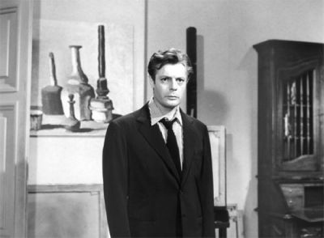
However, I was later surprised to discover that many other professions share this admiration, including several poets and even one contemporary architect, Frank Gehry, whose Winton Guest House echoes several Morandi still life forms.  And let us not forget the Italian surrealist filmmaker, Federico Fellini, and his references to Morandi’s work in the classic film “La Dolce Vita!”

morandi2
Federico Fellini
Film still from “La Dolce Vita”
1960
Featuring Marcello Mastroianni, Anita Ekberg, Anouk Aimee, et al.
Cineriz/Pathe Consortium Cinema

Earlier this year, on a visit with family and friends in Florida, I happened upon the Vero Beach Book Center hosting a reading by the Poet Laureate of Indian River County, Sean Sexton.  He also mentioned Morandi in several instances:  both his paintings and his etchings.  When I asked him about his interest in Morandi this is how he responded:

“The poem ‘Disparate’ lays out my visit to the Metropolitan Museum of Art to see the Morandi show . . . and observations from a noonday repast in the cafeteria, just a flight of stairs down out of the show. . . . The works collectively comprise something so completely outside convention and the sources that inspired them and succeed in what they present as a whole.”[i]

morandi3
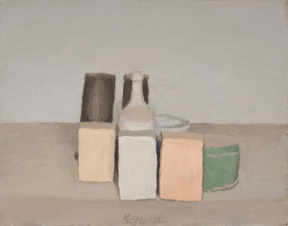
Giorgio Morandi
“Still Life”
1956
Oil on canvas
Private Collection, Switzerland

“Disparate”
“The girls in the museum cafeteria titter in
pleasant gossip, coiffed and garbed alike
in gold, cashmere, and silk.  Each face keeps
the same joy in this holiday escape from dailiness,
as their secret society, founded upon commiseration,
excludes a Venus in synthetic leopard wrap the next
table over, her long, raven hair mussed as if
she’d just stepped from a baroque bedchamber.
She has nothing to say to them (nor do they ask),
but sits attending an old, blind Tobit and his
wife sipping water and taking a frugal repast.

Morandi’s lonely bottles hang in galleries upstairs,
paintings in lush pink butter and almond paste,
and the most exquisite greys in art.  On a wall placard
is a quote from his ending days:
“If only you knew Longhi, how badly I want to work,
I have so many ideas I wish to develop…”
In quiet and solitude he kept at his métier, sharing
the family apartment with his three unmarried sisters,
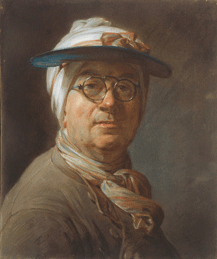
seeking only the recognition of his peers—the leering Chardin,
rag tied round his bespectacled head, stolid Piero, mercurial
Caravaggio, and the intractable, enraptured, Cezanne.”[ii]

morandi4
Jean Baptiste Simeon Chardin
“Self-Portrait with a Visor”
c. 1776
Pastel on blue laid paper, mounted on canvas
457mm x 374mm
The Art Institute of Chicago,
Chicago, Illinois

Several years ago at the Butler University Visiting Writers’ Series I heard the poet Charles Wright read from his work.  I was impressed with the range and depth of his work, and especially several of his remarks mentioning both Piet Mondrian and Giorgio Morandi, two of my own personal favorites.

Giorgio Morandi’s work is often difficult on many levels.  For first time viewers it is so simple, even mundane, that they wonder what is the big deal?  For the experienced viewer, they become more complicated, utilizing formal devices and placement to create subtle but powerful tensions.  And for others, perhaps only painters and poets, these pieces become mystical.

This is such a powerful element in his work, that in one recent five-year period (from 2004 to 2009) there were three major exhibitions in celebration of his work:  at both the Metropolitan Museum[iii] in New York, the one Sean Sexton mentioned above, and the Phillips Collection[iv] in Washington, DC, and a small but highly successful presentation at the Lucas Schoormans Gallery, also in New York.

In the catalogue for that exhibition, Schoormans wrote:  “At first glance, the works may appear quiet, contemplative, but once the viewer engages with them, one realizes that they are anything but.  Instead, it becomes apparent that they seem to affirm only one thing:  that nothing is certain, and permanently subject to change.  Embracing this message, Morandi presents the viewer with endless variations, at times with the subtlest of shifts in tonal values and composition, and thereby he becomes the architect of a world as finely calibrated and rigorously constructed as any great work of art, or perhaps a piece of music – think Bach’s Well Tempered Piano:  a monumental under-statement, of riveting and stimulating beauty that allows us a notion of the sublime.”[v]

“Giorgio Morandi and the talking eternity blues”
“Late April in January, seventy-some-odd degree.
The entry of Giorgio Morandi in The Appalachian Book of the Dead
Begins here, without text, without dates—
A photograph of the master contemplating four of his objects,
His glasses pushed high on his forehead,
his gaze replaced and pitiless.”

morandi5
Herbert List
“Portrait of Giorgio Morandi”
B&W photograph
1953
Collection of Herbert List Estate,
Hamburg, Germany

“The dove, in summer, coos sixty times a minute, one book says.
Hard to believe that,
even in this unseasonable heat,
A couple of them appearing and silent in the bare tree
Above me.
Giorgio Morandi doesn’t blink an eye
As sunlight showers like sulphur grains across his face.
There is an end to language.

There is an end to handing out the names of things,
Clouds moving south to north along the Alleghenies
And Blue Ridge, south to north on the wind.
Eternity, unsurprisingly, doesn’t give this a take,
Eternity’s comfortless, a rock and a hard ground.

Now starless, Madonnaless, Morandi
Seems oddly comforted by the lack of comforting,
A proper thing in its proper place,
Landscape subsumed, language subsumed,
the shadow of God
Liquid and indistinguishable.”[vi]

morandi6
Giorgio Morandi
“Still Life”
1953
Oil on canvas
8” x 15 7/8”
The Phillips Collection,
Washington, DC.


[i] Sexton, Sean; “An Artist’s Statement” contained in an e-mail to this writer, 10 March 2019, 9:36pm.

[ii] Sexton, Sean; May Darkness Restore; Press 53; Winston-Salem, North Carolina; 2019; p. 32.

[iii] Bandera, Maria Cristina, and Renato Miracco; Morandi 1890-1946; The Metropolitan Museum of Art and SKIRA; New York, New York, and Milano, Italy; 2008.

[iv] Fergonzi, Flavio, and Elisabetta Barisoni; Morandi:  Master of Modern Still Life; The Phillips Collection; Washington, DC; 2009

[v] Mattioli-Rossi, Laura; Giorgio Morandi Late Paintings 1950-1964; Lucas Schoormans Gallery; New York, New York; 2004; p. 3.

[vi] Wright, Charles; Negative Blue; Farrar, Straus and Giroux; New York, New York; 2000; p. 167.

HOW TO DRAW A CATHEDRAL

“…even though I have so profound an admiration for the beauty of Chartres, I realize strongly that it belongs to a culture, a tradition, a people of which I am not a part….It seems to be a persistent necessity for me to feel a sense of derivation from the country in which I live and work.”[i]

cathedral1
Charles Sheeler
“Chartres Cathedral”
1929
B&W photograph
9” x 7”
The Lane Collection, Charles Sheeler Archives
Museum of Fine Arts, Boston, Massachusetts

I have often had a similar feeling as that expressed by Charles Sheeler above.  As an American I have always felt that my voice and vision should grow out of my own country and experience.  However, I had not counted on participating in a graduate art history seminar at Indiana University on Gothic Architecture and seeing, for the first time, a beautiful little book titled “The Sketchbook of Villard de Honnecourt” that had been edited by Theodore Bowie.[ii] Many years later, searching through the ‘librairie’ at the Musee Cluny in Paris, I purchased a more recent and larger edition of the same title.

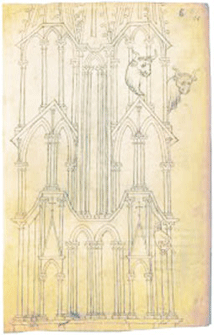
Villard de Honnecourt may have been an architect, or possibly an itinerant designer or draughtsman.  Some historians have described him as the Leonardo da Vinci of the dark-ages.  In any event, he did produce a sketchbook full of drawings and devices that changed how we see the world.  They were at least a ‘pattern book’ or stylistic guide to the articulation of Gothic facades and interiors.[iii]  These drawings by Honnecourt were not the only reason, but they were one of the reasons that allowed this new ‘gothic’ style to spread throughout Europe.

cathedral2
Villard de Honnecourt
“Double Row of Flying Buttresses, Rheims Cathedral VI”
(The Sketchbook of Villard de Honnecourt, [C.LXIV])
1230
Pen & ink on paper
9.25” x 6.1”
Bibliotheque Nationale, Paris
These little drawings are focused, insightful, powerfully structural, filled with character and attention to detail, and I always think of them immediately whenever I hear of the writer Raymond Carver or read about his short story “Cathedral.”

In this story, a young couple is surprised by a visit from a friend of the wife, an old blind man for whom she had worked several years ago.  She did his reading for him and other chores.  He was in town taking care of some business after the death of his wife and he wanted to ‘see’ them again.

The husband was a bit leery of this old man and his unexpected visit, as it was his wife who had been close to him.  They had dinner and a few drinks and afterwards they watched a program on Gothic Cathedrals on TV.  The wife had soon gone to sleep, leaving the two men in the living room, when the old blind man came up with this suggestion:  would the young man teach him how to draw a cathedral?  All that he really new about these things was what he had just heard on the TV program and didn’t know what they really looked like.

This young man, totally disoriented and slightly tipsy, searched the house for papers and pens and drawing materials and spread them all out on the living room floor.

“The blind man got down from the sofa and sat next to me on the carpet.”

“He ran his fingers over the paper.  He went up and down the sides of the paper.  The edges, even the edges.  He fingered the corners.”

“‘All right,’ he said.  ‘All right, let’s do her.’”

“He found my hand, the hand with the pen.  He closed his hand over my hand.  ‘Go ahead, bub, draw,’ he said.  ‘Draw.  You’ll see.  I’ll follow along with you.  It’ll be okay.  Just begin now like I’m telling you.  You’ll see.  Draw,’ the blind man said.”

cathedral3
Villard de Honnecourt
“Exterior and Interior Elevations, Rheims Cathedral IV”
(The Sketchbook of Villard de Honnecourt, [C.LXII])
1230
Pen & ink on paper
9.25” x 6.1”
Bibliotheque Nationale, Paris
“The blind man said, ‘We’re drawing a cathedral….Press hard,’ he said to me.  That’s right.  That’s good,’ he said.”

“‘You got it, bub.  I can tell.  You didn’t think you could.  But you can, can’t you?  You’re cooking with gas now.’”

“‘Close your eyes now,’ the blind man said to me.

I did it.  I closed them just like he said.

‘Are they closed?’ he said.  ‘Don’t fudge.’

‘They’re closed,’ I said.

‘Keep them that way,’ he said.  He said, ‘Don’t stop now.  Draw.”

cathedral4
Villard de Honnecourt
“North Tower of Laon Cathedral”
(The Sketchbook of Villard de Honnecourt, [C.XIX])
1230
Pen & ink on paper
9.25” x 6.1”
Bibliotheque Nationale, Paris
“So we kept on with it.  His fingers rode my fingers as my hand went over the paper.  It was like nothing else in my life up to now.”

“Then he said, ‘I think that’s it.  I think you got it,’ he said.  ‘Take a look.  What do you think?’”

“But I had my eyes closed.  I thought I’d keep them that way for a little longer.  I thought it was something I ought to do.”[iv]


[i] Tsujimoto, Karen; Images of America:  Precisionist Painting and Modern Photography; San Francisco Museum of Modern Art and the University of Washington Press; Seattle & London; 1982; p. 85.  (Statement made by Sheeler on his series of photographs of Chartres Cathedral, originally published in Constance Rourke; Charles Sheeler:  Artist in the American Tradition; New York, New York; Harcourt, Brace; 1938; p. 130).

[ii] Bowie, Theodore; The Sketchbook of Villard de Honnecourt; Indiana University Press; Bloomington and London; 1959.

[iii] von Simpson, Otto; The Gothic Cathedral:  Origins of Gothic Architecture and the Medieval Concept of Order; Harper & Row Publishers; New York and Evanston; 1962; p. 198.

[iv] Carver, Raymond; “Cathedral” Where I’m Calling From; Atlantic Monthly Press; New York, New York; 1991; pp. 306-307.