SEAN SCULLY: A PROSE POEM

At the Cincinnati Art Museum near the end of the summer of 2006 there was a special exhibition of paintings by the Irish painter Sean Scully titled “Wall of Light.” It originated at the Phillips Collection in Washington, DC, in late 2005 and included approximately eighty paintings and thirty works on paper including drawings, watercolors, and photographs.

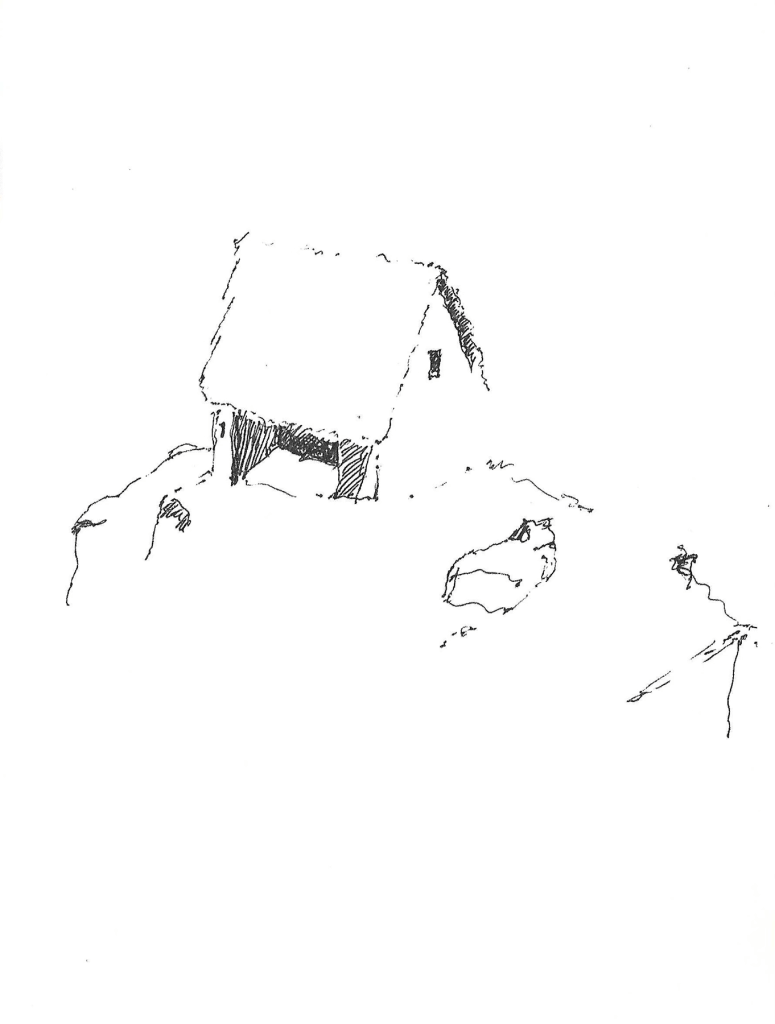
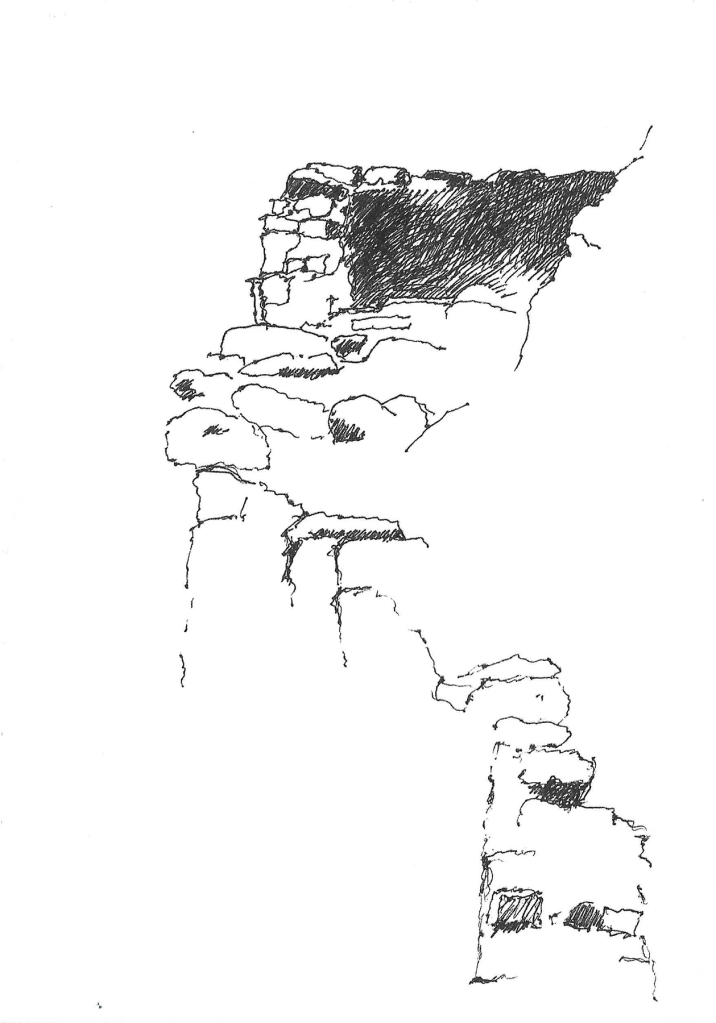
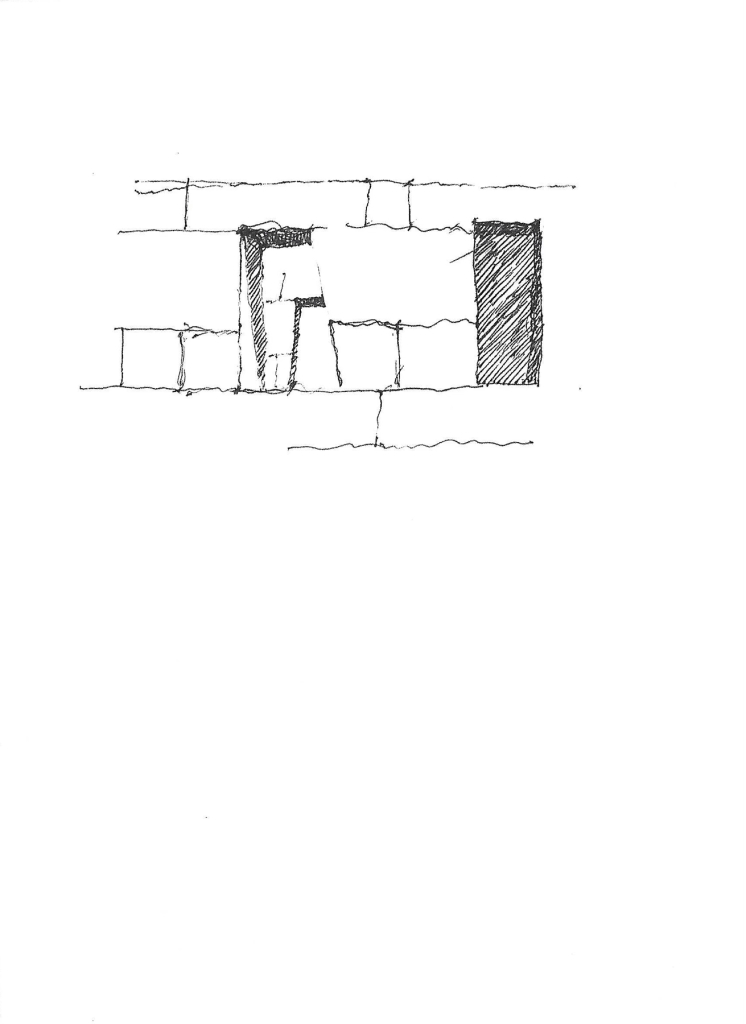
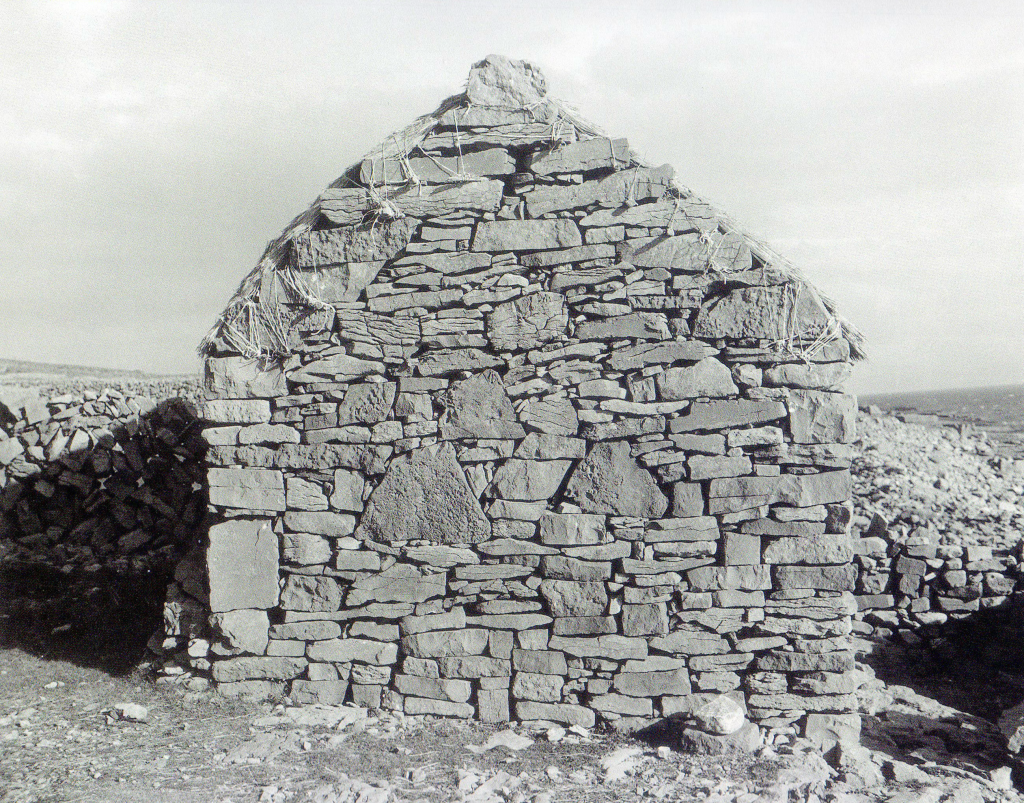
One particular photograph of an old farm shack made from stacked stone featured a beautiful façade complete with light, shadow, texture: some of the very things that Scully looks at and draws from outside of his studio, in the real world. And certain writers have noted how the elements in Scully’s paintings are placed as if they were bricks or stones.

Sean Scully
“Stone Shack End”
1994
Gelatin silver print
16” x 20”
Collection of the artist.

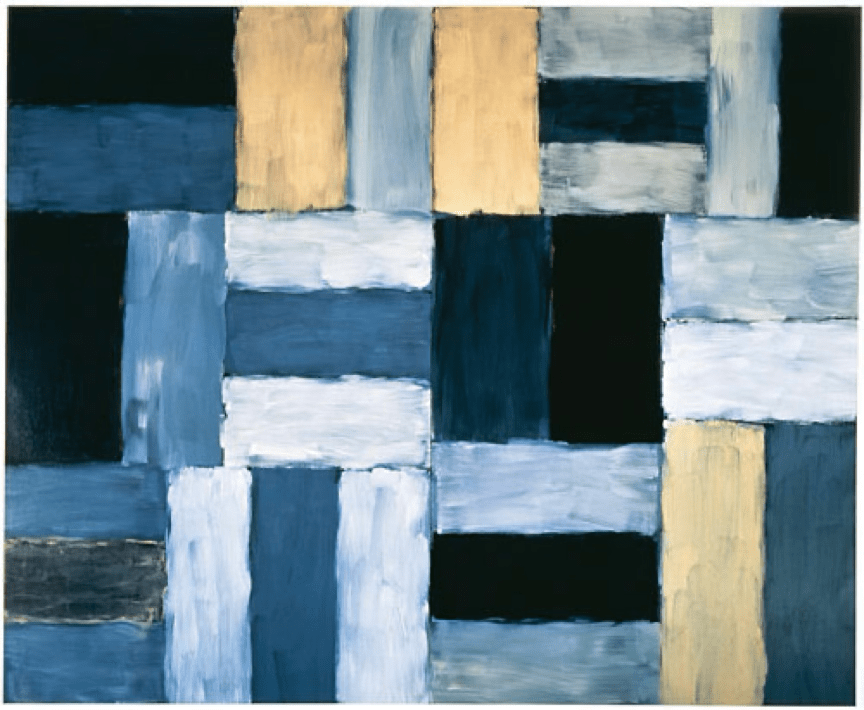
John Yau’s description of Scully’s painted surfaces is one example: “The rhythmic brushstrokes—ranging from feathery to matter-of-fact—and the layers of paint (running from thin to pasty) are visceral, even as light seeps through the interstices or flares where the slabs of caressed color don’t touch. The surface is neither uniform nor packed solid; it breathes. The bricks of color and the luminous spaces between them are equally important, with neither trumping the other.”1

Sean Scully
“Wall of Light: Desert Night”
1999
Oil on canvas
108”x 132”
Modern Art Museum of Fort Worth
Fort Worth, Texas

Stephen Bennett Phillips, writing for the Phillips Collection in Washington, DC, has also observed: “Compositionally, within the Wall of Light series, Scully’s tendency has been to become increasingly asymmetrical and off-kilter. His longstanding focus on stripes—short ones in the case of the Wall of Lights paintings—can be compared with Giorgio Morandi’s lifelong study of a narrow range of still-life forms. In fact, Scully’s brick-like forms are directly analogous to blocks and voids that appear in Morandi’s still lifes.”2

Giorgio Morandi
“Still Life”
1953
Oil on canvas
8” x 15 1/8”
The Phillips Collection, Washington, DC.

In the book by John Yau titled Sean Scully: Night and Day, it seems to me that Yau is not just writing a curator’s statement, or a critical essay but going much further, as a poet would. Using sensitive descriptions of the paintings, along with insightful analysis, he arrives at a synthesis of lyrical and critical reflections on these works of art. Yau has, in essence, created an extended prose poem, whose subject is this series by Scully. The literary pieces that grow out of these paintings, following reflection, lead us to a new vision and understanding of these very pieces.

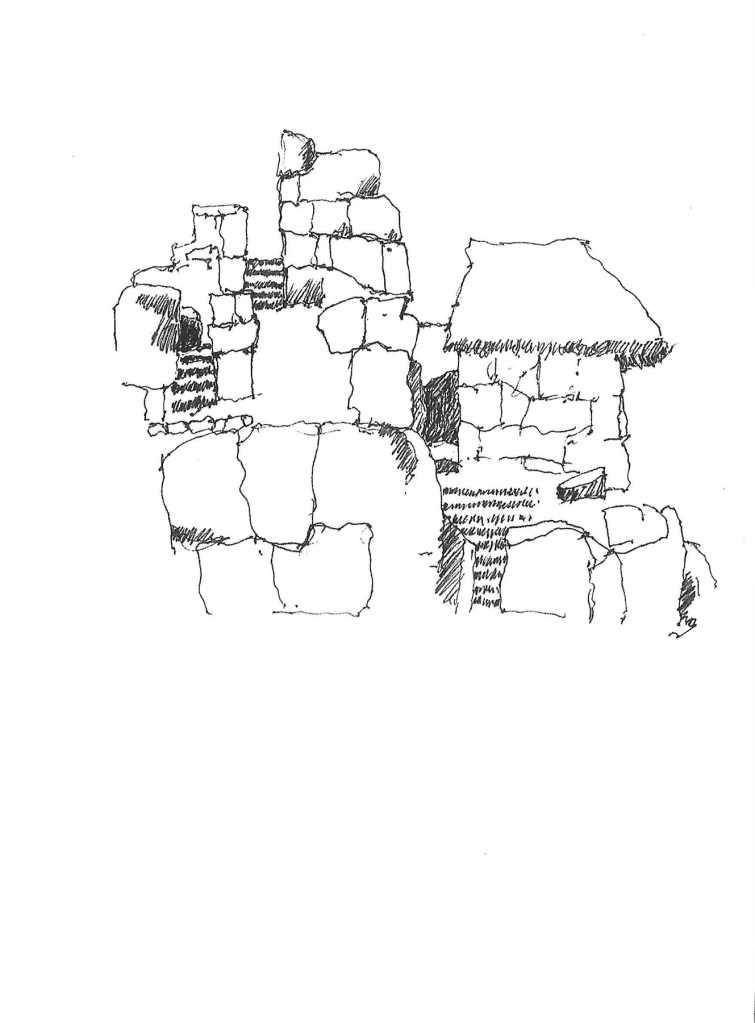
One summer John Yau and his family spent a week on the Dingle Peninsula in western Ireland. The local architecture especially attracted them, from the great Gallarus Oratory down to the many local stone barns and sheds. Later that year, Yau interviewed Sean Scully in preparation for his book on the subject of Night and Day. The writing on Scully’s work contained many references to these buildings and walls and analogies to the process of building up layers of paint as if they were bricks and stones.

“. . . the irregularly shaped stones had to be fitted together. In a way that is breathtaking and inspiring, the people who built the Gallarus Oratory made improvisation and necessity inseparable. A similar indivisibility animates Scully’s work.”3

“Scully builds his compositions out of what he calls ‘bricks’ of rich and often dusty color, but, like the anonymous stonemasons of the Oratory, is similarly committed to improvisation within the indispensable structures he discovers for himself. Whatever the inspiration for a painting might be—and these have ranged from specific landscapes seen in a particular light to a favorite novel and works of art—the tension between obligation and invention is central to Scully’s practice.”4

Sean Scully
“Night and Day”
2012
Oil on aluminum
110” x 320”
Courtesy Cheim & Read, New York

Night and Day is a combination of rhythm and dissonance, with the alternating dark and light bands introducing a rhythmic, percussive aspect into the viewer’s visual experience.”5

“Even as I take note of the repetition, and recognize the changing parameters of the stacked, horizontal bands, I become increasingly sensitive to the shifts and modulations in tonality spanning Night and Day. The dusty, dirty, pale grays evoke certain streets in large cities, foggy mornings, wintry skies, and frozen lakes. The darker gray bands—ranging from slate and to ash, interrupted by midnight black—conjure a changing nocturnal domain. Evocative of winter, especially in northern climates, where the sun appears briefly, if at all, Night and Day thrives in contradiction; it is chilly and soft, warm and aloof.”6

Amongst his own writings, the artist Sean Scully has offered several observations and descriptions of the work of other artists, especially Mark Rothko, Vincent van Gogh, and Giorgio Morandi. One example here, is Scully writing about Morandi: “Morandi paints like no other, before or since. His brushstroke is in complete philosophical agreement with the subject, the scale and the color of his paintings. It is expressive, though it is modest, and not so expressionistic as to disturb the senses of meditative silence that inhabits all his works.”7

Giorgio Morandi
“Still Life”
1953-54
Oil on canvas
26cm x 70cm
Museo di Arte Moderna e Contemporanea
di Trento e Rovereto, Giovanardi Collection.

1 Yau, John; Sean Scully: Night and Day; Cheim & Read; New York, New York; 2013; (unpaginated).

2 Phillips, Stephen Bennett, et. al.; Sean Scully: Wall of Light; The Phillips Collection; Washington, D.C. and Rizzoli International Publications; New York, New York; 2005; p. 43.

3 Yau, John; Sean Scully: Night and Day; Cheim & Read; New York, New York; 2013; (unpaginated).

4 Yau, John; Sean Scully: Night and Day; Cheim & Read; New York, New York; 2013; (unpaginated).

5 Yau, John; Sean Scully: Night and Day; Cheim & Read; New York, New York; 2013; (unpaginated).

6 Yau, John; Sean Scully: Night and Day; Cheim & Read; New York, New York; 2013; (unpaginated).

7 Ingleby, Florence, ed.; Sean Scully: Resistance and Persistence, Selected Writings; Merrell Publishers Limited; London and New York; 2006; p. 15.

CEPHALOPHORES: HEADLESS SAINTS AND MARTYRS IN FRANCE

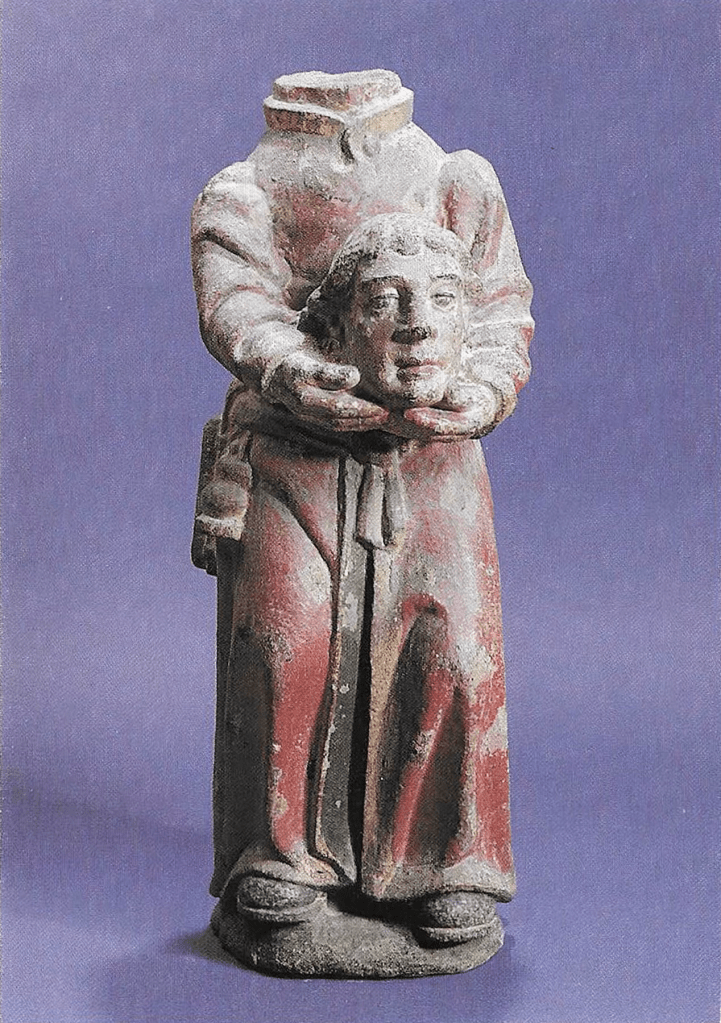
This is going to be messy! In ancient times in Brittany, there were magicians and wise men and martyrs roaming the countryside, often secluding themselves in the nearby forests. In equal numbers of cases, there were heroic as well as villainous knights, many soon to become martyrs. So many of them were killed in battles or through torture, including beheadings over the years, that the early church had to invent a specific word for this: “cephalophores.”

Anonymous
“Saint Trémeur”
XVIIe Century
Bois polychrome
Chapelle Saint-Trémeur,
Bury, France

At the beginning of each Summer Session in 1995, 1997, 2000, and 2007, while teaching at the Pont-Aven School of Contemporary Art in Brittany, France, there would always be a school-wide orientation followed by field trips to the local churches and museums. All local institutions with regional collections filled with histories and legends.

During these trips, many of the local stories were passed down to us by word of mouth. One important story related how a certain figure had suffered a beheading in battle, whereupon he picked up his own head and carried it out into the Brocéliande Forest where Merlin the Magician supposedly lived. Merlin returned this young man’s head to its correct position so that revenge could be accomplished. It parallels so many other stories in the history of ‘cephalophores!’

Anonymous
“Saint Trémeur”
XVIe Century
Pierre de kersanton
Le Musée Departmental Breton,
Quimper, France

In one of the local bookstores I discovered a small collection of stories titled Celtic Legends of Brittany containing many references to the local people and history. One especially was the story of Trémeur who was beheaded by his step-father Conmore. Conmore was totally against the Catholic Church and its proselytizing in the area. His wife Trephine had become interested in this new religion and so she was killed by her own husband.

“Years passed, when one day as Conmore was walking in the woods he came to the very spot where he had slain Trephine. There he found children playing, one of whom was called by his companions Tremeur. The name attracted his attention. He looked at the child and asked him his age.”

“‘I shall soon be nine’, he replied.”

“Conmore thought for a moment. He had the intuition, soon the certainty, that this child before him was the son of himself and Trephine. Quick as a flash he drew his sword and struck the child’s head off, as he had struck off the head of his mother, and then hastened away.”

“The little martyr, says the legend, when the tyrant was gone, took his head in his hands and carried it to the side of his mother’s tomb where she was sleeping. In the cemetery of St. Trephine is a chapel, of modern construction, covering the tomb of Tremeur, which is not far from that of his mother. Inside the church, five round stones emerge. The people declare they are the stones with which Tremeur was playing when he was struck down by his father.”1

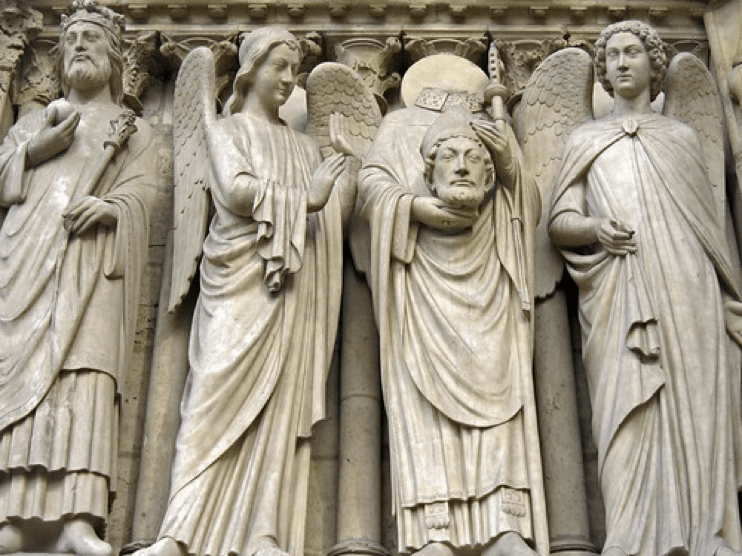
The greatest story along these lines of course is that of St. Denis, the first bishop of Paris. There are several sculptural representations of St. Denis included in the collections of both the Musée Cluny and the Louvre as well on the walls of Notre Dame Cathedral in Paris.

“Saint Denis”
From the outside walls of Notre Dame Cathedral
(after the major renovation of the 19th Century by Viollet-le-Duc)
Paris, France

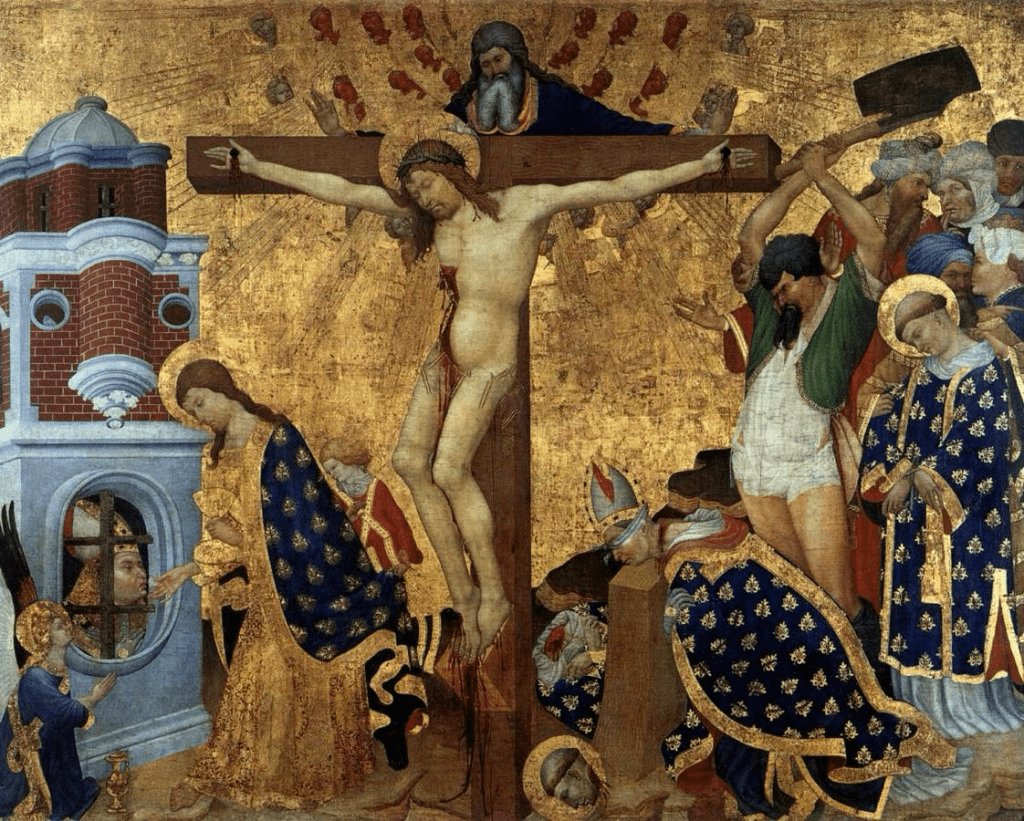
During an anti-Christian period in Paris, St. Denis was evangelizing in the area when he was beheaded by the Romans on what is now Montmartre. It is said that he picked up his own head and continued his sermon as he walked across the city to the site he had chosen for his own grave. On this site he was buried in a small chapel.

Henri Bellechose
“Calvary and the Martyrdom of St. Denis”
1415-1416
Tempera and gold leaf on canvas and panel
162cm x 211cm
Musée Louvre, Paris

Later this chapel was dedicated as an Abbey and the architect Suger was designated by the Pope to revitalize it. In the process it was dedicated as the Abbey of St. Denis in the town of the same name. As Abbot Suger designed the building and rebuilt the altar and the upper choir from 1135 to 1144, he clarified his theories on both light and structure, combining the old and the new in harmony, defining what would become Gothic Architecture. It became the resting place for many of the Kings of France and is now known as the Basilique Cathédrale de Saint-Denis.

Here, taken from the writings of Suger, is part of his vision for synthesizing the reconstruction of the chapel that St. Denis chose for his burial.

“The admirable power of one unique and supreme reason equalizes by proper composition the disparity between things human and Divine; and what seems mutually to conflict by inferiority of origin and contrariety of nature is conjoined by the single, delightful concordance of one superior, well-tempered harmony.”2

Abott Suger, Design and Architecture
Side Aisles, Transept’s, Upper Choir and Facade
1135-1144
St. Denis, France

In tribute to Saint Denis, here is what Abbot Suger had written into the Panel on the Altar Front in the Upper Choir at the Chapel of St. Denis:

“Great Denis, open the door of Paradise
And protect Suger through thy pious guardianship.”

“That which is signified pleases more than that which signifies.”3


1 Aubert, O.-L.; Celtics Legends of Brittany; COOP BREIZH; Spézet, Brittay, France; 1993; pp. 86-87.

2 Panofsky, Erwin (Translator and Editor); Abbot Suger: On the Abbey Church of St.-Denis and It’s Art Treasures; Princeton University Press, Princeton, New Jersey; 1946; p. 83.

3 Panofsky, Erwin (Translator and Editor); Abbot Suger: On the Abbey Church of St.-Denis and It’s Art Treasures; Princeton University Press, Princeton, New Jersey; 1946; p. 55.

VERMEER AND THE HALF-FINISHED HEAVEN

So many wars, the Eighty Years War and the Franco-Dutch War among them. During a peaceful interlude a pet goldfinch was waiting patiently to be painted. Later, the explosion of the powder magazine in Delft and the death of Carel Fabritius. And that beautiful spot of yellow on the rooftops of the city of Delft, as well as the nearby shadows on the Oude Kerk and the light on the Nieuwe Kerk in the “View of Delft.” The Nieuwe Kerk where Johannes Vermeer was baptized and the resting place for William of Orange.

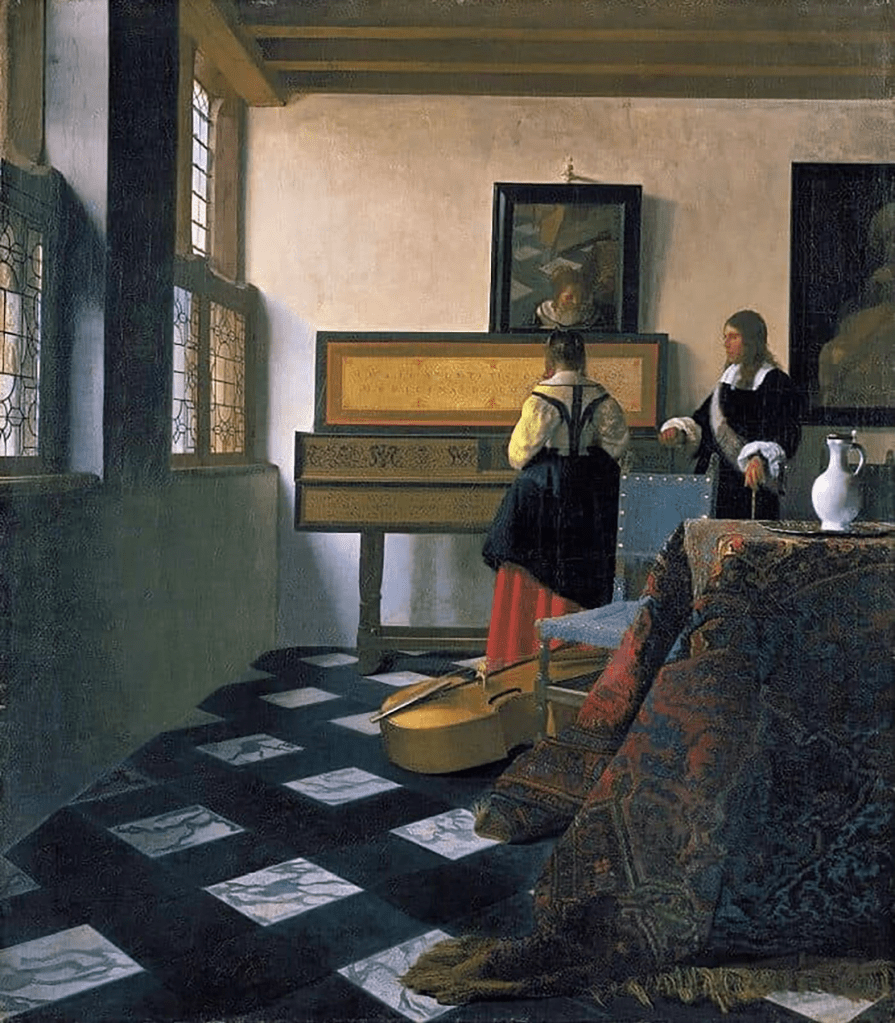
Johannes Vermeer
“The Music Lesson”
1662-1664
Oil on canvas
73.3cm x 64.5cm
The Royal Collection
London, United Kingdom

Such an important poet in his own right, Robert Bly was also a significant translator of the work of other poets. He published for the first time, many European and South American poets, and his translations range from Goethe, Hölderlin, Kabir, Rilke, Rumi, Ghalib and now to Tomas Tranströmer.

In his introduction to this translation of Tranströmer’s work, Bly mentions, a couple of times “. . . something approaching over a border. . . .”1 or “. . . the noise begins over there, on the other side of the wall. . . .”2 A kind of literary searching, I think, as both a poet and translator. Something beyond, but something that we cannot exactly put our finger on, in order to break through, either a border or a wall.

Vermeer

“It’s not a sheltered world. The noise begins over there, on the
other side of the wall
where the alehouse is
with its laughter and quarrels, its rows of teeth, its tears, its
chiming of clocks,
and the psychotic brother-in-law, the murderer, in whose
presence everyone feels fear.

The huge explosion and the emergency crew arriving late,
boats showing off on the canals, money slipping down into
pockets—the wrong man’s—
ultimatum piled on ultimatum,
wide-mouthed red flowers whose sweat reminds us of
approaching war.

And then straight through the wall—from there—straight into
the airy studio
and the seconds that have got permission to live for centuries.
Paintings that chose the name: The Music Lesson
or A Woman in Blue Reading a Letter.
She is eight months pregnant, two hearts beating inside her.
The wall behind her holds a crinkly map of Terra Incognito.

Just create. An unidentifiable blue fabric has been tacked to
the chairs.
Gold-headed tacks flew in with astronomical speed
and stopped smack there
as if they had always been stillness and nothing else.

The ears experience a buzz, perhaps it’s depth or perhaps
height.
It’s the pressure from the other side of the wall,
the pressure that makes each fact float
and makes the brushstroke firm.

Passing through walls hurts human beings, they get sick from
it,
but we have no choice.
It’s all one world. Now to the walls.
The walls are a part of you.
One either knows that, or one doesn’t; but it’s the same for
everyone
except for small children. There aren’t any walls for them.

The airy sky has taken its place leaning against the wall.
It is like a prayer to what is empty.
And what is empty turns its face to us
and whispers:
‘I am not empty, I am open.’”3

Johannes Vermeer
“Woman in Blue Reading a Letter”
1662-1664
Oil on canvas
46.5cm x 39cm
Rijksmuseum,
Amsterdam, The Netherlands

Later in life Tomas Tranströmer suffered a stroke that left his right side paralyzed, leading to difficulties in both writing and his piano playing. Several of his friends and colleagues, musicians and composers, set about composing piano pieces to be played only by the left hand, and sent them directly to him.4

Tranströmer’s imagery is so clear that we believe in its reality and in his imagination. As when he drew out a piano key-board on the kitchen tabletop in order to silently practice his music: “I played on them, without a sound. Neighbors came by to listen!”5


1 Tranströmer, Tomas; Translated by Robert Bly; The Half-Finished Heaven; Graywolf Press; Saint Paul, Minnesota; 2001; p. xviii.

2 Tranströmer, Tomas; Translated by Robert Bly; The Half-Finished Heaven; Graywolf Press; Saint Paul, Minnesota; 2001; p. xviii.

3 Tranströmer, Tomas; Translated by Robert Bly; The Half-Finished Heaven; Graywolf Press; Saint Paul, Minnesota; 2001; pp. 87-88.

4 Tranströmer, Tomas; Translated by Robert Bly; The Half-Finished Heaven; Graywolf Press; Saint Paul, Minnesota; 2001; p. xxi.

5 Tranströmer, Tomas; Translated by Robert Bly; The Half-Finished Heaven; Graywolf Press; Saint Paul, Minnesota; 2001; p. xx.

THE MAN WITH THE BLUE GUITAR

“The colour blue offers a multiplicity of remarkable characteristics to the observing eye and to the reflective mind alike. It is the only colour which can be seen as a close neighbor to and essentially akin to both dark and light, almost black in the night and almost white at the horizon by day; and it is also the colour of shadows on snow. It can darken, it can obscure, it may float to and fro like a mist, dimming reality with sadness and concealing truth…. By contrast light blue is the colour of loyalty and ecstasy—‘true blue’ for example….”1

This description is from a remarkable study on Paul Cézanne by the German art historian Kurt Badt. Cézanne of course pushed the use of color and structure to new limits in all of his work and so many of the younger artists migrating to Paris at the beginning of the 20th Century soon became aware of this, including Pablo Picasso.

Pablo Picasso
“Self Portrait”
1901
Oil on canvas
81 cm x 60 cm
Picasso Museum, Paris

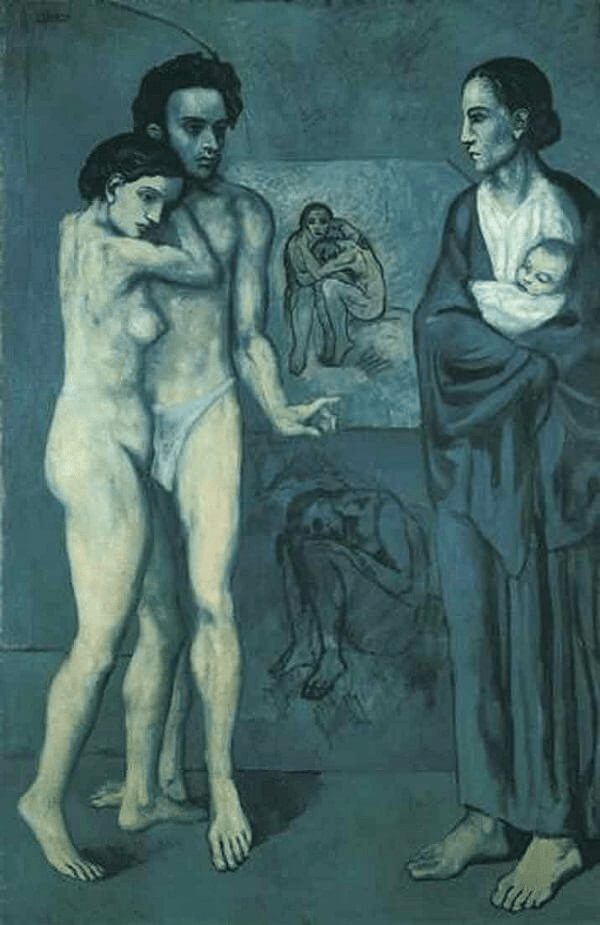
For Picasso, this became one of the most important attributes to his early paintings. Alone and isolated as many artists found themselves in Paris at that time, it was inevitable that a certain melancholy would set in. This was intensified by the sudden death of one of his dear friends, Casagemas. The psychological range of the color blue became an important element in his search for a way out of his situation. Using local residents, not traditional artist’s models, he began to paint this series from 1901 through 1904. His portrait of Casagemas was painted as a tribute in 1901, and was included again as the male figure in “La Vie” from the Cleveland Museum of Art in 1903.

Along with his description of the color blue, Kurt Badt also has mentioned the psychology of this color, even referring to it emotionally as ‘the blues’ as we might assume. For Picasso, this was a turning point.

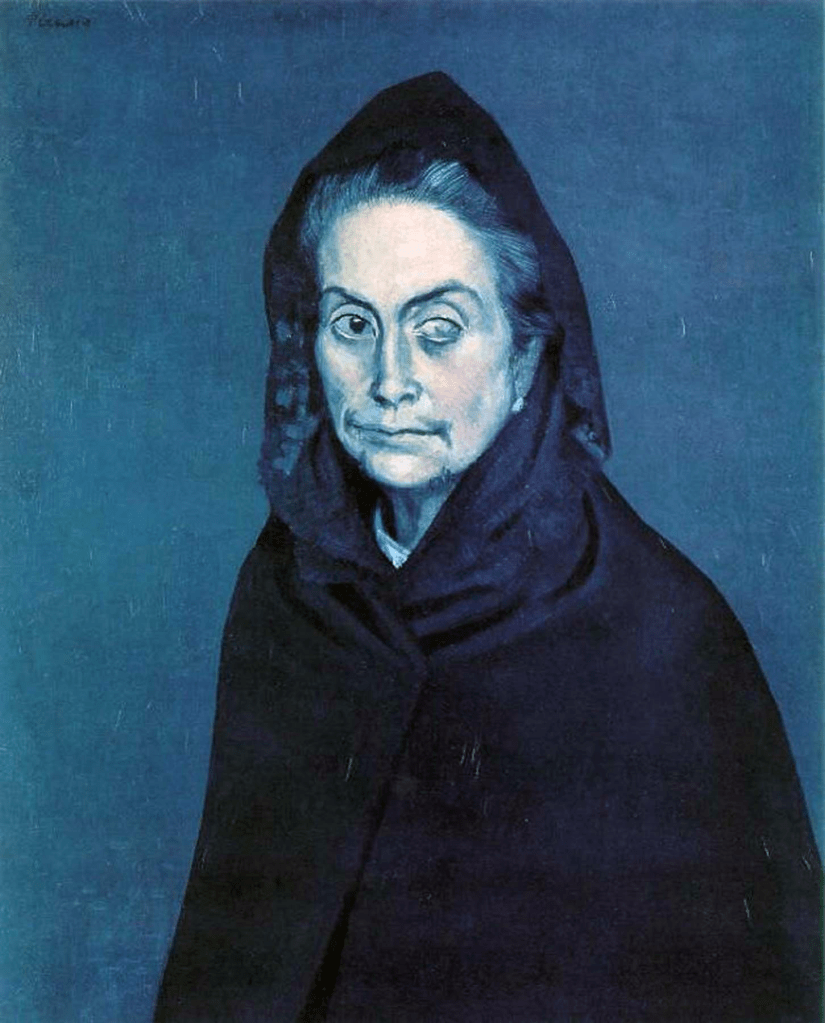
Pablo Picasso
“La Celestina”
1904
Oil on canvas
70 cm x 56 cm
Musee Picasso, Paris

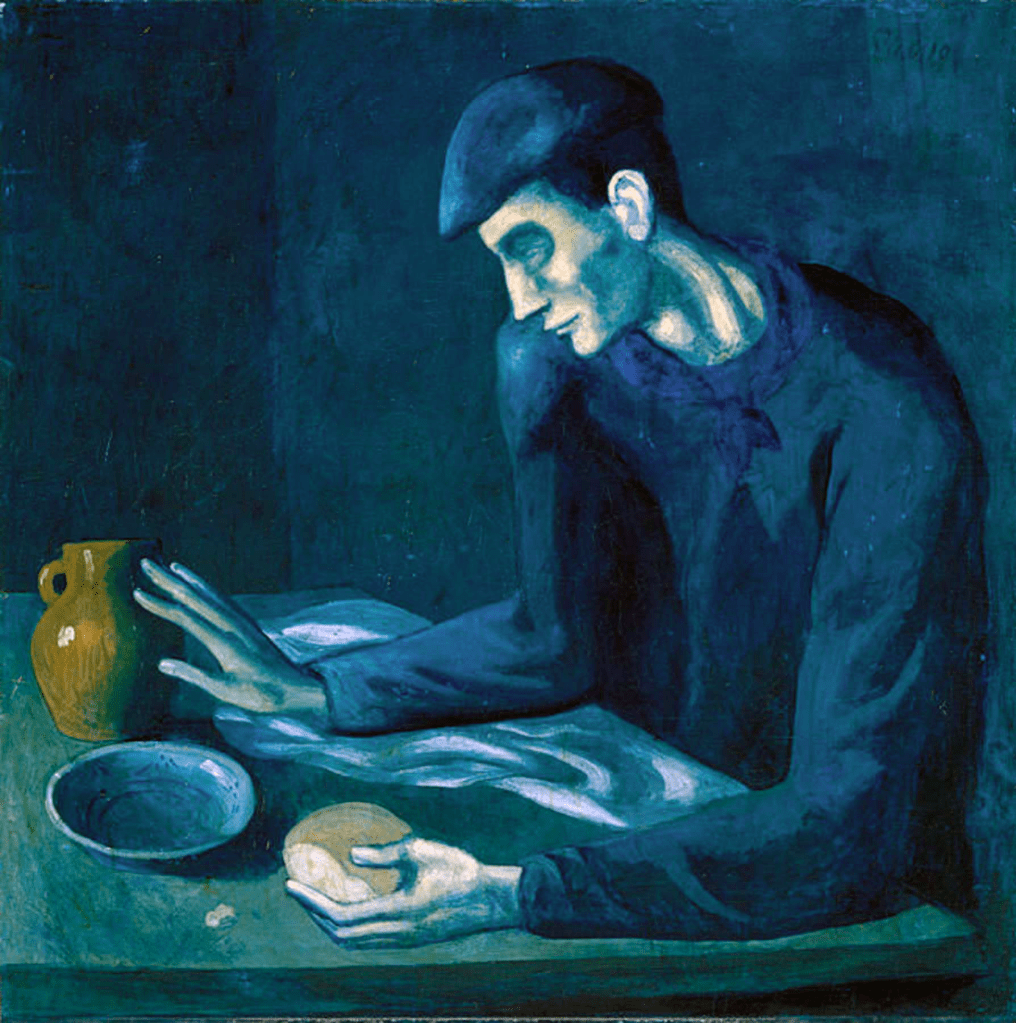
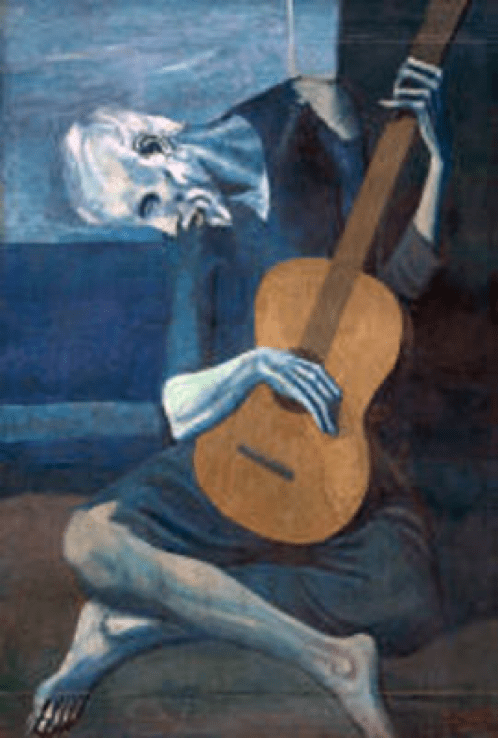
Whether it was a half blind woman in the street, a procuress named Celestina from a Spanish tragicomedy of 1499, or a totally blind man having his evening dinner, the people, their poses, and their color are simultaneously expressing a set of emotions and questions for the viewer. Add to these images, the portrait of “The Old Guitarist” from the collection of the Art Institute of Chicago, and we have more questions regarding life during this time period.

Pablo Picasso
“The Blind Man’s Meal”
1903
Oil on canvas
37 1/2” x 37 1/2”
The Metropolitan Museum of Art, New York

The musician, with his head bent over his instrument, with the weight of blue pressing down on his shoulder, we follow the line of his arm downward to the elbow and across to his hand strumming the guitar. And then up the neck of this guitar, to his fingers holding steady on the chords, and then across to his other shoulder, through his own neck and back to his dazed expression: a full compositional circle. This resulted of course, in one of the most important modern examples of the ekphrastic tradition, Wallace Stevens’ “The Man with the Blue Guitar.”

“The man bent over his guitar,

A shearsman of sorts. The day was green.

They said, ‘You have a blue guitar, 
You do not play things as they are.’

The man replied, ‘Things as they are

Are changed upon the blue guitar.’

And they said to him, ‘But play, you must,

A tune beyond us, yet ourselves,

A tune upon the blue guitar,

Of things exactly as they are.’”2

“I cannot bring a world quite round,

Although I patch it as I can.

I sing a hero’s head, large eye

And bearded bronze, but not a man,

Although I patch him as I can

And reach through him almost to man.

If a serenade almost to man

Is to miss, by that, things as they are,

Say that it is the serenade

Of a man that plays a blue guitar.”


Pablo Picasso
“The Old Guitarist”
1903–1904
Oil on panel
48 3/8” x 32 1/2”
The Art Institute of Chicago


So, we have a set up between the artist and the audience: the artist saying that things are changed upon the blue guitar, while the audience insists upon a tune of things exactly as they are!

Stevens starts with this guitarist from the Blue Period but soon goes on to other thoughts, not descriptive but reflective: “A tune beyond us as we are….”3 and ventures into the modern world of painting and poetry. He has to touch upon descriptions of general life and the accompanying dilemmas of 20th century artists. This then continues through several of the later sections of this poem. As Glen MacLeod mentioned in Wallace Stevens and Modern Art, he fuses references to Picasso with more general observations to modern life and a sense of contemporary surrealism, a kind of “…permissible imagination.”4


“A tune beyond us as we are, 

Yet nothing changed by the blue guitar;

Ourselves in tune as if in space,

Yet nothing changed, except the place

Of things as they are and only the place

As you play them on the blue guitar,

Placed, so, beyond the compass of change, 

Perceived in a final atmosphere;

For a moment final, in the way

The thinking of art seems final when

The thinking of god is smoky dew.

The tune is space. The blue guitar

Becomes the place of things as they are,

A composing of senses of the guitar.”5

Pablo Picasso
“La Vie”
1903
Oil on canvas
197 cm x 129 cm
The Cleveland Museum of Art,
Cleveland, Ohio


“The world washed in his imagination,
The world was a shore, whether sound or form

Or light, the relic of farewells,
Rock, of valedictory echoing,

To which his imagination returned,
From which it sped, a bar in space,

Sand heaped in the clouds, giant that fought
Against the murderous alphabet:

The swarm of thoughts, the swarm of dreams
Of inaccessible Utopia.

A mountainous music always seemed
To be falling and to be passing away.”6

“Is this picture of Picasso’s, this ‘hoard
Of destructions’, a picture of ourselves,

Now, an image of our society?”7


1 Badt, Kurt; The Art of Cezanne; University of California Press; Berkeley and Los Angeles; 1965; pp. 58-59.
2 Stevens, Wallace; “The Man With The Blue Guitar” Collected Poetry and Prose; The Library of America; New York, New York; 1997; Section I, p. 135.
3 Stevens, Wallace; “The Man With The Blue Guitar” Collected Poetry and Prose; The Library of America; New York, New York; 1997; Section VI, p. 137.

4 MacLeod, Glen; Wallace Stevens and Modern Art: From the Armory show to Abstract Expressionism; Yale University Press; New Haven and London; 1993; p. 197.

5 Stevens, Wallace; “The Man With The Blue Guitar” Collected Poetry and Prose; The Library of America; New York, New York; 1997; Section VI, p. 137.

6 Stevens, Wallace; “The Man With The Blue Guitar” Collected Poetry and Prose; The Library of America; New York, New York; 1997; Section XXVI, pp. 146-147.

7 Stevens, Wallace; “The Man With The Blue Guitar” Collected Poetry and Prose; The Library of America; New York, New York; 1997; Section XV, p. 141.

HUNTERS IN THE SNOW

My friend and colleague, Brett Waller, Director Emeritus of the Indianapolis Museum of Art, used to always mention to students and visitors that art museums were the birth-right of artists: explaining that historically, when many royal and private collections were first opened to the public as museums, they were linked to the local art academies and schools.

Artists such as Paul Cézanne and Alberto Giacometti both were sensitive to the importance of museums and their collections. It was Cézanne who stated many times that “. . . it was his ambition ‘to do Poussin again after nature’ and that he wanted to make of Impressionism ‘. . . something solid and enduring like the art of the museums.’”1

In his Sketchbook of Interpretive Drawings Alberto Giacometti shows us both the range and depth of how he looked at the great art of museums: “I began to copy long before even asking myself why I did it, probably in order to give reality to my predilections, much rather this painting here than that one there, but for many years I have known that copying is the best means for making me aware of what I see, the way it happens with my own work; I can know a little about the world there, a head, a cup, or a landscape, only by copying it.”2

Alberto Giacometti
“Study after Pieter Breughel’s Hunters in the Snow”
c. 1952
Ballpoint pen on paper
8 1/4” x 11 1/2”
Annette and Alberto Giacometti Foundation,
Paris and Zurich

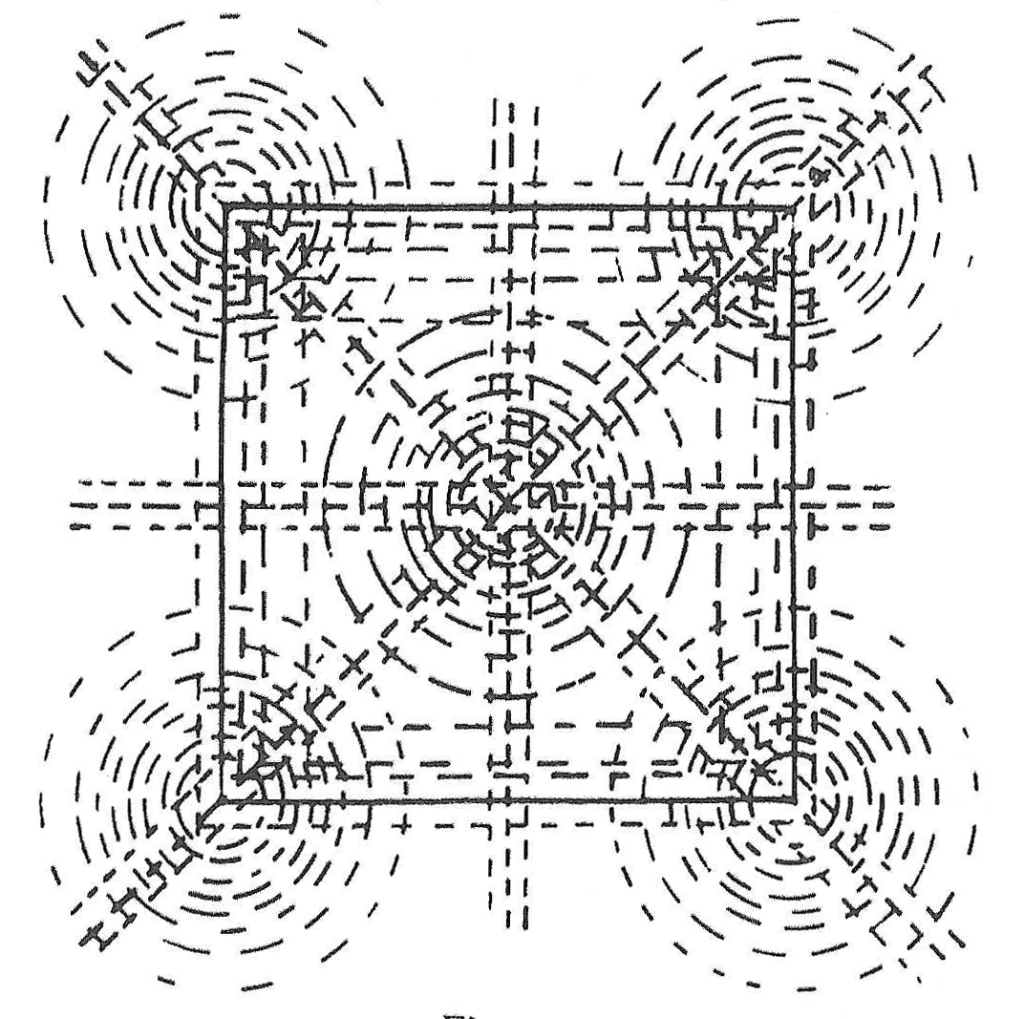
Through the writings of Rudolph Arnheim we have known of the ascending and descending angles and movements through out a painting.3 Also, we understand kinetic and haptic space as it runs through a work of art, leading our eye and mind through this very space.

Rudolph Arnheim
“Structural Map” (Figure 3, p. 4)
Art and Visual Perception
1971

Whether it is a snow covered hill leading us downward from the center left to the bottom right of the painting, or the path that the hunters are taking from the lower left upward into the center, or even the complimentary angles of the magpie gliding above the distant landscape and holding the upper part of the composition, we can feel the structural movement throughout.

It is this seeing, and experiencing of the thing that is most important, and this of course is exactly what William Carlos Williams achieved with this great painting “The Hunters in the Snow.”

Pieter Breughel the Elder
“The Hunters in the Snow”
1565
Oil on wood panel
46” x 63 3/4”
Kunsthistorisches Museum, Vienna

The Hunters in the Snow

“The over-all picture is winter
icy mountains
in the background the return

from the hunt it is toward evening
from the left
sturdy hunters lead in

their pack the inn-sign
hanging from a
broken hinge is a stag a crucifix

between his antlers the cold
inn yard is
deserted but for a huge bonfire

that flares wind-driven tended by
women who cluster
about it to the right beyond

the hill is a pattern of skaters
Breughel the painter
concerned with it all has chosen

a winter-struck bush for his
foreground to
complete the picture . . ”4


1 Chilvers, Ian, & John Glaves-Smith; A Dictionary of Modern and Contemporary Art; Oxford University Press; Oxford, United Kingdom; 2009; p. 132.

2 Carluccio, Luigi; Giacometti: A Sketchbook of Interpretive Drawings; Harry N. Abrams, Inc.; New York, New York; 1967; p. xi.

3 Arnheim, Rudolf; Art and Visual Perception: A Psychology of the Creative Eye; University of California Press; Berkeley and Los Angeles; 1971; p. 4.

4 Williams, William Carlos; Pictures from Brueghel and other poems; New Directions Publishing Corporation; New York, New York; 1967; p. 5.

HOMAGE TO HALABY

One might say that her work, both paintings and writings, go far past the literal and mimetic functions and into the realm of the metaphorical. These writings are not unlike many other modern essayists, such as Susan Sontag and John Berger, or Suzi Gablik and Albert Camus. Samia Halaby’s reflections regarding her artistic life and personal experience, are examples of fully developed analytical and lyrical statements, and they are written after the paintings, in response to the paintings.

“Learning to see with our invaluable eyes is a socially educated process. Heightened focus on the art of seeing can be a rare pleasure. As a painter, I think about how things look and how our own size and movement affects what we see and how we understand what we see. I pay special attention to the boundaries of things, their intersection, texture, density, weight, gestation, movement, speed, and their relative distance to each other and to me as I am looking at them. The difference in speed between near and far things relative to our motion, the time it takes for an object to move from one location to another, how such movement defines space, and how space is translatable into time, are all essential considerations in my visual thinking.”

Samia Halaby
“Centers of Energy”
1989
Acrylic on canvas
60” x 115”
Collection of the artist, New York.

One could construct a drawing or a painting using triangles and compasses for the geometric shapes and arches, or just use the kinetic movement of one’s arm: the shoulder as the center point and the sweep of an arm as the arch. The human body as the instrument for the creation of any number of broad gestures! Movement, but neither blind nor arbitrary: totally natural and intentional.

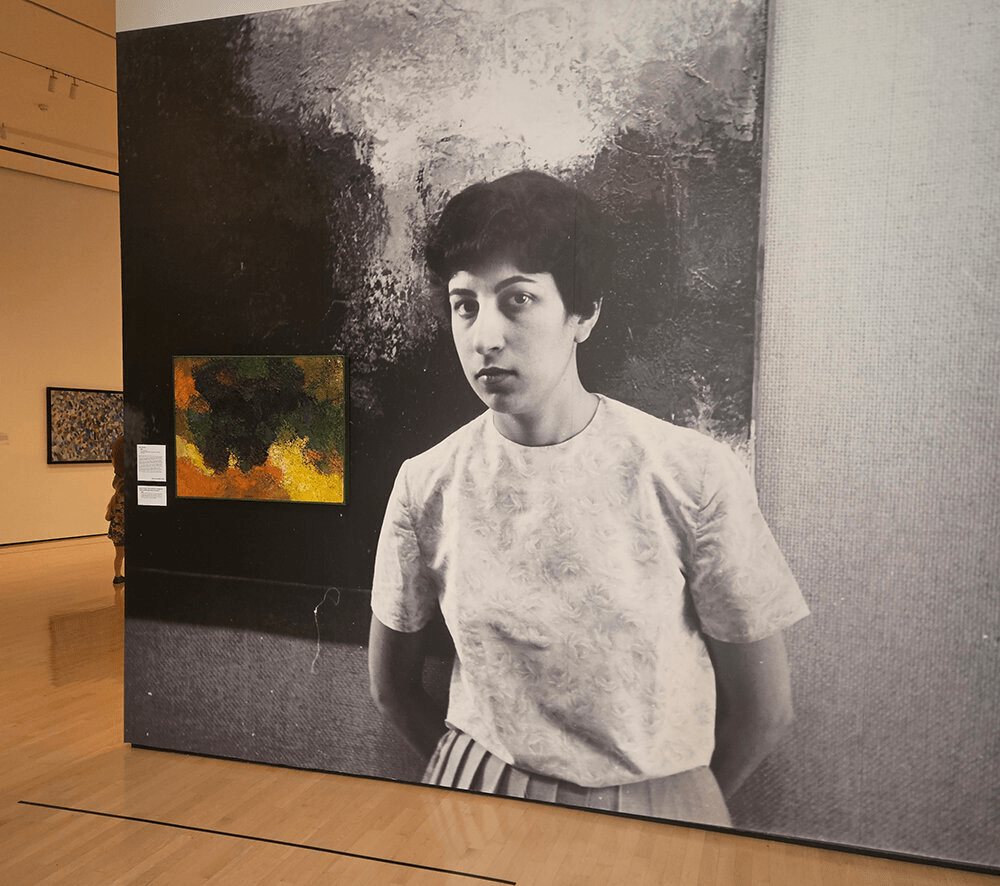
Here is a local story that comes to us now as being of international importance. The artist, Samia Halaby, was born in Jerusalem, Palestine in 1936. Her family later moved to Beirut, Lebanon in 1949 and then on to Cincinnati, Ohio in 1951. This young artist studied at the University of Cincinnati, Michigan State University, and finally at Indiana University, where she received an MFA degree in 1963.

Entrance to the exhibition “Samia Halaby: Eye Witness”
Courtesy the Eli and Edythe Broad Art Museum,
Michigan State University,
East Lansing, Michigan
2024.

One of the earlier paintings from her MFA Exhibition at Indiana University is titled “The Apron, After Gorky’s Mother” and is abstracted from an important earlier painting by Arshille Gorky. This leads us to recognize that many of Halaby’s paintings are indeed abstracted from her immediate world of experience. “Angels and Butterflies” and an “Olive Grove in my Studio” or the “Train Ride from New York to New Haven” are other specific examples. Whether the natural landscape or other more urban landscapes, this sense of space occurs throughout all of her work.

There are two very contradictory definitions to the word “abstract.” The first over used one is in the form of an adjective that usually means anything that is not understood, or un-recognizable. The second one is much stronger, it is in the form of a verb, it is an action. In this form it means to abstract, as in seeing one thing and then abstracting from there. This is more difficult. And this brings me right to the work of Samia Halaby.

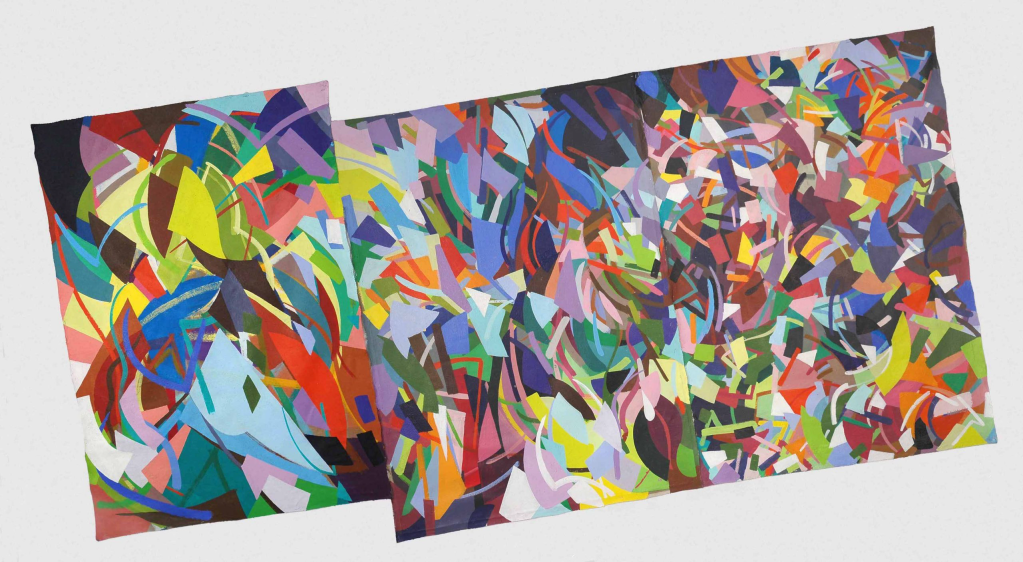
Samia Halaby
“Angels and Butterflies”
2010
Acrylic on linen
80 3/4” x 78 3/4”
Collection of the artist.
Copyright by Samia Halaby 2023

Regarding one specific painting: “Angels and Butterflies” is described in the catalogue as “A kaleidoscope of interacting, reflecting, and refracting lines, shapes, and colors mimic the flapping wings of a butterfly as it glides through the sky. ‘Angels and Butterflies’ reflects Halaby’s analytical approach to painting that examines processes of motion and growth while investigating how space is depicted in paintings. . . . Rather than depicting a particular moment, Halaby paints the general principles of movement, exemplifying the artist’s long-standing belief that abstraction is a means of expressing general principles.”

The two sister exhibitions “Centers of Energy” and “Eye Witness” were curated by Elliot Josephine Leila Reichert and Rachel Winter respectively. Unfortunately, the first part of this exhibition was cancelled earlier this year from being shown at the Sidney and Lois Eskenazi Art Museum at Indiana University by University President Pamela Whitten. One of a series of decisions by the university administration that brought an Indiana University Faculty ‘vote of no confidence’ at their next full faculty meeting. It is especially sad for us in Indiana, as several examples of Halaby’s paintings are contained in the collections of both the Indianapolis Museum of Art and the Eskenazi Art Museum of Indiana University. And for me personally as one of Samia Halaby’s former graduate teaching assistants in the Fundamental Studio Program at Indiana University during the spring semester of 1972.

“The nature of abstraction allows a viewer to recall many different memories and experiences. It occurs to me that Takheel I is like the scattered yellow leaves in the Vancouver Island forest. A painting proves itself to me when a viewer recognizes their own experience in it. Abstraction is not about the person of the artist or his individualism, but rather about the far more difficult, and thus more satisfying, ambition to invent a visual language capable of containing exchangeable knowledge. Of course, the uniqueness of painting is that this shared knowledge is a visual one.”

Samia Halaby
“Takheel I”
2013
Acrylic on canvas
48” x 66”
Courtesy Ayyam Gallery, London.

“I can write with some degree of clarity only after the fact. The first brush mark guides other parts and interacts with them to initiate the growth process. The initial stage becomes a suggestion for the whole of the painting. The discourse between all the parts, from the general to the intermediate and most specific parts continues until it all seems to work—to meet a visual idea that we as artists, ourselves shaped by society, can accept as a good painting. Then we show it to others and a new social process begins resulting from their acceptance or critique. It is as though the process of change is echoed in the dual act of painting and seeking input. Artists making pictures, in and for society, are like a growing tree giving fruit. Paintings are the fruits of the interaction of artists and society.”

Near the end of the exhibition on one of the museum walls is the artist’s own question to herself: “How do I look at the world, right here, right now, and how shall I move and remember in order to make a painting of our time?”

“I look hard, hoping to avoid the backwardness of post-modernism that dominates the world of art fashion. To see and reflect even a small fragment of the world in the forms of revolutionary twentieth-century painting is as exciting as the clear air and the sun-shine. I think that I see it. Maybe I see how I might do it. But taking it all to the studio is not easily done.”

“Samia Halaby in her studio”
Tribeca, New York City.
Photo copyright by Samia Halaby 2023.

“Samia Halaby: Eye Witness” is currently on view at the Eli and Edyth Broad Art Museum at Michigan State University in East Lansing, Michigan and will run through 15 December 2024. Always Free and Open to All.


1 Halaby, Samia A.; Growing Shapes: Aesthetic Insights of an Abstract Painter; Palestine Books, Inc. in collaboration with Ayyum Gallery; Wooster,Ohio; 2016; p. 5.

2 Reichert, Elliot Josephine Leila, and Rachel Winter; Samia Halaby: Centers of Energy; Hirmer Publishers, Munich and Sidney and Lois Eskenazi Museum of Art, Bloomington; 2023; p. 114.

3 Farhat, Maymanah; Samia Halaby: Five Decades of Painting and Innovation; Booth-Clibborn Editions; London, United Kingdom; 2013; p. 350.

4 Halaby, Samia A.; Growing Shapes: Aesthetic Insights of an Abstract Painter; Palestine Books, Inc. in collaboration with Ayyum Gallery; Wooster,Ohio; 2016; p. 17.

5 Halaby, Samia A.; Growing Shapes: Aesthetic Insights of an Abstract Painter; Palestine Books, Inc. in collaboration with Ayyum Gallery; Wooster,Ohio; 2016; p. 102.

PATRICIA CLARK, DEBORAH BUTTERFIELD AND JOAN MITCHELL

From Grand Rapids, Michigan to Baltimore, Maryland, the poet Patricia Clark is always searching for artists to study, and to be inspired by. In the last couple of years she has visited the work of two such artists. A newly installed sculpture by Deborah Butterfield on a rooftop balcony at Grand Valley State University at its Downtown Campus. And a few months later, on a trip to Baltimore, a pilgrimage of sorts to the Joan Mitchell Retrospective Exhibition at the Baltimore Museum of Art.

Just last year, 7 September 2023 to be exact, I attended a reading by Patricia Clark at the Poetry on Brick Street Series in Zionsville, Indiana. It was there, reading from a selection of her latest work, that I heard her read two new works, these ones on Deborah Butterfield and Joan Mitchell.

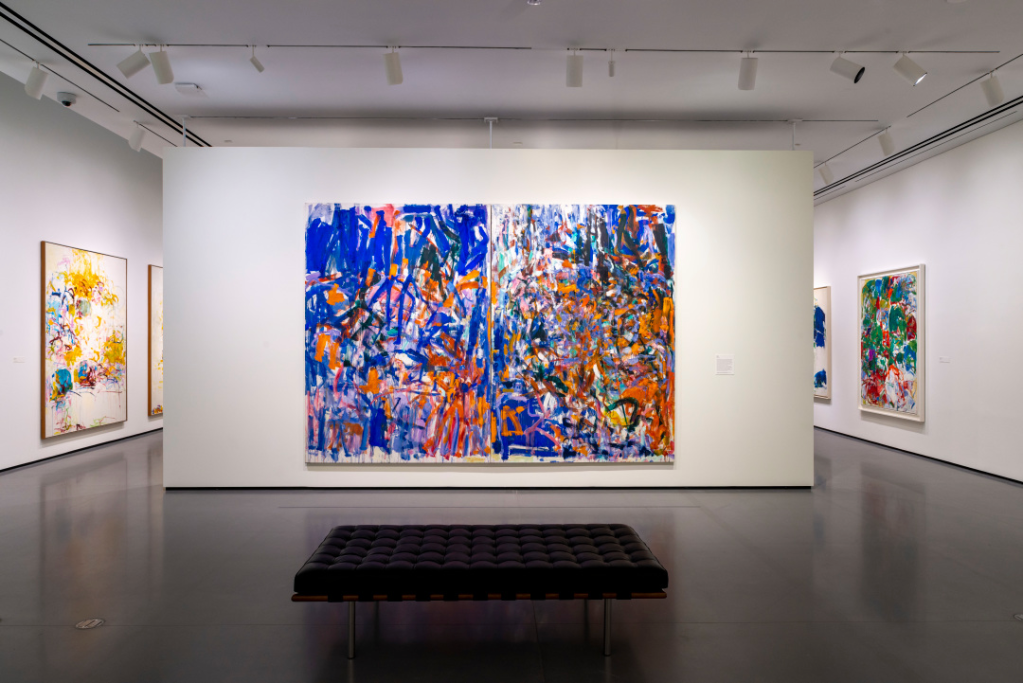
Joan Mitchell
“Weeds”
Installation view:
Joan Mitchell Retrospective Exhibition,
Baltimore Museum of Art,
2022

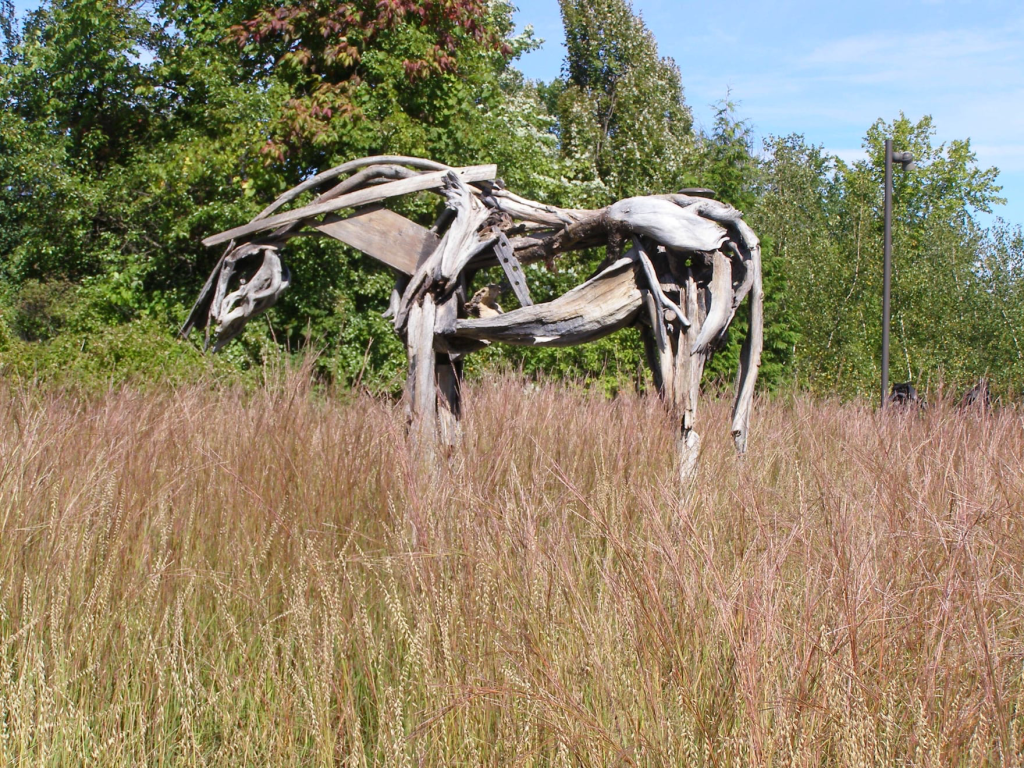
Situated in a prairie like setting at the Meijer Gardens and Sculpture Park in Grand Rapids is an isolated crazing horse by Deborah Butterfield1. It has a natural like stance and bend to its neck, standing in this open space. Further downtown, in fact near the very center of the city and elevated to the top of a Grand Valley State University classroom building, is another one of these pieces.

Deborah Butterfield
“Cabin Creek”
1999
Bronze
88” x 122.5: x 30.5”
Meijer Sculpture Garden and Park
Grand Rapids, Michigan

Char: Above the City
–for Nathan, Joel, and Alison

“On a rooftop downtown at the edge
of the building where they’ve planted succulents
stands a horse blackened by fire
called Char by its maker Deborah Butterfield.
The artist scoured a smoky ravaged forest
in California, picking up branches, limbs,
burnt saplings, then brought these to her studio
where she fashioned them into the shape of a horse.
During the process, taking weeks, Butterfield often dreams
of horses. This one grazing in a meadow
where red-tipped grass waved against its belly, seeds
catching in its long tail. Horse has become the artist’s
mirror self, a dream figure made manifest.
After the studio, a foundry, a way to cast
wood into metal, finally pouring
bronze for the final sculpture. The workers made marks
in metal to resemble wood, adding a patina black
as night sky. Char looks east into clouds
above our city, ignoring for past weeks
the haze from Canada wildfires, not pricking
its ears in terror or flipping its tail.
Char is more skeleton than mass, negative space
allowing us to glimpse what’s been ruined and where
we stand, on the edge, barely able to breathe.”2

Deborah Butterfield
“Char”
2021
Bronze
82.5″ x 102.5″ x 33″
Center for Interprofessional Health,
Grand Valley State University,
Grand Rapids, Michigan

In the Spring of 2019 I visited the Baltimore Art Museum in order to see the Joan Mitchell Retrospective3. It was the first time I had returned to Baltimore in so many years and certain sites were hard to remember. We arrived early, way before our scheduled entry time, not crowded at all so the guards waved us right on in. When I mentioned this to Patricia Clark later, back in the Mid-West, she stated that she and her husband Stanley Krohmer, who had also studied in Baltimore, were planning a very similar trip, and specifically to see the Joan Mitchell Retrospective.

One really important element to all of Mitchell’s work is her affinity with other artists and poets of her generation. Several of her paintings have inspired writers and writers have inspired her in both her paintings and her poem pastels.

These include James Schyler, Eileen Myles, Frank O’Hara and John Ashbery. Below is Patricia Clark’s poem in response to this exhibition.

Painter Joan Mitchell Pulls Me Up

“What was in the air was leaf-fall, the rot
of the year’s perennials and annuals, stems

and blossom ends done for, going back to earth.
I couldn’t move for being caught by the suck

of quicksand, a clump of blue feathers smacked
on a window from a hit. Here I am on a cold Friday

and to my amazement the painter Joan
Mitchell reaches for me, from her oil

on canvas, a diptych called Weeds,
grabbing a hold of me, saying ‘Here,

take my hand!’ There’s something about
her seeming riot of marks that’s giving

a calming and cooling effect. It’s cobalt blue,
orange, tawny, and flecked with white,

even a spot or two of sage, and I see
the trail-side at Huff Park with tall

teasel, Queen Anne’s lace, and a waving
frond of goldenrod or a flat-topped

white aster. Each year I’m caught watching
this awakening starting up in early spring,

a mere sprout or two at first, then
climbing, growing, a stem hoisting itself up

all season till it’s five feet high,
shedding petals, pollen and seeds. Not

a riot at all, a cyclic process of
great determination, genetics, chance . . .”

Joan Mitchell
“Weeds”
1976
Oil on canvas,
110 1/2” x 157 1/2”
Hirshhorn Museum and Sculpture Garden
Washington, DC.

“. . . weather, sunlight, rain. Right now,
I’m bowing to the botanical display and to two

canvasses of supreme order, remembering
our visit to the Baltimore Art Museum, August,

standing in front of the actual paintings,
work as sturdy and wrought

as any palace. Then we went walking off
in a pack for lunch, having salad and Chesapeake oysters

on the half-shell along with a crisp
citrus tasting wine. Good friends, fellow

artists, a couple more hands to pull me
out of quicksand. Where do we turn, lost

on that trail, or sinking? The Baltimore light
was pure lemon as we strolled through

the galleries pointing, talking, saying
look at that magenta, violet, sage, her vision,

her ability to make these marks. The gleam of it
lasting as long as the light, what we call a day.”4


1 Kuspit, Donald, and Marcia Tucker; Horses: The Art of Deborah Butterfield; Lowe Art Museum, University of Miami, Coral Gables, Florida, and Chronicle Books, San Francisco, California; 1992.

2 Clark, Patricia; “Char;” The Superstition Review; Arizona State University; Issue 32; Fall 2023.

3 Roberts, Sarah, and Katy Siegel, eds.; Joan Mitchell; Baltimore Museum of Art and the San Francisco Museum of Modern Art; Yale University Press, New Haven and London; 2020.

4 Clark, Patricia; “Painter Joan Mitchell Pulls Me Up;” Nelle; University of Alabama at Birmingham; Issue 7; 2024.

THE MIGHTY QUINN!

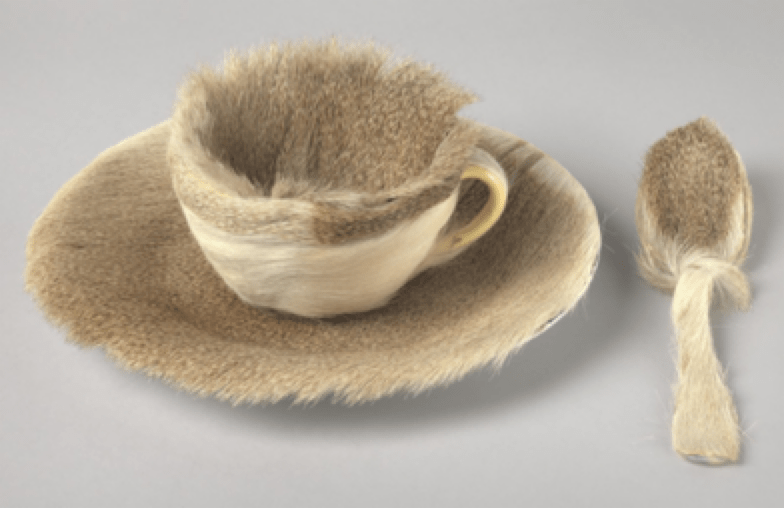
Surrealism and absurdity, fantasy and fiction, images come together in a variety of combinations. The range can be unbelievable: from Giotto’s painting of St. Francis Preaching to the Birds to a contemporary sculptural assemblage of a spoon and teacup lined with fur!1

“I like to do just like the rest, I like my sugar sweet
But guarding fumes and making haste
It ain’t my cup of meat. . . .”

Meret Oppenheim
“Object”
1936
Mixed media
32.7 cm x 7.3 cm
Museum of Modern Art, New York

“. . . Ev’rybody’s ’neath the trees
Feeding pigeons on a limb
But when Quinn the Eskimo gets here
All the pigeons gonna run to him.”2

Giotto di Bondone
“St. Francis Preaching to the Birds”
1296-1300
Fresco
Upper Church of St. Francis
Assisi, Italy

In one of his most important collections of poetry, the author and editor Robert Bly takes a look at this literature from so many angles. The Rag and Bone Shop of the Heart3 takes its title from the absurd poem “The Circus Animals’ Desertion” by William Butler Yeats:

“Now that my ladder’s gone,
I must lie down where all the ladders start,
in that foul rag and bone shop of the heart.”4

Included in the “Zaniness” section of this collection, Bly describes a song by Bob Dylan titled “The Mighty Quinn!” Packed full of silliness and surrealism, this mighty Eskimo is here to save us all.

“Nanook of the North”
1922
Lithographic Poster
Royal Pictures, Inc.

There is a subtle source for this story: an early short documentary film of 1922 from the Museum of Modern Art Film Library titled “Nanook of the North.” This film circulated around New York and beyond in the 1960’s, even making it to the Maryland Institute College of Art in Baltimore for a film series.

Several sources also point to the movie “The Savage Innocents” starring Anthony Quinn, playing the part of an Eskimo, as the inspiration for this song.

“The Savage Innocents”
Movie Poster
1960
40” x 27”

“Ev’rybody’s building the big ships and the boats
Some are building monuments
Others, jotting down notes
Ev’rybody’s in despair
Ev’ry girl and boy
But when Quinn the Eskimo gets here
Ev’rybody’s gonna jump for joy
Come all without, come all within
You’ll not see nothing like the mighty Quinn”5

“I like to do just like the rest, I like my sugar sweet
But guarding fumes and making haste
It ain’t my cup of meat
Ev’rybody’s ’neath the trees
Feeding pigeons on a limb
But when Quinn the Eskimo gets here
All the pigeons gonna run to him
Come all without, come all within
You’ll not see nothing like the mighty Quinn”6

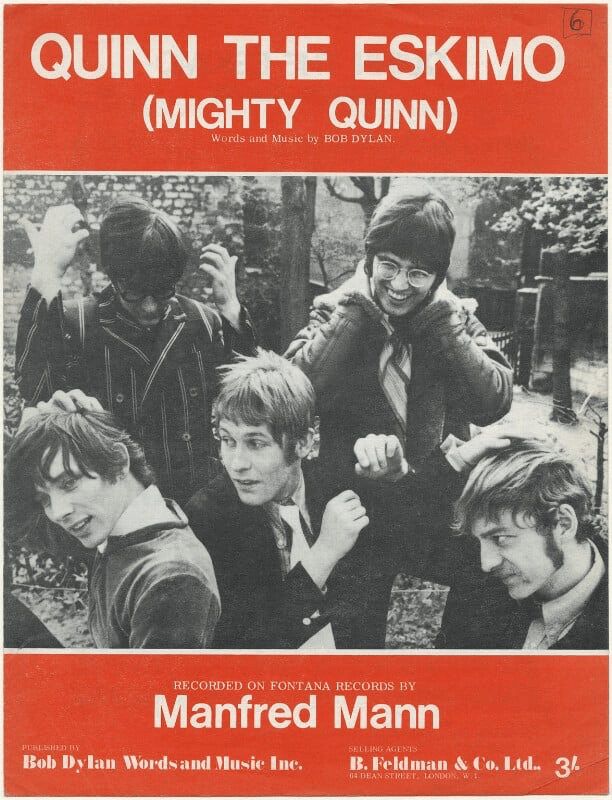
“Quinn the Eskimo” Sheet Music Cover
Words and Music, Bob Dylan,
Performed by Manfred Mann
1968
(Photographer Unknown)
11” x 8 1/2”
National Portrait Gallery
London, United Kingdom

Bob Dylan wrote this song in 1967 during the Basement Tapes Sessions however it was one of two outtakes at that time. Shortly afterwards, in 1968, it was picked up and famously recorded by the English group Manfred Mann. They used it often in live concerts and recorded several later versions, including an extended play one that lasted over ten minutes. Dylan’s original recording of the “Mighty Quinn” was finally included in the Biograph CD released in 1985.

“A cat’s meow and a cow’s moo, I can recite ’em all
Just tell me where it hurts yuh, honey
And I’ll tell you who to call
Nobody can get no sleep
There’s someone on ev’ryone’s toes
But when Quinn the Eskimo gets here
Ev’rybody’s gonna wanna doze
Come all without, come all within
You’ll not see nothing like the mighty Quinn”7

Although it may seem like double talk, writing in the absurd mode often gets more directly to the truth. As it happens in Bob Dylan, it also occurs in William Butler Yeats, who provides one last word:

“Players and painted stage took all my love,
And not those things that they were emblems of.”8

Anthony Quinn as the Eskimo Inuk
“The Savage Innocents”
Paramount Pictures,
Technicolor Film Still,
Nicholas Ray, Director
1960.

1 Dylan, Bob; “The Mighty Quinn” Words and Music; © 1968 by Dwarf Music; renewed in 1996 by Dwarf Music.

2 Dylan, Bob; “The Mighty Quinn” Words and Music; © 1968 by Dwarf Music; renewed in 1996 by Dwarf Music.

3 Bly, Robert; James Hillman and Michael Meade; The Rag and Bone Shop of the Heart: Poems for Men; Harper Perennial, Harper Collins Publishers; New Yrok, New York; 1992.

4 Rosenthal, M. L., ed.; Selected Poems and Two Plays of William Butler Yeats; The MacMillan Company; New York, New York; 1962; pp. 184-185.

5 Dylan, Bob; “The Mighty Quinn” Words and Music; © 1968 by Dwarf Music; renewed in 1996 by Dwarf Music.

6 Dylan, Bob; “The Mighty Quinn” Words and Music; © 1968 by Dwarf Music; renewed in 1996 by Dwarf Music.

7 Dylan, Bob; “The Mighty Quinn” Words and Music; © 1968 by Dwarf Music; renewed in 1996 by Dwarf Music.

8 Rosenthal, M. L., ed.; Selected Poems and Two Plays of William Butler Yeats; The MacMillan Company; New York, New York; 1962; p. 185.


SELF-PORTRAIT IN A CONVEX MIRROR

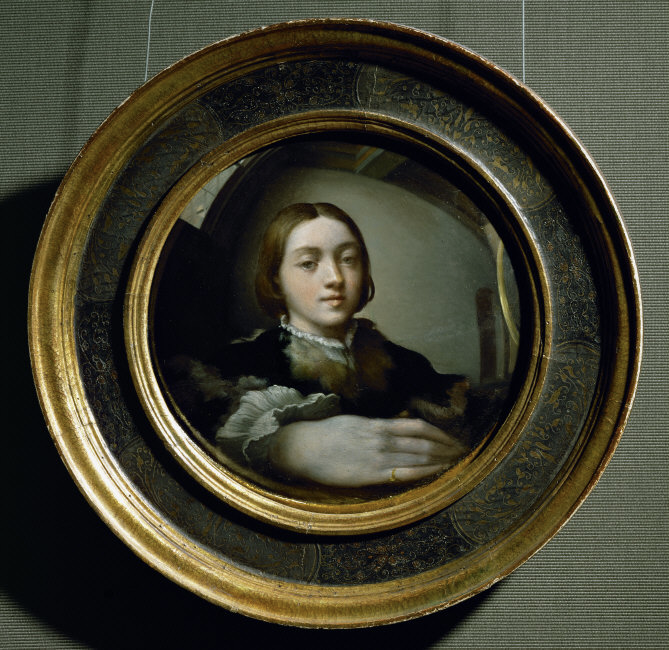
Beginning with the Renaissance and running through our contemporary era it has been a recurring metaphor that painting has provided a window onto, or a mirror of, the world. So much so, that we may often forget the power of reflection and the conventions of reflecting the things surrounding us. Two examples include the foreground still life in the Northern Renaissance painting of “The Money Changer and his Wife” from 1514 by Quinten Massys and an M. C. Escher lithograph of the “Hand with a Reflecting Sphere” from 1935. Sandwiched in between is that great “Self-Portrait in a Convex Mirror” by Girolamo Francesco Maria Mazzola, otherwise known as Parmigianano.

Quinten Massys
“The Money Changer and his Wife”
1514
Oil on canvas
70.5cm x 67cm
Musée Louvre, Paris

There are two important literary examples associated with this single painting by Parmigianino: the first one historic, written by Vasari regarding the creation of this painting, and the second one modern, John Ashberry’s extensive and thoughtful meditation on this subject.

The artist is seen in a circular form: a sphere that has been cut in half, one part to be polished and glazed into a mirror and the second part to be prepared and used as the support for this very painting.

Although it is small in diameter, it is forceful in its imagery, and a perfect presentation piece intended to be seen by future patrons in Rome. We are confronted by his intense stare, slightly above center of the composition, and then the sweep of his shoulder and arm around into the extreme foreground, concluding with that hand. A circular movement shown by the model himself that echoes the circular form of the entire painting.

Francesco Mazzola, called Parmigianino
c. 1524
Oil on a convex panel
9.6” in diameter
Kunsthistorisches Museum, Vienna

“Then came upon him the desire to see Rome, hearing men greatly praise the works of the masters there, especially of Raffaello and Michael Angelo, and he told his desire to his old uncles. They, seeing nothing in the desire that was not praiseworthy, agreed, but said that it would be well to take something with him which would gain him an introduction to artists. And the counsel seeming good to Francesco, he painted three pictures, two small and one very large. Besides these, inquiring one day into the subtleties of art, he began to draw himself as he appeared in a barber’s convex glass. He had a ball of wood made at a turner’s and divided in half, and on this he set himself to paint all that he saw in the glass, and because the mirror enlarged everything that was near and diminished what was distant, he painted the hand a little large. Francesco himself, being of very beautiful countenance and more like an angel than a man, his portrait on the ball seemed a thing divine, and the work altogether was a happy success, having all the lustre of the glass, with every reflection and the light and shade so true, that nothing more could be hoped for from the human intellect.”1

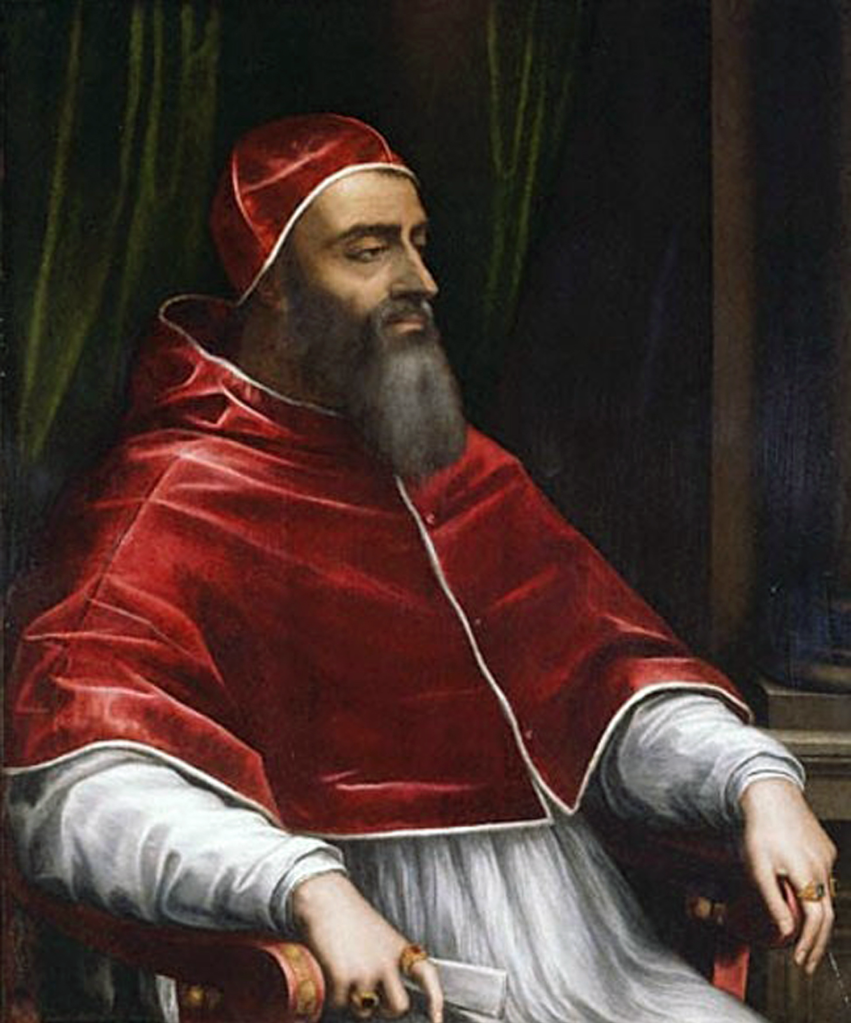
“The picture being finished and packed, together with the portrait, he set out, accompanied by one of his uncles, for Rome; and as soon as the Chancellor of the Pope had seen the pictures, he introduced the youth and his uncle to Pope Clement, who seeing the works produced and Francesco so young, was astonished, and all his court with him. And his Holiness gave him the charge of painting the Pope’s hall.”2

Sebastiano del Piombo
“Portrait of Pope Clement VII”
c. 1531
41 1/2” x 34 1/2”
Oil on slate
J. Paul Getty Museum, Los Angeles, California.

“The glass chose to reflect only what he saw

Which was enough for his purpose: his image

Glazed, embalmed, projected at a 180-degree angle.

The time of day or the density of the light

Adhering to the face keeps it

Lively and intact in a recurring wave

Of arrival. The soul establishes itself.

But how far can it swim out through the eyes 

And still return safely to its nest? The surface

Of the mirror being convex, the distance increases

Significantly; that is, enough to make the point

That the soul is a captive, treated humanely, kept

In suspension, unable to advance much farther

Than your look as it intercepts the picture.

Pope Clement and his court were ‘stupefied’

By it, according to Vasari, and promised a commission

That never materialized. . . .”3

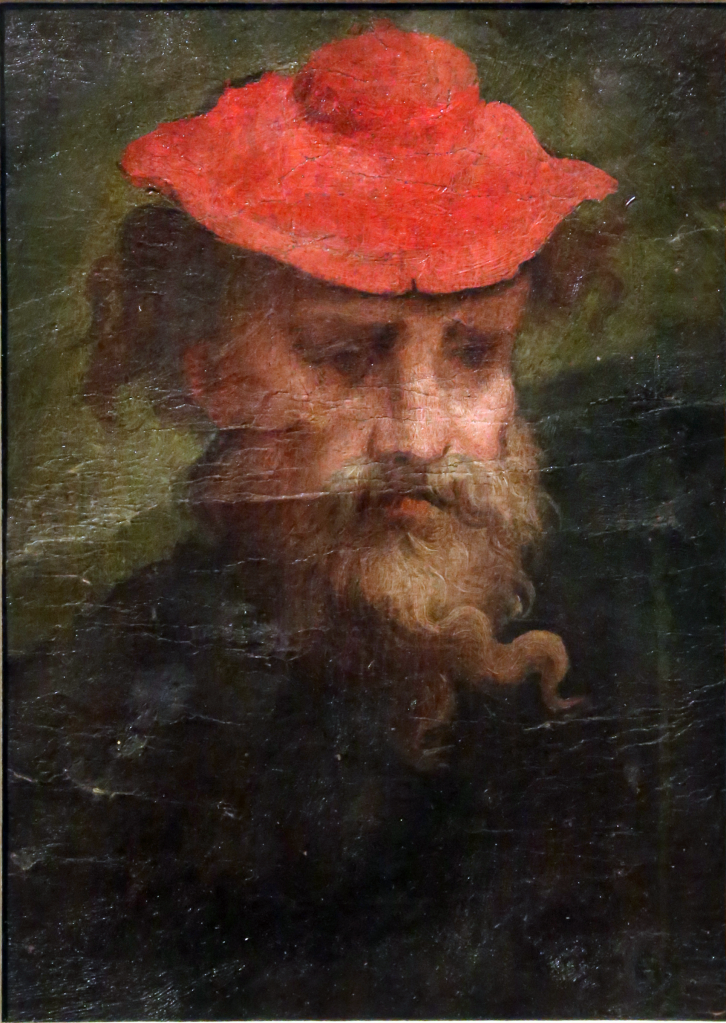
Atributed to: Francesco Mazzola, called Parmigianino
“Self Portrait in Old Age, or Portrait of a Man in a Red Beret”
1540
Oil on paper
21cm x 15.5cm
National Gallery of Parma, Italy

Years later Parmigianino again took the self-portrait as his subject matter. This time without the youthful visage and silvery reflections, but with a melancholy softness. Vasari’s discussion of tis artist would become an important part of his larger written masterpiece The Lives of the Artists, published in 1550 & 1568, and remains one of the most important documents in the history of art.

John Ashberry’s “Self Portrait in a Convex Mirror” was first published by Viking Press in 1975. The following year John Ashberry won the Pulitzer Prize, the National Book Award, and the National Book Critics Circle Award. Twenty years later I attended his reading at the Visiting Writers Lecture Series at Butler University in Indianapolis, Indiana, 9 April 1996. Ashberry was such an important figure in the New York School as it related to both poets and painters. His friends and colleagues over the years have included Fairfield Porter, Jane Freilicher and Frank O’Hara and he always acknowledges these inter-relationships. Below are three excerpts from his extended poem, along with a visual footnote: M. C. Escher’s well known “Self-Portrait in Spherical Mirror.”

Francesco Mazzola, called Parmigianino
c. 1524
Oil on a convex panel
9.6” in diameter
Kunsthistorisches Museum, Vienna

“As Parmigianino did it, the right hand

Bigger than the head, thrust at the viewer

And swerving easily away, as though to protect

What it advertises. A few leaded panes, old beams,

Fur, pleated muslin, a coral ring run together

In a movement supporting the face, which swims

Toward and away like the hand

Except that it is in repose. It is what is

Sequestered. Vasari says, “Francesco one day set himself

To take his own portrait, looking at himself from that purpose

In a convex mirror, such as is used by barbers . . .

He accordingly caused a ball of wood to be made

By a turner, and having divided it in half and

Brought it to the size of the mirror, he set himself

With great art to copy all that he saw in the glass. . . .”4

“This past

Is now here: the painter’s

Reflected face, in which we linger, receiving

Dreams and inspirations on an unassigned

Frequency, but the hues have turned metallic,

The curves and edges are not so rich. Each person

Has one big theory to explain the universe

But it doesn’t tell the whole story

And in the end it is what is outside him

That matters, to him and especially to us

Who have been given no help whatever

In decoding our own man-size quotient and must rely

On second-hand knowledge.”5

“Aping naturalness may be the first step

Toward achieving an inner calm

But it is the first step only, and often 

Remains a frozen gesture of welcome etched

On the air materializing behind it,

A convention.”6

Maurits Cornelis Escher
“Hand with Reflecting Sphere
(Self-Portrait in Spherical Mirror)”
1935
Lithograph
31.8cm x 21.3cm
Kunstmuseum Den Haag, The Netherlands.

1 Vasari, Giorgio, translated by Gaston du C. de Vere; Lives of the Painters, Sculptors and Architects; Everyman’s Library, Alfred A. Knopf; New York and Toronto; 1996; Volume 1, pp. 934-935.

2 Vasari, Giorgio, translated by Gaston du C. de Vere; Lives of the Painters, Sculptors and Architects; Everyman’s Library, Alfred A. Knopf; New York and Toronto; 1996; Volume 1, pp. 934-935.

3 Ashberry, John; Self Portrait in a Convex Mirror; Penguin Books; New York, New York; 1990; pp. 68-69.

4 Ashberry, John; Self Portrait in a Convex Mirror; Penguin Books; New York, New York; 1990; p. 68.

5 Ashberry, John; Self Portrait in a Convex Mirror; Penguin Books; New York, New York; 1990; pp. 81-82
.
6 Ashberry, John; Self Portrait in a Convex Mirror; Penguin Books; New York, New York; 1990; p. 82
.

THE AMERICANS

In a short prose poem, six pages at best, Jack Kerouac sets the stage for a much longer visual poem by the photographer Robert Frank:

“Robert Frank, Swiss, unobtrusive, nice, with that little camera that he raises and snaps with one hand he sucked a sad poem right out of America onto film, taking rank among the tragic poets of the world. . . . And I say: ‘That little ole lonely elevator girl looking up sighing in an elevator full of blurred demons, what’s her name & address?’”1

Robert Frank
“Elevator, Miami Beach”
1955
Gelatin silver print
9 1/8” x 13 1/4”
Metropolitan Museum of Art, New York


For many years my Dad worked as a photographer, first for the commercial company Cooper-Trent in Washington, DC, and later for the federal government. He was the one who first taught me how to shoot and process film, although I struggled with this. Later in college, 1967 summer school in Norfolk, Connecticut, it was Walter Rosenblum and his assistant, Sedat Pakay, who took us under their wings. Two other personal influences also should be mentioned here: the sensitive portraits of one of my classmates at Norfolk, Carol Ginandes; and a second classmate in Baltimore, Dudley Gray, whose visions of New York City are continually inspiring. All of these examples are ways to help us to see and to work directly.

In writing, it is no surprise that many contemporary poets used the dictum: first thought, best thought. Not unlike the photographer who composes, shoots, and fills the full frame, instantaneously. By writing directly, it eliminated the process of editing and re-writing, which can often make a work stiff, too structured, and not as spontaneous. So it is no surprise that the photographer Robert Frank hooked up with the writer Jack Kerouac for the publication of his photographic series “The Americans.”

Kerouac’s lines resonate with the imagery in equally spontaneous ways.

“——-The gasoline monsters stand in the New Mexico flats under big sign says Save——-the sweet little white baby in the black nurse’s arms both of them bemused in heaven, a picture that should have been blown up and hung in the street of Little Rock showing love under the sky and in the womb of our universe. . . .”2

Robert Frank
“Charlestown, South Carolina”
1955
Gelatin silver print
8 1/4” x 12 1/4”
Metropolitan Museum of Art, New York

“THAT CRAZY FEELING IN AMERICA when the sun is hot on the streets and music comes out of the jukebox or from a nearby funeral, that’s what Robert Frank has captured. . . with the agility, mystery, genius, sadness and strange secrecy of a shadow photographed scenes that have never been seen before on film. . . . After seeing these pictures you end up finally not knowing any more whether a jukebox is sadder than a coffin. That’s because he’s always taking pictures of jukeboxes and coffins. . . !”3

Robert Frank
“Bar, Las Vegas, Nevada”
1955/56
Gelatin silver print
8 15/16” x 13 7/16”
The Art Institute of Chicago, Chicago, Illinois

“What a poem this is, what poems can be written about this book of pictures some day by some young new writer high by candlelight bending over them describing every gray mysterious detail, the gray film that caught the actual pink juice of human kind. Whether ’t is the milk of humankind-ness, of human-kindness, Shakespeare meant, makes no difference when you look at these pictures. Better than a Show.”4

Louis Faurer
“Robert Frank”
1947
Gelatin silver print
8 1/16″ x 5 3/8″
National Portrait Gallery, Smithsonian Institution,
Washington, DC.

And Kerouac’s last word to all of this:

“Anybody doesnt like these these pitchers dont like potry, see? Anybody dont like potry go home see Television shots of big hatted cowboys being tolerated by kind horses.”

“To Robert Frank I now give this message: You got eyes.”5


1 Frank, Robert; The Americans; (With and Introduction by Jack Kerouac); An Aperture Book, Grossman Publishers; New York, New York; 1969; p. vi.

2 Frank, Robert; The Americans; (With and Introduction by Jack Kerouac); An Aperture Book, Grossman Publishers; New York, New York; 1969; p. vi.

3 Frank, Robert; The Americans; (With and Introduction by Jack Kerouac); An Aperture Book, Grossman Publishers; New York, New York; 1969; p. i.

4 Frank, Robert; The Americans; (With and Introduction by Jack Kerouac); An Aperture Book, Grossman Publishers; New York, New York; 1969; p. iii.

5 Frank, Robert; The Americans; (With and Introduction by Jack Kerouac); An Aperture Book, Grossman Publishers; New York, New York; 1969; p. vi.