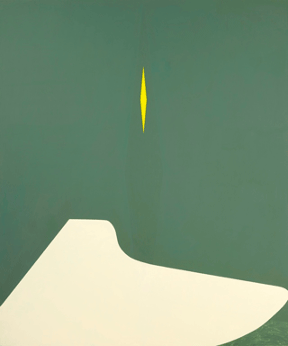
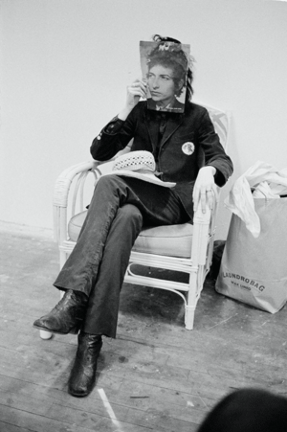
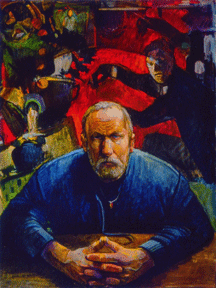
SEAN SCULLY: A PROSE POEM

At the Cincinnati Art Museum near the end of the summer of 2006 there was a special exhibition of paintings by the Irish painter Sean Scully titled “Wall of Light.” It originated at the Phillips Collection in Washington, DC, in late 2005 and included approximately eighty paintings and thirty works on paper including drawings, watercolors, and photographs.

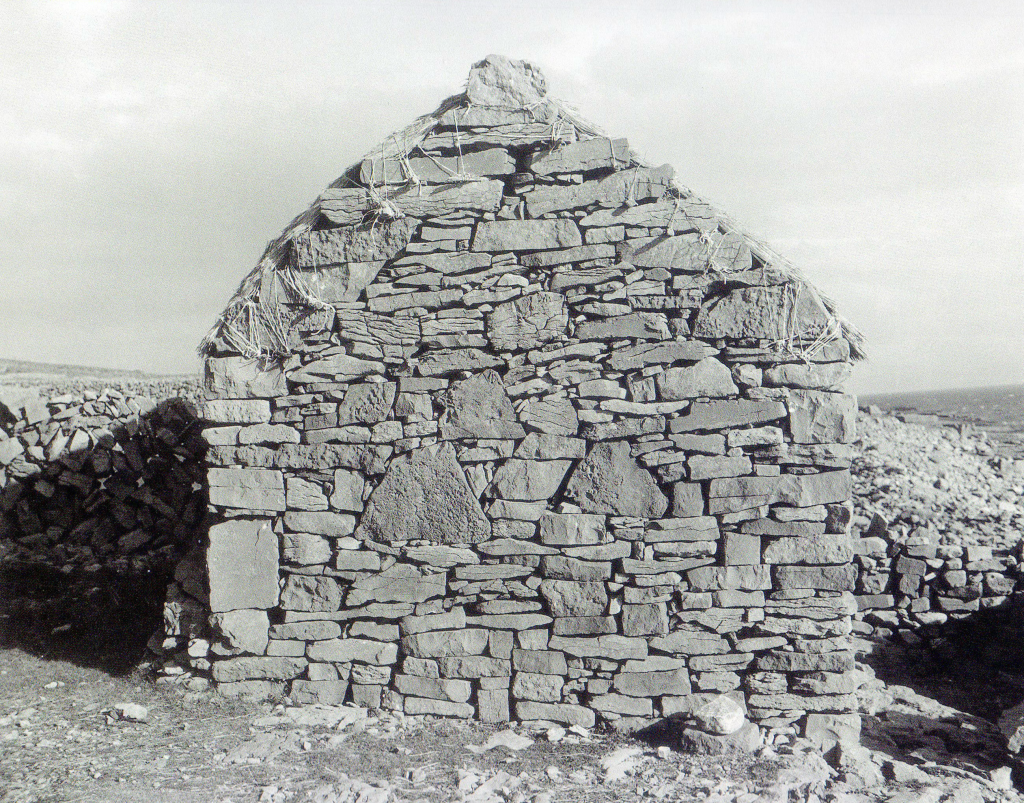
One particular photograph of an old farm shack made from stacked stone featured a beautiful façade complete with light, shadow, texture: some of the very things that Scully looks at and draws from outside of his studio, in the real world. And certain writers have noted how the elements in Scully’s paintings are placed as if they were bricks or stones.

Sean Scully
“Stone Shack End”
1994
Gelatin silver print
16” x 20”
Collection of the artist.

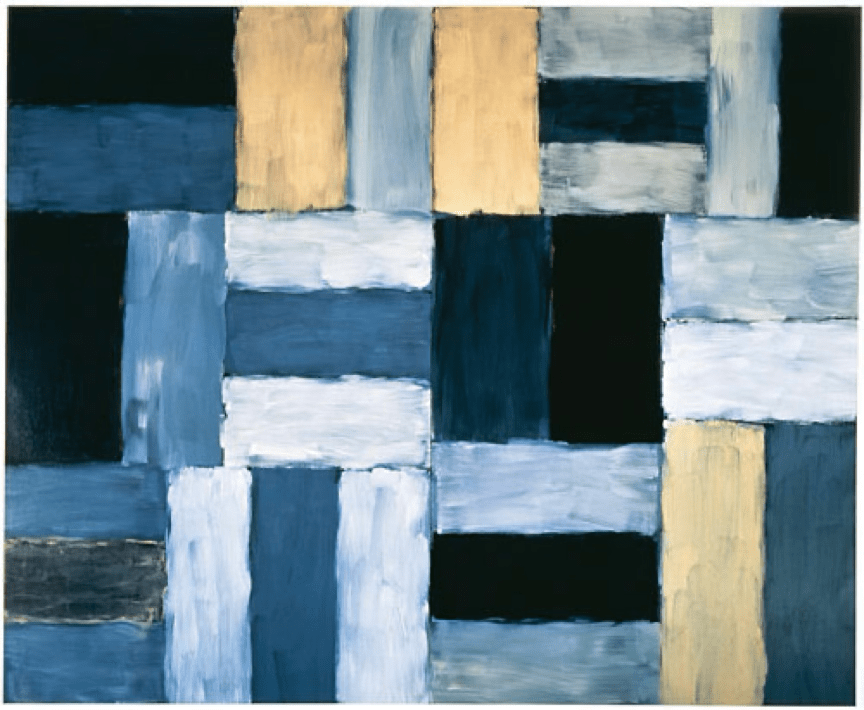
John Yau’s description of Scully’s painted surfaces is one example: “The rhythmic brushstrokes—ranging from feathery to matter-of-fact—and the layers of paint (running from thin to pasty) are visceral, even as light seeps through the interstices or flares where the slabs of caressed color don’t touch. The surface is neither uniform nor packed solid; it breathes. The bricks of color and the luminous spaces between them are equally important, with neither trumping the other.”1

Sean Scully
“Wall of Light: Desert Night”
1999
Oil on canvas
108”x 132”
Modern Art Museum of Fort Worth
Fort Worth, Texas

Stephen Bennett Phillips, writing for the Phillips Collection in Washington, DC, has also observed: “Compositionally, within the Wall of Light series, Scully’s tendency has been to become increasingly asymmetrical and off-kilter. His longstanding focus on stripes—short ones in the case of the Wall of Lights paintings—can be compared with Giorgio Morandi’s lifelong study of a narrow range of still-life forms. In fact, Scully’s brick-like forms are directly analogous to blocks and voids that appear in Morandi’s still lifes.”2

Giorgio Morandi
“Still Life”
1953
Oil on canvas
8” x 15 1/8”
The Phillips Collection, Washington, DC.

In the book by John Yau titled Sean Scully: Night and Day, it seems to me that Yau is not just writing a curator’s statement, or a critical essay but going much further, as a poet would. Using sensitive descriptions of the paintings, along with insightful analysis, he arrives at a synthesis of lyrical and critical reflections on these works of art. Yau has, in essence, created an extended prose poem, whose subject is this series by Scully. The literary pieces that grow out of these paintings, following reflection, lead us to a new vision and understanding of these very pieces.

One summer John Yau and his family spent a week on the Dingle Peninsula in western Ireland. The local architecture especially attracted them, from the great Gallarus Oratory down to the many local stone barns and sheds. Later that year, Yau interviewed Sean Scully in preparation for his book on the subject of Night and Day. The writing on Scully’s work contained many references to these buildings and walls and analogies to the process of building up layers of paint as if they were bricks and stones.

“. . . the irregularly shaped stones had to be fitted together. In a way that is breathtaking and inspiring, the people who built the Gallarus Oratory made improvisation and necessity inseparable. A similar indivisibility animates Scully’s work.”3

“Scully builds his compositions out of what he calls ‘bricks’ of rich and often dusty color, but, like the anonymous stonemasons of the Oratory, is similarly committed to improvisation within the indispensable structures he discovers for himself. Whatever the inspiration for a painting might be—and these have ranged from specific landscapes seen in a particular light to a favorite novel and works of art—the tension between obligation and invention is central to Scully’s practice.”4

Sean Scully
“Night and Day”
2012
Oil on aluminum
110” x 320”
Courtesy Cheim & Read, New York

Night and Day is a combination of rhythm and dissonance, with the alternating dark and light bands introducing a rhythmic, percussive aspect into the viewer’s visual experience.”5

“Even as I take note of the repetition, and recognize the changing parameters of the stacked, horizontal bands, I become increasingly sensitive to the shifts and modulations in tonality spanning Night and Day. The dusty, dirty, pale grays evoke certain streets in large cities, foggy mornings, wintry skies, and frozen lakes. The darker gray bands—ranging from slate and to ash, interrupted by midnight black—conjure a changing nocturnal domain. Evocative of winter, especially in northern climates, where the sun appears briefly, if at all, Night and Day thrives in contradiction; it is chilly and soft, warm and aloof.”6

Amongst his own writings, the artist Sean Scully has offered several observations and descriptions of the work of other artists, especially Mark Rothko, Vincent van Gogh, and Giorgio Morandi. One example here, is Scully writing about Morandi: “Morandi paints like no other, before or since. His brushstroke is in complete philosophical agreement with the subject, the scale and the color of his paintings. It is expressive, though it is modest, and not so expressionistic as to disturb the senses of meditative silence that inhabits all his works.”7

Giorgio Morandi
“Still Life”
1953-54
Oil on canvas
26cm x 70cm
Museo di Arte Moderna e Contemporanea
di Trento e Rovereto, Giovanardi Collection.

1 Yau, John; Sean Scully: Night and Day; Cheim & Read; New York, New York; 2013; (unpaginated).

2 Phillips, Stephen Bennett, et. al.; Sean Scully: Wall of Light; The Phillips Collection; Washington, D.C. and Rizzoli International Publications; New York, New York; 2005; p. 43.

3 Yau, John; Sean Scully: Night and Day; Cheim & Read; New York, New York; 2013; (unpaginated).

4 Yau, John; Sean Scully: Night and Day; Cheim & Read; New York, New York; 2013; (unpaginated).

5 Yau, John; Sean Scully: Night and Day; Cheim & Read; New York, New York; 2013; (unpaginated).

6 Yau, John; Sean Scully: Night and Day; Cheim & Read; New York, New York; 2013; (unpaginated).

7 Ingleby, Florence, ed.; Sean Scully: Resistance and Persistence, Selected Writings; Merrell Publishers Limited; London and New York; 2006; p. 15.

THE AMERICANS

In a short prose poem, six pages at best, Jack Kerouac sets the stage for a much longer visual poem by the photographer Robert Frank:

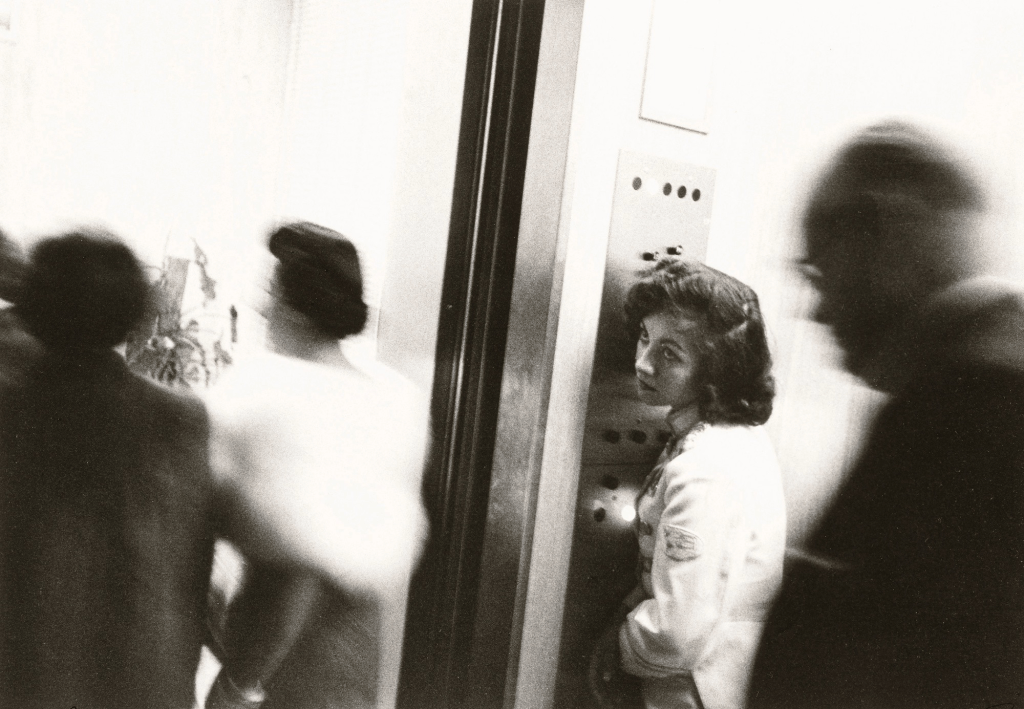
“Robert Frank, Swiss, unobtrusive, nice, with that little camera that he raises and snaps with one hand he sucked a sad poem right out of America onto film, taking rank among the tragic poets of the world. . . . And I say: ‘That little ole lonely elevator girl looking up sighing in an elevator full of blurred demons, what’s her name & address?’”1

Robert Frank
“Elevator, Miami Beach”
1955
Gelatin silver print
9 1/8” x 13 1/4”
Metropolitan Museum of Art, New York


For many years my Dad worked as a photographer, first for the commercial company Cooper-Trent in Washington, DC, and later for the federal government. He was the one who first taught me how to shoot and process film, although I struggled with this. Later in college, 1967 summer school in Norfolk, Connecticut, it was Walter Rosenblum and his assistant, Sedat Pakay, who took us under their wings. Two other personal influences also should be mentioned here: the sensitive portraits of one of my classmates at Norfolk, Carol Ginandes; and a second classmate in Baltimore, Dudley Gray, whose visions of New York City are continually inspiring. All of these examples are ways to help us to see and to work directly.

In writing, it is no surprise that many contemporary poets used the dictum: first thought, best thought. Not unlike the photographer who composes, shoots, and fills the full frame, instantaneously. By writing directly, it eliminated the process of editing and re-writing, which can often make a work stiff, too structured, and not as spontaneous. So it is no surprise that the photographer Robert Frank hooked up with the writer Jack Kerouac for the publication of his photographic series “The Americans.”

Kerouac’s lines resonate with the imagery in equally spontaneous ways.

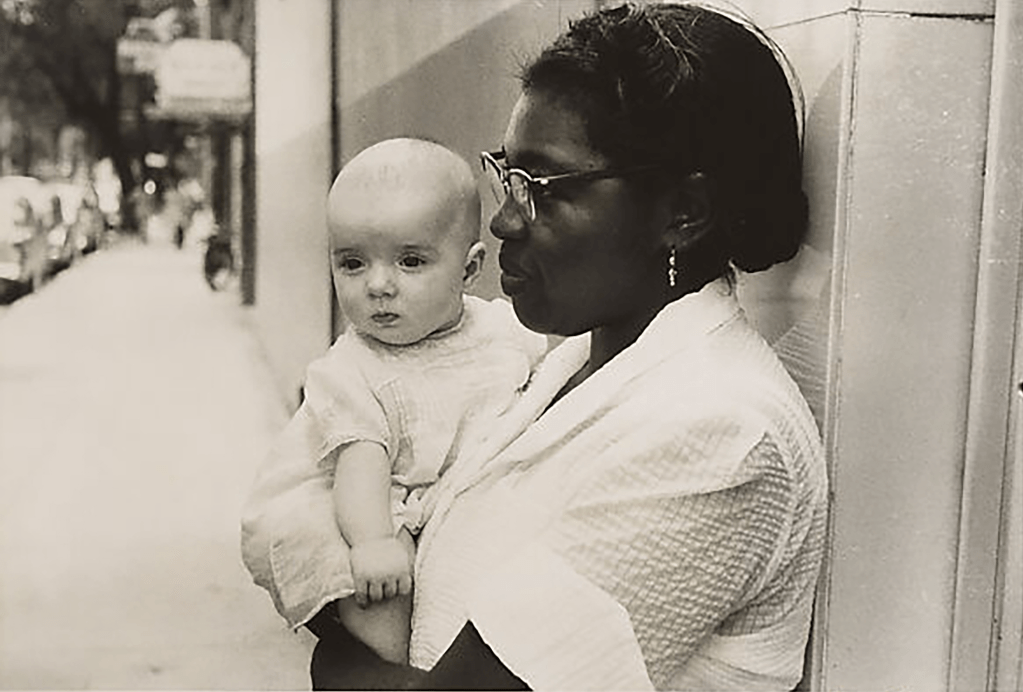
“——-The gasoline monsters stand in the New Mexico flats under big sign says Save——-the sweet little white baby in the black nurse’s arms both of them bemused in heaven, a picture that should have been blown up and hung in the street of Little Rock showing love under the sky and in the womb of our universe. . . .”2

Robert Frank
“Charlestown, South Carolina”
1955
Gelatin silver print
8 1/4” x 12 1/4”
Metropolitan Museum of Art, New York

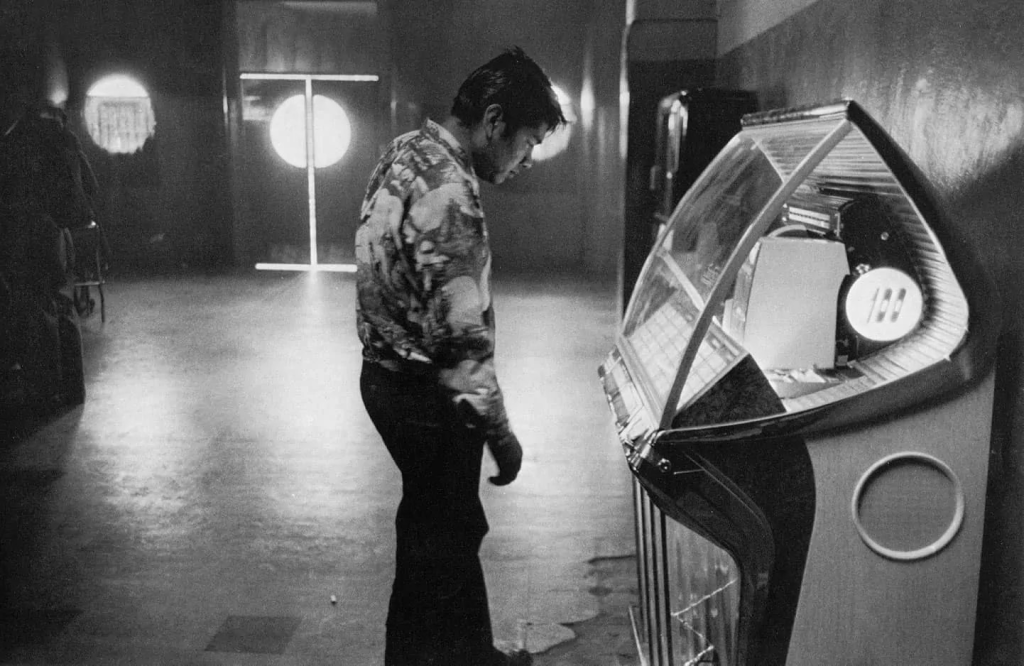
“THAT CRAZY FEELING IN AMERICA when the sun is hot on the streets and music comes out of the jukebox or from a nearby funeral, that’s what Robert Frank has captured. . . with the agility, mystery, genius, sadness and strange secrecy of a shadow photographed scenes that have never been seen before on film. . . . After seeing these pictures you end up finally not knowing any more whether a jukebox is sadder than a coffin. That’s because he’s always taking pictures of jukeboxes and coffins. . . !”3

Robert Frank
“Bar, Las Vegas, Nevada”
1955/56
Gelatin silver print
8 15/16” x 13 7/16”
The Art Institute of Chicago, Chicago, Illinois

“What a poem this is, what poems can be written about this book of pictures some day by some young new writer high by candlelight bending over them describing every gray mysterious detail, the gray film that caught the actual pink juice of human kind. Whether ’t is the milk of humankind-ness, of human-kindness, Shakespeare meant, makes no difference when you look at these pictures. Better than a Show.”4

Louis Faurer
“Robert Frank”
1947
Gelatin silver print
8 1/16″ x 5 3/8″
National Portrait Gallery, Smithsonian Institution,
Washington, DC.

And Kerouac’s last word to all of this:

“Anybody doesnt like these these pitchers dont like potry, see? Anybody dont like potry go home see Television shots of big hatted cowboys being tolerated by kind horses.”

“To Robert Frank I now give this message: You got eyes.”5


1 Frank, Robert; The Americans; (With and Introduction by Jack Kerouac); An Aperture Book, Grossman Publishers; New York, New York; 1969; p. vi.

2 Frank, Robert; The Americans; (With and Introduction by Jack Kerouac); An Aperture Book, Grossman Publishers; New York, New York; 1969; p. vi.

3 Frank, Robert; The Americans; (With and Introduction by Jack Kerouac); An Aperture Book, Grossman Publishers; New York, New York; 1969; p. i.

4 Frank, Robert; The Americans; (With and Introduction by Jack Kerouac); An Aperture Book, Grossman Publishers; New York, New York; 1969; p. iii.

5 Frank, Robert; The Americans; (With and Introduction by Jack Kerouac); An Aperture Book, Grossman Publishers; New York, New York; 1969; p. vi.

MARJORIE PHILLIPS & NIGHT BASEBALL

Several years ago, during a visit to the Detroit Institute of the Arts, I was surprised to discover a painting by Robert Moskowitz, “Hard Ball III.”  This painting reminded me of my own love of baseball.  From childhood stickball games in the street, where fire hydrants, telephone poles, and man-hole covers served as the bases, and on to later years when we played in a summer league on real fields along the Mall and the Elipse just across the street from the White House in Washington, DC. 


Robert Moskowitz
“Hard Ball III”
1993
Oil on canvas
108” x 58”
Detroit Institute of the Arts,
Detroit, Michigan

The Washington Senators were of course our home town team.  One had to root, root, root for the home team even when they didn’t win, which was often, and a shame.  But it was always great, whether we were sitting right there on the first base line or out in left field waiting for hits from Mantle and Berra, or Runnels and Busby and Yost.  

Over the years my Dad and I both worked for a printing and photography company located at 19th and K Streets, NW:  he much earlier in his career, and I during the summers right after high school and on through art school.  The company was called Cooper/Trent after its two owners, and we were all baseball fans.   Mr. Cooper and Mr. Trent had season tickets at Griffith Stadium and would usually bring back souvenirs for us, a photograph signed by Stan “The Man” Musial of the Cardinals, and a baseball, signed by the entire Senators team.  I still have both of these, to this day. 

Photographer Unknown
“Stan Musial” (Publicity Photo)
c.1956-1957
B&W Photograph
11” x 8 1/2”
Private Collection, Indianapolis

But this is about something larger than these pieces of nostalgia.  It is about a history that is both athletic and aesthetic:  perfect for bridging the gap between painting and poetry, and as it turns out, two women have played an important part in this process. 

During the 1930’s and 40’s the artist Marjorie Acker Phillips accompanied her husband Duncan to hundreds of local baseball games.  Duncan Phillips of course, was the founder of the Phillips Collection of Washington, DC.  During these outings, Marjorie often carried a sketchbook and drawing materials with her and drew the field, the players, and the general atmosphere of that great old ballpark, Griffith Stadium. 

Later in the 1950’s and 60’s in New York, the poet Marianne Moore also became a baseball fan, especially of the Brooklyn Dodgers.  Pee Wee Reese and Roy Campanella were some of her favorite subjects.  She was well aware of the contribution that Jackie Robinson was making to our history at that time, and I think that the sound of Branch Rickey’s name may have brought a smile to her face.   

“Baseball and Writing”  

“Fanaticism?  No.  Writing is exciting
and baseball is like writing. 
         You can never tell with either
                  how it will go
                  or what you will do; 
generating excitement—
a fever in the victim—
pitcher, catcher, fielder, batter. 
                  Victim in what category? 
Owlman watching from the press box? 
                  To whom does it apply? 
                  Who is excited?  Might it be I?[i]    

As the Phillips Collection developed and grew, Marjorie and Duncan Phillips moved out of their original home near DuPont Circle in Washington, and gave over the entire space to the museum.  The Phillips Collection became the first museum in the country dedicated to modern art.  It also provided an educational component in support of the works contained therein, and soon became known as a museum of modern art and its sources.  Works of art were grouped as they played off of each other:  from Ingres, Goya and Delacroix to Degas, Renoir and Cezanne, from Monticelli to van Gogh, with Henri Matisse, Francis Bacon and Georges Braque included in the mix.    

Over the years Marjorie Phillips’ work became more known and she continued to enjoy the games of the Washington Senators at Griffith Stadium.  Her painting “Night Baseball” depicts a moment during a Yankees/Senators game when Joe DiMaggio comes up to bat.  It is 1951, his last playing season.  Everything is still, and rather than depict an action, she chose instead the tension of waiting on the delivery of that pitch to home plate. 

I have recently discovered, from an old article in the Washington Post, that Marianne Moore had actually seen this painting and wrote to Marjorie Phillips about it.[ii]  “Night Baseball” could have ended up in the collection of Miss Moore, unfortunately Marjorie Phillips had already given it as a gift to her husband Duncan, who placed it in his collection.  Supposedly, even the National Baseball Hall of Fame in Cooperstown was interested in this painting, however it has remained in the Phillips Collection to this day.

It has been years since the Senators and Calvin Griffith left Washington, DC.  They are only memories nowadays.  However, newer painters and poets often remind us of those days.  As mentioned above, Robert Moskowitz has always chosen simple, iconic images for his work, transforming them into monumental statements.  Now, the poet Joseph Stanton, in the series “Painting the Corners” from his recent collection Things Seen, has taken a similar look at familiar icons, and this includes Marjorie Phillips’ painting “Night Baseball.”

Marjorie Phillips 
“Night Baseball”
1951
Oil on canvas
24 1/4” x 36”
Gift of the artist to the Phillips Collection
Washington, DC.

 MARJORIE PHILLIPS’ Night Baseball

“It’s the 1st of September 1951
and Joe Dimaggio
is about to take his last swing
in our nation’s capital. 
He’s up against the great,
but largely forgotten,
Connie Marrero,
El Guajiro de Labertinto,
El Premier of the Cuban stars,
four years older than Joltin’ Joe,
but still floating them up there,
one damned knuckle ball after another,
pitching with canny discernment
and elderly grace,
losing game after game,
for the hapless Senators,
despite his stellar ERA. 

The electrified white of his home togs
makes him seem a bright X,
marking the spot of green field
that waits under the glowering bruise
of the night sky
suspended above Griffith stadium
in this brief instant before the fateful pitch. 

Duncan Phillips has taken his wife
to witness the great Dimaggio,
another masterpiece for their gallery,
but Marjorie can see this night
as all about the weary pitcher,
spread-limbed as if on a cross,
arrayed against the base path
the too much celebrated Joe
will too soon circle. 

Oh, where have you gone,
Connie Marrero?”[iii]                          


[i] Schulman, Grace, ed; The Poems of Marianne Moore; Viking Penguin; New York, New York; 2002; p. 329.

[ii] Gildea, William; “Griffith Stadium Still Green and Alive;” The Washington Post; Washington, DC; 6 April 1985.  

[iii] Stanton, Joseph; Things Seen; Brick Road Poetry Press; Columbus, Georgia; 2016; pp. 106-107.

CHARLES SHEELER AND THE SHAKERS

“I know a good print when I see it.  I know when it is good and why it is good.  It is the neck of a man, the nose of a woman . . . . It is a photograph by Sheeler.  It is.  It is the thing where it is.  So.  That’s the mine out of which riches have always been drawn.”[i]

Charles Sheeler
“Shaker Window”
c. 1935
B&W photograph
The William H. Lane Collection,
Museum of Fine Arts,
Boston, Massachusetts

This is one of many observations made by William Carlos Williams regarding his long time friend Charles Sheeler.  Williams was constantly calling for an “intense vision of the facts”[ii] and considered a painting or a photograph or a poem as a thing to be shaped or carved out in the process. 

Williams noted this many times throughout his career:  from his early work, in several of his essays, and in his epic poem Patterson.  It even came up in his “Introduction” for Sheeler’s Retrospective Exhibition at the Museum of Modern Art in New York in 1939 where he observed:  “It is in things that for the artist the power lies. . . .”[iii]

Sheeler had a wide range of interests, not only through his professional work but also as an inquisitive and thoughtful human being.  He supported himself for many years as a documentary photographer both with Vogue and Fortune Magazines, as well as work for the Metropolitan Museum of Art.    

These projects often paralleled his aesthetic interests, complimenting his studio work.  Modern industrial subjects such as the factories in Ballardvale, Massachusetts and the Ford Motors plant in Detroit, Michigan became important sources of inspiration for this work.  Simultaneously, he was interested in, and paid visits to historic farmhouses in Pennsylvania and New England, as well as communitarian sites such as the Ephrata Community in Lancaster County, and the Shaker Villages in both Mount Lebanon, New York and Hancock, Massachusetts.  He even began collecting certain pieces of antique furniture with which he furnished his own home:  folk art, ceramics, curved wooden boxes, and of course many Shaker chairs, cabinets, and tables. 

Charles Sheeler
“Buildings at Lebanon”
1949
Tempera and graphite on pressed board faced with sized paper
14 5/16” x 20 1/4” 
Walker Art Center, Minneapolis, Minnesota 

William Carlos Williams even noted how his friend Charles Sheeler had taken certain objects and constructed an environment in which to live.  Williams writing in his autobiography stated: 

“The poem is our objective, the secret at the heart of the matter—as Sheeler’s small house, reorganized….”

“Charles Sheeler, artist, has taken the one rare object remaining more or less intact…and proceeded to live in it…and make a poem (a painting) of it….”[iv] 

“How shall we in this region of the mind which is all we can tactically, sensually know, organize our history other than as Shaker furniture is organized?  It is a past, totally uninfluenced by anything but the necessity, the total worth of the thing itself, the relationship of the parts to the whole.  The Shakers made furniture for their own simple ritualistic use, of white pine, applewood, birch—what they had.  Sheeler has a remarkable collection of this furniture.”[v]                

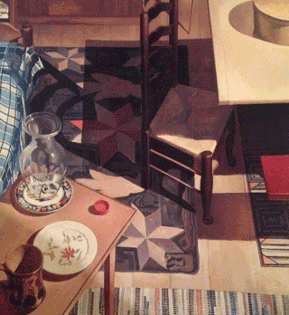
Charles Sheeler
“American Interior”
1934
Oil on canvas
32 1/2” x 30”
Gift of Mrs. Paul Moore,
Yale University Art Gallery,
New Haven, Connecticut

For several years Sheeler had been working on an autobiography, which he turned over to the writer Constance Rourke, who edited and organized it.  Rourke drew heavily upon Sheeler’s words, which became an important element in her monograph on this artist in 1939.  Later, the historians Faith and Edward Demming Andrews referred to this book in their article on Sheeler in “Art in America” that focused on his interest in the Shakers: 

“But as time went on he must have become more and more convinced that he wanted to do, through his medium, what the Shakers . . . had done in theirs:  to strip away all that was superficial, to find the essential, the absolute, the inner undisguised meaning, the final irreducible character in form.”[vi] 

Charles Sheeler
“Americana 31”
1931
Oil on canvas
36” x 48”
Collection of Mr. and Mrs. Milton Lowenthal,
Museum of Modern Art, New York

Sheeler himself had many things to say regarding his interests and this collection.  They were historic artifacts by that time, but they were also very contemporary in feeling and form.  He stated that:  “I don’t like these things because they are old but in spite of it.  I’d like them still better if they were made yesterday because then they would afford proof that the same kind of creative power is continuing.”[vii] 

Charles Sheeler
“Shaker Detail”
1941
Oil and tempera on Masonite
8.75” x 9.75”
Wallace M. Scudder Bequest
Newark Museum of Art, Newark, New Jersey

“No embellishment meets the eye.  Beauty of line and proportion through excellence of craftsmanship make the absence of ornament in no way an omission.  The sense of light and spaciousness received upon entering the hall is indicative of similar spiritual qualities of the Shakers.  Instinctively one takes a deep breath, as in the midst of some moving and exalted association of nature.  There were no dark corners in those lives.”[viii] 

Charles Sheeler
“On a Shaker Theme”
1956
Oil on canvas
30” x 36”
Stephen and Sybil Stone Foundation,
Wareham, Massachusetts

“—Say it, no ideas but in things— 
         nothing but the blank faces of the houses
         and cylindrical trees 
         bent, forked by preconception and accident—
         split, furrowed, creased, mottled, stained—
         secret—into the body of the light!”[ix]


[i] Williams, William Carlos; “The Descent of Winter” included in Imaginations; New Directions Publishing Corporations; New York, New York; 1971; p. 253.     

[ii] Williams, William Carlos; “The Descent of Winter” included in Imaginations; New Directions Publishing Corporation; New York, New York; 1971; p. 231.

[iii] Williams, William Carlos; Selected Essays; New Directions Publishing Corporations; New York, New York; 1992; p. 234.     

[iv] Williams, William Carlos; The Autobiography of William Carlos Williams; New Directions Publishing Corporation; New York, New York; 1967; pp. 332-333.

[v] Williams, William Carlos; The Autobiography of William Carlos Williams; New Directions Publishing Corporation; New York, New York; 1967; pp. 333-334.

[vi] Andrews, Faith and Edward D.; “Sheeler and the Shakers;” Art in America; New York, New York; Number One; 1965; p. 95.

[vii] Rourke, Constance; Charles Sheeler:  Artist in the American Tradition; Kennedy Galleries, Inc., and Da Capo Press; New York, New York; 1938 and 1969; p. 136.

[viii] Rourke, Constance; Charles Sheeler:  Artist in the American Tradition; Kennedy Galleries, Inc., and Da Capo Press; New York, New York; 1938 and 1969; p. 136.

[ix] Williams, William Carlos; Patterson; New Directions Publishing Corporations; New York, New York; 1992; pp. 6-7.     

IN THE AMERICAN GRAIN:  CHARLES SHEELER AND WILLIAM CARLOS WILLIAMS

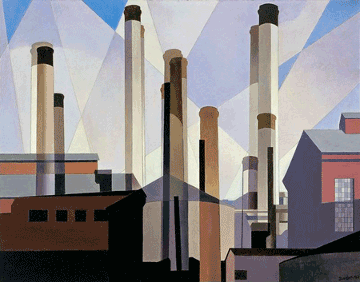
“We looked upon the French with a certain amount of awe because we thought they had secrets about art and literature which we might gain.  We were anxious to learn, and yet we were repelled too.  There was a little resentment in us against all the success of the French.  The time had come for us to talk on our own terms.  We felt this.”[i]

Charles Sheeler
“Buttresses, Chartres Cathedral”
1929
Gelatin silver print
9 5/8” x 7 9/16”
Gift of the artist
Museum of Modern Art, New York

“Even though I have so profound an admiration for the beauty of Chartres, I realize strongly that it belongs to a culture, a tradition, a people of which I am not a part….It seems to be a persistent necessity for me to feel a sense of derivation from the country in which I live and work.”[ii] 

Here are two important statements by 20th Century Americans:  the first from William Carlos Williams and the second from Charles Sheeler.  They became friends almost immediately after meeting for the first time and remained so for years to follow.  Sheeler was concerned as a painter and photographer with discovering an American vision and a local, immediate subject matter.  Williams, in his search for a poetic voice and an American idiom in his writing, incorporated everyday subjects and images, always insisting to ‘say it, no ideas but in things!’[iii]

In her early book on Charles Sheeler, Constance Rourke noticed the mutual interest in painting and poetry and the personal affection that had been established between the painter Charles Sheeler and the poet William Carlos Williams.  They travelled in some of the same social and aesthetic circles:  in Philadelphia within the Louise and Walter Arensberg family of influence, and New York, both were included in the circle built around the Steiglitz Group, which also included the artists Marsden Hartley and Charles Demuth. 

Elizabeth Black Carmer
“William Carlos Williams, Charles Sheeler and
Carl Carmer at the Carmer’s Octagon House”
1961
B&W photograph
26” x 21”
Archives of American Art, Smithsonian Institution,
Washington, DC.

“A new intercommunication between artists and writers had begun of which this lasting friendship was a symbol.  Williams, Wallace Stevens, and a few other ‘new’ poets had read some of their work at one of the Independents exhibitions.  Some of Sheeler’s drawings and photographs were reproduced in Broom. . . . Each group was tending more often to look at the work of the other, to consider it, stay with it, give it the warmth of immediate discussion.  Exchanges of ideas were taking place that might not be reflected directly in either painting or writing but could provide something in the way of a generative force for both.”[iv]

And here is one of Williams’ early observations regarding Sheeler’s work:  “Romance, decoration, fullness—are lost in touch, sight, a word, to bite an apple.  Henry Ford has asked Chas. Sheeler to go to Detroit and photograph everything.  Carte blanche.  Sheeler!  That’s rich. . . .”[v]

Charles Sheeler
“River Rouge Plant”
1932
Oil on canvas
20” x 24 1/8”
Whitney Museum of American Art, New York

Sheeler, in his capacity as a professional photographer, worked for several publications in the Conde Nast Group, as well as documenting the collection of the Metropolitan Museum of Art and the Arensburg family private collection.  Williams also knew of the Arensburg circle of artists, realists and surrealists amongst them, and of the importance of the local avant-garde.  These are interesting parallels in their lives and activities.  Today however, writers and artists often see this as the glorification of the industrial object, or as nostalgia, or realism so real, that it becomes surreal. 

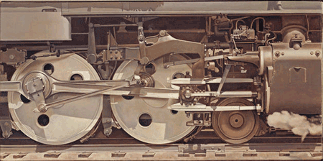
Charles Sheeler
“Rolling Power”
1939
Oil on canvas
15 “ x 30”
Smith College Museum of Art
Northampton, Massachusetts

The Descent of Winter 10/30

“To freight cars in the air
all the slow
         clank, clank
         clank, clank
moving above the treetops

the
         wha,   wha
of the horse whistle

         pah,   pah,   pah
         pah,   pah,   pah,   pah,   pah

         piece and piece
         piece and piece
moving still trippingly
through the morningmist

long after the engine
has fought by
                           and disappeared
in silence
                  to the left”[vi] 

Sheeler took great advantage of his many photographic essay commissions not just to document industrial sites in the East and the Mid-West, but to also collect valuable images for his own studio work in both drawing and painting.  Variations on many of these themes appeared in his work throughout his lifetime and they have continued to provide inspiration for several artists in younger generations.   

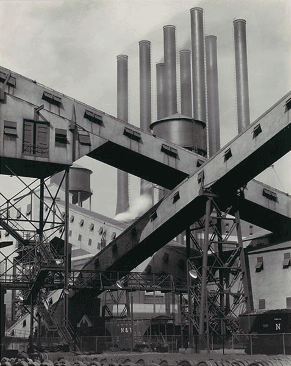
Charles Sheeler
“Criss-Crossed Conveyors—Ford Plant ”
1927
B&W Photograph
The William H. Lane Collection,
Museum of Fine Arts,
Boston, Massachusetts

Contemporary painters such as Donald Sultan and Robert Moskowitz have benefitted from this insight that is contained in Sheeler’s work:  an intense perception of the man-made environment and landscape.  Recent curators and art historians have also noticed this, especially those writing about the Industrial Sublime[vii] and Charles Sheeler and the Cult of the Machine.[viii]   It is an ongoing aesthetic.          

Donald Sultan
“Veracruz, November 18, 1986”
1986
Latex and tar on tile over Masonite
Matthew and Iris Strauss Collection,
Rancho Santa Fe, California

“A poem is a small (or large) machine made of words.  When I say there’s nothing sentimental about a poem I mean that there can be no part, as in any other machine, that is redundant. . . . Its movement is intrinsic, undulant, a physical more than a literary character.  Therefore, each speech having its own character, the poetry it engenders will be peculiar to that speech also in its own intrinsic form.  The effect is beauty, what in a single object resolves our complex feelings of propriety. . . .”

Charles Sheeler
“Stacks in Celebration”
1954
Oil on canvas
22” x 28”
Dayton Art Institute, Dayton, Ohio

“When a man makes a poem, makes it, mind you, he takes words as he finds them interrelated about him and composes them—without distortion which would mar their exact significances—into an intense expression of his perceptions and ardors that they may constitute a revelation in the speech that he uses.  It isn’t what he says that counts as a work of art, it’s what he makes, with such intensity of perception that it lives with an intrinsic movement of its own to verify its authenticity.”[ix]

Robert Moskowitz
“Stack”
2000
Pastel on paper
50 5/8” x 22 1/2”
Lawrence Markey Inc.,
San Antonio, Texas


[i] Rourke, Constance; Charles Sheeler:  Artist in the American Tradition; Kennedy Galleries, Inc., and Da Capo Press; New York, New York; 1938 and 1969; p. 49.

[ii] Tsujimoto, Karen; Images of America:  Precisionist Painting and Modern Photography; San Francisco Museum of Modern Art and the University of Washington Press; Seattle & London; 1982; p. 85.  (Statement made by Sheeler on his series of photographs of Chartres Cathedral, originally published in Constance Rourke; Charles Sheeler:  Artist in the American Tradition; New York, New York; Harcourt, Brace; 1938; p. 130).

[iii] Williams, William Carlos; Patterson; New Directions Publishing Corporation; New York, New York; 1946 & 1992; p. 6.

[iv] Rourke, Constance; Charles Sheeler:  Artist in the American Tradition; Kennedy Galleries, Inc., and Da Capo Press; New York, New York; 1938 and 1969; p. 50.

[v] Williams, William Carlos; Imaginations; New Directions Publishing Corporation; New York, New York; 1971; p. 253. 

[vi] Williams, William Carlos; Imaginations; New Directions Publishing Corporation; New York, New York; 1971; p. 246.

[vii] Botwinick, Michael, et al; Industrial sublime; Empire State Editions, Fordham University Press; Yonkers, New York; 2014.

[viii] Lucic, Karen; Charles Sheeler and the Cult of the Machine; Harvard University Press; Cambridge, Massachusetts; 1991.

[ix] Williams, William Carlos; I Wanted to Write a Poem:  The Autobiography of the Works of a Poet; (Edited by Edith Heal); New Directions Publishing Corporation; New York, New York; 1978; pp. 78-79.

BATTLE OF LIGHTS: CONEY ISLAND & BROOKLYN BRIDGE

For how many years have these two landmarks, Coney Island and the Brooklyn Bridge, attracted the attention of poets and painters?  Many have tackled this subject.  When we read Walt Whitman’s ‘Crossing Brooklyn Ferry’ or Hart Crane’s ‘To Brooklyn Bridge’ there are many elements that remind us of other works by artists like John Marin, Marsden Hartley and Joseph Stella.  Contemporary poets such as Lawrence Ferlinghetti and Joseph Stanton have also made mention of these sites. 

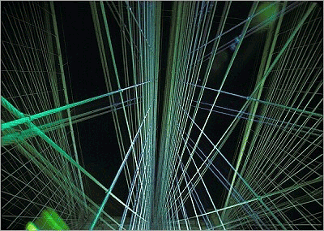
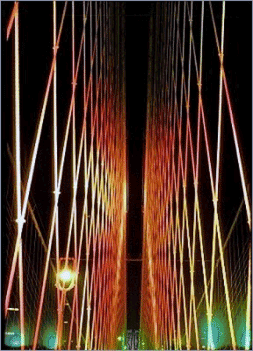
Most recently, and very importantly, we have images from the contemporary photographer Dudley Gray, whose work clearly shares many of these same aesthetic concerns.  In fact, many of Dudley Gray’s images have been published over the years, and the writer Janel Bladow has had this to say in describing his work in OMNI Magazine: 

“The cables of the Brooklyn Bridge…become flamboyant, spidery abstractions.  Around Manhattan other buildings, bathed in vivid colored light, brightly beam the urban nightscape.  These marvels of design sparkle like precious jewels.”[i] 

Dudley Gray
“Brooklyn Bridge Illuminations:  Cables”
COPYRIGHT 2003
Color photograph
Collection of the artist  

“Without altering the physical structure of the cityscape, artist Joseph Strand and photographer Dudley Gray can change the mood of the city.  Their urban illuminations transform today’s skyline into stunning abstract light sculptures of the future.”[ii] 

However, we must go back in time and follow a progression of these words and images.  In “Crossing Brooklyn Ferry” Walt Whitman describes some of the very spots that would later become the views people would have when crossing the Brooklyn Bridge.  In fact, throughout this poem Whitman makes reference to the generations of the future who will experience these sights. 

“The stretch afar growing dimmer and dimmer, the gray walls of the granite store-houses by the docks,

On the river the shadowy group, the big steam-tug closely flank’d on each     side by the barges—the hay-boat, the belated lighter,

On the neighboring shore, the fires from the foundry chimneys burning high and glaringly into the night,

Casting their flicker of black, contrasted with wild red and yellow light, over the tops of houses, and down into the clefts of streets.”[iii]

“Others will enter the gates of the ferry, and cross from shore to shore;
Others will watch the run of the flood-tide;

Others will see the shipping of Manhattan north and west, and the heights of Brooklyn to the south and east;

Others will see the islands large and small;

Fifty years hence, others will see them as they cross, the sun half an hour      high;

A hundred years hence, or ever so many hundred years hence, others will see them,

Will enjoy the sunset, the pouring in of the flood-tide, the falling back to the sea of the ebb-tide.”[iv]

John Marin
“Brooklyn Bridge, on the Bridge”
1930
Watercolor on paper
21 3/4” x 26 3/4”
Terra Foundation for American Art, Chicago, Illinois  

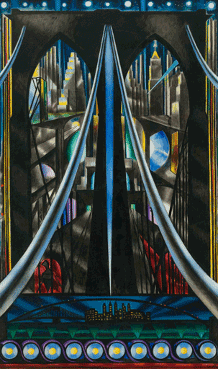
One of these others from fifty or one hundred years hence would surely be the painter Joseph Stella.  Stella has always been a difficult artist to categorize.  Although he was a very figurative painter he was not close to the American realists and regionalists so popular during the early years of the 20th Century.  Although he was a modernist, he would not be classified as a colonial cubist, as others were during that same era.  He is appealing to us today for these very reasons. 

Stella’s body of work includes almost classical portrait drawings of his contemporaries such as Edgar Varese, Marcel Duchamp, and Katherine Millay.  Amongst his most important, and famous images, are paintings from the “New York Interpreted” series, especially the works in reference to Coney Island and the Brooklyn Bridge.  And finally, there exists another body of work that includes many references to natural objects and fantasies. 

Another literary reference should be added here:  Joseph Stella wrote several manuscript notes regarding his individual paintings.  They were written fragments, translated from the Italian by Irma B. Jaffe, and included in her book dealing with the symbolism in Stella’s work.[v]  These written statements by Stella are in themselves quite serious and lyrical.  They do not just describe, but provide a literary parallel to his paintings.  They are just as mystical as his paintings, equal to them, and excellent examples of the ekphrastic process in their own right.

Joseph Stella
“The Brooklyn Bridge:  Variation on an Old Theme”
1939
Oil on canvas
70 1/4” x 42”
Whitney Museum of American Art,
New York, New York

“Seen for the first time, as a weird metallic Apparition under a metallic sky, out of proportion with the winged lightness of its arch, traced for the conjunction of Worlds, supported by the massive dark towers dominating the surrounding tumult of the surging skyscrapers with their gothic majesty sealed in the purity of their arches, the cables, like divine messages from above, transmitted to the vibrating coils, cutting and dividing into innumerable musical spaces the nude immensity of the sky, it impressed me as the shrine containing all the efforts of the new civilization of America…the eloquent meeting of all the forces arising in a superb assertion of powers, in Apotheosis.”[vi]

Joseph Stella
“Battle of Lights, Coney Island”
1913-1914
Oil on canvas
39 7/16” x 29 5/16”
Anna R. and Frank M. Hall Charitable Trust,
Sheldon Museum of Art, University of Nebraska,
Lincoln, Nebraska

Jumping ahead to contemporary literature, recent references have appeared to both Coney Island and Far Rockaway by Lawrence Ferlinghetti.  The very first book I read by Ferlinghetti was A Coney Island of the Mind, purchased in San Francisco in 1970 or so; and the most recent one was A Far Rockaway of the Heart, which I purchased just after his reading here in Indianapolis at Clowes Memorial Hall on the Butler University campus on 7 February 2000. 

We learned that night, that he had been continually writing, adding to, and expanding upon many of his earlier themes.  Even though he had spent so much time at the City Lights Bookshop in San Francisco, he seemed to be making several references to his earlier years:  the Brooklyn Bridge, Coney Island, and any number of childlike antics on sidewalks just below the bridges and elevated train tracks.    

The Junkman’s Obligato

“Let us arise and go now 
into the interior dark night
of the soul’s still bowery
and find ourselves anew
where subways stall and wait
under the River. 
Cross over
into full puzzlement. 
South Ferry will not run forever. 
They are cutting out the Bay ferries
but it is still not too late
to get lost in Oakland. 
Washington has not yet toppled
from his horse. 
There is still time to goose him
and go
leaving our income tax form behind
and our waterproof wristwatch with it
staggering blind after alleycats
under Brooklyn’s Bridge
blown statues in baggy pants
our tincan cries and garbage voices
trailing. 
Junk for sale!”[vii]

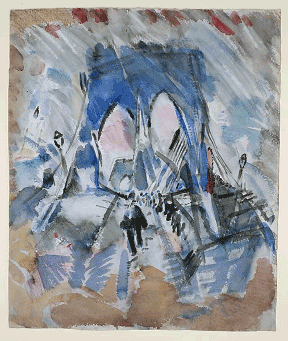
John Marin
“Brooklyn Bridge”
1912
Watercolor and charcoal
18 5/8” x 15 5/8”
Alfred Stieglitz Collection
Metropolitan Museum of Art, New York

Poets of a younger generation have also taken on these ideas and images, including the writer and art historian Joseph Stanton.  With his writing, Stanton creates imaginary places and even museums with various ‘wings’ housing his personal collection of ekphrastic masterpieces, including this reference to Josef Stella and the Brooklyn Bridge.

Josef Stella’s Brooklyn Bridge

“On his first painting of it,
lines of force slant this way, then slant that,
flickering a cacophony of blue and white
above a blossom of blood;
while the spine articulates—
in tiny, elegant detail—
the sequenced towers. 

Passing the frisson futurism
in subsequent pictures,
Stella settled to a symmetry
a quintessential modernism
that became the way he crossed
this bridge every subsequent time
he came to its soaring contradictions—

Josef Stella
“Brooklyn Bridge”
1919-1920
Oil on canvas
84.7” x 76.6”
Yale University Art Gallery
New Haven, Connecticut

medieval gothic are its massive piers
and yet the machined-aged cables of steel,
the taut song of its wiring mechanique,
is what lifts our spirits, transports us,
as we walk the interior passage,
unique to this suspension,
a path that makes our walking seem

a transit towards an altar,
an altar that turns out to be
the City of Brooklyn,
a place worthy of worship in its way,
but cruel, ungraspable. 
‘Only the dead know Brooklyn,’
sayeth the gospel of Thomas Wolfe.”[viii]                           

Thinking again about modernism and the “wiring mechanique,” Janel Bladow has summarized perfectly the effect of light falling on the Brooklyn Bridge, while quoting Dudley Gray:  “To Gray, light caresses structure.  ‘It’s like a love affair between light and steel.  Colors run from hot purples to cold blues.  Buildings suddenly acquire both intense identification and peaceful beauty in one dazzling moment.’”[ix] 

Dudley Gray
“Brooklyn Bridge Illuminations:  Cables”
COPYRIGHT 2003
Color photograph
Collection of the artist 

TO BROOKLYN BRIDGE

“Out of some subway scuttle, cell or loft
A bedlamite speeds to thy parapets,
Tilting there momently, shrill shirt ballooning,
A jest falls from the speechless caravan.

Down Wall, from girder into street noon leaks,
A rip-tooth of the sky’s acetylene;
All afternoon the cloud flown derricks turn…
Thy cables breathe the North Atlantic still.”[x]


[i] Bladow, Janel; “Luminicity,” OMNI; New York, New York; Volume 2, Number 11; August 1980; p. 70.

[ii] Bladow, Janel; “Luminicity,” OMNI; New York, New York; Volume 2, Number 11; August 1980; p. 70.

[iii] Whitman, Walt; “Crossing Brooklyn Ferry,” Selected poems; Gramercy Books; New York, New York and Avenel, New Jersey; 1992; Section 3, p. 144. 

[iv] Whitman, Walt; “Crossing Brooklyn Ferry,” Selected poems; Gramercy Books; New York, New York and Avenel, New Jersey; 1992; Section 2, p. 143.

[v] Jaffe, Irma B.; Joseph Stella’s Symbolism; Pomegranate Artbooks and Chameleon Books; San Francisco, California, and New York, New York; 1994.

[vi] Jaffe, Irma B.; Joseph Stella’s Symbolism; Pomegranate Artbooks and Chameleon Books; San Francisco, California and New York, New York; 1994; (Unpaginated, printed opposite Plate 13).

[vii] Ferlinghetti, Lawrence; A Coney Island of the Mind; New Directions Publishing Corporation; New York, New York; 1958; p. 56.

[viii] Stanton, Joseph; Moving pictures; Shanti Arts Publishing; Brunswick, Maine; 2019; p. 86.

[ix] Bladow, Janel; “Luminicity,” OMNI; New York, New York; Volume 2, Number 11; August 1980; p. 73.

[x] Crane, Hart, ed. Marc Simon; “To Brooklyn Bridge” from The Complete Poems of Hart Crane; Liveright Publishing Corporation; New York and London; 2001; p. 43.

MUSA MCKIM AND RAYMOND CARVER: MODERN DETAILS

Somehow in the course of events we have been led to believe that the ‘modern’ has come to mean only formalist abstraction and minimalism.  A smaller and smaller world defined by a very tight description.  There are however, several important modern writers and artists who have paid special attention to the details of modern life, seeing in them the larger world and how these details might speak to us. 

SUNDAY NIGHT
“Make use of the things around you. 
This light rain
Outside the window, for one. 
This cigarette between my fingers,
These feet on the couch. 
The faint sound of rock-and-roll,
The red Ferrari in my head. 
The woman bumping
Drunkenly around the kitchen . . .
Put it all in,
Make use.”[i]

“Don’t forget when the phone was off the hook
all day, every day.”[ii]   

“When, at 12:24, I look at the clock that isn’t running and it tells
the same time as the clock that is”[iii]   

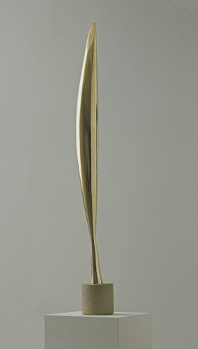
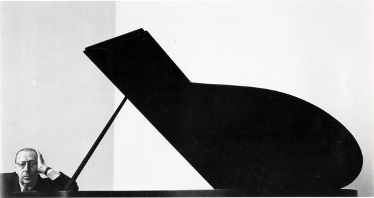
As we read the above observations, both Musa McKim and Raymond Carver look directly at the world surrounding us:  a telephone lying off its hook, a broken alarm clock, a bag of sugar, or just the sun creating a glare on a sheet of white paper.  Many of the same things that would catch the eye of an artist.  The abstract form and shape of a grand piano, or the abstracted movement of a bird in space.  All are examples of minimal imagery with maximum power that both poets and painters would employ.

Brancusi’s sculpture, straight out of a folk tradition, but unrecognzable to the Parisian elite, later became the sophisticated form that synthesized beauty, abstraction and content.  There is the catch:  abstraction and content.  At first no one saw Brancusi’s pieces as birds, neither in space nor in flight.  Today, however, they have become a symbol of just that. 

Constantin Brancusi
“Bird in Space”
1928
Bronze
54” x 8 ½” x 6 ½”
Collection:  Museum of Modern Art, New York

Not unlike the sculpture of Brancusi, the orchestral pieces of Igor Stravinsky synthesized classical music with jazz, folk and even the primal. Traditional painting had also gone through a similar synthesis of realism, cubism and pure plastic painting. 

Arnold Newman
“Igor Stravinsky, New York City”
1946
Black & White Photograph
12 1/16” x 22 5/16”
National Portrait Gallery, Washington, DC.

In the 1950’s and 60’s many young art students were taught by American abstract artists.  Process and abstraction formed the content of most of the work at that time.  But later, outside of academia, these artists were also confronted by the dilemma of what to do now?  They were well versed in process, but struggled to find content.  One artist however, set the  most impressive example.  Philip Guston at his Marlborough show in 1970  envisioned the end of one aspect of this process, and opened the gates and possibilities to new forms of imagery.  Making use of the things around him. 

By looking at certain details occurring in the world he single handedly opened the doors for himself, for poets, and later artists to come.  These included Clarke Coolidge, Musa McKim, Raymond Carver, Robert Moskowitz, Elizabeth Murray, Susan Rothenberg and more.

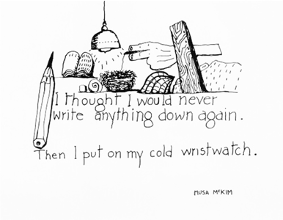
“I thought I would never write anything down again.  Then I put on my cold wristwatch.”[iv] 

Philip Guston in collaboration with Musa McKim
“I thought I would never write anything down again.”
(UNDATED)
Pen & ink drawing on paper
19” x 24”
The Estate of Musa Guston

In the mid 1960’s Robert Moskowitz produced a series of small paintings of a simple corner of a room.  Quiet, minimal, very abstract and infused with a new sense of content and space.  Where the simplest shape or form of a thing could clearly speak. 

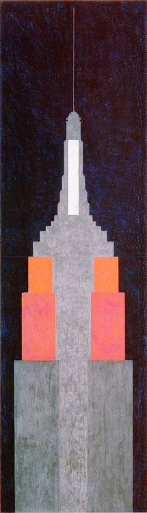
He would later take this process, including both personal and universal images, and juxtapose them in subtle but provacotive ways.  A corner of the Flatiron Building, or the tops of the Empire State Building and the World Trade Towers, for example.  A simplified assortment of visual images, not unlike the sparse and provacotive language used by Raymond Carver and Musa McKim.

Robert Moskowitz
“Untitled (Empire State)”
1980 
Graphite and pastel on paper
106” x 31 1/4”
Collection:  Mr. and Mrs. Robert K. Hoffman,
Dallas, Texas

“Talking about her brother Morris, Tess said: 
‘The night always catches him.  He never
believes it’s coming.’”[v]     

“When on TV I see my sister in a bit part in an old movie”[vi]   

“Three men and a woman in wet suits.  The door to their motel room is open and they are watching TV.”[vii]     

“And below in the street they are rattling the Coca-Cola bottles”[viii] 

Robert Moskowitz
“Painting (For Duke Ellington)”
1977
Oil on canvas
90” x 75”
Collection of Mary and Jim Parton, Great Falls, Virginia

His Bathrobe Pocket Stuffed With Notes
“Duke Ellington riding in the back of his limo, somewhere
in Indiana.  He is reading by lamplight.  Billy Strayhorn
is with him, but asleep.  The tires hiss on the pavement. 
The Duke goes on reading and turning the pages.”[ix]


[i] Carver, Raymond; “Sunday Night,” A New Path to the Waterfall; The Atlantic Monthly Press; New York, New York; 1989; p. 53.

[ii] Carver, Raymond; “His Bathrobe Pocket Stuffed With Notes,” A New Path to the Waterfall; The Atlantic Monthly Press; New York, New York; 1989; p. 66.

[iii] McKim, Musa; Alone With the Moon; The Figures; Great Barrington, Massachusetts; 1994; p. 105.

[iv] McKim, Musa; Alone With the Moon; The Figures; Great Barrington, Massachusetts; 1994; p. 121.

[v] Carver, Raymond; “His Bathrobe Pocket Stuffed With Notes,” A New Path to the Waterfall; The Atlantic Monthly Press; New York, New York; 1989; p. 64.

[vi] McKim, Musa; Alone With the Moon; The Figures; Great Barrington, Massachusetts; 1994; p. 105.

[vii] Carver, Raymond; “His Bathrobe Pocket Stuffed With Notes,” A New Path to the Waterfall; The Atlantic Monthly Press; New York, New York; 1989; p. 65.

[viii] McKim, Musa; Alone With the Moon; The Figures; Great Barrington, Massachusetts; 1994; p. 105.

[ix] Carver, Raymond; “His Bathrobe Pocket Stuffed With Notes,” A New Path to the Waterfall; The Atlantic Monthly Press; New York, New York; 1989; p. 66.

JOYCE, WHAT KIND OF NAME IS THAT?

Judy Linn
“Patti Smith’s Window, 23rd Street”
(Copyright) 1971
B&W Photograph
Collection of the artist

“conversation with the kid”

“who’s the guy on the glass?
that’s joyce.
joyce, that’s a girl’s name.
that’s a name.
well, what’s with him?
he watches over me.
he only got one eye.
a guy like him that’s all he needs.”[i]

The poems of Patti Smith are simultaneously cutting and fanciful, getting at a certain truth even as they weave myths, fantasies and contemporary literature together.  There are several statements made by Smith that remind me of another artist’s work, the contemporary painter Robert Barnes.  Whether in a poem by Smith or a painting by Barnes, we definitely witness a series of visual ambiguities and associative shifts taking place.

“a coronet of stars
ornament of the tame
no one to bow to
to vow to
to blame
how did i die?
i tried to walk thru light
with tangled hair
not yet prepared
for the valley of combat.”[ii]   

Judy Linn
“Patti Smith as Bob Dylan”
(Copyright) 1971
B&W Photograph
Collection of the artist

“dog dream”

“have you seen
dylan’s dog
it got wings
it can fly
if you speak
of it to him
it’s the only
time Dylan
can’t look you in the eye”

“have you seen
dylan’s dog
it got wings
it can fly
when it lands
like a clown
he’s the only
thing allowed
to look Dylan in the eye”[iii]

They both, Patti Smith and Robert Barnes, have their idols and inspirations, an assortment of creative and eccentric characters.  For Barnes these include:  James Joyce, Marcel Duchamp, Arthur Craven, Jeremy Bentham, and Tristan Tzara.  And Smith:  again James Joyce, William S. Burrows, Jean Genet, Andre Breton, Arthur Rimbaud, and Bob Dylan.  Magicians and tricksters they are, in both words and images.  Smith masquerading as Dylan, and Barnes often using the analogy of the slight of hand embodied in the old time ‘table cloth’ trick!

“dishes crank on my nerves”[iv] 

Robert Barnes
“Regency Room”
1981
Pastel on Masonite
23 7/8” x 23 7/8”
Larry and Evelyn Aronson, Chicago, Illinois

During the fall of 2015 the Indiana University Art Museum held a retrospective of Robert Barnes’ work, “Grand Illusions:  Late Works 1985-2015.”   This was such a powerful show, and it was the second such exhibition of his work that I have seen in person.  In his remarks at the opening Barnes mentioned several influential books including:  “The Golden Bough” by James George Frazer, “The White Goddess” by Robert Graves, and “Ulysses” by James Joyce.  Using these examples, he noted how a subject unfolds as it is invented in his paintings.  A narrative transformation of sorts takes place.[v] 

“Robert Barnes 1956-1984 A Survey” was the earlier exhibition organized by the Madison Art Center in Wisconsin, which travelled to the Herron School of Art in Indianapolis, and several other national locations.  The main essay for this catalogue was written by the Chicago critic and curator Dennis Adrian, and set about describing and defining many of the issues and ideas that flow through this work.

“The complex, shifting, and many-layered sense of a larger reality has important correspondences in Barmes’s (sic) various literary and artistic enthusiasms.  Among the most significant of these is his love and regard for the writing of James Joyce.  In fact, Barnes’ method and effects are like the continuous unreeling present in Joyce’s Ulysses, where the events of Leopold Bloom’s day are experienced by both him and the reader as shifting and overlapping elements of feeling, observation, memory, fantasy, imagination, conflation of past and present…all of which are rooted in the structure, incidents, and characters of Homer’s Odyssey.[vi]  

“In both Joyce and Barnes, the ‘subject,’ so to speak, is created and even invented freshly for us, but it also contains, through parallels of structure, allusion, or direct reference, a connection with other realms of experience, ‘actual,’ artistic, or both….The elements in Barnes’ paintings which feel like the record or recollections of some specific actuality help to create a forceful presence for his abstract inventions and the curious forms which we seem to recognize but cannot identify, that is, the things which we know about perceptually but cannot name.”[vii]   

Robert Barnes
“James Joyce”
1959
Oil on canvas
96 1/4” x 72”
Private Collection, New York

More recently, I wrote to Robert Barnes to ask him about his work and especially his interest in James Joyce.  He graciously responded:   

“When I attended the University of Chicago in the fifties I was fortunate to have as a friend the poet Paul Carroll who wanted to be James Joyce!  We had as a drinking companion an Irishman who was then the answerman for the now defunct Chicago Daily News!  He was at one time an actor at the Abbey Theatre in the old country!  If we bought him drinks he would recite complete Irish plays (all the parts)!”

“At one time he undertook the reading of Ulysses!  He could do the plays verbatim but read Joyce from a book!  He claimed it had to be read with an Irish accent and I believe he was right!  It took him several evenings and lots of booze but was well worth it and gave me a life long love of things Joycean!”

Nancy Morgan Barnes
“Portrait of Bob (in front of his painting Molinard-Grasse)”
2000
Oil on panel
Indiana University Art Museum,
Bloomington, Indiana

“I have been fortunate in to have encountered inspiring people at the right time (it seems magical)!  Even without an Irish accent I think it a good idea to read Ulysses aloud or at least part of it….it is a life changing experience!”[viii]

Racing through a day in Dublin, in a stream of consciousness, Ulysses proceeds with abandon to its conclusion.  Its characters and stories often parallel the paintings of Robert Barnes.  Not only in his painting of Joyce, but in many other subjects, Barnes has created a cast of invented characters and self-portrait equivalents that exist within the spatial logic of both painting and poetry.

At the other end of the aesthetic spectrum, the Joyce family often used a local Dublin painter for family portraits.  This task went to Patrick Tuohy, who required James Joyce to sit daily for almost a month.  With tensions building between the artist and the writer as the work went on, Joyce became increasingly irritable, and it has been noted:  “…he was impatient with the artist’s pretensions:  ‘Never mind my soul.  Just be sure you have my tie right.’”[ix]

Patrick Tuohy
“James Joyce in Paris”
1924
Oil on canvas
24” x 19 3/4”
State University of New York, Buffalo, New York

“In art and dream may you proceed with abandon.
In life may you proceed with balance and stealth.”[x]   


[i] Smith, Patti; Early Work:  1970-1979; W. W. Norton & Company; New York and London; 1994; p. 13.

[ii] Smith, Patti; Early Work:  1970-1979; W. W. Norton & Company; New York and London; 1994; p. 163.

[iii] Smith, Patti; Early Work:  1970-1979; W. W. Norton & Company; New York and London; 1994; pp. 22-23.

[iv] Smith, Patti; Early Work:  1970-1979; W. W. Norton & Company; New York and London; 1994; p. 53.

[v] A discussion between Robert Barnes and Michael Brooks that took place during the opening ceremonies of the “Robert Barnes:  Grand Illusions, Late Works 1985-2015” exhibition at the Indiana University Museum of Art, Bloomington, Indiana.  From my notes taken during that program, 25 September 2015. 

[vi] Adrian, Dennis; “Robert Barnes 1956-1984 A Survey;” The Madison Art Center; Madison, Wisconsin; 1984; p. 10. 

[vii] Adrian, Dennis; “Robert Barnes 1956-1984 A Survey;” The Madison Art Center; Madison, Wisconsin; 1984; p. 10. 

[viii] Barnes, Robert; from an e-mail correspondence with this writer on 24 March 2020, at 11:53 am.

[ix] Joyce, James; Ulysses; Everyman’s Library; Alfred A. Knopf; New York, London, and Toronto; 1997; p. xxviii.

[x] Smith, Patti; Early Work:  1970-1979; W. W. Norton & Company; New York and London; 1994; p. x.

WAR, WHAT’S IT GOOD FOR?

war1
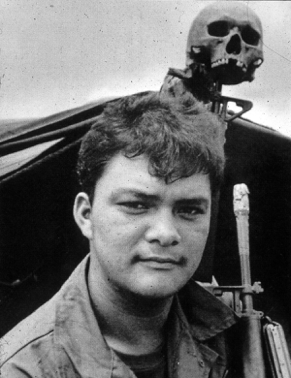
Dick Durrance
“An American soldier with a VC skull”
1968
B&W Photograph
DASPO, US Army


From ancient Greek sculptures on the theme of “The Fallen Warrior” to Uccello’s sequence of three versions of “The Battle of San Romano” we have the beginnings of a great history of images of war.

In 1633 the artist Jacques Callot published his “Miseries and Misfortunes of War” as a response to the French invasion of Lorraine during the Thirty Years War.  In the early 19th Century, it was Francisco Goya who was inspired to work in this direction as he witnessed the Napoleonic invasion of Spain from 1808 to 1814, which resulted in his series of  “The Disasters of War.”

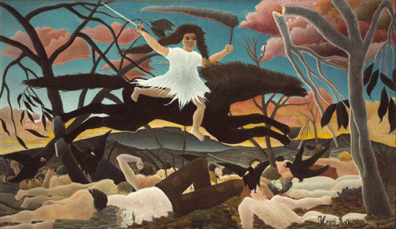
Even the French artist Henri Rousseau took up the subject in his 1894 painting titled:  “War, or The Ride of Discord.”  Although it had been more than twenty years since the Franco-Prussian War of 1870 these events continued to haunt Rousseau’s ideas for paintings.

war2
Henri Rousseau,
“War, or The Ride of Discord”
1894
Oil on canvas
1.145m x 1.95m
Musee d’Orsay, Paris


From the earliest years of photography, during both the Crimean War and the American Civil War, to present day combat photographers and journalists, we have a continuing record of many important historical events.

war3
Mathew Brady
“Photographic outfit near Petersburg, Virginia,
used during the American Civil War”
1864
B&W Photograph
Library of Congress, Washington, DC.


The initial Armistice Day was offered as a celebration of the peace that came at the end of the First World War on 11 November 1919.  Unfortunately, this annual observance has now turned into a celebration of war, the exact opposite of its original intent.
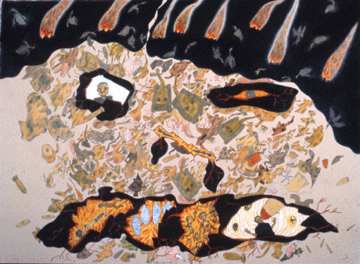
Many recent artists and veterans have used a variety of media as a means of documenting and coming to grips with their wartime experiences.  However, it is the aftermath that becomes more confusing.  From a distance, there is a completely different perspective.

The Smithsonian Institution, the Library of Congress and the United States Army Center of Military History all have important collections of works of art created by active participants and witnesses in the field.  More recently the Viet Nam Veterans Artist Group was formed and organized in Chicago, from 1981 to 1992 and has now grown and become known as the National Veterans Art Museum.[i]

war4
Karl Michel
“Loomings”
1983
Pastel on paper
34 3/4” x 25 3/4”
National Veterans Art Museum, Chicago, Illinois


Inspired by many of the artists whose work is in the collection of the National Veterans Art Museum as well as work from the United States Army Center of Military History, the Indianapolis Art Center curated an important exhibition of this work in it’s “Art of Combat:  Artists from the Viet Nam War Then and Now” in 2000.[ii]

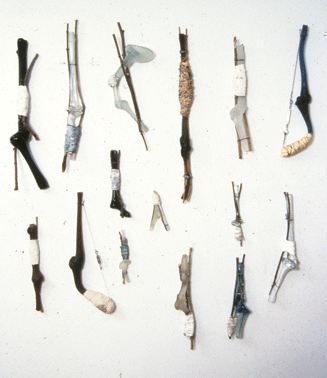
Many veterans, as well as concerned civilians in the United States, have chosen this as a major part of their subject matter, including:  Arturo Alonzo Sandoval, Ric Haynes, David Shirm, Michael Helbing, Karl Michel and especially Michael Aschenbrenner in his “Broken Bone” series.  Although many of these artists were actual witnesses to the Viet Nam War, their current works are often reflections and memories of events sometimes lost, and sometimes regained.

war5
David Shirm
“What We Left Behind”
1992
Prisma color on paper
22” x 30”
Courtesy of the artist


Writers and musicians during the 1960’s also tackled these issues.  How could we forget the words of Bob Dylan’s “Masters of War” or Country Joe and the Fish’s “I Feel Like I’m Fixin’ to Die?”  A number of other examples include work by Joan Baez, Judy Collins, Barry McGuire and Kemo Williams.  And especially, Edwin Starr’s “War!”

“…Oh, war it’s an enemy to all mankind
The point of war blows my mind
War has caused unrest
Within the younger generation
Induction then destruction
Who wants to die, ah, war-huh, good god y’all
What is it good for
Absolutely nothing
Say it, say it, say it
War, huh
What is it good for
Absolutely nothing listen to me…”

war6
Michael Aschenbrenner
“Damaged Bone Series”
1990
Glass, fabric, wire and twigs
Variable dimensions
Metropolitan Museum of Art, New York


“…it ain’t nothing but a heart breaker
(War) it’s got one friend that’s the undertaker
Oh, war, has shattered many a young mans dreams
Made him disabled, bitter and mean
Life is much too short and precious
To spend fighting wars these days
War can’t give life
It can only take it away

Oh, war, huh good god y’all
What is it good for
Absolutely nothing say it again….”[iii]


[i] Sinaiko, Eve, et al.; Vietnam:  Reflexes and Reflections; the National Vietnam Veterans Art Museum and Harry N. Abrams, Inc.; Chicago, Illinois and New York, New York; 1998.

[ii] Moore, Julia Muney, et al.; The Art of Combat:  Artists and the Vietnam War, Then and Now; Indianapolis Art Center; Indianapolis, Indiana; 2000.

[iii] Starr, Edwin; “War” (lyrics by Barret Strong and Norman Whitfield); 20th Century Masters:  The Millennium Collection – The Best of Edwin Starr; Audio CD, B00005R8E7; Motown Records; 2001.

LET US NOW PRAISE FAMOUS MEN

“When we say that the artist imitates the poet or the poet the artist, we can mean one of two things:  either that the one takes the other’s work as his model, or that both work from the same model and one borrows his manner of presentation from the other.”[i]

“If . . . the poet and the artist must contemplate those objects common to both from the same point of view, the inevitable result is that their representations will correspond to one another in many points without there having been even the slightest imitation or emulation.  These points of agreement between contemporaneous artists and poets in regard to things that no longer exist may lead to mutual illumination . . . .”[ii]

Although the above observations were made by Gotthold Ephraim Lessing concerning ancient examples of sculpture and literature they could just as easily apply to a more modern example:  Let Us Now Praise Famous Men.[iii]

James Agee and Walker Evans were commissioned to produce a series of essays and images documenting rural life in the Southern United States in the aftermath of the Great Depression.  After many stops and starts, negotiations with publishers and printers, and a very general concept and structure for this project, they set off touring the South and ultimately living with three sharecropper families.  A writer and an artist, sharing their experiences first hand, responding to the people, the landscape, the times, and to each other, Agee and Evans produced one of the most haunting and lyrical portraits of American life.

walker1
Walker Evans
“House of cotton sharecropper Floyd Borroughs, Hale County, Alabama”
1936-1941
Gelatin silver print
5 1/4” x 9 7/8”
The Library of Congress, Washington, DC.

“We lay on the front porch.  The boards were unplaned thick oak, of uneven length, pinned down by twenty-penny nails.  A light roof stuck out its tongue above us dark and squarely, sustained at its outward edge by the slippery trunks of four young trees from which the bark had been peeled.  There were four steps down, oak two-by-twelves; the fourth, when stepped on, touched the ground.  These steps were in the middle of the porch.  They led, across the porch, into a roofed doorless hallway, about six feet wide, which ran straight through the house and clove it in half.  There was a floor to this hallway, of wide unplaned boards.  Laid across beams too wide apart, they sagged beneath a heavy foot.  For ten feet toward the rear end they were only an inch from the ground.  At the end they lay flush on it.”[iv]

The title for this work seemed to be almost Biblical to me and I tried to search for its source.  It turned out to be from the book of Ecclesiasticus in the Apocrypha, not to be confused with Ecclesiastes.  So it is not included in modern editions.  It does however, recognize and praise the generations of mankind, from all walks of life and throughout time, drawing parallels between the ancient and the modern.

“Let us now sing praises of famous men, our ancestors in their generations.

The Lord apportioned to them great glory, his majesty from the beginning.

There were those who ruled in their kingdoms, and made a name for themselves by their valor; those who gave counsel because they were intelligent; those who spoke in prophetic oracles . . . .”

walker2
Walker Evans
“Bud Fields, Sharecropper’s Family, Hale County, Alabama”
March 1935
Gelatin silver print
7 5/8” x 9 5/8”
Gift of the Farm Security Administration,
Museum of Modern Art, New York.

“Some of them have left behind a name, so that others declare their praise.

But of others there is no memory; they have perished as though they had never existed; they have become as though they had never been born, they and their children after them . . . .

The assembly declares their wisdom, and the congregation declares their praise.”[v]

The original names of the farmers were Frank Tengle, Bud Fields, and Floyd Burroughs.  In order to protect and insure the privacy of these farmers and their families the names in the text were changed to Fred Gavin Ricketts, Thomas Gallatin Woods, and George Gudger.  The dates of the photographs also vary, from as early as 1936 to as late as 1941.  These were probably mix-ups in between the shooting, printing, and publishing times as well as museum and gallery cataloging.

Although I have found examples of Walker Evans’ photographs from several collections including the National Gallery and the Library of Congress, the Art Institute of Chicago and the Museum of Modern Art, they are all copyrighted through the Walker Evans Archives at the Metropolitan Museum of Art in New York.  Below you will find a small portfolio of the photographic images and literary quotations from Let Us Now Praise Famous Men.  These are paired in such a way as to give a broader picture of this work, however, they are not a substitute for it in its entirety.  Only an introduction.

“Its west wall is the front of the house; its north wall, the hallway; its east wall, the partition; its south wall, the side of the house.  At the center of the partition wall is a fireplace.  At the center of the side wall and of the front wall is an exactly square window, about three feet each way.  At the center of the north wall a door leads into the rear bedroom.  The doors are very wide vertical planks, not paneled, but crosslaid with planks in a Z.  They are held shut by block wood buttons and are kept shut most of the time. . . .”

walker3
Walker Evans
“Fireplace, Burrough’s Bedroom, Hale County, Alabama”
1936
Gelatin silver print
9 15/16” x 8”
National Gallery of Art, Washington, DC.

“. . . The square shutters, hung on sagged and rusted, loud hinges, are less broad verticals.  Always at night and nearly always during the day they are drawn shut and secured, one by a leather strap over a nail, the other by a piece of rag over a nail.  When they are shut, the room is dark and has a special heat and odor of daylight darkness; but also there is a strong starlight of sunshine with slits and blades and rods of light through the roof and two outward walls and, looking through the floor, the quiet sunless daylighted grain of the earth can be seen, strange to see as at the bottom of a lake; and in this oddly lighted darkness, certain flecks of the room are brilliantly picked out, and every part of it is visible.”[vi]

“Overalls”

“They are pronounced overhauls.”

“Try—I cannot write of it here—to imagine and to know, as against other garments, the difference of their feeling against your body; drawn-on, and bibbed on the whole belly and chest, naked from the kidneys up behind, save for crossed straps, and slung by these straps from the shoulders; the slanted pockets on each thigh, the deep square pockets on each buttock; the complex . . .”

walker4
Walker Evans
“Frank Tengle”
1936
Gelatin silver print
7 13/16” x 4 13/16”
Library of Congress, Washington, DC.

“. . . and slanted structures, on the chest, of the pockets shaped for pencils, rulers, and watches; the coldness of sweat when they are young, and their stiffness; their sweetness to the skin and pleasure of sweating when they are old; the thin metal buttons of the fly; the lifting aside of straps and the deep slipping downward in defecation; the belt some men use with them to steady their middles; the swift, simple, and inevitably supine gestures of dressing and of undressing, which, as is less true of any other garment, are those of harnessing and of unharnessing the shoulders of a tired and hard-used animal.”[vii]

walker5
Walker Evans
“The Frank Tengle Family in Hale County, Alabama”
1936-1941
Gelatin silver print
10 3/4” x 13 3/4”
The Library of Congress,
Washington, DC.

“The family exists for work.  It exists to keep itself alive.  It is a cooperative economic unit.  The father does one set of tasks; the mother another; the children still a third, with the sons and daughters serving apprenticeship to their father and mother respectively.  A family is called a force, without irony; and children come into the world chiefly that they may help with the work and that through their help the family may increase itself.  Their early years are leisurely; a child’s life work begins as play.  Among his first imitative gestures are gestures of work; and the whole imitative course of his maturing and biologic envy is a stepladder of learning of physical tasks and skills.

This work solidifies, and becomes steadily more and more, in greater and greater quantity and variety, an integral part of his life.”[viii]

“And Ellen where she rests, in the gigantic light:  she, too, is completely at peace, this child, the arms squared back, and palms open loose against the floor, the floursack on her face; the soles of the feet facing:  her blown belly swimming its navel, white as flour; and blown full broad with slumbering blood into a circle:  so white all the outward flesh, it glows of blue; so dark, the deep hole, a dark red shadow of life blood:  this center and source, . . .

walker6
Walker Evans
“Squeakie asleep”
1936
Gelatin silver print
24” x 16”
The Library of Congress, Washington, DC.

. . . for which we have never contrived any worthy name, is as if it were breathing, flowering, soundlessly, a snoring silence of flame; it is as if flame were breathed forth from it and subtly played about it:  and here in this breathing and play of flame, a thing so strong, so valiant, so unvanquishable, it is without effort, without emotion, I know it shall at length outshine the sun.”[ix]


[i] Lessing, Gotthold Ephraim; (translated by Edward Allen McCormick from the original of 1766); Laocoon:  An Essay on the Limits of Painting and Poetry; The Johns Hopkins University Press; Baltimore and London; 1984; p. 45.

[ii] Lessing, Gotthold Ephraim; (translated by Edward Allen McCormick from the original of 1766); Laocoon:  An Essay on the Limits of Painting and Poetry; pp. 45-46.

[iii] Agee, James, and Walker Evans; Let Us Now Praise Famous Men; Houghton Mifflin Company; Boston and New York; 1941.

[iv] Agee, James, and Walker Evans; Let Us Now Praise Famous Men; p. 201.

[v] Metzger, Bruce M., and Roland E. Murphy, eds.; “Ecclesiasticus, or the Wisdom of Jesus Son of Sirach,” Chapter 44, Verses 1-15, The New Oxford Annotated Bible with the Apocryphal/Deuterocanonical books; Oxford University Press; New York, New York; 1991; p. 148.

[vi] Agee, James, and Walker Evans; Let Us Now Praise Famous Men; p. 142.

[vii] Agee, James, and Walker Evans; Let Us Now Praise Famous Men; pp. 240-241.

[viii] Agee, James and Walker Evans; Let Us Now Praise Famous Men; pp. 291-292.

[ix] Agee, James and Walker Evans; Let Us Now Praise Famous Men; p. 402.