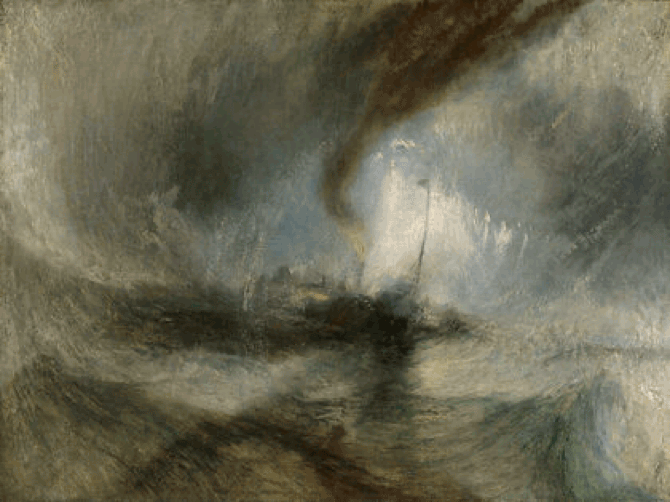
There are certain images, or should I say icons, that exert a visual power over all others. Two in particular come to mind: Turner’s great paintings of various “Storms at Sea” and Hokusai’s series of “Thirty-six Views of Mt. Fuji” which includes important images of nearby waves and distant views of Mt. Fuji. Whereas Hokusai often happily described himself as an old crazy man to paint, Turner was often derogatorily described by many of his contemporaries, often depicted as a crazy man wielding mops in order to complete his paintings!

Satirical cartoon, Almanack of the Month
1846
J. Paul Getty Trust, Los Angeles, California
We have often seen entire sets of Hokusai’s woodcuts exhibited at both the Art Institute of Chicago and the Metropolitan Museum of Art in New York. As for Turner, nothing surpasses the work from the Turner Bequest at the Tate Museum in London, or the Clowes Collection at the Indianapolis Museum of Art.
Contemporary writers have also been drawn to these two artists, including Yusef Komunyakaa and Patricia Clark. We have previously written regarding Komunyakaa’s “Turner’s Tussle with Water” and take a look now at Hokusai’s waves as written by Patricia Clark. Clark and her husband, the contemporary painter Stanley Krohmer, are often traveling and visiting museums. They collect exhibition catalogues, calendars and post cards from these locations. These are all important visual mnemonic devices, reminders of people and places seen, as well as sources for future investigations into both painting and poetry.1

“Nocturne, Lake Michigan”
2021
Oil on wood panel
30” x 24”
Collection of the artist.
As a result of one of these trips, an image from Hokusai re-appeared in Clark’s memory. When I asked her about it, this was her response: “I never PLAN to write about some image ahead of time; I like to wait & see if it speaks to me somehow, over time. And somehow this one did. I think I was attracted to the tension in the fishing lines, the odd outfit the fellow is wearing, and the two figures. Plus the evident danger they might be in. I was surprised when it called up an old memory of mine — fishing during a camping trip, and also wandering along the shore, looking into tidepools and under rocks.”2
As is her practice, Patricia Clark uses her direct written responses to this visual work of art in order to combine them with certain memories of family members and their interactions with a landscape remembered from a distance.
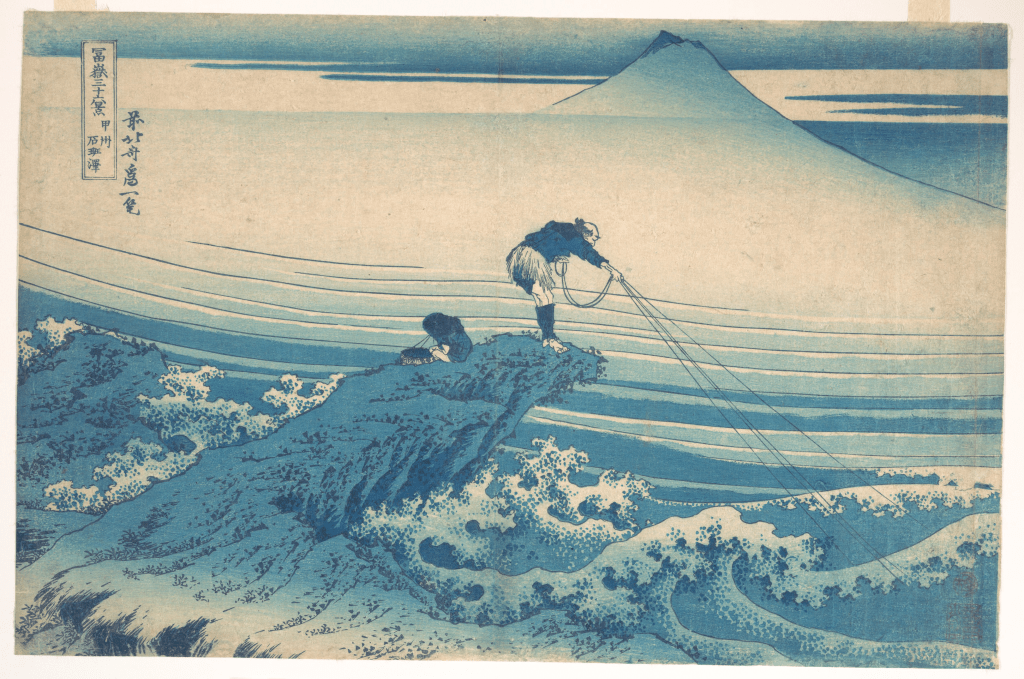
“Thirty-six Views of Mount Fuji: Fishermen standing on a rocky promontory at Kajikazawa”
1830-1832
Woodblock print on paper
10” x 15 1/8”
Metropolitan Museum of Art, New York
Barnacle
“The fisherman’s bent in half
on the tip
of a promontory,
a jacket, short pants, a grass skirt
over the pants,
no hat, tall socks
with shoes—though I’m fearful he’ll slip
where below
waves growl and snap.
He’s pulling in at least four lines, heavy
with fish,
one has to hope—
and he’s not alone. Nearby crouches a person
down on his haunches
also holding lines.
If the land’s rocky, okay, but it looks
fragile enough
to break off,
soft ground with wet sod crumbling
to pitch him in,
if not both of them. Once,
we wandered far down Agate & Crescent Beach,
stooping at
tidepools, turning over rocks
to find small gray crabs and touch
anemones, fascinated
by their pulse, heedless of tides.
By the time we looked up, our path back
was erased,
water crashing in, spraying foam,
and only through luck did we find
a cut
in the bluff where a path
snaked down—we clambered up with sea-
salt biting
at our heels. That was the day
later on, we hauled in a creature of the deep
we didn’t know,
a purple spiny thing large
as a cabbage we brought to the park ranger
in a bucket—
sea urchin, he said mildly.
It was a fearsome beautiful thing—
those spines dripping
with the sea, waving–I hope we let it go.
My father and his father, me and who else?
–my brother Dan?—
last seen on that shore
now washed away by waves of time
though memory has
planted a barnacle there.”3

“Steller’s Jay”
2015
Oil on canvas
36” x 36”
Collection of the Artist.
1 And as a footnote to this essay, I have included at the end an image of one of Stanley Krohmer’s paintings, “Steller’s Jay” which was actually used as the cover art for one of Patricia Clark’s books, “The Canopy” published by Terrapin Books in 2017.
2 Clark, Patricia; “Barnacle;” Manuscript page and notes in an E-Mail correspondence to this author, 2 December 2021, 4:58 PM.
3 Clark, Patricia; “Barnacle;” Included in the journal SALT; Santa Barbara, California; Issue 4, #1; 2023.



 BRIDGING THE GAP