THE MATISSE STORIES

At the Salon of 1907 in Paris, the critic Louis Vauxcelles described the “Blue Nude” as: “A nude woman, ugly, spread out on opaque blue grass under some palm trees.”[i]

In 1913 in New York and Chicago the Armory Show was a catalyst for derision of both European and modern art by the general American population. It was of course the first exposure of works by Cezanne, Picasso, Matisse, and even Ingres to the American public. This exhibition also included selected contemporary American artists, including several who were associated with Alfred Stieglitz and his gallery.

Henri Matisse’s early painting, “Blue Nude, a Souvenir of Biskra” from 1907 was one of the pieces to cause a public stir. At the close of the exhibition at the Art Institute of Chicago in 1913, the students rioted and burned both the painting and Matisse in effigy on the steps of the museum.
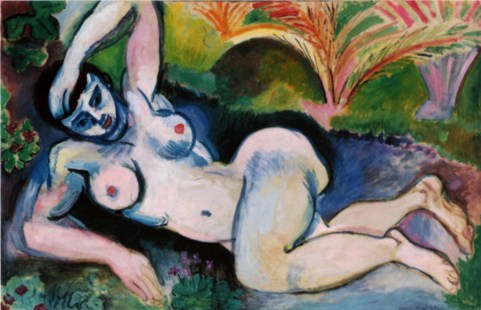
matisse-1
Henri Matisse
“Blue Nude, Souvenir of Biskra”
1907
36 1/4″ x 55 1/4″
Oil on canvas Baltimore Museum of Art, The Cone Collection, formed by Dr. Claribel Cone and Miss Etta Cone of Baltimore, Maryland

The painting had been purchased by Leo Stein in Paris at the 1907 Salon. Later it was purchased by the American collector John Quinn, whose estate in turn sold it to Etta and Claribel Cone of Baltimore, where it remains in the collection of the Baltimore Museum of Art.

The Blue Nude was also featured in an exhibition at Stieglitz’s gallery in 1921, where it was seen by the American poet William Carlos Williams. His prose poem, inspired by this painting, may be one of the first positive pieces of writing regarding the “Blue Nude.”

“A Matisse in New York”

“On the french grass, in that room on Fifth Ave., lay that woman who had never seen my own poor land.”

“So he painted her. The sun had entered his head in the color of sprays of flaming palm leaves. They had been walking for an hour or so after leaving the train. They were hot. She had chosen the place to rest and he had painted her resting, with interest in the place she had chosen.”

“It was the first of summer. Bare as was his mind of interest in anything save the fullness of his knowledge, into which her simple body entered as into the eye of the sun himself, so he painted her.”

“No man in my country has seen a woman naked and painted her as if he knew anything except that she was naked. No woman in my country is naked except at night.”

“In the french sun, on the french grass in a room on Fifth Ave., a french girl lies and smiles at the sun without seeing us.”[ii]

More recently, in 1993 the English writer A. S. Byatt has taken a similar approach to this subject in The Matisse Stories, a series of short stories each inspired by one of Matisse’s paintings. This time, it is the “Large Reclining Nude” also known as the “Pink Nude” purchased in 1936 directly from the artist by Etta Cone and donated to the Baltimore Museum of Art through the Cone Sisters’ bequest in 1950.

Dr. Claribel Cone’s will stated that the Baltimore Museum of Art should receive the bequest of their collection provided that “…the spirit of appreciation for modern art in Baltimore became improved.”[iii]

matisse-2
Henri Matisse
“Large Reclining Nude”
1935
26 1/8″ x 36 3/4″
Oil on canvas
Baltimore Museum of Art, The Cone Collection, formed by Dr. Claribel Cone and Miss Etta Cone of Baltimore, Maryland

“She had walked in one day because she had seen the Rosy Nude through the plate glass. That was odd, she thought, to have that lavish and complex creature stretched voluptuously above the coat rack, where one might have expected the stare, silver and supercilious or jetty and frenzied, of the model girl. They were all girls now, not women. The rosy nude was pure flat colour, but suggested mass. She had huge haunches and a monumental knee, lazily propped high. She had round breasts, contemplations of the circle, reflections on flesh and its fall. . . . She had asked cautiously for a cut and blow-dry.”[iv]

In conversations with his friends and fellow artists over the years, especially with the poet Louis Aragon, Matisse often stated that: “The importance of an artist is to be measured by the number of new signs he has introduced into the plastic language…”[v]


[i] Flam, Jack; Matisse in the Cone Collection: The Poetics of Vision; The Baltimore Museum of Art; Baltimore, Maryland; 2001; pp. 41-42.

[ii] Tashjian, Dickran; William Carlos Williams and the American Scene 1920-1940; Whitney Museum of American; New York, New York; 1978; 29-31.

[iii] Flam; Matisse in the Cone Collection; p. 7.

[iv] Byatt, A. S.; The Matisse Stories; Vintage International; New York, New York; 1996; p. 3.

[v] Flam, Jack; Matisse on Art; University of California Press; Berkeley, Los Angeles, London; 1995; p. 150.

EXPHRASTICS

“Someone, I tell you, in another time,
will remember us.”[i]

Ekphrasis or ecphrasis, from the Greek: a description of a work of art, either real or imaginary, produced as a rhetorical exercise; often used in the adjectival form, ekphrastic, a graphic, often dramatic, description of a visual work of art.

keats
John Keats
“Tracing of an engraving of the Sosibios vase”
1819
Ink on paper
The Louvre, Paris, France

From ancient times to the 20th century there has been an interdisciplinary dance played out between poets and painters. The idea of writing a poem or a play that was descriptive of, or inspired by a work of visual art was in fact invented by the Greeks. Homer’s description of the Shield of Achilles in the 18th Book of The Illiad being one of the first examples.

“Then first he form’d the immense and solid shield;
Rich various artifice emblazed the field;
Its utmost verge a threefold circle bound;
A silver chain suspends the massy round;
Five ample plates the broad expanse compose,
And godlike labours on the surface rose.
There shone the image of the master-mind:
There earth, there heaven, there ocean he design’d;
The unwearied sun, the moon completely round;
The starry lights that heaven’s high convex crown’d;
The Pleiads, Hyads, with the northern team;
And great Orion’s more refulgent beam;
To which, around the axle of the sky,
The Bear, revolving, points his golden eye,
Still shines exalted on the ethereal plain,
Nor bathes his blazing forehead in the main.”[ii]

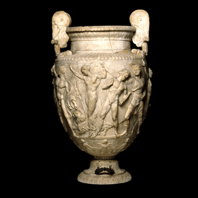
This was of course, a literary fiction based totally on a plastic fiction, made real through the art of storytelling. The Romantic poet John Keats harks back to classic examples with his “Ode on a Grecian Urn.” Published anonymously in the January 1820, Number 15 issue of the magazine “Annals of the Fine Arts” it is an elegaic description on this single object. Early speculation centered around the fact that Keats had based his poem on a specific vase, either “The Sosibios Vase” at the Louvre in Paris or later on “The Townley Urn” at the British Museum in London. Nowadays it is considered that his work is more of a synthesis of several objects.

townley
“The Townley Urn”
100-200AD
Marble
H:1.06 metres
The British Museum, London

“Thou still unravish’d bride of quietness,
Thou foster-child of silence and slow time,
Sylvan historian, who canst thus express
A flowery tale more sweetly than our rhyme:
What leaf-fring’d legend haunts about thy shape
Of deities or mortals, or of both,
In Tempe or the dales of Arcady?
What men or gods are these? What maidens loth?
What mad pursuit? What struggle to escape?
What pipes and timbrels? What wild ecstasy?”

“O Attic shape! Fair attitude! with brede
Of marble men and maidens overwrought,
With forest branches and the trodden weed;
Thou, silent form, dost tease us out of thought
As doth eternity: Cold Pastoral!
When old age shall this generation waste,
Thou shalt remain, in midst of other woe
Than ours, a friend to man, to whom thou say’st,
Beauty is truth, truth beauty,—that is all
Ye know on earth, and all ye need to know.”[iii]

Keats ends his poem with an observation that has become an everlasting philosophical debate: “Beauty is truth, truth beauty.” From artists’ arguments in cafes and bars to doctoral dissertation defenses, it has become an ongoing discussion. Whether writing directly from a work of art as the primary source, as Keats has done, or inventing an image and then writing about it, this form of inspiration flows directly from the visual artist to the writer. In some more recent cases the artist seizes upon an image written by a poet and then makes a drawing or painting.

Near the end of his life, the 20th century abstract painter Philip Guston chose an entire new direction for his work, seeming to reject everything he had created before. He got himself hated by many former friends, but not everyone. Younger poets and painters recognized this new figuration, not as a retreat back into a mimetic mode, but as a venture into a new plastic and literary arena. His late drawings and paintings are a rare example of real dialogue between one painter and several contemporary poets. These poets included: Clark Coolidge, Bill Bergson, Musa McKim, Anne Waldman, William Corbett, Frank O’Hara and Stanley Kunitz.

guston
Philip Guston
“Untitled (Book)”
1968
Goache on paper board
51 cm x 76 cm
Estate of the artist

A generation later, young painters who had studied exclusively with abstract artists in school struggled to find their own voices and visions. It seemed like a dead end to continue without a subject, or subject matter. At first they were accused of producing ‘bad’ painting. With a few more artists testing these waters they became known as ‘New Image’ painters and even ‘neo-expressionists.’ Amongst these artists were: Susan Rothenberg, Robert Moskowitz, Elizabeth Murray and Neil Jenney. All were working, in no small part, thanks to the doors that Philip Guston had opened.

“Henceforth a painting was a legible record of all the decisions, whether tentative or assured, that went into its conception and realization. The issue was not one of speed . . . but rather one of the immediacy and responsiveness of process, the simultaneity of thinking and making.”
Philip Guston [iv]


[i] Sappho; “No Oblivion,” The Complete Poems of Sappho (translated by Willis Barnstone); Shambala Publications; Boston & London; 2011; [147].

[ii] Translated by Alexander Pope. This poem is in the public domain.

[iii] Keats, John; John Keats: The Major Works; Oxford University Press; Oxford & New York; 1990 & 2001; pp. 288-289.

[iv] Storr, Robert; Philip Guston; Abbeville Press; New York, New York; 1986; p. 25.